maintenance Seat Altea 2008 Owner's Manual
[x] Cancel search | Manufacturer: SEAT, Model Year: 2008, Model line: Altea, Model: Seat Altea 2008Pages: 309, PDF Size: 9.45 MB
Page 249 of 309
If and when247
Safety First
Operating instructions
Tips and Maintenance
Te c h n i c a l D a t a
Note
The compressor should never be allowed to run for longer than 6 minutes.FusesChanging a fuse
If a fuse has blown it must be replaced
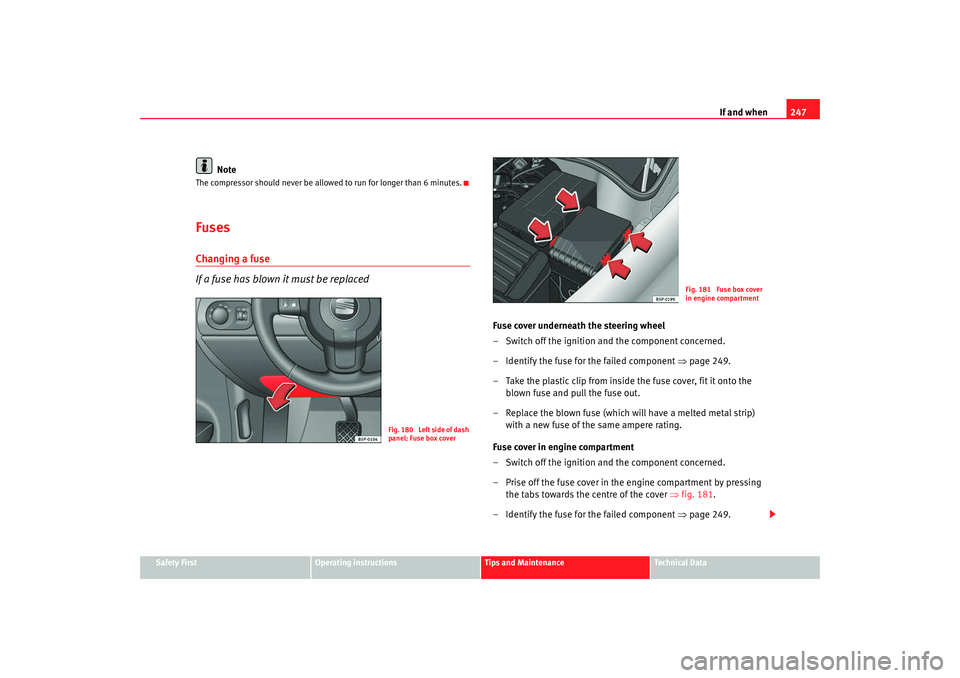
Fuse cover underneath the steering wheel
– Switch off the ignition and the component concerned.
– Identify the fuse for the failed component ⇒page 249.
– Take the plastic clip from inside the fuse cover, fit it onto the
blown fuse and pull the fuse out.
– Replace the blown fuse (which will have a melted metal strip) with a new fuse of the same ampere rating.
Fuse cover in engine compartment
– Switch off the ignition and the component concerned.
– Prise off the fuse cover in the engine compartment by pressing the tabs towards the centre of the cover ⇒fig. 181.
– Identify the fuse for the failed component ⇒page 249.
Fig. 180 Left side of dash
panel: Fuse box cover
Fig. 181 Fuse box cover
in engine compartment
altea ingles.book Seite 247 Dienstag, 11. September 2007 4:39 16
Page 251 of 309
If and when249
Safety First
Operating instructions
Tips and Maintenance
Te c h n i c a l D a t a
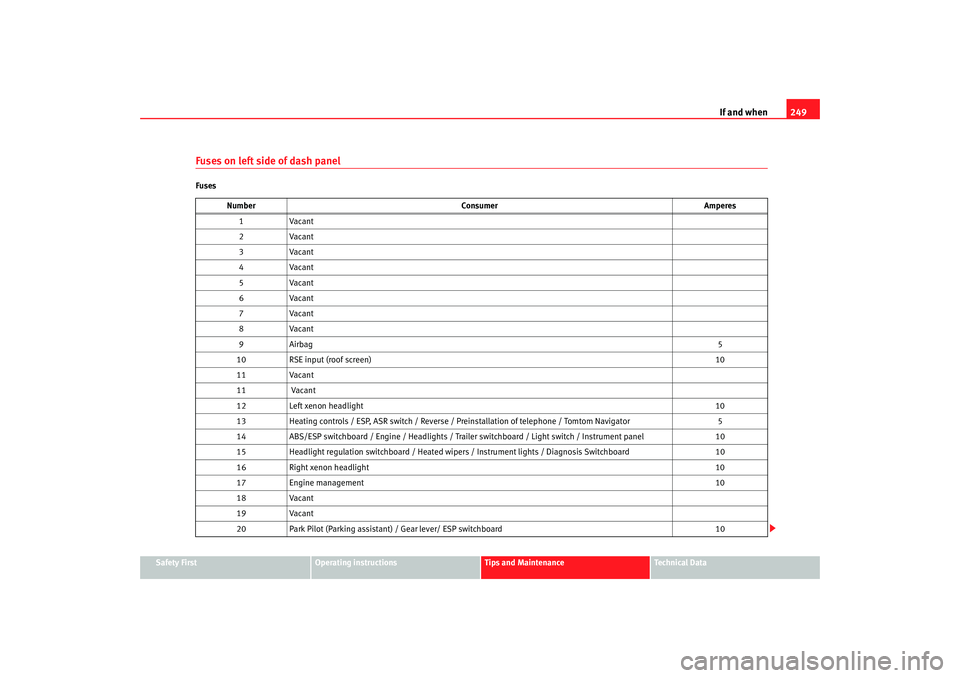
Fuses on left side of dash panelFuses
Number Consumer Amperes
1V aca n t
2V aca n t
3V aca n t
4V aca n t
5V aca n t
6V aca n t
7V aca n t
8V aca n t
9 Airbag 5
10 RSE input (roof screen) 10
11 Vacant
11 Vacant
12 Left xenon headlight 10
13 Heating controls / ESP, ASR switch / Reverse / Preinstallation of telephone / Tomtom Navigator 5
14 ABS/ESP switchboard / Engine / Headlights / Traile r switchboard / Light switch / Instrument panel 10
15 Headlight regulation switchboard / Heated wipers / Instrument lights / Diagnosis Switchboard 10
16 Right xenon headlight 10
17 Engine management 10
18 Vacant
19 Vacant
20 Park Pilot (Parking assistant) / Gear lever/ ESP switchboard 10
altea ingles.book Seite 249 Dienstag, 11. September 2007 4:39 16
Page 253 of 309
If and when251
Safety First
Operating instructions
Tips and Maintenance
Te c h n i c a l D a t a
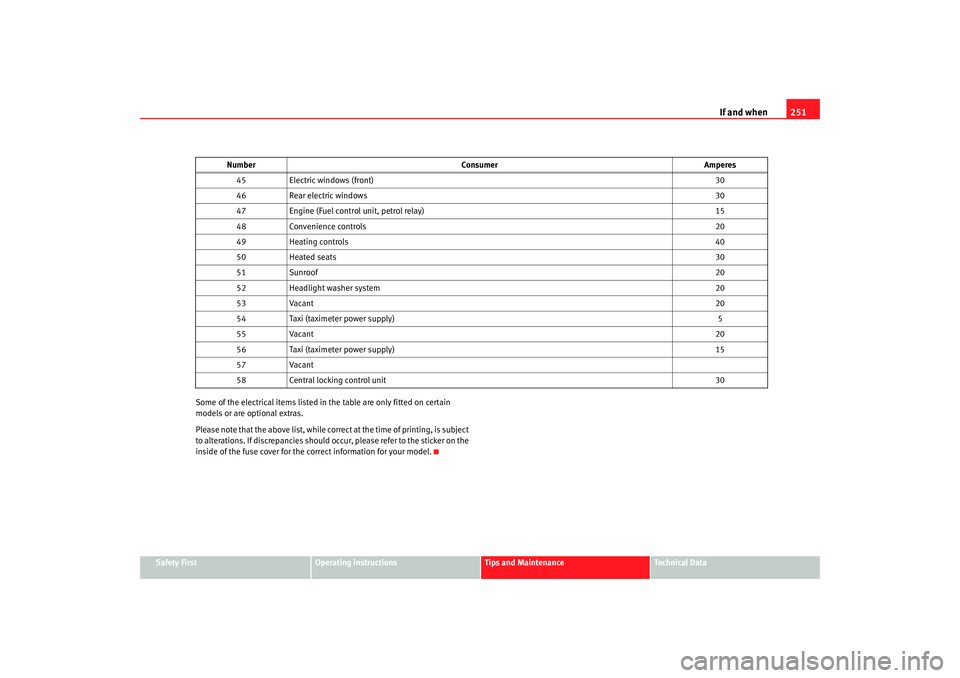
Some of the electrical items listed in
the table are only fitted on certain
models or are optional extras.
Please note that the above list, while correct at the time of printing, is subject
to alterations. If discrepancies should occur, please refer to the sticker on the
inside of the fuse cover for the co rrect information for your model.
45
Electric windows (front) 30
46 Rear electric windows 30
47 Engine (Fuel control unit, petrol relay) 15
48 Convenience controls 20
49 Heating controls 40
50 Heated seats 30
51 Sunroof 20
52 Headlight washer system 20
53 Vacant 20
54 Taxi (taximeter power supply) 5
55 Vacant 20
56 Taxi (taximeter power supply) 15
57 Vacant
58 Central locking control unit 30
Number
Consumer Amperes
altea ingles.book Seite 251 Dienstag, 11. September 2007 4:39 16
Page 255 of 309
If and when253
Safety First
Operating instructions
Tips and Maintenance
Te c h n i c a l D a t a
19
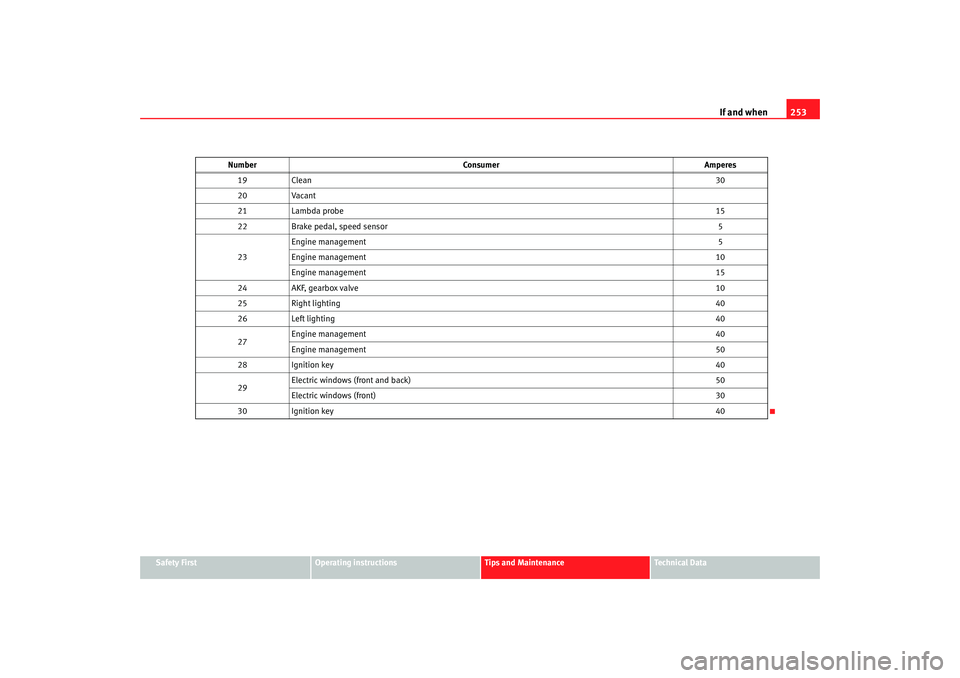
Clean 30
20 Vacant
21 Lambda probe 15
22 Brake pedal, speed sensor 5
23 Engine management
5
Engine management 10
Engine management 15
24 AKF, gearbox valve 10
25 Right lighting 40
26 Left lighting 40
27 Engine management
40
Engine management 50
28 Ignition key 40
29 Electric windows (front and back)
50
Electric windows (front) 30
30 Ignition key 40
Number
Consumer Amperes
altea ingles.book Seite 253 Dienstag, 11. September 2007 4:39 16
Page 257 of 309
If and when255
Safety First
Operating instructions
Tips and Maintenance
Te c h n i c a l D a t a
Xenon headlights
21)/ self-adjusting*
Dipped and full beam - D1S
22)
Flashes and extra full beam - H1
Position W5W
Turn signals PY21W
Fog lights
Fog lights - H3
Upper rear light
Stop/Position - P21W
23)
Turn signals - R10W
Lower rear light
Fog light - P21W
Reverse light - P21W
Side indicator
Side indicator - W5W
Registration plate light
Registration plate light - C5W
Note
•
Due to the difficulty in accessing the lamps, any replacement work should
be done by a SEAT dealer. However, the following is a description of how to
change the lamps except for the fog lights* and interior lamps.
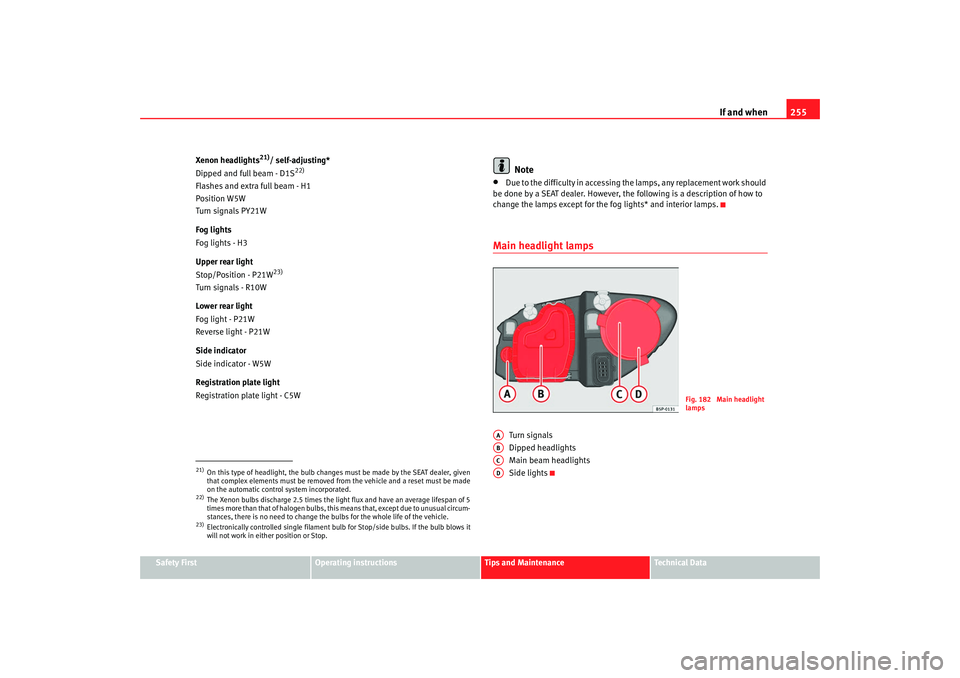
Main headlight lamps
Turn signals
Dipped headlights
Main beam headlights
Side lights
21)On this type of headlight, the bulb changes must be made by the SEAT dealer, given
that complex elements must be removed from the vehicle and a reset must be made
on the automatic control system incorporated.22)The Xenon bulbs discharge 2.5 times the light flux and have an average lifespan of 5
times more than that of halogen bulbs, this means that, except due to unusual circum-
stances, there is no need to change the bulbs for the whole life of the vehicle.23)Electronically controlled single filament bulb for Stop/side bulbs. If the bulb blows it
will not work in either position or Stop.
Fig. 182 Main headlight
lamps
AAABACAD
altea ingles.book Seite 255 Dienstag, 11. September 2007 4:39 16
Page 259 of 309
If and when257
Safety First
Operating instructions
Tips and Maintenance
Te c h n i c a l D a t a
– Remove the loops ⇒page 256, fig. 184 in the direction of
the arrow and remove the cover.
– Remove the connector ⇒page 256, fig. 185 from the bulb.
– Disengage the retainer spring ⇒ page 256, fig. 185 pressing
inwards and to the right.
– Extract the bulb and fit the replacement so that the rim of the attachment plate is on the reflector cut-out.Main beam lights
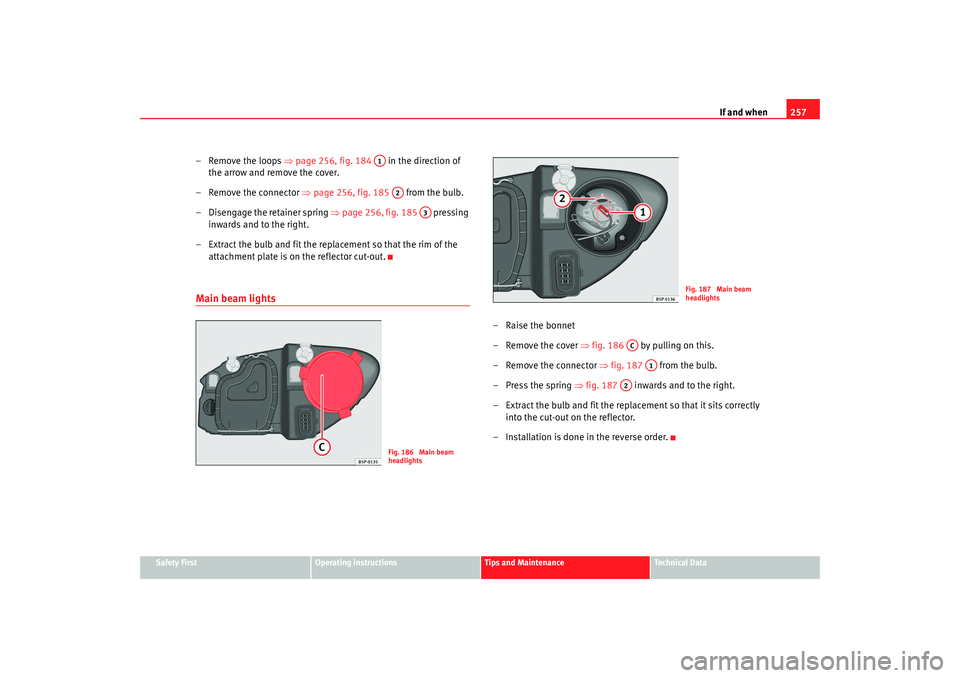
– Raise the bonnet
– Remove the cover ⇒fig. 186 by pulling on this.
– Remove the connector ⇒fig. 187 from the bulb.
– Press the spring ⇒fig. 187 inwards and to the right.
– Extract the bulb and fit the replacement so that it sits correctly into the cut-out on the reflector.
– Installation is done in the reverse order.
A1
A2
A3
Fig. 186 Main beam
headlights
Fig. 187 Main beam
headlights
AC
A1
A2
altea ingles.book Seite 257 Dienstag, 11. September 2007 4:39 16
Page 261 of 309
If and when259
Safety First
Operating instructions
Tips and Maintenance
Te c h n i c a l D a t a
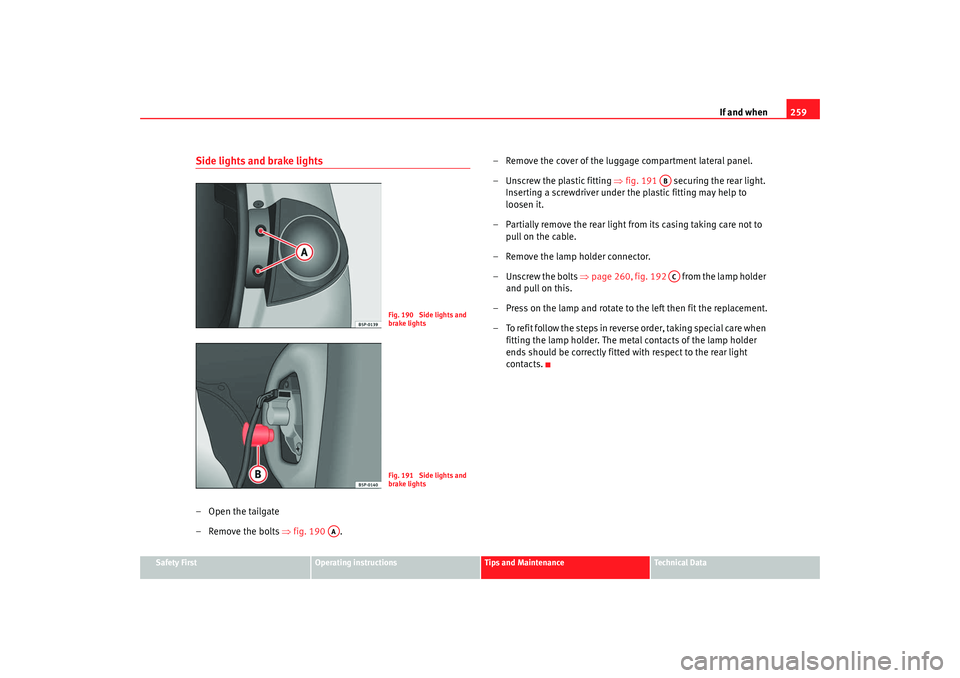
Side lights and brake lights– Open the tailgate
– Remove the bolts ⇒fig. 190 . – Remove the cover of the luggage compartment lateral panel.
– Unscrew the plastic fitting
⇒fig. 191 securing the rear light.
Inserting a screwdriver under the plastic fitting may help to
loosen it.
– Partially remove the rear light from its casing taking care not to pull on the cable.
– Remove the lamp holder connector.
– Unscrew the bolts ⇒page 260, fig. 192 from the lamp holder
and pull on this.
– Press on the lamp and rotate to the left then fit the replacement.
– To refit follow the steps in reverse order, taking special care when fitting the lamp holder. The metal contacts of the lamp holder
ends should be correctly fitted with respect to the rear light
contacts.
Fig. 190 Side lights and
brake lightsFig. 191 Side lights and
brake lights
AA
ABAC
altea ingles.book Seite 259 Dienstag, 11. September 2007 4:39 16
Page 263 of 309
If and when261
Safety First
Operating instructions
Tips and Maintenance
Te c h n i c a l D a t a
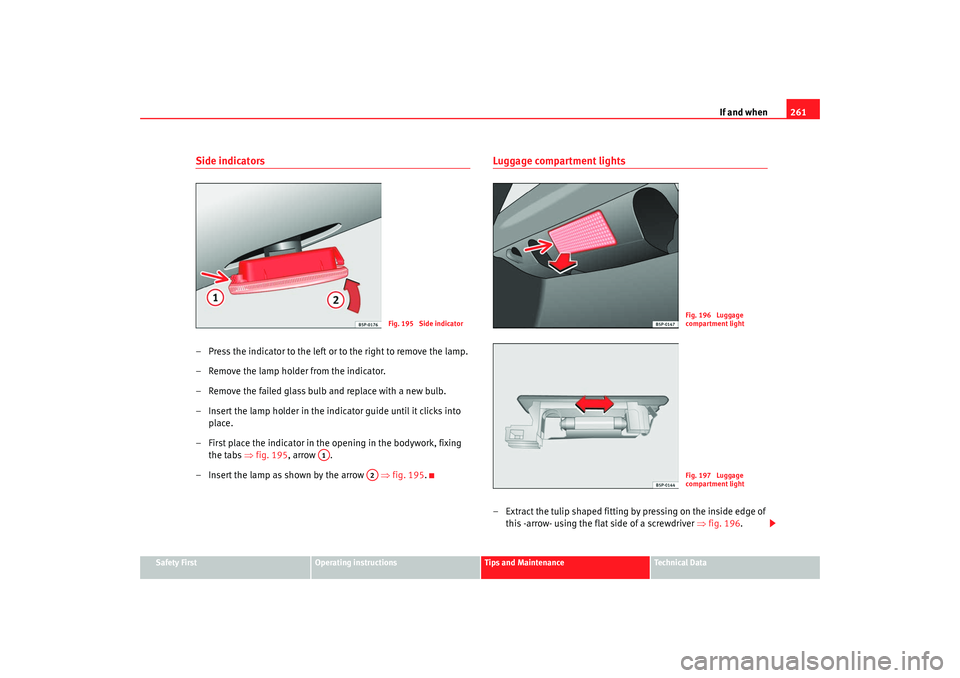
Side indicators– Press the indicator to the left or to the right to remove the lamp.
– Remove the lamp holder from the indicator.
– Remove the failed glass bulb and replace with a new bulb.
– Insert the lamp holder in the indicator guide until it clicks into
place.
– First place the indicator in the opening in the bodywork, fixing the tabs ⇒fig. 195 , arrow .
– Insert the lamp as shown by the arrow ⇒fig. 195.
Luggage compartment lights– Extract the tulip shaped fitting by pressing on the inside edge of
this -arrow- using the flat side of a screwdriver ⇒fig. 196 .
Fig. 195 Side indicator
A1
A2
Fig. 196 Luggage
compartment lightFig. 197 Luggage
compartment light
altea ingles.book Seite 261 Dienstag, 11. September 2007 4:39 16
Page 265 of 309
If and when263
Safety First
Operating instructions
Tips and Maintenance
Te c h n i c a l D a t a
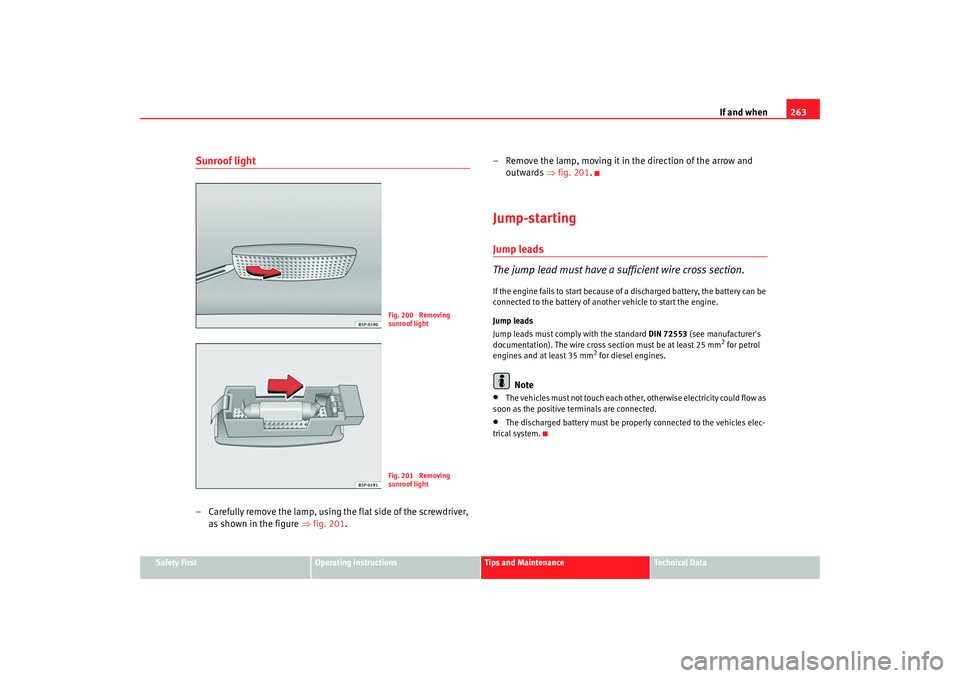
Sunroof light– Carefully remove the lamp, using the flat side of the screwdriver,
as shown in the figure ⇒fig. 201. – Remove the lamp, moving it in the direction of the arrow and
outwards ⇒fig. 201.
Jump-startingJump leads
The jump lead must have a sufficient wire cross section.If the engine fails to start because of a discharged battery, the battery can be
connected to the battery of another vehicle to start the engine.
Jump leads
Jump leads must comply with the standard DIN 72553 (see manufacturer's
documentation). The wire cross section must be at least 25 mm
2 for petrol
engines and at least 35 mm
2 for diesel engines.
Note
•
The vehicles must not touch each othe r, otherwise electricity could flow as
soon as the positive terminals are connected.
•
The discharged battery must be properly connected to the vehicles elec-
trical system.
Fig. 200 Removing
sunroof lightFig. 201 Removing
sunroof light
altea ingles.book Seite 263 Dienstag, 11. September 2007 4:39 16
Page 267 of 309
If and when265
Safety First
Operating instructions
Tips and Maintenance
Te c h n i c a l D a t a
WARNING
•
Please note the safety warnings referring to working in the engine
compartment ⇒page 212, “Working in the engine compartment”.
•
The battery providing assistance must have the same voltage as the flat
battery (12V) and approximately the same capacity (see imprint on
battery). Failure to comply could result in an explosion.
•
Never use jump leads when one of the batteries is frozen. Danger of
explosion! Even after the battery has thawed, battery acid could leak and
cause chemical burns. If a battery freezes, it should be replaced.
•
Keep sparks, flames and lighted cigarettes away from batteries, danger
of explosion. Failure to comply could result in an explosion.
•
Observe the instructions provided by the manufacturer of the jump
leads.
•
Do not connect the negative cable from the other vehicle directly to the
negative terminal of the flat battery. The gas emitted from the battery could
be ignited by sparks. Danger of explosion.
•
Do not attach the negative cable from the other vehicle to parts of the
fuel system or to the brake line.
•
The non-insulated parts of the battery clamps must not be allowed to
touch. The jump lead attached to the positive battery terminal must not
touch metal parts of the vehicle, this can cause a short circuit.
•
Position the leads in such a way that they cannot come into contact
with any moving parts in the engine compartment.
•
Do not bend over the batteries. This could result in chemical burns.Note
The vehicles must not touch each other, otherwise electricity could flow as
soon as the positive terminals are connected.
altea ingles.book Seite 265 Dienstag, 11. September 2007 4:39 16