ECU Seat Altea 2008 Owner's Guide
[x] Cancel search | Manufacturer: SEAT, Model Year: 2008, Model line: Altea, Model: Seat Altea 2008Pages: 309, PDF Size: 9.45 MB
Page 211 of 309
Checking and refilling levels209
Safety First
Operating instructions
Tips and Maintenance
Te c h n i c a l D a t a
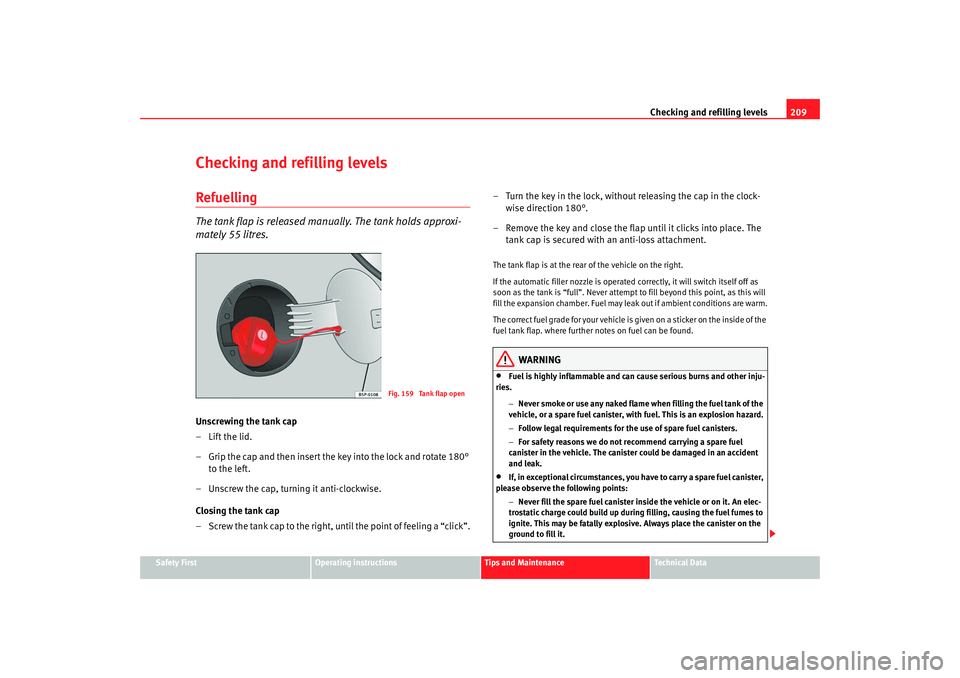
Checking and refilling levelsRefuellingThe tank flap is released manually. The tank holds approxi-
mately 55 litres.Unscrewing the tank cap
– Lift the lid.
– Grip the cap and then insert the key into the lock and rotate 180°
to the left.
– Unscrew the cap, turning it anti-clockwise.
Closing the tank cap
– Screw the tank cap to the right, until the point of feeling a “click”. – Turn the key in the lock, without releasing the cap in the clock-
wise direction 180°.
– Remove the key and close the flap until it clicks into place. The tank cap is secured with an anti-loss attachment.
The tank flap is at the rear of the vehicle on the right.
If the automatic filler nozzle is operated correctly, it will switch itself off as
soon as the tank is “full”. Never attempt to fill beyond this point, as this will
fill the expansion chamber. Fuel may le ak out if ambient conditions are warm.
The correct fuel grade for your vehicle is given on a sticker on the inside of the
fuel tank flap. where further notes on fuel can be found.
WARNING
•
Fuel is highly inflammable and can cause serious burns and other inju-
ries.
−Never smoke or use any naked flame when filling the fuel tank of the
vehicle, or a spare fuel canister, with fuel. This is an explosion hazard.
− Follow legal requirements for the use of spare fuel canisters.
− For safety reasons we do not recommend carrying a spare fuel
canister in the vehicle. The canister could be damaged in an accident
and leak.
•
If, in exceptional circumstances, you have to carry a spare fuel canister,
please observe the following points:
−Never fill the spare fuel canister inside the vehicle or on it. An elec-
trostatic charge could build up during filling, causing the fuel fumes to
ignite. This may be fatally explosive. Always place the canister on the
ground to fill it.
Fig. 159 Tank flap open
altea ingles.book Seite 209 Dienstag, 11. September 2007 4:39 16
Page 215 of 309
Checking and refilling levels213
Safety First
Operating instructions
Tips and Maintenance
Te c h n i c a l D a t a
this reason we recommend that you have service fluids and consumables
replaced by an Authorised Service Centre. Please observe the relevant
instructions
⇒page 207. The engine compartment of any motor vehicle is a
hazardous area ⇒.
WARNING
All work on the engine or in the engine compartment, e.g. checking and
refilling fluids, involves the danger of injury and scalding as well as the risk
of accident or fire.•
Never open the bonnet if you see steam, smoke or coolant escaping
from the engine compartment. Otherwis e, there is a risk of sustaining
burns. Wait until no more steam or coolant is emitted, then allow the
engine to cool before carefully opening the bonnet.
•
Switch off the engine and remove the key from the ignition.
•
Apply the handbrake and move the gear stick to neutral or selector
lever to position P.
•
Keep children away from the vehicle.
•
Never touch hot engine parts. There is a risk of burns.
•
Never spill liquids on a hot engine or on a hot exhaust gas system. This
is a fire hazard.
•
Avoid causing short-circuits in the electrical system, particularly at the
points where the jump leads are attached ⇒page 264. The battery could
explode.
•
Never touch the radiator fan. It is temperature controlled and could
start automatically, even when the engine has been switched off and the
key removed from the ignition!
•
Do not unscrew the cap on the expansion tank when the engine is hot.
If the coolant is hot, the cooling system will be pressurised!
•
Protect face, hands and arms by covering the cap with a large, thick
cloth to protect against escaping coolant and steam.
•
Always make sure you have not left any objects, such as cleaning cloths
and tools, in the engine compartment.
•
If you have to work underneath the vehicle, you must use suitable
stands additionally to support the vehicle, there is a risk of accident!. A
hydraulic jack is insufficient for securi ng the vehicle and there is a risk of
injury.
•
If any work has to be performed when the engine is started or with the
engine running, there is an additional, potentially fatal, safety risk from the
rotating parts, such as the drive belts, alternator, radiator fan, etc., and
from the high-voltage ignition system. You should also observe the
following points:
−Never touch the electrical wiring of the ignition system.
− Ensure that jewellery, loose cl othing and long hair do not get
trapped in rotating engine parts. Danger of death. Before starting any
work remove jewellery, tie back and cover hair, and wear tight-fitting
clothes.
− Always think carefully about pressing the accelerator if a gear is
engaged in either an automatic or manual gearbox. The vehicle could
move, even if the handbrake is applied. Danger of death.
•
If work has to be carried out on the fuel system or on electrical compo-
nents, you must observe the following sa fety notes in addition to the above
warnings:
−Always disconnect the battery. The vehicle must be unlocked when
this is done, otherwise the alarm will be triggered.
− Do not smoke.
− Never work near naked flames.
− Always have a fire extinguisher on hand.WARNING (continued)
altea ingles.book Seite 213 Dienstag, 11. September 2007 4:39 16
Page 216 of 309
Checking and refilling levels
214
CautionWhen changing or topping up service fluids, make absolutely certain that you
fill the fluids into the correct reservoirs. Failure to observe this point will result
in serious malfunctions and engine damage!
For the sake of the environment
Service fluids leaks are harmful to the environment. For this reason you
should make regular checks on the gr ound underneath your vehicle. If you
find spots of oil or other fluids, have your vehicle inspected in a qualified
workshop.Opening the bonnet
The bonnet is released from inside the vehicle.
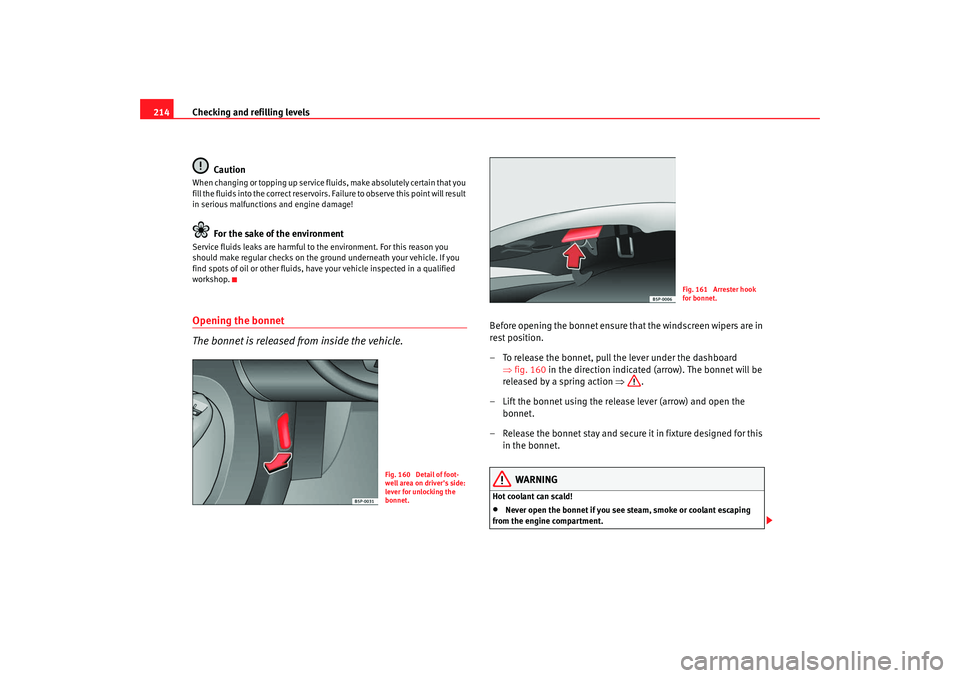
Before opening the bonnet ensure that the windscreen wipers are in
rest position.
– To release the bonnet, pull the lever under the dashboard ⇒fig. 160 in the direction indicated (arrow). The bonnet will be
released by a spring action ⇒.
– Lift the bonnet using the release lever (arrow) and open the bonnet.
– Release the bonnet stay and secure it in fixture designed for this in the bonnet.
WARNING
Hot coolant can scald!•
Never open the bonnet if you see steam, smoke or coolant escaping
from the engine compartment.
Fig. 160 Detail of foot-
well area on driver's side:
lever for unlocking the
bonnet.
Fig. 161 Arrester hook
for bonnet.
altea ingles.book Seite 214 Dienstag, 11. September 2007 4:39 16
Page 217 of 309
Checking and refilling levels215
Safety First
Operating instructions
Tips and Maintenance
Te c h n i c a l D a t a
•
Wait until no more steam, smoke or coolant is emitted from the bonnet,
then carefully open the bonnet.
•
When working in the engine compartment, always observe the safety
warnings ⇒ page 212.
Closing the bonnet– Raise the bonnet slightly
– Release the bonnet stay and replace it in its support.
– At a height of about 30 cm let it fall so it is locked.If the bonnet does not close, do not pr ess downwards. Open it once more and
let it fall as before.
WARNING
If the bonnet is not closed properly, it could open while you are driving and
completely obscure your view of the road. Risk of accident.•
After closing the bonnet, always check that it is properly secured. The
bonnet must be flush with the surrounding body panels.
•
If you notice that the bonnet latch is not secured when the vehicle is
moving, stop the vehicle immediately and close the bonnet properly. Risk
of accident.
Engine oilEngine oil specifications
The engine oil used must conform with exact specifications.Specifications
The engine comes with a special, high quality, multi grade oil that can be
used in all seasons of the year except for those regions affected by extreme
cold.
As the use of good quality oil is necessary for the correct operation and long
service life of the engine, when it be comes necessary to replenish or change
the oil, always use an oil that complies to the VW standards.
If it is not possible to find oil co nforming to the VW standards then oil
conforming to the ACEA or API standa rds with an appropriate viscosity at
atmospheric temperature should be used instead. The use of this type of oil
may have some repercussions on the performance of the engine for example,
long starting time, increased consumption and a higher emission level.
If a top up is required then different oils may be mixed as long as they all
conform to the VW standards.
The specifications (VW standards) set out in the following page should
appear on the container of the service oil; the container will display together
the different standards for petrol and diesel engines, the oil can be used for
both types of engines.
WARNING (continued)
altea ingles.book Seite 215 Dienstag, 11. September 2007 4:39 16
Page 237 of 309
Wheels and tyres235
Safety First
Operating instructions
Tips and Maintenance
Te c h n i c a l D a t a
heads must be used. This ensures that wheels are fitted securely and that the
brake system functions correctly.
In certain circumstances, you may not
use wheel bolts from a different car -
even if it is the same model ⇒page 207.
After the wheels have been changed, the tightening torque of the wheel bolts
should be checked as soon as possible with a torque wrench ⇒. The tight-
ening torque for steel and alloy wheels is 120 Nm.
WARNING
If the wheel bolts are not tightened correctly, the wheel could become
loose while driving. Risk of accident.•
The wheel bolts must be clean and turn easily. Never apply grease or oil
to them.
•
Use only wheel bolts which belong to the wheel.
•
If the torque of the wheel bolts is too low, they could loosen whilst the
vehicle is in motion. Risk of accident! If the tightening torque is too high,
the wheel bolts and threads could be damaged.Caution
The prescribed torque for wheel bolts for steel and alloy wheels is 120 Nm.Winter tyres
Winter tyres will improve the vehicles handling on snow and
ice.In winter conditions winter tyres will considerably improve the vehicles
handling. The design of summer tyre s (width, rubber compound, tread
pattern) gives less grip on ice and snow. Winter tyres must be inflated to a
pressure 0.2 bar higher than the pressures
specified for summer tyres (see sticker on tank flap).
Winter tyres must be fitted on all four wheels.
Information on permitted winter tyre sizes can be found in the vehicle's regis-
tration documents. Use only radial winter tyres. All tyre sizes listed in the
vehicle documentation also apply to winter tyres.
Winter tyres lose their effectiveness when the tread is worn down to a depth
of 4 mm.
The speed rating code ⇒page 233, “New tyres and wheels” determines the
following speed limits: ⇒ ⇒
Q max. 160 km/h
S max. 180 km/h
T max. 190 km/h
H max. 210 km/h
In some countries, vehicles which can exceed the speed rating of the fitted
tyre must have an appropriate sticker in the driver's field of view. These
stickers are available from your Authorised Service Centre. The legal require-
ments of each country must be followed.
Do not have winter tyres fitted for unnecessarily long periods. Vehicles with
summer tyres handle better when the roads are free of snow and ice.
If you have a flat tyre, please refer to the notes on the spare wheel
⇒ page 233, “New tyres and wheels”.
WARNING
The maximum speed for the winter tyres must not be exceeded. Otherwise,
this could lead to tyre damage and thus, an accident risk.
altea ingles.book Seite 235 Dienstag, 11. September 2007 4:39 16
Page 242 of 309
If and when
240After changing a wheel
After changing the wheel there are still tasks to complete.– Put the tools and jack back in the luggage compartment.
– Place the wheel with the defective tyre in the luggage compart-
ment and secure it.
– Check the tyre pressure of the newly fitted tyre as soon as
possible.
– Have the tightening torque of the wheel bolts checked as soon as possible with a torque wrench. The prescribed torque is 120 Nm.
Note•
If you notice that the wheel bolts are corroded and difficult to turn when
changing a wheel, they must be replaced before having the wheel bolt torque
checked.
•
In the interest of safety, drive at moderate speeds until the wheel bolt
torque has been checked.
Wheel trims
The wheel trims must be removed to gain access to the wheel
bolts.Removing
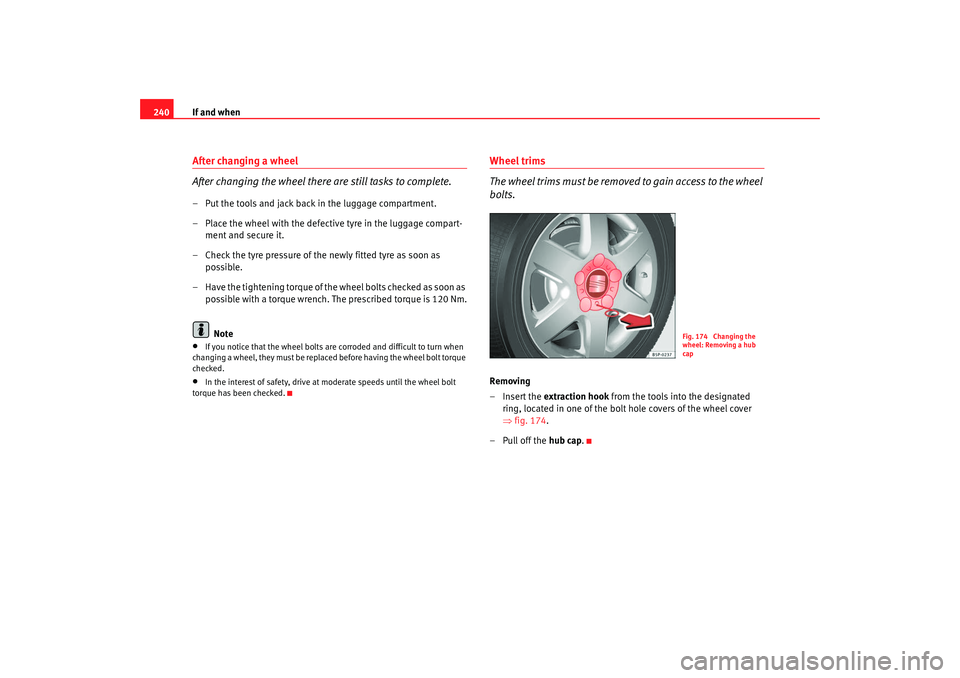
– Insert the extraction hook from the tools into the designated
ring, located in one of the bolt hole covers of the wheel cover
⇒ fig. 174.
–Pull off the hub cap.
Fig. 174 Changing the
wheel: Removing a hub
cap
altea ingles.book Seite 240 Dienstag, 11. September 2007 4:39 16
Page 243 of 309
If and when241
Safety First
Operating instructions
Tips and Maintenance
Te c h n i c a l D a t a
Wheel covers*
The wheel covers must be removed for access to the wheel
boltsRemoving
– Remove the wheel cover using the wire hook.
– Hook this into one of the cut-outs of the wheel cover.
Fitting
– Fit the wheel cover onto the wheel rim by pressing it firmly. Put pressure initially on the point of the cut-out for the valve. Then
press the wheel cover onto the steel rim so that it engages all
round.
Loosening the wheel bolts
The wheel bolts must be loosened before raising the vehicle.Loosening
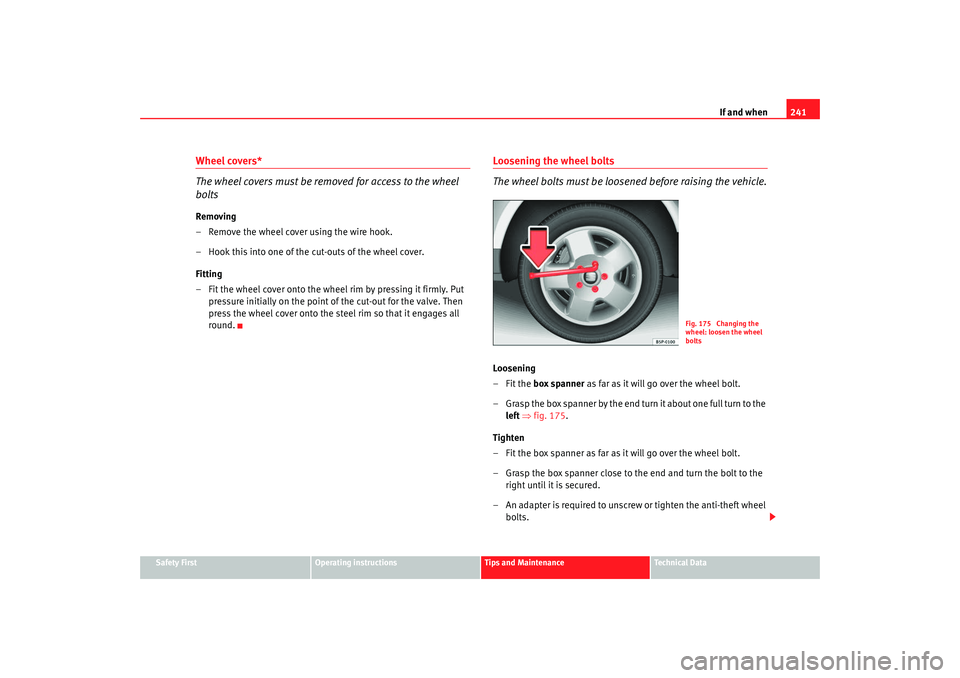
–Fit the box spanner as far as it will go over the wheel bolt.
– Grasp the box spanner by the end turn it about one full turn to the left ⇒ fig. 175 .
Tighten
– Fit the box spanner as far as it will go over the wheel bolt.
– Grasp the box spanner close to the end and turn the bolt to the right until it is secured.
– An adapter is required to unscrew or tighten the anti-theft wheel bolts.
Fig. 175 Changing the
wheel: loosen the wheel
bolts
altea ingles.book Seite 241 Dienstag, 11. September 2007 4:39 16
Page 261 of 309
If and when259
Safety First
Operating instructions
Tips and Maintenance
Te c h n i c a l D a t a
Side lights and brake lights– Open the tailgate
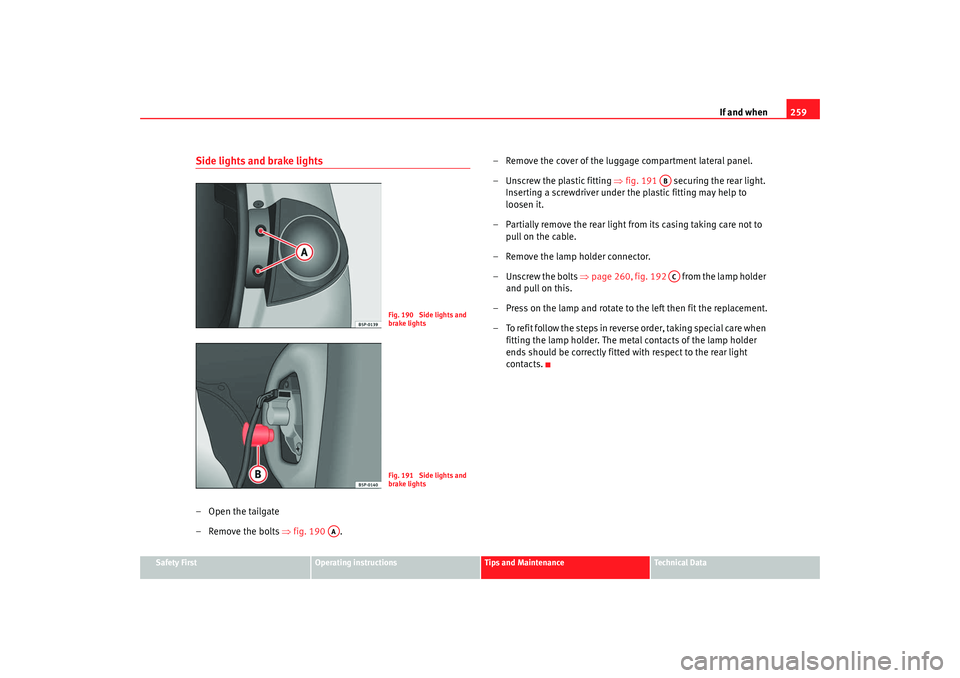
– Remove the bolts ⇒fig. 190 . – Remove the cover of the luggage compartment lateral panel.
– Unscrew the plastic fitting
⇒fig. 191 securing the rear light.
Inserting a screwdriver under the plastic fitting may help to
loosen it.
– Partially remove the rear light from its casing taking care not to pull on the cable.
– Remove the lamp holder connector.
– Unscrew the bolts ⇒page 260, fig. 192 from the lamp holder
and pull on this.
– Press on the lamp and rotate to the left then fit the replacement.
– To refit follow the steps in reverse order, taking special care when fitting the lamp holder. The metal contacts of the lamp holder
ends should be correctly fitted with respect to the rear light
contacts.
Fig. 190 Side lights and
brake lightsFig. 191 Side lights and
brake lights
AA
ABAC
altea ingles.book Seite 259 Dienstag, 11. September 2007 4:39 16
Page 300 of 309
Index
298Brake system . . . . . . . . . . . . . . . . . . . . . . . . . . . 225
Brake servo . . . . . . . . . . . . . . . . . . . . . . . . . 183
Brakes . . . . . . . . . . . . . . . . . . . . . . . . . . . . . 183
Warning lamp . . . . . . . . . . . . . . . . . . . . . . . . 77
Brakes . . . . . . . . . . . . . . . . . . . . . . . . . . . . . . . . 184
Braking distance . . . . . . . . . . . . . . . . . . . . . . . . 184
Bulb changes general notes . . . . . . . . . . . . . . . . . . . . . . . 254
Bulb defect warning lamp . . . . . . . . . . . . . . . . . . . . . . . . . 77
Buzzer . . . . . . . . . . . . . . . . . . . . . . . . . . . . 117, 162CCar care Exterior . . . . . . . . . . . . . . . . . . . . . . . . . . . . . 199
Car care products . . . . . . . . . . . . . . . . . . . . . . . 198
Catalytic converter . . . . . . . . . . . . . . . . . . . . . . 186
CD changer . . . . . . . . . . . . . . . . . . . . . . . . . . . . 135
Central locking . . . . . . . . . . . . . . . . . . . . . . . . . . 93 Automatic speed dependent locking and un-locking system* . . . . . . . . . . . . . . . . . . . . . 95
Emergency unlocking system . . . . . . . . . . . . 95
Locking system for invo luntary unlocking . . 95
Selective unlocking system* . . . . . . . . . . . . 94
Unlocking system* . . . . . . . . . . . . . . . . . . . . 95
Central locking button Central locking . . . . . . . . . . . . . . . . . . . . . . . 97
unlocking . . . . . . . . . . . . . . . . . . . . . . . . . . . . 97
Centre arm rest . . . . . . . . . . . . . . . . . . . . . . . . . 135
Cetane number . . . . . . . . . . . . . . . . . . . . . . . . . 211 Changing gear
See Manual gearbox . . . . . . . . . . . . . . . . . . 166
Changing the lamps Main headlight lamps . . . . . . . . . . . . . . . . . 255
rear lights . . . . . . . . . . . . . . . . . . . . . . . . . . 258
Changing the main headlight lamps dipped beam lights . . . . . . . . . . . . . . . . . . . 256
main beam lights . . . . . . . . . . . . . . . . . . . . 257
Side lights . . . . . . . . . . . . . . . . . . . . . . . . . . 258
turn signal lamps . . . . . . . . . . . . . . . . . . . . 256
Changing the rear lights indicator lights . . . . . . . . . . . . . . . . . . . . . . 260
luggage compartment lights . . . . . . . . . . . 261
rear fog light . . . . . . . . . . . . . . . . . . . . . . . . 260
reverse light . . . . . . . . . . . . . . . . . . . . . . . . . 260
side lights . . . . . . . . . . . . . . . . . . . . . . . . . . 259
Changing windscreen wiper blades . . . . . . . . . 222
Chassis number . . . . . . . . . . . . . . . . . . . . . . . . 272
Checking . . . . . . . . . . . . . . . . . . . . . . . . . . . . . . 227
Checking battery electrolyte level . . . . . . . . . . 227
Checking engine oil level . . . . . . . . . . . . . . . . . 217
Child safety . . . . . . . . . . . . . . . . . . . . . . . . . . . . . 46
Child seat . . . . . . . . . . . . . . . . . . . . . . . . . . . . . . . 48 Categorisation in groups . . . . . . . . . . . . . . . 48
Group 1 . . . . . . . . . . . . . . . . . . . . . . . . . . . . . 49
Group 2 . . . . . . . . . . . . . . . . . . . . . . . . . . . . . 49
Group 3 . . . . . . . . . . . . . . . . . . . . . . . . . . . . . 49
Groups 0 and 0+ . . . . . . . . . . . . . . . . . . . . . . 48
Safety notes . . . . . . . . . . . . . . . . . . . . . . . . . . 47
Securing . . . . . . . . . . . . . . . . . . . . . . . . . . . . . 51 Child seats
ISOFIX and Toptether systems . . . . . . . . . . . 52
on the front passenger seat . . . . . . . . . . . . . 31
Cigarette lighter* . . . . . . . . . . . . . . . . . . . . . . . 143
Cleaning alloy wheels . . . . . . . . . . . . . . . . . . . . 203
Cleaning and caring for your vehicle . . . . . . . . 198
Cleaning chrome . . . . . . . . . . . . . . . . . . . . . . . . 202
Cleaning cloth seat covers . . . . . . . . . . . . . . . . 205
Cleaning dash panel . . . . . . . . . . . . . . . . . . . . . 205
Cleaning engine compartment . . . . . . . . . . . . . 204
Cleaning fabric trim . . . . . . . . . . . . . . . . . . . . . 205
Cleaning leather . . . . . . . . . . . . . . . . . . . . . . . . 205
Cleaning plastic parts . . . . . . . . . . . . . . . . . . . . 205
Cleaning seat belts . . . . . . . . . . . . . . . . . . . . . . 206
Cleaning steel wheels . . . . . . . . . . . . . . . . . . . . 203
Cleaning windows . . . . . . . . . . . . . . . . . . . . . . . 201
Cleaning wooden trim . . . . . . . . . . . . . . . . . . . . 205
Climatic* . . . . . . . . . . . . . . . . . . . . . . . . . . . . . . 152
Climatronic General notes . . . . . . . . . . . . . . . . . . . . . . . 159
Clock . . . . . . . . . . . . . . . . . . . . . . . . . . . . . . . . . . 58
Clothes hook . . . . . . . . . . . . . . . . . . . . . . . . . . . 138
Cockpit . . . . . . . . . . . . . . . . . . . . . . . . . . . . . . . . . 55
Control Light switches . . . . . . . . . . . . . . . . . . . . . . . 111
Control lamps . . . . . . . . . . . . . . . . . . . . . . . . . . . 72
Control lighting . . . . . . . . . . . . . . . . . . . . . . . . . . 55
Controls Electric windows . . . . . . . . . . . . . . . . . . . . . 106
altea ingles.book Seite 298 Dienstag, 11. September 2007 4:39 16