seats Seat Altea 2008 Service Manual
[x] Cancel search | Manufacturer: SEAT, Model Year: 2008, Model line: Altea, Model: Seat Altea 2008Pages: 309, PDF Size: 9.45 MB
Page 144 of 309
Seats and stowage
142
Opening
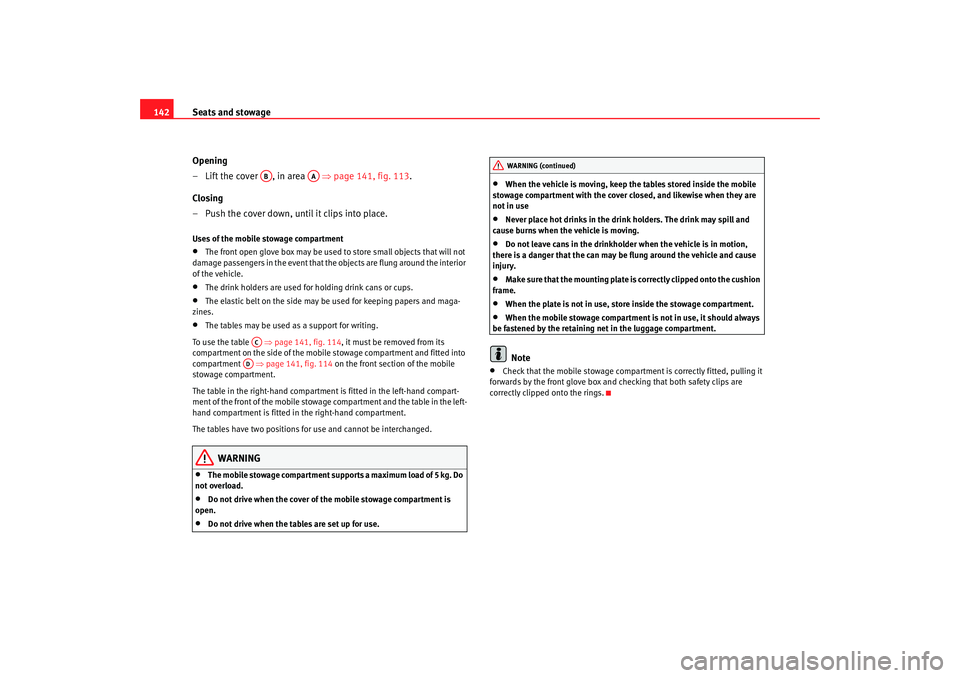
– Lift the cover , in area ⇒page 141, fig. 113 .
Closing
– Push the cover down, until it clips into place.Uses of the mobile stowage compartment•
The front open glove box may be used to store small objects that will not
damage passengers in the event that the objects are flung around the interior
of the vehicle.
•
The drink holders are used for holding drink cans or cups.
•
The elastic belt on the side may be used for keeping papers and maga-
zines.
•
The tables may be used as a support for writing.
To use the table ⇒page 141, fig. 114, it must be removed from its
compartment on the side of the mobile stowage compartment and fitted into
compartment ⇒page 141, fig. 114 on the front section of the mobile
stowage compartment.
The table in the right-hand compartment is fitted in the left-hand compart-
ment of the front of the mobile stowage compartment and the table in the left-
hand compartment is fitted in the right-hand compartment.
The tables have two positions for use and cannot be interchanged.
WARNING
•
The mobile stowage compartment supports a maximum load of 5 kg. Do
not overload.
•
Do not drive when the cover of the mobile stowage compartment is
open.
•
Do not drive when the tables are set up for use.
•
When the vehicle is moving, keep the tables stored inside the mobile
stowage compartment with the cover closed, and likewise when they are
not in use
•
Never place hot drinks in the drink holders. The drink may spill and
cause burns when the vehicle is moving.
•
Do not leave cans in the drinkholder when the vehicle is in motion,
there is a danger that the can may be flung around the vehicle and cause
injury.
•
Make sure that the mounting plate is correctly clipped onto the cushion
frame.
•
When the plate is not in use, store inside the stowage compartment.
•
When the mobile stowage compartment is not in use, it should always
be fastened by the retaining net in the luggage compartment.Note
•
Check that the mobile stowage compartment is correctly fitted, pulling it
forwards by the front glove box and checking that both safety clips are
correctly clipped onto the rings.
AB
AA
AC
AD
WARNING (continued)
altea ingles.book Seite 142 Dienstag, 11. September 2007 4:39 16
Page 145 of 309
Seats and stowage143
Safety First
Operating instructions
Tips and Maintenance
Te c h n i c a l D a t a
Ashtrays*, cigarette lighter* and electrical
socketsAshtray* Opening and closing the ashtray
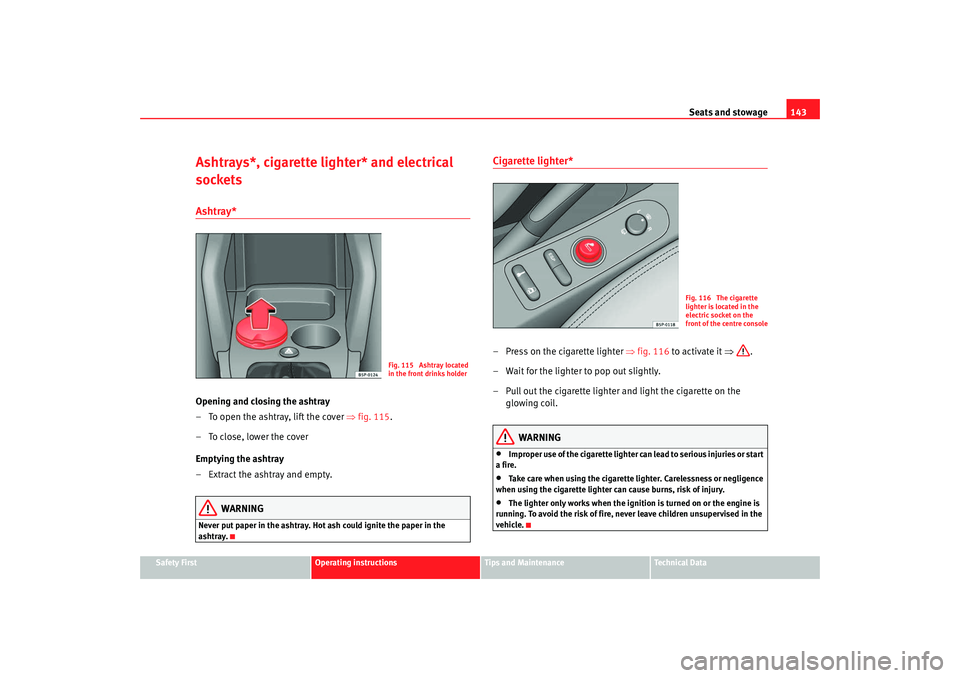
– To open the ashtray, lift the cover ⇒fig. 115 .
– To close, lower the cover
Emptying the ashtray
– Extract the ashtray and empty.
WARNING
Never put paper in the ashtray. Hot ash could ignite the paper in the
ashtray.
Cigarette lighter* – Press on the cigarette lighter ⇒fig. 116 to activate it ⇒.
– Wait for the lighter to pop out slightly.
– Pull out the cigarette lighter and light the cigarette on the glowing coil.
WARNING
•
Improper use of the cigarette lighter can lead to serious injuries or start
a fire.
•
Take care when using the cigarette lighter. Carelessness or negligence
when using the cigarette lighter can cause burns, risk of injury.
•
The lighter only works when the ignition is turned on or the engine is
running. To avoid the risk of fire, never leave children unsupervised in the
vehicle.
Fig. 115 Ashtray located
in the front drinks holder
Fig. 116 The cigarette
lighter is located in the
electric socket on the
front of the centre console
altea ingles.book Seite 143 Dienstag, 11. September 2007 4:39 16
Page 146 of 309
Seats and stowage
144Electrical sockets
Electrical equipment can be connected to any of the 12 volt
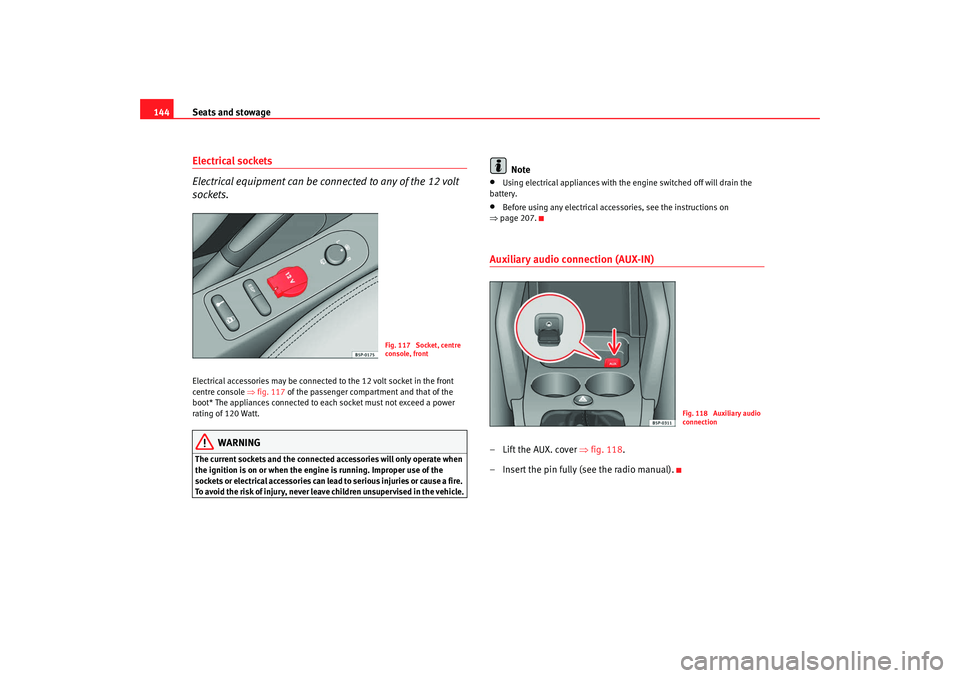
sockets.Electrical accessories may be connected to the 12 volt socket in the front
centre console ⇒ fig. 117 of the passenger compartment and that of the
boot* The appliances connected to each socket must not exceed a power
rating of 120 Watt.
WARNING
The current sockets and the connected accessories will only operate when
the ignition is on or when the engine is running. Improper use of the
sockets or electrical accessories can lead to serious injuries or cause a fire.
To avoid the risk of injury, never leave children unsupervised in the vehicle.
Note
•
Using electrical appliances with the engine switched off will drain the
battery.
•
Before using any electrical accessories, see the instructions on
⇒ page 207.
Auxiliary audio connection (AUX-IN)– Lift the AUX. cover ⇒fig. 118 .
– Insert the pin fully (see the radio manual).
Fig. 117 Socket, centre
console, front
Fig. 118 Auxiliary audio
connection
altea ingles.book Seite 144 Dienstag, 11. September 2007 4:39 16
Page 147 of 309
Seats and stowage145
Safety First
Operating instructions
Tips and Maintenance
Te c h n i c a l D a t a
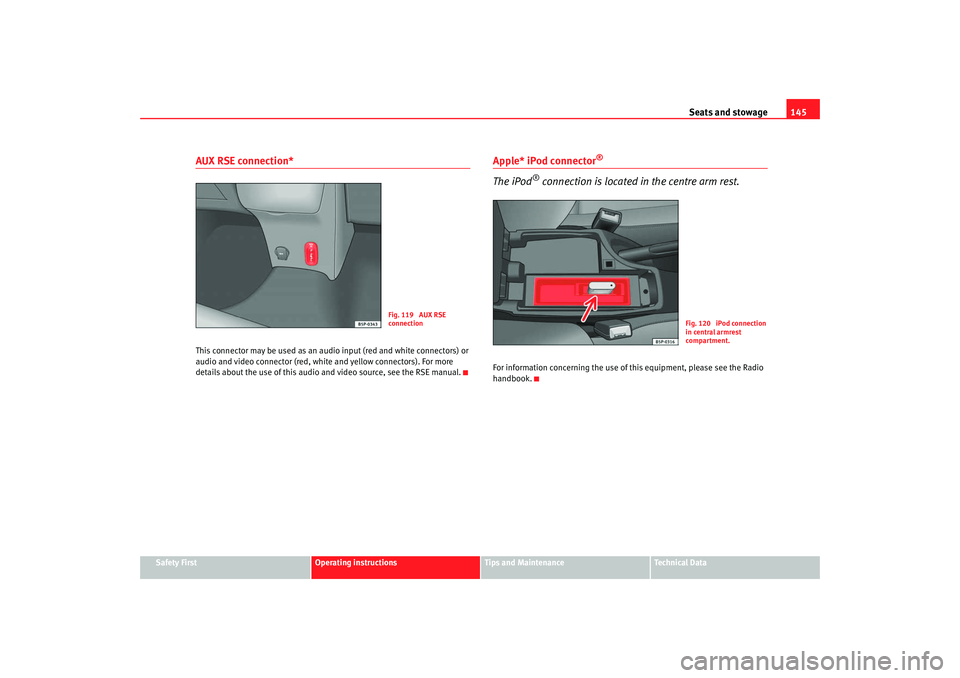
AUX RSE connection*This connector may be used as an audi o input (red and white connectors) or
audio and video connector (red, white and yellow connectors). For more
details about the use of this audio and video source, see the RSE manual.
Apple* iPod connector
®
The iPod
® connection is located in the centre arm rest.
For information concerning the use of this equipment, please see the Radio
handbook.
Fig. 119 AUX RSE
connection
Fig. 120 iPod connection
in central armrest
compartment.
altea ingles.book Seite 145 Dienstag, 11. September 2007 4:39 16
Page 148 of 309
Seats and stowage
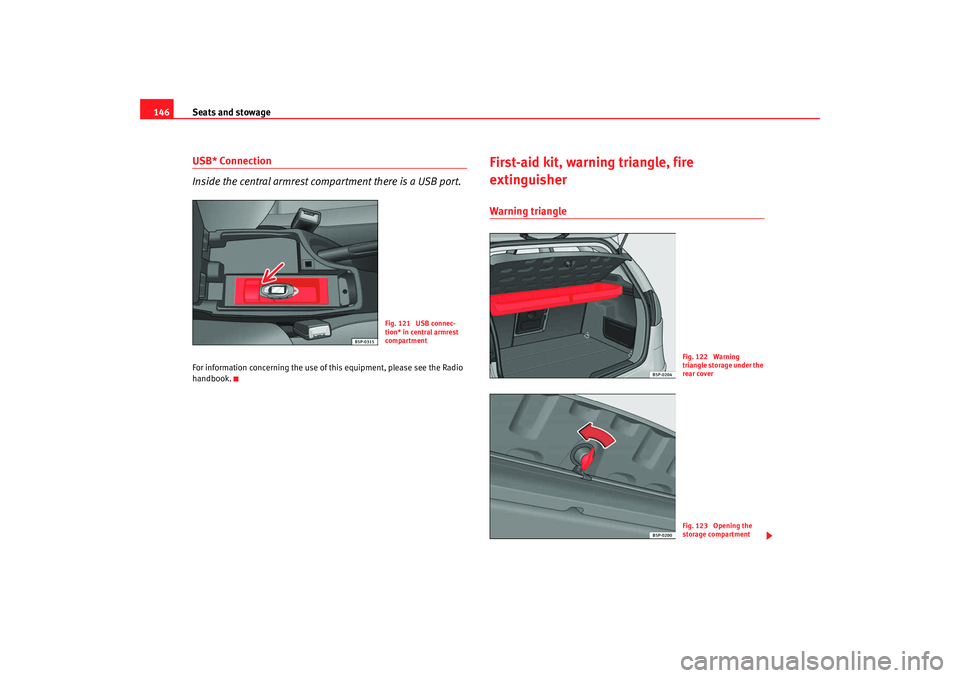
146USB* Connection
Inside the central armrest compartment there is a USB port.For information concerning the use of this equipment, please see the Radio
handbook.
First-aid kit, warning triangle, fire
extinguisherWarning triangle
Fig. 121 USB connec-
tion* in central armrest
compartment
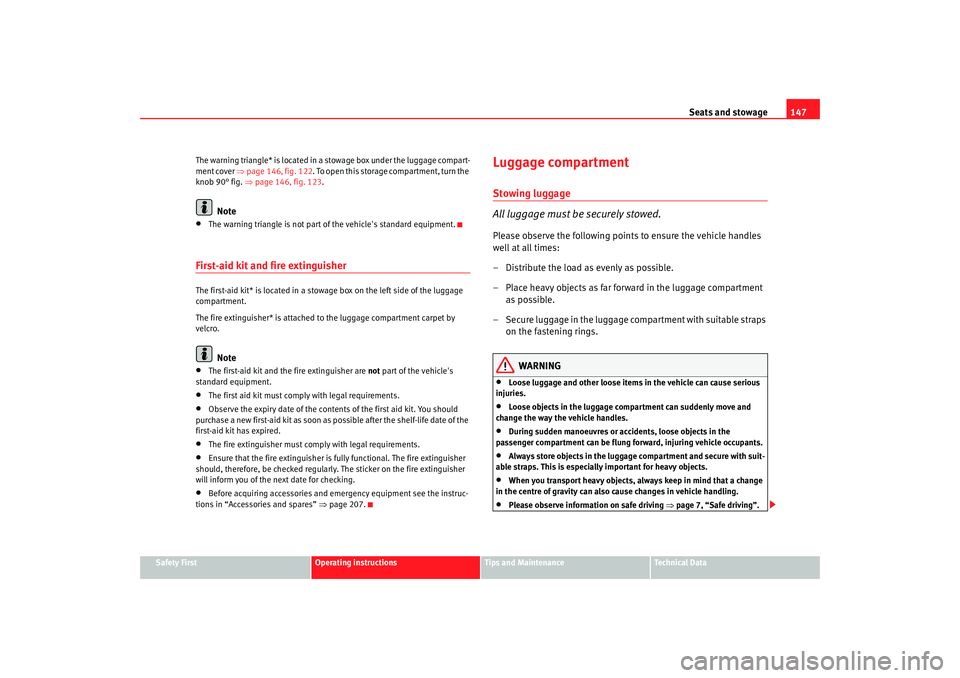
Fig. 122 Warning
triangle storage under the
rear coverFig. 123 Opening the
storage compartment
altea ingles.book Seite 146 Dienstag, 11. September 2007 4:39 16
Page 149 of 309
Seats and stowage147
Safety First
Operating instructions
Tips and Maintenance
Te c h n i c a l D a t a
The warning triangle* is located in a stowage box under the luggage compart-
ment cover
⇒page 146, fig. 122. To open this storage compartment, turn the
knob 90° fig. ⇒page 146, fig. 123 .
Note
•
The warning triangle is not part of the vehicle's standard equipment.
First-aid kit and fire extinguisherThe first-aid kit* is located in a stowage box on the left side of the luggage
compartment.
The fire extinguisher* is attached to the luggage compartment carpet by
velcro.
Note
•
The first-aid kit and the fire extinguisher are not part of the vehicle's
standard equipment.
•
The first aid kit must comply with legal requirements.
•
Observe the expiry date of the contents of the first aid kit. You should
purchase a new first-aid kit as soon as possible after the shelf-life date of the
first-aid kit has expired.
•
The fire extinguisher must comply with legal requirements.
•
Ensure that the fire extinguisher is fu lly functional. The fire extinguisher
should, therefore, be checked regularly. The sticker on the fire extinguisher
will inform you of the next date for checking.
•
Before acquiring accessories and emergency equipment see the instruc-
tions in “Accessories and spares” ⇒page 207.
Luggage compartmentStowing luggage
All luggage must be securely stowed.Please observe the following points to ensure the vehicle handles
well at all times:
– Distribute the load as evenly as possible.
– Place heavy objects as far forward in the luggage compartment
as possible.
– Secure luggage in the luggage compartment with suitable straps on the fastening rings.
WARNING
•
Loose luggage and other loose items in the vehicle can cause serious
injuries.
•
Loose objects in the luggage compartment can suddenly move and
change the way the vehicle handles.
•
During sudden manoeuvres or ac cidents, loose objects in the
passenger compartment can be flung forward, injuring vehicle occupants.
•
Always store objects in the luggage compartment and secure with suit-
able straps. This is especially important for heavy objects.
•
When you transport heavy objects, always keep in mind that a change
in the centre of gravity can also cause changes in vehicle handling.
•
Please observe information on safe driving ⇒page 7, “Safe driving”.
altea ingles.book Seite 147 Dienstag, 11. September 2007 4:39 16
Page 150 of 309
Seats and stowage
148
CautionHard objects on the shelf could chafe against the wires of the heating
element in the rear window and cause damage.
Note
The ventilation slots in front of the rear side windows must not be covered as
this would prevent stale air being extracted from the vehicle.Rear shelf
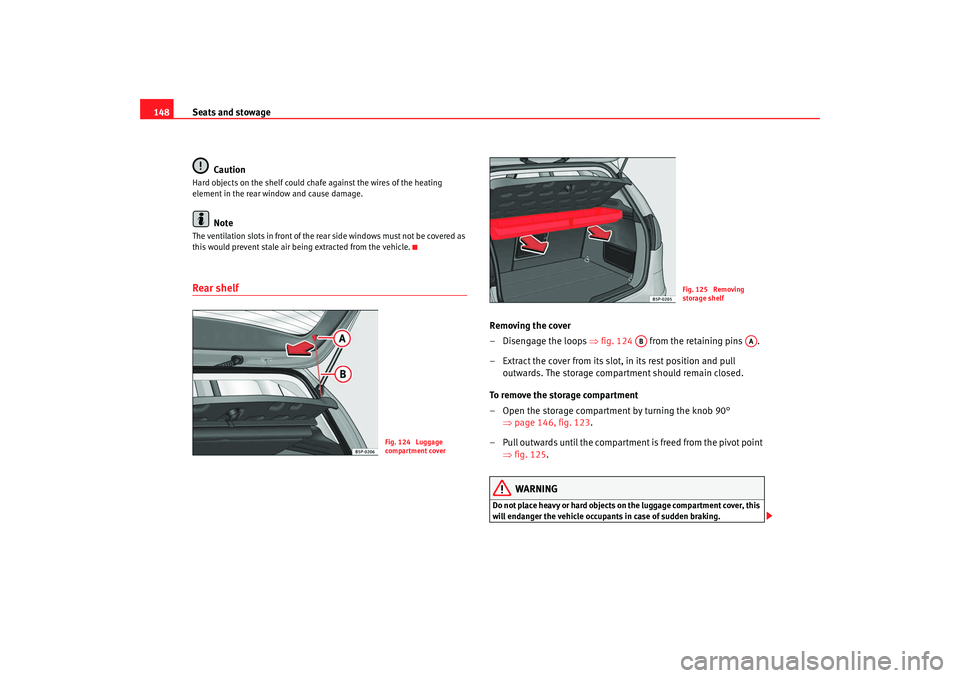
Removing the cover
– Disengage the loops ⇒fig. 124 from the retaining pins .
– Extract the cover from its slot, in its rest position and pull outwards. The storage compartment should remain closed.
To remove the storage compartment
– Open the storage compartment by turning the knob 90° ⇒page 146, fig. 123 .
– Pull outwards until the compartmen t is freed from the pivot point
⇒ fig. 125.
WARNING
Do not place heavy or hard objects on the luggage compartment cover, this
will endanger the vehicle occupants in case of sudden braking.
Fig. 124 Luggage
compartment cover
Fig. 125 Removing
storage shelf
AB
AA
altea ingles.book Seite 148 Dienstag, 11. September 2007 4:39 16
Page 151 of 309
Seats and stowage149
Safety First
Operating instructions
Tips and Maintenance
Te c h n i c a l D a t a
Caution
•
Before closing the tailgate, ensure that the stowage compartment tray is
correctly fitted.
•
An overloaded boot could mean that the rear stowage tray is not correctly
seated and it may be bent or damaged.
•
If the boot is overloaded, remove the tray.Note
•
Ensure that, when placing items of clothing on the luggage compartment
cover, rear visibility is not reduced.
•
Only the warning triangle* and other lightweight objects should be stored
in the storage compartment.
Roof carrier*Please observe the following points if you intend to carry loads on the roof:•
For safety reasons, only luggage racks and accessories approved by SEAT
should be used.
•
It is imperative to precisely follow the fitting instructions included for the
rack, taking special care when fitting the front bar in the holes designed for
this and the rear bar between the marks on the upper part of the rear door
frame while respecting the correct direction of travel indicated in the installa-
tion manual. Not following these instructions may lead to paintwork damage
or marks on the bodywork.
•
Pay special attention to the tightening torque of the attachment bolts and
check them following a short journey. If necessary, retighten the bolts and
check them at regular intervals.
•
Distribute the load evenly. A maximum load of 40 kg only is permitted for
each roof carrier system support bar, the load must be distributed evenly over the entire length. However, the maximum load permitted for the entire roof
(including the support system) of 75 kg must not be exceeded nor should the
total weight of the vehicle be exceeded. See the chapter on “Technical Data”.
•
When transporting heavy or large objects on the roof, any change in the
normal vehicle behaviour due to a change in the centre of gravity or an
increased wind resistance must be taken into account. For this reason, a suit-
able speed and driving style must be used.
•
For those vehicles fitted with a sunroof*, ensure that it does not interfere
with the load on the roof carrier system when opened.
altea ingles.book Seite 149 Dienstag, 11. September 2007 4:39 16
Page 174 of 309
Driving
172
Note•
The gearbox controls on the steering wheel can operate with the gear stick
in any position and with the vehicle in motion.
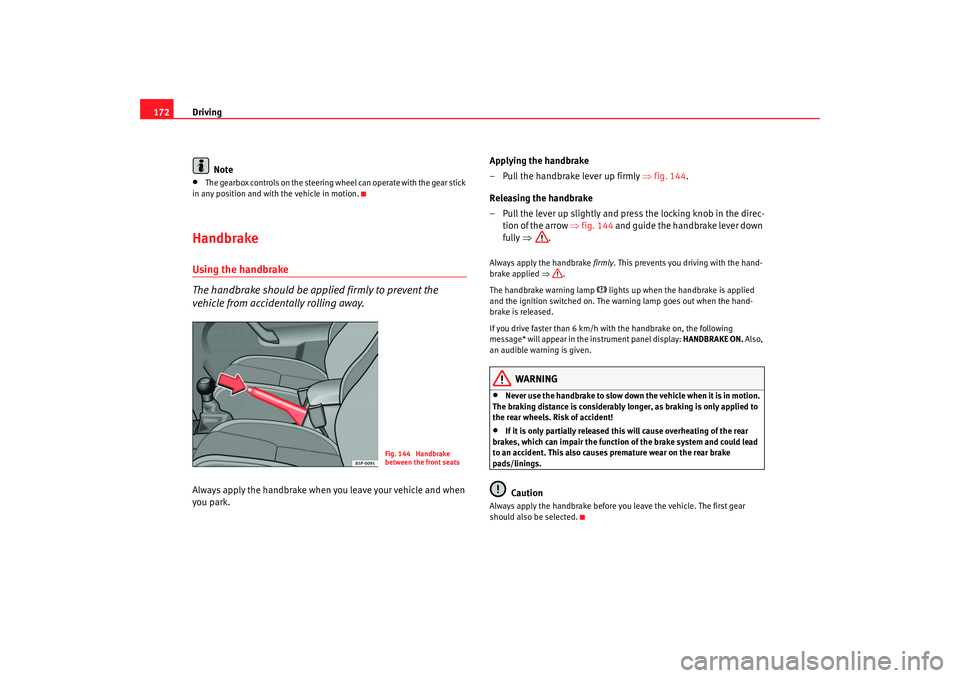
HandbrakeUsing the handbrake
The handbrake should be applied firmly to prevent the
vehicle from accidentally rolling away.Always apply the handbrake when you leave your vehicle and when
you park. Applying the handbrake
– Pull the handbrake lever up firmly ⇒
fig. 144.
Releasing the handbrake
– Pull the lever up slightly and press the locking knob in the direc- tion of the arrow ⇒fig. 144 and guide the handbrake lever down
fully ⇒ .
Always apply the handbrake firmly. This prevents you driving with the hand-
brake applied ⇒.
The handbrake warning lamp
lights up when the handbrake is applied
and the ignition switched on. The warning lamp goes out when the hand-
brake is released.
If you drive faster than 6 km/h with the handbrake on, the following
message* will appear in the instrument panel display: HANDBRAKE ON. Also,
an audible warning is given.
WARNING
•
Never use the handbrake to slow down the vehicle when it is in motion.
The braking distance is considerably longer, as braking is only applied to
the rear wheels. Risk of accident!
•
If it is only partially released this will cause overheating of the rear
brakes, which can impair the function of the brake system and could lead
to an accident. This also causes premature wear on the rear brake
pads/linings.Caution
Always apply the handbrake before you leave the vehicle. The first gear
should also be selected.
Fig. 144 Handbrake
between the front seats
altea ingles.book Seite 172 Dienstag, 11. September 2007 4:39 16
Page 253 of 309
If and when251
Safety First
Operating instructions
Tips and Maintenance
Te c h n i c a l D a t a
Some of the electrical items listed in
the table are only fitted on certain
models or are optional extras.
Please note that the above list, while correct at the time of printing, is subject
to alterations. If discrepancies should occur, please refer to the sticker on the
inside of the fuse cover for the co rrect information for your model.
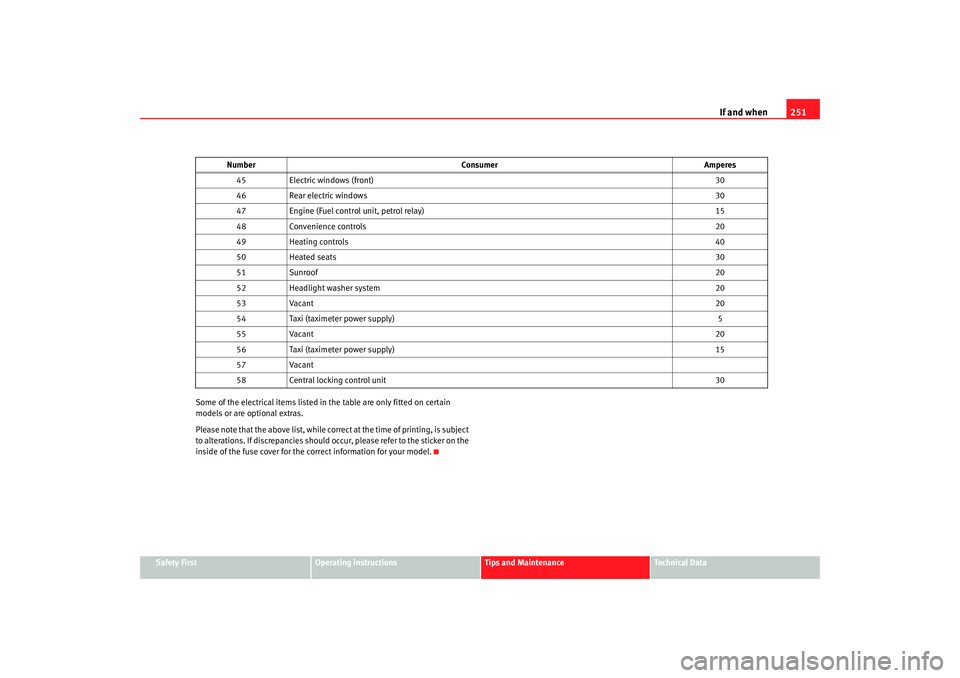
45
Electric windows (front) 30
46 Rear electric windows 30
47 Engine (Fuel control unit, petrol relay) 15
48 Convenience controls 20
49 Heating controls 40
50 Heated seats 30
51 Sunroof 20
52 Headlight washer system 20
53 Vacant 20
54 Taxi (taximeter power supply) 5
55 Vacant 20
56 Taxi (taximeter power supply) 15
57 Vacant
58 Central locking control unit 30
Number
Consumer Amperes
altea ingles.book Seite 251 Dienstag, 11. September 2007 4:39 16