radio Seat Altea 2009 User Guide
[x] Cancel search | Manufacturer: SEAT, Model Year: 2009, Model line: Altea, Model: Seat Altea 2009Pages: 299, PDF Size: 9.39 MB
Page 101 of 299
Unlocking and locking
100Radio frequency remote controlLocking and unlocking the vehicle
The remote control key is used to lock and unlock the vehicle
from a distance.
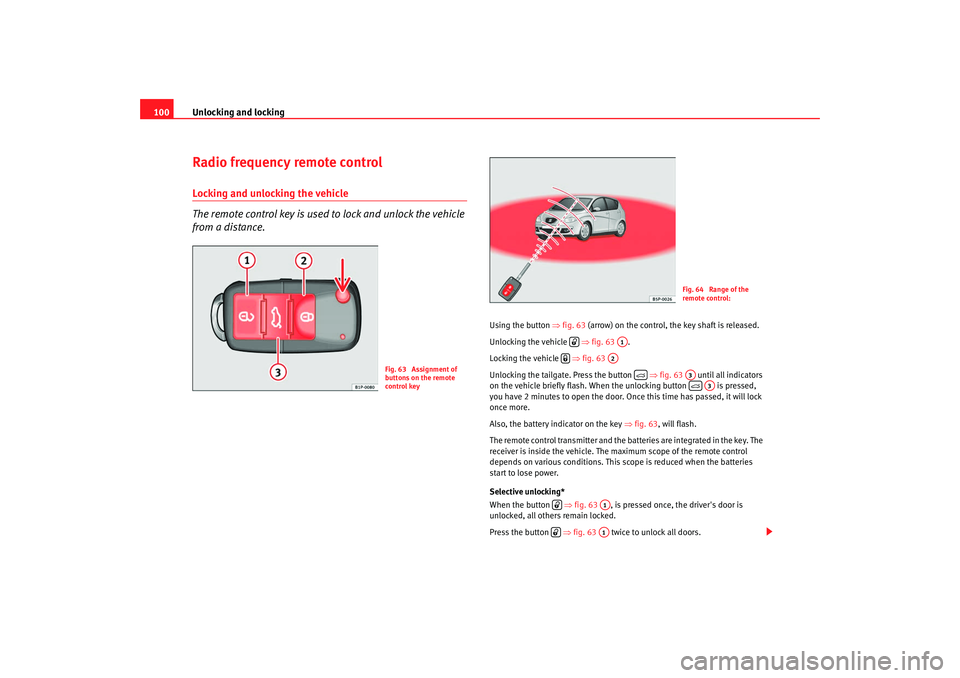
Using the button ⇒fig. 63 (arrow) on the control, the key shaft is released.
Unlocking the vehicle ⇒fig. 63 .
Locking the vehicle ⇒fig. 63
Unlocking the tailgate. Press the button ⇒fig. 63 until all indicators
on the vehicle briefly flash. When the unlocking button is pressed,
you have 2 minutes to open the door. Once this time has passed, it will lock
once more.
Also, the battery indicator on the key ⇒fig. 63 , will flash.
The remote control transmitter and the batteries are integrated in the key. The
receiver is inside the vehicle. The maximum scope of the remote control
depends on various conditions. This scope is reduced when the batteries
start to lose power.
Selective unlocking*
When the button ⇒fig. 63 , is pressed once, the driver's door is
unlocked, all others remain locked.
Press the button ⇒fig. 63 twice to unlock all doors.
Fig. 63 Assignment of
buttons on the remote
control key
Fig. 64 Range of the
remote control:
A1
A2
A3
A3
A1
A1
Altea_EN.book Seite 100 Montag, 19. Januar 2009 1:31 13
Page 102 of 299
Unlocking and locking101
Safety First
Operating instructions
Practical tips
Te c h n i c a l D a t a
WARNING
•
An improper use of the key can cause serious injuries.
•
Never leave children or disabled persons in the vehicle. In case of emer-
gency, they may not be able to leave the vehicle and not manage on their
own.
•
Never forget the keys inside the vehicle. Otherwise, this could result in
serious injuries, accidents or even the theft of your vehicle. Always take the
key with you when you leave the vehicle.
•
An uncontrolled use of the key could start the engine or activate any
electric equipment(e.g. electric win dows), causing risk of accident. The
vehicle can be locked when using the remote control key. This could
complicate the aid in cas of emergency.Note
•
The radio-frequency remote control can be programmed by means of
pressing the unlocking button once; as a result, only the driver door will
unlock. When the button is pressed once more, all doors and the tailgate will
be unlocked.
•
The remote control functions only when you are in range ⇒page 100,
fig. 64 (red area).
•
If the vehicle is unlocked using the button, it will lock again auto-
matically if any of the doors or the tailgate are not opened within 30 seconds
after unlocking it. This function prevents the vehicle from remaining unlocked
if the unlock button is pressed by mistake.
•
If the vehicle cannot be opened and closed using the remote control, the
remote control key will have to be re-synchronised ⇒page 101.
Changing the batteryIf the battery indicator does not flash when the buttons are pushed, the
battery must be replaced.
Caution
The use of inappropriate batteries ma y damage the radio frequency remote
control. For this reason, always replac e the dead battery with another of the
same size and power.
For the sake of the environment
The flat batteries must be thrown away in accordance with regulations
governing the protection of the environment.Synchronising the remote control key
If it is not possible to unlock or lock the door with the remote
control, it should be re-synchronised.– Press the ⇒page 100, fig. 63 button on the remote control.
– Then close the vehicle using the key bit within one minute.It is possible that the vehicle could no longer be opened and closed with the
remote control if the button is repeatedly pressed outside the radio
frequency remote control effective scope. The remote control key will have to
be resynchronised.
Spare remote control keys are available in your Authorised Service Centres,
where they must be matched to the locking system.
Up to eight remote control keys can be used.
A1
Altea_EN.book Seite 101 Montag, 19. Januar 2009 1:31 13
Page 148 of 299
Seats and stowage147
Safety First
Operating instructions
Practical tips
Te c h n i c a l D a t a
Electrical sockets*
Electrical equipment can be connected to any of the 12 volt
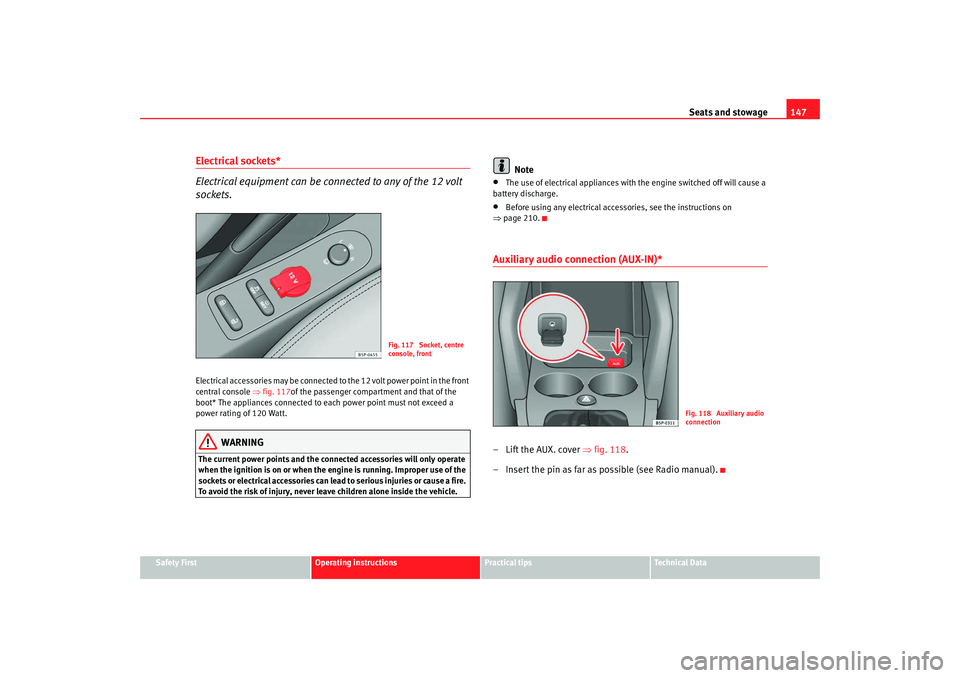
sockets.Electrical accessories may be connected to the 12 volt power point in the front
central console ⇒fig. 117 of the passenger compartment and that of the
boot* The appliances connected to ea ch power point must not exceed a
power rating of 120 Watt.
WARNING
The current power points and the connected accessories will only operate
when the ignition is on or when the engine is running. Improper use of the
sockets or electrical accessories can lead to serious injuries or cause a fire.
To avoid the risk of injury, never leave children alone inside the vehicle.
Note
•
The use of electrical appliances with the engine switched off will cause a
battery discharge.
•
Before using any electrical accessories, see the instructions on
⇒ page 210.
Auxiliary audio connection (AUX-IN)*– Lift the AUX. cover ⇒fig. 118.
– Insert the pin as far as possible (see Radio manual).
Fig. 117 Socket, centre
console, front
Fig. 118 Auxiliary audio
connection
Altea_EN.book Seite 147 Montag, 19. Januar 2009 1:31 13
Page 149 of 299
Seats and stowage
148AUX RSE connection*This connector may be used as an audi o input (red and white connectors) or
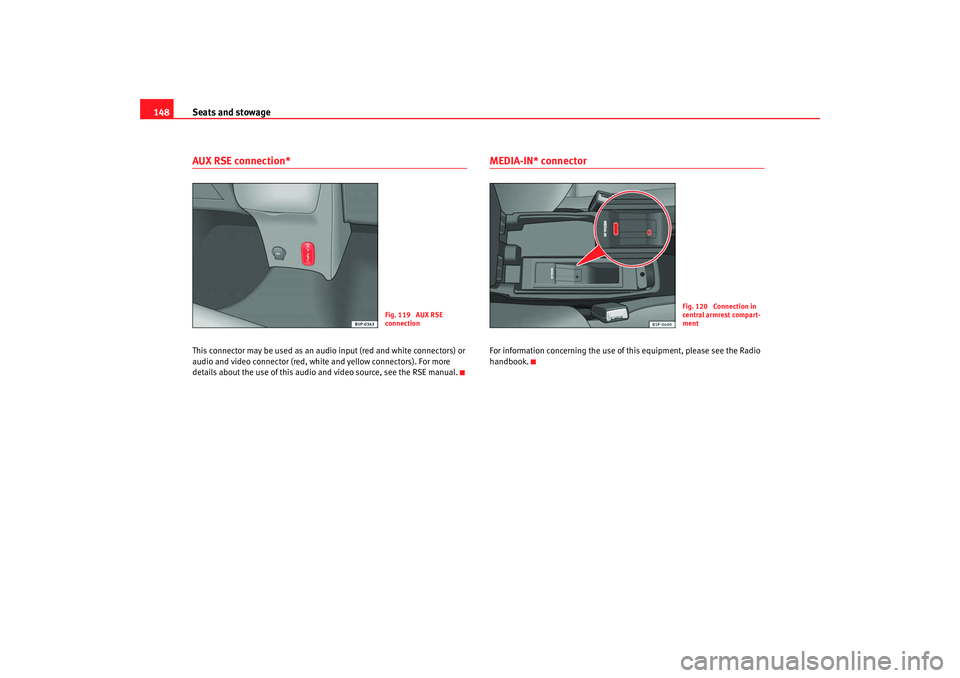
audio and video connector (red, whit e and yellow connectors). For more
details about the use of this audio and video source, see the RSE manual.
MEDIA-IN* connectorFor information concerning the use of this equipment, please see the Radio
handbook.
Fig. 119 AUX RSE
connection
Fig. 120 Connection in
central armrest compart-
ment
Altea_EN.book Seite 148 Montag, 19. Januar 2009 1:31 13
Page 160 of 299
Heating, Ventilation and Air conditioning 159
Safety First
Operating instructions
Practical tips
Te c h n i c a l D a t a
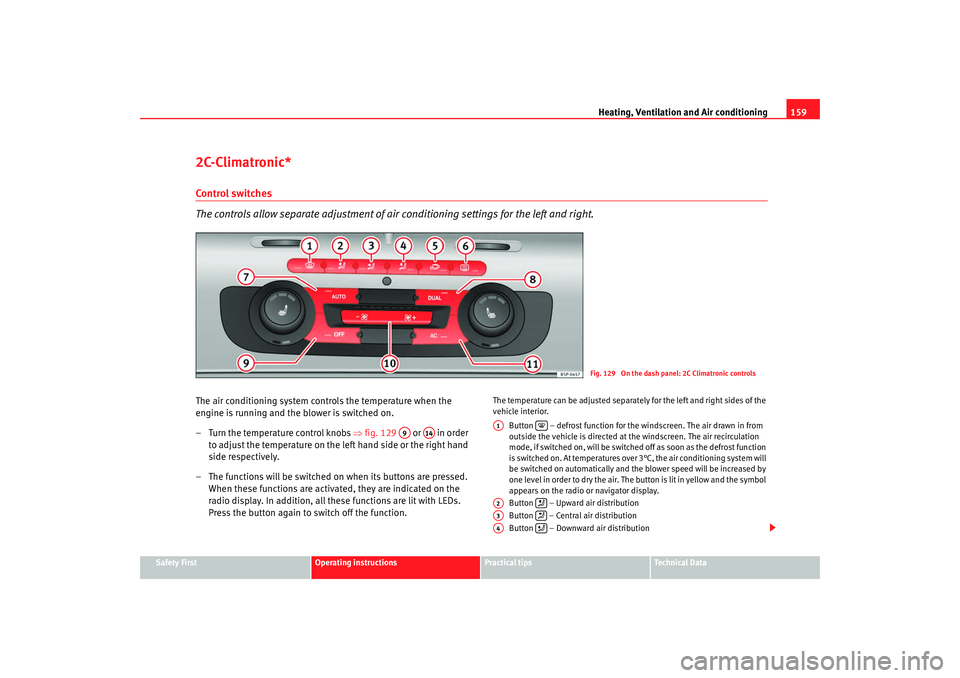
2C-Climatronic*Control switches
The controls allow separate adjustment of air conditioning settings for the left and right.The air conditioning system controls the temperature when the
engine is running and the blower is switched on.
– Turn the temperature control knobs ⇒fig. 129 or in order
to adjust the temperature on the left hand side or the right hand
side respectively.
– The functions will be switched on when its buttons are pressed. When these functions are activated, they are indicated on the
radio display. In addition, all these functions are lit with LEDs.
Press the button again to switch off the function.
The temperature can be adjusted separately for the left and right sides of the
vehicle interior.
Button – defrost function for the windscreen. The air drawn in from
outside the vehicle is directed at the windscreen. The air recirculation
mode, if switched on, will be switched off as soon as the defrost function
is switched on. At temperatures over 3°C, the air conditioning system will
be switched on automatically and the blower speed will be increased by
one level in order to dry the air. The button is lit in yellow and the symbol
appears on the radio or navigator display.
Button – Upward air distribution
Button – Central air distribution
Button – Downward air distribution
Fig. 129 On the dash panel: 2C Climatronic controls
A9
A14
A1
A2
A3
A4
Altea_EN.book Seite 159 Montag, 19. Januar 2009 1:31 13
Page 161 of 299
Heating, Ventilation and Air conditioning
160
Button – Manual air recirculation mode.
Button – Rear window heating. The heating will be switched off auto-
matically approximately 20 minutes after switching on. However, it may
be turned off by pushing the button. Th e button lights up yellow and the
symbol appears in the display.
Button – Automatic temperature, ventilation and air distribution
control ⇒page 161
button - Dual zone synchroniser
Button – Switches the 2C-Climatronic on and off ⇒page 162
Blower control ⇒page 162
button – Switches heating, ventilation and air-conditioning system
onWARNING
For road safety all windows must be clear of ice, snow, and condensation.
This is essential to ensure good visibility. Please familiarise yourself with
the correct operation of the heating and ventilation system, including the
anti-fog/defrost functions for the windscreens.
Note
Please observe the general notes ⇒page 163.
Viewing Climatronic information
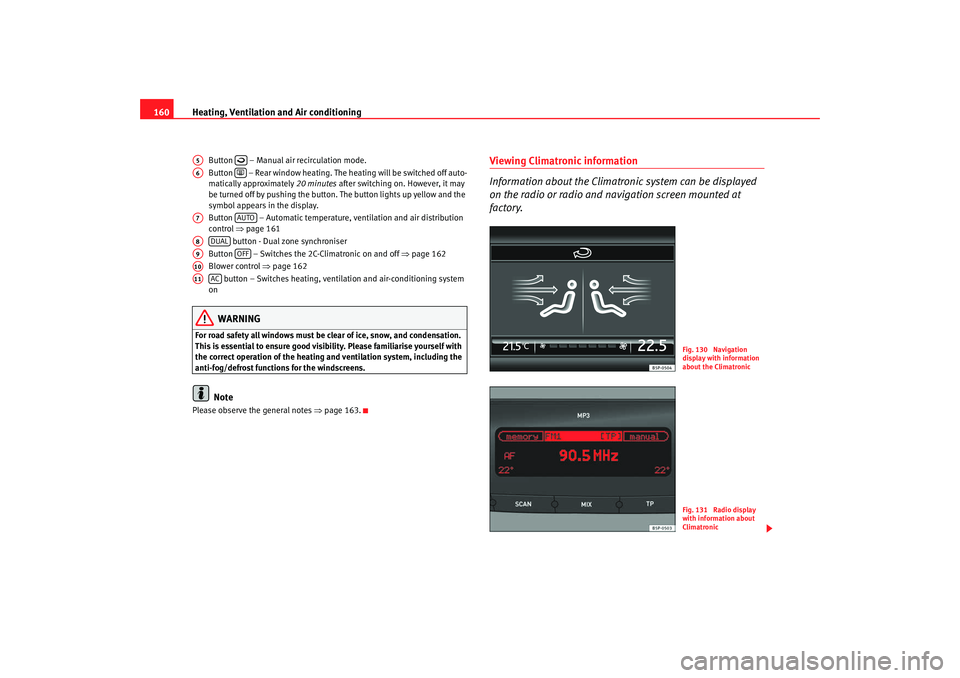
Information about the Climatronic system can be displayed
on the radio or radio and na vigation screen mounted at
factory.
A5
A6
A7
AUTO
A8
DUAL
A9
OFF
A10A11
AC
Fig. 130 Navigation
display with information
about the ClimatronicFig. 131 Radio display
with information about
Climatronic
Altea_EN.book Seite 160 Montag, 19. Januar 2009 1:31 13
Page 162 of 299
Heating, Ventilation and Air conditioning 161
Safety First
Operating instructions
Practical tips
Te c h n i c a l D a t a
The LEDs on the Climatronic controls indicate that the selected function has
been activated.
In addition, the radio or radio and navigation displays mounted at factory
briefly display the current settings of the Climatronic if any are modified.
The symbols used on the radio or radio and navigation displays are the same
as the symbols used for the Climatronic controls.
Automatic mode
In automatic mode air temperature, air flow and distribution
are automatically regulated so that a specified temperature is
attained as quickly as possible and then maintained.The temperature can be adjusted separately for the left and right
sides of the vehicle interior.
Switching on automatic mode
–Press the ⇒
page 159, fig. 129 button. “AUTO High” is
shown on the radio display (high fan speed).
– Press the button again ⇒ page 159, fig. 129. “AUTO Low”
is shown on the radio display (low fan speed).Depending upon the version and finish, the vehicle may include:
When a temperature of 22°C (72°F) is set in automatic mode a comfortable
interior climate is quickly reached. Therefore, we recommend you not to
change this adjustment, except as necessary to suit individual preferences or
particular circumstances. The compartment temperature can be set between
+18°C (64°F) and +26°C (80°F). These ar e approximate temperatures and the actual temperature may be slightly higher or lower depending on the ambient
conditions.
Climatronic maintains a constant temperature. The temperature of the air
supplied to the interior, the blower speed and the air distribution are regu-
lated automatically. The system also considers the sunlight radiation, so
there is no need for manual readjustment. Therefore,
automatic mode almost
always provides the best comfort for the vehicle occupants throughout the
year.
Automatic mode is switched off whenever an adjustment is made using the
buttons for the air distribution, air flow or or the air recirculation button
. The temperature will continue to be regulated within the parameters
manually selected by the user.
Note
There are two automatic modes:•
Automatic mode LO: This calculates the air flow for two people.
•
Automatic mode HI: This calculates the air flow for more than two
people.
AUTOAUTO
Altea_EN.book Seite 161 Montag, 19. Januar 2009 1:31 13
Page 163 of 299
Heating, Ventilation and Air conditioning
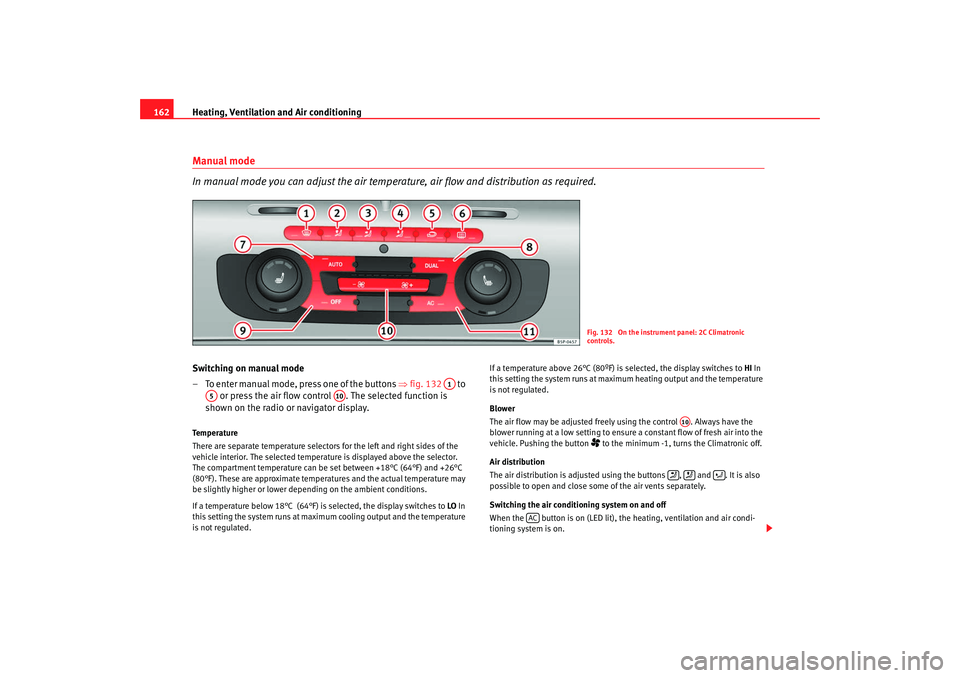
162Manual mode
In manual mode you can adjust the air temperat ure, air flow and distribution as required.Switching on manual mode
– To enter manual mode, press one of the buttons ⇒fig. 132 to
or press the air flow control . The selected function is
shown on the radio or navigator display.Temperature
There are separate temperature selectors for the left and right sides of the
vehicle interior. The selected temperature is displayed above the selector.
The compartment temperature can be set between +18°C (64°F) and +26°C
(80°F). These are approximate temperat ures and the actual temperature may
be slightly higher or lower depending on the ambient conditions.
If a temperature below 18°C (64°F) is selected, the display switches to LO In
this setting the system runs at maximum cooling output and the temperature
is not regulated. If a temperature above 26°C (80ºF) is selected, the display switches to
HI In
this setting the system runs at maximum heating output and the temperature
is not regulated.
Blower
The air flow may be adjusted freely using the control . Always have the
blower running at a low setting to ensure a constant flow of fresh air into the
vehicle. Pushing the button
to the minimum -1, turns the Climatronic off.
Air distribution
The air distribution is adjusted using the buttons , and . It is also
possible to open and close some of the air vents separately.
Switching the air conditioning system on and off
When the button is on (LED lit), th e heating, ventilation and air condi-
tioning system is on.
Fig. 132 On the instrument panel: 2C Climatronic
controls.
A1
A5
A10
A10
AC
Altea_EN.book Seite 162 Montag, 19. Januar 2009 1:31 13
Page 181 of 299
Driving
180The volume of the warning beeps will be gradually reduced after about 4
seconds if the vehicle remains at a constant distance from a detected
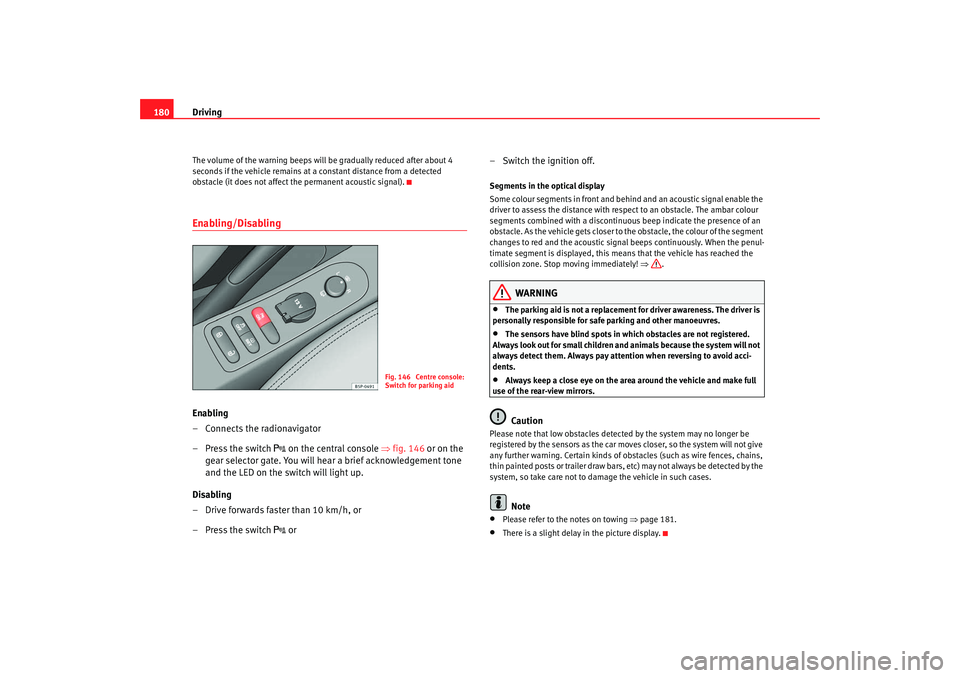
obstacle (it does not affect the permanent acoustic signal).Enabling/DisablingEnabling
– Connects the radionavigator
– Press the switch
on the central console ⇒fig. 146 or on the
gear selector gate. You will hear a brief acknowledgement tone
and the LED on the switch will light up.
Disabling
– Drive forwards faster than 10 km/h, or
– Press the switch
or – Switch the ignition off.
Segments in the optical display
Some colour segments in front and behind and an acoustic signal enable the
driver to assess the distance with respect to an obstacle. The ambar colour
segments combined with a discontinuous beep indicate the presence of an
obstacle. As the vehicle gets closer to
the obstacle, the colour of the segment
changes to red and the acoustic signal beeps continuously. When the penul-
timate segment is displayed, this means that the vehicle has reached the
collision zone. Stop moving immediately! ⇒.
WARNING
•
The parking aid is not a replacement for driver awareness. The driver is
personally responsible for safe parking and other manoeuvres.
•
The sensors have blind spots in which obstacles are not registered.
Always look out for small children and animals because the system will not
always detect them. Always pay attention when reversing to avoid acci-
dents.
•
Always keep a close eye on the area around the vehicle and make full
use of the rear-view mirrors.Caution
Please note that low obstacles detected by the system may no longer be
registered by the sensors as the car moves closer, so the system will not give
any further warning. Certain kinds of obstacles (such as wire fences, chains,
thin painted posts or trailer draw bars, etc) may not always be detected by the
system, so take care not to damage the vehicle in such cases.
Note
•
Please refer to the notes on towing ⇒page 181.
•
There is a slight delay in the picture display.
Fig. 146 Centre console:
Switch for parking aid
Altea_EN.book Seite 180 Montag, 19. Januar 2009 1:31 13
Page 203 of 299
Cleaning and caring for your vehicle
202Vehicle exterior maintenanceAutomatic car wash tunnel
The car can normally be washed without problem in an auto-
matic car wash.The vehicle paintwork is so durable that the car can normally be washed
without problems in an automatic car washing tunnel. However, the paint-
work wear depends to a large extent, on the kind of the car washing tunnel,
the brushes used, its water filtering and the type of cleaning and preservative
products.
Before going through a car wash, be sure to take the usual precautions such
as closing the windows and sunroof. There is nothing to note apart from that.
If the vehicle has special accessories such as spoilers or a roof carrier or two-
way radio aerial, etc., it is advisable to consult the car washing tunnel oper-
ator.
After washing, the brakes could hesitate to respond as the brake discs and
pads could be wet, or even frozen in winter. “Dry” the brakes by braking
several times.
WARNING
Water, ice and salt on the brakes can reduce braking efficiency. Risk of acci-
dent.
Caution
If an automatic car wash tunnel is u sed, before entering the tunnel, put the
aerial down parallel to the roof and do not tighten to avoid damage.
Washing by handVehicle washing
– First soften the dirt with plenty of water and rinse it off.
– Clea n you r vehicle from top to bo ttom with a soft sponge, a g love or a brush. Use very light pressure.
– Rinse the sponge or glove often with clean water.
– Special car shampoo should only be used for very stubborn dirt.
– Clean the wheels, sill panels etc. until last with a different sponge or glove.
– Rinse the vehicle thoroughly with water.
– Dry your vehicle surface gently with a chamois leather.
–When temperature is cold , dry the rubber seals and its surfaces
to prevent them from freezing. Ap ply silicone spray to the rubber
seals.
After washing
– Directly after washing, avoid sudden and sharp braking. “Dry” ⇒page 192, “Braking effect and braking distance”the brakes by
braking several times.
WARNING
•
Wash your car with the ignition switched off.
•
Protect your hands and arms from cuts on sharp metal edges when
cleaning the underbody, the inside of the wheel housings etc. Risk of
injury.
Altea_EN.book Seite 202 Montag, 19. Januar 2009 1:31 13