tailgate Seat Altea 2009 User Guide
[x] Cancel search | Manufacturer: SEAT, Model Year: 2009, Model line: Altea, Model: Seat Altea 2009Pages: 299, PDF Size: 9.39 MB
Page 106 of 299
Unlocking and locking105
Safety First
Operating instructions
Practical tips
Te c h n i c a l D a t a
WARNING
•
Always close the tailgate properly. Risk of accident or injury.
•
Do not close the tailgate by pushing it down with your hand on the rear
window. The glass could smash. Risk of injury!
•
Ensure the tailgate is locked after closing it. If not, it may open unex-
pectedly while driving.
•
Never allow children to play in or ar ound the vehicle. A locked vehicle
can be subjected to extremely high and low temperatures, depending on
the time of year, thus causing serious injuries/illness. It could even have
fatal consequences. Close and lock both the tailgate and all the other doors
when you are not using the vehicle.
•
Closing the tailgate without observing and ensuring it is clear could
cause serious injury to you and to third parties. Make sure that no one is in
the path of the tailgate.
•
Never drive with the tailgate open or half-closed, exhaust gases may
penetrate into the interior of th e vehicle. Danger of poisoning!
•
If you only open the tailgate, do not leave the key inside. The vehicle
will not be opened if the key is left inside.
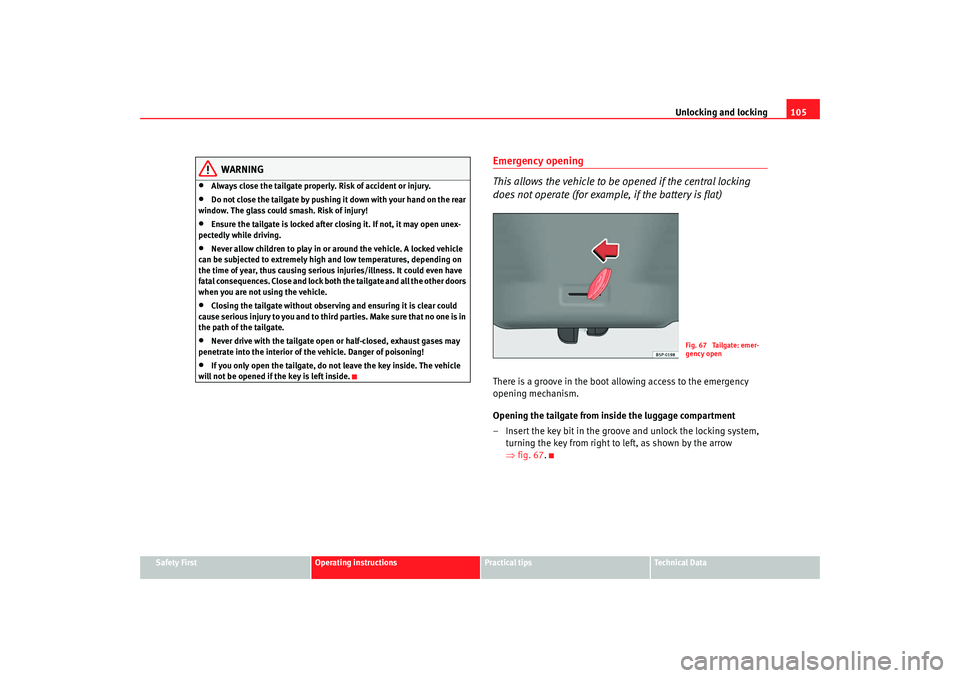
Emergency opening
This allows the vehicle to be opened if the central locking
does not operate (for example, if the battery is flat)There is a groove in the boot allowing access to the emergency
opening mechanism.
Opening the tailgate from inside the luggage compartment
– Insert the key bit in the groove and unlock the locking system, turning the key from right to left, as shown by the arrow
⇒fig. 67 .
Fig. 67 Tailgate: emer-
gency open
Altea_EN.book Seite 105 Montag, 19. Januar 2009 1:31 13
Page 107 of 299
Unlocking and locking
106WindowsOpening or closing the windows electrically
The front and rear electric windows can be operated by using
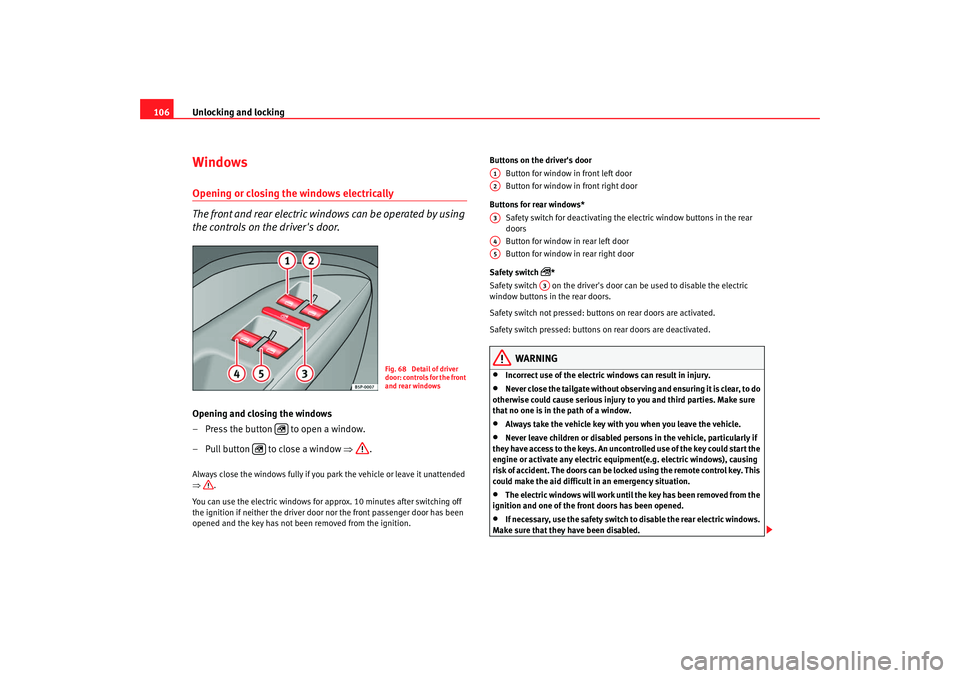
the controls on the driver's door.Opening and closing the windows
– Press the button to open a window.
– Pull button to close a window ⇒.Always close the windows fully if you park the vehicle or leave it unattended
⇒.
You can use the electric windows for approx. 10 minutes after switching off
the ignition if neither the driver door nor the front passenger door has been
opened and the key has not been removed from the ignition. Buttons on the driver's door
Button for window in front left door
Button for window in front right door
Buttons for rear windows* Safety switch for deactivating the electric window buttons in the rear
doors
Button for window in rear left door
Button for window in rear right door
Safety switch
*
Safety switch on the driver's door can be used to disable the electric
window buttons in the rear doors.
Safety switch not pressed: buttons on rear doors are activated.
Safety switch pressed: buttons on rear doors are deactivated.
WARNING
•
Incorrect use of the electric windows can result in injury.
•
Never close the tailgate without observing and ensuring it is clear, to do
otherwise could cause serious injury to you and third parties. Make sure
that no one is in the path of a window.
•
Always take the vehicle key with you when you leave the vehicle.
•
Never leave children or disabled persons in the vehicle, particularly if
they have access to the keys. An unco ntrolled use of the key could start the
engine or activate any electric equi pment(e.g. electric windows), causing
risk of accident. The doors can be lock ed using the remote control key. This
could make the aid difficult in an emergency situation.
•
The electric windows will work unti l the key has been removed from the
ignition and one of the front doors has been opened.
•
If necessary, use the safety switch to disable the rear electric windows.
Make sure that they have been disabled.
Fig. 68 Detail of driver
door: controls for the front
and rear windows
A1A2A3A4A5
A3
Altea_EN.book Seite 106 Montag, 19. Januar 2009 1:31 13
Page 109 of 299
Unlocking and locking
108•
Always take the key with you when leaving the vehicle, even if you only
intend to be gone for a short time. Please ensure that children are never left
alone inside the vehicle.
•
The electric windows will work until the key has been removed from the
ignition and one of the front doors has been opened.
•
Never close the tailgate without observin g a n d e n s u r i n g i t i s c l e a r, t o d o
otherwise could cause serious injury to you and third parties. Make sure
that no one is in the path of a window.
•
Never allow people to remain in th e vehicle when you close the vehicle
from the outside. The windows cannot be opened even in an emergency.Note
The roll-back function is deactivated if the windows are closed from the
outside of the vehicle using the ignition key for convenience closing
⇒ page 108.Convenience opening and closing* Using the door lock
– Hold the key in the door lock of the driver door in either the
locking or the unlocking position until all windows are either
opened or closed.
– Release the key to interrupt this function. Using the remote control
– Push the lock or unlock button on the remote control for about 3
seconds. All windows which function electrically will be either
opened or closed.
– Release the unlock button to interrupt the function.
– Once the windows are completely closed, the indicators will flash.
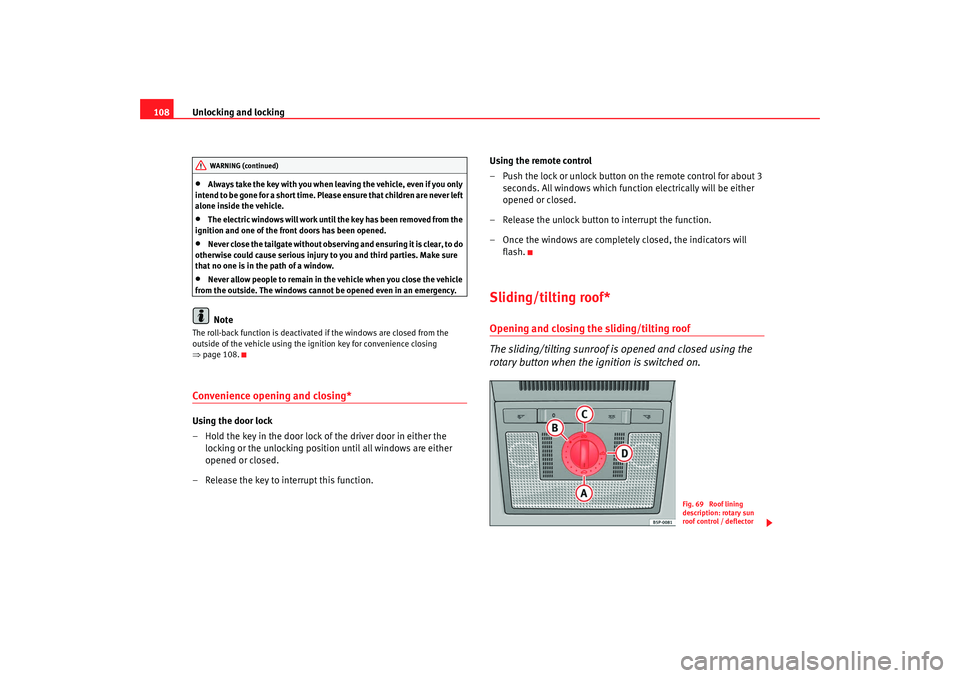
Sliding/tilting roof*Opening and closing the sliding/tilting roof
The sliding/tilting sunroof is opened and closed using the
rotary button when the ignition is switched on.
WARNING (continued)
Fig. 69 Roof lining
description: rotary sun
roof control / deflector
Altea_EN.book Seite 108 Montag, 19. Januar 2009 1:31 13
Page 114 of 299
Lights and visibility113
Safety First
Operating instructions
Practical tips
Te c h n i c a l D a t a
•
If the daylight driving automatic light function is switched on, the fog
lights or rear fog light cannot be switched on in addition.
•
The use of the lighting described here is subject to the relevant statutory
requirements.
•
Do not put stickers on the windscreen in front of the sensor. This may
cause disruptions or faults in the automatic lighting system.
•
To avoid damage to the tail lights, the lights mounted on the tailgate go
off when the tailgate is opened (according to country).
Daytime lights*
The daytime light reduces the risk of accidents by increasing
the visibility of the vehicle. The daytime running lights are
enabled automatically when the ignition is switched on. It is
automatically switched off when the side lights are turned on.Daytime lights (halogen lamps)
18)
The daytime lights increase road safety in vehicles fitted with halogen lamps.
These include the dipped, side and registration plate lights.
The daytime lights are switched on each time the ignition is turned on if the
light setting is in position 0 or
. Depending upon the model, a control
lamp
on the light control switch or the lighting up of the instrument panel
will indicate that the daytime lighting is on.
It is not possible for the driver to switch the daytime lights on or off. Please
contact a qualified workshop if you wish to deactivate the lights. Daytime lights (bi-xenon lamps)
The daytime lights increase road safety in vehicles fitted with bi-xenon lamps.
The lights are built-in separately to the headlights and are switched on each
time the ignition is turned on if the light setting is in position
0 or
.
Automatic control of the dipped lig ht in combination with the daytime
lighting (bi-xenon headlamps)
If the dipped light control and the daytime lighting are activated at the same
time, the dipped lights and the instrument panel lighting will automatically
come on as required (e.g. on entering a tunnel) and the daytime lights will go
off. When the automatic dipped light control switches off the dipped lights
(e.g. on coming out of the tunnel), the daytime lights come back on.
Activating/deactivating the daytime lights*
In vehicles with daytime lights* combined with bi-xenon headlamps, these
lights may be activated or deactivated with the indicator and main beam
lever. In vehicles with daytime lights combined with halogen lamps, this func-
tion can only be activated or deactivated in a specialist workshop.
Deactivating daytime lights (bi-xenon lamps)
With the ignition switched off, move the indicator and main beam lever
upwards and back (left indicator and headlamp flash).
Switch on the ignition for 3 seconds. The daytime lights are deactivated and
can not be switched on.
Activating daytime lights (bi-xenon lamps)
With the ignition switched off, move the indicator and main beam lever
upwards and back (left indicator and headlamp flash).
Switch on the ignition for 3 seconds. The daytime lights are activated and can
be switched on.
18)It is only available in some countries or as an optional extra
Altea_EN.book Seite 113 Montag, 19. Januar 2009 1:31 13
Page 115 of 299
Lights and visibility
114
NotePlease observe any relevant legal requirements which may apply in your
country.Coming home / leaving home function*
The Coming Home function is controlled manually. The
Leaving Home function is cont rolled with a photo sensor.If the Coming Home or Leaving Home function is connected, the front side
and dipped lights, the tail lights and the registration plate light will light up
to provide assistance.
Coming home function
The Coming Home function is activate d by switching off the ignition and
briefly flashing the lights. When the dr iver's door is opened, the Coming
Home lighting comes on. If the driver's door is already open when the lights
are flashed briefly, the Comi ng Home lighting comes on immediately.
When the last door of the vehicle or the tailgate is closed, the Coming Home
function starts and the switching off the headlights is delayed.
The Coming Home lighting switches off in the following cases:•
On completion of the time period established for the delay in switching off
the lights after all the vehicle doors and the tailgate have been closed.
•
If, 30 seconds after being connected, any doors or the tailgate remain
open.
•
If the light switch is turned to position
.
•
If the ignition is switched on.
Leaving home function
The Leaving Home function is activated when the vehicle is unlocked if:
•
the light control is in position
and
•
the photosensor detects “darkness”.
The Leaving Home lighting switches off in the following cases:
•
If the time period for the delay in switching off the headlamps has ended
•
If the vehicle is locked again.
•
If the light switch is turned to position
.
•
If the ignition is switched on.Note
The setting for the delay in switching off the headlamps in the Coming Home
and Leaving Home function can be chan ged or the function can be connected
or disconnected in the menu Lights and visibility ⇒ page 74.•
If the ignition key is removed while the lights are on, and the lights are
flashed briefly and the driver's door opened, no acoustic signal is heard, as
when the Coming Home function is on, the lights are automatically switched
off after a period of time (except when the light switch is in position
or
.
Altea_EN.book Seite 114 Montag, 19. Januar 2009 1:31 13
Page 127 of 299
Lights and visibility
126Rear window wiper
The windscreen wiper lever operates the windscreen wiper
and the wash and wipe system for the rear window.
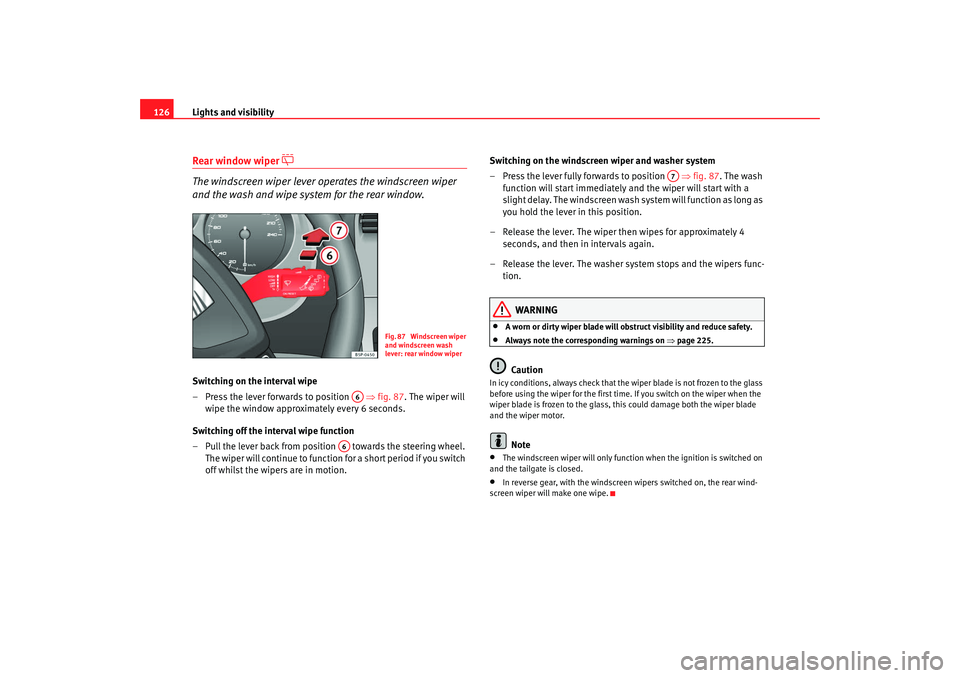
Switching on the interval wipe
– Press the lever forwards to position ⇒fig. 87 . The wiper will
wipe the window approximately every 6 seconds.
Switching off the interval wipe function
– Pull the lever back from position towards the steering wheel. T h e wi p e r will co n t i n u e to fun c t i o n fo r a sh o r t p e r i o d i f yo u s wi tch
off whilst the wipers are in motion. Switching on the windscreen wiper and washer system
– Press the lever fully forwards to position
⇒fig. 87 . The wash
function will start immediately and the wiper will start with a
slight delay. The windscreen wash system will function as long as
you hold the lever in this position.
– Release the lever. The wiper then wipes for approximately 4 seconds, and then in intervals again.
– Release the lever. The washer system stops and the wipers func- tion.
WARNING
•
A worn or dirty wiper blade will obstruct visibility and reduce safety.
•
Always note the corresponding warnings on ⇒page 225.Caution
In icy conditions, always check that the wiper blade is not frozen to the glass
before using the wiper for the first time. If you switch on the wiper when the
wiper blade is frozen to the glass, this could damage both the wiper blade
and the wiper motor.
Note
•
The windscreen wiper will only function when the ignition is switched on
and the tailgate is closed.
•
In reverse gear, with the windscreen wipers switched on, the rear wind-
screen wiper will make one wipe.
Fig. 87 Windscreen wiper
and windscreen wash
lever: rear window wiper
A6
A6
A7
Altea_EN.book Seite 126 Montag, 19. Januar 2009 1:31 13
Page 152 of 299
Seats and stowage151
Safety First
Operating instructions
Practical tips
Te c h n i c a l D a t a
Rear shelfRemoving the cover
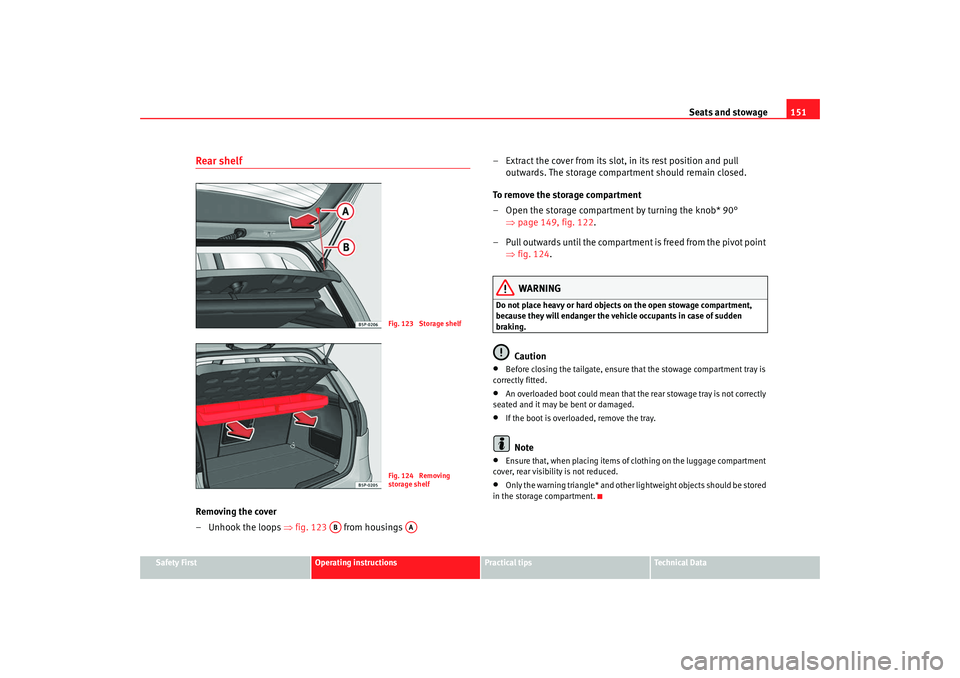
– Unhook the loops ⇒fig. 123 from housings – Extract the cover from its slot, in its rest position and pull
outwards. The storage compartment should remain closed.
To remove the storage compartment
– Open the storage compartment by turning the knob* 90° ⇒page 149, fig. 122 .
– Pull outwards until the compartment is freed from the pivot point ⇒fig. 124.
WARNING
Do not place heavy or hard objects on the open stowage compartment,
because they will endanger the ve hicle occupants in case of sudden
braking.
Caution
•
Before closing the tailgate, ensure th at the stowage compartment tray is
correctly fitted.
•
An overloaded boot could mean that the rear stowage tray is not correctly
seated and it may be bent or damaged.
•
If the boot is overloaded, remove the tray.Note
•
Ensure that, when placing items of clothing on the luggage compartment
cover, rear visibility is not reduced.
•
Only the warning triangle* and other lightweight objects should be stored
in the storage compartment.
Fig. 123 Storage shelfFig. 124 Removing
storage shelf
AB
AA
Altea_EN.book Seite 151 Montag, 19. Januar 2009 1:31 13
Page 204 of 299
Cleaning and caring for your vehicle203
Safety First
Operating instructions
Practical tips
Te c h n i c a l D a t a
•
Water, ice and salt on the brakes can reduce braking efficiency. Risk of
accident.Caution
•
Never remove dirt, mud or dust if the vehicle surface is dry. Never use a
dry cloth or sponge for cleaning purposes. This could scratch the paintwork
or glass on your vehicle.
•
Washing the vehicle in low temperatures: when washing the vehicle with
a hose, do not direct water into the lo ck cylinders or the gaps around the
doors, tailgate, or sunroof. Risk of freezing.For the sake of the environment
To protect environment, the car should be washed only in specially provided
wash bays. This prevents toxic, oil-laden waste water entering the sewerage
system. In some districts, washing vehicles outside wash bays is prohibited.
Note
Do not wash the vehicle in direct sunlight.Washing the car with a high pressure cleaner
Be particularly careful when using a high pressure cleaner!– Always observe the instructions for the high-pressure cleaner, particularly those concerning the pressure and the spraying
distance . – Increase the spraying distance for soft materials and painted
bumpers.
– Do not use a high pressure cleaner to remove ice or snow from windows ⇒page 204.
– Never use concentrated jet nozzles (“rotating jets”) ⇒.
– Directly after washing, avoid sudden and sharp braking. “Dry” ⇒page 192 the brakes by braking several times.
WARNING
•
Never wash tyres with a concentrated jet (“rotating nozzle”). Even at
large spraying distances and short cleaning times, visible and invisible
damage can occur to the tyres. This may cause an accident.
•
Water, ice and salt on the brakes can reduce braking efficiency. Risk of
accident.Caution
•
Do not use water hotter than 60°C. This could damage the vehicle.
•
To avoid damage to the vehicle, keep a sufficient distance from sensitive
materials such as flexible hoses, plastic, soundproofing material, etc. This is
also important for bumpers painted as the paintwork. The closer the nozzle is
to the surface, the greater the wear on the material.
Vehicle paint maintenance requirements
Regular waxing protects the paintwork.You need to apply wax to your car if water does not form small drops and run
off the paintwork when it is clean.
WARNING (continued)
Altea_EN.book Seite 203 Montag, 19. Januar 2009 1:31 13
Page 260 of 299
If and when259
Safety First
Operating instructions
Practical tips
Te c h n i c a l D a t a
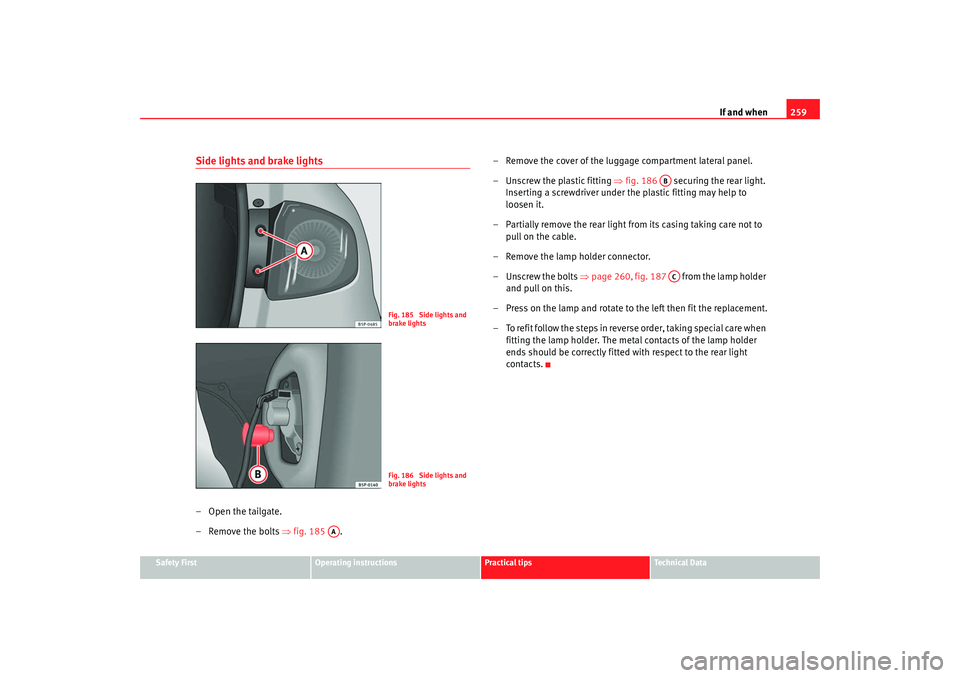
Side lights and brake lights– Open the tailgate.
– Remove the bolts ⇒fig. 185 . – Remove the cover of the luggage compartment lateral panel.
– Unscrew the plastic fitting
⇒fig. 186 securing the rear light.
Inserting a screwdriver under the plastic fitting may help to
loosen it.
– Partially remove the rear light from its casing taking care not to pull on the cable.
– Remove the lamp holder connector.
– Unscrew the bolts ⇒page 260, fig. 187 from the lamp holder
and pull on this.
– Press on the lamp and rotate to the left then fit the replacement.
– To refit follow the steps in reverse order, taking special care when fitting the lamp holder. The metal contacts of the lamp holder
ends should be correctly fitted with respect to the rear light
contacts.
Fig. 185 Side lights and
brake lightsFig. 186 Side lights and
brake lights
AA
ABAC
Altea_EN.book Seite 259 Montag, 19. Januar 2009 1:31 13
Page 296 of 299
Index295
Seat belts . . . . . . . . . . . . . . . . . . . . . . . . . . . . . . . 19
adjustment . . . . . . . . . . . . . . . . . . . . . . . . . . . 24
Incorrectly fastened . . . . . . . . . . . . . . . . . . . . 28
Not worn . . . . . . . . . . . . . . . . . . . . . . . . . . . . . 22
Safety notes . . . . . . . . . . . . . . . . . . . . . . . . . . 23
Warning lamp . . . . . . . . . . . . . . . . . . . . . . . . . 19
Seat belts cleaning . . . . . . . . . . . . . . . . . . . . . . 209
Seat belts protection . . . . . . . . . . . . . . . . . . . . . . 23
Seat heating . . . . . . . . . . . . . . . . . . . . . . . . . . . . 134
Seats . . . . . . . . . . . . . . . . . . . . . . . . . . . . . . . . . . . 19
Selective opening* . . . . . . . . . . . . . . . . . . . . . . . 94
Selector lever locking . . . . . . . . . . . . . . . . . . . . 173
Selector lever positions . . . . . . . . . . . . . . . . . . . 172
Self directional headlights . . . . . . . . . . . . . . . . 115
Service interval display . . . . . . . . . . . . . . . . . . . . 61
servotronic . . . . . . . . . . . . . . . . . . . . . . . . . . . . . 191
Shoes . . . . . . . . . . . . . . . . . . . . . . . . . . . . . . . . . . 16
Side airbags . . . . . . . . . . . . . . . . . . . . . . . . . . . . . 37 Description . . . . . . . . . . . . . . . . . . . . . . . . . . . 37
Function . . . . . . . . . . . . . . . . . . . . . . . . . . . . . 39
Safety notes . . . . . . . . . . . . . . . . . . . . . . . . . . 40
Side lights . . . . . . . . . . . . . . . . . . . . . . . . . . . . . 111
Sitting position Driver . . . . . . . . . . . . . . . . . . . . . . . . . . . . . . . 10
Front passenger . . . . . . . . . . . . . . . . . . . . . . . 11
Incorrect sitting position . . . . . . . . . . . . . . . . 15
Passengers . . . . . . . . . . . . . . . . . . . . . . . . . . . 12
Sitting position, occupants . . . . . . . . . . . . . . . . . 10
Sliding/tilting roof . . . . . . . . . . . . . . . . . . . . . . . 108
Snow chains . . . . . . . . . . . . . . . . . . . . . . . 239, 272 Soot accumulation in the
diesel engine particulate
filter
Indicator . . . . . . . . . . . . . . . . . . . . . . . . . . . . . 79
Spare parts . . . . . . . . . . . . . . . . . . . . . . . . . . . . . 210
Spare wheel . . . . . . . . . . . . . . . . . . . . . . . . . . . . 241
Starting on an uphill . . . . . . . . . . . . . . . . . . . . . 178
Starting Petrol engines . . . . . . . . . . . . . . . . . . . 169
Starting the engine . . . . . . . . . . . . . . . . . 168, 169 After the fuel tank has been run dry . . . . . . 169
Steam jets . . . . . . . . . . . . . . . . . . . . . . . . . . . . . 203
Steering . . . . . . . . . . . . . . . . . . . . . . . . . . . . . . . 165 Steering lock . . . . . . . . . . . . . . . . . . . . . . . . 167
Steering wheel audio controls audio + telephone version . . . . . . . . . . . . . . 85
audio version . . . . . . . . . . . . . . . . . . . . . . . . . 85
Steering wheel height adjustment . . . . . . . . . . 165
Storage compartment Lock . . . . . . . . . . . . . . . . . . . . . . . . . . . . . . . 151
Stowage area Centre arm rest . . . . . . . . . . . . . . . . . . . . . . 137
Front seats . . . . . . . . . . . . . . . . . . . . . . . . . . 138
Other stowage areas . . . . . . . . . . . . . . . . . . 141
Stowage compartment Front passenger side . . . . . . . . . . . . . . . . . . 137
Stowage in the luggage compartment . . . . . . . 140
Sun visors . . . . . . . . . . . . . . . . . . . . . . . . . . . . . 122
Sunroof . . . . . . . . . . . . . . . . . . . . . . . . . . . . . . . . 108
Sunroof blind Sliding/tilting roof . . . . . . . . . . . . . . . . . . . . 109
Switch Hazard warning lights . . . . . . . . . . . . . . . . . 116 Switches
Electric windows . . . . . . . . . . . . . . . . . . . . . 106
Electrical exterior mirrors . . . . . . . . . . . . . . 128
Sliding/tilting roof . . . . . . . . . . . . . . . . . . . . 108
Switching off the engine . . . . . . . . . . . . . . . . . . 170
TTailgate . . . . . . . . . . . . . . . . . . . . . . . . . . . . . . . 104 Emergency opening . . . . . . . . . . . . . . . . . . . 105
Warning lamp . . . . . . . . . . . . . . . . . . . . . . . . 82
Tank fuel level . . . . . . . . . . . . . . . . . . . . . . . . . . . . . 58
reserve indicator . . . . . . . . . . . . . . . . . . . . . . 58
tank capacity . . . . . . . . . . . . . . . . . . . . . . . . . 58
TCS . . . . . . . . . . . . . . . . . . . . . . . . . . . . . . . . . . . 186
TCS (Traction control system) Warning lamp . . . . . . . . . . . . . . . . . . . . . . . . 84
Technical modification s . . . . . . . . . . . . . . . . . . 210
The danger of not using the seat belt . . . . . . . . 22
Tightening torque of wheel bo lts . . . . . . . . . . . 272
Tools . . . . . . . . . . . . . . . . . . . . . . . . . . . . . . . . . . 240
Tow starting Comments . . . . . . . . . . . . . . . . . . . . . . . . . . 266
Towing . . . . . . . . . . . . . . . . . . . . . . . . . . . . . . . . 266
Towing a trailer . . . . . . . . . . . . . . . . . . . . . . . . . 272
Towing bracket . . . . . . . . . . . . . . . . . . . . . . . . . 198
Towing bracket, fitting . . . . . . . . . . . . . . . . . . . 199
Towing eye . . . . . . . . . . . . . . . . . . . . . . . . . . . . . 266
Tow-starting . . . . . . . . . . . . . . . . . . . . . . . . . . . . 266
Altea_EN.book Seite 295 Montag, 19. Januar 2009 1:31 13