doors Seat Altea 2009 Owner's Guide
[x] Cancel search | Manufacturer: SEAT, Model Year: 2009, Model line: Altea, Model: Seat Altea 2009Pages: 299, PDF Size: 9.39 MB
Page 110 of 299
Unlocking and locking109
Safety First
Operating instructions
Practical tips
Te c h n i c a l D a t a
Closing the sliding/tilting sunroof
– Turn the rotary button to position ⇒fig. 69 ⇒ .
Opening/tilting the sliding/tilting sunroof
– Turn the rotary button to position . The sunroof opens to the convenience position where wind noise is reduced.
– To open the roof further, turn the switch to position and hold the switch in this position until the roof opens to the desired
position.
Tilting the sliding/tilting sunroof
– Turn the rotary button to position .Always close the sliding/tilting roof fully if you park the vehicle or leave it
unattended ⇒.
The sliding/tilting sunroof can be operat ed for up to about ten minutes after
the ignition has been switched off, pr ovided the driver door and the front
passenger door are not opened.
Sunroof blind
The sunroof blind is opened together with the sliding/tilting roof. If required,
it can be closed by hand when the sunroof is closed.
WARNING
•
Incorrect use of the sliding/tilting sunroof can result in injury.
•
Never close the sliding/tilting sunr oof without observing and ensuring
it is clear, to do otherwise could cause serious injury to you and others.
Make sure that no one is in the path of the sliding/tilting sunroof.
•
Always take the vehicle key with you when you leave the vehicle.
•
Never leave children or disabled persons in the vehicle, particularly if
they have access to the keys. Unsupervised use of a key could mean that
the engine is started or that electrical equipment is used (e.g. electric
sliding/tilting sunroof). Risk of accide nt! The doors can be locked using the
remote control key. This could make the aid difficult in an emergency situ-
ation.
•
The sliding/tilting sunroof continues to function until one of the front
doors is opened and the key removed from the ignition.
Convenience closing*Using the door lock
– Hold the key in the door lock of the driver's door in the locking position until the sliding/tilting sunroof is closed.
– Release the key to interrupt this function.
Using the remote control
– Push the lock button on the remo te control for about 3 seconds.
The sliding/tilting sunroof is closed.
– Release the unlock button to interrupt the function.
– When the sliding/tilting sunroof has closed completely, the indi- cators flash once.
AAAB
AC
AD
WARNING (continued)
Altea_EN.book Seite 109 Montag, 19. Januar 2009 1:31 13
Page 115 of 299
Lights and visibility
114
NotePlease observe any relevant legal requirements which may apply in your
country.Coming home / leaving home function*
The Coming Home function is controlled manually. The
Leaving Home function is cont rolled with a photo sensor.If the Coming Home or Leaving Home function is connected, the front side
and dipped lights, the tail lights and the registration plate light will light up
to provide assistance.
Coming home function
The Coming Home function is activate d by switching off the ignition and
briefly flashing the lights. When the dr iver's door is opened, the Coming
Home lighting comes on. If the driver's door is already open when the lights
are flashed briefly, the Comi ng Home lighting comes on immediately.
When the last door of the vehicle or the tailgate is closed, the Coming Home
function starts and the switching off the headlights is delayed.
The Coming Home lighting switches off in the following cases:•
On completion of the time period established for the delay in switching off
the lights after all the vehicle doors and the tailgate have been closed.
•
If, 30 seconds after being connected, any doors or the tailgate remain
open.
•
If the light switch is turned to position
.
•
If the ignition is switched on.
Leaving home function
The Leaving Home function is activated when the vehicle is unlocked if:
•
the light control is in position
and
•
the photosensor detects “darkness”.
The Leaving Home lighting switches off in the following cases:
•
If the time period for the delay in switching off the headlamps has ended
•
If the vehicle is locked again.
•
If the light switch is turned to position
.
•
If the ignition is switched on.Note
The setting for the delay in switching off the headlamps in the Coming Home
and Leaving Home function can be chan ged or the function can be connected
or disconnected in the menu Lights and visibility ⇒ page 74.•
If the ignition key is removed while the lights are on, and the lights are
flashed briefly and the driver's door opened, no acoustic signal is heard, as
when the Coming Home function is on, the lights are automatically switched
off after a period of time (except when the light switch is in position
or
.
Altea_EN.book Seite 114 Montag, 19. Januar 2009 1:31 13
Page 120 of 299
Lights and visibility119
Safety First
Operating instructions
Practical tips
Te c h n i c a l D a t a
•
The main beam headlights can only be switched on if the dipped beam
headlights are already on. The warning lamp
then comes on in the combi-
instrument.
•
The headlight flasher comes on for as long as you pull the lever – even if
no other lights are switched on. The warning lamp
then comes on in the
combi-instrument.
•
When the parking lights are switched on, the headlight and the rear light
on the corresponding side of the vehicle light up. The parking lights will only
work if the key is removed from the ignition. If the lights are switched on, a
buzzer gives an audible warning while the driver door is open.
•
If the turn signal lever is left on after the key has been taken out of the
ignition lock, an acoustic signal sounds when the driver door is opened. This
is a reminder to switch off the turn signal, unless of course you wish to leave
the parking light on.
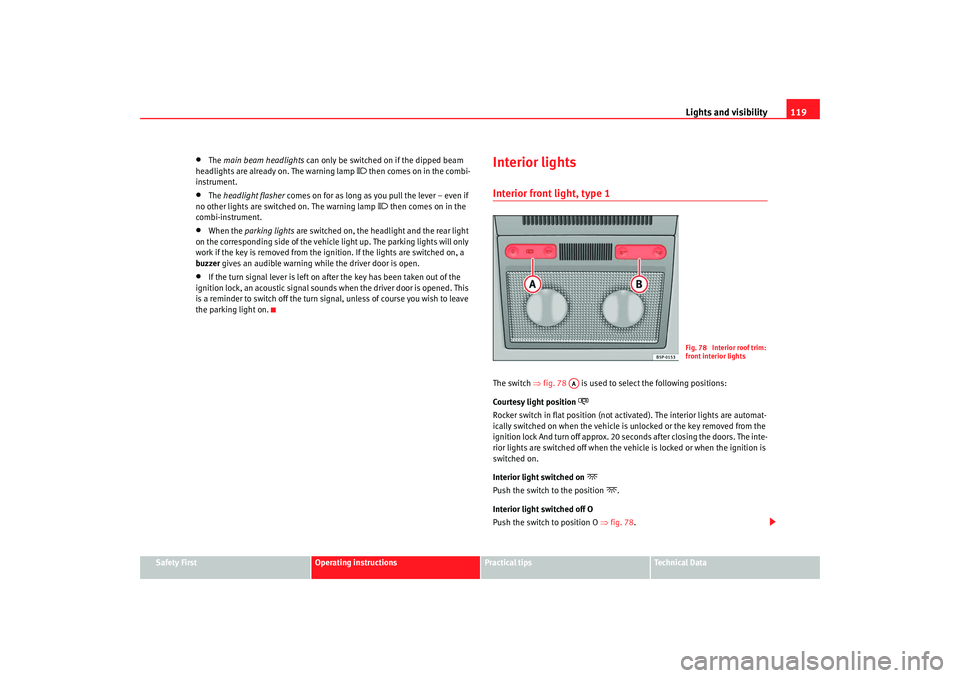
Interior lightsInterior front light, type 1 The switch ⇒fig. 78 is used to select the following positions:
Courtesy light position
Rocker switch in flat position (not ac tivated). The interior lights are automat-
ically switched on when the vehicle is unlocked or the key removed from the
ignition lock And turn off approx. 20 seconds after closing the doors. The inte-
rior lights are switched off when the vehi cle is locked or when the ignition is
switched on.
Interior light switched on
Push the switch to the position
.
Interior light switched off O
Push the switch to position O ⇒fig. 78 .
Fig. 78 Interior roof trim:
front interior lights
AA
Altea_EN.book Seite 119 Montag, 19. Januar 2009 1:31 13
Page 121 of 299
Lights and visibility
120
NoteIf not all the vehicle doors are closed, th e interior lights will be switched off
after approx. 10 minutes, providing th e key has been removed and the cour-
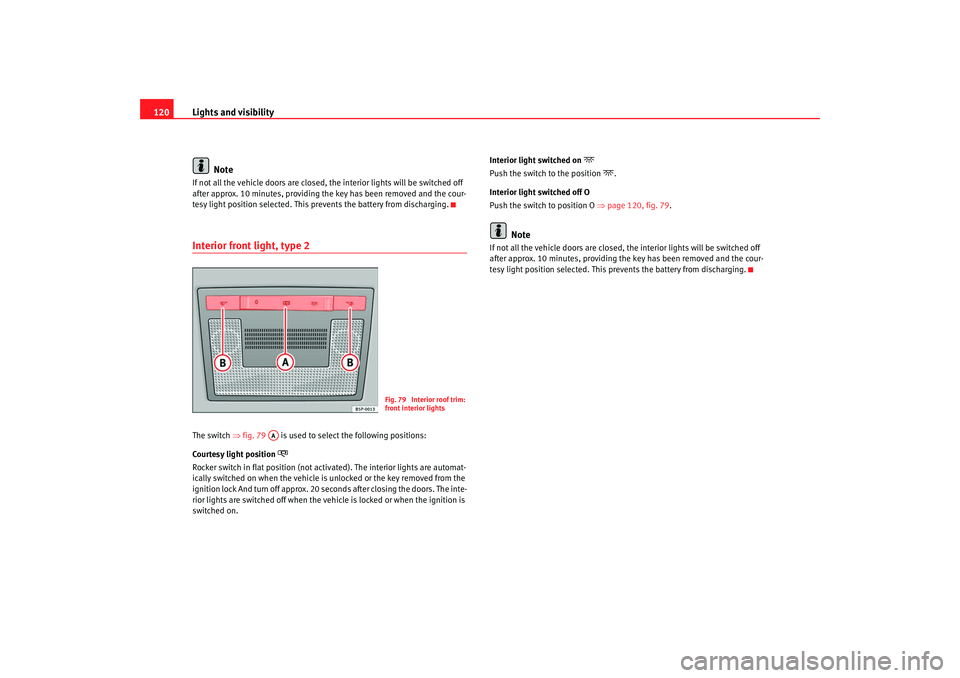
tesy light position selected. This prevents the battery from discharging.Interior front light, type 2 The switch ⇒fig. 79 is used to select the following positions:
Courtesy light position
Rocker switch in flat position (not ac tivated). The interior lights are automat-
ically switched on when the vehicle is unlocked or the key removed from the
ignition lock And turn off approx. 20 seconds after closing the doors. The inte-
rior lights are switched off when the vehicle is locked or when the ignition is
switched on. Interior light switched on
Push the switch to the position
.
Interior light switched off O
Push the switch to position O ⇒page 120, fig. 79.
Note
If not all the vehicle doors are closed, the interior lights will be switched off
after approx. 10 minutes, providing the key has been removed and the cour-
tesy light position selected. This pr events the battery from discharging.
Fig. 79 Interior roof trim:
front interior lights
AA
Altea_EN.book Seite 120 Montag, 19. Januar 2009 1:31 13
Page 123 of 299
Lights and visibility
122light turns off about 20 seconds after closing the doors. The interior lights are
switched off when the vehicle is locked or when the ignition is switched on.
Interior lights or both reading lights switched on
Turn the control to position .
Note
If not all the vehicle doors are closed, th e interior lights will be switched off
after approx. 10 minutes, providing th e key has been removed and the cour-
tesy light position selected. This prevents the battery from discharging.VisibilitySun visors
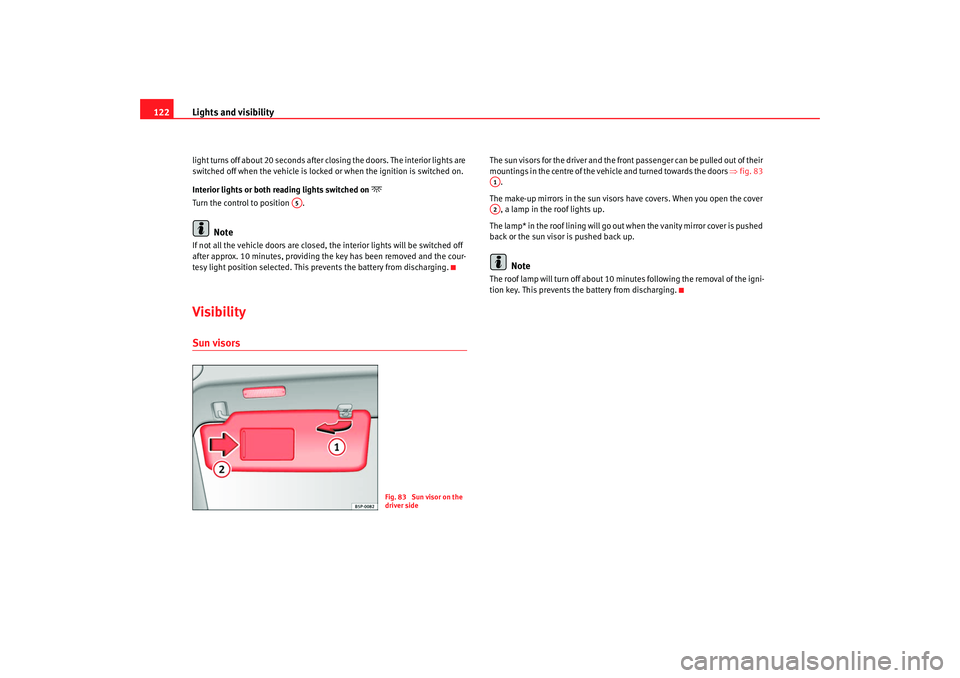
The sun visors for the driver and the front passenger can be pulled out of their
mountings in the centre of the vehicle and turned towards the doors ⇒fig. 83
.
The make-up mirrors in the sun visors have covers. When you open the cover
, a lamp in the roof lights up.
The lamp* in the roof lining will go out when the vanity mirror cover is pushed
back or the sun visor is pushed back up.
Note
The roof lamp will turn of f about 10 minutes following the removal of the igni-
tion key. This prevents the battery from discharging.
A5
Fig. 83 Sun visor on the
driver side
A1A2
Altea_EN.book Seite 122 Montag, 19. Januar 2009 1:31 13
Page 179 of 299
Driving
178•
Never park where the hot exhaust system could ignite inflammable
materials, such as dry grass, low bushes, spilt fuel etc.
•
Never allow vehicle occupants to remain in the vehicle when it is
locked. They would be unable to open the vehicle from the inside, and
could become trapped in the vehicle in an emergency. In the event of an
emergency, locked doors will delay assistance to occupants.
•
Never leave children alone in the vehicle. They could set the vehicle in
motion, for example, by releasing the handbrake or the gear lever /
selector lever.
•
Depending on weather conditions, it may become extremely hot or cold
inside the vehicle. This can be fatal.
Starting on an uphill*
This function is only included in vehicles fitted with ESP.This device helps when starting uphill.
These are the basic operation conditions: doors closed, brake pedal pressed
down and vehicle in neutral. The system is activated on engaging gear.
After removing your foot from the brake pedal, the braking force is maintained
for a few seconds to prevent the vehicle from moving backward when put into
gear. This short space of time is enough to start the vehicle with ease.
This system also works when reversing uphill.
WARNING
•
If you do not start the vehicle immedi ately after taking your foot off the
brake pedal, the vehicle may start to roll back under certain conditions.
Depress the brake pedal or use the hand brake immediately.
•
If the engine stalls, depress the brake pedal or use the hand brake
immediately.
•
When following a line of traffic uphill, if you want to prevent the vehicle
from rolling back accidentally when starting off, hold the brake pedal down
for a few seconds before starting off.Note
The Official Service or a specialist workshop can tell you if your vehicle is
equipped with this system.Acoustic parking aid system*General notesVarious systems are available to help you when parking or manoeuvring in
tight spaces, depending on the equipment fitted on your vehicle.
The SEAT parking system* gives an acoustic warning if there are any obsta-
cles behind your car.
When you are parking, the SEAT parking system* plus warns you acoustically
and optically
19) about obstacles “in front of” and “behind” the vehicle.
Note
To ensure the acoustic parking aid works properly, the sensors must be kept
clean and free of snow and ice.
WARNING (continued)
19)Vehicles with a navigation system.WARNING (continued)
Altea_EN.book Seite 178 Montag, 19. Januar 2009 1:31 13
Page 204 of 299
Cleaning and caring for your vehicle203
Safety First
Operating instructions
Practical tips
Te c h n i c a l D a t a
•
Water, ice and salt on the brakes can reduce braking efficiency. Risk of
accident.Caution
•
Never remove dirt, mud or dust if the vehicle surface is dry. Never use a
dry cloth or sponge for cleaning purposes. This could scratch the paintwork
or glass on your vehicle.
•
Washing the vehicle in low temperatures: when washing the vehicle with
a hose, do not direct water into the lo ck cylinders or the gaps around the
doors, tailgate, or sunroof. Risk of freezing.For the sake of the environment
To protect environment, the car should be washed only in specially provided
wash bays. This prevents toxic, oil-laden waste water entering the sewerage
system. In some districts, washing vehicles outside wash bays is prohibited.
Note
Do not wash the vehicle in direct sunlight.Washing the car with a high pressure cleaner
Be particularly careful when using a high pressure cleaner!– Always observe the instructions for the high-pressure cleaner, particularly those concerning the pressure and the spraying
distance . – Increase the spraying distance for soft materials and painted
bumpers.
– Do not use a high pressure cleaner to remove ice or snow from windows ⇒page 204.
– Never use concentrated jet nozzles (“rotating jets”) ⇒.
– Directly after washing, avoid sudden and sharp braking. “Dry” ⇒page 192 the brakes by braking several times.
WARNING
•
Never wash tyres with a concentrated jet (“rotating nozzle”). Even at
large spraying distances and short cleaning times, visible and invisible
damage can occur to the tyres. This may cause an accident.
•
Water, ice and salt on the brakes can reduce braking efficiency. Risk of
accident.Caution
•
Do not use water hotter than 60°C. This could damage the vehicle.
•
To avoid damage to the vehicle, keep a sufficient distance from sensitive
materials such as flexible hoses, plastic, soundproofing material, etc. This is
also important for bumpers painted as the paintwork. The closer the nozzle is
to the surface, the greater the wear on the material.
Vehicle paint maintenance requirements
Regular waxing protects the paintwork.You need to apply wax to your car if water does not form small drops and run
off the paintwork when it is clean.
WARNING (continued)
Altea_EN.book Seite 203 Montag, 19. Januar 2009 1:31 13
Page 206 of 299
Cleaning and caring for your vehicle205
Safety First
Operating instructions
Practical tips
Te c h n i c a l D a t a
If possible, use a de-icing spray to remove ice. If you use an ice scraper, push
it in one direction only without swinging it.
Use window cleaner or a silicone remover to clean rubber, oil, grease and sili-
cone deposits off.
Wax deposits can be removed with a special cleaner available in your Author-
ised Service Centre. Wax deposits on the windscreen could cause the wiper
blades to judder. If a window cleanser
, specifically for removing wax, is added
to the windscreen washer fluid prevents wiper blades from juddering. Wax
deposits are not removed.
Caution
•
Never use warm or hot water to remove snow and ice from windows and
mirrors. This could cause the glass to crack!
•
The heating element for the rear window is located on the inner side of the
window. To prevent damage, do not put stickers on the heating elements
inside the window.
Cleaning windscreen wiper bladesClean wiper blades are essential to provide clear vision.
1. Use a soft cloth to remove dust and dirt from the windscreen wiper blades.
2. Use window cleanser to clean the windscreen wiper blades. Use a sponge or a cloth to remove stubborn stains.
Rubber seals maintenance
If rubber seals are well looked after, they will not freeze so
quickly.1. Use a soft cloth to remove dust and dirt from the rubber seals.
2. Apply a specialist care product to the rubber seals.The strips on the doors, windows, bonnet and rear lid will remain pliable and
last longer if they are treated with a suitable care product (for example sili-
cone spray).
Caring for rubber seals will also prevent premature ageing and leaks. The
doors will be easier to open. If rubber seals are well looked after, they will not
freeze so quickly in winter.Door lock cylinders
The door lock cylinders can freeze up in winter.To de-ice the lock cylinders you should only use spray with lubricating and
anti-corrosive properties.Cleaning chrome parts1. Clean chrome parts with a damp cloth.
2. Polish chrome parts with a soft, dry cloth.
Altea_EN.book Seite 205 Montag, 19. Januar 2009 1:31 13
Page 209 of 299
Cleaning and caring for your vehicle
208Vehicle interior maintenancePlastic parts and dash panel cleaning– Use a clean, damp cloth to clean plastic parts and the dash
panel.
– If this does not provide satisfactory results, use a special solvent-free plastic cleaning product.
WARNING
Never clean the dash panel and the airbag module surface with cleansers
containing solvents. Solvents cause the surface to become porous. If the
airbag triggered, disintegrating plastic parts could cause substantial inju-
ries.
Caution
Cleaning products which contain solvents will damage the material.Wooden trim cleaning*– Clean the wooden trim with a water-moistened clean cloth.
– If this does not provide satisfactory results, use a gentle soap
solution.
CautionCleaning products which contain solvents will damage the material.
Cloth seat covers and fabric trim cleaningCloth seat covers and fabric trim on the doors, headlining etc. can be cleaned
with a special interior cleanser or with dry foam and a soft brush.Cleaning the radio and climate controlsTo clean the radio and/or climate controls, use a soft damp cloth. For more
resistant dirt, a neutral soap solution may be used.Leather cleaning*Normal cleaning
– Moisten a cotton or woollen cloth with water and wipe over the leather surfaces.
Cleaning stubborn stains
– More stubborn dirt can be removed using a mild soap solution (pure liquid soap; two tablespoons diluted in one litre of water)
and a cloth.
– Do not let the water soak through the leather or soak into the seams.
– Then wipe off with a soft, dry cloth.
Leather maintenance
– The leather should be treated twice a year with a special leather- care product, available in your Authorised Service Centre.
Altea_EN.book Seite 208 Montag, 19. Januar 2009 1:31 13
Page 292 of 299
Index291
DDanger of fitting a child seat on the front passenger
seat . . . . . . . . . . . . . . . . . . . . . . . . . . . . . . . 31
Dash panel cleaning . . . . . . . . . . . . . . . . . . . . . 208
Daytime lights . . . . . . . . . . . . . . . . . . . . . . . . . . 113 activating . . . . . . . . . . . . . . . . . . . . . . . . . . . 113
deactivating . . . . . . . . . . . . . . . . . . . . . . . . . 113
Diesel . . . . . . . . . . . . . . . . . . . . . . . . . . . . . . . . . 214
Diesel engine Winter driving . . . . . . . . . . . . . . . . . . . . . . . . 215
Diesel engine particulate filter . . . . . . . . . . . . . 194
Differential lock . . . . . . . . . . . . . . . . . . . . . . . . . 188
Differential lock fault (EDL) warning lamp . . . . . . . . . . . . . . . . . . . . . . . . . 84
Digital clock . . . . . . . . . . . . . . . . . . . . . . . . . . . . . 59
Dipped headlights . . . . . . . . . . . . . . . . . . . . . . . 111
Disabling front passenger airbag Safety notes . . . . . . . . . . . . . . . . . . . . . . . . . . 45
Disabling the airbag Disabling front passenger airbag . . . . . . . . . 44
Display (without warning or information texts) . 60
Displays in the Multi-function display Memory displays . . . . . . . . . . . . . . . . . . . . . . 63
Disposal Airbags . . . . . . . . . . . . . . . . . . . . . . . . . . . . . . 32
Door lock cylinders . . . . . . . . . . . . . . . . . . . . . . 205
Door release lever . . . . . . . . . . . . . . . . . . . . . . . . 55
Doors Childproof locks . . . . . . . . . . . . . . . . . . . . . . . 98
Warning lamp . . . . . . . . . . . . . . . . . . . . . . . . . 82 Drawer . . . . . . . . . . . . . . . . . . . . . . . . . . . . . . . . 138
Drinks holders at the front . . . . . . . . . . . . . . . . 142
Drive wheels traction control system . . . . . . . . 186
Driveshaft differential
XDS . . . . . . . . . . . . . . . . . . . . . . . . . . . . . . . . 187
Driving Driving abroad . . . . . . . . . . . . . . . . . . . . . . . 196
Economical/ Environtmental . . . . . . . . . . . 194
With a trailer . . . . . . . . . . . . . . . . . . . . . . . . . 198
Driving abroad . . . . . . . . . . . . . . . . . . . . . . . . . . 196 Headlights . . . . . . . . . . . . . . . . . . . . . . . . . . 196
Driving programmes . . . . . . . . . . . . . . . . . . . . . 172
Driving safety . . . . . . . . . . . . . . . . . . . . . . . . . . . . . 8
Driving with an automati c gearbox / DSG automatic
gearbox . . . . . . . . . . . . . . . . . . . . . . . . . . . 173
Duplicate keys . . . . . . . . . . . . . . . . . . . . . . . . . . . 99
Dust filter . . . . . . . . . . . . . . . . . . . . . . . . . . . . . . 163
Dynamic curve lights . . . . . . . . . . . . . . . . . . . . . 115
Dynamic headlight range control . . . . . . . . . . . 115
EEcological driving . . . . . . . . . . . . . . . . . . . . . . . 194
Economical driving . . . . . . . . . . . . . . . . . . . . . . 194
EDL . . . . . . . . . . . . . . . . . . . . . . . . . . . . . . . . . . . 188
EDS Warning lamp . . . . . . . . . . . . . . . . . . . . . . . . . 79
Electrical sockets . . . . . . . . . . . . . . . . . . . . . . . . 147
Electronic differential lock . . . . . . . . . . . . . . . . 188 Warning lamp . . . . . . . . . . . . . . . . . . . . . . . . . 79
Electronic immobiliser . . . . . . . . . . . . . . . . . 84, 168 Electronic stabilisation program . . . . . . . . . . . 187
Electronic stabilisation programme . . . . . . . . . . 83
Description . . . . . . . . . . . . . . . . . . . . . . . . . . 166
Warning light . . . . . . . . . . . . . . . . . . . . . . . . 167
Electronic stabilisation programme (ESP) warning lamp . . . . . . . . . . . . . . . . . . . . . . . . . 83
Emergency braking function . . . . . . . . . . 117, 185
emergency manual locking . . . . . . . . . . . . . . . . . 97
Emergency opening Doors . . . . . . . . . . . . . . . . . . . . . . . . . . . . . . 102
Emission control system warning lamp . . . . . . . . . . . . . . . . . . . . . . . . . 83
Engine Running in . . . . . . . . . . . . . . . . . . . . . . . . . . 192
Engine compartment Working in the engine compartment . . . . . 215
Engine coolant . . . . . . . . . . . . . . . . . . . . . . . . . . 222
Engine fault Warning lamp . . . . . . . . . . . . . . . . . . . . . . . . 78
Engine management Warning lamp . . . . . . . . . . . . . . . . . . . . . . . . 78
Engine oil . . . . . . . . . . . . . . . . . . . . . . . . . . . . . . 218 Changing . . . . . . . . . . . . . . . . . . . . . . . . . . . 221
Checking level . . . . . . . . . . . . . . . . . . . . . . . 219
Oil properties . . . . . . . . . . . . . . . . . . . . . . . . 219
Specifications . . . . . . . . . . . . . . . . . . . . . . . 218
Topping up . . . . . . . . . . . . . . . . . . . . . . . . . . 220
Engine oil dipstick . . . . . . . . . . . . . . . . . . . . . . . 219
Engine oil pressure monitor indicator . . . . . . . . . . . . . . . . . . . . . . 65
Warning lamp . . . . . . . . . . . . . . . . . . . . . . . . 82
Altea_EN.book Seite 291 Montag, 19. Januar 2009 1:31 13