brake light Seat Altea 2009 Owner's Guide
[x] Cancel search | Manufacturer: SEAT, Model Year: 2009, Model line: Altea, Model: Seat Altea 2009Pages: 299, PDF Size: 9.39 MB
Page 250 of 299
If and when249
Safety First
Operating instructions
Practical tips
Te c h n i c a l D a t a
Note
Seek professional assistance if the repair of a tyre puncture is not possible
with the sealing compound.Preparation work
Certain steps must be taken before repairing a tyre.– If you have a flat tyre or puncture, park the vehicle as far away
from the flow of traffic as possible.
–Apply the handbrake firmly.
–Engage first gear, or put the selector lever to position P.
– All passengers should leave the vehicle. They should wait in a
safe area (for instance behind the roadside crash barrier).
– Check whether a repair is possible using the Tyre Mobility System “General information and safety notes.”
– Unscrew inflation cap from the affected wheel.
–Take the tyre repair kit out of the luggage compartment.
WARNING
Put the hazard warning lights on and place the warning triangle in position.
This is for your own safety and also warns other road users.
Caution
Take special care if you have to repair a tyre on a slope.
Note
Please observe legal requirements when doing so.Tyre repair
The following sections describe the procedures for repairing
a tyre.Using the sealing compound
– The instructions on the container give detailed information on
how to use the sealing compound.
Inflating the tyre.
– Remove the air compressor and hose from the container.
– Screw the retaining nut onto the valve.
– Plug the compressor cable into a 12 volt power point.
– Turn on compressor and monitor the pressure shown on the pres- sure gauge.
Completing the repair
– Remove the compressor hose from the valve.
–Fit the valve cap.
– Unplug the compressor from the socket.
– Return all tools to their proper storing location.
Altea_EN.book Seite 249 Montag, 19. Januar 2009 1:31 13
Page 253 of 299
If and when
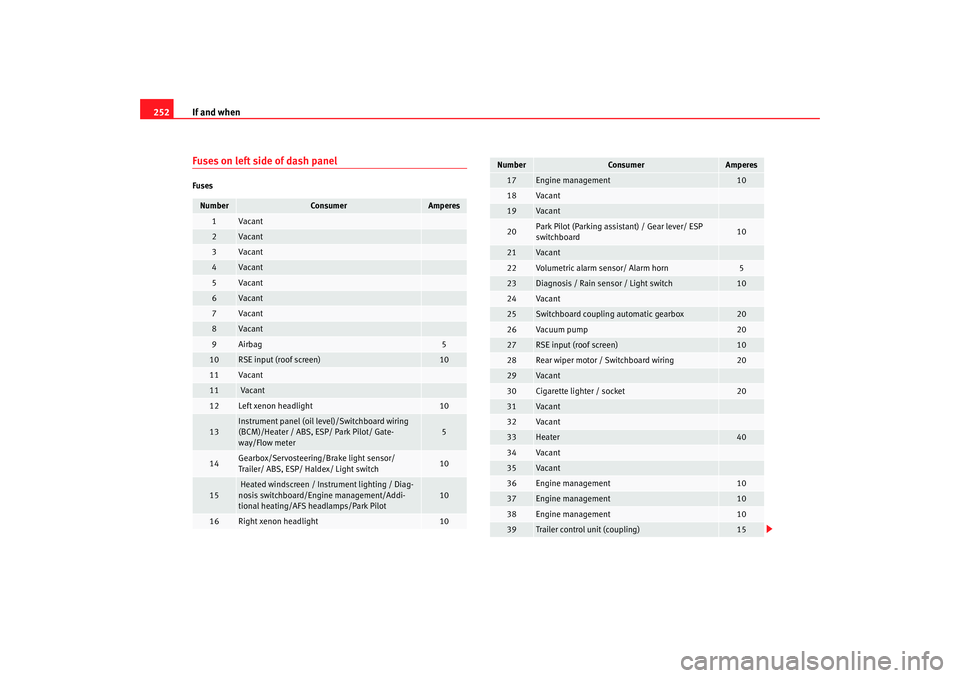
252Fuses on left side of dash panelFusesNumber
Consumer
Amperes
1
Vacant
2
Vacant
3
Vacant
4
Vacant
5
Vacant
6
Vacant
7
Vacant
8
Vacant
9
Airbag
5
10
RSE input (roof screen)
10
11
Vacant
11
Vacant
12
Left xenon headlight
10
13
Instrument panel (oil level)/Switchboard wiring
(BCM)/Heater / ABS, ESP/ Park Pilot/ Gate-
way/Flow meter
5
14
Gearbox/Servosteering/Brake light sensor/
Trailer/ ABS, ESP/ Haldex/ Light switch
10
15
Heated windscreen / In strument lighting / Diag-
nosis switchboard/Engine management/Addi-
tional heating/AFS h eadlamps/Park Pilot
10
16
Right xenon headlight
10
17
Engine management
10
18
Vacant
19
Vacant
20
Park Pilot (Parking assistant) / Gear lever/ ESP
switchboard
10
21
Vacant
22
Volumetric alarm sensor/ Alarm horn
5
23
Diagnosis / Rain sensor / Light switch
10
24
Vacant
25
Switchboard coupling automatic gearbox
20
26
Vacuum pump
20
27
RSE input (roof screen)
10
28
Rear wiper motor / Switchboard wiring
20
29
Vacant
30
Cigarette lighter / socket
20
31
Vacant
32
Vacant
33
Heater
40
34
Vacant
35
Vacant
36
Engine management
10
37
Engine management
10
38
Engine management
10
39
Trailer control unit (coupling)
15
Number
Consumer
Amperes
Altea_EN.book Seite 252 Montag, 19. Januar 2009 1:31 13
Page 254 of 299
If and when253
Safety First
Operating instructions
Practical tips
Te c h n i c a l D a t a
Some of the electrical items listed in
the table are only fitted on certain
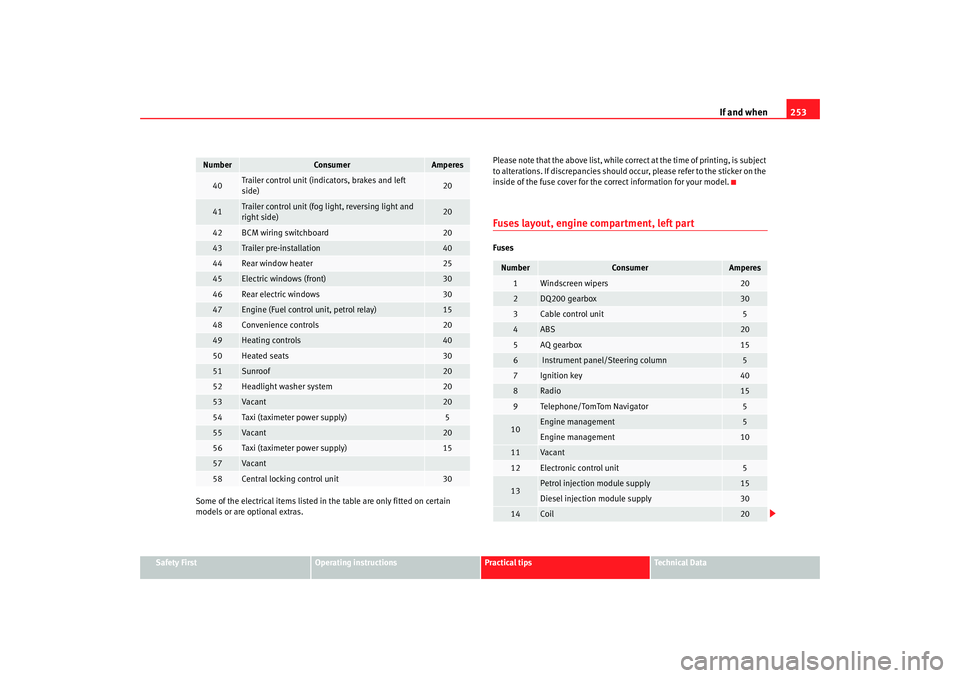
models or are optional extras. Please note that the above list, while correct at the time of printing, is subject
to alterations. If discrepancies should occur, please refer to the sticker on the
inside of the fuse cover for the correct information for your model.
Fuses layout, engine compartment, left partFuses
40
Trailer control unit (indicators, brakes and left
side)
20
41
Trailer control unit (fog light, reversing light and
right side)
20
42
BCM wiring switchboard
20
43
Trailer pre-installation
40
44
Rear window heater
25
45
Electric windows (front)
30
46
Rear electric windows
30
47
Engine (Fuel control unit, petrol relay)
15
48
Convenience controls
20
49
Heating controls
40
50
Heated seats
30
51
Sunroof
20
52
Headlight washer system
20
53
Va can t
20
54
Taxi (taximeter power supply)
5
55
Va can t
20
56
Taxi (taximeter power supply)
15
57
Va can t
58
Central locking control unit
30
Number
Consumer
Amperes
Number
Consumer
Amperes
1
Windscreen wipers
20
2
DQ200 gearbox
30
3
Cable control unit
5
4
ABS
20
5
AQ gearbox
15
6
Instrument panel/Steering column
5
7
Ignition key
40
8
Radio
15
9
Te l e p ho n e/ To m To m Na vi ga to r
5
10
Engine management
5
Engine management
10
11
Vacant
12
Electronic control unit
5
13
Petrol injection module supply
15
Diesel injection module supply
30
14
Coil
20
Altea_EN.book Seite 253 Montag, 19. Januar 2009 1:31 13
Page 255 of 299
If and when
254
Bulb changeGeneral notesBefore changing any bulb, first turn off the failed component.
Do not touch the bulb glass. Fingerprints vaporise in the heat, causing a
reduction in the bulb life and condensation on the mirror surface, thus
reducing efficiency.
A bulb should only be replaced by one of the same type. The type is inscribed
on the bulb, either on the glass part or on the base.
It is highly recommended to keep a box of spare bulbs in the vehicle. At the
very least, the following spare bulbs, which are essential for road safety,
should be kept in the vehicle.
Main headlights
Dipped beam - H7
Main beam - H1
Position - W5W
Indicator - PY21W
Xenon headlights
23)/ self-adjusting*
Dipped and full beam - D1S
24)
Daylight - P21W SLL
Position W5W
Indicators PY21W
15
Engine management
5
Pump relay
10
16
Right li ghting
30
17
Horn
15
18
Vacant
19
Clean
30
20
Water pump
10
Pressure sensor pump for 1.8 engine
20
21a)
Lambda probe
15
22
Brake pedal, speed sensor
5
23a)
Engine management
5
Engine management
10
Engine management
15
24
AKF, gearbox valve
10
25a)
ABS pump
40
26
Left lighting
30
27a)
Engine management
40
Engine management
50
28
Vacant
29a)
Electric windows (front and back)
50
Electric windows (front)
30
30
Ignition key
50
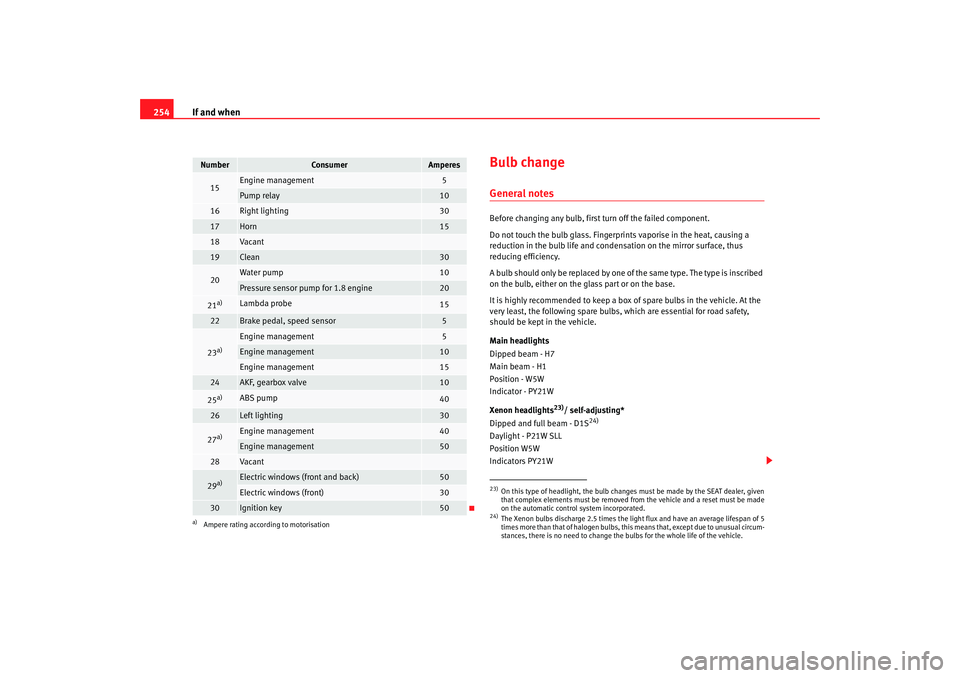
a)Ampere rating according to motorisationNumber
Consumer
Amperes
23)On this type of headlight, the bulb changes must be made by the SEAT dealer, given
that complex elements must be removed from the vehicle and a reset must be made
on the automatic control system incorporated.24)The Xenon bulbs discharge 2.5 times the light flux and have an average lifespan of 5
times more than that of halogen bulbs, this means that, except due to unusual circum-
stances, there is no need to change the bulbs for the whole life of the vehicle.
Altea_EN.book Seite 254 Montag, 19. Januar 2009 1:31 13
Page 259 of 299
If and when
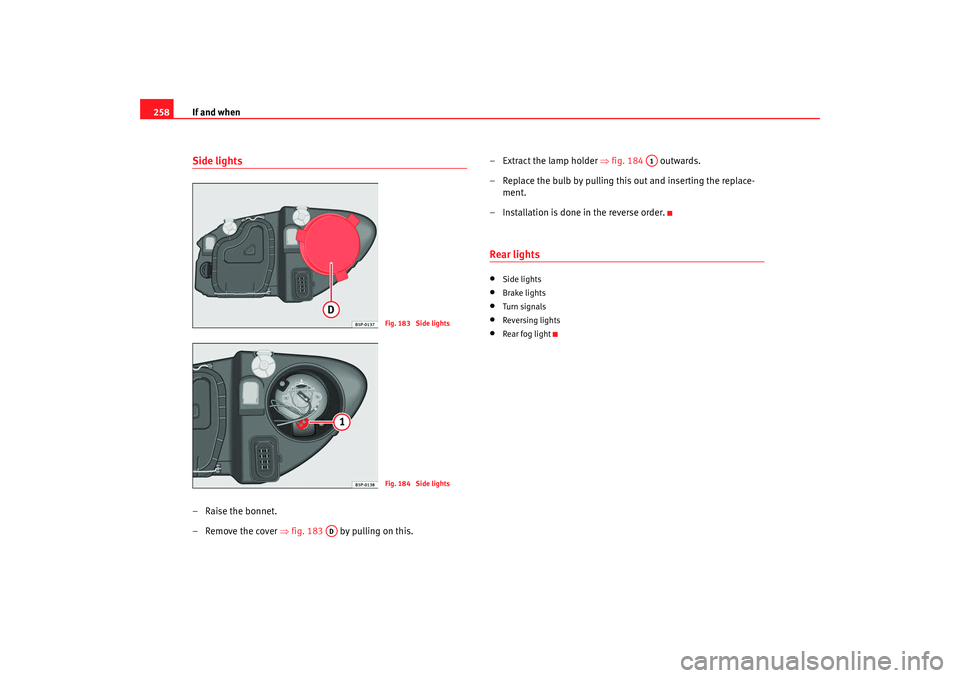
258Side lights– Raise the bonnet.
– Remove the cover ⇒fig. 183 by pulling on this. – Extract the lamp holder
⇒fig. 184 outwards.
– Replace the bulb by pulling this out and inserting the replace- ment.
– Installation is done in the reverse order.
Rear lights•
Side lights
•
Brake lights
•
Turn signals
•
Reversing lights
•
Rear fog light
Fig. 183 Side lightsFig. 184 Side lights
AD
A1
Altea_EN.book Seite 258 Montag, 19. Januar 2009 1:31 13
Page 260 of 299
If and when259
Safety First
Operating instructions
Practical tips
Te c h n i c a l D a t a
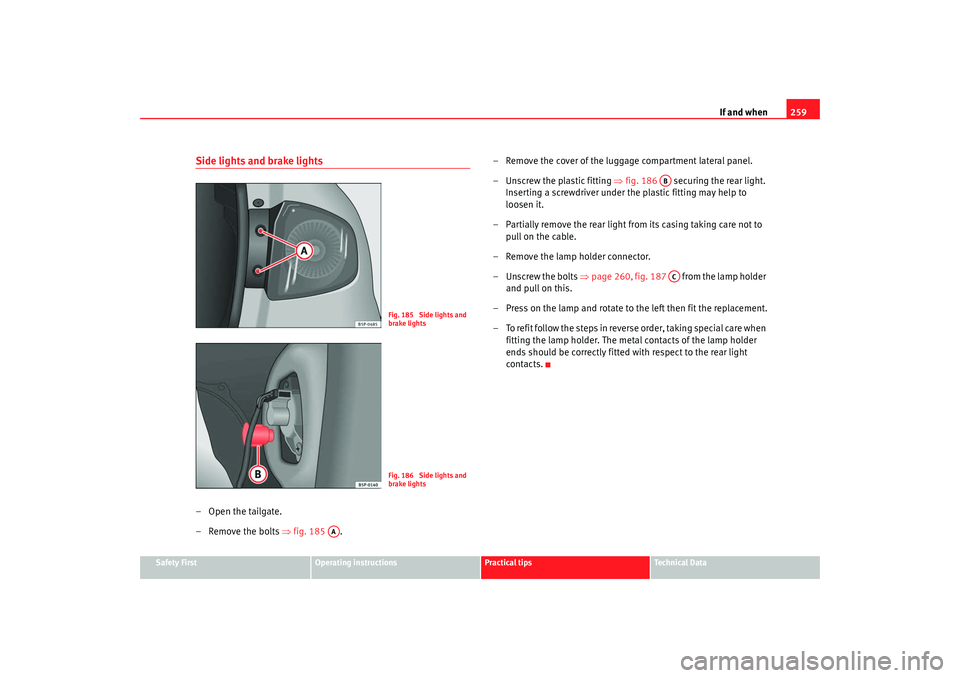
Side lights and brake lights– Open the tailgate.
– Remove the bolts ⇒fig. 185 . – Remove the cover of the luggage compartment lateral panel.
– Unscrew the plastic fitting
⇒fig. 186 securing the rear light.
Inserting a screwdriver under the plastic fitting may help to
loosen it.
– Partially remove the rear light from its casing taking care not to pull on the cable.
– Remove the lamp holder connector.
– Unscrew the bolts ⇒page 260, fig. 187 from the lamp holder
and pull on this.
– Press on the lamp and rotate to the left then fit the replacement.
– To refit follow the steps in reverse order, taking special care when fitting the lamp holder. The metal contacts of the lamp holder
ends should be correctly fitted with respect to the rear light
contacts.
Fig. 185 Side lights and
brake lightsFig. 186 Side lights and
brake lights
AA
ABAC
Altea_EN.book Seite 259 Montag, 19. Januar 2009 1:31 13
Page 266 of 299
If and when265
Safety First
Operating instructions
Practical tips
Te c h n i c a l D a t a
WARNING
•
Please note the safety warnings referring to working in the engine
compartment ⇒page 215, “Working in the engine compartment”.
•
The battery providing assistance must have the same voltage as the flat
battery (12V) and approximately the same capacity (see imprint on
battery). Failure to comply could result in an explosion.
•
Never use jump leads when one of the batteries is frozen. Danger of
explosion! Even after the battery has thawed, battery acid could leak and
cause chemical burns. If a battery freezes, it should be replaced.
•
Keep sparks, flames and lighted cigarettes away from batteries, danger
of explosion. Failure to comply could result in an explosion.
•
Observe the instructions provided by the manufacturer of the jump
leads.
•
Do not connect the negative cable from the other vehicle directly to the
negative terminal of the flat battery. The gas emitted from the battery could
be ignited by sparks. Danger of explosion.
•
Do not attach the negative cable from the other vehicle to parts of the
fuel system or to the brake line.
•
The non-insulated parts of the battery clamps must not be allowed to
touch. The jump lead attached to the positive battery terminal must not
touch metal parts of the vehicle, this can cause a short circuit.
•
Position the leads in such a way that they cannot come into contact
with any moving parts in the engine compartment.
•
Do not bend over the batteries. This could result in chemical burns.Note
The vehicles must not touch each other, otherwise electricity could flow as
soon as the positive terminals are connected.
Altea_EN.book Seite 265 Montag, 19. Januar 2009 1:31 13
Page 267 of 299
If and when
266To w i n g a n d t o w - s t a r t i n gTo w - s t a r t i n g
The use of jump leads is preferable to tow-starting.We recommend that you do not t o w - s t a r t yo u r v e h i c l e . J u m p - s ta r t i n g
is preferable ⇒page 263.
However, if your vehicle has to be tow-started:
– Engage the 2
nd or the 3
rd gear.
– Keep the clutch pressed down.
– Switch the ignition on.
– Once both vehicles are moving, release the clutch.
– As soon as the engine starts, press the clutch and move the gear lever into neutral. This helps to prevent driving into the towing
vehicle.
WARNING
The risk of accidents is high when tow-starting. The vehicle being towed
can easily collide with the towing vehicle.
Caution
When tow-starting, fuel could enter the catalytic converter and damage it.
CommentsPlease observe the following points if you use a tow-rope:
Notes for the driver of the towing vehicle
– Drive slowly at first until the tow-rope is taut. Then accelerate gradually.
– Begin and change gears cautiously. If you are driving an auto- matic vehicle, accelerate gently.
– Remember that the brake servo and power steering are not working in the vehicle you are towing. Brake earlier than you
would normally, but with a more gentle pressure on the brake.
Notes for the driver of the towed vehicle
– Ensure that the tow-rope remains taut at all times when towing.Tow-rope or tow-bar
It is easier and safer to tow a vehicle with a tow-bar. You should only use a
tow-rope if you do not have a tow-bar.
A tow-rope should be slightly elastic to reduce the loading on both vehicles.
It is advisable to use a tow-rope made of synthetic fibre or similarly elastic
material.
Attach the tow-rope or the tow-bar only to the towing eyes provided or a
towing bracket.
Driving style
Towing requires some experience, espec ially when using a tow-rope. Both
drivers should be familiar with the te chnique required for towing. Inexperi-
enced drivers should not attempt to tow-start or tow away another vehicle.
Altea_EN.book Seite 266 Montag, 19. Januar 2009 1:31 13
Page 268 of 299
If and when267
Safety First
Operating instructions
Practical tips
Te c h n i c a l D a t a
Do not pull too hard with the towing vehi
cle and take care to avoid jerking the
tow-rope. When towing on an unpaved road, there is always a risk of over-
loading and damaging the anchorage points.
The ignition of the vehicle being towed must be switched on to prevent the
steering wheel from locking and also to allow the use of the turn signals,
horn, windscreen wipers and washers.
As the brake servo does not work if th e engine is not running, you must apply
considerably more pressure to the brake pedal than you normally would.
As the power assisted steering does not wo rk if the engine is not running, you
will need more strength to steer than you normally would.
Towing vehicles with an automatic gearbox
•
Put the selector lever into position “N”.
•
Do not drive faster than 50 km/h when towing a vehicle.
•
Do not tow further than 50 km.
•
If a breakdown vehicle is used, the vehicle must be towed with the front
wheels raised.Note
•
Observe legal requirements when towing or tow-starting.
•
Switch on the hazard warning lights of both vehicles. However, observe
any regulations to the contrary.
•
For technical reasons, vehicles with an automatic gearbox must not be
tow-started.
•
If damage to your vehicle means that there is no lubricant in the gearbox,
you must raise the drive wheels while the vehicle is being towed.
•
If the vehicle has to be towed more than 50 km, the front wheels must be
raised during towing, and towing should be carried out by a qualified person.
•
The steering wheel is locked when the vehicle has no electrical power. The
vehicle must then be towed with the front wheels raised. Towing should be
carried out by a qualified person.
•
The towing eye should always be kept in the vehicle. Please refer to the
notes on ⇒page 266, “Tow-starting”.
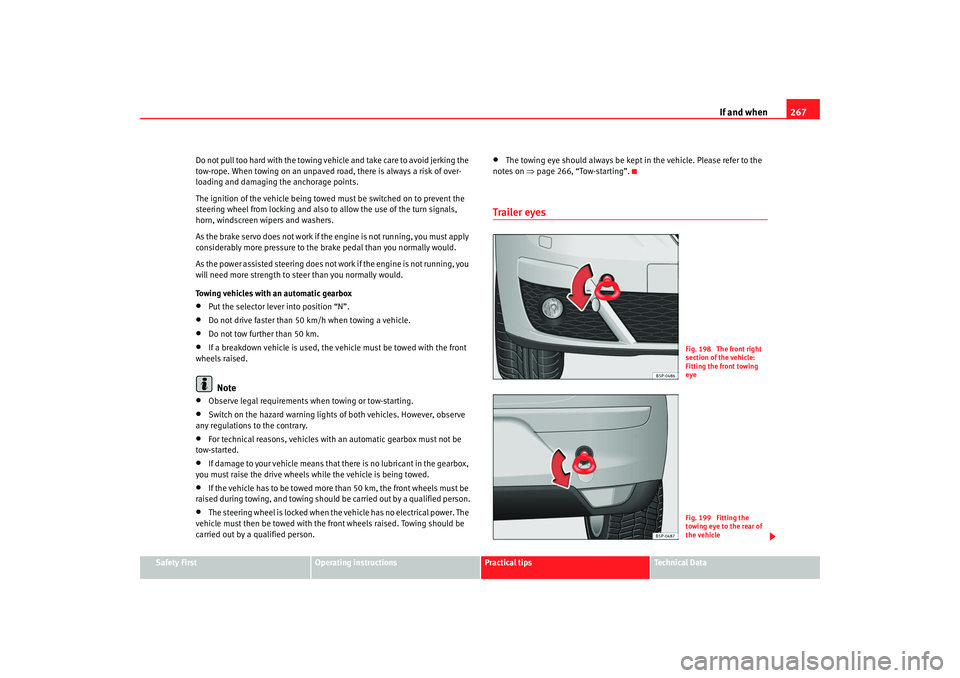
Trailer eyes
Fig. 198 The front right
section of the vehicle:
Fitting the front towing
eyeFig. 199 Fitting the
towing eye to the rear of
the vehicle
Altea_EN.book Seite 267 Montag, 19. Januar 2009 1:31 13
Page 276 of 299
Technical Data275
Safety First
Operating instructions
Practical tips
Te c h n i c a l D a t a
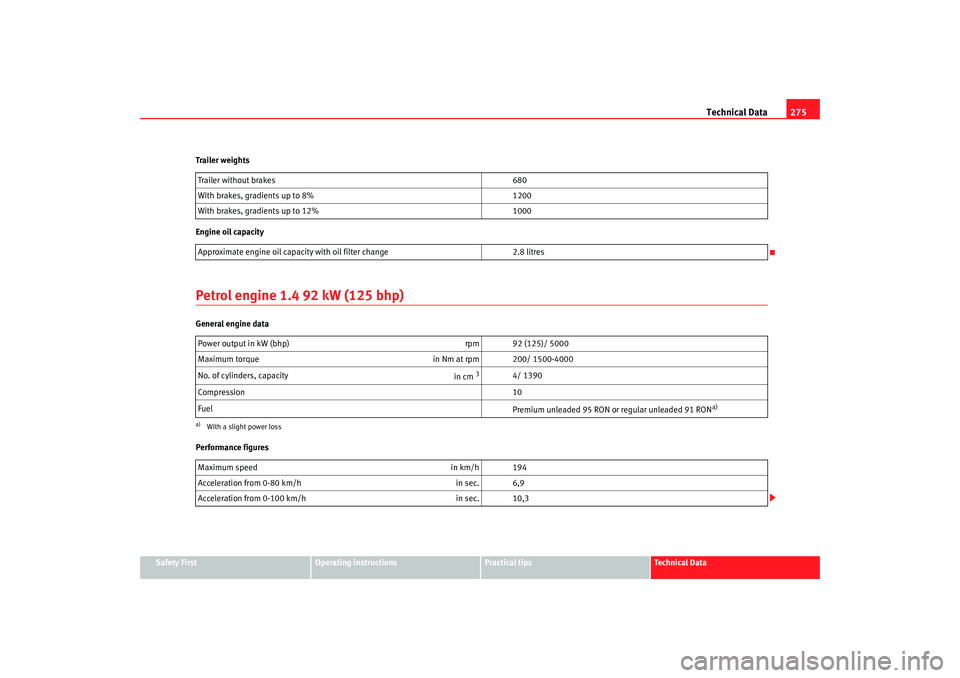
Trailer weights
Engine oil capacity
Petrol engine 1.4 92 kW (125 bhp)General engine data
Performance figures
Trailer without brakes
680
With brakes, gradients up to 8% 1200
With brakes, gradients up to 12% 1000
Approximate engine oil capacity with oil filter change 2.8 litres
Power output in kW (bhp) rpm 92 (125)/ 5000
Maximum torque in Nm at rpm 200/ 1500-4000
No. of cylinders, capacity in cm
3
4/ 1390
Compression 10
Fuel Premium unleaded 95 RON or regular unleaded 91 RON
a)
a)With a slight power lossMaximum speedin km/h 194
Acceleration from 0-80 km/h in sec. 6,9
Acceleration from 0-100 km/h in sec. 10,3
Altea_EN.book Seite 275 Montag, 19. Januar 2009 1:31 13