air condition Seat Altea 2010 User Guide
[x] Cancel search | Manufacturer: SEAT, Model Year: 2010, Model line: Altea, Model: Seat Altea 2010Pages: 310, PDF Size: 7.46 MB
Page 161 of 310
Heating, Ventilation and Air conditioning159
Safety First
Operating instructions
Practical tips
Technical Data
– Use the air distribution control to guide the flow of air in the
required direction: (to the windscreen), (to the upper
body), (to the foot well) and (to the windscreen and to the
foot well).Heating
Maximum heat output, which is needed to defrost the windows quickly, is
only available when the engine has reached its operating temperature.
Air conditioner
When the air conditioning system is switched on, not only the temperature,
but also the air humidity in the vehicle interior is reduced. This improves comfort for the vehicle occupants and prevents misting of the windows when
the ambient air humidity is high.
If the air conditioning system cannot be switched on this may be caused by
the following reasons:
•The engine may not be running.•The blower is switched off.•The outside temperature is below +3°C.•The air conditioning system compressor has been temporarily switched
off because the engine coolant temperature is too high.•The air conditioning fuse is faulty.•Another fault in the vehicle. Have the air conditioning checked by a qual-
ified workshop.
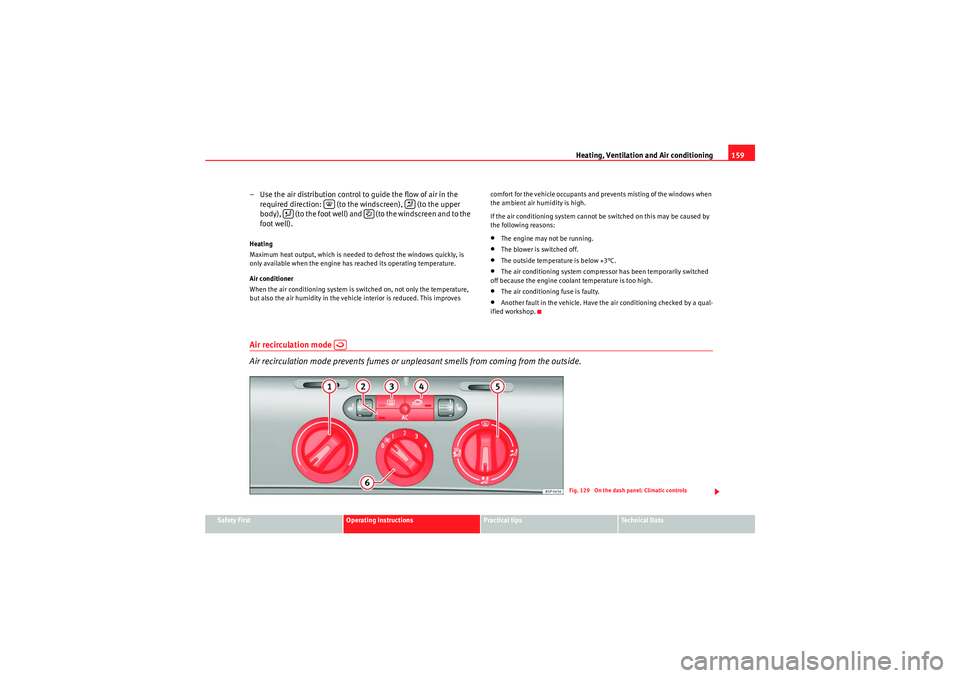
Air recirculation mode
Air recirculation mode prevents fumes or unpleasant smells from coming from the outside.
Fig. 129 On the dash panel: Climatic controls
altea_EN Seite 159 Mittwoch, 26. August 2009 6:00 18
Page 162 of 310
Heating, Ventilation and Air conditioning
160Air recirculation mode ⇒page 159, fig. 129 prevents strong odours in
the outside air from entering the vehicle interior, for example when passing
through a tunnel or in queuing traffic.
With low temperatures outside, the air recirculation increases the effective-
ness of the heating system by warming the air inside the passenger compart-
ment rather than the cold air from outside.
With high ambient temperatures, the air recirculation increases the effective-
ness of the air conditioning system by cooling the air inside the passenger
compartment rather than the ambient air.
If the windscreen air output is on and the air recirculation mode is pressed,
this remains active. When the recirculation mode is on, if the air distribution
towards the windscreen mode is selected, the recirculation mode is deacti-
vated. For safety reasons, the air recirculation mode should not be
connected.
WARNING
In air recirculation mode, no cold air from the outside enters the vehicle
interior. If the air conditioning system is switched off, the windows can
quickly mist over. Therefore, never leave the air recirculation mode
switched on for a long time (risk of accident).
altea_EN Seite 160 Mittwoch, 26. August 2009 6:00 18
Page 163 of 310
Heating, Ventilation and Air conditioning161
Safety First
Operating instructions
Practical tips
Technical Data
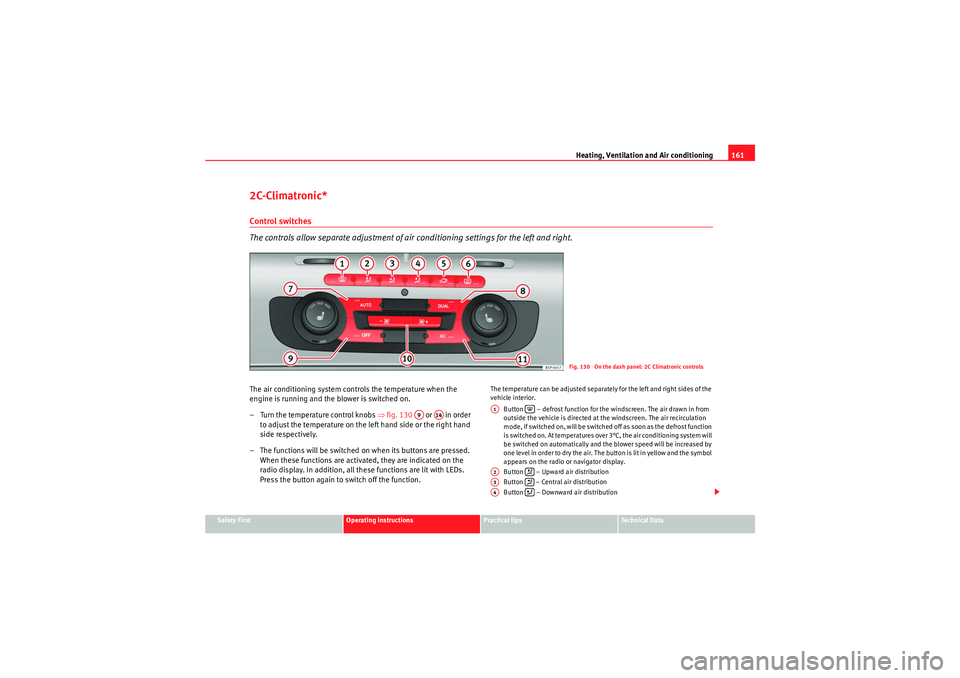
2C-Climatronic*Control switches
The controls allow separate adjustment of air co nditioning settings for the left and right.The air conditioning system controls the temperature when the
engine is running and the blower is switched on.
– Turn the temperature control knobs ⇒fig. 130 or in order
to adjust the temperature on the left hand side or the right hand
side respectively.
– The functions will be switched on when its buttons are pressed.
When these functions are activated, they are indicated on the
radio display. In addition, all these functions are lit with LEDs.
Press the button again to switch off the function.
The temperature can be adjusted separately for the left and right sides of the
vehicle interior.
Button – defrost function for the windscreen. The air drawn in from
outside the vehicle is directed at the windscreen. The air recirculation
mode, if switched on, will be switched off as soon as the defrost function
is switched on. At temperatures over 3°C, the air conditioning system will
be switched on automatically and the blower speed will be increased by
one level in order to dry the air. The button is lit in yellow and the symbol
appears on the radio or navigator display.
Button – Upward air distribution
Button – Central air distribution
Button – Downward air distribution
Fig. 130 On the dash panel: 2C Climatronic controls
A9
A14
A1
A2
A3
A4
altea_EN Seite 161 Mittwoch, 26. August 2009 6:00 18
Page 164 of 310
Heating, Ventilation and Air conditioning
162
Button – Manual air recirculation mode.
Button – Rear window heating. The heating will be switched off auto-
matically approximately 20 minutes after switching on. However, it may
be turned off by pushing the button. The button lights up yellow and the
symbol appears in the display.
Button – Automatic temperature, ventilation and air distribution
control ⇒page 163
button - Dual zone synchroniser
Button – Switches the 2C-Climatronic on and off ⇒page 164
Blower control ⇒ page 164
button – Switches heating, ventilation and air-conditioning system
onWARNING
For road safety all windows must be clear of ice, snow, and condensation.
This is essential to ensure good visibility. Please familiarise yourself with
the correct operation of the heating and ventilation system, including the
anti-fog/defrost functions for the windscreens.
Note
Please observe the general notes ⇒page 165.
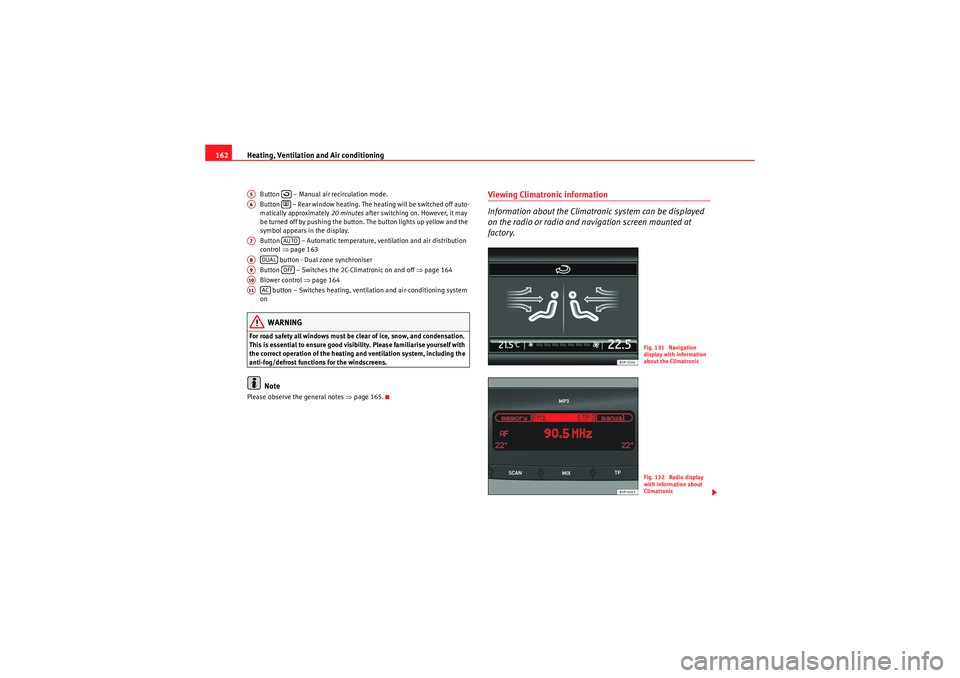
Viewing Climatronic information
Information about the Climatronic system can be displayed
on the radio or radio and navigation screen mounted at
factory.
A5
A6
A7
AUTO
A8
DUAL
A9
OFF
A10A11
AC
Fig. 131 Navigation
display with information
about the ClimatronicFig. 132 Radio display
with information about
Climatronic
altea_EN Seite 162 Mittwoch, 26. August 2009 6:00 18
Page 165 of 310
Heating, Ventilation and Air conditioning163
Safety First
Operating instructions
Practical tips
Technical Data
The LEDs on the Climatronic controls indicate that the selected function has
been activated.
In addition, the radio or radio and navigation displays mounted at factory
briefly display the current settings of the Climatronic if any are modified.
The symbols used on the radio or radio and navigation displays are the same
as the symbols used for the Climatronic controls.
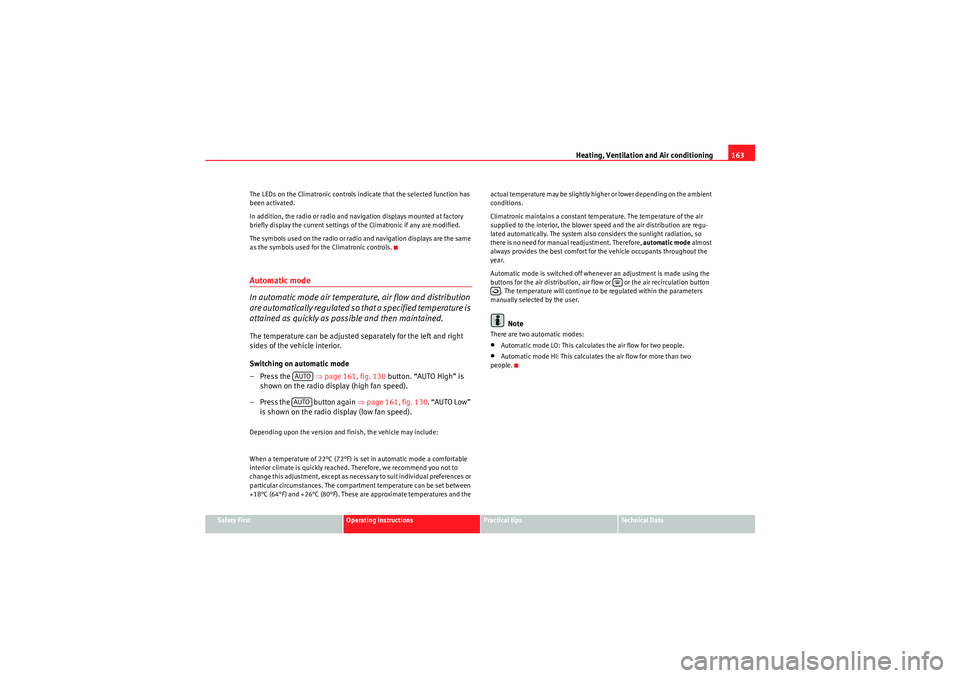
Automatic mode
In automatic mode air temperature, air flow and distribution
are automatically regulated so that a specified temperature is
attained as quickly as possible and then maintained.The temperature can be adjusted separately for the left and right
sides of the vehicle interior.
Switching on automatic mode
– Press the
⇒page 161, fig. 130 button. “AUTO High” is
shown on the radio display (high fan speed).
– Press the button again ⇒page 161, fig. 130 . “AUTO Low”
is shown on the radio display (low fan speed).Depending upon the version and finish, the vehicle may include:
When a temperature of 22°C (72°F) is set in automatic mode a comfortable
interior climate is quickly reached. Therefore, we recommend you not to
change this adjustment, except as necessary to suit individual preferences or
particular circumstances. The compartment temperature can be set between
+18°C (64°F) and +26°C (80°F). These are approximate temperatures and the actual temperature may be slightly higher or lower depending on the ambient
conditions.
Climatronic maintains a constant temperature. The temperature of the air
supplied to the interior, the blower speed and the air distribution are regu-
lated automatically. The system also considers the sunlight radiation, so
there is no need for manual readjustment. Therefore,
automatic mode almost
always provides the best comfort for the vehicle occupants throughout the
year.
Automatic mode is switched off whenever an adjustment is made using the
buttons for the air distribution, air flow or or the air recirculation button . The temperature will continue to be regulated within the parameters
manually selected by the user.
Note
There are two automatic modes:•Automatic mode LO: This calculates the air flow for two people.•Automatic mode HI: This calculates the air flow for more than two
people.
AUTOAUTO
altea_EN Seite 163 Mittwoch, 26. August 2009 6:00 18
Page 166 of 310
Heating, Ventilation and Air conditioning
164Manual mode
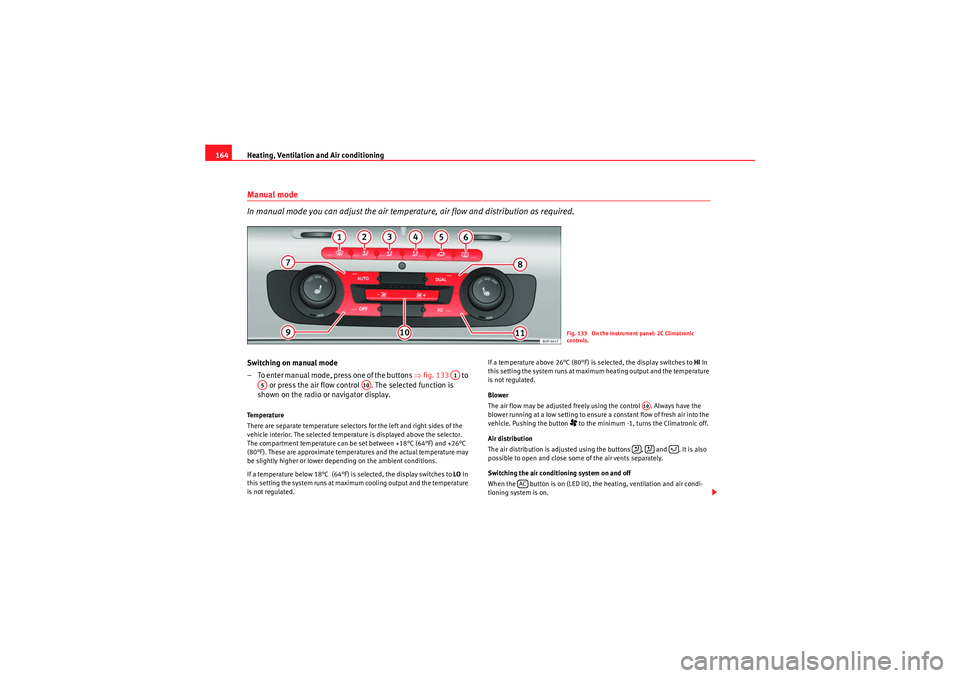
In manual mode you can adjust the air temperature, air flow and distribution as required.Switching on manual mode
– To enter manual mode, press one of the buttons ⇒fig. 133 to
or press the air flow control . The selected function is
shown on the radio or navigator display.Te m p e r a t u r e
There are separate temperature selectors for the left and right sides of the
vehicle interior. The selected temperature is displayed above the selector.
The compartment temperature can be set between +18°C (64°F) and +26°C
(80°F). These are approximate temperatures and the actual temperature may
be slightly higher or lower depending on the ambient conditions.
If a temperature below 18°C (64°F) is selected, the display switches to LO In
this setting the system runs at maximum cooling output and the temperature
is not regulated. If a temperature above 26°C (80°F) is selected, the display switches to
HI In
this setting the system runs at maximum heating output and the temperature
is not regulated.
Blower
The air flow may be adjusted freely using the control . Always have the
blower running at a low setting to ensure a constant flow of fresh air into the
vehicle. Pushing the button
to the minimum -1, turns the Climatronic off.
Air distribution
The air distribution is adjusted using the buttons , and . It is also
possible to open and close some of the air vents separately.
Switching the air conditioning system on and off
When the button is on (LED lit), the heating, ventilation and air condi-
tioning system is on.Fig. 133 On the instrument panel: 2C Climatronic
controls.
A1
A5
A10
A10
AC
altea_EN Seite 164 Mittwoch, 26. August 2009 6:00 18
Page 167 of 310
Heating, Ventilation and Air conditioning165
Safety First
Operating instructions
Practical tips
Technical Data
When the button is off (LED off), the heating, ventilation and air condi-
tioning system is off.
When the button is off, the heating, ventilation and air conditioning
system is switched off to save fuel. The temperature continues to self-regu-
late. The set temperature can then only be reached if it is higher than the
ambient temperature.
Driver and passenger temperature control
The button controls the synchronisation of the 2 Climatronic climate
zones.
When the button is on (LED lit), the climate zone of the Climatronic is
personalised, for example: Driver side temperature 22°C and passenger side
temperature 23°C.
When the button is off (LED off), the climate zone of the Climatronic is
synchronised, for example: Driver side temperature 22°C and passenger side
temperature 22°C.
If the button is off and the passenger side temperature is changed, the
function is automatically activated.
Air recirculation mode
Air recirculation mode prevents fumes or unpleasant smells
from coming from the outside.– Press the button
⇒page 164, fig. 133 to switch air recir-
culation mode on or off. It is switched on if the following symbol
appears in the display
.
Air recirculation mode prevents strong odours in the ambient air from
entering the vehicle interior, for example when passing through a tunnel or in
a traffic jam. With low temperatures outside, the air recirculation increases the effective-
ness of the heating system by heating the air inside the passenger compart-
ment rather than the air from outside.
With high ambient temperatures, the air recirculation increases the effective-
ness of the air conditioning system by cooling the air inside the passenger
compartment rather than the ambient air.
If the windscreen air output is on and the air recirculation mode is pressed,
this remains active. When the recirculation mode is on, if the air distribution
towards the windscreen mode is selected, the recirculation mode is deacti-
vated. For safety reasons, the air recirculation mode should not be
connected.
WARNING
In air recirculation mode, no cold air from the outside enters the vehicle
interior. If the air conditioning system is switched off, the windows can
quickly mist over. Therefore, never leave the air recirculation mode
switched on for a long time (risk of accident).General notesThe impurity filter
The impurity filter (a combined particle filter and active carbon filter) serves
as a barrier against impurities in the ambient air, including dust and pollen.
For the air conditioning system to work with maximum efficiency, the pollen
filter must be replaced at the intervals specified in the Service Schedule.
If the filter loses efficiency prematurely due to use in areas reaching very high
pollution levels, the pollen filter must be changed more frequently than
stated in the Service Schedule.
ACAC
DUAL
DUALDUAL
DUAL
A2
altea_EN Seite 165 Mittwoch, 26. August 2009 6:00 18
Page 168 of 310
Heating, Ventilation and Air conditioning
166Air conditioner
When the air conditioning system is switched on, not only the temperature,
but also the air humidity in the vehicle interior is reduced. This improves
comfort for the vehicle occupants and prevents misting of the windows when
the ambient air humidity is high.
If the air conditioning system cannot be switched on this may be caused by
the following reasons:•The engine is not running.•The button is disconnected.•The outside temperature is below +3°C.•The air conditioning system compressor has been temporarily switched
off because the engine coolant temperature is too high.•The air conditioning fuse is faulty.•Another fault in the vehicle. Have the air conditioning checked by a qual-
ified workshop.Caution
•If you suspect that the air conditioning is damaged, switch it off with the button to prevent further damage and have it checked by a qualified
workshop.•Repairs to the air conditioning system require specialist knowledge and
special tools. Therefore, we recommend you to take the vehicle to a qualified
workshop.Note
•If the humidity and temperature outside the vehicle are high, condensa-
tion can drip off the evaporator in the cooling system and so forming a puddle
underneath the vehicle. This is completely normal and there is no need to
suspect a leak.
•Keep the air intake slots in front of the windscreen free of snow, ice and
leaves to ensure heating and cooling are not impaired, and to prevent the
windows from misting over.•The air from the vents flows through the passenger compartment and is
extracted by slots designed for this purpose. Therefore, do not cover these
slots with items of clothing or other objects.•The air conditioning system operates most effectively with the windows
and the sliding/tilting roof* closed. However, if the vehicle has been over-
heated by sun, the air inside can be cooled quicklier by opening the windows
for a short time.•Do not smoke while air recirculation mode is on, as smoke drawn into the
air conditioning system leaves a residue on the evaporator, producing a
permanent unpleasant odour.•It is advisable to connect the air conditioning at least once a month, to
lubricate the system gaskets and prevent leaks. If a decrease in the cooling
capacity is detected, an Authorised Service Centre should be consulted to
check the system.
AC
AC
altea_EN Seite 166 Mittwoch, 26. August 2009 6:00 18
Page 177 of 310
Driving175
Safety First
Operating instructions
Practical tips
Technical Data
•The temperature of the passenger compartment must be within the
convenience limits (button ⇒page 164, fig. 133 should be selected).•The windscreen de-mist function must be off.•If not , it requires an increase in airflow ⇒page 164, fig. 133 for more
than three presses.•Either of the temperature settings, HI or LO must not be set.•The driver's door must be closed.•The diesel particulate filter must not be in regeneration mode, for diesel
engines.•The battery charge must not be low for the next start.•The battery temperature must be between -1°C and 55°C.•The parking assistant, Park Assist* must not be activated.
Interrupting the Start-Stop function
In the following situations, the Start-Stop function will be interrupted and the
engine will automatically start:•The vehicle is moving.•The brake pedal is pressed several times in a row.•The battery has been discharged excessively.•The Start-Stop System has been manually deactivated.•The windscreen de-mist function is turned on.•The temperature of the passenger compartment exceeds the convenience
limits (button ⇒page 164, fig. 133 should be selected).•If in an increase in airflow ⇒page 164, fig. 133 is required for more
than three presses.•Either of the temperature settings, HI or LO, is selected.•The engine coolant temperature is insufficient.•The alternator is faulty, for example the V-belt has ruptured.•If any of the conditions described in the previous section are not fulfilled.
WARNING
Never allow the vehicle to move with the engine off for any reason. You
could lose control of your vehicle. This could cause an accident and serious
injury.•The brake servo does not work when the engine is not running. You
need more force to stop the vehicle.•Power assisted steering does not work when the engine is not running.
That is why it is much more difficult to turn the steering wheel.Note
•For vehicles with the Start-Stop function and a manual gearbox, when the
engine is started, the clutch must be pressed.•When the conditions for the Start-Stop function are not fulfilled, the dash
panel displays the Start-Stop indicator dimmed.•The vehicle can be restarted by rotating the steering wheel three times,
that is, more than 270°.
ACA11
A10
ACA11
A10
altea_EN Seite 175 Mittwoch, 26. August 2009 6:00 18
Page 185 of 310
Driving183
Safety First
Operating instructions
Practical tips
Technical Data
•You should use the kickdown feature only when traffic and weather
conditions allow it to be used safely.
HandbrakeUsing the handbrake
The handbrake should be applied firmly to prevent the
vehicle from accidentally rolling away.Always apply the handbrake when you leave your vehicle and when
you park. Applying the handbrake
– Pull the handbrake lever up firmly
⇒fig. 149 .
Releasing the handbrake
– Pull the lever up slightly and pr ess the release knob in the direc-
tion of the arrow ⇒fig. 149 and guide the handbrake lever down
fully ⇒ .
Always apply the handbrake firmly. This prevents you driving with the hand-
brake applied ⇒.
The handbrake warning lamp
lights up when the handbrake is applied
and the ignition switched on. The warning turns off when the handbrake is
released.
If you drive faster than 6 km/h with the handbrake on, the following
message* will appear on the instrument panel display: HANDBRAKE ON. Also,
an audible warning is given.
WARNING
•Never use the handbrake to stop the vehicle when it is in motion. The
braking distance is considerably longer, because braking is only applied to
the rear wheels. Risk of accident!•If it is only partially released, this will cause rear brakes overheating,
which can impair the function of the brake system and could lead to an acci-
dent. This also causes premature wear on the rear brake pads.Caution
Always apply the handbrake before you leave the vehicle. The first gear
should also be selected.
WARNING (continued)
Fig. 149 Handbrake
between the front seats
altea_EN Seite 183 Mittwoch, 26. August 2009 6:00 18