ECU Seat Altea 2010 Owner's Guide
[x] Cancel search | Manufacturer: SEAT, Model Year: 2010, Model line: Altea, Model: Seat Altea 2010Pages: 310, PDF Size: 7.46 MB
Page 107 of 310
Unlocking and locking105
Safety First
Operating instructions
Practical tips
Technical Data
Activation
– It is automatically turned on with the anti-theft alarm, when the
vehicle is locked mechanically with the key and when the button on the remote control is used.
Deactivation
– Press the button on the remote control twice. Only the volu- metric sensor is deactivated. The alarm system remains acti-
vated.
WARNING
•The “safe” security system remains deactivated if the volumetric
sensor is deactivated.•For those vehicles in which a separate sunblind is fitted in the
passenger compartment, the alarm will not function correctly due to inter-
ference with the sensor.Note
•If the alarm has been triggered by the volumetric sensor, this will be indi-
cated by a flashing of the indicator on the driver's door. This flashing will be
different to that for an activated alarm.
altea_EN Seite 105 Mittwoch, 26. August 2009 6:00 18
Page 136 of 310
Seats and stowage
134Removing or adjusting head restraints
The head restraints can be adjusted by moving them up and
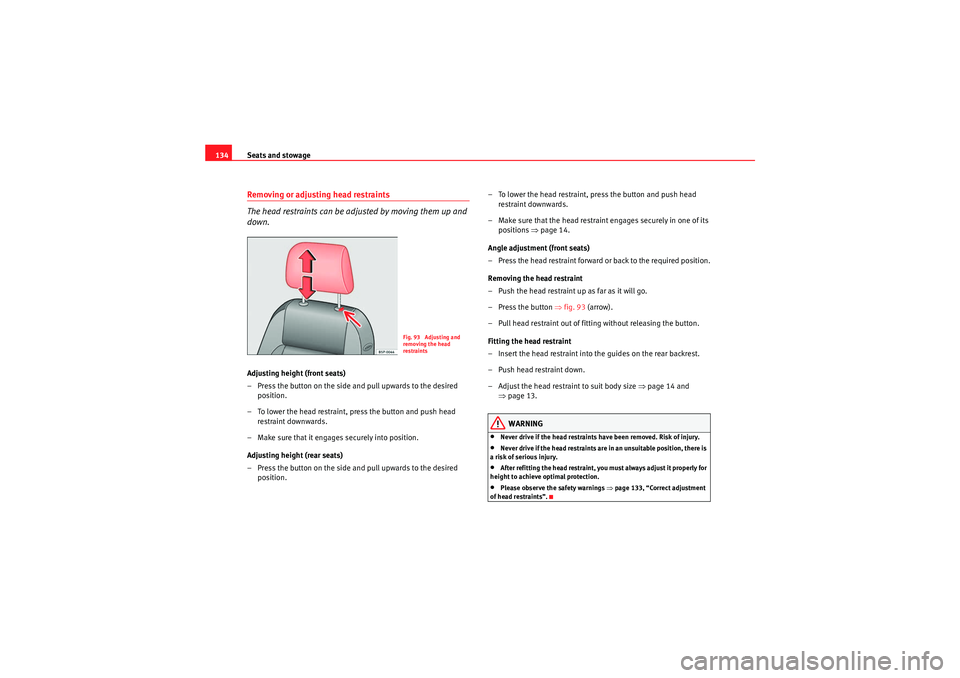
down.Adjusting height (front seats)
– Press the button on the side and pull upwards to the desired
position.
– To lower the head restraint, press the button and push head restraint downwards.
– Make sure that it engage s securely into position.
Adjusting height (rear seats)
– Press the button on the side and pull upwards to the desired position. – To lower the head restraint, pr
ess the button and push head
restraint downwards.
– Make sure that the head restrain t engages securely in one of its
positions ⇒page 14.
Angle adjustment (front seats)
– Press the head restraint forward or back to the required position.
Removing the head restraint
– Push the head restraint up as far as it will go.
– Press the button ⇒fig. 93 (arrow).
– Pull head restraint out of fitting without releasing the button.
Fitting the head restraint
– Insert the head restraint into the guides on the rear backrest.
– Push head restraint down.
– Adjust the head restraint to suit body size ⇒page 14 and
⇒ page 13.
WARNING
•Never drive if the head restraints have been removed. Risk of injury.•Never drive if the head restraints are in an unsuitable position, there is
a risk of serious injury.•After refitting the head restraint, you must always adjust it properly for
height to achieve optimal protection.•Please observe the safety warnings ⇒page 133, “Correct adjustment
of head restraints”.
Fig. 93 Adjusting and
removing the head
restraints
altea_EN Seite 134 Mittwoch, 26. August 2009 6:00 18
Page 137 of 310
Seats and stowage135
Safety First
Operating instructions
Practical tips
Technical Data
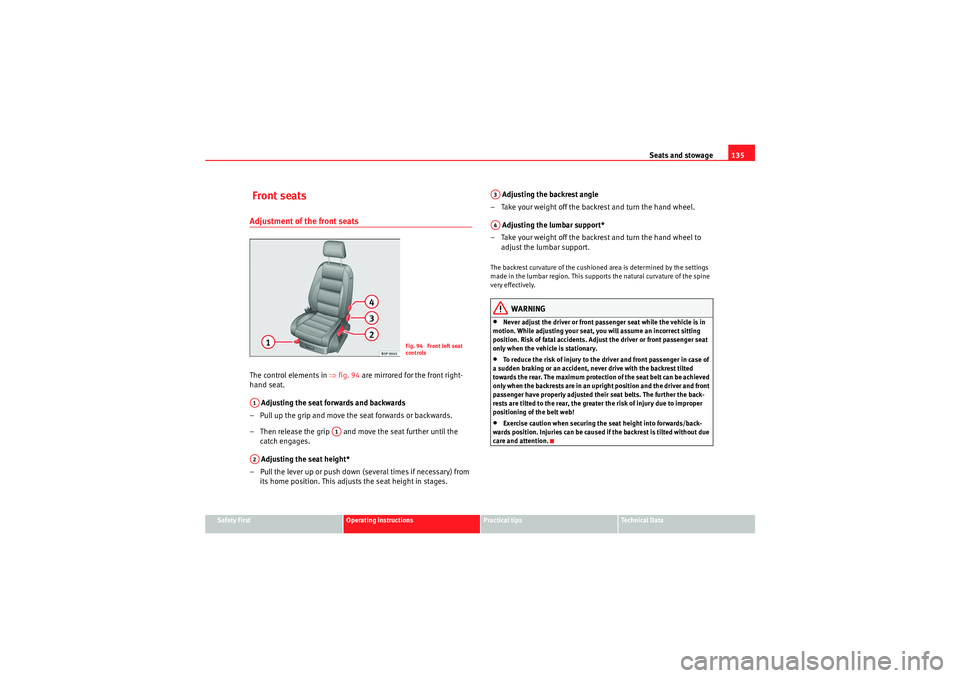
Front seatsAdjustment of the front seatsThe control elements in ⇒fig. 94 are mirrored for the front right-
hand seat.
Adjusting the seat forwards and backwards
– Pull up the grip and move the seat forwards or backwards.
– Then release the grip and move the seat further until the catch engages.
Adjusting the seat height*
– Pull the lever up or push down (several times if necessary) from its home position. This adjusts the seat height in stages. Adjusting the backrest angle
– Take your weight off the backrest and turn the hand wheel.
Adjusting the lumbar support*
– Take your weight off the backrest and turn the hand wheel to adjust the lumbar support.
The backrest curvature of the cushioned area is determined by the settings
made in the lumbar region. This supports the natural curvature of the spine
very effectively.
WARNING
•Never adjust the driver or front passenger seat while the vehicle is in
motion. While adjusting your seat, you will assume an incorrect sitting
position. Risk of fatal accidents. Adjust the driver or front passenger seat
only when the vehicle is stationary.•To reduce the risk of injury to the driver and front passenger in case of
a sudden braking or an accident, never drive with the backrest tilted
towards the rear. The maximum protection of the seat belt can be achieved
only when the backrests are in an upright position and the driver and front
passenger have properly adjusted their seat belts. The further the back-
rests are tilted to the rear, the greater the risk of injury due to improper
positioning of the belt web!•Exercise caution when securing the seat height into forwards/back-
wards position. Injuries can be caused if the backrest is tilted without due
care and attention.
Fig. 94 Front left seat
controls
A1
A1
A2
A3A4
altea_EN Seite 135 Mittwoch, 26. August 2009 6:00 18
Page 140 of 310
Seats and stowage
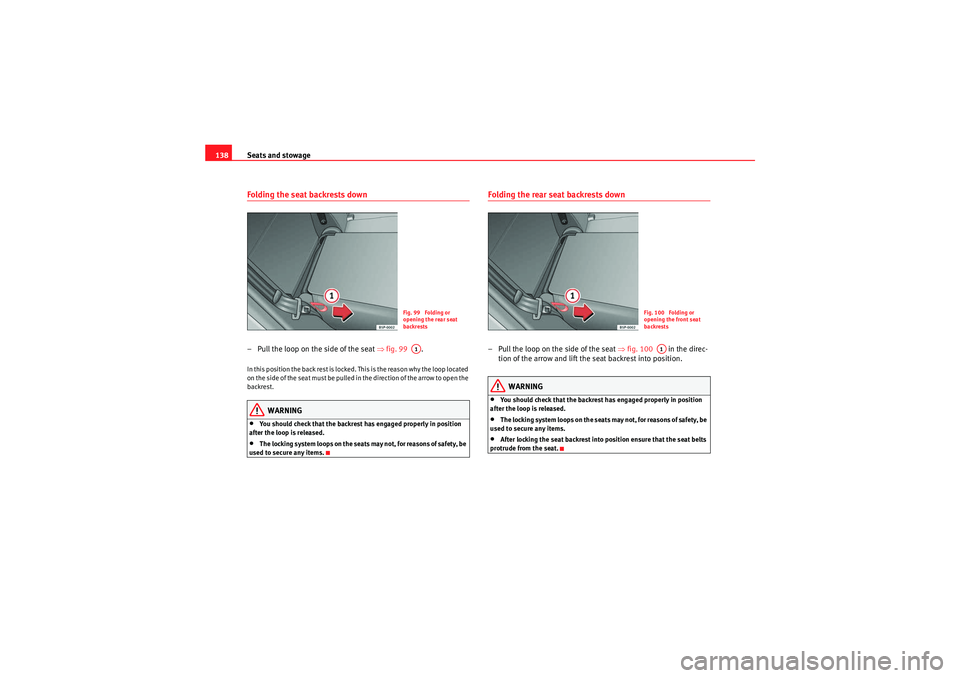
138Folding the seat backrests down – Pull the loop on the side of the seat ⇒fig. 99 .In this position the back rest is locked. This is the reason why the loop located
on the side of the seat must be pulled in the direction of the arrow to open the
backrest.
WARNING
•You should check that the backrest has engaged properly in position
after the loop is released.•The locking system loops on the seats may not, for reasons of safety, be
used to secure any items.
Folding the rear seat backrests down– Pull the loop on the side of the seat ⇒fig. 100 in the direc-
tion of the arrow and lift the seat backrest into position.
WARNING
•You should check that the backrest has engaged properly in position
after the loop is released.•The locking system loops on the seats may not, for reasons of safety, be
used to secure any items.•After locking the seat backrest into position ensure that the seat belts
protrude from the seat.
Fig. 99 Folding or
opening the rear seat
backrestsA1
Fig. 100 Folding or
opening the front seat
backrests
A1
altea_EN Seite 138 Mittwoch, 26. August 2009 6:00 18
Page 143 of 310
Seats and stowage141
Safety First
Operating instructions
Practical tips
Technical Data
WARNING
•The folding tables may not be folded down whilst the vehicle is in
motion and anyone is seated on the second row of seats. There is a risk on
injury during a sudden braking manoeuvre! The table must therefore be
closed and properly secured whilst the vehicle is in motion.•Never place hot drinks in the drink holders. During normal or sudden
driving manoeuvres, sudden braking or an accident, the hot drink could be
spilled. Danger of scalding.Caution
When driving, do not leave open cans in the cup holders. The drink might be
spilt on braking, for example, and could damage the vehicle.Roof stowage compartment*
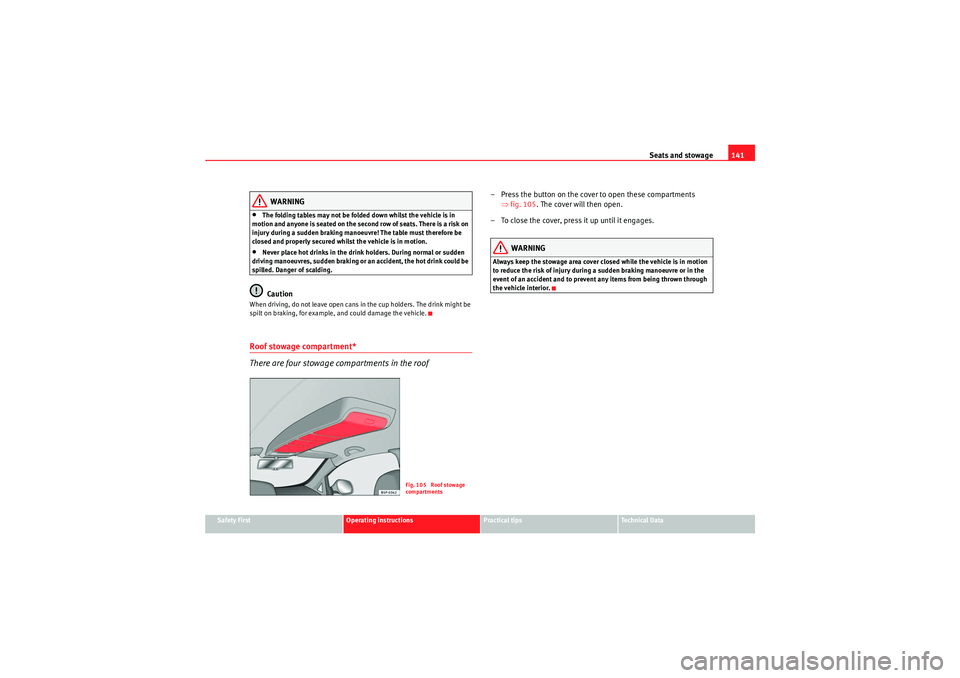
There are four stowage compartments in the roof
– Press the button on the cover to open these compartments ⇒fig. 105 . The cover will then open.
– To close the cover, press it up until it engages.
WARNING
Always keep the stowage area cover closed while the vehicle is in motion
to reduce the risk of injury during a sudden braking manoeuvre or in the
event of an accident and to prevent any items from being thrown through
the vehicle interior.
Fig. 105 Roof stowage
compartments
altea_EN Seite 141 Mittwoch, 26. August 2009 6:00 18
Page 145 of 310
Seats and stowage143
Safety First
Operating instructions
Practical tips
Technical Data
Luggage compartment net
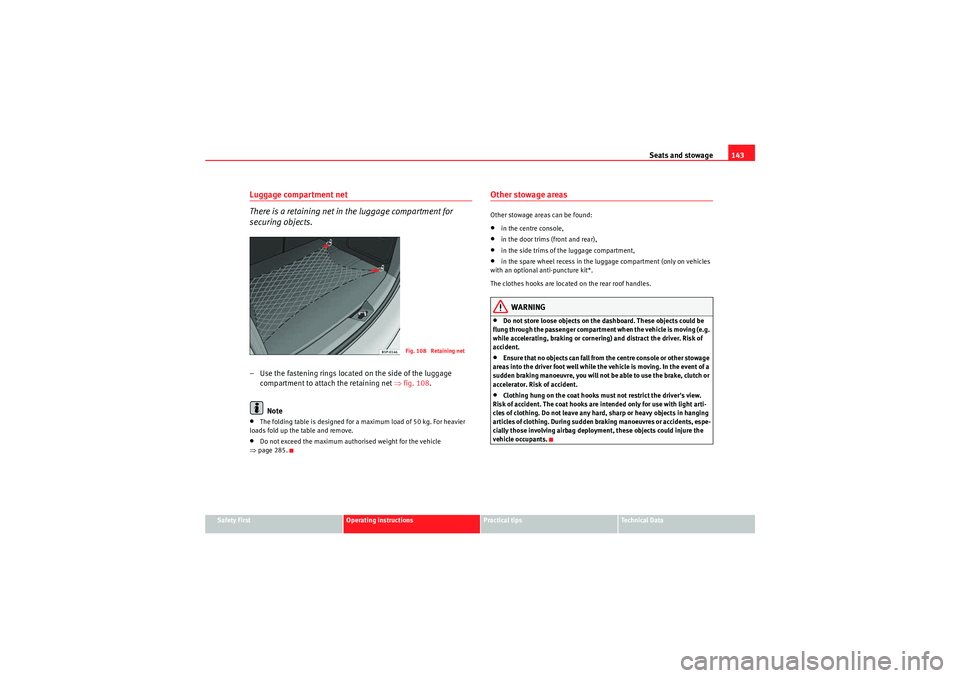
There is a retaining net in the luggage compartment for
securing objects.– Use the fastening rings located on the side of the luggage
compartment to attach the retaining net ⇒ fig. 108.
Note•The folding table is designed for a maximum load of 50 kg. For heavier
loads fold up the table and remove.•Do not exceed the maximum authorised weight for the vehicle
⇒ page 285.
Other stowage areasOther stowage areas can be found:•in the centre console,•in the door trims (front and rear),•in the side trims of the luggage compartment,•in the spare wheel recess in the luggage compartment (only on vehicles
with an optional anti-puncture kit*.
The clothes hooks are located on the rear roof handles.WARNING
•Do not store loose objects on the dashboard. These objects could be
flung through the passenger compartment when the vehicle is moving (e.g.
while accelerating, braking or cornering) and distract the driver. Risk of
accident.•Ensure that no objects can fall from the centre console or other stowage
areas into the driver foot well while the vehicle is moving. In the event of a
sudden braking manoeuvre, you will not be able to use the brake, clutch or
accelerator. Risk of accident.•Clothing hung on the coat hooks must not restrict the driver's view.
Risk of accident. The coat hooks are intended only for use with light arti-
cles of clothing. Do not leave any hard, sharp or heavy objects in hanging
articles of clothing. During sudden braking manoeuvres or accidents, espe-
cially those involving airbag deployment, these objects could injure the
vehicle occupants.
Fig. 108 Retaining net
altea_EN Seite 143 Mittwoch, 26. August 2009 6:00 18
Page 147 of 310
Seats and stowage145
Safety First
Operating instructions
Practical tips
Technical Data
Opening and closing the armrest* / drink holder*
– To open, pull the loop in the direction of the arrow ⇒page 144,
fig. 110 .
– To close, lift the Drink holder* / armrest* in the direction of the arrow ⇒page 144, fig. 111 .
WARNING
Ensure that the load in the luggage compartment is correctly secured with
the retainer net when travelling with the armrest down ⇒page 143.Multi-purpose* mobile stowage compartment - Fitting and removal
This stowage compartment may only be placed in the central
area of the rear seat
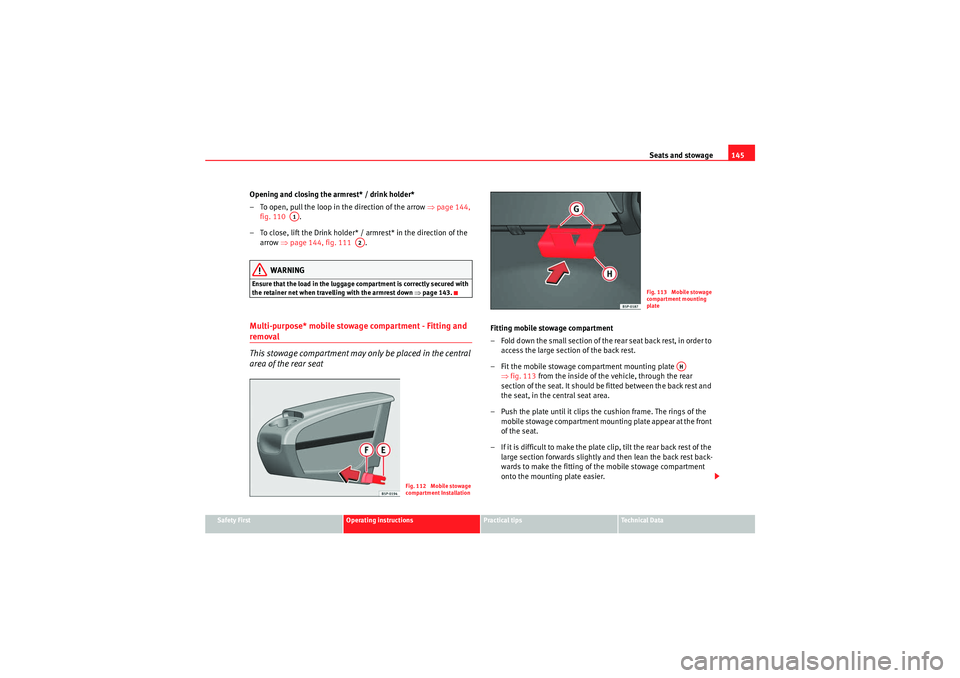
Fitting mobile stowage compartment
– Fold down the small section of the rear seat back rest, in order to
access the large sectio n of the back rest.
– Fit the mobile stowage compartment mounting plate ⇒fig. 113 from the inside of the vehicle, through the rear
section of the seat. It should be fitted between the back rest and
the seat, in the central seat area.
– Push the plate until it clips the cushion frame. The rings of the mobile stowage compartment mounting plate appear at the front
of the seat.
– If it is difficult to make the plate clip, tilt the rear back rest of the large section forwards slightly and then lean the back rest back-
wards to make the fitting of the mobile stowage compartment
onto the mounting plate easier.
A1
A2
Fig. 112 Mobile stowage
compartment Installation
Fig. 113 Mobile stowage
compartment mounting
plate
AH
altea_EN Seite 145 Mittwoch, 26. August 2009 6:00 18
Page 154 of 310
Seats and stowage
152Luggage compartmentStowing luggage
All luggage must be securely stowed.Please observe the following points to ensure the vehicle handles
well at all times:
– Distribute the load as evenly as possible.
– Place heavy objects as far forward in the luggage compartment
as possible.
– Secure luggage in the luggage compartment with suitable straps on the fastening rings.
WARNING
•Loose luggage and other loose items in the vehicle can cause serious
injuries.•Loose objects in the luggage compartment can suddenly move and
change the way the vehicle handles.•During sudden manoeuvres or accidents, loose objects in the
passenger compartment can be flung forward, injuring vehicle occupants.•Always store objects in the luggage compartment and secure with suit-
able straps. This is especially important for heavy objects.•When you transport heavy objects, always take in account that a
change in the centre of gravity can also cause changes in vehicle handling.•Please observe information on safe driving ⇒page 7, “Safe driving”.
Caution
Hard objects on the shelf could chafe against the wires of the heating
element in the rear window and cause damage.
Note
The ventilation slots in front of the rear side windows must not be covered as
this would prevent stale air being extracted from the vehicle.
altea_EN Seite 152 Mittwoch, 26. August 2009 6:00 18
Page 186 of 310
Driving
184Parking
The handbrake should always be firmly applied when the
vehicle is parked.Always note the following points when parking the vehicle:
– Use the foot brake to stop the vehicle.
– Apply the handbrake.
– The first gear should also be selected.
– Switch the engine off and remove the key from the ignition lock.
Turn the steering wheel slightly to engage the steering lock.
– Always take you car keys with you when you leave the vehicle ⇒ .Additional notes on parking the vehicle on gradients:
Turn the steering wheel so that the vehicle rolls against the kerb if it started
to roll.•If the vehicle is parked facing downhill, turn the front wheels so that they
point towards the kerb .•If the vehicle is parked facing uphill, turn the front wheels so that they
point away from the kerb .•Secure the vehicle as normal by applying the handbrake firmly and
engaging first gear.WARNING
•Take measures to reduce the risk of injury when you leave your vehicle
unattended.
•Never park where the hot exhaust system could ignite inflammable
materials, such as dry grass, low bushes, spilt fuel etc.•Never allow vehicle occupants to remain in the vehicle when it is
locked. They would be unable to open the vehicle from the inside, and
could become trapped in the vehicle in an emergency. In the event of an
emergency, locked doors will delay assistance to occupants.•Never leave children alone in the vehicle. They could set the vehicle in
motion, for example, by releasing the handbrake or the gear lever /
selector lever.•Depending on weather conditions, it may become extremely hot or cold
inside the vehicle. This can be fatal.
Hill-start aid*
This function is only included in vehicles with ESP.This device helps when starting uphill.
These are the basic operation conditions: doors closed, brake pedal pressed
down and vehicle in neutral. The system is activated on engaging gear.
After removing your foot from the brake pedal, the braking force is maintained
for a few seconds to prevent the vehicle from moving backward when
engaging gear. This short space of time is enough to start the vehicle with
ease.
This system also works when reversing uphill.
WARNING (continued)
altea_EN Seite 184 Mittwoch, 26. August 2009 6:00 18
Page 207 of 310
Trailer towing205
Safety First
Operating instructions
Practical tips
Technical Data
Trailer towingInstructions to followYour vehicle may be used to tow a trailer when fitted with the correct equip-
ment.
If the car is supplied with a factory-fitted towing bracket it will already have
the necessary technical modifications and meet the statutory requirements
for towing a trailer. For the after-market fitting of a trailer towing bracket see
⇒ page 207.
Connectors
Your vehicle is fitted with a 12-pin connector for the electrical connection
between the trailer and the vehicle.
If the trailer has a 7-pin plug you will need to use an adapter cable. This is
available in any SEAT dealer.
Trailer weight / draw bar loading
Never exceed the authorised towing limit. If you do not load the trailer up to
the maximum permitted trailer weight, you can then climb correspondingly
steeper slopes.
The maximum trailer weights listed are only applicable for altitudes up to
1,000 m above sea level. With increasing altitude the engine power and
therefore the vehicle's climbing ability are impaired because of the reduced
air density. The maximum trailer weight has to be reduced accordingly. The
weight of the vehicle and trailer combination must be reduced by 10% for
every further 1,000 m (or part thereof). The gross combination weight is the
actual weight of the laden vehicle plus the actual weight of the laden trailer.
When possible, operate the trailer with the maximum permitted draw bar
weight on the ball joint of the towing bracket, but do not exceed the specified
limit. The figures for
trailer weights and draw bar weights that are given on the
data plate of the towing bracket are for certification purposes only. The
correct figures for your specific model, which may be lower than these figures
for the towing bracket, are given in the registration documents ⇒Section
“Technical data”.
Distributing the load
Distribute loads in the trailer so that heavy objects are as near to the axle as
possible. Loads carried in the trailer must be secured to prevent them
moving.
Ty re pre ssu re
Set tyre pressure to the maximum permissible pressure shown on the sticker
on the inside of the fuel tank flap. Set the tyre pressure of the trailer tyres in
accordance with the trailer manufacturer's recommendations.
Exterior mirrors
Check whether you can see enough of the road behind the trailer with the
standard mirrors. If this is not the case, you should have additional mirrors
fitted. Both exterior mirrors should be mounted on hinged extension
brackets. Adjust the mirrors to give sufficient vision to the rear.
WARNING
Never transport people in a trailer. This could result in fatal accidents.
Note
•Towing a trailer places additional demands on the vehicle. We recom-
mend additional services between the normal inspection intervals if the
vehicle is used frequently for towing a trailer.
altea_EN Seite 205 Mittwoch, 26. August 2009 6:00 18