belt Seat Altea 2010 Service Manual
[x] Cancel search | Manufacturer: SEAT, Model Year: 2010, Model line: Altea, Model: Seat Altea 2010Pages: 310, PDF Size: 7.46 MB
Page 137 of 310
Seats and stowage135
Safety First
Operating instructions
Practical tips
Technical Data
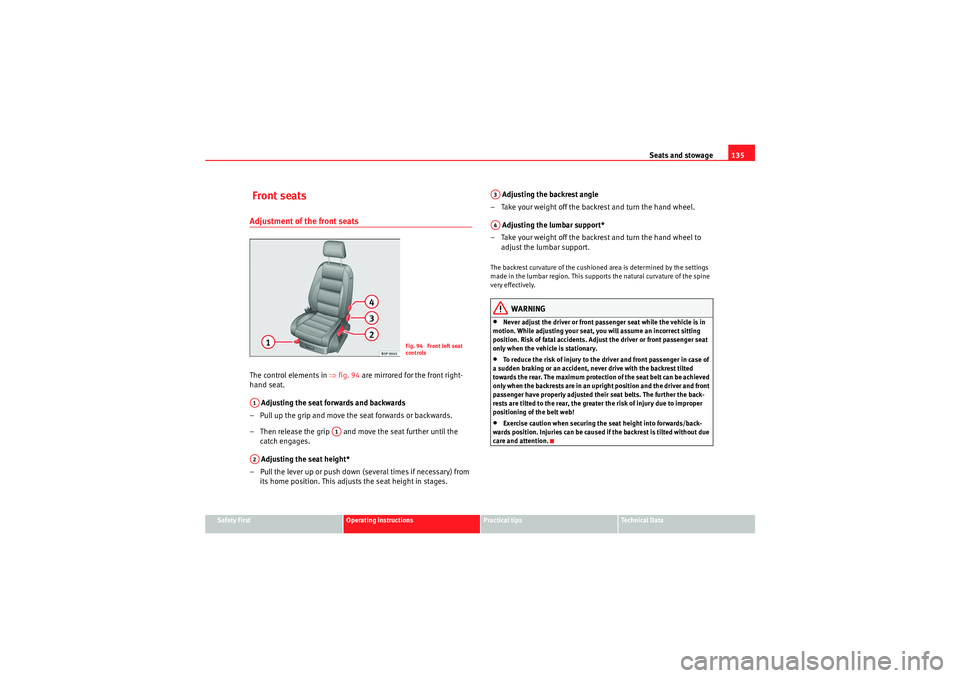
Front seatsAdjustment of the front seatsThe control elements in ⇒fig. 94 are mirrored for the front right-
hand seat.
Adjusting the seat forwards and backwards
– Pull up the grip and move the seat forwards or backwards.
– Then release the grip and move the seat further until the catch engages.
Adjusting the seat height*
– Pull the lever up or push down (several times if necessary) from its home position. This adjusts the seat height in stages. Adjusting the backrest angle
– Take your weight off the backrest and turn the hand wheel.
Adjusting the lumbar support*
– Take your weight off the backrest and turn the hand wheel to adjust the lumbar support.
The backrest curvature of the cushioned area is determined by the settings
made in the lumbar region. This supports the natural curvature of the spine
very effectively.
WARNING
•Never adjust the driver or front passenger seat while the vehicle is in
motion. While adjusting your seat, you will assume an incorrect sitting
position. Risk of fatal accidents. Adjust the driver or front passenger seat
only when the vehicle is stationary.•To reduce the risk of injury to the driver and front passenger in case of
a sudden braking or an accident, never drive with the backrest tilted
towards the rear. The maximum protection of the seat belt can be achieved
only when the backrests are in an upright position and the driver and front
passenger have properly adjusted their seat belts. The further the back-
rests are tilted to the rear, the greater the risk of injury due to improper
positioning of the belt web!•Exercise caution when securing the seat height into forwards/back-
wards position. Injuries can be caused if the backrest is tilted without due
care and attention.
Fig. 94 Front left seat
controls
A1
A1
A2
A3A4
altea_EN Seite 135 Mittwoch, 26. August 2009 6:00 18
Page 140 of 310
Seats and stowage
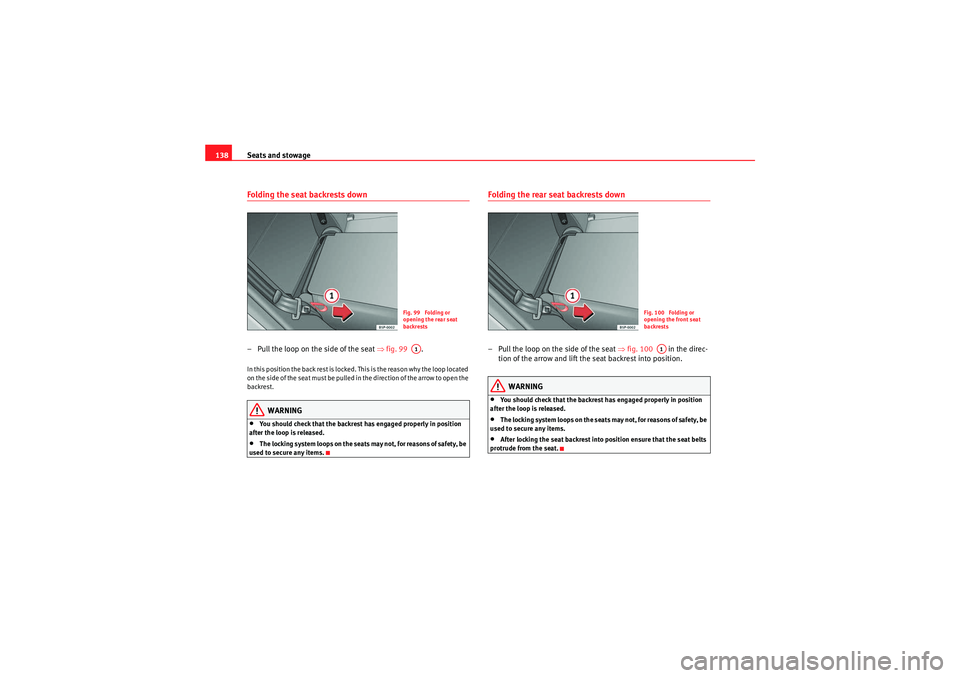
138Folding the seat backrests down – Pull the loop on the side of the seat ⇒fig. 99 .In this position the back rest is locked. This is the reason why the loop located
on the side of the seat must be pulled in the direction of the arrow to open the
backrest.
WARNING
•You should check that the backrest has engaged properly in position
after the loop is released.•The locking system loops on the seats may not, for reasons of safety, be
used to secure any items.
Folding the rear seat backrests down– Pull the loop on the side of the seat ⇒fig. 100 in the direc-
tion of the arrow and lift the seat backrest into position.
WARNING
•You should check that the backrest has engaged properly in position
after the loop is released.•The locking system loops on the seats may not, for reasons of safety, be
used to secure any items.•After locking the seat backrest into position ensure that the seat belts
protrude from the seat.
Fig. 99 Folding or
opening the rear seat
backrestsA1
Fig. 100 Folding or
opening the front seat
backrests
A1
altea_EN Seite 138 Mittwoch, 26. August 2009 6:00 18
Page 149 of 310
Seats and stowage147
Safety First
Operating instructions
Practical tips
Technical Data
Opening
– Lift the cover , in area ⇒ page 146, fig. 114.
Closing
– Push the cover down, until it clips into place.Uses of the mobile stowage compartment•The front open glove box may be used to store small objects that will not
damage passengers in the event that the objects are flung around the interior
of the vehicle.•The drink holders are used for holding drink cans or cups.•The elastic belt on the side may be used for keeping papers and maga-
zines.•The tables may be used as a support for writing.
To use the table ⇒page 146, fig. 115, it must be removed from its
compartment on the side of the mobile stowage compartment and fitted into
compartment ⇒page 146, fig. 115 on the front section of the mobile
stowage compartment.
The table in the right-hand compartment is fitted in the left-hand compart-
ment of the front of the mobile stowage compartment and the table in the left-
hand compartment is fitted in the right-hand compartment.
The tables have two positions for use and cannot be interchanged.WARNING
•The mobile stowage compartment supports a maximum load of 5 kg. Do
not overload.•Do not drive when the cover of the mobile stowage compartment is
open.•Do not drive when the tables are set up for use.
•When the vehicle is moving, keep the tables stored inside the mobile
stowage compartment with the cover closed, and likewise when they are
not in use•Never place hot drinks in the drink holders. The drink may spill and
cause burns when the vehicle is moving.•Do not leave cans in the drink holder when the vehicle is in motion,
there is a danger that the can may be flung around the vehicle and cause
injury.•Make sure that the mounting plate is correctly clipped onto the cushion
frame.•When the plate is not in use, store inside the stowage compartment.•When the mobile stowage compartment is not in use, it should always
be fastened by the retaining net in the luggage compartment.Note
•Check that the mobile stowage compartment is correctly fitted, pulling it
forwards by the front glove box and checking that both safety clips are
correctly clipped onto the rings.
AB
AA
ACAD
WARNING (continued)
altea_EN Seite 147 Mittwoch, 26. August 2009 6:00 18
Page 176 of 310
Driving
174•If there is a fault in the LPG system.•At very low temperatures below minus 10°C.
Manual switch from petrol to LPG
Press the GAS button to switch modes. When the necessary conditions are
met, the system switches to LPG mode and the ON lamp is lit. If the ON
lamp flashes, the following conditions have not been met:•There is enough LPG in the tank.•The temperature of the vehicle coolant is above 30°C.•Engine speed while driving is above 1200 rpm.
When these conditions are met, the system switches to LPG mode and the ON
lamp is lit .
Manual switch from LPG to petrol
Press the button to switch modes. When the OFF lamp is lit, the
vehicle is running on petrol.
Running on petrol
Run the engine with petrol for short journeys at regular intervals to avoid
problems in the petrol system.WARNING
LPG is a highly explosive and inflammable substance. It may cause severe
burns and other injury.•Due care must be taken to avoid any risk of fire or explosion.•When parking the vehicle in a closed area (for example in a garage),
make sure that there is adequate ventilation, either natural or mechanical,
to neutralise the LPG in the event of a leak.
Note
•If frequent short journeys are made, especially when the outside temper-
ature is low, the vehicle will tend to run on petrol more often than on LPG.
Therefore, the petrol tank may empty before the LPG tank.Start-Stop function*Description and operationThe Start-Stop function stops the engine when the vehicle is
stopped and starts it automatically when required.
– When the vehicle is stopped, put it in neutral and release the clutch pedal. The engine will stop.
– When the clutch pedal is pressed, the engine starts again.
– The instrument panel screen displays information about the status of the Start-Stop function ⇒page 176, fig. 140 .Start-Stop function conditions•The driver's seat belt must be buckled.•The engine hood must be closed.•The engine must be at operating temperature•The steering wheel must be straight.•The vehicle must be on flat ground.•The vehicle must not be in reverse.•A trailer must not be connected.
A1
A3
A3A3GAS
A1
A2
altea_EN Seite 174 Mittwoch, 26. August 2009 6:00 18
Page 177 of 310
Driving175
Safety First
Operating instructions
Practical tips
Technical Data
•The temperature of the passenger compartment must be within the
convenience limits (button ⇒page 164, fig. 133 should be selected).•The windscreen de-mist function must be off.•If not , it requires an increase in airflow ⇒page 164, fig. 133 for more
than three presses.•Either of the temperature settings, HI or LO must not be set.•The driver's door must be closed.•The diesel particulate filter must not be in regeneration mode, for diesel
engines.•The battery charge must not be low for the next start.•The battery temperature must be between -1°C and 55°C.•The parking assistant, Park Assist* must not be activated.
Interrupting the Start-Stop function
In the following situations, the Start-Stop function will be interrupted and the
engine will automatically start:•The vehicle is moving.•The brake pedal is pressed several times in a row.•The battery has been discharged excessively.•The Start-Stop System has been manually deactivated.•The windscreen de-mist function is turned on.•The temperature of the passenger compartment exceeds the convenience
limits (button ⇒page 164, fig. 133 should be selected).•If in an increase in airflow ⇒page 164, fig. 133 is required for more
than three presses.•Either of the temperature settings, HI or LO, is selected.•The engine coolant temperature is insufficient.•The alternator is faulty, for example the V-belt has ruptured.•If any of the conditions described in the previous section are not fulfilled.
WARNING
Never allow the vehicle to move with the engine off for any reason. You
could lose control of your vehicle. This could cause an accident and serious
injury.•The brake servo does not work when the engine is not running. You
need more force to stop the vehicle.•Power assisted steering does not work when the engine is not running.
That is why it is much more difficult to turn the steering wheel.Note
•For vehicles with the Start-Stop function and a manual gearbox, when the
engine is started, the clutch must be pressed.•When the conditions for the Start-Stop function are not fulfilled, the dash
panel displays the Start-Stop indicator dimmed.•The vehicle can be restarted by rotating the steering wheel three times,
that is, more than 270°.
ACA11
A10
ACA11
A10
altea_EN Seite 175 Mittwoch, 26. August 2009 6:00 18
Page 219 of 310
Cleaning and caring for your vehicle217
Safety First
Operating instructions
Practical tips
Technical Data
– Apply these products very sparingly.
– Then wipe off with a soft, dry cloth.SEAT does everything possible to preserve the genuine qualities of this
natural product. Due to the natural properties of the specially selected hides
employed, the finished leather has a certain sensitivity to grease and dirt, etc.
so a degree of care is required in everyday use and when looking after the
leather.
Dust and grit in the pores and seams can scratch and damage the surface. If
the vehicle is under solar radiation for long periods, the leather should be
protected to prevent it from fading. However, slight colour variations in high-
quality natural leather are normal.
Caution
•Do not use solvents, wax polish, shoe cream, spot removers or similar
products on leather.•To avoid damage, stubborn stains should be removed by a qualified
workshop.Seat belts cleaning
A dirty belt may not work properly.Check all seat belts regularly and keep them clean.
Seat belts cleaning
– Pull the dirty seat belt right out and unroll it.
– Clean the dirty seat belts with a gentle soap solution.
– Allow it to dry. – Do not roll the seat belt up until it is dry.
If large stains form on the belts, it will not retract correctly into the automatic
belt retractor.
WARNING
•Do not use chemical cleaning agents on the seat belts, as this can
impair the strength of the webbing. Ensure that belts do not come into
contact with corrosive fluids.•Check all seat belts condition at regular intervals. If you notice that the
belt webbing, fittings, retractor mechanism or buckle of any of the belts is
damaged, the belt must be replaced by a specialist workshop.•Do not attempt to repair a damaged seat belt yourself. The seat belts
must not be removed or modified in any way.Caution
After cleaning, allow seat belts to dry completely before rolling them up.
Otherwise, the belt retractors could become damaged.
altea_EN Seite 217 Mittwoch, 26. August 2009 6:00 18
Page 229 of 310
Checking and refilling levels227
Safety First
Operating instructions
Practical tips
Technical Data
WARNING
All work on the engine or in the engine compartment, e.g. checking and
refilling fluids, involves the danger of injury and scalding as well as the risk
of accident or fire.•Never open the bonnet if you see steam, smoke or coolant escaping
from the engine compartment. Otherwise, there is a risk of sustaining
burns. Wait until no more steam or coolant is emitted, then allow the
engine to cool before carefully opening the bonnet.•Switch off the engine and remove the key from the ignition.•Apply the handbrake and move the gear stick to neutral or selector
lever to position P.•Keep children away from the vehicle.•Never touch hot engine parts. There is a risk of burns.•Never spill liquids on a hot engine or on a hot exhaust gas system. This
is a fire hazard.•Avoid causing short-circuits in the electrical system, particularly at the
points where the jump leads are attached ⇒ page 276. The battery could
explode.•Never touch the radiator fan. It is temperature controlled and could
start automatically, even when the engine has been switched off and the
key removed from the ignition!•Do not unscrew the cap on the expansion tank when the engine is hot.
If the coolant is hot, the cooling system will be pressurised!•Protect face, hands and arms by covering the cap with a large, thick
cloth to protect against escaping coolant and steam.•Always make sure you have not left any objects, such as cleaning cloths
and tools, in the engine compartment.•If you have to work underneath the vehicle, you must use suitable
stands additionally to support the vehicle, there is a risk of accident!. A
hydraulic jack is insufficient for securing the vehicle and there is a risk of
injury.
•If any work has to be performed when the engine is started or with the
engine running, there is an additional, potentially fatal, safety risk from the
rotating parts, such as the drive belts, alternator, radiator fan, etc., and
from the high-voltage ignition system. You should also observe the
following points:
−Never touch the electrical wiring of the ignition system.
− Ensure that jewellery, loose clothing and long hair do not get
trapped in rotating engine parts. Danger of death. Before starting any
work remove jewellery, tie back and cover hair, and wear tight-fitting
clothes.
− Always think carefully about pressing the accelerator if a gear is
engaged in either an automatic or manual gearbox. The vehicle could
move, even if the handbrake is applied. Danger of death.•If work has to be carried out on the fuel system or on electrical compo-
nents, you must observe the following safety notes in addition to the above
warnings:
−Always disconnect the battery. The vehicle must be unlocked when
this is done, otherwise the alarm will be triggered.
− Do not smoke.
− Never work near naked flames.
− Always have a fire extinguisher on hand.Caution
When changing or topping up service fluids, make absolutely certain that you
fill the fluids into the correct reservoirs. Failure to observe this point will result
in serious malfunctions and engine damage!
WARNING (continued)
altea_EN Seite 227 Mittwoch, 26. August 2009 6:00 18
Page 301 of 310
Index299
Index
AABS . . . . . . . . . . . . . . . . . . . . . . . . . . . . . . . . . . . 194
Warning lamp . . . . . . . . . . . . . . . . . . . . . . . . . 81
Accessories . . . . . . . . . . . . . . . . . . . . . . . . . . . . 218
Acoustic signal . . . . . . . . . . . . . . . . . . . . . . . . . . 19
Acoustic warning . . . . . . . . . . . . . . . . . . . . . . . . 169
Adaptive headlights . . . . . . . . . . . . . . . . . . . . . 117
Adjusting the seat belt height . . . . . . . . . . . . . . 27
AFS (curve lights) . . . . . . . . . . . . . . . . . . . . . . . . 118
Air conditioner* 2C-Climatronic* . . . . . . . . . . . . . . . . . . . . . . 161
Air conditioning system General notes . . . . . . . . . . . . . . . . . . . . . . . . 165
Air conditioning* . . . . . . . . . . . . . . . . . . . . . . . . 157
Air recirculation mode 2C-Climatronic . . . . . . . . . . . . . . . . . . . . . . . 165
Manual air conditioning . . . . . . . . . . . . . . . 159
Airbag covers . . . . . . . . . . . . . . . . . . . . . . . . . . . . 36
Airbag system . . . . . . . . . . . . . . . . . . . . . . . . . . . 30 Curtain airbags . . . . . . . . . . . . . . . . . . . . . . . 41
Front airbags . . . . . . . . . . . . . . . . . . . . . . . . . 34
Side airbags . . . . . . . . . . . . . . . . . . . . . . . . . . 37
Warning lamp . . . . . . . . . . . . . . . . . . . . . . . . . 31
Alarm system Switching off . . . . . . . . . . . . . . . . . . . . . . . . 104
Alternator Warning lamp . . . . . . . . . . . . . . . . . . . . . . . . . 82 Ambient temperature display . . . . . . . . . . . . 65, 73
Anti-freeze . . . . . . . . . . . . . . . . . . . . . . . . . . . . . 233
Anti-lock brake system . . . . . . . . . . . . . . . . . . . 194
Warning lamp . . . . . . . . . . . . . . . . . . . . . . . . . 81
Anti-puncture tyres . . . . . . . . . . . . . . . . . . . . . . 246
Anti-theft alarm system . . . . . . . . . . . . . . . . . . . 104 Switching off . . . . . . . . . . . . . . . . . . . . . . . . 104
Anti-theft wheel bolts . . . . . . . . . . . . . . . . . . . . 255
Aquaplaning . . . . . . . . . . . . . . . . . . . . . . . . . . . 246
Ashtray* . . . . . . . . . . . . . . . . . . . . . . . . . . . . . . . 148
Automatic anti-dazzle interior mirror* Activating the anti-dazzle function . . . . . . 129
Deactivating anti-dazzle function . . . . . . . . 129
Automatic car wash tunnel . . . . . . . . . . . . . . . . 210
Automatic gearbox Kick-down feature . . . . . . . . . . . . . . . . . . . . 182
Automatic gearbox / DSG automatic gearbox . 178
Automatic lighting . . . . . . . . . . . . . . . . . . . . . . . 114
Automatic mode 2C-Climatronic . . . . . . . . . . . . . . . . . . . . . . . 163
Automatic wiper/wash function for the rear window 128
Auxiliary audio connection: AUX-IN . . . . . . . . . 149
BBall coupling . . . . . . . . . . . . . . . . . . . . . . . . . . . 206
BAS . . . . . . . . . . . . . . . . . . . . . . . . . . . . . . . . . . . 193 Battery
Changing . . . . . . . . . . . . . . . . . . . . . . . . . . . 242
Charging . . . . . . . . . . . . . . . . . . . . . . . . . . . . 242
Winter conditions . . . . . . . . . . . . . . . . . . . . 240
Belt tension device Disposal . . . . . . . . . . . . . . . . . . . . . . . . . . . . . 28
Warning lamp . . . . . . . . . . . . . . . . . . . . . . . . 31
Belt tension devices . . . . . . . . . . . . . . . . . . . . . . 28
Biodiesel . . . . . . . . . . . . . . . . . . . . . . . . . . . . . . 225
Biodiesel fuel . . . . . . . . . . . . . . . . . . . . . . . . . . . 225
Bonnet . . . . . . . . . . . . . . . . . . . . . . . . . . . . . . . . 228
Brake assist system . . . . . . . . . . . . . . . . . . . . . 193
Brake fluid . . . . . . . . . . . . . . . . . . . . . . . . . . . . . 239 Brake fluid . . . . . . . . . . . . . . . . . . . . . . . . . . . 66
Changing . . . . . . . . . . . . . . . . . . . . . . . . . . . 239
Brake pads . . . . . . . . . . . . . . . . . . . . . . . . . . . . . 200
Brake servo . . . . . . . . . . . . . . . . . . . . . . . 193, 200
Brake system . . . . . . . . . . . . . . . . . . . . . . . . . . . 239 Brake servo . . . . . . . . . . . . . . . . . . . . . . . . . 198
Brakes . . . . . . . . . . . . . . . . . . . . . . . . . . . . . 198
Warning lamp . . . . . . . . . . . . . . . . . . . . . . . . 83
Brakes . . . . . . . . . . . . . . . . . . . . . . . . . . . . . . . . 200
Braking distance . . . . . . . . . . . . . . . . . . . . . . . . 200
Bulb changes general notes . . . . . . . . . . . . . . . . . . . . . . . . 266
Bulb defect warning lamp . . . . . . . . . . . . . . . . . . . . . . . . . 84
Buzzer . . . . . . . . . . . . . . . . . . . . . . . . . . . . 120, 169
altea_EN Seite 299 Mittwoch, 26. August 2009 6:00 18
Page 307 of 310
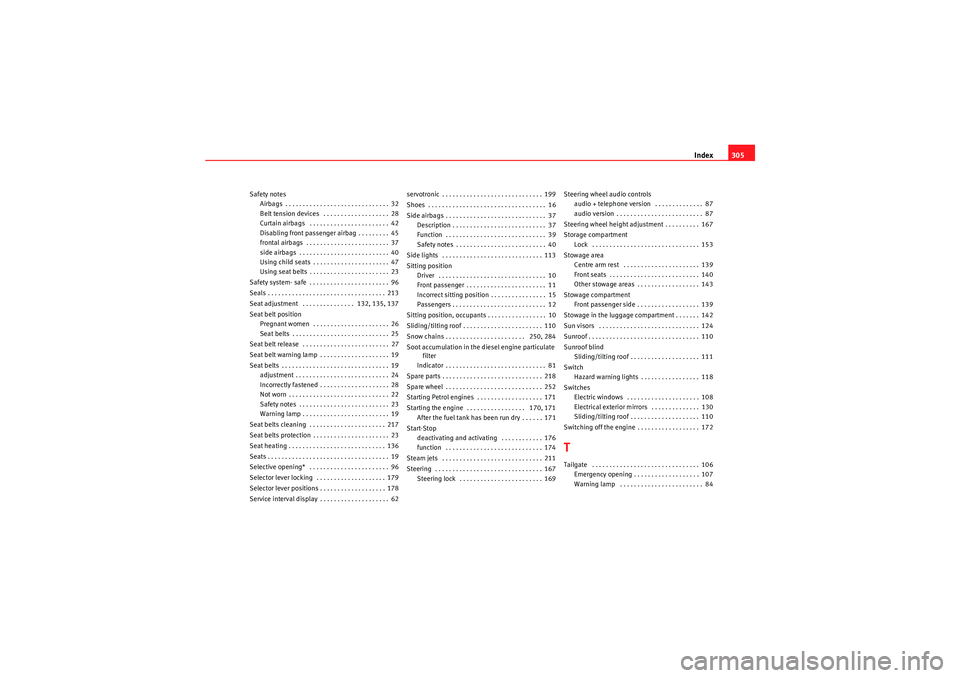
Index305
Safety notes
Airbags . . . . . . . . . . . . . . . . . . . . . . . . . . . . . . 32
Belt tension devices . . . . . . . . . . . . . . . . . . . 28
Curtain airbags . . . . . . . . . . . . . . . . . . . . . . . 42
Disabling front passenger airbag . . . . . . . . . 45
frontal airbags . . . . . . . . . . . . . . . . . . . . . . . . 37
side airbags . . . . . . . . . . . . . . . . . . . . . . . . . . 40
Using child seats . . . . . . . . . . . . . . . . . . . . . . 47
Using seat belts . . . . . . . . . . . . . . . . . . . . . . . 23
Safety system- safe . . . . . . . . . . . . . . . . . . . . . . . 96
Seals . . . . . . . . . . . . . . . . . . . . . . . . . . . . . . . . . . 213
Seat adjustment . . . . . . . . . . . . . . . 132, 135, 137
Seat belt position Pregnant women . . . . . . . . . . . . . . . . . . . . . . 26
Seat belts . . . . . . . . . . . . . . . . . . . . . . . . . . . . 25
Seat belt release . . . . . . . . . . . . . . . . . . . . . . . . . 27
Seat belt warning lamp . . . . . . . . . . . . . . . . . . . . 19
Seat belts . . . . . . . . . . . . . . . . . . . . . . . . . . . . . . . 19 adjustment . . . . . . . . . . . . . . . . . . . . . . . . . . . 24
Incorrectly fastened . . . . . . . . . . . . . . . . . . . . 28
Not worn . . . . . . . . . . . . . . . . . . . . . . . . . . . . . 22
Safety notes . . . . . . . . . . . . . . . . . . . . . . . . . . 23
Warning lamp . . . . . . . . . . . . . . . . . . . . . . . . . 19
Seat belts cleaning . . . . . . . . . . . . . . . . . . . . . . 217
Seat belts protection . . . . . . . . . . . . . . . . . . . . . . 23
Seat heating . . . . . . . . . . . . . . . . . . . . . . . . . . . . 136
Seats . . . . . . . . . . . . . . . . . . . . . . . . . . . . . . . . . . . 19
Selective opening* . . . . . . . . . . . . . . . . . . . . . . . 96
Selector lever locking . . . . . . . . . . . . . . . . . . . . 179
Selector lever positions . . . . . . . . . . . . . . . . . . . 178
Service interval display . . . . . . . . . . . . . . . . . . . . 62 servotronic . . . . . . . . . . . . . . . . . . . . . . . . . . . . . 199
Shoes . . . . . . . . . . . . . . . . . . . . . . . . . . . . . . . . . . 16
Side airbags . . . . . . . . . . . . . . . . . . . . . . . . . . . . . 37
Description . . . . . . . . . . . . . . . . . . . . . . . . . . . 37
Function . . . . . . . . . . . . . . . . . . . . . . . . . . . . . 39
Safety notes . . . . . . . . . . . . . . . . . . . . . . . . . . 40
Side lights . . . . . . . . . . . . . . . . . . . . . . . . . . . . . 113
Sitting position Driver . . . . . . . . . . . . . . . . . . . . . . . . . . . . . . . 10
Front passenger . . . . . . . . . . . . . . . . . . . . . . . 11
Incorrect sitting position . . . . . . . . . . . . . . . . 15
Passengers . . . . . . . . . . . . . . . . . . . . . . . . . . . 12
Sitting position, occupants . . . . . . . . . . . . . . . . . 10
Sliding/tilting roof . . . . . . . . . . . . . . . . . . . . . . . 110
Snow chains . . . . . . . . . . . . . . . . . . . . . . . 250, 284
Soot accumulation in the diesel engine particulate filter
Indicator . . . . . . . . . . . . . . . . . . . . . . . . . . . . . 81
Spare parts . . . . . . . . . . . . . . . . . . . . . . . . . . . . . 218
Spare wheel . . . . . . . . . . . . . . . . . . . . . . . . . . . . 252
Starting Petrol engines . . . . . . . . . . . . . . . . . . . 171
Starting the engine . . . . . . . . . . . . . . . . . 170, 171 After the fuel tank has been run dry . . . . . . 171
Start-Stop deactivating and activating . . . . . . . . . . . . 176
function . . . . . . . . . . . . . . . . . . . . . . . . . . . . 174
Steam jets . . . . . . . . . . . . . . . . . . . . . . . . . . . . . 211
Steering . . . . . . . . . . . . . . . . . . . . . . . . . . . . . . . 167 Steering lock . . . . . . . . . . . . . . . . . . . . . . . . 169 Steering wheel audio controls
audio + telephone version . . . . . . . . . . . . . . 87
audio version . . . . . . . . . . . . . . . . . . . . . . . . . 87
Steering wheel height adjustment . . . . . . . . . . 167
Storage compartment Lock . . . . . . . . . . . . . . . . . . . . . . . . . . . . . . . 153
Stowage area Centre arm rest . . . . . . . . . . . . . . . . . . . . . . 139
Front seats . . . . . . . . . . . . . . . . . . . . . . . . . . 140
Other stowage areas . . . . . . . . . . . . . . . . . . 143
Stowage compartment Front passenger side . . . . . . . . . . . . . . . . . . 139
Stowage in the luggage compartment . . . . . . . 142
Sun visors . . . . . . . . . . . . . . . . . . . . . . . . . . . . . 124
Sunroof . . . . . . . . . . . . . . . . . . . . . . . . . . . . . . . . 110
Sunroof blind Sliding/tilting roof . . . . . . . . . . . . . . . . . . . . 111
Switch Hazard warning lights . . . . . . . . . . . . . . . . . 118
Switches Electric windows . . . . . . . . . . . . . . . . . . . . . 108
Electrical exterior mirrors . . . . . . . . . . . . . . 130
Sliding/tilting roof . . . . . . . . . . . . . . . . . . . . 110
Switching off the engine . . . . . . . . . . . . . . . . . . 172
TTailgate . . . . . . . . . . . . . . . . . . . . . . . . . . . . . . . 106 Emergency opening . . . . . . . . . . . . . . . . . . . 107
Warning lamp . . . . . . . . . . . . . . . . . . . . . . . . 84
altea_EN Seite 305 Mittwoch, 26. August 2009 6:00 18
Page 308 of 310
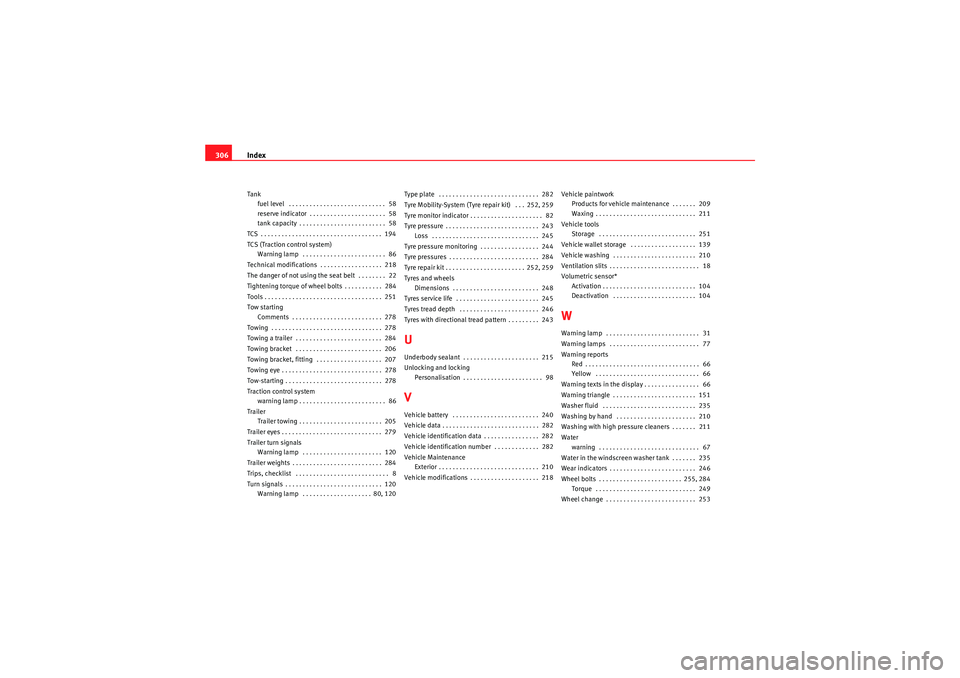
Index
306Tank
fuel level . . . . . . . . . . . . . . . . . . . . . . . . . . . . 58
reserve indicator . . . . . . . . . . . . . . . . . . . . . . 58
tank capacity . . . . . . . . . . . . . . . . . . . . . . . . . 58
TCS . . . . . . . . . . . . . . . . . . . . . . . . . . . . . . . . . . . 194
TCS (Traction control system) Warning lamp . . . . . . . . . . . . . . . . . . . . . . . . 86
Technical modifications . . . . . . . . . . . . . . . . . . 218
The danger of not using the seat belt . . . . . . . . 22
Tightening torque of wheel bolts . . . . . . . . . . . 284
Tools . . . . . . . . . . . . . . . . . . . . . . . . . . . . . . . . . . 251
Tow starting Comments . . . . . . . . . . . . . . . . . . . . . . . . . . 278
Towing . . . . . . . . . . . . . . . . . . . . . . . . . . . . . . . . 278
Towing a trailer . . . . . . . . . . . . . . . . . . . . . . . . . 284
Towing bracket . . . . . . . . . . . . . . . . . . . . . . . . . 206
Towing bracket, fitting . . . . . . . . . . . . . . . . . . . 207
Towing eye . . . . . . . . . . . . . . . . . . . . . . . . . . . . . 278
Tow-starting . . . . . . . . . . . . . . . . . . . . . . . . . . . . 278
Traction control system warning lamp . . . . . . . . . . . . . . . . . . . . . . . . . 86
Trailer Trailer towing . . . . . . . . . . . . . . . . . . . . . . . . 205
Trailer eyes . . . . . . . . . . . . . . . . . . . . . . . . . . . . . 279
Trailer turn signals Warning lamp . . . . . . . . . . . . . . . . . . . . . . . 120
Trailer weights . . . . . . . . . . . . . . . . . . . . . . . . . . 284
Trips, checklist . . . . . . . . . . . . . . . . . . . . . . . . . . . 8
Turn signals . . . . . . . . . . . . . . . . . . . . . . . . . . . . 120 Warning lamp . . . . . . . . . . . . . . . . . . . . 80, 120 Type plate . . . . . . . . . . . . . . . . . . . . . . . . . . . . . 282
Tyre Mobility-System (Tyre repair kit) . . . 252, 259
Tyre monitor indicator . . . . . . . . . . . . . . . . . . . . . 82
Tyre pressure . . . . . . . . . . . . . . . . . . . . . . . . . . . 243
Loss . . . . . . . . . . . . . . . . . . . . . . . . . . . . . . . 245
Tyre pressure monitoring . . . . . . . . . . . . . . . . . 244
Tyre pressures . . . . . . . . . . . . . . . . . . . . . . . . . . 284
Tyre repair kit . . . . . . . . . . . . . . . . . . . . . . . 252, 259
Tyres and wheels Dimensions . . . . . . . . . . . . . . . . . . . . . . . . . 248
Tyres service life . . . . . . . . . . . . . . . . . . . . . . . . 245
Tyres tread depth . . . . . . . . . . . . . . . . . . . . . . . 246
Tyres with directional tread pattern . . . . . . . . . 243
UUnderbody sealant . . . . . . . . . . . . . . . . . . . . . . 215
Unlocking and locking Personalisation . . . . . . . . . . . . . . . . . . . . . . . 98VVehicle battery . . . . . . . . . . . . . . . . . . . . . . . . . 240
Vehicle data . . . . . . . . . . . . . . . . . . . . . . . . . . . . 282
Vehicle identification data . . . . . . . . . . . . . . . . 282
Vehicle identification number . . . . . . . . . . . . . 282
Vehicle MaintenanceExterior . . . . . . . . . . . . . . . . . . . . . . . . . . . . . 210
Vehicle modifications . . . . . . . . . . . . . . . . . . . . 218 Vehicle paintwork
Products for vehicle maintenance . . . . . . . 209
Waxing . . . . . . . . . . . . . . . . . . . . . . . . . . . . . 211
Vehicle tools Storage . . . . . . . . . . . . . . . . . . . . . . . . . . . . 251
Vehicle wallet storage . . . . . . . . . . . . . . . . . . . 139
Vehicle washing . . . . . . . . . . . . . . . . . . . . . . . . 210
Ventilation slits . . . . . . . . . . . . . . . . . . . . . . . . . . 18
Volumetric sensor* Activation . . . . . . . . . . . . . . . . . . . . . . . . . . . 104
Deactivation . . . . . . . . . . . . . . . . . . . . . . . . 104
WWarning lamp . . . . . . . . . . . . . . . . . . . . . . . . . . . 31
Warning lamps . . . . . . . . . . . . . . . . . . . . . . . . . . 77
Warning reportsRed . . . . . . . . . . . . . . . . . . . . . . . . . . . . . . . . . 66
Yellow . . . . . . . . . . . . . . . . . . . . . . . . . . . . . . 66
Warning texts in the display . . . . . . . . . . . . . . . . 66
Warning triangle . . . . . . . . . . . . . . . . . . . . . . . . 151
Washer fluid . . . . . . . . . . . . . . . . . . . . . . . . . . . 235
Washing by hand . . . . . . . . . . . . . . . . . . . . . . . 210
Washing with high pressure cleaners . . . . . . . 211
Water warning . . . . . . . . . . . . . . . . . . . . . . . . . . . . . 67
Water in the windscreen wash er tank . . . . . . . 235
Wear indicators . . . . . . . . . . . . . . . . . . . . . . . . . 246
Wheel bolts . . . . . . . . . . . . . . . . . . . . . . . . 255, 284 Torque . . . . . . . . . . . . . . . . . . . . . . . . . . . . . 249
Wheel change . . . . . . . . . . . . . . . . . . . . . . . . . . 253
altea_EN Seite 306 Mittwoch, 26. August 2009 6:00 18