engine Seat Altea 2011 Owners Manual
[x] Cancel search | Manufacturer: SEAT, Model Year: 2011, Model line: Altea, Model: Seat Altea 2011Pages: 317, PDF Size: 8.87 MB
Page 273 of 317
If and when271
Safety First
Operating Instructions
Practical Tips
Technical Specifications
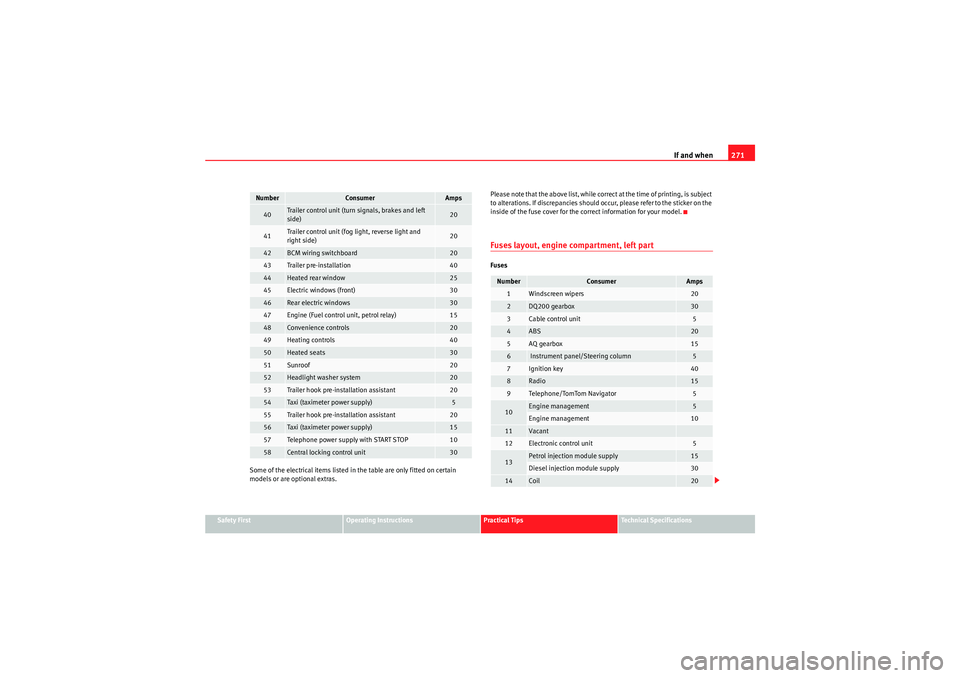
Some of the electrical items listed in the table are only fitted on certain
models or are optional extras. Please note that the above list, while correct at the time of printing, is subject
to alterations. If discrepancies should occur, please refer to the sticker on the
inside of the fuse cover for the correct information for your model.
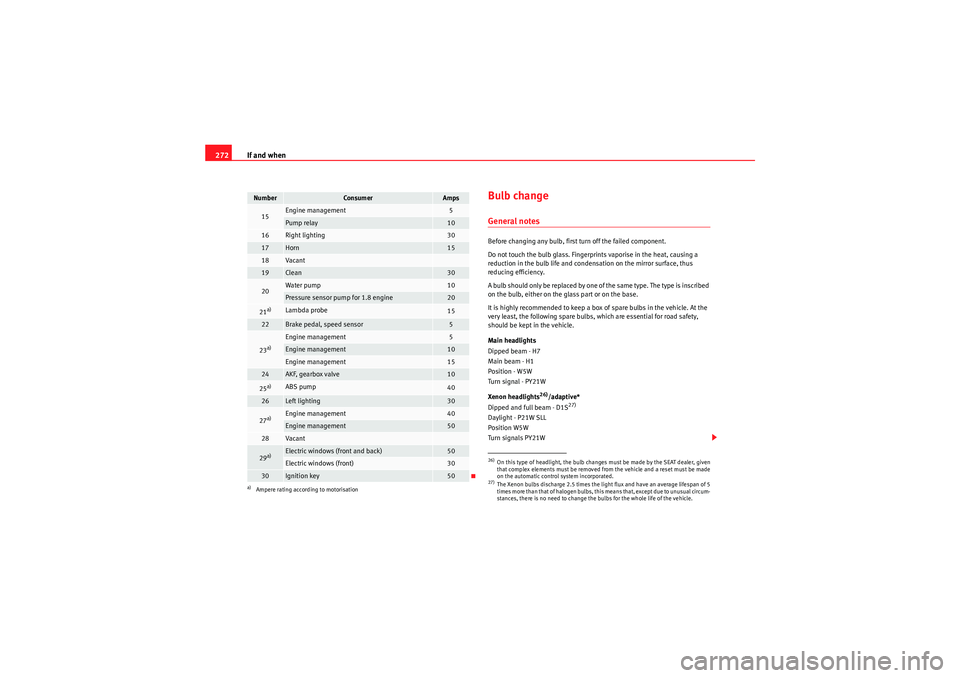
Fuses layout, engine compartment, left partFuses
40
Trailer control unit (turn signals, brakes and left
side)
20
41
Trailer control unit (fog light, reverse light and
right side)
20
42
BCM wiring switchboard
20
43
Trailer pre-installation
40
44
Heated rear window
25
45
Electric windows (front)
30
46
Rear electric windows
30
47
Engine (Fuel control unit, petrol relay)
15
48
Convenience controls
20
49
Heating controls
40
50
Heated seats
30
51
Sunroof
20
52
Headlight washer system
20
53
Trailer hook pre-installation assistant
20
54
Taxi (taximeter power supply)
5
55
Trailer hook pre-installation assistant
20
56
Taxi (taximeter power supply)
15
57
Telephone power supply with START STOP
10
58
Central locking control unit
30
Number
Consumer
Amps
Number
Consumer
Amps
1
Windscreen wipers
20
2
DQ200 gearbox
30
3
Cable control unit
5
4
ABS
20
5
AQ gearbox
15
6
Instrument panel/Steering column
5
7
Ignition key
40
8
Radio
15
9
Te lep ho ne /TomTo m Na viga tor
5
10
Engine management
5
Engine management
10
11
Vacant
12
Electronic control unit
5
13
Petrol injection module supply
15
Diesel injection module supply
30
14
Coil
20
Altea_EN.book Seite 271 Donnerstag, 2. September 2010 2:00 14
Page 274 of 317
If and when
272
Bulb changeGeneral notesBefore changing any bulb, first turn off the failed component.
Do not touch the bulb glass. Fingerprints vaporise in the heat, causing a
reduction in the bulb life and condensation on the mirror surface, thus
reducing efficiency.
A bulb should only be replaced by one of the same type. The type is inscribed
on the bulb, either on the glass part or on the base.
It is highly recommended to keep a box of spare bulbs in the vehicle. At the
very least, the following spare bulbs, which are essential for road safety,
should be kept in the vehicle.
Main headlights
Dipped beam - H7
Main beam - H1
Position - W5W
Turn signal - PY21W
Xenon headlights
26)/adaptive*
Dipped and full beam - D1S
27)
Daylight - P21W SLL
Position W5W
Turn signals PY21W
15
Engine management
5
Pump relay
10
16
Right lighting
30
17
Horn
15
18
Vacan t
19
Clean
30
20
Water pump
10
Pressure sensor pump for 1.8 engine
20
21a)
Lambda probe
15
22
Brake pedal, speed sensor
5
23a)
Engine management
5
Engine management
10
Engine management
15
24
AKF, gearbox valve
10
25a)
ABS pump
40
26
Left lighting
30
27a)
Engine management
40
Engine management
50
28
Vacan t
29a)
Electric windows (front and back)
50
Electric windows (front)
30
30
Ignition key
50
a)Ampere rating according to motorisationNumber
Consumer
Amps
26)On this type of headlight, the bulb changes must be made by the SEAT dealer, given
that complex elements must be removed from the vehicle and a reset must be made
on the automatic control system incorporated.27)The Xenon bulbs discharge 2.5 times the light flux and have an average lifespan of 5
times more than that of halogen bulbs, this means that, except due to unusual circum-
stances, there is no need to change the bulbs for the whole life of the vehicle.
Altea_EN.book Seite 272 Donnerstag, 2. September 2010 2:00 14
Page 283 of 317
If and when281
Safety First
Operating Instructions
Practical Tips
Technical Specifications
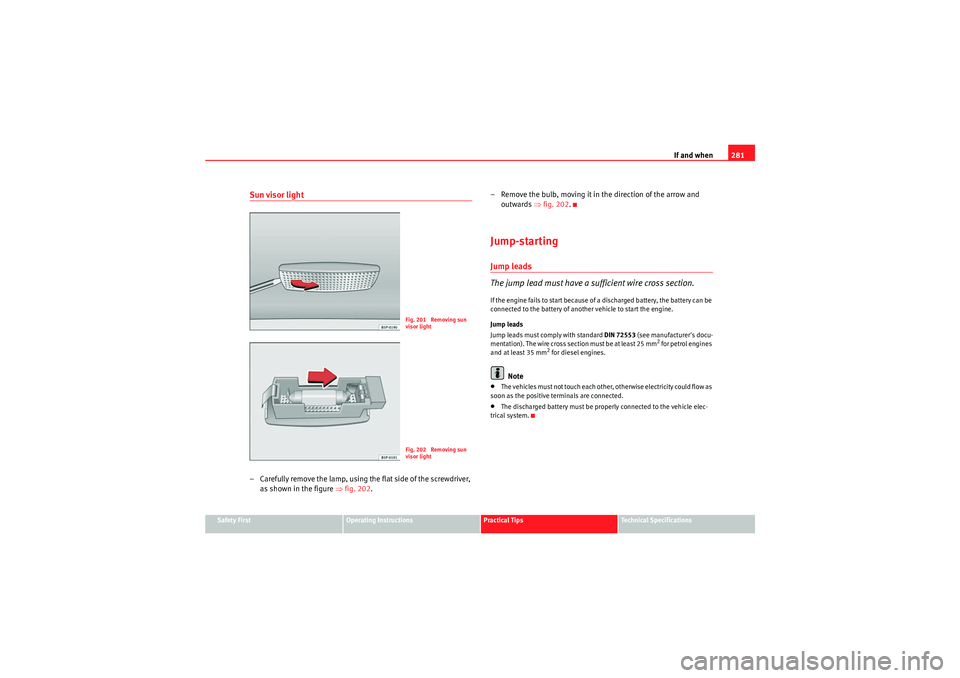
Sun visor light– Carefully remove the lamp, using the flat side of the screwdriver,
as shown in the figure ⇒fig. 202 . – Remove the bulb, moving it in the direction of the arrow and
outwards ⇒fig. 202 .
Jump-startingJump leads
The jump lead must have a su fficient wire cross section.If the engine fails to start because of a discharged battery, the battery can be
connected to the battery of another vehicle to start the engine.
Jump leads
Jump leads must comply with standard DIN 72553 (see manufacturer's docu-
mentation). The wire cross section must be at least 25 mm
2 for petrol engines
and at least 35 mm
2 for diesel engines.
Note
•The vehicles must not touch each other, otherwise electricity could flow as
soon as the positive terminals are connected.•The discharged battery must be properly connected to the vehicle elec-
trical system.
Fig. 201 Removing sun
visor lightFig. 202 Removing sun
visor light
Altea_EN.book Seite 281 Donnerstag, 2. September 2010 2:00 14
Page 284 of 317
If and when
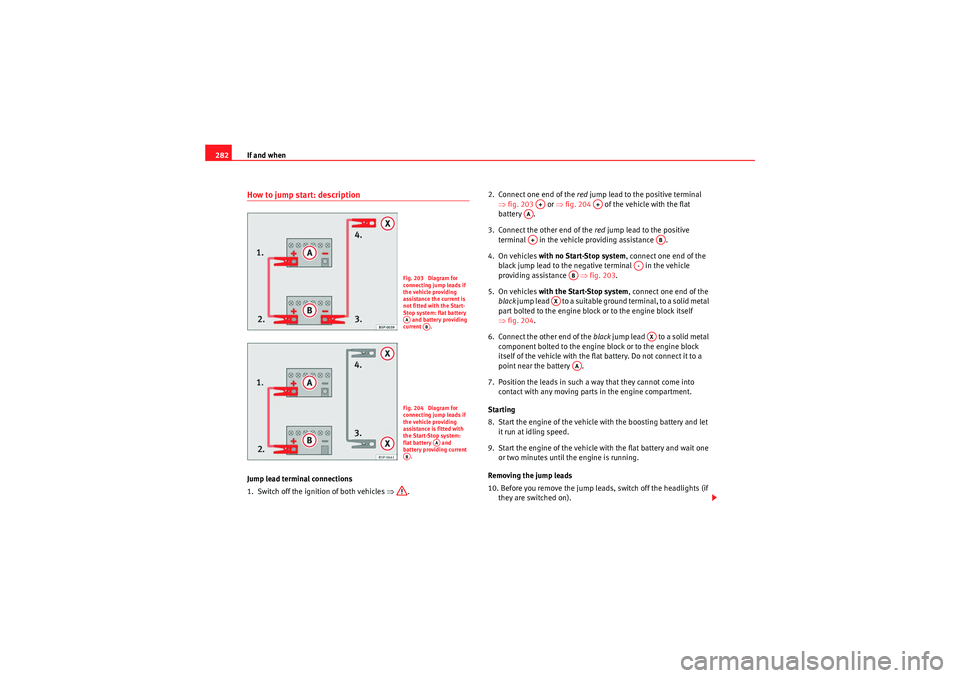
282How to jump start: descriptionJump lead terminal connections
1. Switch off the ignition of both vehicles ⇒. 2. Connect one end of the
red jump lead to the positive terminal
⇒ fig. 203 or ⇒fig. 204 of the vehicle with the flat
battery .
3. Connect the other end of the red jump lead to the positive
terminal in the vehicle providing assistance .
4. On vehicles with no Start-Stop system , connect one end of the
black jump lead to the negative terminal in the vehicle
providing assistance ⇒fig. 203 .
5. On vehicles with the Start-Stop system , connect one end of the
black jump lead to a suitable ground terminal, to a solid metal
part bolted to the engine block or to the engine block itself
⇒ fig. 204 .
6. Connect the other end of the black jump lead to a solid metal
component bolted to the engine block or to the engine block
itself of the vehicle with the flat battery. Do not connect it to a
point near the battery .
7. Position the leads in such a way that they cannot come into contact with any moving parts in the engine compartment.
Starting
8. Start the engine of the vehicle with the boosting battery and let it run at idling speed.
9. Start the engine of the vehicle with the flat battery and wait one or two minutes until the engine is running.
Removing the jump leads
10. Before you remove the jump leads, switch off the headlights (if they are switched on).
Fig. 203 Diagram for
connecting jump leads if
the vehicle providing
assistance the current is
not fitted with the Start-
Stop system: flat battery and battery providing
current .AA
AB
Fig. 204 Diagram for
connecting jump leads if
the vehicle providing
assistance is fitted with
the Start-Stop system:
flat battery and
battery providing current .
AA
AB
A+
A+
AAA+
AB
A-
AB
AX
AX
AA
Altea_EN.book Seite 282 Donnerstag, 2. September 2010 2:00 14
Page 285 of 317
If and when283
Safety First
Operating Instructions
Practical Tips
Technical Specifications
11. Turn on the heater blower and heated rear window in the vehicle
with the flat battery. This helps minimise voltage peaks which are
generated when the leads are disconnected.
12. When the engine is running, disconnect the leads in reverse order to the details given above.Connect the battery clamps so they have good metal-to-metal contact with
the battery terminals.
If the engine fails to start, switch off the starter after about 10 seconds and
try again after about half a minute.
WARNING
•Please note the safety warnings referring to working in the engine
compartment ⇒page 232, “Working in the engine compartment”.•The battery providing assistance must have the same voltage as the flat
battery (12V) and approximately the same capacity (see imprint on
battery). Failure to comply could result in an explosion.•Never use jump leads when one of the batteries is frozen. Danger of
explosion! Even after the battery has thawed, battery acid could leak and
cause chemical burns. If a battery freezes, it should be replaced.•Keep sparks, flames and lighted cigarettes away from batteries, danger
of explosion. Failure to comply could result in an explosion.•Observe the instructions provided by the manufacturer of the jump
leads.•Do not connect the negative cable from the other vehicle directly to the
negative terminal of the flat battery. The gas emitted from the battery could
be ignited by sparks. Danger of explosion.•Do not attach the negative cable from the other vehicle to parts of the
fuel system or to the brake line.
•The non-insulated parts of the battery clamps must not be allowed to
touch. The jump lead attached to the positive battery terminal must not
touch metal parts of the vehicle, this can cause a short circuit.•Position the leads in such a way that they cannot come into contact
with any moving parts in the engine compartment.•Do not bend over the batteries. This could result in chemical burns.Note
The vehicles must not touch each other, otherwise electricity could flow as
soon as the positive terminals are connected.
WARNING (continued)
Altea_EN.book Seite 283 Donnerstag, 2. September 2010 2:00 14
Page 286 of 317
If and when
284Towing and tow-startingTo w - s t a r t i n g
The use of jump leads is preferable to tow-starting.We recommend that you do not tow-start your vehicle. Jump-starting
is preferable ⇒ page 281.
However, if your vehicle has to be tow-started:
– Engage the 2nd or the 3rd gear.
– Keep the clutch pressed down.
– Switch the ignition on.
– Once both vehicles are moving, release the clutch.
– As soon as the engine starts, press the clutch and move the gear lever into neutral. This helps to prevent driving into the towing
vehicle.
WARNING
The risk of accidents is high when tow-starting. The vehicle being towed
can easily collide with the towing vehicle.
Caution
When tow-starting, fuel could enter the catalytic converter and damage it.
General notesPlease observe the following points if you use a tow-rope:
Notes for the driver of the towing vehicle
– Drive slowly at first until the tow-rope is taut. Then accelerate gradually.
– Begin and change gears cautiously. If you are driving an auto- matic vehicle, accelerate gently.
– Remember that the brake servo and power steering are not working in the vehicle you are towing. Brake sooner than normal
and pressing the pedal gently.
Notes for the driver of the towed vehicle
– Ensure that the tow-rope remains taut at all times when towing.Tow-rope or tow-bar
It is easier and safer to tow a vehicle with a tow-bar. You should only use a
tow-rope if you do not have a tow-bar.
A tow-rope should be slightly elastic to reduce the loading on both vehicles.
It is advisable to use a tow-rope made of synthetic fibre or similarly elastic
material.
Attach the tow-rope or the tow-bar only to the towing eyes provided or a
towing bracket.
Driving style
Towing requires some experience, especially when using a tow-rope. Both
drivers should be familiar with the technique required for towing. Inexperi-
enced drivers should not attempt to tow.
Altea_EN.book Seite 284 Donnerstag, 2. September 2010 2:00 14
Page 287 of 317
If and when285
Safety First
Operating Instructions
Practical Tips
Technical Specifications
Do not pull too hard with the towing vehicle and take care to avoid jerking the
tow-rope. When towing on an unpaved road, there is always a risk of over-
loading and damaging the anchorage points.
The ignition of the vehicle being towed must be switched on to prevent the
steering wheel from locking and also to allow the use of the turn signals,
horn, windscreen wipers and washers.
As the brake servo does not work if the engine is not running, you must apply
considerably more pressure to the brake pedal than you normally would.
As the power assisted steering does not work if the engine is not running, you
will need more strength to steer than you normally would.
Towing vehicles with an automatic gearbox
•Put the selector lever into position “N”.•Do not drive faster than 50 km/h.•Do not tow further than 50 km.•If a breakdown vehicle is used, the vehicle must be towed with the front
wheels raised.Note
•Observe legal requirements when towing or tow-starting.•Switch on the hazard warning lights of both vehicles. However, observe
any regulations to the contrary.•For technical reasons, vehicles with an automatic gearbox must not be
tow-started.•If damage to your vehicle means that there is no lubricant in the gearbox,
you must raise the drive wheels while the vehicle is being towed.•If the vehicle has to be towed more than 50 km, the front wheels should
be raised during towing, and towing should be carried out by a qualified
person.
•The steering wheel is locked when the vehicle has no electrical power. The
vehicle must then be towed with the front wheels raised. Towing should be
carried out by a qualified person.•The towing eye should always be kept in the vehicle. Please refer to the
notes on ⇒page 284, “Tow-starting”.
Altea_EN.book Seite 285 Donnerstag, 2. September 2010 2:00 14
Page 289 of 317
Description of specifications287
Safety First
Operating Instructions
Practical Tips
Technical Specifications
Technical SpecificationsDescription of specificationsImportant informationImportant
The information in the vehicle documentation always has
precedence.All technical specifications provided in this manual are valid for the standard
model in Spain. The vehicle data card included in the Maintenance
Programme or the vehicle registration documents shows which engine is
installed in the vehicle.
The figures may be different depending on if additional equipment is fitted,
for different models, for special vehicles and for other countries. Abbreviations used in the Technical Specifications section
Abbrevia-
tion
Meaning
kW
Kilowatt, engine power measurement.
PS
Pferdestärke (horsepower), formerly used to denote engine
power.
rpm
Revolutions per minute - engine speed.
Nm
Newton metres, unit of engine torque.
l/100 km
Fuel consumption in litres per 100 km.
g/km
Carbon dioxide emissions in grams per km travelled.
CO2
Carbon dioxide
CN
Cetane number, indication of the diesel combustion power.
RON
Research octane number, indication of the knock resistance
of petrol.
Altea_EN.book Seite 287 Donnerstag, 2. September 2010 2:00 14
Page 290 of 317
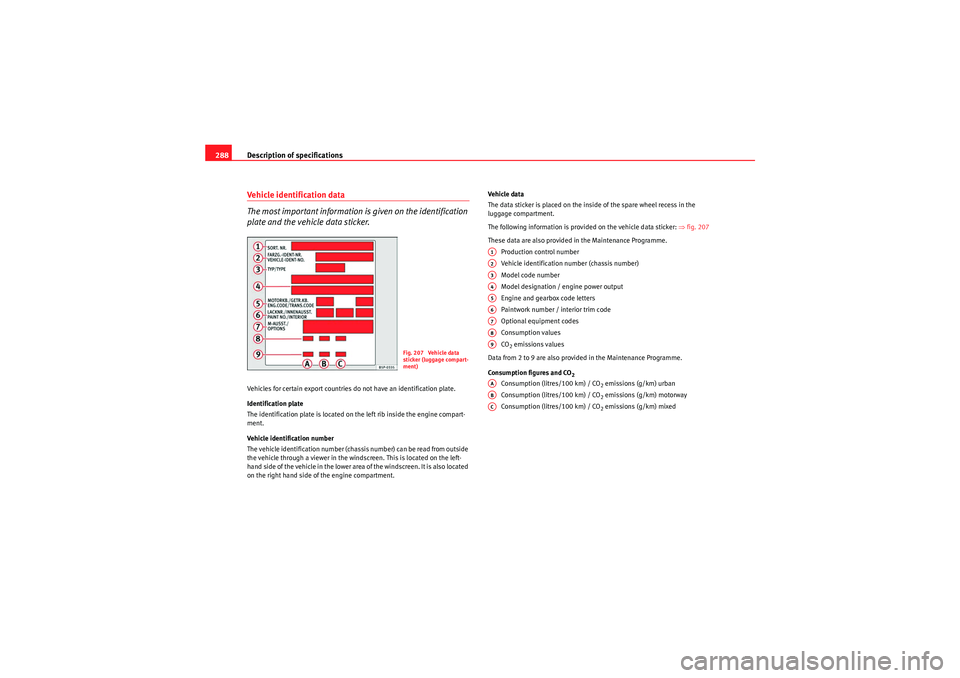
Description of specifications
288Vehicle identification data
The most important information is given on the identification
plate and the vehicle data sticker.Vehicles for certain export countries do not have an identification plate.
Identification plate
The identification plate is located on the left rib inside the engine compart-
ment.
Vehicle identification number
The vehicle identification number (chassis number) can be read from outside
the vehicle through a viewer in the windscreen. This is located on the left-
hand side of the vehicle in the lower area of the windscreen. It is also located
on the right hand side of the engine compartment. Vehicle data
The data sticker is placed on the inside of the spare wheel recess in the
luggage compartment.
The following information is provided on the vehicle data sticker:
⇒fig. 207
These data are also provided in the Maintenance Programme. Production control number
Vehicle identification number (chassis number)
Model code number
Model designation / engine power output
Engine and gearbox code letters
Paintwork number / interior trim code
Optional equipment codes
Consumption values
CO
2 emissions values
Data from 2 to 9 are also provided in the Maintenance Programme.
Consumption figures and CO
2
Consumption (litres/100 km) / CO
2 emissions (g/km) urban
Consumption (litres/100 km) / CO2 emissions (g/km) motorway
Consumption (litres/100 km) / CO2 emissions (g/km) mixed
Fig. 207 Vehicle data
sticker (luggage compart-
ment)
A1A2A3A4A5A6A7A8A9AAABAC
Altea_EN.book Seite 288 Donnerstag, 2. September 2010 2:00 14
Page 291 of 317
Description of specifications289
Safety First
Operating Instructions
Practical Tips
Technical Specifications
Information on fuel consumptionFuel consumption
The consumption and emission details shown on the vehicle
data sticker differ from one vehicle to another.The fuel consumption and CO
2 emissions of the vehicle can be found on the
vehicle data sticker.
The fuel consumption and emissions figures given are based on the vehicle
weight category, which is determined according to the engine/gearbox
combination and the equipment fitted.
The consumption and emission figures are calculated in accordance with the
tests indicated in regulations 715/2007/EC and 692/2008/EC.
Note
•Actual consumption may vary from quoted test values, depending on
personal driving style, road and traffic conditions, the weather and the
vehicle condition.WeightsKerb weight refers to the basic model with a fuel tank filled to 90% capacity
and without optional extras. The figure quoted includes 75 kg to allow for the
weight of the driver.
For special versions and optional equipment fittings or for the addition of
accessories, the weight of the vehicle will increase ⇒.
WARNING
•Please note that the centre of gravity may shift when transporting
heavy objects; this may affect the vehicle’s handling and lead to an acci-
dent. Always adjust your speed and driving style to suit road conditions
and requirements.•Never exceed the gross axle weight rating or the gross vehicle weight
rating. If the allowed axle load or the allowed total weight is exceeded, the
driving characteristics of the vehicle may change, leading to accidents,
injuries and damage to the vehicle.
To w i n g a t r a i l e rTrailer weightsTrailer weight
The trailer weights and drawbar loads approved are selected in intensive
trials according to precisely defined criteria. The approved trailer weights are
valid for vehicles in the EU for maximum speeds of 80 km/h (in certain
circumstances up to 100 km/h). The figures may be different in other coun-
tries. All data in the official vehicle documents take precedence over these
data ⇒ .
Drawbar load
The maximum permitted drawbar load on the ball joint of the towing bracket
must not exceed 75 kg.
In the interest of road safety, we recommend that you always tow
approaching the maximum drawbar load. The response of the trailer on the
road will be poor if the drawbar load is too small.
Altea_EN.book Seite 289 Donnerstag, 2. September 2010 2:00 14