ABS Seat Altea 2011 User Guide
[x] Cancel search | Manufacturer: SEAT, Model Year: 2011, Model line: Altea, Model: Seat Altea 2011Pages: 317, PDF Size: 8.87 MB
Page 199 of 317
Intelligent technology197
Safety First
Operating Instructions
Practical Tips
Technical Specifications
Practical TipsIntelligent technologyBrakesBrake servoThe brake servo increases the pressure you apply to the brake pedal. It works
only when the engine is running .
If the brake servo is not functioning due to a malfunction, or if the vehicle has
to be towed, you will have to press the brake pedal considerably harder to
make up for the lack of servo assistance.
WARNING
The braking distance can also be affected by external factors.•Never let the vehicle coast with the engine switched off. Failure to do so
could result in an accident. The braking distance is increased considerably
when the brake servo is not active.•If the brake servo is not working, for example when the vehicle is being
towed, you will have to press the brake pedal considerably harder than
normal.
Hydraulic Brake Assist (HBA)*
The Hydraulic Brake Assist function (HBA) is only included in
vehicles with ESP.In an emergency, most drivers brake in time, but not with maximum force.
This results in unnecessarily long braking distances.
This is when the brake assist system comes into action. When pressing the
brake pedal rapidly, the assistant interprets it as an emergency. It then very
quickly builds up the full brake pressure so that the ABS can be activated
more quickly and efficiently, thus reducing the braking distance.
Do not reduce the pressure on the brake pedal. The brake assist system
switches off automatically as soon as you release the brake.
Emergency braking warning
If the vehicle is braked suddenly and continuously at a speed of more than 80
km/h, the brake light flashes several times per second to warn vehicles
driving behind. If you continue braking, the hazard warning lights will come
on automatically when the vehicle comes to a standstill. They switch off auto-
matically when the vehicle starts to move again.
WARNING
•The risk of accident is higher if you drive too fast, if you do not keep
your distance to the vehicle in front, and when the road surface is slippery
or wet. The increased accident risk cannot be reduced by the brake assist
system.
Altea_EN.book Seite 197 Donnerstag, 2. September 2010 2:00 14
Page 200 of 317
Intelligent technology
198•The brake assist system cannot defy the laws of physics. Slippery and
wet roads are dangerous even with the brake assist system! Therefore, it is
essential that you adjust your speed to suit the road and traffic conditions.
Do not let the extra safety features tempt you into taking any risks when
driving.
Anti-lock brake system and traction control
M-ABS (ABS and TCS)Anti-lock brake system (ABS)
The anti-lock brake system prevents the wheels locking
during braking.The anti-lock brake system (ABS) is an important part of the vehicle’s active
safety system.
How the ABS works
If one of the wheels is turns too slowly in relation to the road speed, and is
close to locking, the system will reduce the braking pressure for this wheel.
The driver is made aware of this control process by a pulsating of the brake
pedal and audible noise. This is a deliberate warning to the driver that one or
more of the wheels is tending to lock and the ABS control function has inter-
vened. In this situation it is important to keep the brake pedal fully depressed
so the ABS can regulate the brake application. Do not “pump”.
If you brake hard on a slippery road surface, the best possible control is
retained as the wheels do not lock. However, ABS will not necessarily gu
arantee shorter braking distances in all
conditions. The braking distance could even be longer if you brake on gravel
or on fresh snow covering a slippery surface.
WARNING
•The anti-lock brake system cannot defy the laws of physics. Slippery
and wet roads are dangerous even with ABS! If you notice that the ABS is
working (to counteract locked wheels under braking), you should reduce
speed immediately to suit the road and traffic conditions. Do not let the
extra safety features tempt you into taking any risks when driving.•The effectiveness of ABS is also determined by the tyres fitted
⇒ page 249.•If the running gear or brakes are modified, the effectiveness of the ABS
could be severely limited.
Traction control system (TCS)
The traction control system prevents the drive wheels from
spinning when the vehicle is accelerating.Description and operation of the traction control system during acceleration
(TCS)
TCS reduces engine power to help prevent the drive wheels of front-wheel
drive vehicles losing traction during acceleration. The system works in the
entire speed range in conjunction with ABS. If a malfunction occurs in the
ABS, the TCS will also be inoperative.
TCS helps the vehicle to start moving, accelerate and climb a gradient in slip-
pery conditions where this may otherwise be difficult or even impossible.
T h e T C S i s s wi tch e d o n a u t o m a t i ca ll y w h e n t h e e n g i n e i s s t a r te d . I f n e ce s sa r y,
it may be turned on or off pushing the button on the centre console.
WARNING (continued)
Altea_EN.book Seite 198 Donnerstag, 2. September 2010 2:00 14
Page 201 of 317
Intelligent technology199
Safety First
Operating Instructions
Practical Tips
Technical Specifications
When the TCS is off, the warning lamp is lit. The TCS should normally
be left on. Only in exceptional circumstances, when the slipping of the wheels
is required, should it be disconnected, for example
•With compact temporary spare wheel.•When using the snow chains.•When driving in deep snow or on loose surfaces•When the vehicle is bogged-down, to free it by rocking.
The TCS should be switched on again as soon as possible.WARNING
•It must be remembered that TCS cannot defy the laws of physics. This
should be kept in mind, particularly on slippery and wet roads and when
towing a trailer.•Always adapt your driving style to suit the condition of the roads and
the traffic situation. Do not let the extra safety afforded by TCS tempt you
into taking any risks when driving, this can cause accidents.Caution
•In order to ensure that TCS function correctly, all four wheels must be
fitted with the same tyres. Any differences in the rolling radius of the tyres can
cause the system to reduce engine power when this is not desired.•Modifications to the vehicle (e.g. to the engine, the brake system, running
gear or any components affecting the wheels and tyres) could affect the effi-
ciency of the ABS and TCS.
XDS*
Driveshaft differentialWhen taking a bend, the driveshaft differential mechanism allows the outer
wheel to turn at a higher speed than the inner wheel. In this way, the wheel
that is turning faster (outer wheel) receives less drive torque than the inner
wheel. This may mean that in certain situations the torque delivered to the
inner wheel is too high, causing the wheels to spin. On the other hand, the
outer wheel is receiving a lower drive torque than it could transmit. This
causes an overall loss of lateral grip on the front axle, resulting in understeer
or “lengthening” of the trajectory.
By using the ESP sensors and signals, the XDS system is able to detect and
correct this effect.
Through the ESP, the XDS brakes the inner wheel, thereby counteracting the
excess drive torque in this wheel. This means that the driver’s desired trajec-
tory is much more precise,
The XDS system operates in combination with the ESP and is always active,
even when the traction control, TCS, is disconnected.Electronic Stability Programme (ESP)*General notes
The Electronic Stability Programme increases the vehicle’s
stability on the road.The Electronic Stability Programme helps reduce the danger of skidding.
The Electronic Stability Programme (ESP) consists of ABS, EDL, TCS and
Steering manoeuvre recommendations.
OFF
Altea_EN.book Seite 199 Donnerstag, 2. September 2010 2:00 14
Page 202 of 317
Intelligent technology
200Electronic Stability Programme (ESP)*
ESP reduces the danger of skidding by braking the wheels individually.
The system uses the steering wheel angle and road speed to calculate the
changes of direction desired by the driver, and constantly compares them
with the actual behaviour of the vehicle. If the desired course is not being
maintained (for instance, if the vehicle is starting to skid), then the ESP
compensates automatically by braking the appropriate wheel.
The forces acting on the braked wheel bring the vehicle back to a stable
condition. If the vehicle tends to oversteer, the system will act on the front
wheel on the outside of the turn.
Steering manoeuvre recommendations
This is a complementary safety function included in the ESP This function aids
the driver to better stabilize the vehicle in a critical situation. For example, in
case of sudden braking surface with varied adherence, the vehicle will tend
to destabilise its trajectory to the right or to the left. In this case the ESP
recognizes the situation and helps the driver with a counter steering
manoeuvre from the power steering.
This function simply provides the driver with a recommended manoeuvre in
critical situations.
The vehicle does not steer itself with this function, the driver has full control
of the vehicle at all times.
WARNING
•It must be remembered that ESP cannot defy the laws of physics. This
should be kept in mind, particularly on slippery and wet roads and when
towing a trailer.•Always adapt your driving style to suit the condition of the roads and
the traffic situation. Do not let the extra safety afforded by ESP tempt you
into taking any risks when driving, as this can cause accidents.
Caution
•In order to ensure that ESP functions correctly, all four wheels must be
fitted with the same tyres. Any differences in the rolling radius of the tyres can
cause the system to reduce engine power when this is not desired.•Modifications to the vehicle (e.g. to the engine, the brake system, running
gear or any components affecting the wheels and tyres) could affect the effi-
ciency of the ABS, EDL, ESP and TCS.Anti-lock brake system (ABS)The anti-lock brake system prevents the wheels locking during braking
⇒ page 198.Electronic differential lock (EDL)*
The electronic differential lock helps prevent the loss of trac-
tion caused if one of the driven wheels starts spinning.EDL helps the vehicle to start moving, accelerate and climb a gradient in slip-
pery conditions where this may otherwise be difficult or even impossible.
The system will control the revolutions of the drive wheels using the ABS
sensors (in case of an EDL fault the warning lamp for ABS lights up)
⇒ page 84.
At speeds of up to approximately 80 km/h, it is able to balance out differ-
ences in the speed of the driven wheels of approximately 100 rpm caused by
a slippery road surface on one side of the vehicle. It does this by braking the
wheel which has lost traction and distributing more driving force to the other
driven wheel via the differential.
Altea_EN.book Seite 200 Donnerstag, 2. September 2010 2:00 14
Page 230 of 317
Checking and refilling levels
228
Refuelling with LPG
–Before refuelling, stop the engine and switch off the ignition.
–Open the tank flap.
– Before refuelling, please read the instructions on the pump.
– Unscrew the cap of the gas filler neck .
– Screw the required adapter on the gas filler neck .
– Refuel as indicated in the instructions on the pump.
–Unscrew the adapter .
– Screw on the cap of the gas filler neck .
– Close the tank flap.When the hose is removed from the tank, a small amount of LPG may spill out
⇒ . The LPG tank
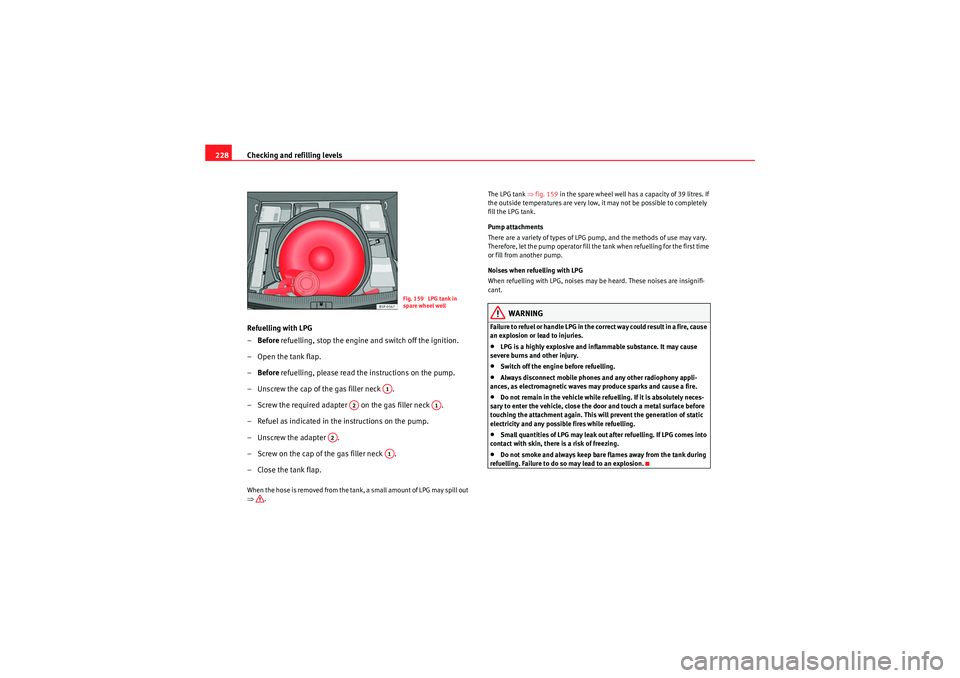
⇒fig. 159 in the spare wheel well has a capacity of 39 litres. If
the outside temperatures are very low, it may not be possible to completely
fill the LPG tank.
Pump attachments
There are a variety of types of LPG pump, and the methods of use may vary.
Therefore, let the pump operator fill the tank when refuelling for the first time
or fill from another pump.
Noises when refuelling with LPG
When refuelling with LPG, noises may be heard. These noises are insignifi-
cant.
WARNING
Failure to refuel or handle LPG in the correct way could result in a fire, cause
an explosion or lead to injuries.•LPG is a highly explosive and inflammable substance. It may cause
severe burns and other injury.•Switch off the engine before refuelling.•Always disconnect mobile phones and any other radiophony appli-
ances, as electromagnetic waves may produce sparks and cause a fire.•Do not remain in the vehicle while refuelling. If it is absolutely neces-
sary to enter the vehicle, close the door and touch a metal surface before
touching the attachment again. This will prevent the generation of static
electricity and any possible fires while refuelling.•Small quantities of LPG may leak out after refuelling. If LPG comes into
contact with skin, there is a risk of freezing.•Do not smoke and always keep bare flames away from the tank during
refuelling. Failure to do so may lead to an explosion.
Fig. 159 LPG tank in
spare wheel well
A1
A2
A1
A2
A1
Altea_EN.book Seite 228 Donnerstag, 2. September 2010 2:00 14
Page 247 of 317
Checking and refilling levels245
Safety First
Operating Instructions
Practical Tips
Technical Specifications
Brake fluidChecking the brake fluid level
The brake fluid is checked at the intervals given in the service
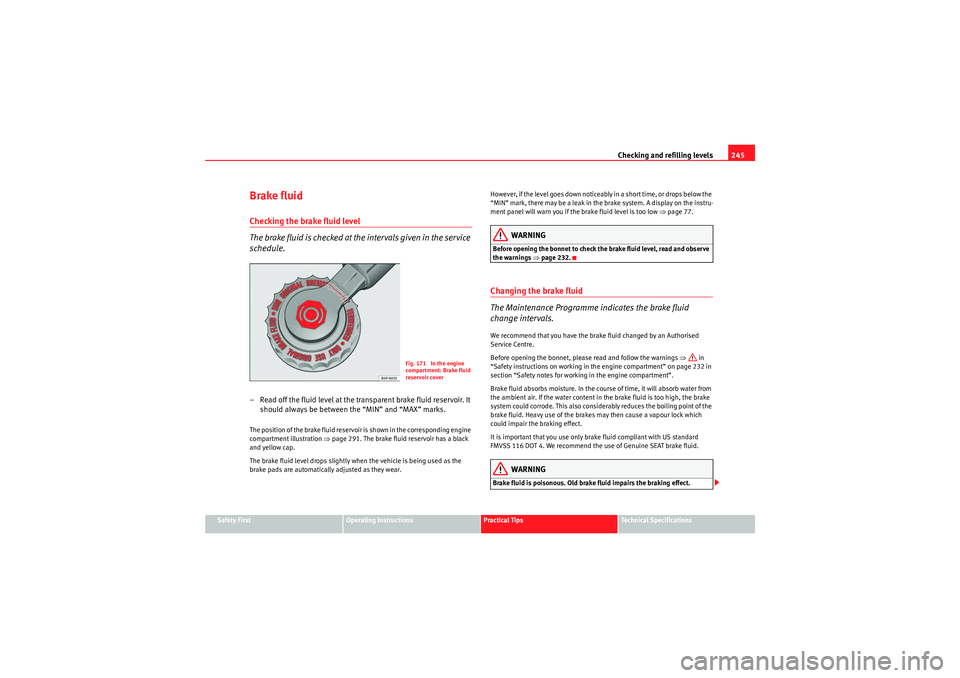
schedule.– Read off the fluid level at the transparent brake fluid reservoir. It
should always be between the “MIN” and “MAX” marks.The position of the brake fluid reservoir is shown in the corresponding engine
compartment illustration ⇒page 291. The brake fluid reservoir has a black
and yellow cap.
The brake fluid level drops slightly when the vehicle is being used as the
brake pads are automatically adjusted as they wear. However, if the level goes down noticeably in a short time, or drops below the
“MIN” mark, there may be a leak in the brake system. A display on the instru-
ment panel will warn you if the brake fluid level is too low
⇒page 77.
WARNING
Before opening the bonnet to check the brake fluid level, read and observe
the warnings ⇒page 232.Changing the brake fluid
The Maintenance Programme indicates the brake fluid
change intervals.We recommend that you have the brake fluid changed by an Authorised
Service Centre.
Before opening the bonnet, please read and follow the warnings ⇒ in
“Safety instructions on working in the engine compartment” on page 232 in
section “Safety notes for working in the engine compartment”.
Brake fluid absorbs moisture. In the course of time, it will absorb water from
the ambient air. If the water content in the brake fluid is too high, the brake
system could corrode. This also considerably reduces the boiling point of the
brake fluid. Heavy use of the brakes may then cause a vapour lock which
could impair the braking effect.
It is important that you use only brake fluid compliant with US standard
FMVSS 116 DOT 4. We recommend the use of Genuine SEAT brake fluid.
WARNING
Brake fluid is poisonous. Old brake fluid impairs the braking effect.
Fig. 171 In the engine
compartment: Brake fluid
reservoir cover
Altea_EN.book Seite 245 Donnerstag, 2. September 2010 2:00 14
Page 252 of 317

Wheels and tyres
250
2. The tyre pressures should only be checked when the tyres are cold. The slightly raised pressu res of warm tyres must not be
reduced.
3. Adjust the tyre pressure to the load you are carrying.Tyre pressure
The correct tyre pressure is especially important at high speeds. The pressure
should therefore be checked at least once a month and before starting a
journey.
The sticker with the tyre pressure values can be found on the inside of the
tank flap. The tyre pressure values given are for cold tyres. Do not reduce the
slightly raised pressures of warm tyres ⇒.
WARNING
•Check the tyre pressure at least once per month. Checking the tyre
pressure is very important. If the tyre pressure is too high or too low, there
is an increased danger of accidents - particularly at high speeds.•A tyre can easily burst if the pressure is too low, causing an accident!•At continuously high speeds, a tyre with insufficient pressure flexes
more. In this way it becomes too hot, and this can cause tread separation
and tyre blow-out. Always observe the recommended tyre pressures.•If the tyre pressure is too low or too high, the tyres will wear prema-
turely and the vehicle will not handle well. Risk of accident!For the sake of the environment
Under-inflated tyres will increase fuel consumption.
Tyre pressure monitoring
The tyre pressure monitoring system constantly checks the
pressure of the tyres.The system uses the speed sensors of the ABS wheels. It operates by
analysing the speed and frequency spectrum of each wheel.
For optimum performance, use genuine SEAT tyres. In addition, check and
adjust tyre pressures regularly.
Whenever the tyre pressures are changed or one or more tyres are changed,
the system should be Reset by pressing the SET switch on the centre console.
The system warns the driver in the event of a loss of pressure by means of
symbols and messages in the instrument panel display. The system uses ESP
⇒ page 199.
Note that tyre pressure also depends on tyre temperature. Tyre pressure
increases about 0.1 bar for each 10 °C in tyre temperature increase. The tyre
heats up while the vehicle is being driven and the tyre pressure will rise
accordingly. For this reason, you should only adjust the tyre pressures when
they are cold (i.e. approximately at ambient temperature).
To ensure that the tyre pressure monitoring system works reliably, you should
check and, if necessary, adjust the tyre pressures at regular intervals and
store the correct pressures (reference values) in the system.
A tyre pressure information label is attached to the inside of the fuel tank flap.
WARNING
•Never adjust tyre pressure when the tyres are hot. This may damage or
even burst the tyres. Risk of accident!•An insufficiently inflated tyre flexes a lot more at high speeds and
causes significant heating of the tyre. Under these conditions, the tyre
bead may be released or the tyre may burst. Risk of accident!
Altea_EN.book Seite 250 Donnerstag, 2. September 2010 2:00 14
Page 270 of 317
If and when
268
Fuse cover underneath the steering wheel
– Switch off the ignition and the component concerned.
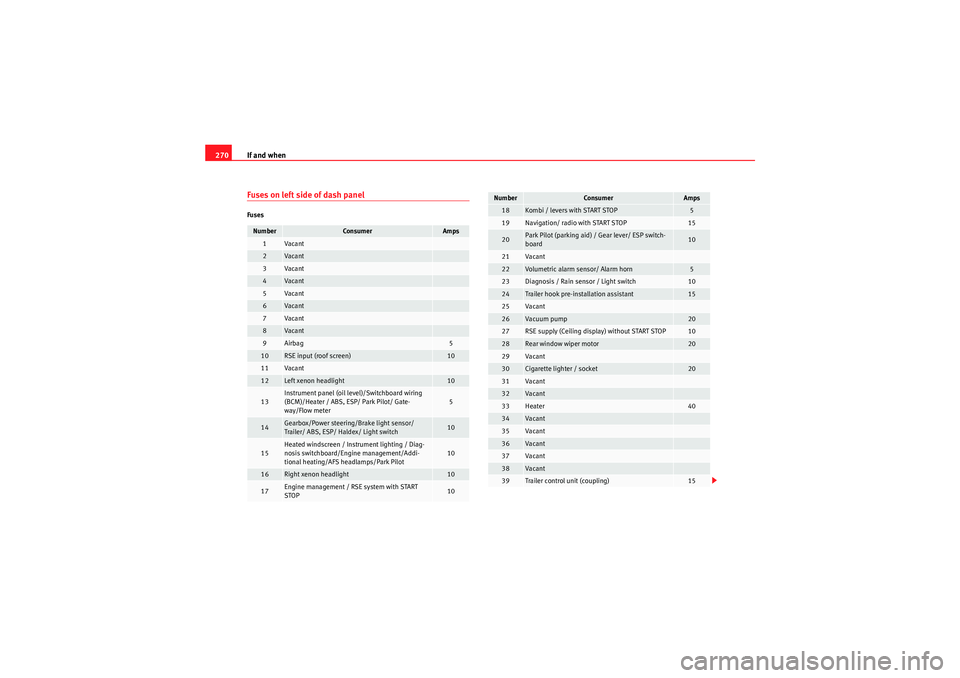
– Identify the fuse corresponding to the damaged electric consumer ⇒page 270.
– Take the plastic clip from inside the fuse cover, fit it onto the blown fuse and pull the fuse out.
– Replace the blown fuse (which will have a melted metal strip) with a new fuse of the same ampere rating.
Fuse cover in engine compartment
– Switch off the ignition and its failed electrical component.
– Prise off the fuse cover in the engine compartment by pressing the tabs towards the centre of the cover ⇒page 267, fig. 182 .
– Identify the fuse for the failed component ⇒page 270.
– Take the plastic clip from inside the fuse cover (at left-hand end of the dash panel), fit it onto the blown fuse and pull the fuse out.
– Replace the blown fuse (which will have a melted metal strip) with a new fuse of the same ampere rating.
– Carefully fit the fuse cover back on to ensure no water can enter
the fuse box.The individual electrical circuits are protected by fuses. The fuses are located
behind a cover at the left-hand end of the dash panel and on the left-hand
side of the engine compartment. The electric windows are protected by
circuit breakers. These reset automat-
ically after a few seconds when the overload (caused for example by frozen
windows) has been corrected.
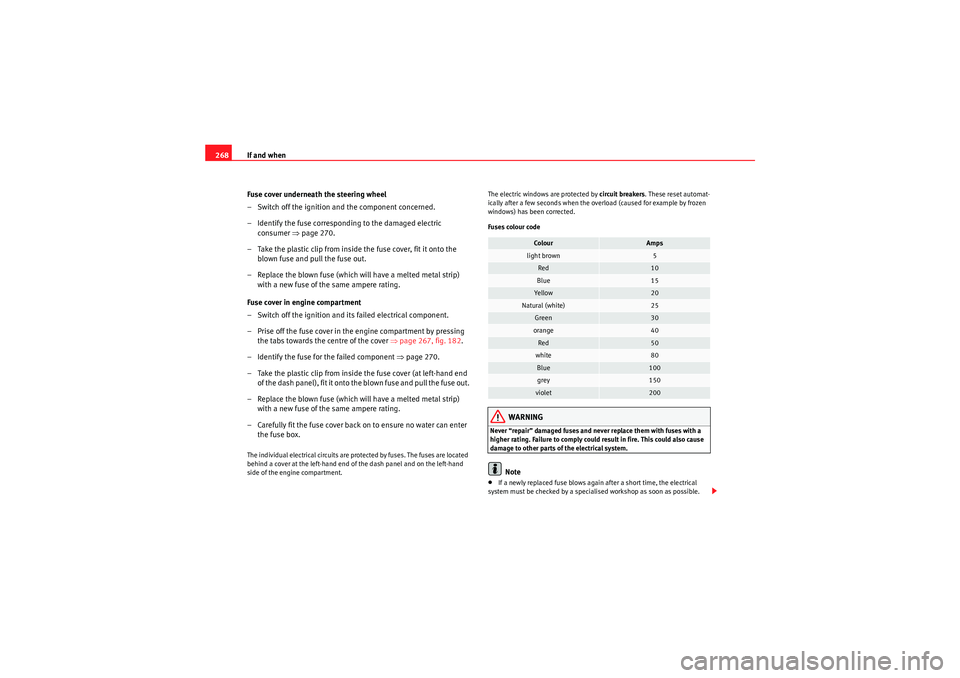
Fuses colour code
WARNING
Never “repair” damaged fuses and never replace them with fuses with a
higher rating. Failure to comply could result in fire. This could also cause
damage to other parts of the electrical system.
Note
•If a newly replaced fuse blows again after a short time, the electrical
system must be checked by a specialised workshop as soon as possible.
Colour
Amps
light brown
5
Red
10
Blue
15
Ye ll ow
20
Natural (white)
25
Green
30
orange
40
Red
50
white
80
Blue
100
grey
150
violet
200
Altea_EN.book Seite 268 Donnerstag, 2. September 2010 2:00 14
Page 272 of 317
If and when
270Fuses on left side of dash panelFusesNumber
Consumer
Amps
1
Va ca n t
2
Va ca n t
3
Va ca n t
4
Va ca n t
5
Va ca n t
6
Va ca n t
7
Va ca n t
8
Va ca n t
9
Airbag
5
10
RSE input (roof screen)
10
11
Va ca n t
12
Left xenon headlight
10
13
Instrument panel (oil level)/Switchboard wiring
(BCM)/Heater / ABS, ESP/ Park Pilot/ Gate-
way/Flow meter
5
14
Gearbox/Power steering/Brake light sensor/
Trailer/ ABS, ESP/ Haldex/ Light switch
10
15
Heated windscreen / Instrument lighting / Diag-
nosis switchboard/Engine management/Addi-
tional heating/AFS headlamps/Park Pilot
10
16
Right xenon headlight
10
17
Engine management / RSE system with START
STOP
10
18
Kombi / levers with START STOP
5
19
Navigation/ radio with START STOP
15
20
Park Pilot (parking aid) / Gear lever/ ESP switch-
board
10
21
Va ca n t
22
Volumetric alarm sensor/ Alarm horn
5
23
Diagnosis / Rain sensor / Light switch
10
24
Trailer hook pre-installation assistant
15
25
Va ca n t
26
Va cu um pum p
20
27
RSE supply (Ceiling display) without START STOP
10
28
Rear window wiper motor
20
29
Va ca n t
30
Cigarette lighter / socket
20
31
Va ca n t
32
Va ca n t
33
Heater
40
34
Va ca n t
35
Va ca n t
36
Va ca n t
37
Va ca n t
38
Va ca n t
39
Trailer control unit (coupling)
15
Number
Consumer
Amps
Altea_EN.book Seite 270 Donnerstag, 2. September 2010 2:00 14
Page 273 of 317
If and when271
Safety First
Operating Instructions
Practical Tips
Technical Specifications
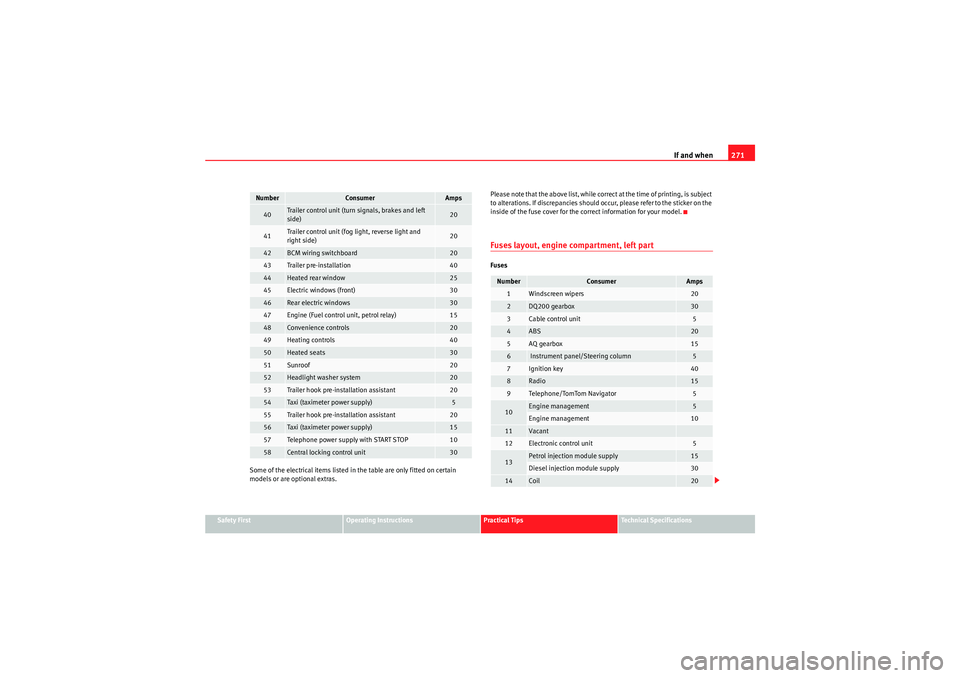
Some of the electrical items listed in the table are only fitted on certain
models or are optional extras. Please note that the above list, while correct at the time of printing, is subject
to alterations. If discrepancies should occur, please refer to the sticker on the
inside of the fuse cover for the correct information for your model.
Fuses layout, engine compartment, left partFuses
40
Trailer control unit (turn signals, brakes and left
side)
20
41
Trailer control unit (fog light, reverse light and
right side)
20
42
BCM wiring switchboard
20
43
Trailer pre-installation
40
44
Heated rear window
25
45
Electric windows (front)
30
46
Rear electric windows
30
47
Engine (Fuel control unit, petrol relay)
15
48
Convenience controls
20
49
Heating controls
40
50
Heated seats
30
51
Sunroof
20
52
Headlight washer system
20
53
Trailer hook pre-installation assistant
20
54
Taxi (taximeter power supply)
5
55
Trailer hook pre-installation assistant
20
56
Taxi (taximeter power supply)
15
57
Telephone power supply with START STOP
10
58
Central locking control unit
30
Number
Consumer
Amps
Number
Consumer
Amps
1
Windscreen wipers
20
2
DQ200 gearbox
30
3
Cable control unit
5
4
ABS
20
5
AQ gearbox
15
6
Instrument panel/Steering column
5
7
Ignition key
40
8
Radio
15
9
Te lep ho ne /TomTo m Na viga tor
5
10
Engine management
5
Engine management
10
11
Vacant
12
Electronic control unit
5
13
Petrol injection module supply
15
Diesel injection module supply
30
14
Coil
20
Altea_EN.book Seite 271 Donnerstag, 2. September 2010 2:00 14