check engine light Seat Altea 2011 User Guide
[x] Cancel search | Manufacturer: SEAT, Model Year: 2011, Model line: Altea, Model: Seat Altea 2011Pages: 317, PDF Size: 8.87 MB
Page 210 of 317
Driving and the environment
208Drive anticipating the traffic situation
A vehicle uses most fuel when accelerating. When you anticipate the situa-
tion, you have to brake less often and, thus, accelerate less. If it is possible,
let the vehicle roll with a gear engaged, for example, if you see a red light
ahead. The braking effect achieved in this way helps to reduce the wear of
brakes and tyres; emissions and fuel consumption are reduced to zero
(disconnection due to inertia).
Change gear early to save energy
An effective way of saving fuel is to change up quickly through the gears.
Running the engine at high rpm in the lower gears uses an unnecessary
amount of fuel.
Manual gearbox: Change from first to second gear as quickly as possible. We
recommend that, whenever possible, you change to a higher gear upon
reaching 2000 rpm. Follow the recommended gear indication that appears on
the instrument panel ⇒page 62.
Avoid driving at high speed
We advise you not to drive at the top speed permitted by the vehicle. Fuel
consumption, exhaust emissions and noise levels all increase very rapidly at
higher speeds. Driving at moderate speeds will help to save fuel.
Avoid idling
It is worthwhile switching off the engine when waiting in a traffic jam, at level
crossings or at traffic lights with a long red phase. The fuel saved after only
30 - 40seconds is greater than the amount of fuel needed to restart the
engine.
The engine takes a long time to warm up when it is idling. Mechanical wear
and pollutant emissions are also especially high during this initial warm-up
phase. It is therefore best to drive off immediately after starting the engine.
Avoid running the engine at high speed. Periodic maintenance
Periodic maintenance work guarantees that, before beginning a journey, you
will not consume more than the required amount of fuel. A well-serviced
engine gives you the benefit of
improved fuel efficiency as well as maximum
reliability and an enhanced resale value.
A badly serviced engine can consume up to 10% more fuel than necessary.
Avoid short journeys
To reduce the consumption and emission of polluting gases, the engine and
the exhaust filtration systems should reach the optimum service tempera-
ture .
With the engine cold, fuel consumption is proportionally higher. The engine
does not warm up and fuel consumption does not normalise until having
driven approximately four kilometres. This is why we recommend avoiding
short trips whenever possible.
Maintain the correct tyre pressures
Bear in mind that keeping the tyres at an adequate pressure saves fuel. If the
tyre pressure is just one bar too low, fuel consumption can increase by as
much as 5%. Due to the greater rolling resistance, under-inflation also
increases tyre wear and impairs handling.
The tyre pressures should always be checked when the tyres are cold.
Do not use winter tyres all year round as they increase fuel consumption by
up to 10%.
Avoid unnecessary weight
Every kilo of extra weight will put up the fuel consumption, so it is worth
checking the luggage compartment occasionally to make sure that no unnec-
essary loads are being transported.
A roof rack is often left in place for the sake of convenience, even when it is
no longer needed. At a speed of 100-120km/h your vehicle will use about
12% more fuel as a result of the extra wind resistance caused by the roof rack
even when it is not in use.
Altea_EN.book Seite 208 Donnerstag, 2. September 2010 2:00 14
Page 236 of 317
Checking and refilling levels
234Opening the bonnet
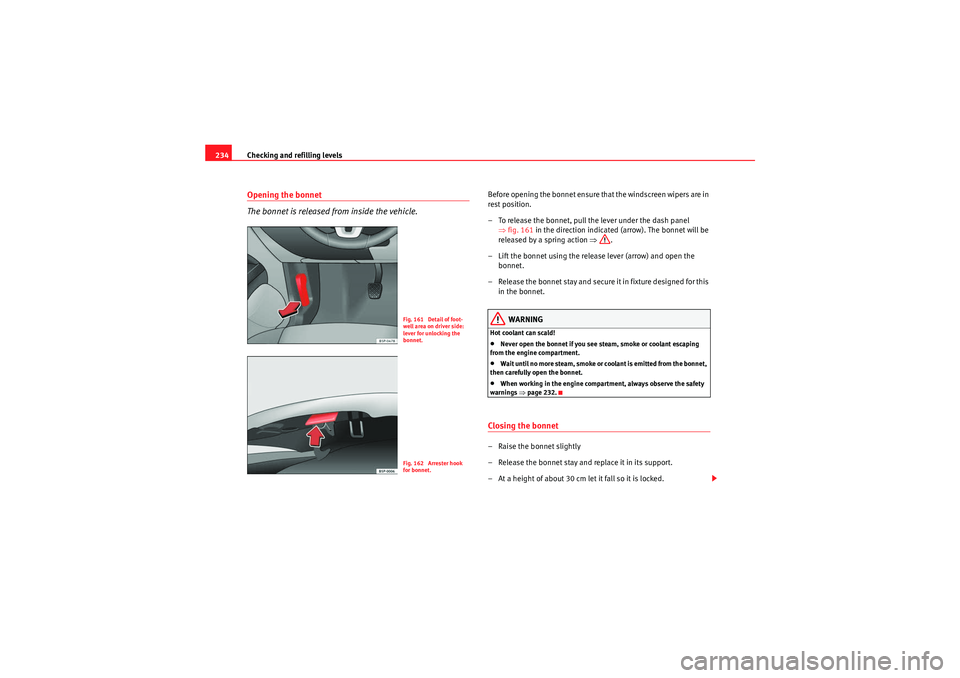
The bonnet is released from inside the vehicle.
Before opening the bonnet ensure that the windscreen wipers are in
rest position.
– To release the bonnet, pull the lever under the dash panel
⇒fig. 161 in the direction indicated (arrow). The bonnet will be
released by a spring action ⇒.
– Lift the bonnet using the release lever (arrow) and open the bonnet.
– Release the bonnet stay and secure it in fixture designed for this
in the bonnet.
WARNING
Hot coolant can scald!•Never open the bonnet if you see steam, smoke or coolant escaping
from the engine compartment.•Wait until no more steam, smoke or coolant is emitted from the bonnet,
then carefully open the bonnet.•When working in the engine compartment, always observe the safety
warnings ⇒page 232.
Closing the bonnet– Raise the bonnet slightly
– Release the bonnet stay and replace it in its support.
– At a height of about 30 cm let it fall so it is locked.
Fig. 161 Detail of foot-
well area on driver side:
lever for unlocking the
bonnet.Fig. 162 Arrester hook
for bonnet.
Altea_EN.book Seite 234 Donnerstag, 2. September 2010 2:00 14
Page 243 of 317
Checking and refilling levels241
Safety First
Operating Instructions
Practical Tips
Technical Specifications
•When the engine is warm or hot, the cooling system is pressurised! Do
not unscrew the cap on the expansion tank when the engine is hot. This is
a burn injury risk.Caution
•When mixed with other additives the colour of G12 will change to brown.
If this occurs you should have the coolant changed immediately. Failure to do
so will result in engine damage!•If a lot of coolant fluid has been lost, wait for the engine to cool down
before putting in cold coolant. This avoids damaging the engine. Large
coolant losses are an indication of leaks in the cooling system. See a special-
ised workshop immediately and have the cooling system checked. Other-
wise, there is a risk of engine damage.
Washer fluid and windscreen wiper bladesTopping up washer fluid
Y
The water for cleaning the windscreen should always be
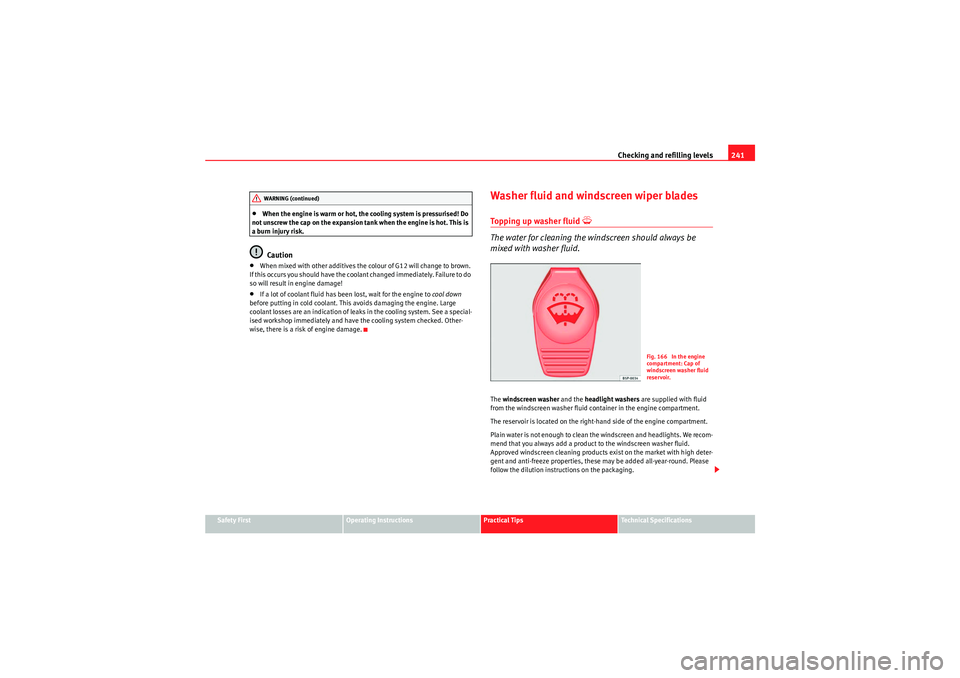
mixed with washer fluid.The windscreen washer and the headlight washers are supplied with fluid
from the windscreen washer fluid container in the engine compartment.
The reservoir is located on the right-hand side of the engine compartment.
Plain water is not enough to clean the windscreen and headlights. We recom-
mend that you always add a product to the windscreen washer fluid.
Approved windscreen cleaning products exist on the market with high deter-
gent and anti-freeze properties, these may be added all-year-round. Please
follow the dilution instructions on the packaging.
WARNING (continued)
Fig. 166 In the engine
compartment: Cap of
windscreen washer fluid
reservoir.
Altea_EN.book Seite 241 Donnerstag, 2. September 2010 2:00 14
Page 247 of 317
Checking and refilling levels245
Safety First
Operating Instructions
Practical Tips
Technical Specifications
Brake fluidChecking the brake fluid level
The brake fluid is checked at the intervals given in the service
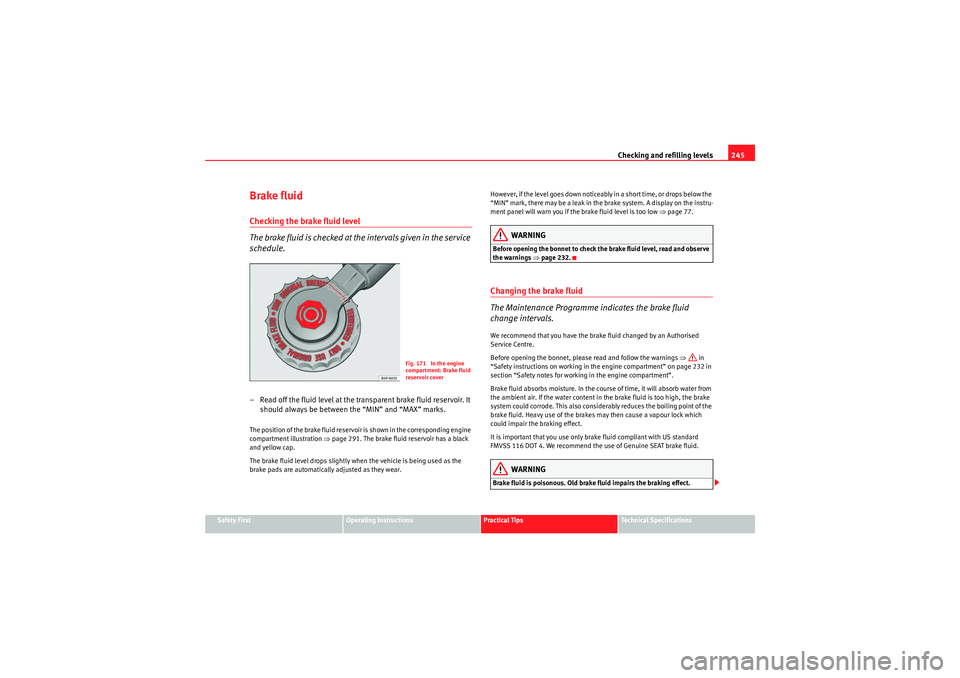
schedule.– Read off the fluid level at the transparent brake fluid reservoir. It
should always be between the “MIN” and “MAX” marks.The position of the brake fluid reservoir is shown in the corresponding engine
compartment illustration ⇒page 291. The brake fluid reservoir has a black
and yellow cap.
The brake fluid level drops slightly when the vehicle is being used as the
brake pads are automatically adjusted as they wear. However, if the level goes down noticeably in a short time, or drops below the
“MIN” mark, there may be a leak in the brake system. A display on the instru-
ment panel will warn you if the brake fluid level is too low
⇒page 77.
WARNING
Before opening the bonnet to check the brake fluid level, read and observe
the warnings ⇒page 232.Changing the brake fluid
The Maintenance Programme indicates the brake fluid
change intervals.We recommend that you have the brake fluid changed by an Authorised
Service Centre.
Before opening the bonnet, please read and follow the warnings ⇒ in
“Safety instructions on working in the engine compartment” on page 232 in
section “Safety notes for working in the engine compartment”.
Brake fluid absorbs moisture. In the course of time, it will absorb water from
the ambient air. If the water content in the brake fluid is too high, the brake
system could corrode. This also considerably reduces the boiling point of the
brake fluid. Heavy use of the brakes may then cause a vapour lock which
could impair the braking effect.
It is important that you use only brake fluid compliant with US standard
FMVSS 116 DOT 4. We recommend the use of Genuine SEAT brake fluid.
WARNING
Brake fluid is poisonous. Old brake fluid impairs the braking effect.
Fig. 171 In the engine
compartment: Brake fluid
reservoir cover
Altea_EN.book Seite 245 Donnerstag, 2. September 2010 2:00 14
Page 249 of 317
Checking and refilling levels247
Safety First
Operating Instructions
Practical Tips
Technical Specifications
charge. Never short the battery terminals. High-energy sparks can cause
injury.
•A highly explosive mixture of gases is released when the battery is
under charge. The batteries should be charged in a well-ventilated room
only.•Keep children away from acid and batteries.•Before working on the electrical system, you must switch off the
engine, the ignition and all consumers. The negative cable on the battery
must be disconnected. When a light bulb is changed, you need only switch
off the light.•Deactivate the anti-theft alarm by unlocking the vehicle before you
disconnect the battery! The alarm will otherwise be triggered.•When disconnecting the battery from the vehicle electrical system,
disconnect first the negative cable and then the positive cable.•Switch off all electrical consumers before reconnecting the battery.
Reconnect first the positive cable and then the negative cable. Never
reverse the polarity of the connections. This could cause an electrical fire.•Never charge a frozen battery, or one which has thawed. This could
result in explosions and chemical burns. Always replace a battery which
has frozen. A flat battery can freeze at temperatures around 0 °C.•Ensure that the vent hose is always connected to the battery.•Never use a defective battery. This could cause an explosion. Replace a
damaged battery immediately.Caution
•Never disconnect the battery if the ignition is switched on or if the engine
is running. This could damage the electrical system or electronic compo-
nents.•Do not expose the battery to direct sunlight over a long period of time, as
the intense ultraviolet radiation can damage the battery housing.
•If the vehicle is left standing in cold conditions for a long period, protect
the battery from freezing. If it freezes it will be damaged.Checking the electrolyte level
The electrolyte level should be checked regularly in high-
mileage vehicles, in hot countries and in older batteries.– Open the engine bonnet and the battery cover ⇒ in “Safety
instructions on working in the engine compartment” on
page 232 ⇒ in “Warnings on handling the battery” on
page 246.
– Check the colour display in the "magic eye" on the top of the battery.
– If there are air bubbles in the window, tap the window gently until they disperse.The position of the battery is shown in the corresponding engine compart-
ment diagram ⇒page 291.
The “magic eye” indicator, located on the top of the battery changes colour,
depending on the charge state and electrolyte level of the battery.
There are two different colours:•Black: correct charge status.•Transparent/clear yellow: the battery must be replaced. Contact a
specialist workshop.
WARNING (continued)
Altea_EN.book Seite 247 Donnerstag, 2. September 2010 2:00 14
Page 270 of 317
If and when
268
Fuse cover underneath the steering wheel
– Switch off the ignition and the component concerned.
– Identify the fuse corresponding to the damaged electric consumer ⇒page 270.
– Take the plastic clip from inside the fuse cover, fit it onto the blown fuse and pull the fuse out.
– Replace the blown fuse (which will have a melted metal strip) with a new fuse of the same ampere rating.
Fuse cover in engine compartment
– Switch off the ignition and its failed electrical component.
– Prise off the fuse cover in the engine compartment by pressing the tabs towards the centre of the cover ⇒page 267, fig. 182 .
– Identify the fuse for the failed component ⇒page 270.
– Take the plastic clip from inside the fuse cover (at left-hand end of the dash panel), fit it onto the blown fuse and pull the fuse out.
– Replace the blown fuse (which will have a melted metal strip) with a new fuse of the same ampere rating.
– Carefully fit the fuse cover back on to ensure no water can enter
the fuse box.The individual electrical circuits are protected by fuses. The fuses are located
behind a cover at the left-hand end of the dash panel and on the left-hand
side of the engine compartment. The electric windows are protected by
circuit breakers. These reset automat-
ically after a few seconds when the overload (caused for example by frozen
windows) has been corrected.
Fuses colour code
WARNING
Never “repair” damaged fuses and never replace them with fuses with a
higher rating. Failure to comply could result in fire. This could also cause
damage to other parts of the electrical system.
Note
•If a newly replaced fuse blows again after a short time, the electrical
system must be checked by a specialised workshop as soon as possible.
Colour
Amps
light brown
5
Red
10
Blue
15
Ye ll ow
20
Natural (white)
25
Green
30
orange
40
Red
50
white
80
Blue
100
grey
150
violet
200
Altea_EN.book Seite 268 Donnerstag, 2. September 2010 2:00 14
Page 308 of 317
Index
306CCatalytic converter . . . . . . . . . . . . . . . . . . . . . . 206
CD changer . . . . . . . . . . . . . . . . . . . . . . . . . . . . 144
Central lock button
Locking . . . . . . . . . . . . . . . . . . . . . . . . . . . . 102
Unlocking . . . . . . . . . . . . . . . . . . . . . . . . . . . 102
Central locking . . . . . . . . . . . . . . . . . . . . . . . . . . 99 Automatic locking system for involuntary unlocking . . . . . . . . . . . . . . . . . . . . . . . . . 101
Automatic speed dependent locking and un- locking system* . . . . . . . . . . . . . . . . . . . . 101
Emergency unlocking system . . . . . . . . . . . 101
Selective unlocking system* . . . . . . . . . . . 100
Unlocking system* . . . . . . . . . . . . . . . . . . . 101
Centre armrest . . . . . . . . . . . . . . . . . . . . . . . . . . 144
Cetane number . . . . . . . . . . . . . . . . . . . . . . . . . 231
Changing gear See Manual gearbox . . . . . . . . . . . . . . . . . . 181
Changing gear in tiptronic mode . . . . . . . . . . . 185
Changing the bulbs Main headlight bulbs . . . . . . . . . . . . . . . . . 273
Tail lights . . . . . . . . . . . . . . . . . . . . . . . . . . . 276
Changing the main headlight bulbs dipped beam headlights . . . . . . . . . . . . . . 274
Main beam headlights . . . . . . . . . . . . . . . . 275
Side lights . . . . . . . . . . . . . . . . . . . . . . . . . . 276
Turn signal bulbs . . . . . . . . . . . . . . . . . . . . 274
Changing the tail lights Luggage compartment lights . . . . . . . . . . . 279
Rear fog light . . . . . . . . . . . . . . . . . . . . . . . . 278 Reverse light . . . . . . . . . . . . . . . . . . . . . . . . 278
Side lights . . . . . . . . . . . . . . . . . . . . . . . . . . 277
Turn signal light . . . . . . . . . . . . . . . . . . . . . 278
Changing windscreen wiper blades . . . . . . . . . 242
Chassis number . . . . . . . . . . . . . . . . . . . . . . . . 288
Checking . . . . . . . . . . . . . . . . . . . . . . . . . . . . . . 247
Checking battery electrolyte level . . . . . . . . . . 247
Checking engine oil level . . . . . . . . . . . . . . . . . 236
Child safety . . . . . . . . . . . . . . . . . . . . . . . . . . . . . 46
Child seat . . . . . . . . . . . . . . . . . . . . . . . . . . . . . . . 48 Categorisation in groups . . . . . . . . . . . . . . . 48
Group 1 . . . . . . . . . . . . . . . . . . . . . . . . . . . . . 49
Group 2 . . . . . . . . . . . . . . . . . . . . . . . . . . . . . 49
Group 3 . . . . . . . . . . . . . . . . . . . . . . . . . . . . . 49
Groups 0 and 0+ . . . . . . . . . . . . . . . . . . . . . . 48
Safety notes . . . . . . . . . . . . . . . . . . . . . . . . . . 46
Securing . . . . . . . . . . . . . . . . . . . . . . . . . . . . . 51
Child seats ISOFIX system . . . . . . . . . . . . . . . . . . . . . . . . 52
on the front passenger seat . . . . . . . . . . . . . 31
Top Tether system . . . . . . . . . . . . . . . . . . . . . 52
Cigarette lighter* . . . . . . . . . . . . . . . . . . . . . . . . 153
Cleaning alloy wheel rims . . . . . . . . . . . . . . . . 220
Cleaning chrome . . . . . . . . . . . . . . . . . . . . . . . . 219
Cleaning engine compartment . . . . . . . . . . . . . 221
Cleaning steel wheel rims . . . . . . . . . . . . . . . . 220
Cleaning windows . . . . . . . . . . . . . . . . . . . . . . . 218
Climatic* . . . . . . . . . . . . . . . . . . . . . . . . . . . . . . 161
Climatronic General notes . . . . . . . . . . . . . . . . . . . . . . . 169 Clock . . . . . . . . . . . . . . . . . . . . . . . . . . . . . . . . . . 59
Cloth seat covers cleaning . . . . . . . . . . . . . . . . 222
Clothes hook . . . . . . . . . . . . . . . . . . . . . . . . . . . 148
Cockpit . . . . . . . . . . . . . . . . . . . . . . . . . . . . . . . . . 55
Compartment for on-board documentation . . 144
Control lamps . . . . . . . . . . . . . . . . . . . . . . . . . . . 77
Control lighting . . . . . . . . . . . . . . . . . . . . . . . . . . 55
Controls
Electric windows . . . . . . . . . . . . . . . . . . . . . 113
Exterior mirrors . . . . . . . . . . . . . . . . . . . . . . 135
Sliding/tilting sunroof . . . . . . . . . . . . . . . . 115
Convenience closing Sliding/tilting sunroof . . . . . . . . . . . . . . . . 116
Windows . . . . . . . . . . . . . . . . . . . . . . . . . . . 115
Convenience opening Windows . . . . . . . . . . . . . . . . . . . . . . . . . . . 115
Coolant . . . . . . . . . . . . . . . . . . . . . . . . . . . 239, 240 Warning lamp . . . . . . . . . . . . . . . . . . . . . . . . 66
Coolant level . . . . . . . . . . . . . . . . . . . . . . . . . . . 240 Warning lamp . . . . . . . . . . . . . . . . . . . . . . . . 82
Coolant loss . . . . . . . . . . . . . . . . . . . . . . . . . . . . 240
Coolant temperature Gauge . . . . . . . . . . . . . . . . . . . . . . . . . . . . . . 58
Safety instructions . . . . . . . . . . . . . . . . . . . . 83
Correct adjustment of front seat head restraints . . 13
Correct adjustment of rear seat head restraints In-use and non-use positions . . . . . . . . . . . 14
Correct sitting position Front passenger . . . . . . . . . . . . . . . . . . . . . . 12
Incorrect sitting position . . . . . . . . . . . . . . . 15
Altea_EN.book Seite 306 Donnerstag, 2. September 2010 2:00 14
Page 309 of 317
Index307
Cruise control . . . . . . . . . . . . . . . . . . . . . . . . . . . 192
Cruise control system . . . . . . . . . . . . . . . . . . . . 192
Warning lamp . . . . . . . . . . . . . . . . . . . . . . . . . 87
Cruise control* Turning off the cruise control system . . . . . 194
Curtain airbags . . . . . . . . . . . . . . . . . . . . . . . . . . 41 Description . . . . . . . . . . . . . . . . . . . . . . . . . . . 41
Operation . . . . . . . . . . . . . . . . . . . . . . . . . . . . 42
Safety notes . . . . . . . . . . . . . . . . . . . . . . . . . . 42DDanger of fitting a child seat on the front passenger seat . . . . . . . . . . . . . . . . . . . . . . . . . . . . . . . 31
Dash panel . . . . . . . . . . . . . . . . . . . . . . . . . . . . . . 55
Dash panel cleaning . . . . . . . . . . . . . . . . . . . . . 221
Daytime lights . . . . . . . . . . . . . . . . . . . . . . . . . . 120 Activating . . . . . . . . . . . . . . . . . . . . . . . . . . . 120
Deactivating . . . . . . . . . . . . . . . . . . . . . . . . . 120
Deactivating front passenger airbag Safety notes . . . . . . . . . . . . . . . . . . . . . . . . . . 45
Deactivating the airbag Front passenger airbag . . . . . . . . . . . . . . . . . 44
Diesel . . . . . . . . . . . . . . . . . . . . . . . . . . . . . . . . . 231
Diesel engine Winter driving . . . . . . . . . . . . . . . . . . . . . . . . 231
Diesel engine particulate filter . . . . . . . . . . . . . 207
Differential lock . . . . . . . . . . . . . . . . . . . . . . . . . 200
Differential lock fault (EDL) Warning lamp . . . . . . . . . . . . . . . . . . . . . . . . . 89
Digital clock . . . . . . . . . . . . . . . . . . . . . . . . . . . . . 59 Dipped beam headlights . . . . . . . . . . . . . . . . . 118
Display (without warning or information texts) . 61
Disposal
Airbags . . . . . . . . . . . . . . . . . . . . . . . . . . . . . . 32
Seat belt tensioners . . . . . . . . . . . . . . . . . . . 29
Door lock cylinders . . . . . . . . . . . . . . . . . . . . . . 219
Door release lever . . . . . . . . . . . . . . . . . . . . . . . . 55
Doors Childproof locks . . . . . . . . . . . . . . . . . . . . . . 104
warning lamp . . . . . . . . . . . . . . . . . . . . . . . . . 88
Drawer . . . . . . . . . . . . . . . . . . . . . . . . . . . . . . . . 145
Drive wheels traction control system . . . . . . . . 198
Driver See Correct sitting position . . . . . . . . . . . . . . 10
Driveshaft differential XDS . . . . . . . . . . . . . . . . . . . . . . . . . . . . . . . . 199
Driving Driving abroad . . . . . . . . . . . . . . . . . . . . . . . 210
Economically / Environmentally friendly . . 207
With a trailer . . . . . . . . . . . . . . . . . . . . . . . . . 212
Driving abroad . . . . . . . . . . . . . . . . . . . . . . . . . . 210 Headlights . . . . . . . . . . . . . . . . . . . . . . . . . . 210
Driving programmes . . . . . . . . . . . . . . . . . . . . . 182
Driving safety . . . . . . . . . . . . . . . . . . . . . . . . . . . . . 8
Driving with an automatic gearbox / DSG automatic gearbox . . . . . . . . . . . . . . . . . . . . . . . . . . . 183
Duplicate keys . . . . . . . . . . . . . . . . . . . . . . . . . . 105
Dust filter . . . . . . . . . . . . . . . . . . . . . . . . . . . . . . 169
Dynamic cornering lights . . . . . . . . . . . . . . . . . 123
Dynamic headlight range control . . . . . . . . . . . 122
EEconomical driving . . . . . . . . . . . . . . . . . . . . . . 207
EDL . . . . . . . . . . . . . . . . . . . . . . . . . . . . . . . . . . . 200 Warning lamp . . . . . . . . . . . . . . . . . . . . . . . . 84
Electrical sockets . . . . . . . . . . . . . . . . . . . . . . . . 153
Electronic differential lock . . . . . . . . . . . . . . . . 200 Warning lamp . . . . . . . . . . . . . . . . . . . . . . . . 84
Electronic immobiliser . . . . . . . . . . . . . . . . 90, 174
Electronic Stability Programme . . . . . . . . . 88, 199 Description . . . . . . . . . . . . . . . . . . . . . . . . . . 172
Emergency braking warning . . . . . . . . . . 124, 197
Emergency manual locking . . . . . . . . . . . . . . . . 103
Emergency opening Doors . . . . . . . . . . . . . . . . . . . . . . . . . . . . . . 109
Emission control system Warning lamp . . . . . . . . . . . . . . . . . . . . . . . . 88
Engine Running in . . . . . . . . . . . . . . . . . . . . . . . . . . 205
Engine compartment Working in the engine compartment . . . . . 232
Engine coolant . . . . . . . . . . . . . . . . . . . . . . . . . . 239
Engine fault Warning lamp . . . . . . . . . . . . . . . . . . . . . . . . 83
Engine management Warning lamp . . . . . . . . . . . . . . . . . . . . . . . . 83
Engine oil . . . . . . . . . . . . . . . . . . . . . . . . . . . . . . 235 Changing . . . . . . . . . . . . . . . . . . . . . . . . . . . 238
Checking engine oil level . . . . . . . . . . . . . . 236
Oil properties . . . . . . . . . . . . . . . . . . . . . . . . 236
Altea_EN.book Seite 307 Donnerstag, 2. September 2010 2:00 14