fuel consumption Seat Altea 2011 User Guide
[x] Cancel search | Manufacturer: SEAT, Model Year: 2011, Model line: Altea, Model: Seat Altea 2011Pages: 317, PDF Size: 8.87 MB
Page 211 of 317
Driving and the environment209
Safety First
Operating Instructions
Practical Tips
Technical Specifications
Save electricity
The engine activates the alternator, which produces electricity. With the need
for electricity, fuel consumption is also increased. Because of this, always
turn off electrical components when you do not need them. Examples of
components that use a lot of electricity are: the fan at high speeds, the rear
window heating or the seat heaters*.
Note
•If you vehicle has
Start-Stop, it is not recommended to disconnect this
function.•It is recommended to close the windows when driving at more than 60
km/h•Do not drive with your foot resting on the clutch pedal, as the pressure can
make the plate spin, more fuel will be used and it can burn the clutch plate
lining, causing a serious fault.•Do not hold the vehicle on a hill with the clutch, use the foot brake or hand
brake, using the latter to start. The fuel consumption will be lower and you will
prevent the clutch plate from being damaged.•On descents, use the engine brake, changing to the gear that is more suit-
able for the slope. The fuel consumption will be lower and the brakes will not
suffer.Environmental friendlinessEnvironmental protection is a top priority in the design, choice of materials
and production of your new Seat.
Design measures for economical recycling•Joints and connections designed for easy dismantling•Modular construction to facilitate dismantling•Increased use of single-grade materials
•Plastic parts and elastomers are rated in accordance with ISO 1043, ISO
11469 and ISO 1629
Choice of materials•Nearly all materials used can be recycled•Similar types of plastics grouped together for easy recycling•Recycled materials used in manufacture•Reduction of volatile compounds in plastics•CFC-free refrigerant in air conditioner
Compliance with prohibited materials regulation : cadmium, lead, mercury,
chrome VI.
Manufacturing methods•Use of recycled material for manufacturing plastic parts•Solvent-free cavity sealing•Solvent-free wax for protecting the vehicles in transit•Solvent-free adhesives•No CFCs used in production•Surplus materials used extensively for energy conversion and building
materials•Overall water consumption reduced•Heat recovery systems•The use of water-soluble paints
Altea_EN.book Seite 209 Donnerstag, 2. September 2010 2:00 14
Page 231 of 317
Checking and refilling levels229
Safety First
Operating Instructions
Practical Tips
Technical Specifications
Adapter for the liquid petroleum gas (LPG) filler neck
An adapter is required due to the existence of a range of
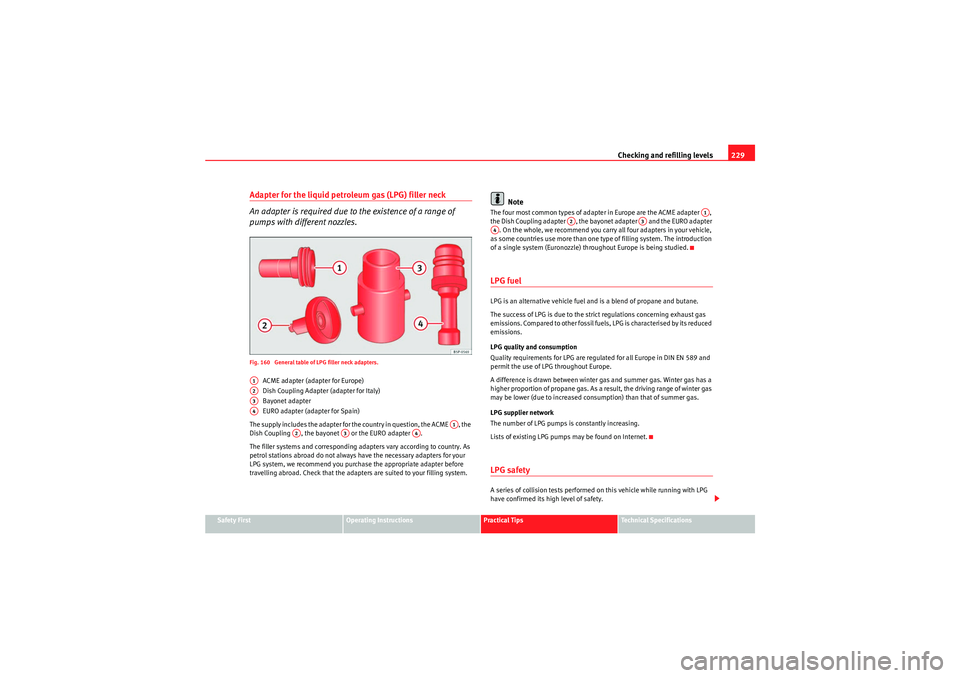
pumps with different nozzles.Fig. 160 General table of LPG filler neck adapters.
ACME adapter (adapter for Europe)
Dish Coupling Adapter (adapter for Italy)
Bayonet adapter
EURO adapter (adapter for Spain)
The supply includes the adapter for the country in question, the ACME , the
Dish Coupling , the bayonet or the EURO adapter .
The filler systems and corresponding adapters vary according to country. As
petrol stations abroad do not always have the necessary adapters for your
LPG system, we recommend you purchase the appropriate adapter before
travelling abroad. Check that the adapters are suited to your filling system.
Note
The four most common types of adapter in Europe are the ACME adapter ,
the Dish Coupling adapter , the bayonet adapter and the EURO adapter . On the whole, we recommend you carry all four adapters in your vehicle,
as some countries use more than one type of filling system. The introduction
of a single system (Euronozzle) throughout Europe is being studied.LPG fuelLPG is an alternative vehicle fuel and is a blend of propane and butane.
The success of LPG is due to the strict regulations concerning exhaust gas
emissions. Compared to other fossil fuels, LPG is characterised by its reduced
emissions.
LPG quality and consumption
Quality requirements for LPG are regulated for all Europe in DIN EN 589 and
permit the use of LPG throughout Europe.
A difference is drawn between winter gas and summer gas. Winter gas has a
higher proportion of propane gas. As a result, the driving range of winter gas
may be lower (due to increased consumption) than that of summer gas.
LPG supplier network
The number of LPG pumps is constantly increasing.
Lists of existing LPG pumps may be found on Internet.LPG safetyA series of collision tests performed on this vehicle while running with LPG
have confirmed its high level of safety.
A1A2A3A4
A1
A2
A3
A4
A1
A2
A3
A4
Altea_EN.book Seite 229 Donnerstag, 2. September 2010 2:00 14
Page 232 of 317
Checking and refilling levels
230The safety of the LPG system guarantees operation without risk. The following
safety measures have been adopted:•The LPG tank has a solenoid valve which closes automatically when the
engine is switched off (ignition off) or when running on petrol.•A solenoid type main valve disconnects the supply of gas to the engine
compartment when the engine is switched off or running on petrol.•A safety valve in the LPG tank with pipes to the outside prevents the gas
from entering the vehicle interior.•All anchorage points and materials have been designed to ensure the
maximum possible levels of safety.
The condition of the LPG system should be checked regularly to guarantee
safe driving conditions ⇒. These checks are included in the Maintenance
Programme.WARNING
•If there is a smell of gas or a susp ected leak, stop the vehicle immedi-
ately and switch off the ignition. Open the doors to ventilate the vehicle. Do
not carry on driving! Take the vehicle to a specialised workshop and have
the fault repaired.•Immediately extinguish any cigarettes and remove from the vehicle any
objects which might produce a spark or cause a fire, and switch off imme-
diately if gas is smelt or a leak is detected.•LGP tanks are subject to pressure and must be checked regularly. The
owner of the vehicle must check that these services are performed
correctly.•When parking the vehicle in a closed area (for example in a garage),
make sure that there is adequate ventilation, either natural or mechanical,
to neutralise the LPG in the event of a leak.
Note
For any fault in the LGP system, please refer to the SEAT web page, which lists
the workshops authorised to repair these faults.PetrolPetrol types
The recommended fuel types are listed on a sticker inside the
fuel tank flap.Only unleaded petrol conforming to standard DIN EN 228 may be used for
vehicles with catalytic converters (EN = “European Standard”).
Fuel types are differentiated by the octane rating, e.g: 91, 95, 98 RON (RON
= “Research Octane Number”, unit for determining the knock resistance of
petrol). You may use petrol with a higher octane number than the one recom-
mended for your engine. However, this has no advantage in terms of fuel
consumption and engine power.
The correct fuel type for your vehicle is given in the technical table for the
engine, in the Technical Data section.
Caution
•Petrol with standard EN 228 may be mixed with small quantities of
ethanol. However, the so-called “bioethanol fuels” available at commercial
establishments with reference E50 or E85, which contain a high percentage
of ethanol, may not be used, as they will damage the fuel system.•Even one tankful of leaded fuel would permanently impair the efficiency
of the catalytic converter.
Altea_EN.book Seite 230 Donnerstag, 2. September 2010 2:00 14
Page 252 of 317

Wheels and tyres
250
2. The tyre pressures should only be checked when the tyres are cold. The slightly raised pressu res of warm tyres must not be
reduced.
3. Adjust the tyre pressure to the load you are carrying.Tyre pressure
The correct tyre pressure is especially important at high speeds. The pressure
should therefore be checked at least once a month and before starting a
journey.
The sticker with the tyre pressure values can be found on the inside of the
tank flap. The tyre pressure values given are for cold tyres. Do not reduce the
slightly raised pressures of warm tyres ⇒.
WARNING
•Check the tyre pressure at least once per month. Checking the tyre
pressure is very important. If the tyre pressure is too high or too low, there
is an increased danger of accidents - particularly at high speeds.•A tyre can easily burst if the pressure is too low, causing an accident!•At continuously high speeds, a tyre with insufficient pressure flexes
more. In this way it becomes too hot, and this can cause tread separation
and tyre blow-out. Always observe the recommended tyre pressures.•If the tyre pressure is too low or too high, the tyres will wear prema-
turely and the vehicle will not handle well. Risk of accident!For the sake of the environment
Under-inflated tyres will increase fuel consumption.
Tyre pressure monitoring
The tyre pressure monitoring system constantly checks the
pressure of the tyres.The system uses the speed sensors of the ABS wheels. It operates by
analysing the speed and frequency spectrum of each wheel.
For optimum performance, use genuine SEAT tyres. In addition, check and
adjust tyre pressures regularly.
Whenever the tyre pressures are changed or one or more tyres are changed,
the system should be Reset by pressing the SET switch on the centre console.
The system warns the driver in the event of a loss of pressure by means of
symbols and messages in the instrument panel display. The system uses ESP
⇒ page 199.
Note that tyre pressure also depends on tyre temperature. Tyre pressure
increases about 0.1 bar for each 10 °C in tyre temperature increase. The tyre
heats up while the vehicle is being driven and the tyre pressure will rise
accordingly. For this reason, you should only adjust the tyre pressures when
they are cold (i.e. approximately at ambient temperature).
To ensure that the tyre pressure monitoring system works reliably, you should
check and, if necessary, adjust the tyre pressures at regular intervals and
store the correct pressures (reference values) in the system.
A tyre pressure information label is attached to the inside of the fuel tank flap.
WARNING
•Never adjust tyre pressure when the tyres are hot. This may damage or
even burst the tyres. Risk of accident!•An insufficiently inflated tyre flexes a lot more at high speeds and
causes significant heating of the tyre. Under these conditions, the tyre
bead may be released or the tyre may burst. Risk of accident!
Altea_EN.book Seite 250 Donnerstag, 2. September 2010 2:00 14
Page 253 of 317
Wheels and tyres251
Safety First
Operating Instructions
Practical Tips
Technical Specifications
For the sake of the environment
Under-inflated tyres lead to increased fuel consumption and tyre wear.Significant tyre pressure lossThe tyre symbol
~ is displayed and indicates that the tyre pressure of at least
one tyre is insufficient.
–Stop the vehicle.
– Switch the engine off.
– Check the tyre(s).
– Change the wheel if necessary.
Tyre ser vice life
The service life of tyres is dependent on tyre pressure, driving
style and fitting.
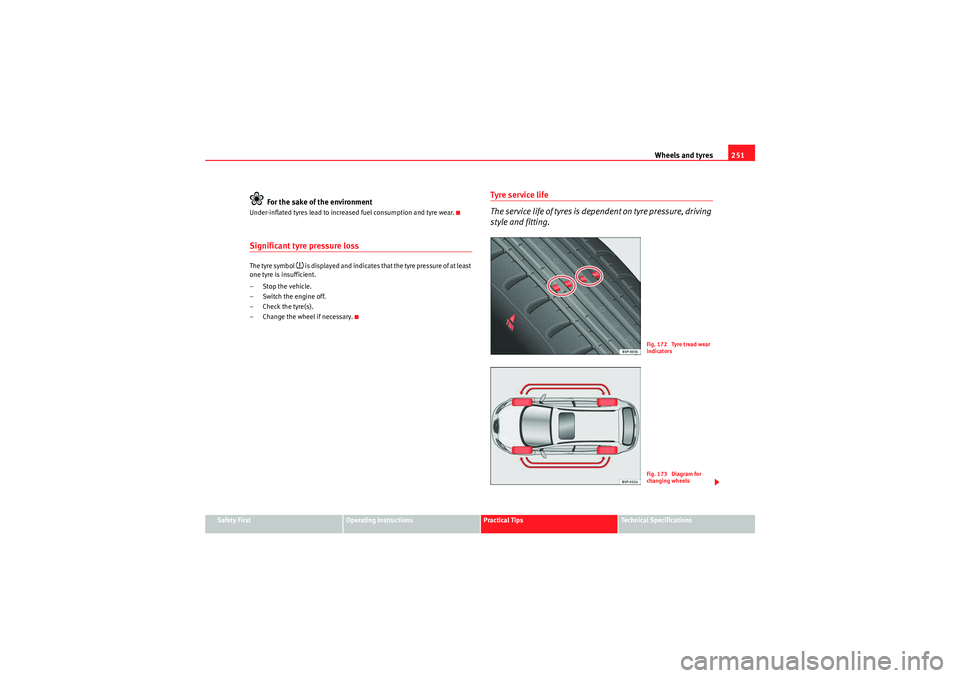
Fig. 172 Tyre tread wear
indicatorsFig. 173 Diagram for
changing wheels
Altea_EN.book Seite 251 Donnerstag, 2. September 2010 2:00 14
Page 254 of 317
Wheels and tyres
252Wear indicators
The original tyres on your vehicle have 1.6 mm high tread wear indicators
⇒ page 251, fig. 172 , running across the tread. Depending on the make,
there will be 6 to 8 of them evenly spaced around the tyre. Markings on the
tyre sidewall (for instance the letters “TWI” or other symbols) indicate the
positions of the tread wear indicators. The minimum tread depth required by
law is 1.6 mm (measured in the tread grooves next to the tread wear indica-
tors). Worn tyres must be replaced. Different figures may apply in export
countries ⇒.
Tyre pressure
Incorrect tyre pressure causes premature wear and could cause tyre blow-out.
For this reason, the tyre pressure should be checked at least once per month
⇒ page 249.
Driving style
Fast cornering, heavy acceleration and hard braking all increase tyre wear.
Changing wheels around
If the front tyres are worn considerably more than the rear ones it is advisable
to change them around as shown ⇒page 251, fig. 173. All the tyres will then
last for about the same time.
Wheel balance
The wheels on new vehicles are balanced. However, various factors encoun-
tered in normal driving can cause them to become unbalanced, which results
in steering vibration.
Unbalanced wheels should be rebalanced, as they otherwise cause excessive
wear on steering, suspension and tyres. A wheel must also be rebalanced
when a new tyre is fitted.
Incorrect wheel alignment
Incorrect wheel alignment causes excessive tyre wear, impairing the safety of
the vehicle. If tyres show excessive wear, you should have the wheel align-
ment checked by an Authorised Service Centre.
WARNING
There is a serious danger of accidents if a tyre bursts during driving!•The tyres must be replaced at the latest when the tread is worn down to
the tread wear indicators. Failure to do so could result in an accident. Worn
tyres do not grip well at high speeds on wet roads. There is also a greater
risk of aquaplaning.•At continuously high speeds, a tyre with insufficient pressure flexes
more. This causes it to overheat. This can cause tread separation and tyre
blow-out. Risk of accident. Always observe the recommended tyre pres-
sures.•I f t y r e s s h o w e x ce s s i v e w e a r, y o u s h o u l d h a v e t h e r u n n i n g g e a r ch e cke d
by an Authorised Service Centre.•Keep chemicals such as oil, fuel and brake fluid away from tyres.•Damaged wheels and tyres must be replaced immediately!For the sake of the environment
Under-inflated tyres will increase fuel consumption.Run-flat tyres
Run-flat tyres allow you to continue driving even with a punc-
tured tyre, in the majority of cases.In vehicles that are factory-fitted with run-flat tyres
25) the loss of tyre
pressure is indicated on the instrument panel.
25)Depending upon version and country.
Altea_EN.book Seite 252 Donnerstag, 2. September 2010 2:00 14
Page 258 of 317
Wheels and tyres
256
WARNING
The maximum speed for the winter tyres must not be exceeded. Otherwise,
this could lead to tyre damage and risk of accident.
For the sake of the environment
Fit your summer tyres again as soon as possible. They are quieter, do not wear
so quickly and reduce fuel consumption.Snow chainsSnow chains are only permitted on front wheels and only for tyres 195/65R15
and 205/55R16. These tyres may only be fitted with fine-pitch link chains
which do not protrude more than 15 mm ⇒page 290.
Other tyres may use fine-pitch links which do not protrude more than 9 mm,
including tension device.
Remove wheel hub covers and trim rings before fitting snow chains. For safety
reasons cover caps, available in any Authorised Service Centre, must then be
fitted over the wheel bolts.
WARNING
Snow chains should be correctly tightened in accordance with the manu-
facturer’s instructions. This will prevent the chains coming into contact
with the wheel housing.
Caution
Remove the snow chains to drive on roads without snow. Otherwise they will
impair handling, damage the tyres and wear out very quickly.
Note
•In some countries, the speed limit for using snow chains is 50 km/h. The
legal requirements of the country should be followed.•We recommend that you ask your Authorised Service Centre for informa-
tion about appropriate wheel, tyre and snow chain size.
Altea_EN.book Seite 256 Donnerstag, 2. September 2010 2:00 14
Page 289 of 317
Description of specifications287
Safety First
Operating Instructions
Practical Tips
Technical Specifications
Technical SpecificationsDescription of specificationsImportant informationImportant
The information in the vehicle documentation always has
precedence.All technical specifications provided in this manual are valid for the standard
model in Spain. The vehicle data card included in the Maintenance
Programme or the vehicle registration documents shows which engine is
installed in the vehicle.
The figures may be different depending on if additional equipment is fitted,
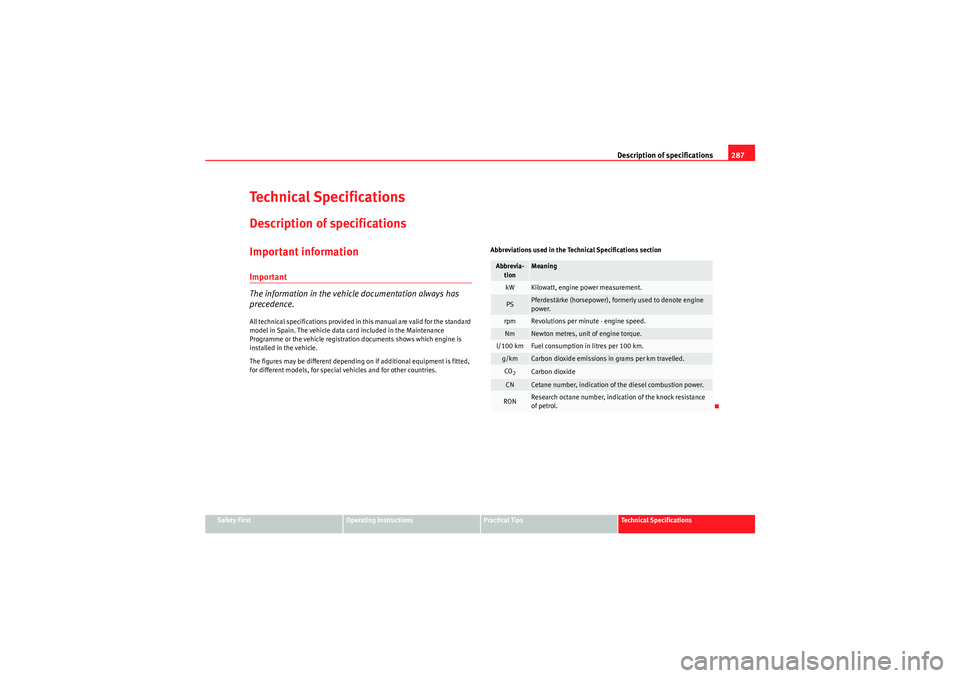
for different models, for special vehicles and for other countries. Abbreviations used in the Technical Specifications section
Abbrevia-
tion
Meaning
kW
Kilowatt, engine power measurement.
PS
Pferdestärke (horsepower), formerly used to denote engine
power.
rpm
Revolutions per minute - engine speed.
Nm
Newton metres, unit of engine torque.
l/100 km
Fuel consumption in litres per 100 km.
g/km
Carbon dioxide emissions in grams per km travelled.
CO2
Carbon dioxide
CN
Cetane number, indication of the diesel combustion power.
RON
Research octane number, indication of the knock resistance
of petrol.
Altea_EN.book Seite 287 Donnerstag, 2. September 2010 2:00 14
Page 291 of 317
Description of specifications289
Safety First
Operating Instructions
Practical Tips
Technical Specifications
Information on fuel consumptionFuel consumption
The consumption and emission details shown on the vehicle
data sticker differ from one vehicle to another.The fuel consumption and CO
2 emissions of the vehicle can be found on the
vehicle data sticker.
The fuel consumption and emissions figures given are based on the vehicle
weight category, which is determined according to the engine/gearbox
combination and the equipment fitted.
The consumption and emission figures are calculated in accordance with the
tests indicated in regulations 715/2007/EC and 692/2008/EC.
Note
•Actual consumption may vary from quoted test values, depending on
personal driving style, road and traffic conditions, the weather and the
vehicle condition.WeightsKerb weight refers to the basic model with a fuel tank filled to 90% capacity
and without optional extras. The figure quoted includes 75 kg to allow for the
weight of the driver.
For special versions and optional equipment fittings or for the addition of
accessories, the weight of the vehicle will increase ⇒.
WARNING
•Please note that the centre of gravity may shift when transporting
heavy objects; this may affect the vehicle’s handling and lead to an acci-
dent. Always adjust your speed and driving style to suit road conditions
and requirements.•Never exceed the gross axle weight rating or the gross vehicle weight
rating. If the allowed axle load or the allowed total weight is exceeded, the
driving characteristics of the vehicle may change, leading to accidents,
injuries and damage to the vehicle.
To w i n g a t r a i l e rTrailer weightsTrailer weight
The trailer weights and drawbar loads approved are selected in intensive
trials according to precisely defined criteria. The approved trailer weights are
valid for vehicles in the EU for maximum speeds of 80 km/h (in certain
circumstances up to 100 km/h). The figures may be different in other coun-
tries. All data in the official vehicle documents take precedence over these
data ⇒ .
Drawbar load
The maximum permitted drawbar load on the ball joint of the towing bracket
must not exceed 75 kg.
In the interest of road safety, we recommend that you always tow
approaching the maximum drawbar load. The response of the trailer on the
road will be poor if the drawbar load is too small.
Altea_EN.book Seite 289 Donnerstag, 2. September 2010 2:00 14