gearbox Seat Altea 2011 User Guide
[x] Cancel search | Manufacturer: SEAT, Model Year: 2011, Model line: Altea, Model: Seat Altea 2011Pages: 317, PDF Size: 8.87 MB
Page 183 of 317
Driving181
Safety First
Operating Instructions
Practical Tips
Technical Specifications
Manual gearboxDriving with a manual gearbox
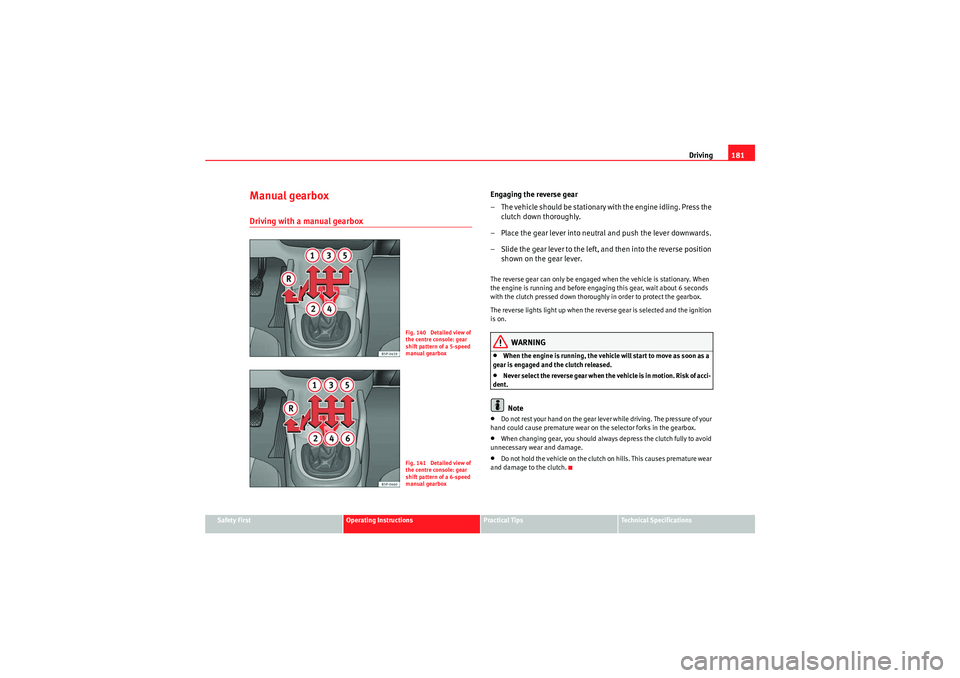
Engaging the reverse gear
– The vehicle should be stationary with the engine idling. Press the
clutch down thoroughly.
– Place the gear lever into neutral and push the lever downwards.
– Slide the gear lever to the left, and then into the reverse position shown on the gear lever.The reverse gear can only be engaged when the vehicle is stationary. When
the engine is running and before engaging this gear, wait about 6 seconds
with the clutch pressed down thoroughly in order to protect the gearbox.
The reverse lights light up when the reverse gear is selected and the ignition
is on.
WARNING
•When the engine is running, the vehicle will start to move as soon as a
gear is engaged and the clutch released.•Never select the reverse gear when the vehicle is in motion. Risk of acci-
dent.Note
•Do not rest your hand on the gear lever while driving. The pressure of your
hand could cause premature wear on the selector forks in the gearbox.•When changing gear, you should always depress the clutch fully to avoid
unnecessary wear and damage.•Do not hold the vehicle on the clutch on hills. This causes premature wear
and damage to the clutch.
Fig. 140 Detailed view of
the centre console: gear
shift pattern of a 5-speed
manual gearboxFig. 141 Detailed view of
the centre console: gear
shift pattern of a 6-speed
manual gearbox
Altea_EN.book Seite 181 Donnerstag, 2. September 2010 2:00 14
Page 184 of 317
Driving
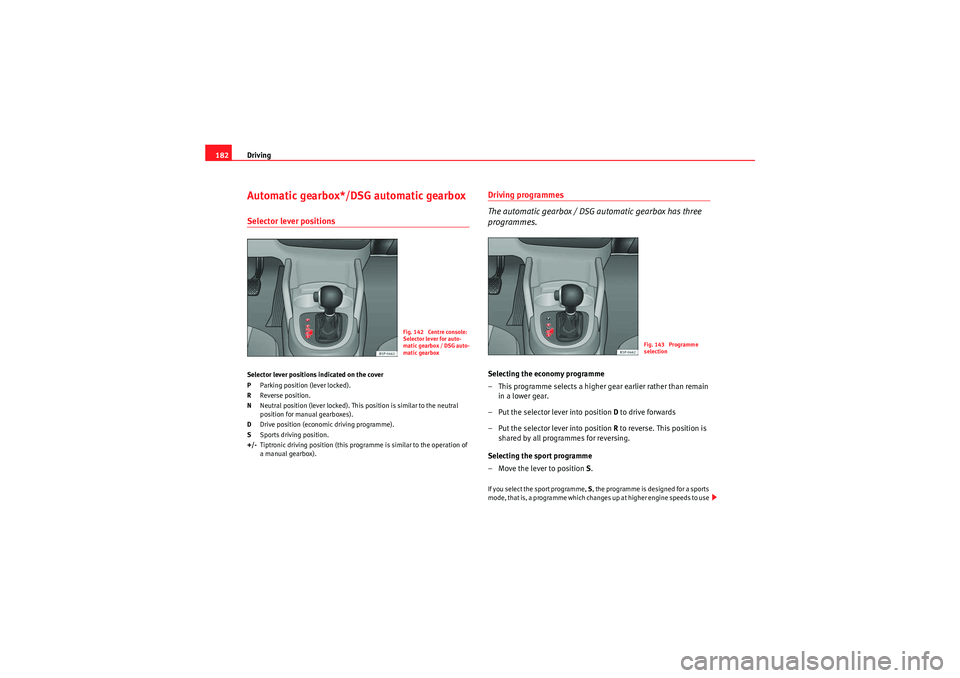
182Automatic gearbox*/DSG automatic gearboxSelector lever positionsSelector lever positions indicated on the cover
P Parking position (lever locked).
R Reverse position.
N Neutral position (lever locked). This position is similar to the neutral
position for manual gearboxes).
D Drive position (economic driving programme).
S Sports driving position.
+/- Tiptronic driving position (this programme is similar to the operation of
a manual gearbox).
Driving programmes
The automatic gearbox / DSG automatic gearbox has three
programmes.Selecting the economy programme
– This programme selects a higher gear earlier rather than remain
in a lower gear.
– Put the selector lever into position D to drive forwards
– Put the selector lever into position R to reverse. This position is
shared by all programmes for reversing.
Selecting the sport programme
– Move the lever to position S.If you select the sport programme, S, the programme is designed for a sports
mode, that is, a programme which changes up at higher engine speeds to use
Fig. 142 Centre console:
Selector lever for auto-
matic gearbox / DSG auto-
matic gearbox
Fig. 143 Programme
selection
Altea_EN.book Seite 182 Donnerstag, 2. September 2010 2:00 14
Page 185 of 317
Driving183
Safety First
Operating Instructions
Practical Tips
Technical Specifications
the full power of the engine. This programme is not recommended for use on
the motorway or in the city.
Selecting the manual programme (tiptronic)
This programme allows driving similar to a manual gearbox.
This programme may be accessed using the selector lever or from the
steering wheel controls when this option is fitted
⇒page 185.
Selector lever locking
The selector lever lock prevents gears from being engaged
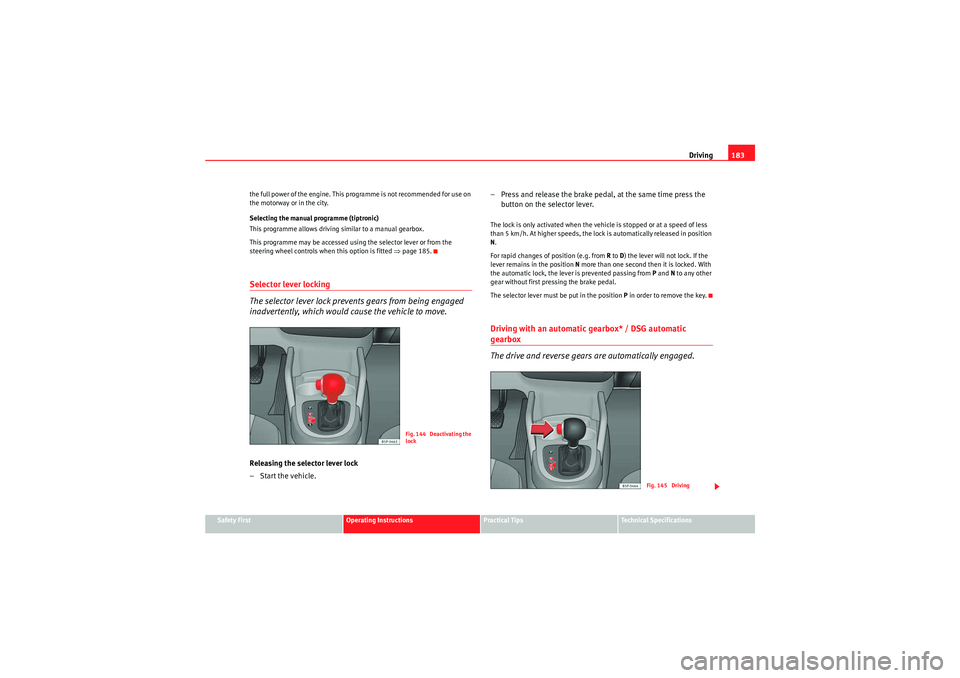
inadvertently, which would cause the vehicle to move.Releasing the selector lever lock
– Start the vehicle. – Press and release the brake pedal, at the same time press the
button on the selector lever.
The lock is only activated when the vehicle is stopped or at a speed of less
than 5 km/h. At higher speeds, the lock is automatically released in position
N.
For rapid changes of position (e.g. from R to D) the lever will not lock. If the
lever remains in the position N more than one second then it is locked. With
the automatic lock, the lever is prevented passing from P and N to any other
gear without first pressing the brake pedal.
The selector lever must be put in the position P in order to remove the key.Driving with an automatic gearbox* / DSG automatic gearbox
The drive and reverse gears are automatically engaged.
Fig. 144 Deactivating the
lock
Fig. 145 Driving
Altea_EN.book Seite 183 Donnerstag, 2. September 2010 2:00 14
Page 186 of 317
Driving
184
Driving
– Press and hold the foot brake.
– Press on the button on the selector lever knob (on the left, ⇒page 183, fig. 145.
– Select a gear for driving ( R, D or S).
– Release the button and wait a few seconds for the gear to engage, a light jerk will be felt.
– Release the brake and accelerate.
Short stop
– Hold the vehicle stationary with the brake pressed down (for example at traffic lights). The selector lever does not need to be
put into the positions P or N for this.
– Do not press the accelerator.
Parking the vehicle
– Press the brake pedal and hold to bring the vehicle to a stop.
– Apply the handbrake firmly.
– Press in the button on the selector lever knob, move the lever to the position P and release the button.
Driving slowly
– Move the selector lever to position D and press to the right to put
the lever into tiptronic mode.
– Press the gear lever towards (-) to select a lower gear. Hill stop
– Hold the vehicle, in all cases, using the brake pedal to prevent
rolling back.
– Do not try to slow the vehicle using another forward gear (engine braking).
Descending gradients
– With the gear engaged, release the brake and accelerate.
The steeper the gradient the lower the gear must be for effective engine
braking. For example, if 3rd gear is used on a very steep gradient, the engine
braking is insufficient and the vehicle accelerates. So that the engine speed
does not become excessive, the gearbox changes to the next highest gear.
Depress the brake pedal and move the selector lever to the tiptronic gate to
return to 3rd gear.
WARNING
•The driver should never leave the vehicle while the engine is running or
with any gear selected. If for any reason you must leave the vehicle with the
engine running, apply the handbrake and move the selector lever to posi-
tion P.•When the engine is running and the positions D, S or R are selected, it
is necessary to hold the vehicle with the brake pedal because the vehicle
will creep at a low speed.•Never accelerate while changing the position of the gear lever (risk of
an accident).•The gear lever must never be moved into the positions R or P while
moving (risk of an accident).•Before descending a steep gradient, reduce speed and use the tiptronic
programme to select a lower gear.
Altea_EN.book Seite 184 Donnerstag, 2. September 2010 2:00 14
Page 187 of 317
Driving185
Safety First
Operating Instructions
Practical Tips
Technical Specifications
•If you must stop on a hill, always hold the vehicle using the footbrake
to avoid rolling back.•The footbrake must not be held for a long period of time, not even
lightly; continuous braking will cause overheating of the brakes and a
reduction or even a loss of braking power and a significant increase in
braking distances.•Never allow the vehicle to coast down a gradient with the selector lever
in positions N or D, even when the engine is not running. For descents, the
use of the tiptronic programme is recommended to keep the speed
reduced.Caution
•Never use the automatic gearbox to hold the vehicle stationary on a hill,
even for short periods, as this may overheat the gearbox and cause damage.
Apply the handbrake or depress the foot brake to hold the vehicle in position.•If the vehicle is allowed to roll with the engine stopped but the selector in
position N then the gearbox may be damaged because it will not be
lubricated.
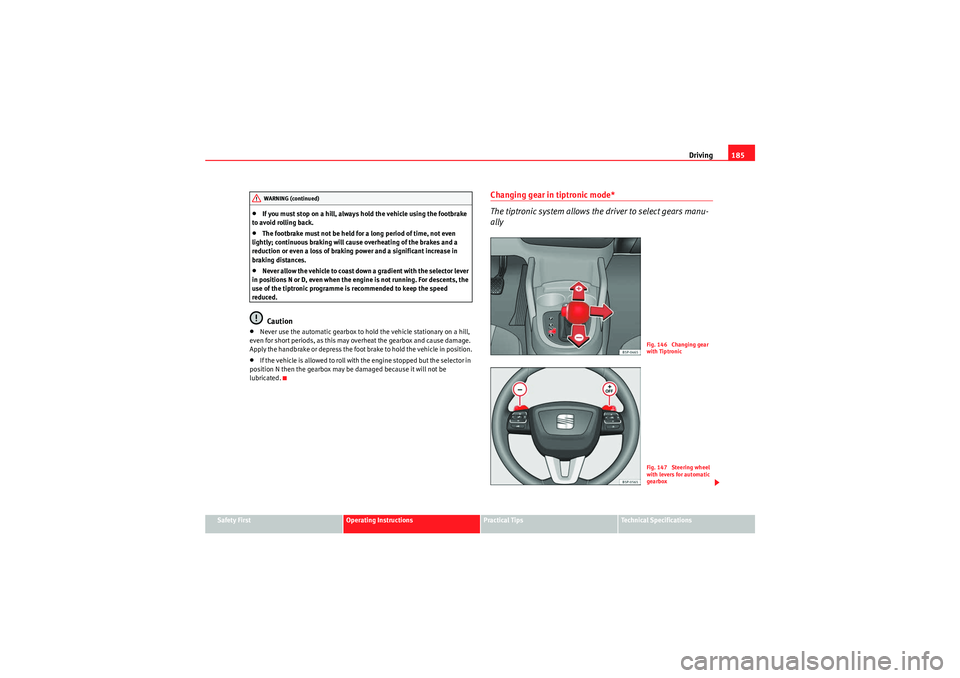
Changing gear in tiptronic mode*
The tiptronic system allows the driver to select gears manu-
ally
WARNING (continued)
Fig. 146 Changing gear
with TiptronicFig. 147 Steering wheel
with levers for automatic
gearbox
Altea_EN.book Seite 185 Donnerstag, 2. September 2010 2:00 14
Page 188 of 317
Driving
186
General information about driving in tiptronic mode
Changing gear with the selector lever
– Put the lever in position D and press towards the right to enter
the Tiptronic gate ⇒page 185, fig. 146 .
– Press the gear lever forwards ⇒page 185, fig. 146 to select
a higher gear.
–Press the gear lever back ⇒ page 185, fig. 146 to select a
lower gear.
Changing gear with the steering wheel levers
– Press the right paddle lever ( +OFF) towards the steering
wheel to change up ⇒page 185, fig. 147 .
– Press the left paddle towards the steering wheel to change down ⇒page 185, fig. 147 .Using the paddle levers on the steering wheel, you can access manual driving
mode regardless of the pre-selected driving mode.
General information about driving in tiptronic mode
When accelerating, the automatic gearbox / DSG automatic gearbox goes
into a higher gear a little before the engine reaches its maximum permitted
revolutions.
If a lower gear is selected, the automatic gearbox / DSG automatic gearbox
will only change down when the engine cannot go over its maximum
permitted revolutions.
If tiptronic is selected whilst the vehicle is in motion and the automatic
gearbox / DSG automatic gearbox is in third gear and selector lever position
D, tiptronic mode will then also be in third gear. Changing gears in the normal or sport programme using the steering wheel
paddle levers
If the paddle levers ⇒
page 185, fig. 147 are used in the normal or sport
programme, the system switches temporarily to tiptronic mode. To exit
tiptronic mode again, press the right paddle lever towards the steering
wheel for approximately one second. You will also leave “Tiptronic” mode if
the paddle levers are not moved for a certain time.
Note
•The gearbox controls on the steering wheel can operate with the selector
lever in any position and with the vehicle in motion.Kickdown feature
This feature allows maximum acceleration.If you press the accelerator down thoroughly, the gearbox automatically
changes down, depending on speed and engine speed, into a lower gear to
take full advantage of give the vehicle maximum acceleration.
The gearbox does not change gear until the engine reaches the maximum
determined engine speed for the gear.
WARNING
You could lose control of the vehicle if you accelerate on slippery road
surfaces. Risk of serious injury.•Be particularly careful when using the kickdown features on slippery
road surfaces. With a fast acceleration, the vehicle could lose traction and
skid.•You should use the kickdown feature only when traffic and weather
conditions allow it to be used safely.
A+
A–A+
A–
+ OFF
Altea_EN.book Seite 186 Donnerstag, 2. September 2010 2:00 14
Page 197 of 317
Driving195
Safety First
Operating Instructions
Practical Tips
Technical Specifications
Vehicles with a manual gearbox
The system
is completely turned off by moving the control all the way to
the right hand side (OFF engaged), or when the vehicle is stationary, ignition
off.
Vehicles with automatic gearbox / DSG automatic gearbox
To completely disengage the system, the selector lever must be placed in one
of the following positions: P , N , R or 1 or with the vehicle stopped and the
ignition turned off.
AB
Altea_EN.book Seite 195 Donnerstag, 2. September 2010 2:00 14
Page 210 of 317
Driving and the environment
208Drive anticipating the traffic situation
A vehicle uses most fuel when accelerating. When you anticipate the situa-
tion, you have to brake less often and, thus, accelerate less. If it is possible,
let the vehicle roll with a gear engaged, for example, if you see a red light
ahead. The braking effect achieved in this way helps to reduce the wear of
brakes and tyres; emissions and fuel consumption are reduced to zero
(disconnection due to inertia).
Change gear early to save energy
An effective way of saving fuel is to change up quickly through the gears.
Running the engine at high rpm in the lower gears uses an unnecessary
amount of fuel.
Manual gearbox: Change from first to second gear as quickly as possible. We
recommend that, whenever possible, you change to a higher gear upon
reaching 2000 rpm. Follow the recommended gear indication that appears on
the instrument panel ⇒page 62.
Avoid driving at high speed
We advise you not to drive at the top speed permitted by the vehicle. Fuel
consumption, exhaust emissions and noise levels all increase very rapidly at
higher speeds. Driving at moderate speeds will help to save fuel.
Avoid idling
It is worthwhile switching off the engine when waiting in a traffic jam, at level
crossings or at traffic lights with a long red phase. The fuel saved after only
30 - 40seconds is greater than the amount of fuel needed to restart the
engine.
The engine takes a long time to warm up when it is idling. Mechanical wear
and pollutant emissions are also especially high during this initial warm-up
phase. It is therefore best to drive off immediately after starting the engine.
Avoid running the engine at high speed. Periodic maintenance
Periodic maintenance work guarantees that, before beginning a journey, you
will not consume more than the required amount of fuel. A well-serviced
engine gives you the benefit of
improved fuel efficiency as well as maximum
reliability and an enhanced resale value.
A badly serviced engine can consume up to 10% more fuel than necessary.
Avoid short journeys
To reduce the consumption and emission of polluting gases, the engine and
the exhaust filtration systems should reach the optimum service tempera-
ture .
With the engine cold, fuel consumption is proportionally higher. The engine
does not warm up and fuel consumption does not normalise until having
driven approximately four kilometres. This is why we recommend avoiding
short trips whenever possible.
Maintain the correct tyre pressures
Bear in mind that keeping the tyres at an adequate pressure saves fuel. If the
tyre pressure is just one bar too low, fuel consumption can increase by as
much as 5%. Due to the greater rolling resistance, under-inflation also
increases tyre wear and impairs handling.
The tyre pressures should always be checked when the tyres are cold.
Do not use winter tyres all year round as they increase fuel consumption by
up to 10%.
Avoid unnecessary weight
Every kilo of extra weight will put up the fuel consumption, so it is worth
checking the luggage compartment occasionally to make sure that no unnec-
essary loads are being transported.
A roof rack is often left in place for the sake of convenience, even when it is
no longer needed. At a speed of 100-120km/h your vehicle will use about
12% more fuel as a result of the extra wind resistance caused by the roof rack
even when it is not in use.
Altea_EN.book Seite 208 Donnerstag, 2. September 2010 2:00 14
Page 261 of 317
If and when259
Safety First
Operating Instructions
Practical Tips
Technical Specifications
reliably seal punctures up to a size of about 4 mm caused by the penetration
of a foreign body into the tyre.
Note
•Seek professional assistance if the repair of a tyre puncture is not
possible with the sealing compound.Wheel changePreparation work
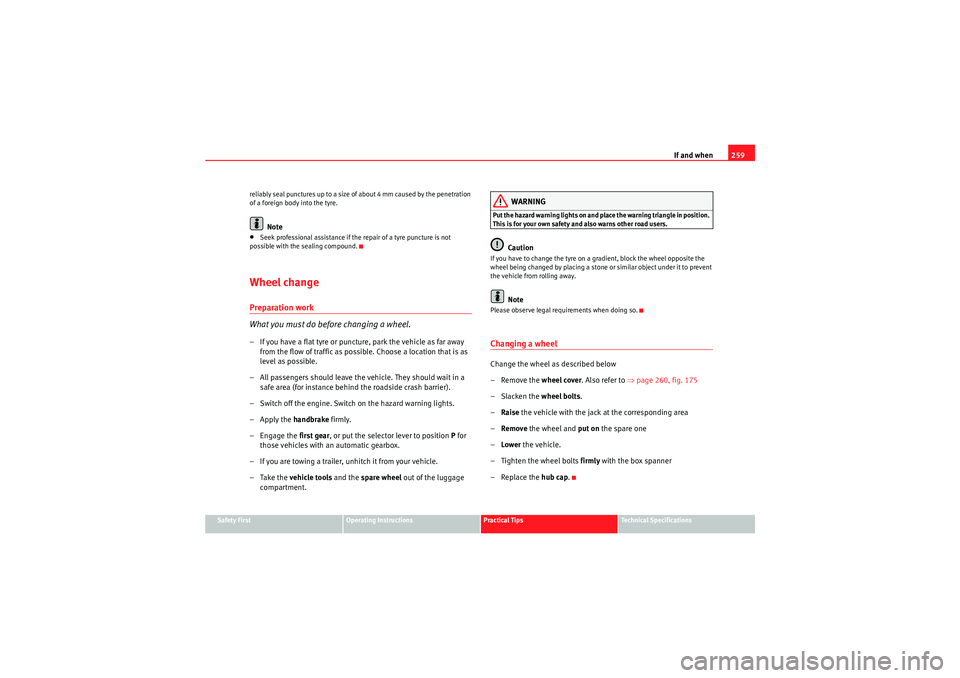
What you must do before changing a wheel.– If you have a flat tyre or puncture, park the vehicle as far away from the flow of traffic as possible. Choose a location that is as
level as possible.
– All passengers should leave the vehicle. They should wait in a safe area (for instance behind the roadside crash barrier).
– Switch off the engine. Switch on the hazard warning lights.
–Apply the handbrake firmly.
– Engage the first gear, or put the selector lever to position P for
those vehicles with an automatic gearbox.
– If you are towing a trailer, unhitch it from your vehicle.
– Take the vehicle tools and the spare wheel out of the luggage
compartment.
WARNING
Put the hazard warning lights on and place the warning triangle in position.
This is for your own safety and also warns other road users.
Caution
If you have to change the tyre on a gradient, block the wheel opposite the
wheel being changed by placing a stone or similar object under it to prevent
the vehicle from rolling away.
Note
Please observe legal requirements when doing so.Changing a wheelChange the wheel as described below
– Remove the wheel cover. Also refer to ⇒page 260, fig. 175
– Slacken the wheel bolts .
– Raise the vehicle with the jack at the corresponding area
– Remove the wheel and put on the spare one
– Lower the vehicle.
– Tighten the wheel bolts firmly with the box spanner
– Replace the hub cap.
Altea_EN.book Seite 259 Donnerstag, 2. September 2010 2:00 14
Page 272 of 317
If and when
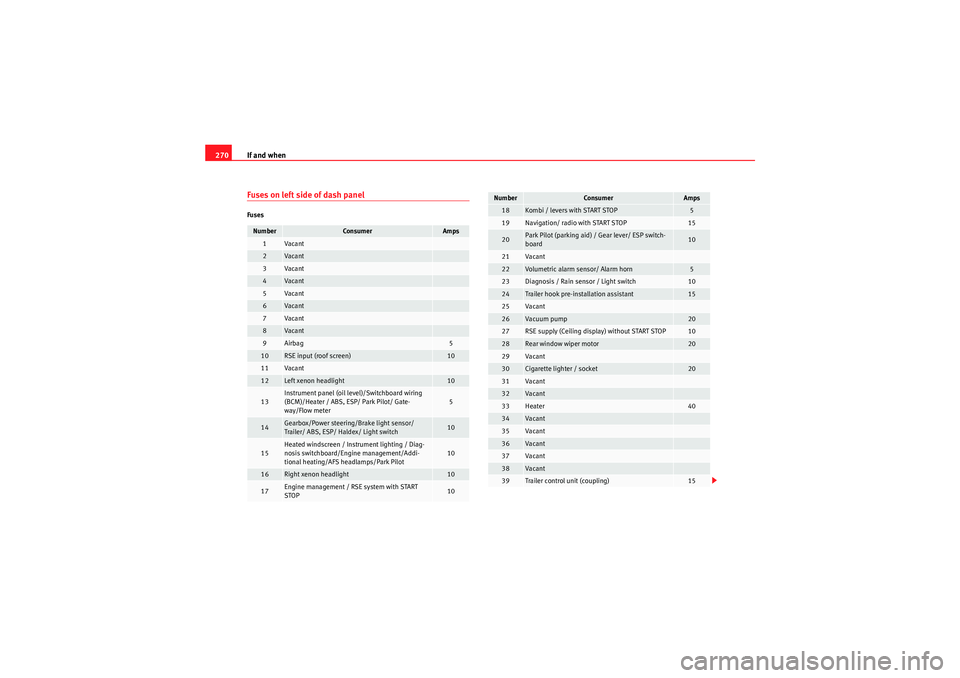
270Fuses on left side of dash panelFusesNumber
Consumer
Amps
1
Va ca n t
2
Va ca n t
3
Va ca n t
4
Va ca n t
5
Va ca n t
6
Va ca n t
7
Va ca n t
8
Va ca n t
9
Airbag
5
10
RSE input (roof screen)
10
11
Va ca n t
12
Left xenon headlight
10
13
Instrument panel (oil level)/Switchboard wiring
(BCM)/Heater / ABS, ESP/ Park Pilot/ Gate-
way/Flow meter
5
14
Gearbox/Power steering/Brake light sensor/
Trailer/ ABS, ESP/ Haldex/ Light switch
10
15
Heated windscreen / Instrument lighting / Diag-
nosis switchboard/Engine management/Addi-
tional heating/AFS headlamps/Park Pilot
10
16
Right xenon headlight
10
17
Engine management / RSE system with START
STOP
10
18
Kombi / levers with START STOP
5
19
Navigation/ radio with START STOP
15
20
Park Pilot (parking aid) / Gear lever/ ESP switch-
board
10
21
Va ca n t
22
Volumetric alarm sensor/ Alarm horn
5
23
Diagnosis / Rain sensor / Light switch
10
24
Trailer hook pre-installation assistant
15
25
Va ca n t
26
Va cu um pum p
20
27
RSE supply (Ceiling display) without START STOP
10
28
Rear window wiper motor
20
29
Va ca n t
30
Cigarette lighter / socket
20
31
Va ca n t
32
Va ca n t
33
Heater
40
34
Va ca n t
35
Va ca n t
36
Va ca n t
37
Va ca n t
38
Va ca n t
39
Trailer control unit (coupling)
15
Number
Consumer
Amps
Altea_EN.book Seite 270 Donnerstag, 2. September 2010 2:00 14