reset Seat Altea 2011 User Guide
[x] Cancel search | Manufacturer: SEAT, Model Year: 2011, Model line: Altea, Model: Seat Altea 2011Pages: 317, PDF Size: 8.87 MB
Page 97 of 317
Steering wheel controls95
Safety First
Operating Instructions
Practical Tips
Technical Specifications
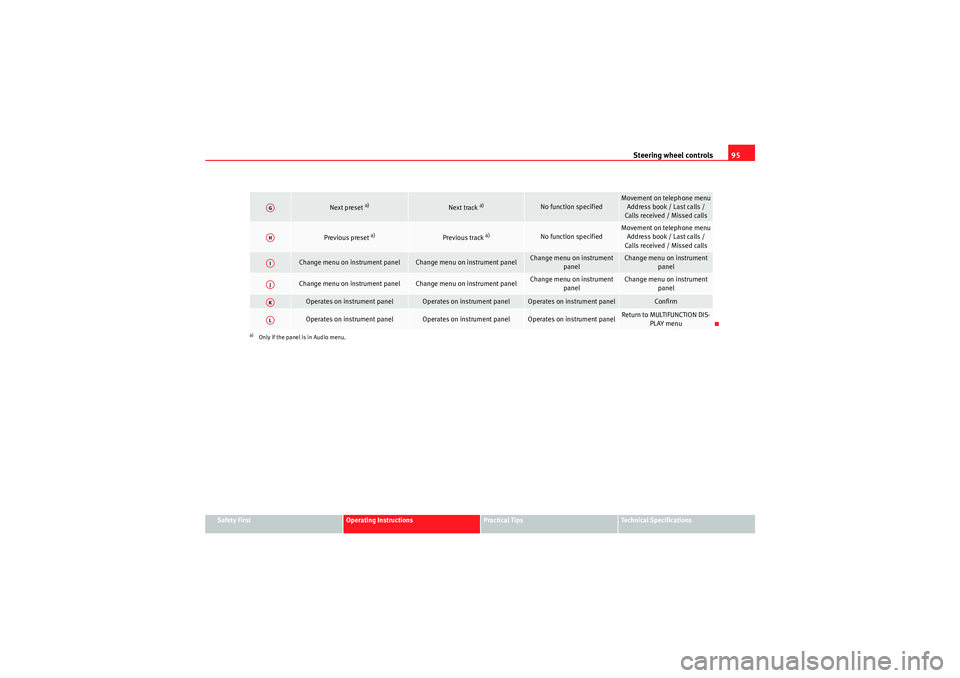
Next preset
a)
Next track
a)
No function specified
Movement on telephone menu
Address book / Last calls /
Calls received / Missed calls
Previous preset
a)
Previous track
a)
No function specified
Movement on telephone menu Address book / Last calls /
Calls received / Missed calls
Change menu on instrument panel
Change menu on instrument panel
Change menu on instrument panel
Change menu on instrument panel
Change menu on instrument panel
Change menu on instrument panel
Change menu on instrument
panel
Change menu on instrument panel
Operates on instrument panel
Operates on instrument panel
Operates on instrument panel
Confirm
Operates on instrument panel
Operates on instrument panel
Operates on instrument panel
Return to MULTIFUNCTION DIS-PLAY menu
a)Only if the panel is in Audio menu.AGAHAIAJAKAL
Altea_EN.book Seite 95 Donnersta g, 2. September 2010 2:00 14
Page 99 of 317
Steering wheel controls97
Safety First
Operating Instructions
Practical Tips
Technical Specifications
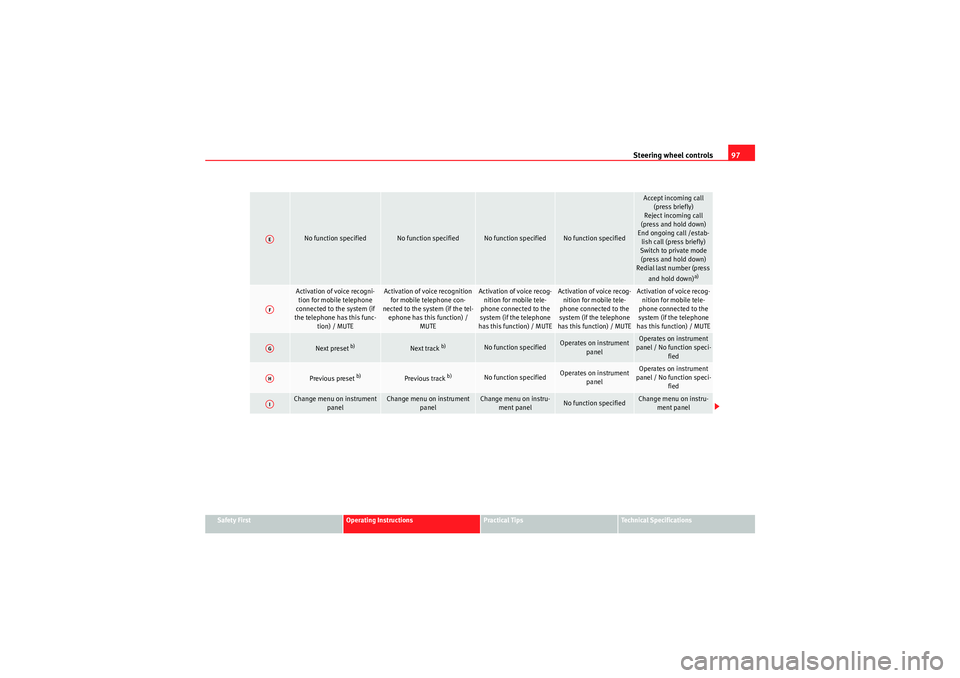
No function specified
No function specified
No function specified
No function specified
Accept incoming call
(press briefly)
Reject incoming call
(press and hold down)
End ongoing call /estab-
lish call (press briefly)
Switch to private mode (press and hold down)
Redial last number (press
and hold down)
a)
Activation of voice recogni-tion for mobile telephone
connected to the system (if
the telephone has this func- tion) / MUTE
Activation of voice recognition for mobile telephone con-
nected to the system (if the tel-
ephone has this function) / MUTE
Activation of voice recog-nition for mobile tele-
phone connected to the
system (if the telephone
has this function) / MUTE
Activation of voice recog- nition for mobile tele-
phone connected to the
system (if the telephone
has this function) / MUTE
Activation of voice recog- nition for mobile tele-
phone connected to the
system (if the telephone
has this function) / MUTE
Next preset
b)
Next track
b)
No function specified
Operates on instrument
panel
Operates on instrument
panel / No function speci-
fied
Previous preset
b)
Previous track
b)
No function specified
Operates on instrument panel
Operates on instrument
panel / No function speci- fied
Change menu on instrument panel
Change menu on instrument panel
Change menu on instru-ment panel
No function specified
Change menu on instru-ment panel
AEAFAGAHAI
Altea_EN.book Seite 97 Donnersta g, 2. September 2010 2:00 14
Page 252 of 317

Wheels and tyres
250
2. The tyre pressures should only be checked when the tyres are cold. The slightly raised pressu res of warm tyres must not be
reduced.
3. Adjust the tyre pressure to the load you are carrying.Tyre pressure
The correct tyre pressure is especially important at high speeds. The pressure
should therefore be checked at least once a month and before starting a
journey.
The sticker with the tyre pressure values can be found on the inside of the
tank flap. The tyre pressure values given are for cold tyres. Do not reduce the
slightly raised pressures of warm tyres ⇒.
WARNING
•Check the tyre pressure at least once per month. Checking the tyre
pressure is very important. If the tyre pressure is too high or too low, there
is an increased danger of accidents - particularly at high speeds.•A tyre can easily burst if the pressure is too low, causing an accident!•At continuously high speeds, a tyre with insufficient pressure flexes
more. In this way it becomes too hot, and this can cause tread separation
and tyre blow-out. Always observe the recommended tyre pressures.•If the tyre pressure is too low or too high, the tyres will wear prema-
turely and the vehicle will not handle well. Risk of accident!For the sake of the environment
Under-inflated tyres will increase fuel consumption.
Tyre pressure monitoring
The tyre pressure monitoring system constantly checks the
pressure of the tyres.The system uses the speed sensors of the ABS wheels. It operates by
analysing the speed and frequency spectrum of each wheel.
For optimum performance, use genuine SEAT tyres. In addition, check and
adjust tyre pressures regularly.
Whenever the tyre pressures are changed or one or more tyres are changed,
the system should be Reset by pressing the SET switch on the centre console.
The system warns the driver in the event of a loss of pressure by means of
symbols and messages in the instrument panel display. The system uses ESP
⇒ page 199.
Note that tyre pressure also depends on tyre temperature. Tyre pressure
increases about 0.1 bar for each 10 °C in tyre temperature increase. The tyre
heats up while the vehicle is being driven and the tyre pressure will rise
accordingly. For this reason, you should only adjust the tyre pressures when
they are cold (i.e. approximately at ambient temperature).
To ensure that the tyre pressure monitoring system works reliably, you should
check and, if necessary, adjust the tyre pressures at regular intervals and
store the correct pressures (reference values) in the system.
A tyre pressure information label is attached to the inside of the fuel tank flap.
WARNING
•Never adjust tyre pressure when the tyres are hot. This may damage or
even burst the tyres. Risk of accident!•An insufficiently inflated tyre flexes a lot more at high speeds and
causes significant heating of the tyre. Under these conditions, the tyre
bead may be released or the tyre may burst. Risk of accident!
Altea_EN.book Seite 250 Donnerstag, 2. September 2010 2:00 14
Page 270 of 317
If and when
268
Fuse cover underneath the steering wheel
– Switch off the ignition and the component concerned.
– Identify the fuse corresponding to the damaged electric consumer ⇒page 270.
– Take the plastic clip from inside the fuse cover, fit it onto the blown fuse and pull the fuse out.
– Replace the blown fuse (which will have a melted metal strip) with a new fuse of the same ampere rating.
Fuse cover in engine compartment
– Switch off the ignition and its failed electrical component.
– Prise off the fuse cover in the engine compartment by pressing the tabs towards the centre of the cover ⇒page 267, fig. 182 .
– Identify the fuse for the failed component ⇒page 270.
– Take the plastic clip from inside the fuse cover (at left-hand end of the dash panel), fit it onto the blown fuse and pull the fuse out.
– Replace the blown fuse (which will have a melted metal strip) with a new fuse of the same ampere rating.
– Carefully fit the fuse cover back on to ensure no water can enter
the fuse box.The individual electrical circuits are protected by fuses. The fuses are located
behind a cover at the left-hand end of the dash panel and on the left-hand
side of the engine compartment. The electric windows are protected by
circuit breakers. These reset automat-
ically after a few seconds when the overload (caused for example by frozen
windows) has been corrected.
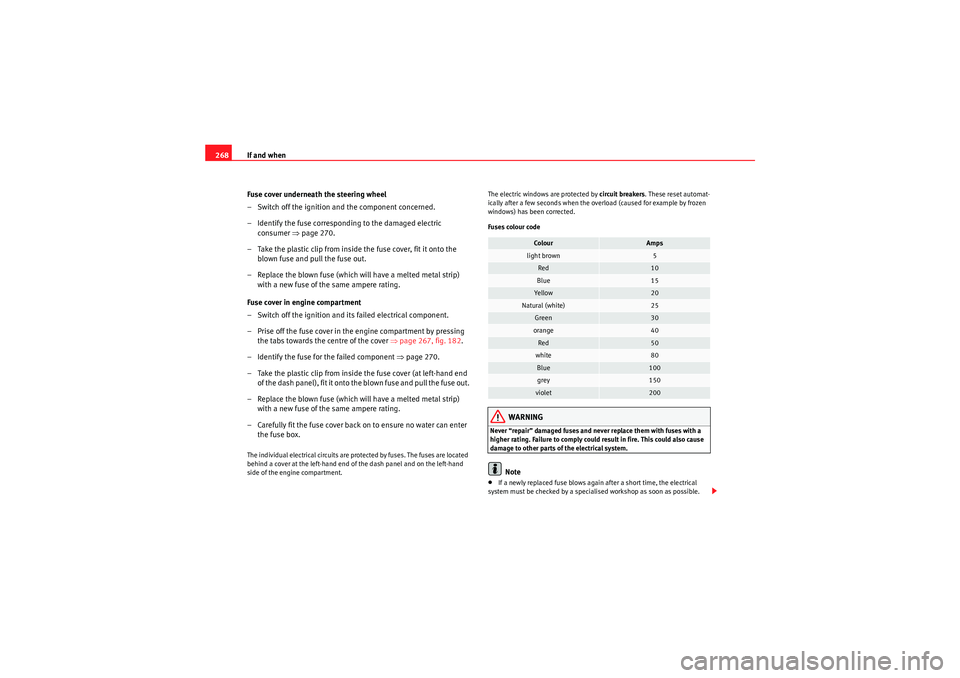
Fuses colour code
WARNING
Never “repair” damaged fuses and never replace them with fuses with a
higher rating. Failure to comply could result in fire. This could also cause
damage to other parts of the electrical system.
Note
•If a newly replaced fuse blows again after a short time, the electrical
system must be checked by a specialised workshop as soon as possible.
Colour
Amps
light brown
5
Red
10
Blue
15
Ye ll ow
20
Natural (white)
25
Green
30
orange
40
Red
50
white
80
Blue
100
grey
150
violet
200
Altea_EN.book Seite 268 Donnerstag, 2. September 2010 2:00 14
Page 274 of 317
If and when
272
Bulb changeGeneral notesBefore changing any bulb, first turn off the failed component.
Do not touch the bulb glass. Fingerprints vaporise in the heat, causing a
reduction in the bulb life and condensation on the mirror surface, thus
reducing efficiency.
A bulb should only be replaced by one of the same type. The type is inscribed
on the bulb, either on the glass part or on the base.
It is highly recommended to keep a box of spare bulbs in the vehicle. At the
very least, the following spare bulbs, which are essential for road safety,
should be kept in the vehicle.
Main headlights
Dipped beam - H7
Main beam - H1
Position - W5W
Turn signal - PY21W
Xenon headlights
26)/adaptive*
Dipped and full beam - D1S
27)
Daylight - P21W SLL
Position W5W
Turn signals PY21W
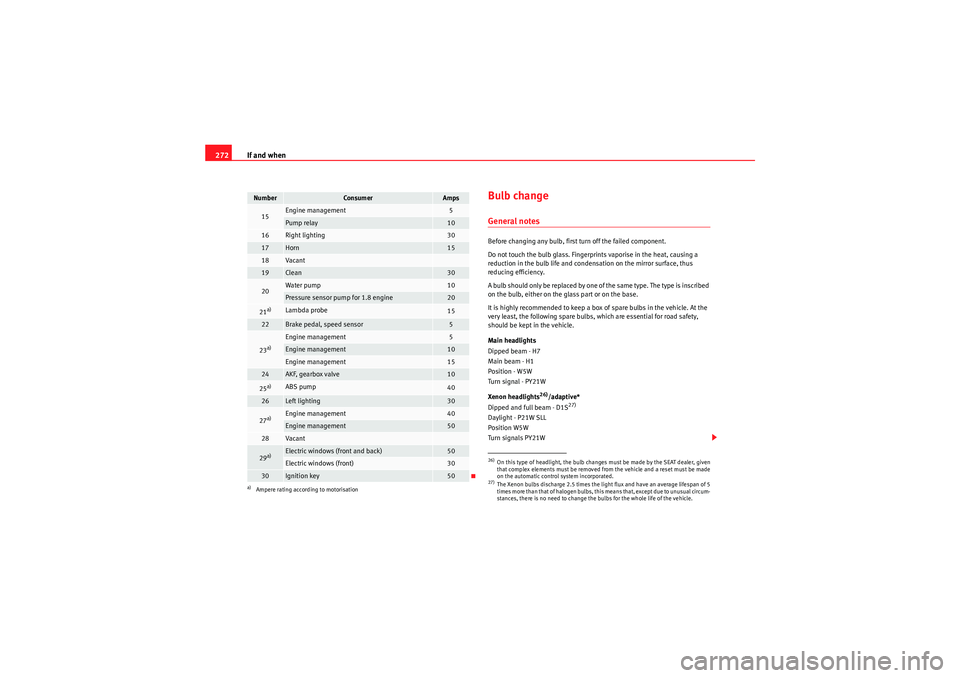
15
Engine management
5
Pump relay
10
16
Right lighting
30
17
Horn
15
18
Vacan t
19
Clean
30
20
Water pump
10
Pressure sensor pump for 1.8 engine
20
21a)
Lambda probe
15
22
Brake pedal, speed sensor
5
23a)
Engine management
5
Engine management
10
Engine management
15
24
AKF, gearbox valve
10
25a)
ABS pump
40
26
Left lighting
30
27a)
Engine management
40
Engine management
50
28
Vacan t
29a)
Electric windows (front and back)
50
Electric windows (front)
30
30
Ignition key
50
a)Ampere rating according to motorisationNumber
Consumer
Amps
26)On this type of headlight, the bulb changes must be made by the SEAT dealer, given
that complex elements must be removed from the vehicle and a reset must be made
on the automatic control system incorporated.27)The Xenon bulbs discharge 2.5 times the light flux and have an average lifespan of 5
times more than that of halogen bulbs, this means that, except due to unusual circum-
stances, there is no need to change the bulbs for the whole life of the vehicle.
Altea_EN.book Seite 272 Donnerstag, 2. September 2010 2:00 14