towing Seat Altea 2011 User Guide
[x] Cancel search | Manufacturer: SEAT, Model Year: 2011, Model line: Altea, Model: Seat Altea 2011Pages: 317, PDF Size: 8.87 MB
Page 214 of 317
Trailer towing
212•Find out whether special regulations apply to towing a trailer in your
country.Ball coupling of towing bracket*Depending on the model version, the spherical head on the trailer hook may
be stored in the tool box.
The ball coupling is provided with instructions on fitting and removing the
ball coupling of the towing bracket.
WARNING
The towing bracket ball coupling must be stored securely in the luggage
compartment to prevent them being flung through the vehicle and causing
injury.
Note
•By law, the ball coupling must be re moved if a trailer is not being towed
and it obscures the number plate.Driving tipsDriving with a trailer always requires extra care.Weight distribution
The weight distribution of a loaded trailer with an unladen vehicle is very
unfavourable. However, if this cannot be avoided, drive extra slowly to allow
for the unbalanced weight distribution. Speed
The stability of the vehicle and trailer is reduced with increasing speed. For
this reason, it is advisable not to drive at the maximum permissible speed in
an unfavourable road, weather or wind conditions. This applies especially
when driving downhill.
You should always reduce speed immediately if the trailer shows the slightest
sign of
snaking . Never try to stop the “snaking” by increasing speed.
Always brake in due course. If the trailer has an overrun brake, apply the
brakes gently at first and then, firmly. This will prevent the jerking that can be
caused by the trailer wheels locking. Select a low gear in due course before
going down a steep downhill. This enables you to use the engine braking to
slow down the vehicle.
Reheating
At very high temperatures and during prolonged slopes, driving in a low gear
and high engine speed, always monitor the coolant temperature gauge
⇒ page 55.
Electronic Stability Programme*
The ESP* system helps to stabilise the trailer in case of skidding or rocking.
Altea_EN.book Seite 212 Donnerstag, 2. September 2010 2:00 14
Page 215 of 317
Trailer towing213
Safety First
Operating Instructions
Practical Tips
Technical Specifications
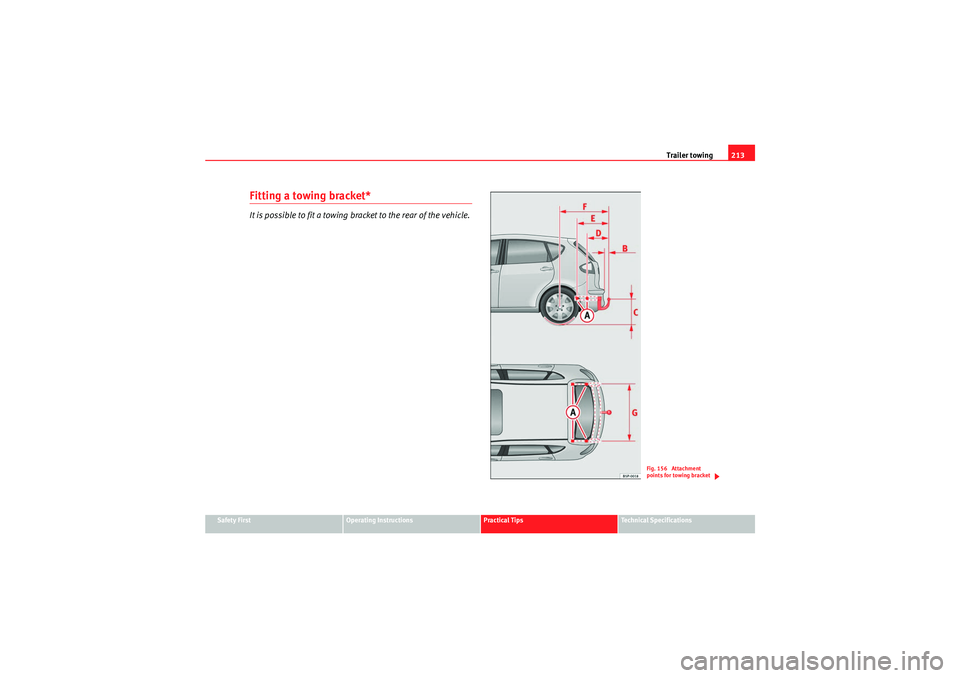
Fitting a towing bracket*It is possible to fit a towing bracket to the rear of the vehicle.
Fig. 156 Attachment
points for towing bracket
Altea_EN.book Seite 213 Donnerstag, 2. September 2010 2:00 14
Page 216 of 317

Trailer towing
214If a towing bracket is to be fitted after the vehicle is purchased, this must be
completed according to the instructions of the towing bracket manufacturer.
The attachment points for the towing bracket are on the lower part of the
vehicle.
The distance between the centre of the ball coupling and the ground should
never be lower than the indicated value, even with a fully loaded vehicle and
including the maximum drawbar load.
Elevation values for securing the towing bracket:
65 mm (minimum)
350 mm to 420 mm (fully laden vehicle)
357 mm
569 mm
875 mm
1040 mm
Fitting a towing bracket•Driving with a trailer involves an extra effort for the vehicle. Therefore,
before fitting a towing bracket, please contact an Authorised Service Centre
to check whether your cooling system needs modification.•The legal requirements in your country must be observed (e.g. the fitting
of a separate warning lamp).•Certain vehicle components, e.g. the rear bumper, must be removed and
reinstalled. The towing bracket securing bolts must be tightened using a
torque wrench, and a power socket must be connected to the vehicle’s elec-
trical system. This requires specialised knowledge and tools.•Figures in the illustration show the elevation value and the attachment
points which must be considered if you are retrofitting a towing bracket.WARNING
The towing brackets should be fitted at a specialised workshop.
•If the towing bracket is incorrectly installed, there is serious danger of
accident.•For your own safety, please observe the instructions provided by the
manufacturer of the towing bracket.Caution
•If the power socket is incorrectly installed, this could cause damage to the
vehicle’s electrical system.Note
For the sports model (FR), fitting of a trailer bracket is not recommended due
to the design of the bumpers.
AA
ABACADAEAFAG
WARNING (continued)
Altea_EN.book Seite 214 Donnerstag, 2. September 2010 2:00 14
Page 259 of 317
If and when257
Safety First
Operating Instructions
Practical Tips
Technical Specifications
If and whenTools, tyre repair kit and spare wheelVehicle Tools
The vehicle onboard tools are lo cated under the floor panel in
the luggage compartment.– Lif t the cover of the luggage compar tment, by pulling it up with a
finger in the fitting.
– Take the on-board tools out of the vehicle.The tool kit includes:•Jack*•Hook for removing wheel covers* or hub caps*•Box spanner for wheel bolts*•Reversible screwdriver with handle (including hexagonal interior) for the
wheel bolts. The screwdriver is a combination tool.•Towing eye•Adapter for the anti-theft wheel bolts*
Some of the items listed are only provided in certain model versions, or are
optional extras.WARNING
•Do not use the hexagonal socket in the screwdriver handle to tighten
the wheel bolts as with this it is not possible to tighten the bolts to the
required torque. Risk of accident.
•The factory-supplied jack is only designed for changing wheels on this
model. On no account attempt to use it for lifting heavier vehicles or other
loads. Risk of injury.•Use the jack only on a firm, level ground.•Never start the engine when the vehicle is on the jack. Risk of accident.•I f w o r k is t o b e ca r r ie d o u t un d e r n ea t h t h e v e h ic l e , t h is m u s t be s e cu re d
by suitable stands. Otherwise, there is a risk of injury.WARNING (continued)
Altea_EN.book Seite 257 Donnerstag, 2. September 2010 2:00 14
Page 261 of 317
If and when259
Safety First
Operating Instructions
Practical Tips
Technical Specifications
reliably seal punctures up to a size of about 4 mm caused by the penetration
of a foreign body into the tyre.
Note
•Seek professional assistance if the repair of a tyre puncture is not
possible with the sealing compound.Wheel changePreparation work
What you must do before changing a wheel.– If you have a flat tyre or puncture, park the vehicle as far away from the flow of traffic as possible. Choose a location that is as
level as possible.
– All passengers should leave the vehicle. They should wait in a safe area (for instance behind the roadside crash barrier).
– Switch off the engine. Switch on the hazard warning lights.
–Apply the handbrake firmly.
– Engage the first gear, or put the selector lever to position P for
those vehicles with an automatic gearbox.
– If you are towing a trailer, unhitch it from your vehicle.
– Take the vehicle tools and the spare wheel out of the luggage
compartment.
WARNING
Put the hazard warning lights on and place the warning triangle in position.
This is for your own safety and also warns other road users.
Caution
If you have to change the tyre on a gradient, block the wheel opposite the
wheel being changed by placing a stone or similar object under it to prevent
the vehicle from rolling away.
Note
Please observe legal requirements when doing so.Changing a wheelChange the wheel as described below
– Remove the wheel cover. Also refer to ⇒page 260, fig. 175
– Slacken the wheel bolts .
– Raise the vehicle with the jack at the corresponding area
– Remove the wheel and put on the spare one
– Lower the vehicle.
– Tighten the wheel bolts firmly with the box spanner
– Replace the hub cap.
Altea_EN.book Seite 259 Donnerstag, 2. September 2010 2:00 14
Page 286 of 317
If and when
284Towing and tow-startingTo w - s t a r t i n g
The use of jump leads is preferable to tow-starting.We recommend that you do not tow-start your vehicle. Jump-starting
is preferable ⇒ page 281.
However, if your vehicle has to be tow-started:
– Engage the 2nd or the 3rd gear.
– Keep the clutch pressed down.
– Switch the ignition on.
– Once both vehicles are moving, release the clutch.
– As soon as the engine starts, press the clutch and move the gear lever into neutral. This helps to prevent driving into the towing
vehicle.
WARNING
The risk of accidents is high when tow-starting. The vehicle being towed
can easily collide with the towing vehicle.
Caution
When tow-starting, fuel could enter the catalytic converter and damage it.
General notesPlease observe the following points if you use a tow-rope:
Notes for the driver of the towing vehicle
– Drive slowly at first until the tow-rope is taut. Then accelerate gradually.
– Begin and change gears cautiously. If you are driving an auto- matic vehicle, accelerate gently.
– Remember that the brake servo and power steering are not working in the vehicle you are towing. Brake sooner than normal
and pressing the pedal gently.
Notes for the driver of the towed vehicle
– Ensure that the tow-rope remains taut at all times when towing.Tow-rope or tow-bar
It is easier and safer to tow a vehicle with a tow-bar. You should only use a
tow-rope if you do not have a tow-bar.
A tow-rope should be slightly elastic to reduce the loading on both vehicles.
It is advisable to use a tow-rope made of synthetic fibre or similarly elastic
material.
Attach the tow-rope or the tow-bar only to the towing eyes provided or a
towing bracket.
Driving style
Towing requires some experience, especially when using a tow-rope. Both
drivers should be familiar with the technique required for towing. Inexperi-
enced drivers should not attempt to tow.
Altea_EN.book Seite 284 Donnerstag, 2. September 2010 2:00 14
Page 287 of 317
If and when285
Safety First
Operating Instructions
Practical Tips
Technical Specifications
Do not pull too hard with the towing vehicle and take care to avoid jerking the
tow-rope. When towing on an unpaved road, there is always a risk of over-
loading and damaging the anchorage points.
The ignition of the vehicle being towed must be switched on to prevent the
steering wheel from locking and also to allow the use of the turn signals,
horn, windscreen wipers and washers.
As the brake servo does not work if the engine is not running, you must apply
considerably more pressure to the brake pedal than you normally would.
As the power assisted steering does not work if the engine is not running, you
will need more strength to steer than you normally would.
Towing vehicles with an automatic gearbox
•Put the selector lever into position “N”.•Do not drive faster than 50 km/h.•Do not tow further than 50 km.•If a breakdown vehicle is used, the vehicle must be towed with the front
wheels raised.Note
•Observe legal requirements when towing or tow-starting.•Switch on the hazard warning lights of both vehicles. However, observe
any regulations to the contrary.•For technical reasons, vehicles with an automatic gearbox must not be
tow-started.•If damage to your vehicle means that there is no lubricant in the gearbox,
you must raise the drive wheels while the vehicle is being towed.•If the vehicle has to be towed more than 50 km, the front wheels should
be raised during towing, and towing should be carried out by a qualified
person.
•The steering wheel is locked when the vehicle has no electrical power. The
vehicle must then be towed with the front wheels raised. Towing should be
carried out by a qualified person.•The towing eye should always be kept in the vehicle. Please refer to the
notes on ⇒page 284, “Tow-starting”.
Altea_EN.book Seite 285 Donnerstag, 2. September 2010 2:00 14
Page 288 of 317
If and when
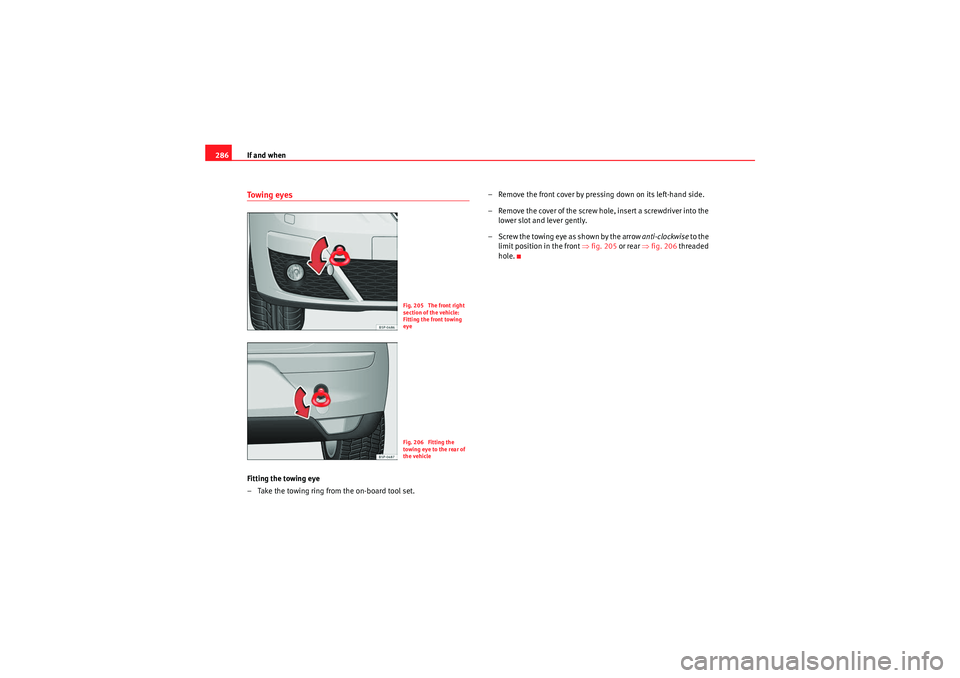
286To w i n g e y e sFitting the towing eye
– Take the towing ring from the on-board tool set. – Remove the front cover by pressing down on its left-hand side.
– Remove the cover of the screw hole, insert a screwdriver into the
lower slot and lever gently.
– Screw the towing eye as shown by the arrow anti-clockwise to the
limit position in the front ⇒ fig. 205 or rear ⇒fig. 206 threaded
hole.
Fig. 205 The front right
section of the vehicle:
Fitting the front towing
eyeFig. 206 Fitting the
towing eye to the rear of
the vehicle
Altea_EN.book Seite 286 Donnerstag, 2. September 2010 2:00 14
Page 291 of 317
Description of specifications289
Safety First
Operating Instructions
Practical Tips
Technical Specifications
Information on fuel consumptionFuel consumption
The consumption and emission details shown on the vehicle
data sticker differ from one vehicle to another.The fuel consumption and CO
2 emissions of the vehicle can be found on the
vehicle data sticker.
The fuel consumption and emissions figures given are based on the vehicle
weight category, which is determined according to the engine/gearbox
combination and the equipment fitted.
The consumption and emission figures are calculated in accordance with the
tests indicated in regulations 715/2007/EC and 692/2008/EC.
Note
•Actual consumption may vary from quoted test values, depending on
personal driving style, road and traffic conditions, the weather and the
vehicle condition.WeightsKerb weight refers to the basic model with a fuel tank filled to 90% capacity
and without optional extras. The figure quoted includes 75 kg to allow for the
weight of the driver.
For special versions and optional equipment fittings or for the addition of
accessories, the weight of the vehicle will increase ⇒.
WARNING
•Please note that the centre of gravity may shift when transporting
heavy objects; this may affect the vehicle’s handling and lead to an acci-
dent. Always adjust your speed and driving style to suit road conditions
and requirements.•Never exceed the gross axle weight rating or the gross vehicle weight
rating. If the allowed axle load or the allowed total weight is exceeded, the
driving characteristics of the vehicle may change, leading to accidents,
injuries and damage to the vehicle.
To w i n g a t r a i l e rTrailer weightsTrailer weight
The trailer weights and drawbar loads approved are selected in intensive
trials according to precisely defined criteria. The approved trailer weights are
valid for vehicles in the EU for maximum speeds of 80 km/h (in certain
circumstances up to 100 km/h). The figures may be different in other coun-
tries. All data in the official vehicle documents take precedence over these
data ⇒ .
Drawbar load
The maximum permitted drawbar load on the ball joint of the towing bracket
must not exceed 75 kg.
In the interest of road safety, we recommend that you always tow
approaching the maximum drawbar load. The response of the trailer on the
road will be poor if the drawbar load is too small.
Altea_EN.book Seite 289 Donnerstag, 2. September 2010 2:00 14
Page 314 of 317
Index
312Tank
Fuel level . . . . . . . . . . . . . . . . . . . . . . . . . . . . 58
Reserve indicator . . . . . . . . . . . . . . . . . . . . . 58
Tank capacity . . . . . . . . . . . . . . . . . . . . . . . . . 58
TCS . . . . . . . . . . . . . . . . . . . . . . . . . . . . . . . . . . . 198
TCS (Traction control system) Warning lamp . . . . . . . . . . . . . . . . . . . . . . . . 89
Technical modifications . . . . . . . . . . . . . . . . . . 224
The danger of not using the seat belt . . . . . . . . 22
Tightening torque of wheel bolts . . . . . . . . . . . 290
Tilting sunroof . . . . . . . . . . . . . . . . . . . . . . . . . . 115
Tools . . . . . . . . . . . . . . . . . . . . . . . . . . . . . . . . . . 257
Top Tether system . . . . . . . . . . . . . . . . . . . . . . . . 52
Tow starting General notes . . . . . . . . . . . . . . . . . . . . . . . 284
Towing . . . . . . . . . . . . . . . . . . . . . . . . . . . . . . . . 284
Towing a trailer . . . . . . . . . . . . . . . . . . . . . . . . . 289
Towing bracket . . . . . . . . . . . . . . . . . . . . . . . . . 212
Towing bracket, fitting . . . . . . . . . . . . . . . . . . . 213
Towing eye . . . . . . . . . . . . . . . . . . . . . . . . . . . . . 284
Towing eyes . . . . . . . . . . . . . . . . . . . . . . . . . . . . 286
Tow-starting . . . . . . . . . . . . . . . . . . . . . . . . . . . . 284
Traction control system Warning lamp . . . . . . . . . . . . . . . . . . . . . . . . 89
Trailer Trailer towing . . . . . . . . . . . . . . . . . . . . . . . . 211
Trailer turn signals Warning lamp . . . . . . . . . . . . . . . . . . . . . . . 125
Trailer weights . . . . . . . . . . . . . . . . . . . . . . . . . . 289 Turn signals . . . . . . . . . . . . . . . . . . . . . . . . . . . . 125
Indicator lamp . . . . . . . . . . . . . . . . . . . . . . . . 83
Warning lamp . . . . . . . . . . . . . . . . . . . . . . . 125
Tyre Mobility System (Tyre repair kit) . . . . . . . . 265
Tyre Mobility-System (Tyre repair kit) . . . . . . . 258
Tyre pressure . . . . . . . . . . . . . . . . . . . . . . . . . . . 249 Loss . . . . . . . . . . . . . . . . . . . . . . . . . . . . . . . 251
Tyre pressure monitoring . . . . . . . . . . . . . . . . . 250
Tyre pressure warning lamp . . . . . . . . . . . . . . . . 85
Tyre pressures . . . . . . . . . . . . . . . . . . . . . . . . . . 290
Tyre repair kit . . . . . . . . . . . . . . . . . . . . . . . 258, 265
Tyres and wheels Dimensions . . . . . . . . . . . . . . . . . . . . . . . . . 254
Tyres service life . . . . . . . . . . . . . . . . . . . . . . . . 251
Tyres tread depth . . . . . . . . . . . . . . . . . . . . . . . 252
Tyres with directional tread pattern . . . . . . . . . 249
UUnderbody protection . . . . . . . . . . . . . . . . . . . . 220
Unlocking and locking Personalisation . . . . . . . . . . . . . . . . . . . . . . 103VVehicle battery . . . . . . . . . . . . . . . . . . . . . . . . . 246
Vehicle data . . . . . . . . . . . . . . . . . . . . . . . . . . . . 288
Vehicle identification data . . . . . . . . . . . . . . . . 288
Vehicle identification number . . . . . . . . . . . . . 288
Vehicle MaintenanceExterior . . . . . . . . . . . . . . . . . . . . . . . . . . . . . 216 Vehicle modifications . . . . . . . . . . . . . . . . . . . . 224
Vehicle paintwork
Maintenance . . . . . . . . . . . . . . . . . . . . . . . . 217
Products for vehicle maintenance . . . . . . . 215
Vehicle tools Storage . . . . . . . . . . . . . . . . . . . . . . . . . . . . 257
Vehicle washing . . . . . . . . . . . . . . . . . . . . . . . . 216
Ventilation slits . . . . . . . . . . . . . . . . . . . . . . . . . . 17
Volumetric sensor* Activation . . . . . . . . . . . . . . . . . . . . . . . . . . . 109
Deactivation . . . . . . . . . . . . . . . . . . . . . . . . 109
WWarning lamp . . . . . . . . . . . . . . . . . . . . . . . . . . . 31
Warning lamps . . . . . . . . . . . . . . . . . . . . . . . . . . 77
Warning messages in the display . . . . . . . . . . . 66
Warning reportsRed . . . . . . . . . . . . . . . . . . . . . . . . . . . . . . 66, 80
Yellow . . . . . . . . . . . . . . . . . . . . . . . . . . . 66, 81
Warning symbols . . . . . . . . . . . . . . . . . . . . . . . . 80
Warning triangle . . . . . . . . . . . . . . . . . . . . . . . . 155
Washer fluid . . . . . . . . . . . . . . . . . . . . . . . . . . . 241
Washing by hand . . . . . . . . . . . . . . . . . . . . . . . 216
Washing with high pressure cleaners . . . . . . . 217
Water Warning message . . . . . . . . . . . . . . . . . . . . . 67
Water in the windscreen washer tank . . . . . . . 241
Wear indicators . . . . . . . . . . . . . . . . . . . . . . . . . 252
Wearing suitable shoes . . . . . . . . . . . . . . . . . . . 16
Altea_EN.book Seite 312 Donnerstag, 2. September 2010 2:00 14