refuelling Seat Altea 2011 Owner's Manual
[x] Cancel search | Manufacturer: SEAT, Model Year: 2011, Model line: Altea, Model: Seat Altea 2011Pages: 317, PDF Size: 8.87 MB
Page 6 of 317
Contents
4Trailer towing
. . . . . . . . . . . . . . . . . . . . . . . . . . . . .
Instructions to follow . . . . . . . . . . . . . . . . . . . . .
Ball coupling of towing bracket* . . . . . . . . . . . .
Driving tips . . . . . . . . . . . . . . . . . . . . . . . . . . . . .
Fitting a towing bracket* . . . . . . . . . . . . . . . . . . .
Vehicle maintenance and cleaning
. . . . . . . .
General notes . . . . . . . . . . . . . . . . . . . . . . . . . . .
Vehicle exterior maintenance . . . . . . . . . . . . . . .
Vehicle interior maintenance . . . . . . . . . . . . . . .
Accessories, parts replacement and
modifications
. . . . . . . . . . . . . . . . . . . . . . . . . . . .
Accessories and spare parts . . . . . . . . . . . . . . . .
Technical modifications . . . . . . . . . . . . . . . . . . .
Roof aerial* . . . . . . . . . . . . . . . . . . . . . . . . . . . . .
Mobile phones and two-way radios . . . . . . . . . .
Checking and refilling levels
. . . . . . . . . . . . . .
Refuelling . . . . . . . . . . . . . . . . . . . . . . . . . . . . . . .
LPG system* . . . . . . . . . . . . . . . . . . . . . . . . . . . . .
Petrol . . . . . . . . . . . . . . . . . . . . . . . . . . . . . . . . . .
Diesel . . . . . . . . . . . . . . . . . . . . . . . . . . . . . . . . . .
Working in the engine compartment . . . . . . . . .
Engine oil . . . . . . . . . . . . . . . . . . . . . . . . . . . . . . .
Coolant . . . . . . . . . . . . . . . . . . . . . . . . . . . . . . . . .
Washer fluid and windscreen wiper blades . . . .
Brake fluid . . . . . . . . . . . . . . . . . . . . . . . . . . . . . .
Vehicle battery . . . . . . . . . . . . . . . . . . . . . . . . . . .
Wheels and tyres
. . . . . . . . . . . . . . . . . . . . . . . . .
Wheels . . . . . . . . . . . . . . . . . . . . . . . . . . . . . . . . .
If and when
. . . . . . . . . . . . . . . . . . . . . . . . . . . . . .
Tools, tyre repair kit and spare wheel . . . . . . . .
Wheel change . . . . . . . . . . . . . . . . . . . . . . . . . . .
Tyre repair kit* (Tyre Mobility System) . . . . . . . .
Fuses . . . . . . . . . . . . . . . . . . . . . . . . . . . . . . . . . .
Bulb change . . . . . . . . . . . . . . . . . . . . . . . . . . . . .
Jump-starting . . . . . . . . . . . . . . . . . . . . . . . . . . . .
Towing and tow-starting . . . . . . . . . . . . . . . . . . .
Technical Specifications
. . . . . . . . . .
Description of specifications
. . . . . . . . . . . . . .
Important information . . . . . . . . . . . . . . . . . . . . .
Information on fuel consumption . . . . . . . . . . . .
Towing a trailer . . . . . . . . . . . . . . . . . . . . . . . . . .
Wheels . . . . . . . . . . . . . . . . . . . . . . . . . . . . . . . . .
Technical Specifications
. . . . . . . . . . . . . . . . . .
Checking fluid levels . . . . . . . . . . . . . . . . . . . . . .
Petrol engine 1.4 63 kW (85 PS) . . . . . . . . . . . .
Petrol engine 1.6 75 kW (102 PS) . . . . . . . . . . .
Petrol engine 1.2 77 kW (105 PS) . . . . . . . . . . .
Petrol engine 1.4 92 kW (125 PS) . . . . . . . . . . .
Petrol engine 1.8 118 kW (160 PS) . . . . . . . . . .
Diesel engine 1.6 TDI CR 77 kW (105 PS)
with/without DPF . . . . . . . . . . . . . . . . . . . . . . . . .
Diesel engine 1.6 TDI CR 77 kW (105 PS) DPF
Start&Stop . . . . . . . . . . . . . . . . . . . . . . . . . . . . . .
Diesel engine 2.0 TDI CR 103 kW (140 PS) DPF
Diesel engine 2.0 TDI PD 103 kW (140 PS) without
DPF . . . . . . . . . . . . . . . . . . . . . . . . . . . . . . . . . . . .
Dimensions and capacities . . . . . . . . . . . . . . . .
Index
. . . . . . . . . . . . . . . . . . . . . . . . . . . . . . . . . .
211
211
212
212
213
215
215
216
221
224
224
224
225
225
226
226
227
230
231
232
235
239
241
245
246
249
249
257
257
259
265
267
272
281
284 287
287
287
289
289
290
291
291
292
293
294
296
297
298
300
301
302
304
305
Altea_EN.book Seite 4 Donnersta
g, 2. September 2010 2:00 14
Page 62 of 317
Cockpit
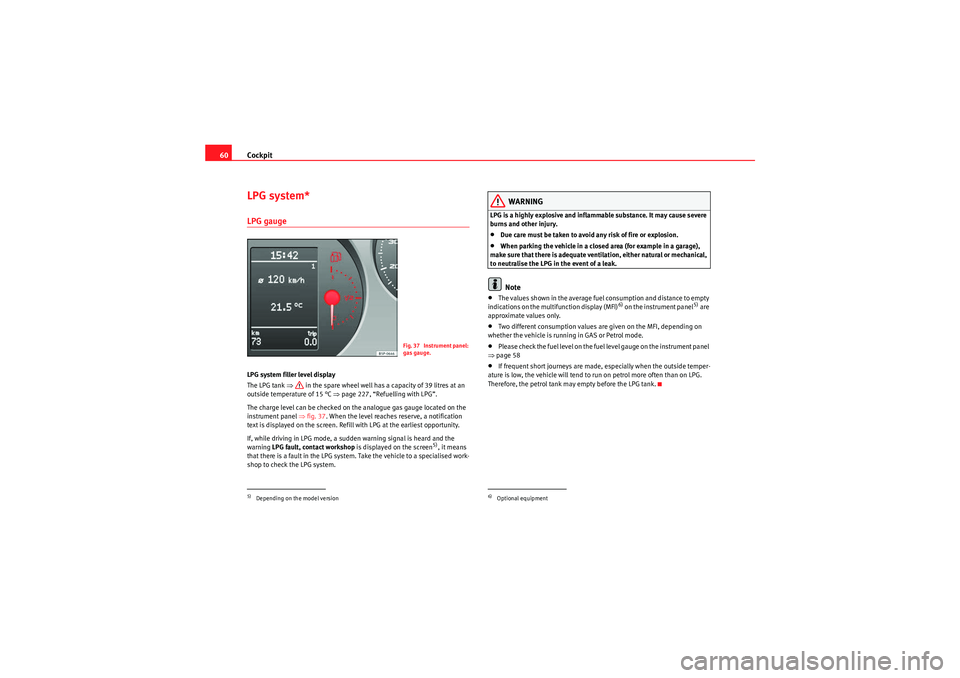
60LPG system*LPG gaugeLPG system filler level display
The LPG tank ⇒ in the spare wheel well has a capacity of 39 litres at an
outside temperature of 15 °C ⇒page 227, “Refuelling with LPG”.
The charge level can be checked on the analogue gas gauge located on the
instrument panel ⇒fig. 37. When the level reaches reserve, a notification
text is displayed on the screen. Refill with LPG at the earliest opportunity.
If, while driving in LPG mode, a sudden warning signal is heard and the
warning LPG fault, contact workshop is displayed on the screen
5), it means
that there is a fault in the LPG system. Take the vehicle to a specialised work-
shop to check the LPG system.
WARNING
LPG is a highly explosive and inflammable substance. It may cause severe
burns and other injury.•Due care must be taken to avoid any risk of fire or explosion.•When parking the vehicle in a closed area (for example in a garage),
make sure that there is adequate ventilation, either natural or mechanical,
to neutralise the LPG in the event of a leak.Note
•The values shown in the average fuel consumption and distance to empty
indications on the multifunction display (MFI)
6) on the instrument panel
5) are
approximate values only.
•Two different consumption values are given on the MFI, depending on
whether the vehicle is running in GAS or Petrol mode.•Please check the fuel level on the fuel level gauge on the instrument panel
⇒ page 58•If frequent short journeys are made, especially when the outside temper-
ature is low, the vehicle will tend to run on petrol more often than on LPG.
Therefore, the petrol tank may empty before the LPG tank.
5)Depending on the model version
Fig. 37 Instrument panel:
gas gauge.
6)Optional equipment
Altea_EN.book Seite 60 Donnersta g, 2. September 2010 2:00 14
Page 177 of 317
Driving175
Safety First
Operating Instructions
Practical Tips
Technical Specifications
If the engine does not start immediately, switch the starter off after
10 seconds and try again after half a minute. If the engine still does not start,
the fuel pump fuse should be checked
⇒page 267, “Fuses”.
WARNING
•Never start or run the engine in unventilated or closed rooms. The
exhaust fumes contain carbon monoxide, an odourless and colourless
poisonous gas. Risk of fatal accidents. Carbon monoxide can cause loss of
consciousness. It can also cause death.•Never leave the vehicle unattended if the engine is running.•Never use “cold start sprays”, they could explode or cause the engine
to run at high revs. Risk of injury.Caution
•When the engine is cold, you should avoid high engine speeds, driving at
full throttle and over-loading the engine. Risk of engine damage.•The vehicle should not be pushed or towed more than 50 metres to start
the engine. Unburnt fuel could enter the catalytic converter and damage it.•Before attempting to push-start or tow a vehicle in order to start it, you
should first try to start it using the battery of another vehicle. Note and follow
the instructions in ⇒page 281, “Jump-starting”.For the sake of the environment
Do not warm-up the engine by running the engine with the vehicle stationary.
Start off immediately, driving gently. This helps the engine reach operating
temperature faster and reduces emissions.
Starting diesel engines
The engine can only be started using a genuine SEAT key with
its correct code.– Move the gear lever to the neutral position and depress the
clutch pedal thoroughly and hold it in this position for the starter
to turn the engine on.
– Turn the ignition key to the starting position.
– Turn the ignition key to position ⇒page 173, fig. 136 . The
indicator lamp
D will light for engine pre-heating.
– When the warning lamp turns off, turn the key to position to start the engine. Do not press the accelerator.
– Let go of the ignition key as soon as the engine starts, the starter motor must not be allowed to run on with the engine.
When starting a very cold engine, it may be a little noisy for the first few
seconds until oil pressure has built up in the hydraulic valve compensators.
This is quite normal, and no cause for concern.
If there are problems starting the engine, see the ⇒page 281.
Glow plug system for the diesel engine
To avoid unnecessary discharging of the battery, do not use any other major
electrical equipment while the glow plugs are pre-heating.
Start the engine as soon as the glow plug warning lamp ⇒page 83 goes out.
Starting the engine after the fuel tank has been completely run dry
If the fuel tank has been completely run dry, it may take longer than normal
(up to one minute) to start the engine after refuelling with diesel fuel. This is
because the system must eliminate air first.
A1A2
Altea_EN.book Seite 175 Donnerstag, 2. September 2010 2:00 14
Page 179 of 317
Driving177
Safety First
Operating Instructions
Practical Tips
Technical Specifications
Driving with LPG*Your SEAT vehicle has a bivalent engine able to run on either LPG or petrol.
The LPG tank ⇒page 227, “Refuelling with LPG” is in the spare wheel well
⇒ .
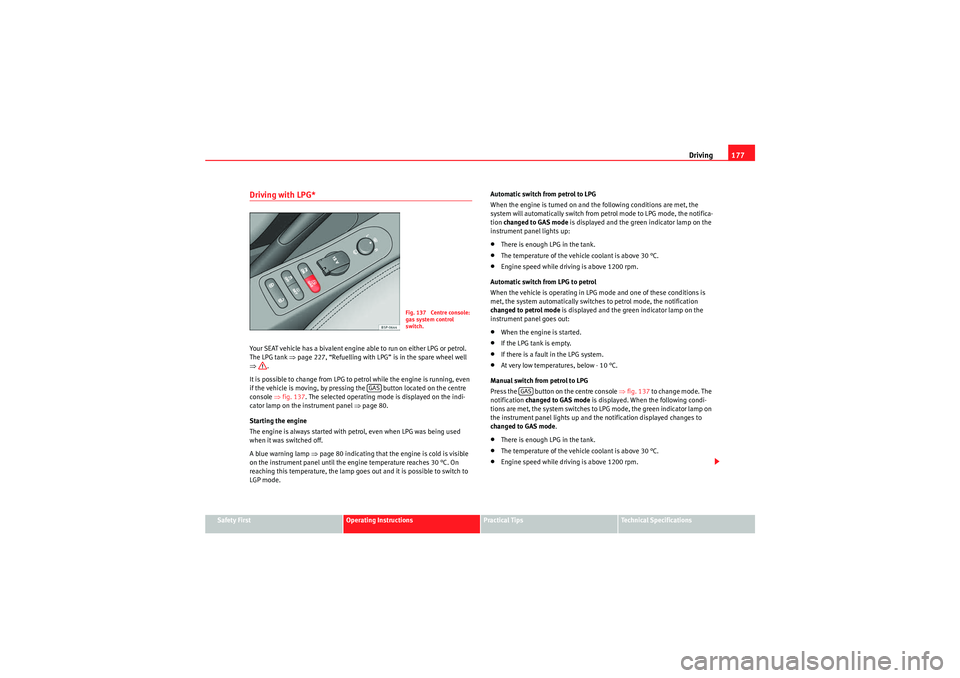
It is possible to change from LPG to petrol while the engine is running, even
if the vehicle is moving, by pressing the button located on the centre
console ⇒fig. 137 . The selected operating mode is displayed on the indi-
cator lamp on the instrument panel ⇒ page 80.
Starting the engine
The engine is always started with petrol, even when LPG was being used
when it was switched off.
A blue warning lamp ⇒page 80 indicating that the engine is cold is visible
on the instrument panel until the engine temperature reaches 30 °C. On
reaching this temperature, the lamp goes out and it is possible to switch to
LGP mode. Automatic switch from petrol to LPG
When the engine is turned on and the following conditions are met, the
system will automatically switch from petrol mode to LPG mode, the notifica-
tion
changed to GAS mode is displayed and the green indicator lamp on the
instrument panel lights up:
•There is enough LPG in the tank.•The temperature of the vehicle coolant is above 30 °C.•Engine speed while driving is above 1200 rpm.
Automatic switch from LPG to petrol
When the vehicle is operating in LPG mode and one of these conditions is
met, the system automatically switches to petrol mode, the notification
changed to petrol mode is displayed and the green indicator lamp on the
instrument panel goes out:•When the engine is started.•If the LPG tank is empty.•If there is a fault in the LPG system.•At very low temperatures, below - 10 °C.
Manual switch from petrol to LPG
Press the button on the centre console ⇒fig. 137 to change mode. The
notification changed to GAS mode is displayed. When the following condi-
tions are met, the system switches to LPG mode, the green indicator lamp on
the instrument panel lights up and the notification displayed changes to
changed to GAS mode .•There is enough LPG in the tank.•The temperature of the vehicle coolant is above 30 °C.•Engine speed while driving is above 1200 rpm.
Fig. 137 Centre console:
gas system control
switch.
GAS
GAS
Altea_EN.book Seite 177 Donnerstag, 2. September 2010 2:00 14
Page 212 of 317
Driving and the environment
210Driving abroadObservationsTo drive abroad, the following must be taken into consideration:•For vehicles fitted with a catalytic converter ensure that unleaded petrol is
available for the journey. See the chapter “Refuelling”. Automobile organisa-
tions will have information about service station networks selling unleaded
fuel.•In some countries, it is possible that your vehicle model is not sold, and
therefore spare parts are not available or the Authorised Services can only
carry out limited repairs.
SEAT importers and distributors will gladly provide information about the
technical preparations that you vehicle requires and also about necessary
maintenance and repair possibilities.Adhesive strips for headlightsIf you have to drive a right-hand drive vehicle in a left-hand drive country, or
vice versa, the asymmetric dipped beam headlights will dazzle oncoming
traffic.
To prevent dazzling, you must apply stickers to certain parts of the headlight
lenses. Further information is available at your Authorised Service Centre.
In vehicles with adaptive headlights, the rotation system must previously be
disconnected. To do this, please go to a specialised workshop.
Altea_EN.book Seite 210 Donnerstag, 2. September 2010 2:00 14
Page 228 of 317
Checking and refilling levels
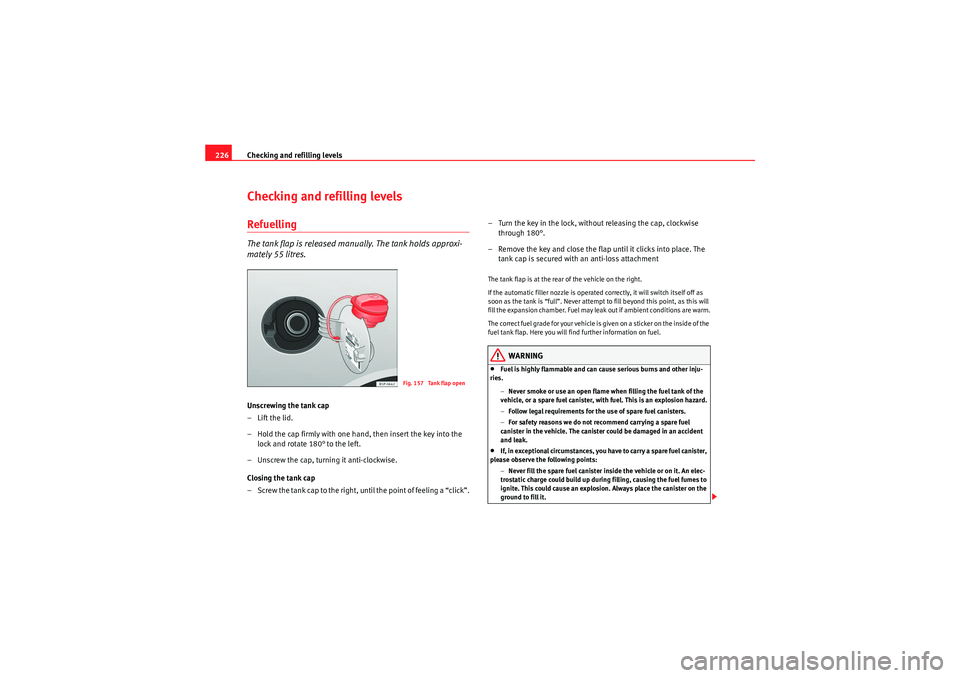
226Checking and refilling levelsRefuellingThe tank flap is released manually. The tank holds approxi-
mately 55 litres.Unscrewing the tank cap
– Lift the lid.
– Hold the cap firmly with one hand, then insert the key into the
lock and rotate 180° to the left.
– Unscrew the cap, turning it anti-clockwise.
Closing the tank cap
– Screw the tank cap to the right, until the point of feeling a “click”. – Turn the key in the lock, without releasing the cap, clockwise
through 180°.
– Remove the key and close the flap until it clicks into place. The tank cap is secured with an anti-loss attachment
The tank flap is at the rear of the vehicle on the right.
If the automatic filler nozzle is operated correctly, it will switch itself off as
soon as the tank is “full”. Never attempt to fill beyond this point, as this will
fill the expansion chamber. Fuel may leak out if ambient conditions are warm.
T he co rr ec t fu el g rad e fo r you r v eh icle is giv en on a sti cker o n th e i nsid e of the
fuel tank flap. Here you will find further information on fuel.
WARNING
•Fuel is highly flammable and can cause serious burns and other inju-
ries.
−Never smoke or use an open flame when filling the fuel tank of the
vehicle, or a spare fuel canister, with fuel. This is an explosion hazard.
− Follow legal requirements for the use of spare fuel canisters.
− For safety reasons we do not recommend carrying a spare fuel
canister in the vehicle. The canister could be damaged in an accident
and leak.•If, in exceptional circumstances, you have to carry a spare fuel canister,
please observe the following points:
−Never fill the spare fuel canister inside the vehicle or on it. An elec-
trostatic charge could build up during filling, causing the fuel fumes to
ignite. This could cause an explosion. Always place the canister on the
ground to fill it.
Fig. 157 Tank flap open
Altea_EN.book Seite 226 Donnerstag, 2. September 2010 2:00 14
Page 229 of 317
Checking and refilling levels227
Safety First
Operating Instructions
Practical Tips
Technical Specifications
−
Insert the fuel nozzle into the mouth of the canister as far as
possible.
− If the spare fuel canister is made of metal, the filling nozzle must be
in contact with the canister during filling. This helps prevent an electro-
static charge building up.
− Never spill fuel in the vehicle or in the luggage compartment. Fuel
vapours are explosive. Danger of death.
Caution
•Fuel spills should be removed from the paintwork immediately.•Never run the tank completely dry. An irregular fuel supply could cause
misfiring. As a result, unburnt fuel could enter the catalytic converter and
cause damage.For the sake of the environment
Do not try to put in more fuel after the automatic filler nozzle has switched off;
this may cause the fuel to overflow if it becomes warm.
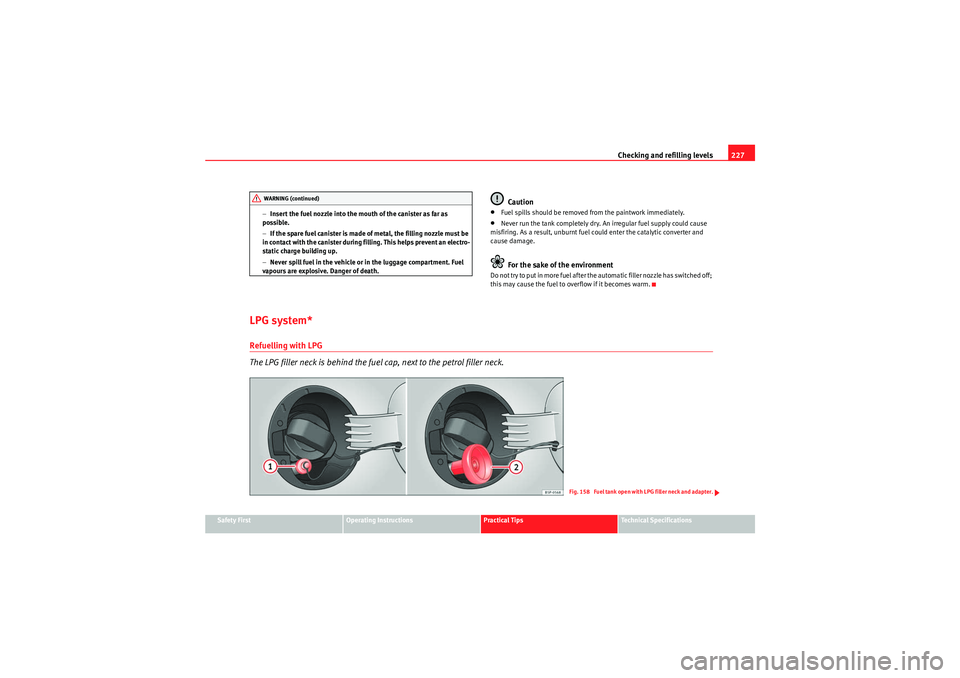
LPG system*Refuelling with LPG
The LPG filler neck is behind the fuel cap, next to the petrol filler neck.
WARNING (continued)
F ig. 158 Fuel tank ope n with LPG fille r neck and adap ter.
Altea_EN.book Seite 227 Donnerstag, 2. September 2010 2:00 14
Page 230 of 317
Checking and refilling levels
228
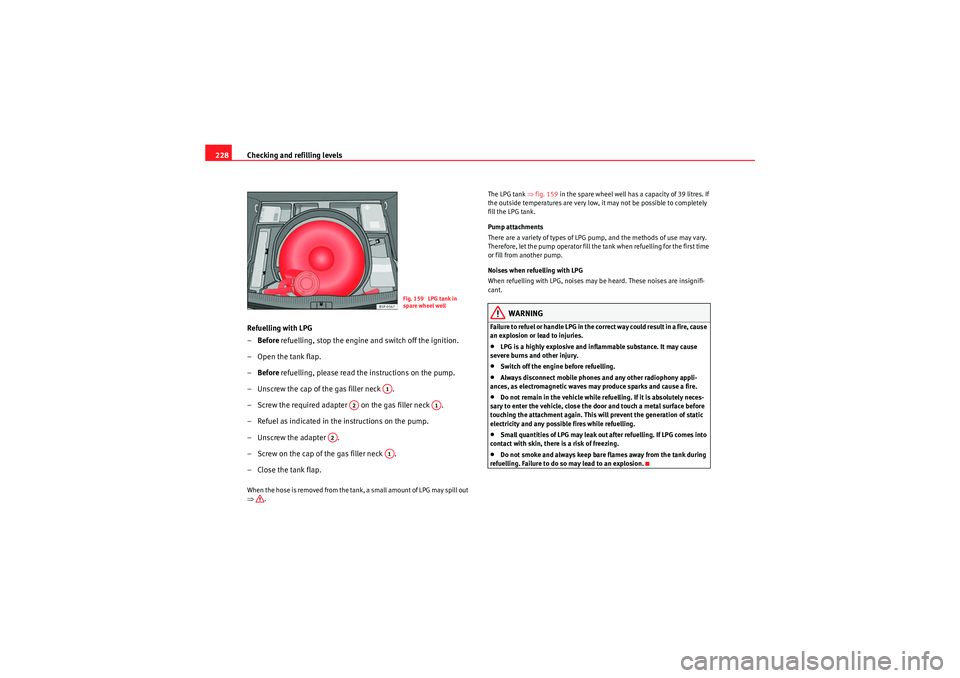
Refuelling with LPG
–Before refuelling, stop the engine and switch off the ignition.
–Open the tank flap.
– Before refuelling, please read the instructions on the pump.
– Unscrew the cap of the gas filler neck .
– Screw the required adapter on the gas filler neck .
– Refuel as indicated in the instructions on the pump.
–Unscrew the adapter .
– Screw on the cap of the gas filler neck .
– Close the tank flap.When the hose is removed from the tank, a small amount of LPG may spill out
⇒ . The LPG tank
⇒fig. 159 in the spare wheel well has a capacity of 39 litres. If
the outside temperatures are very low, it may not be possible to completely
fill the LPG tank.
Pump attachments
There are a variety of types of LPG pump, and the methods of use may vary.
Therefore, let the pump operator fill the tank when refuelling for the first time
or fill from another pump.
Noises when refuelling with LPG
When refuelling with LPG, noises may be heard. These noises are insignifi-
cant.
WARNING
Failure to refuel or handle LPG in the correct way could result in a fire, cause
an explosion or lead to injuries.•LPG is a highly explosive and inflammable substance. It may cause
severe burns and other injury.•Switch off the engine before refuelling.•Always disconnect mobile phones and any other radiophony appli-
ances, as electromagnetic waves may produce sparks and cause a fire.•Do not remain in the vehicle while refuelling. If it is absolutely neces-
sary to enter the vehicle, close the door and touch a metal surface before
touching the attachment again. This will prevent the generation of static
electricity and any possible fires while refuelling.•Small quantities of LPG may leak out after refuelling. If LPG comes into
contact with skin, there is a risk of freezing.•Do not smoke and always keep bare flames away from the tank during
refuelling. Failure to do so may lead to an explosion.
Fig. 159 LPG tank in
spare wheel well
A1
A2
A1
A2
A1
Altea_EN.book Seite 228 Donnerstag, 2. September 2010 2:00 14
Page 233 of 317
Checking and refilling levels231
Safety First
Operating Instructions
Practical Tips
Technical Specifications
•High engine speed and full throttle can damage the engine when using
petrol with an octane rating lower than the correct grade for the engine.For the sake of the environment
Just one full tank of leaded fuel would seriously impair the efficiency of the
catalytic converter.Petrol additives
Petrol additives improve the quality of the petrol.The quality of the petrol influences the performance, power and life of the
engine. For this reason, you should use good quality petrol containing addi-
tives. These additives will help to prevent corrosion, keep the fuel system
clean and prevent deposits from building up in the engine.
If good quality petrol with additives is not available or engine problems occur,
the required additives must be added during refuelling.DieselDiesel*Diesel fuel must conform to DIN EN 590 (EN = “European Standard”). It must
have a cetane number (CN) of at least 51. The cetane number indicates the
ignition quality of the diesel fuel.
Notes on refuelling ⇒ page 226.
Biodiesel*
Caution
•Your vehicle is not designed to use biodiesel fuel. Never, under any
circumstances refuel with biodiesel. The use of biodiesel fuel could damage
the engine and the fuel system. The addition of biodiesel to diesel fuel by the
diesel manufacturer in accordance with standard EN 590 or DIN 51628 is
authorised and will not cause damage to the engine or the fuel system.•The diesel engine has been designed to be used exclusively with diesel
fuel conforming to standard EN 590. Never refuel or use petrol, kerosene, fuel
oil or any other type of fuel. If you accidentally fill up the vehicle with the
wrong type of fuel, do not start the engine. Seek assistance from specialised
personnel. The composition of these fuels may severely damage the fuel
system and the engine.Winter driving
Diesel can thicken in winter.Winter-grade diesel
When using “summer-grade diesel fuel”, difficulties may be experienced at
temperatures below 0 °C because the fuel thickens due to wax separation.
Therefore, “winter-grade diesel fuel” is available in some countries during
the cold months. It can be used at temperatures as low as -22 °C.
In countries with different climatic conditions the diesel fuel generally sold
has different temperature characteristics. Check with an Authorised Service
Centre or filling stations in the country concerned regarding the type of diesel
fuels available.
Altea_EN.book Seite 231 Donnerstag, 2. September 2010 2:00 14
Page 311 of 317
Index309
Heated rear window
2C-Climatronic . . . . . . . . . . . . . . . . . . . . . . . 166
Heating element wires . . . . . . . . . . . . . . . . 219
Heating . . . . . . . . . . . . . . . . . . . . . . . . . . . . . . . . 159
High pressure cleaners . . . . . . . . . . . . . . . . . . . 217
Hill-start aid . . . . . . . . . . . . . . . . . . . . . . . . . . . . 188
Horn . . . . . . . . . . . . . . . . . . . . . . . . . . . . . . . . . . . 55
How to jump start description . . . . . . . . . . . . . 282
Hydraulic Brake Assist . . . . . . . . . . . . . . . . . . . . 197IIdentification number . . . . . . . . . . . . . . . . . . . . 288
Identification plate . . . . . . . . . . . . . . . . . . . . . . 288
Ignition key . . . . . . . . . . . . . . . . . . . . . . . . . . . . 173
Ignition lock . . . . . . . . . . . . . . . . . . . . . . . . . . . . 173
Information in the multifunction display Memory displays . . . . . . . . . . . . . . . . . . . . . . 64
Information messages in the display . . . . . . . . . 66
Instrument and switch lighting . . . . . . . . . . . . . 122
Instrument lighting . . . . . . . . . . . . . . . . . . . . . . . 55
Instrument panel menus Configuration menu . . . . . . . . . . . . . . . . . . . . 74
Example of menu use . . . . . . . . . . . . . . . . . . 68
Lights and visibility menu . . . . . . . . . . . . . . . 76
Main menu . . . . . . . . . . . . . . . . . . . . . . . . . . . 68
Vehicle status menu . . . . . . . . . . . . . . . . . . . 73
Instruments . . . . . . . . . . . . . . . . . . . . . . . . . . . . . 57
Interior front light, type 1 . . . . . . . . . . . . . . . . . 126
Interior front light, type 2 . . . . . . . . . . . . . . . . . 127 Interior mirror . . . . . . . . . . . . . . . . . . . . . . . . . . . 134
Intermittent wipe, windscreen . . . . . . . . . . . . . 130
ISOFIX system . . . . . . . . . . . . . . . . . . . . . . . . . . . 52
JJump leads . . . . . . . . . . . . . . . . . . . . . . . . . . . . . 281
Jump-starting . . . . . . . . . . . . . . . . . . . . . . . . . . . 281KKeys . . . . . . . . . . . . . . . . . . . . . . . . . . . . . . . . . . 105LLeather cleaning . . . . . . . . . . . . . . . . . . . . . . . . 222
Lights . . . . . . . . . . . . . . . . . . . . . . . . . . . . . . . . . 118
Load compartment in the luggage compartment
See Loading the luggage compartment . . . . 17
Loading the luggage compartment . . . . . . . . . . 17
Locks . . . . . . . . . . . . . . . . . . . . . . . . . . . . . . . . . 219
LPG . . . . . . . . . . . . . . . . . . . . . . . . . . . 60, 177, 227
LPG system Driving . . . . . . . . . . . . . . . . . . . . . . . . . . . . . 177
Filler neck adapter . . . . . . . . . . . . . . . . . . . . 229
Level indicator . . . . . . . . . . . . . . . . . . . . . . . . 60
Refuelling . . . . . . . . . . . . . . . . . . . . . . . . . . . 227
Luggage compartment . . . . . . . . . . . . . . . . . . . 156 See also Loading the luggage compartment 17
Luggage compartment net . . . . . . . . . . . . . . . . 147
MMain beam . . . . . . . . . . . . . . . . . . . . . . . . 118, 125
Main beam headlights Indicator lamp . . . . . . . . . . . . . . . . . . . . . . . . 84
Main headlight bulbs . . . . . . . . . . . . . . . . . . . . 273
Maintenance Airbags . . . . . . . . . . . . . . . . . . . . . . . . . . . . . . 32
Maintenance and cleaning . . . . . . . . . . . . . . . . 215
Manual gearbox . . . . . . . . . . . . . . . . . . . . . . . . . 181
Manual mode 2C-Climatronic . . . . . . . . . . . . . . . . . . . . . . . 168
MEDIA-IN connector . . . . . . . . . . . . . . . . . . . . . . 155
MFI . . . . . . . . . . . . . . . . . . . . . . . . . . . . . . . . . . . . 63
Mirrors Exterior mirrors . . . . . . . . . . . . . . . . . . . . . . 135
Interior mirror . . . . . . . . . . . . . . . . . . . . . . . . 134
Vanity mirrors . . . . . . . . . . . . . . . . . . . . . . . 129
Mobile phones and two-way radios . . . . . . . . . 225
Multifunction display . . . . . . . . . . . . . . . . . . . . . 63
Multi-purpose mobile storage compartment* . 151 Closing . . . . . . . . . . . . . . . . . . . . . . . . . . . . . 151
Fitting . . . . . . . . . . . . . . . . . . . . . . . . . . . . . . 150
Opening . . . . . . . . . . . . . . . . . . . . . . . . . . . . 151
Removal . . . . . . . . . . . . . . . . . . . . . . . . . . . . 150
Uses . . . . . . . . . . . . . . . . . . . . . . . . . . . . . . . 151NNumber of seats . . . . . . . . . . . . . . . . . . . . . . . . . 19
Altea_EN.book Seite 309 Donnerstag, 2. September 2010 2:00 14