belt Seat Altea 2012 Service Manual
[x] Cancel search | Manufacturer: SEAT, Model Year: 2012, Model line: Altea, Model: Seat Altea 2012Pages: 313, PDF Size: 4.47 MB
Page 138 of 313
136Seats and storage compartments
Head restraints
Correct adjustment of head restraints
Properly adjusted head restraints are an important part of
passenger protection and can reduce the risk of injuries in
most accident situations.
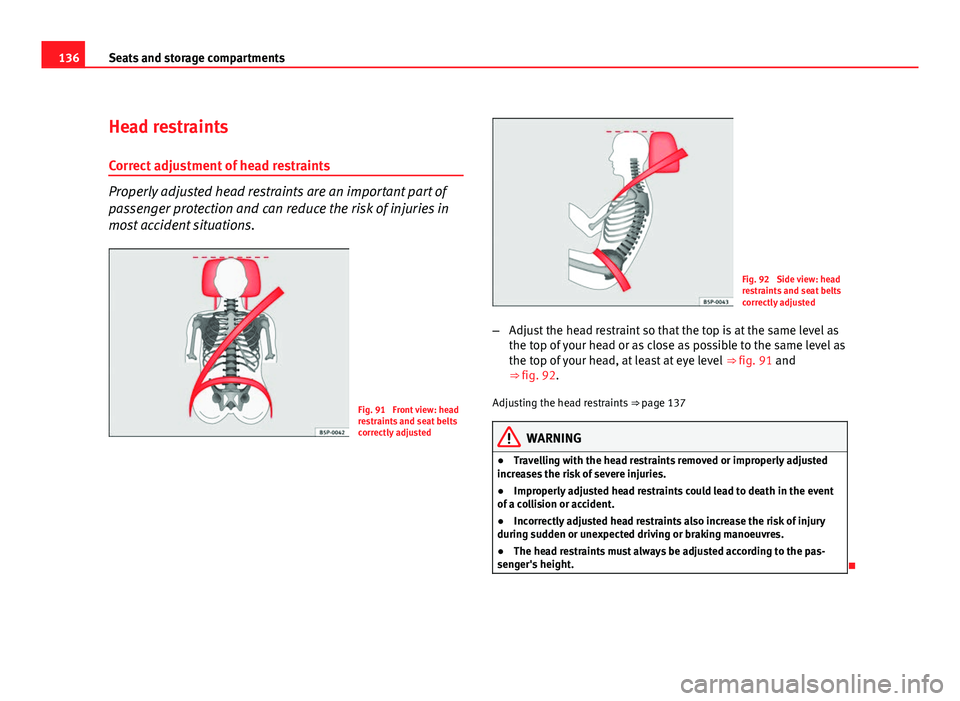
Fig. 91 Front view: head
restraints and seat belts
correctly adjusted
Fig. 92 Side view: head
restraints and seat belts
correctly adjusted
– Adjust the head restraint so that the top is at the same level as
the top of your head or as close as possible to the same level as
the top of your head, at least at eye level ⇒ fig. 91 and
⇒ fig. 92.
Adjusting the head restraints ⇒ page 137
WARNING
● Travelling with the head restraints removed or improperly adjusted
increases the risk of severe injuries.
● Improperly adjusted head restraints could lead to death in the event
of a collision or accident.
● Incorrectly adjusted head restraints also increase the risk of injury
during sudden or unexpected driving or braking manoeuvres.
● The head restraints must always be adjusted according to the pas-
senger's height.
Page 140 of 313
138Seats and storage compartments
Front seats
Adjustment of the front seats
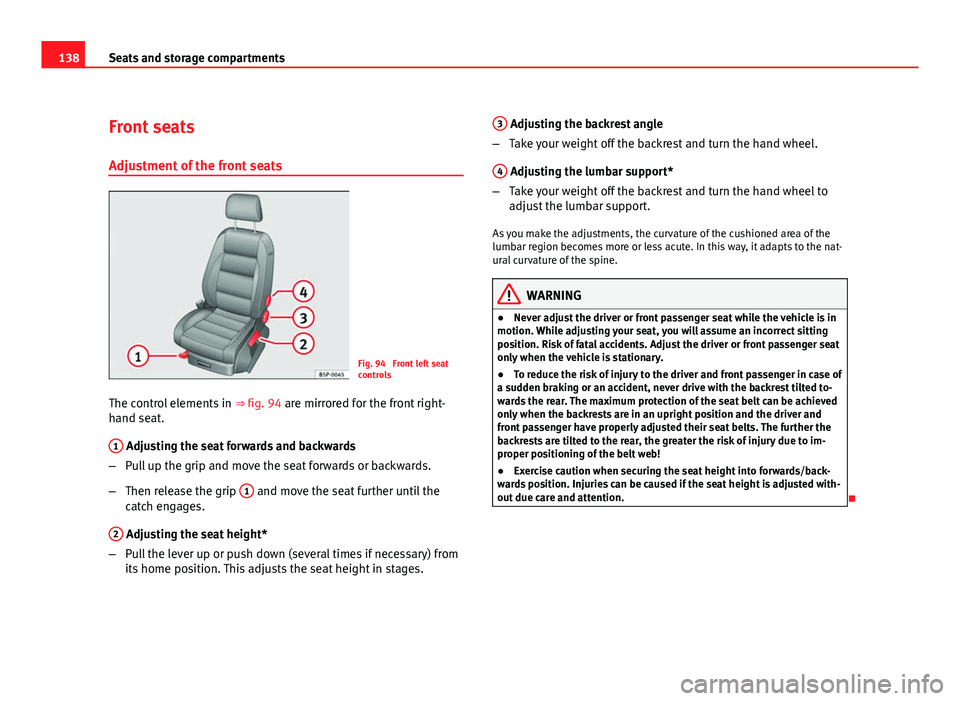
Fig. 94 Front left seat
controls
The control elements in ⇒ fig. 94 are mirrored for the front right-
hand seat.
1
Adjusting the seat forwards and backwards
– Pull up the grip and move the seat forwards or backwards.
– Then release the grip 1
and move the seat further until the
catch engages.
2
Adjusting the seat height*
– Pull the lever up or push down (several times if necessary) from
its home position. This adjusts the seat height in stages. 3
Adjusting the backrest angle
– Take your weight off the backrest and turn the hand wheel.
4
Adjusting the lumbar support*
– Take your weight off the backrest and turn the hand wheel to
adjust the lumbar support.
As you make the adjustments, the curvature of the cushioned area of the
lumbar region becomes more or less acute. In this way, it adapts to the nat-
ural curvature of the spine.
WARNING
● Never adjust the driver or front passenger seat while the vehicle is in
motion. While adjusting your seat, you will assume an incorrect sitting
position. Risk of fatal accidents. Adjust the driver or front passenger seat
only when the vehicle is stationary.
● To reduce the risk of injury to the driver and front passenger in case of
a sudden braking or an accident, never drive with the backrest tilted to-
wards the rear. The maximum protection of the seat belt can be achieved
only when the backrests are in an upright position and the driver and
front passenger have properly adjusted their seat belts. The further the
backrests are tilted to the rear, the greater the risk of injury due to im-
proper positioning of the belt web!
● Exercise caution when securing the seat height into forwards/back-
wards position. Injuries can be caused if the seat height is adjusted with-
out due care and attention.
Page 143 of 313
141
Seats and storage compartments
Folding the seat backrests down
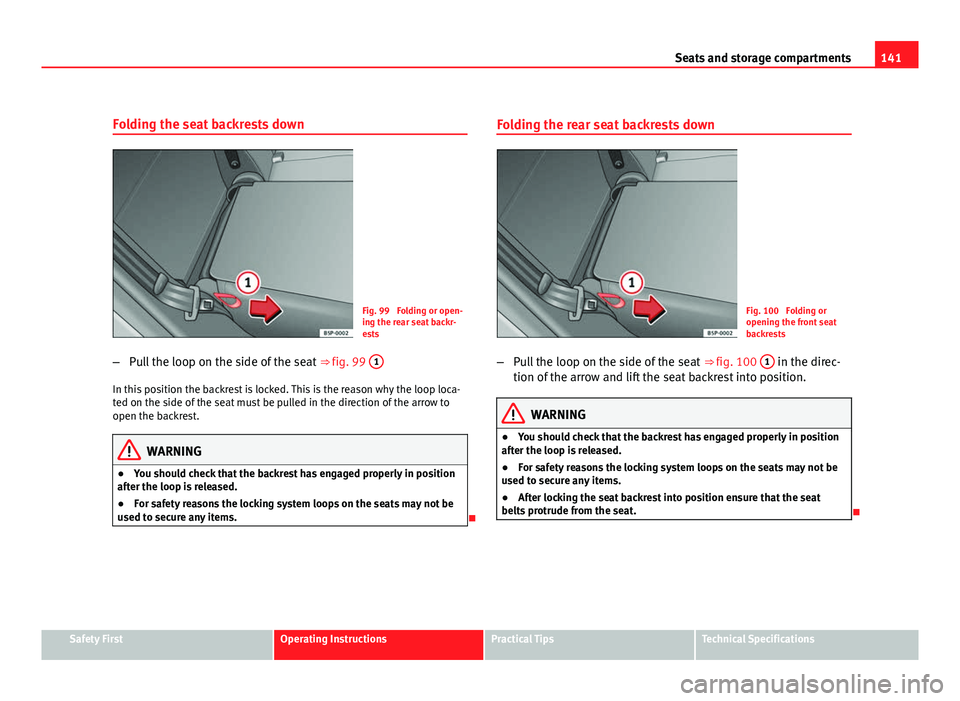
Fig. 99 Folding or open-
ing the rear seat backr-
ests
– Pull the loop on the side of the seat ⇒ fig. 99 1
In this position the backrest is locked. This is the reason why the loop loca-
ted on the side of the seat must be pulled in the direction of the arrow to
open the backrest.
WARNING
● You should check that the backrest has engaged properly in position
after the loop is released.
● For safety reasons the locking system loops on the seats may not be
used to secure any items.
Folding the rear seat backrests down
Fig. 100 Folding or
opening the front seat
backrests
– Pull the loop on the side of the seat ⇒ fig. 100 1
in the direc-
tion of the arrow and lift the seat backrest into position.
WARNING
● You should check that the backrest has engaged properly in position
after the loop is released.
● For safety reasons the locking system loops on the seats may not be
used to secure any items.
● After locking the seat backrest into position ensure that the seat
belts protrude from the seat.
Safety FirstOperating InstructionsPractical TipsTechnical Specifications
Page 151 of 313
149
Seats and storage compartments
Multi-purpose mobile storage compartment* - General
information
This storage compartment may only be placed in the central
area of the rear seat
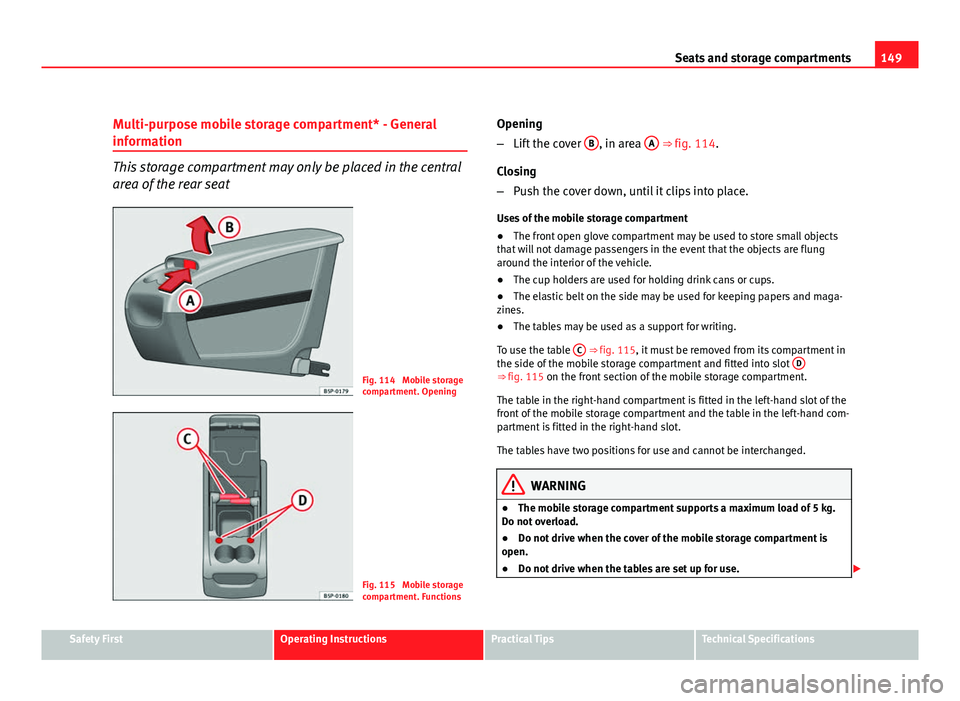
Fig. 114 Mobile storage
compartment. Opening
Fig. 115 Mobile storage
compartment. Functions Opening
–
Lift the cover B
, in area A ⇒ fig. 114.
Closing
– Push the cover down, until it clips into place.
Uses of the mobile storage compartment
● The front open glove compartment may be used to store small objects
that will not damage passengers in the event that the objects are flung
around the interior of the vehicle.
● The cup holders are used for holding drink cans or cups.
● The elastic belt on the side may be used for keeping papers and maga-
zines.
● The tables may be used as a support for writing.
To use the table C
⇒ fig. 115, it must be removed from its compartment in
the side of the mobile storage compartment and fitted into slot D
⇒ fig. 115 on the front section of the mobile storage compartment.
The table in the right-hand compartment is fitted in the left-hand slot of the
front of the mobile storage compartment and the table in the left-hand com-
partment is fitted in the right-hand slot.
The tables have two positions for use and cannot be interchanged.
WARNING
● The mobile storage compartment supports a maximum load of 5 kg.
Do not overload.
● Do not drive when the cover of the mobile storage compartment is
open.
● Do not drive when the tables are set up for use.
Safety FirstOperating InstructionsPractical TipsTechnical Specifications
Page 178 of 313
176Driving
WARNING
LPG is a highly explosive and inflammable substance. It may cause se-
vere burns and other injury.
● Due care must be taken to avoid any risk of fire or explosion.
● When parking the vehicle in a closed area (for example in a garage),
make sure that there is adequate ventilation, either natural or mechani-
cal, to neutralise the LPG in the event of a leak.
Note
● If frequent short journeys are made, especially when the outside tem-
perature is low, the vehicle will tend to run on petrol more often than on
LPG. Therefore, the petrol tank may empty before the LPG tank.
● The notification LPG mode not possible may be displayed.
Start-Stop function* Description and operation
The Start-Stop function stops the engine when the vehicle is stop-
ped and starts it automatically when required.
– When the vehicle is stopped, put it in neutral and release the
clutch pedal. The engine will stop.
– When the clutch pedal is pressed, the engine starts again.
– The instrument panel screen displays information about the sta-
tus of the Start-Stop function ⇒
fig. 139. Start-Stop function conditions
●
The driver seat belt must be buckled.
● The engine hood must be closed.
● The engine must be at operating temperature
● The steering wheel must be straight.
● The vehicle must be on flat ground.
● The vehicle must not be in reverse.
● A trailer must not be connected.
● The temperature of the passenger compartment must be within the com-
fort limits (button AC
11 ⇒ fig. 132 should be selected).
● The windscreen de-mist function must be off.
● If not, it requires an increase in airflow 10
⇒ fig. 132 for more than three
presses.
● The temperature must not be set to HI or LO.
● The driver door must be closed.
● The diesel particulate filter must not be in regeneration mode, for diesel
engines.
● The battery charge must not be low for the next start.
● The battery temperature must be between -1 °C and 55 °C.
● The parking assistant (Park Assist*) must not be activated.
Start-Stop function interruption
In the following situations, the Start-Stop function will be interrupted and
the engine will automatically start:
● The vehicle starts moving.
● The brake pedal is pressed several times in a row.
● The battery has been discharged excessively.
● The Start-Stop System is manually deactivated.
● The windscreen de-mist function is turned on.
● The temperature of the passenger compartment exceeds the comfort
limits (button AC
11 ⇒ fig. 132 should be selected).
Page 179 of 313
177
Driving
● If in an increase in airflow 10
⇒ fig. 132 is required for more than three
presses.
● Temperature setting HI or LO is selected.
● The engine coolant temperature is insufficient.
● The alternator is faulty, for example the V-belt has ruptured.
● If any of the conditions described in the previous section are not fulfil-
led.
WARNING
Never allow the vehicle to move with the engine off for any reason. You
could lose control of your vehicle. This could cause an accident and seri-
ous injury.
● The brake servo does not work with the engine off. You need more
force to stop the vehicle.
● Power steering does not work when the engine is not running. That is
why it is much more difficult to turn the steering wheel.
● Disconnect the Start-Stop system when driving through water (ford-
ing streams, etc.).
Note
● For vehicles with the Start-Stop function and a manual gearbox, when
the engine is started, the clutch must be pressed.
● When the conditions for the Start-Stop function are not fulfilled, the in-
strument panel displays the Start-Stop indicator dimmed.
● If the steering wheel is turned more than 270°, it will not be possible to
start the vehicle again. To start the vehicle, straighten the steering wheel so
that it is turned less than 270°. Activating and deactivating the Start-Stop function
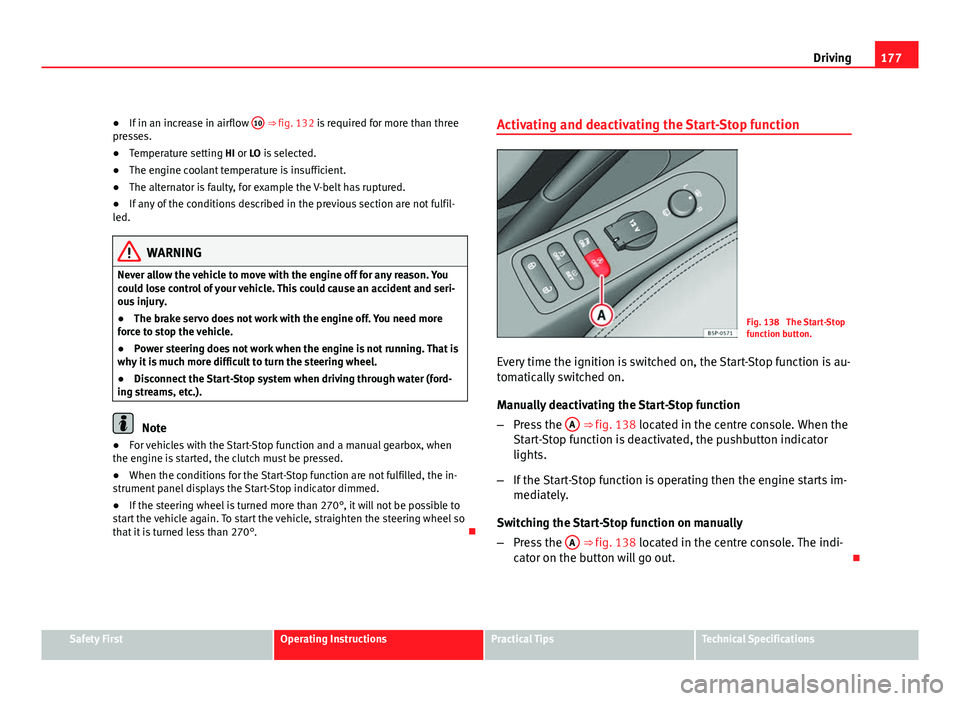
Fig. 138 The Start-Stop
function button.
Every time the ignition is switched on, the Start-Stop function is au-
tomatically switched on.
Manually deactivating the Start-Stop function
– Press the A
⇒ fig. 138 located in the centre console. When the
Start-Stop function is deactivated, the pushbutton indicator
lights.
– If the Start-Stop function is operating then the engine starts im-
mediately.
Switching the Start-Stop function on manually
– Press the A
⇒ fig. 138 located in the centre console. The indi-
cator on the button will go out.
Safety FirstOperating InstructionsPractical TipsTechnical Specifications
Page 222 of 313
220Vehicle maintenance and cleaning
etc. so a degree of care is required in everyday use and when looking after
the leather.
Dust and grit in the pores and seams can scratch and damage the surface. If
the vehicle is under solar radiation for long periods, the leather should be
protected to prevent it from fading. However, slight colour variations in
high-quality natural leather are normal.
CAUTION
● Do not use solvents, wax polish, shoe cream, spot removers or similar
products on leather.
● To avoid damage, stubborn stains should be removed by a specialised
workshop.
Seat belt cleaning
A dirty belt may not work properly.
Check all seat belts regularly and keep them clean.
Seat belt cleaning
– Pull the dirty seat belt right out and unroll it.
– Clean dirty seat belts with a gentle soap solution.
– Allow it to dry.
– Do not roll the seat belt up until it is dry.
If large stains form on the belts, it will not retract correctly into the automat-
ic belt retractor.
WARNING
● Do not use chemical cleaning agents on the seat belts, as this can im-
pair the strength of the webbing. Ensure that belts do not come into con-
tact with corrosive fluids.
● Check the condition of the seat belts at regular intervals. If you notice
that the belt webbing, fittings, retractor mechanism or buckle of any of
the belts is damaged, the belt must be replaced by a specialist work-
shop.
● Do not attempt to repair a damaged seat belt yourself. The seat belts
must not be removed or modified in any way.
CAUTION
After cleaning, allow seat belts to dry completely before rolling them up.
Otherwise, the belt retractors could become damaged.
Page 233 of 313
231
Checking and refilling levels
WARNING (Continued)
● Never touch the radiator fan. It is temperature controlled and could
start automatically, even when the engine has been switched off and the
key removed from the ignition!
● Do not unscrew the cap on the expansion tank when the engine is
hot. If the coolant is hot, the cooling system will be pressurised!
● Protect face, hands and arms by covering the cap with a large, thick
cloth to protect against escaping coolant and steam.
● Always make sure you have not left any objects, such as cleaning
cloths and tools, in the engine compartment.
● If you have to work underneath the vehicle, you must use suitable
stands additionally to support the vehicle, there is a risk of accident!. A
hydraulic jack is insufficient for securing the vehicle and there is a risk of
injury.
● If any work has to be performed when the engine is started or with
the engine running, there is an additional, potentially fatal, safety risk
from the rotating parts, such as the drive belts, alternator, radiator fan,
etc., and from the high-voltage ignition system. You should also observe
the following points:
–Never touch the electrical wiring of the ignition system.
– Ensure that jewellery, loose clothing and long hair do not get trap-
ped in rotating engine parts. Danger of death. Before starting any
work remove jewellery, tie back and cover hair, and wear tight-fitting
clothes.
– Never accelerate with a gear engaged without taking the necessary
precautions. The vehicle could move, even if the handbrake is ap-
plied. Danger of death.
● If work has to be carried out on the fuel system or on electrical com-
ponents, you must observe the following safety notes in addition to the
above warnings:
–Always disconnect the battery. The vehicle must be unlocked when
this is done, otherwise the alarm will be triggered.
– Do not smoke.WARNING (Continued)
– Never work near naked flames.
– Always have a fire extinguisher on hand.
CAUTION
When topping up service fluids, make sure not to mistake them. Using the
wrong fluids could cause serious malfunctions and engine damage!
For the sake of the environment
Service fluids leaks are harmful to the environment. For this reason you
should make regular checks on the ground underneath your vehicle. If you
find spots of oil or other fluids, have your vehicle inspected in a specialised
workshop.
Safety FirstOperating InstructionsPractical TipsTechnical Specifications
Page 303 of 313
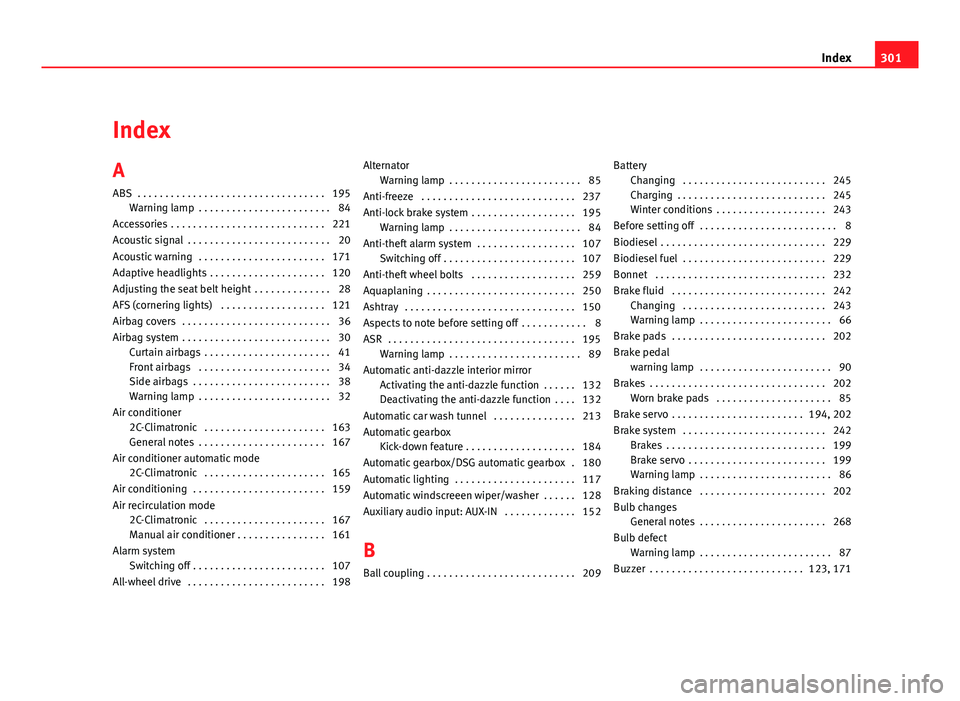
Index
A
ABS . . . . . . . . . . . . . . . . . . . . . . . . . . . . . . . . . . 195Warning lamp . . . . . . . . . . . . . . . . . . . . . . . . 84
Accessories . . . . . . . . . . . . . . . . . . . . . . . . . . . . 221
Acoustic signal . . . . . . . . . . . . . . . . . . . . . . . . . . 20
Acoustic warning . . . . . . . . . . . . . . . . . . . . . . . 171
Adaptive headlights . . . . . . . . . . . . . . . . . . . . . 120
Adjusting the seat belt height . . . . . . . . . . . . . . 28
AFS (cornering lights) . . . . . . . . . . . . . . . . . . . 121
Airbag covers . . . . . . . . . . . . . . . . . . . . . . . . . . . 36
Airbag system . . . . . . . . . . . . . . . . . . . . . . . . . . . 30 Curtain airbags . . . . . . . . . . . . . . . . . . . . . . . 41
Front airbags . . . . . . . . . . . . . . . . . . . . . . . . 34
Side airbags . . . . . . . . . . . . . . . . . . . . . . . . . 38
Warning lamp . . . . . . . . . . . . . . . . . . . . . . . . 32
Air conditioner 2C-Climatronic . . . . . . . . . . . . . . . . . . . . . . 163
General notes . . . . . . . . . . . . . . . . . . . . . . . 167
Air conditioner automatic mode 2C-Climatronic . . . . . . . . . . . . . . . . . . . . . . 165
Air conditioning . . . . . . . . . . . . . . . . . . . . . . . . 159
Air recirculation mode 2C-Climatronic . . . . . . . . . . . . . . . . . . . . . . 167
Manual air conditioner . . . . . . . . . . . . . . . . 161
Alarm system Switching off . . . . . . . . . . . . . . . . . . . . . . . . 107
All-wheel drive . . . . . . . . . . . . . . . . . . . . . . . . . 198 Alternator
Warning lamp . . . . . . . . . . . . . . . . . . . . . . . . 85
Anti-freeze . . . . . . . . . . . . . . . . . . . . . . . . . . . . 237
Anti-lock brake system . . . . . . . . . . . . . . . . . . . 195 Warning lamp . . . . . . . . . . . . . . . . . . . . . . . . 84
Anti-theft alarm system . . . . . . . . . . . . . . . . . . 107 Switching off . . . . . . . . . . . . . . . . . . . . . . . . 107
Anti-theft wheel bolts . . . . . . . . . . . . . . . . . . . 259
Aquaplaning . . . . . . . . . . . . . . . . . . . . . . . . . . . 250
Ashtray . . . . . . . . . . . . . . . . . . . . . . . . . . . . . . . 150
Aspects to note before setting off . . . . . . . . . . . . 8
ASR . . . . . . . . . . . . . . . . . . . . . . . . . . . . . . . . . . 195 Warning lamp . . . . . . . . . . . . . . . . . . . . . . . . 89
Automatic anti-dazzle interior mirror Activating the anti-dazzle function . . . . . . 132
Deactivating the anti-dazzle function . . . . 132
Automatic car wash tunnel . . . . . . . . . . . . . . . 213
Automatic gearbox Kick-down feature . . . . . . . . . . . . . . . . . . . . 184
Automatic gearbox/DSG automatic gearbox . 180
Automatic lighting . . . . . . . . . . . . . . . . . . . . . . 117
Automatic windscreeen wiper/washer . . . . . . 128
Auxiliary audio input: AUX-IN . . . . . . . . . . . . . 152
B
Ball coupling . . . . . . . . . . . . . . . . . . . . . . . . . . . 209 Battery
Changing . . . . . . . . . . . . . . . . . . . . . . . . . . 245
Charging . . . . . . . . . . . . . . . . . . . . . . . . . . . 245
Winter conditions . . . . . . . . . . . . . . . . . . . . 243
Before setting off . . . . . . . . . . . . . . . . . . . . . . . . . 8
Biodiesel . . . . . . . . . . . . . . . . . . . . . . . . . . . . . . 229
Biodiesel fuel . . . . . . . . . . . . . . . . . . . . . . . . . . 229
Bonnet . . . . . . . . . . . . . . . . . . . . . . . . . . . . . . . 232
Brake fluid . . . . . . . . . . . . . . . . . . . . . . . . . . . . 242 Changing . . . . . . . . . . . . . . . . . . . . . . . . . . 243
Warning lamp . . . . . . . . . . . . . . . . . . . . . . . . 66
Brake pads . . . . . . . . . . . . . . . . . . . . . . . . . . . . 202
Brake pedal warning lamp . . . . . . . . . . . . . . . . . . . . . . . . 90
Brakes . . . . . . . . . . . . . . . . . . . . . . . . . . . . . . . . 202 Worn brake pads . . . . . . . . . . . . . . . . . . . . . 85
Brake servo . . . . . . . . . . . . . . . . . . . . . . . . 194, 202
Brake system . . . . . . . . . . . . . . . . . . . . . . . . . . 242 Brakes . . . . . . . . . . . . . . . . . . . . . . . . . . . . . 199
Brake servo . . . . . . . . . . . . . . . . . . . . . . . . . 199
Warning lamp . . . . . . . . . . . . . . . . . . . . . . . . 86
Braking distance . . . . . . . . . . . . . . . . . . . . . . . 202
Bulb changes General notes . . . . . . . . . . . . . . . . . . . . . . . 268
Bulb defect Warning lamp . . . . . . . . . . . . . . . . . . . . . . . . 87
Buzzer . . . . . . . . . . . . . . . . . . . . . . . . . . . . 123, 171
301
Index
Page 305 of 313
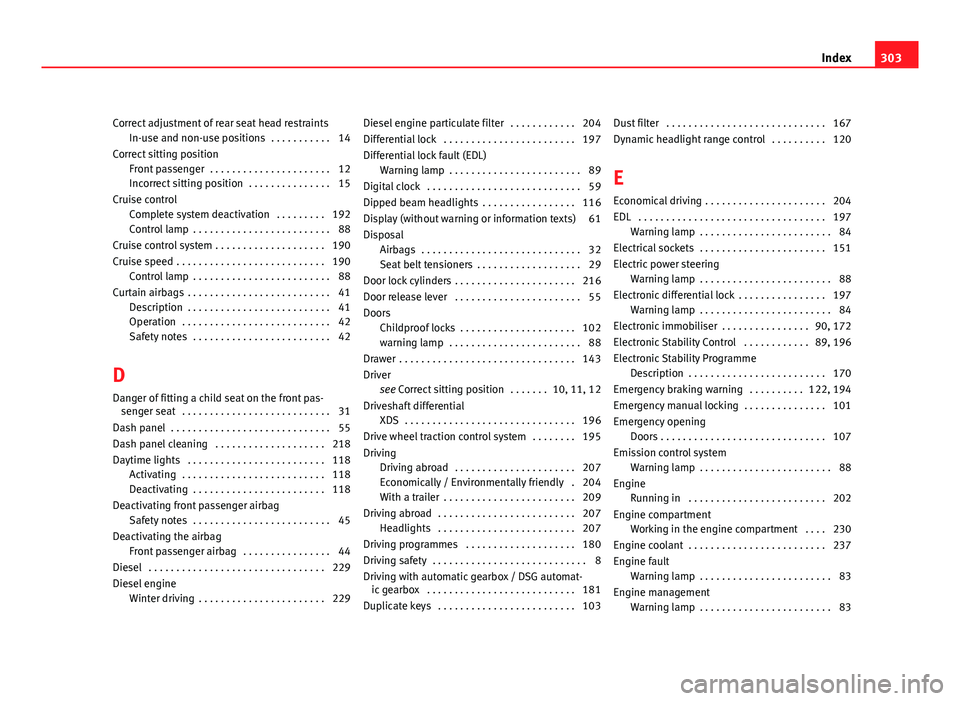
Correct adjustment of rear seat head restraintsIn-use and non-use positions . . . . . . . . . . . 14
Correct sitting position Front passenger . . . . . . . . . . . . . . . . . . . . . . 12
Incorrect sitting position . . . . . . . . . . . . . . . 15
Cruise control Complete system deactivation . . . . . . . . . 192
Control lamp . . . . . . . . . . . . . . . . . . . . . . . . . 88
Cruise control system . . . . . . . . . . . . . . . . . . . . 190
Cruise speed . . . . . . . . . . . . . . . . . . . . . . . . . . . 190 Control lamp . . . . . . . . . . . . . . . . . . . . . . . . . 88
Curtain airbags . . . . . . . . . . . . . . . . . . . . . . . . . . 41 Description . . . . . . . . . . . . . . . . . . . . . . . . . . 41
Operation . . . . . . . . . . . . . . . . . . . . . . . . . . . 42
Safety notes . . . . . . . . . . . . . . . . . . . . . . . . . 42
D Danger of fitting a child seat on the front pas- senger seat . . . . . . . . . . . . . . . . . . . . . . . . . . . 31
Dash panel . . . . . . . . . . . . . . . . . . . . . . . . . . . . . 55
Dash panel cleaning . . . . . . . . . . . . . . . . . . . . 218
Daytime lights . . . . . . . . . . . . . . . . . . . . . . . . . 118 Activating . . . . . . . . . . . . . . . . . . . . . . . . . . 118
Deactivating . . . . . . . . . . . . . . . . . . . . . . . . 118
Deactivating front passenger airbag Safety notes . . . . . . . . . . . . . . . . . . . . . . . . . 45
Deactivating the airbag Front passenger airbag . . . . . . . . . . . . . . . . 44
Diesel . . . . . . . . . . . . . . . . . . . . . . . . . . . . . . . . 229
Diesel engine Winter driving . . . . . . . . . . . . . . . . . . . . . . . 229 Diesel engine particulate filter . . . . . . . . . . . . 204
Differential lock . . . . . . . . . . . . . . . . . . . . . . . . 197
Differential lock fault (EDL)
Warning lamp . . . . . . . . . . . . . . . . . . . . . . . . 89
Digital clock . . . . . . . . . . . . . . . . . . . . . . . . . . . . 59
Dipped beam headlights . . . . . . . . . . . . . . . . . 116
Display (without warning or information texts) 61
Disposal Airbags . . . . . . . . . . . . . . . . . . . . . . . . . . . . . 32
Seat belt tensioners . . . . . . . . . . . . . . . . . . . 29
Door lock cylinders . . . . . . . . . . . . . . . . . . . . . . 216
Door release lever . . . . . . . . . . . . . . . . . . . . . . . 55
Doors Childproof locks . . . . . . . . . . . . . . . . . . . . . 102
warning lamp . . . . . . . . . . . . . . . . . . . . . . . . 88
Drawer . . . . . . . . . . . . . . . . . . . . . . . . . . . . . . . . 143
Driver see Correct sitting position . . . . . . . 10, 11, 12
Driveshaft differential XDS . . . . . . . . . . . . . . . . . . . . . . . . . . . . . . . 196
Drive wheel traction control system . . . . . . . . 195
Driving Driving abroad . . . . . . . . . . . . . . . . . . . . . . 207
Economically / Environmentally friendly . 204
With a trailer . . . . . . . . . . . . . . . . . . . . . . . . 209
Driving abroad . . . . . . . . . . . . . . . . . . . . . . . . . 207 Headlights . . . . . . . . . . . . . . . . . . . . . . . . . 207
Driving programmes . . . . . . . . . . . . . . . . . . . . 180
Driving safety . . . . . . . . . . . . . . . . . . . . . . . . . . . . 8
Driving with automatic gearbox / DSG automat- ic gearbox . . . . . . . . . . . . . . . . . . . . . . . . . . . 181
Duplicate keys . . . . . . . . . . . . . . . . . . . . . . . . . 103 Dust filter . . . . . . . . . . . . . . . . . . . . . . . . . . . . . 167
Dynamic headlight range control . . . . . . . . . . 120
E
Economical driving . . . . . . . . . . . . . . . . . . . . . . 204
EDL . . . . . . . . . . . . . . . . . . . . . . . . . . . . . . . . . . 197 Warning lamp . . . . . . . . . . . . . . . . . . . . . . . . 84
Electrical sockets . . . . . . . . . . . . . . . . . . . . . . . 151
Electric power steering Warning lamp . . . . . . . . . . . . . . . . . . . . . . . . 88
Electronic differential lock . . . . . . . . . . . . . . . . 197 Warning lamp . . . . . . . . . . . . . . . . . . . . . . . . 84
Electronic immobiliser . . . . . . . . . . . . . . . . 90, 172
Electronic Stability Control . . . . . . . . . . . . 89, 196
Electronic Stability Programme Description . . . . . . . . . . . . . . . . . . . . . . . . . 170
Emergency braking warning . . . . . . . . . . 122, 194
Emergency manual locking . . . . . . . . . . . . . . . 101
Emergency opening Doors . . . . . . . . . . . . . . . . . . . . . . . . . . . . . . 107
Emission control system Warning lamp . . . . . . . . . . . . . . . . . . . . . . . . 88
Engine Running in . . . . . . . . . . . . . . . . . . . . . . . . . 202
Engine compartment Working in the engine compartment . . . . 230
Engine coolant . . . . . . . . . . . . . . . . . . . . . . . . . 237
Engine fault Warning lamp . . . . . . . . . . . . . . . . . . . . . . . . 83
Engine management Warning lamp . . . . . . . . . . . . . . . . . . . . . . . . 83
303
Index