light Seat Altea 2012 Workshop Manual
[x] Cancel search | Manufacturer: SEAT, Model Year: 2012, Model line: Altea, Model: Seat Altea 2012Pages: 313, PDF Size: 4.47 MB
Page 130 of 313
128Lights and visibility
Windscreen wipers
Front windscreen wipers
The windscreen wiper lever controls the windscreen wipers
and the automatic wash and wipe.
Fig. 85 Windscreen wip-
er and windscreen wash
lever
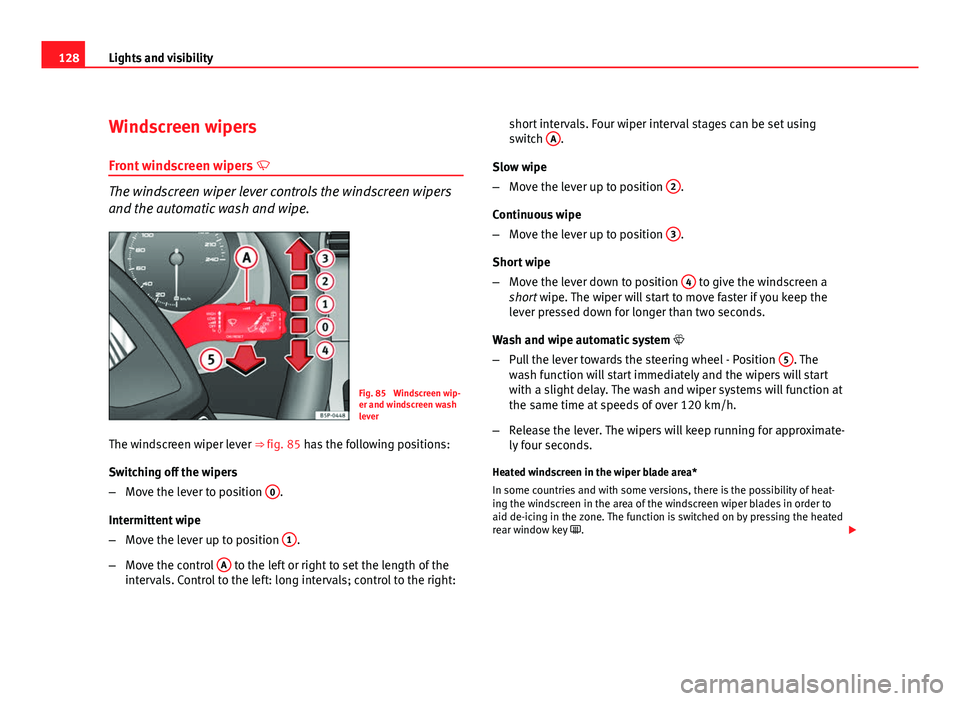
The windscreen wiper lever ⇒ fig. 85 has the following positions:
Switching off the wipers
– Move the lever to position 0
.
Intermittent wipe
– Move the lever up to position 1
.
– Move the control A
to the left or right to set the length of the
intervals. Control to the left: long intervals; control to the right: short intervals. Four wiper interval stages can be set using
switch
A
.
Slow wipe
– Move the lever up to position 2
.
Continuous wipe
– Move the lever up to position 3
.
Short wipe
– Move the lever down to position 4
to give the windscreen a
short wipe. The wiper will start to move faster if you keep the
lever pressed down for longer than two seconds.
Wash and wipe automatic system
– Pull the lever towards the steering wheel - Position 5
. The
wash function will start immediately and the wipers will start
with a slight delay. The wash and wiper systems will function at
the same time at speeds of over 120 km/h.
– Release the lever. The wipers will keep running for approximate-
ly four seconds.
Heated windscreen in the wiper blade area*
In some countries and with some versions, there is the possibility of heat-
ing the windscreen in the area of the windscreen wiper blades in order to
aid de-icing in the zone. The function is switched on by pressing the heated
rear window key .
Page 131 of 313
129
Lights and visibility
WARNING
● Worn and dirty wiper blades reduce visibility and safety levels while
driving.
● In cold conditions, you should not use the wash / wipe system unless
you have warmed the windscreen with the heating and ventilation sys-
tem. The washer fluid could otherwise freeze on the windscreen and ob-
scure your view of the road.
● Always note the corresponding warnings on ⇒ page 240.
CAUTION
In icy conditions, always check that the wiper blades are not frozen to the
glass before using the wipers for the first time. If you switch on the wipers
when the wiper blades are frozen to the windscreen, you could damage
both the wiper blades and the wiper motor.
Note
● The windscreen wipers will only work when the ignition is switched on.
● In certain versions of vehicles with alarms, the windscreen wiper will on-
ly work when the ignition is on and the bonnet closed.
● When in use, the wipers do not go as far as the rest position. When the
lever is moved to position 0, they are totally hidden.
● The next speed down will automatically be selected if wiper speed 2
⇒ fig. 85 or 3 is selected when the vehicle stops. The set speed will be re-
sumed when the vehicle starts again
● The windscreen will be wiped again after approximately five seconds
once the “automatic wipe/wash system” has been operated, provided the
vehicle is in transit (drip function). If you activate the wipers less than three
seconds after the drip function, a new wash sequence will begin without the
last wipe. For the “drip” function to work again, you have to turn the ignition
off and then on again. ●
When the “intermittent wipe function” is on, the intervals are directly
proportional to the speed. This way, the higher the vehicle speed the short-
er the intervals.
● The wiper will try to wipe away any obstacles that are on the windscreen.
The wiper will stop moving if the obstacle blocks its path. Remove the ob-
stacle and switch the wiper back on again.
● Before removing any objects that may be trapped in the side areas of
the windscreen, always move the wiper arms to the service position (hori-
zontal).
● The heat output of the heated jets is controlled automatically when the
ignition is switched on, depending upon the outside temperature.
Safety FirstOperating InstructionsPractical TipsTechnical Specifications
Page 132 of 313
130Lights and visibility
Rain sensor*
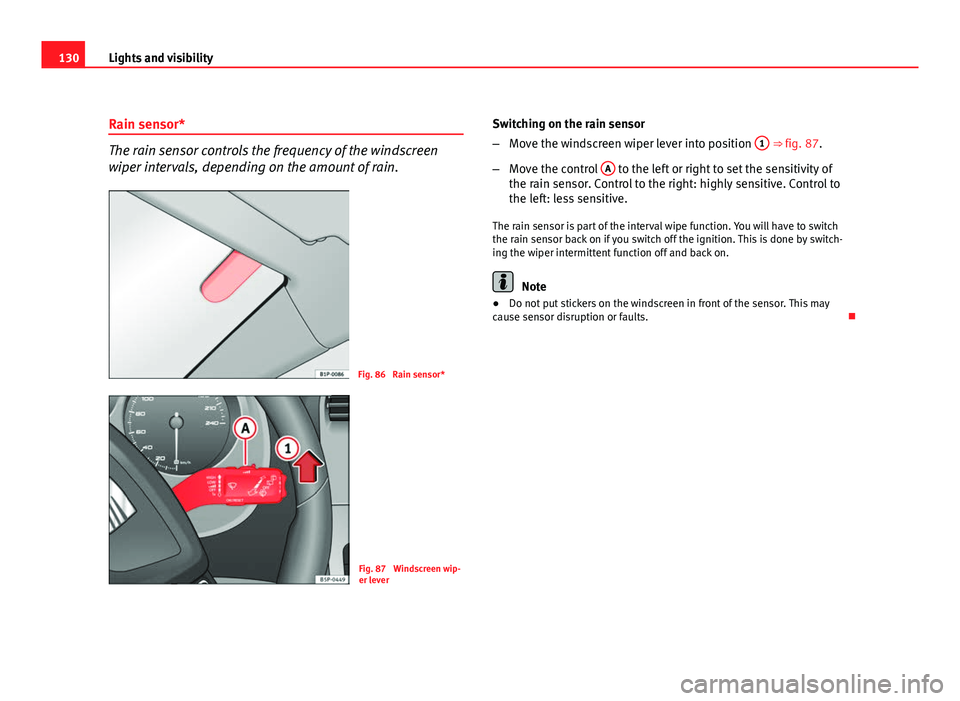
The rain sensor controls the frequency of the windscreen
wiper intervals, depending on the amount of rain.
Fig. 86 Rain sensor*
Fig. 87 Windscreen wip-
er lever Switching on the rain sensor
–
Move the windscreen wiper lever into position 1
⇒ fig. 87.
– Move the control A
to the left or right to set the sensitivity of
the rain sensor. Control to the right: highly sensitive. Control to
the left: less sensitive.
The rain sensor is part of the interval wipe function. You will have to switch
the rain sensor back on if you switch off the ignition. This is done by switch-
ing the wiper intermittent function off and back on.
Note
● Do not put stickers on the windscreen in front of the sensor. This may
cause sensor disruption or faults.
Page 133 of 313
131
Lights and visibility
Rear window wiper
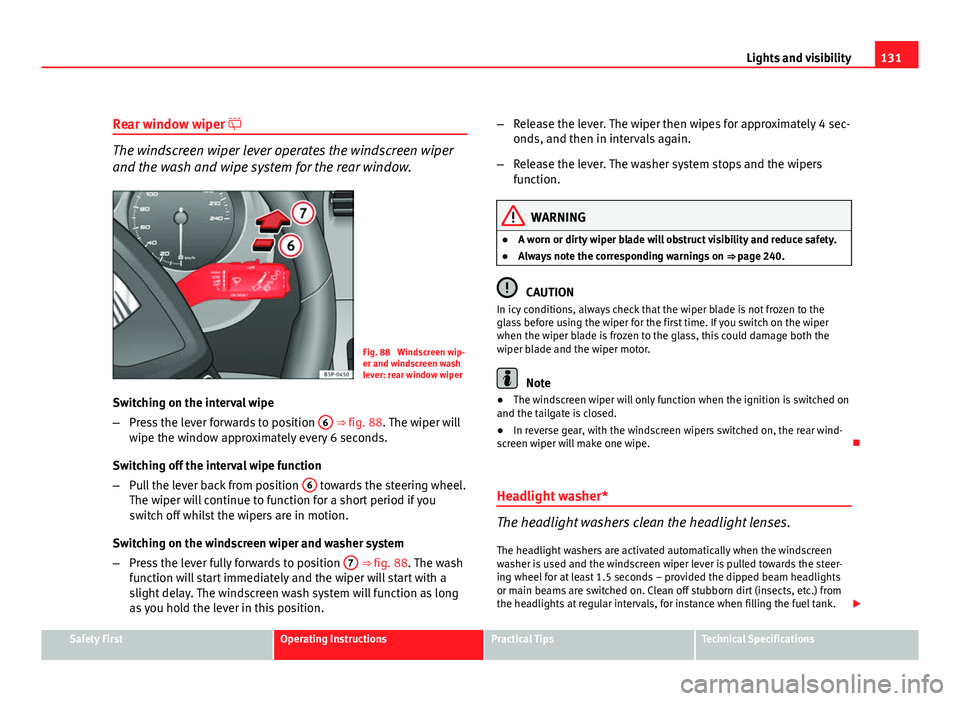
The windscreen wiper lever operates the windscreen wiper
and the wash and wipe system for the rear window.
Fig. 88 Windscreen wip-
er and windscreen wash
lever: rear window wiper
Switching on the interval wipe
– Press the lever forwards to position 6
⇒ fig. 88. The wiper will
wipe the window approximately every 6 seconds.
Switching off the interval wipe function
– Pull the lever back from position 6
towards the steering wheel.
The wiper will continue to function for a short period if you
switch off whilst the wipers are in motion.
Switching on the windscreen wiper and washer system
– Press the lever fully forwards to position 7
⇒ fig. 88. The wash
function will start immediately and the wiper will start with a
slight delay. The windscreen wash system will function as long
as you hold the lever in this position. –
Release the lever. The wiper then wipes for approximately 4 sec-
onds, and then in intervals again.
– Release the lever. The washer system stops and the wipers
function.
WARNING
● A worn or dirty wiper blade will obstruct visibility and reduce safety.
● Always note the corresponding warnings on ⇒ page 240.
CAUTION
In icy conditions, always check that the wiper blade is not frozen to the
glass before using the wiper for the first time. If you switch on the wiper
when the wiper blade is frozen to the glass, this could damage both the
wiper blade and the wiper motor.
Note
● The windscreen wiper will only function when the ignition is switched on
and the tailgate is closed.
● In reverse gear, with the windscreen wipers switched on, the rear wind-
screen wiper will make one wipe.
Headlight washer*
The headlight washers clean the headlight lenses. The headlight washers are activated automatically when the windscreen
washer is used and the windscreen wiper lever is pulled towards the steer-
ing wheel for at least 1.5 seconds – provided the dipped beam headlights
or main beams are switched on. Clean off stubborn dirt (insects, etc.) from
the headlights at regular intervals, for instance when filling the fuel tank.
Safety FirstOperating InstructionsPractical TipsTechnical Specifications
Page 134 of 313
132Lights and visibility
Note
● To ensure that the headlight washers work properly in winter, keep the
nozzle holders in the bumper free of snow and remove any ice with a de-icer
spray.
● To remove water, the windscreen wipers will be activated from time to
time, the headlight wipers will be activated every three cycles.
Rear-view mirrors Interior mirror
It is dangerous to drive if you cannot see clearly through the
rear window.Manual anti-dazzle function for interior mirror
In the basic mirror position, the lever at the bottom edge of the mirror
should be at the front. Pull the lever to the back to select the anti-dazzle
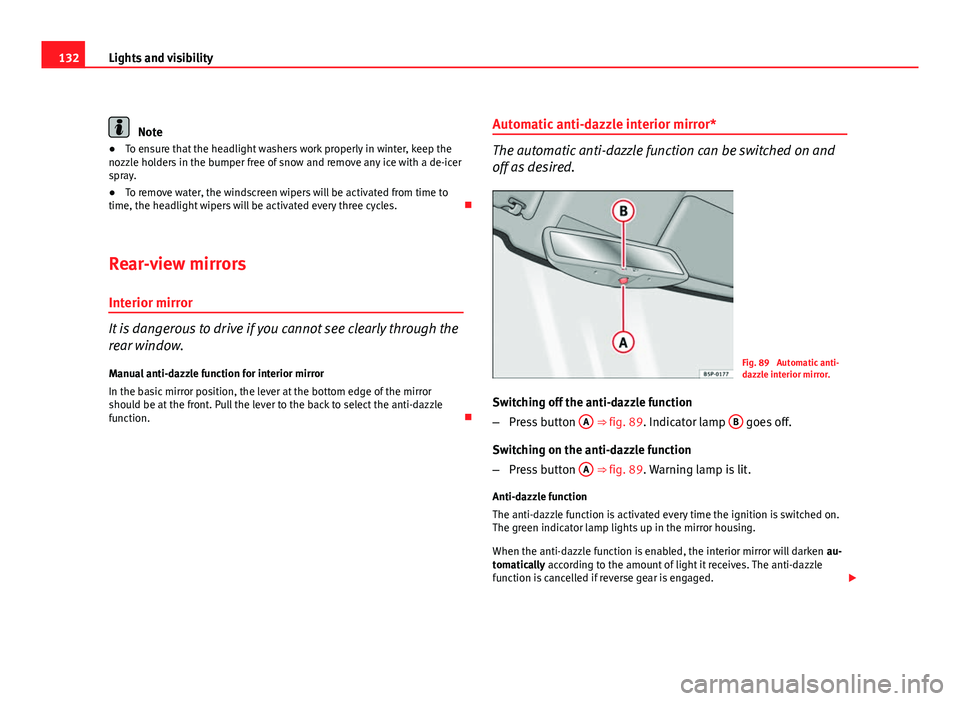
function. Automatic anti-dazzle interior mirror*
The automatic anti-dazzle function can be switched on and
off as desired.
Fig. 89 Automatic anti-
dazzle interior mirror.
Switching off the anti-dazzle function
– Press button A
⇒ fig. 89. Indicator lamp B goes off.
Switching on the anti-dazzle function
– Press button A
⇒ fig. 89. Warning lamp is lit.
Anti-dazzle function
The anti-dazzle function is activated every time the ignition is switched on.
The green indicator lamp lights up in the mirror housing.
When the anti-dazzle function is enabled, the interior mirror will darken au-
tomatically according to the amount of light it receives. The anti-dazzle
function is cancelled if reverse gear is engaged.
Page 135 of 313
133
Lights and visibility
Note
● The automatic anti-dazzle function will only work properly if the sun
blind* for the rear window is retracted and there are no other objects pre-
venting light from reaching the interior mirror.
● If you have to stick any type of sticker on the windscreen, do not do so in
front of the sensors. Doing so could prevent the anti-dazzle function from
working well or even from working at all.
Exterior mirrors
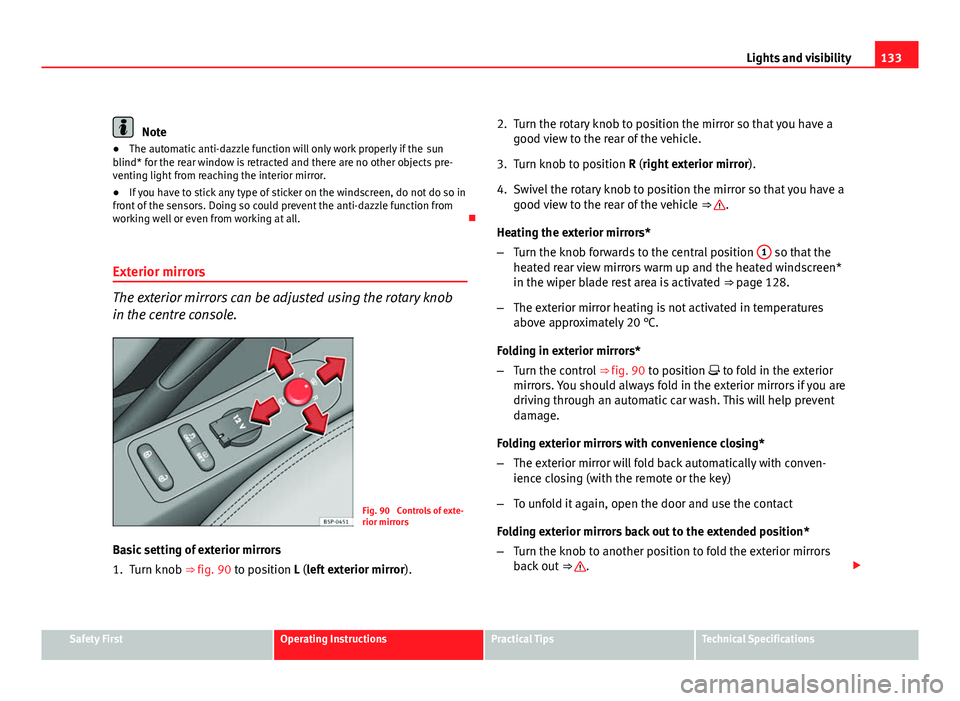
The exterior mirrors can be adjusted using the rotary knob
in the centre console.
Fig. 90 Controls of exte-
rior mirrors
Basic setting of exterior mirrors
1. Turn knob ⇒ fig. 90 to position L (left exterior mirror ).2. Turn the rotary knob to position the mirror so that you have a
good view to the rear of the vehicle.
3. Turn knob to position R (right exterior mirror ).
4. Swivel the rotary knob to position the mirror so that you have a good view to the rear of the vehicle ⇒
.
Heating the exterior mirrors*
– Turn the knob forwards to the central position 1
so that the
heated rear view mirrors warm up and the heated windscreen*
in the wiper blade rest area is activated ⇒ page 128.
– The exterior mirror heating is not activated in temperatures
above approximately 20 °C.
Folding in exterior mirrors*
– Turn the control ⇒ fig. 90 to position to fold in the exterior
mirrors. You should always fold in the exterior mirrors if you are
driving through an automatic car wash. This will help prevent
damage.
Folding exterior mirrors with convenience closing*
– The exterior mirror will fold back automatically with conven-
ience closing (with the remote or the key)
– To unfold it again, open the door and use the contact
Folding exterior mirrors back out to the extended position*
– Turn the knob to another position to fold the exterior mirrors
back out ⇒
.
Safety FirstOperating InstructionsPractical TipsTechnical Specifications
Page 136 of 313
134Lights and visibility
Synchronised mirror adjustment
1. Turn the control to the position L (left exterior mirror).
2. Turn the rotary knob to position the mirror so that you have a good view to the rear of the vehicle. The right exterior mirror
will be adjusted at the same time (synchronised).
WARNING
● Convex or aspheric mirrors increase the field of vision however the
objects appear smaller and further away in the mirrors. If you use these
mirrors to estimate the distance to vehicles behind you when changing
lane, you could make a mistake. Risk of accident.
● If possible, use the rear view mirror to estimate distances to vehicles
behind you.
● Make sure that you do not get your finger trapped between the mirror
and the mirror base when folding back the mirrors. Risk of injury!
For the sake of the environment
The exterior mirror heating should be switched off when it is no longer nee-
ded. Otherwise, it is an unnecessary fuel waste.
Note
● If the electrical adjustment ever fails to operate, the mirrors can be ad-
justed by hand by lightly pressing the edge of the mirror glass.
● In vehicles with electric exterior mirrors, the following points should be
observed: if, due to an external force (e.g. a knock while manoeuvring), the
adjustment of the mirror housing is altered, the mirror will have to be com-
pletely folded electrically. Do not readjust the mirror housing by hand, as
this will interfere with the mirror adjuster function. ●
The rear view mirrors can be adjusted separately or simultaneously, as
described before.
● The fold-in function on the exterior mirrors is not activated at speeds of
above 40 km/h.
Page 148 of 313
146Seats and storage compartments
WARNING
● Do not store loose objects on the dash panel. These objects could be
flung through the passenger compartment when the vehicle is moving
(e.g. while accelerating, braking or cornering) and distract the driver.
Risk of accident.
● Ensure that no objects can fall from the centre console or other stor-
age compartments into the driver footwell while the vehicle is moving. In
the event of a sudden braking manoeuvre, you will not be able to use the
brake, clutch or accelerator. Risk of accident.
● Clothing hung on the coat hooks must not restrict the driver's view.
Risk of accident. The coat hooks are intended only for use with light arti-
cles of clothing. Do not leave any hard, sharp or heavy objects in hanging
articles of clothing. During sudden braking manoeuvres or accidents, es-
pecially those involving airbag deployment, these objects could injure
the vehicle occupants.
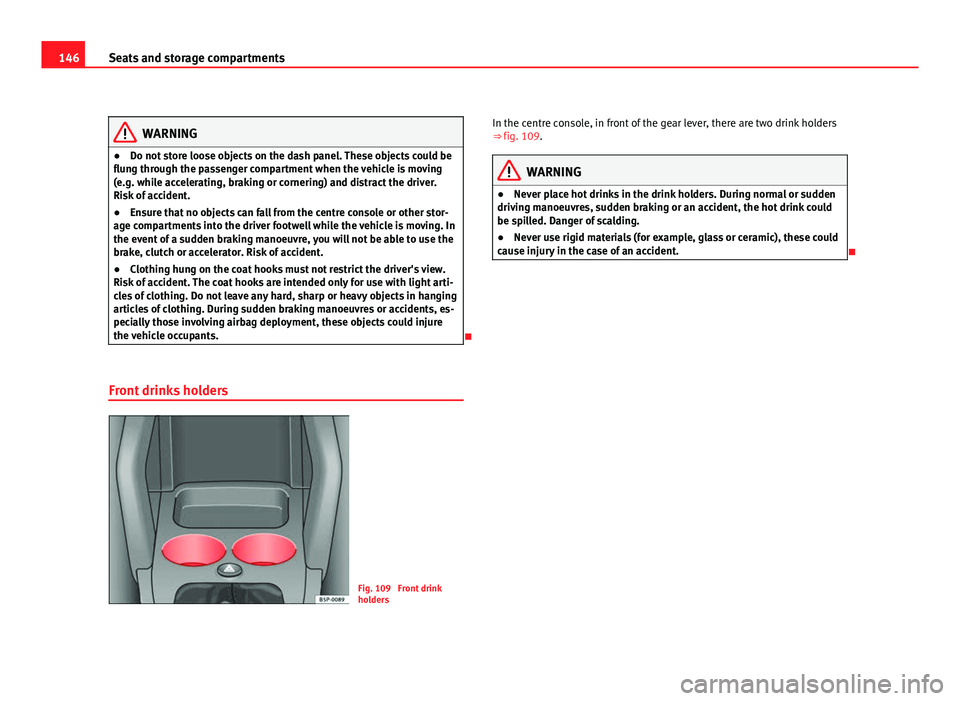
Front drinks holders
Fig. 109 Front drink
holders In the centre console, in front of the gear lever, there are two drink holders
⇒ fig. 109.
WARNING
● Never place hot drinks in the drink holders. During normal or sudden
driving manoeuvres, sudden braking or an accident, the hot drink could
be spilled. Danger of scalding.
● Never use rigid materials (for example, glass or ceramic), these could
cause injury in the case of an accident.
Page 150 of 313
148Seats and storage compartments
Multi-purpose mobile storage compartment* - Installing
and removing
This storage compartment may only be placed in the central
area of the rear seat
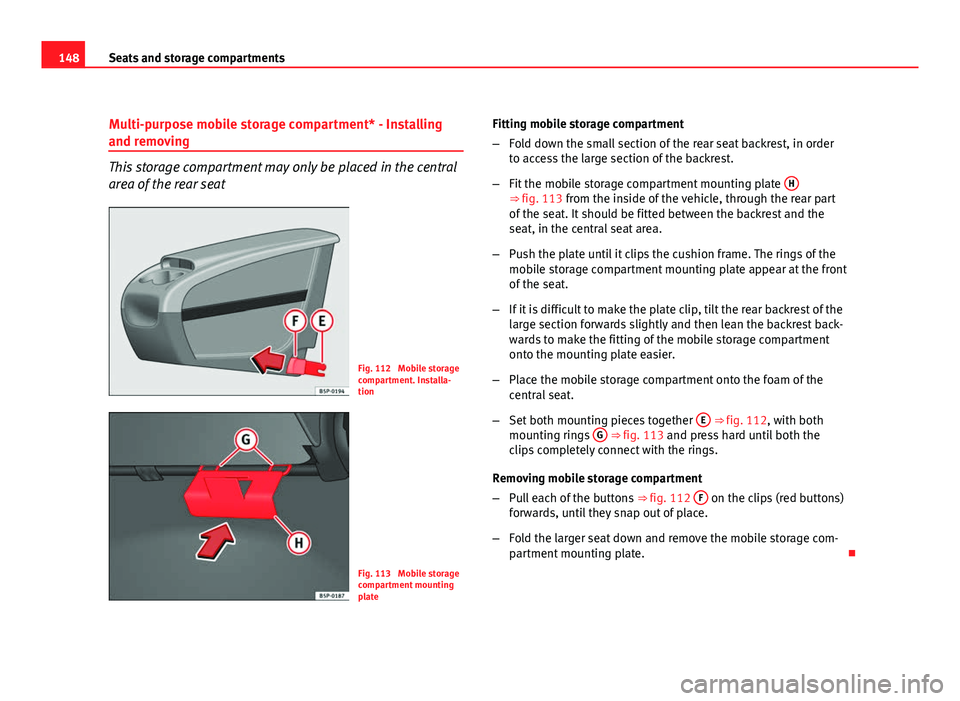
Fig. 112 Mobile storage
compartment. Installa-
tion
Fig. 113 Mobile storage
compartment mounting
plate Fitting mobile storage compartment
–
Fold down the small section of the rear seat backrest, in order
to access the large section of the backrest.
– Fit the mobile storage compartment mounting plate H
⇒ fig. 113 from the inside of the vehicle, through the rear part
of the seat. It should be fitted between the backrest and the
seat, in the central seat area.
– Push the plate until it clips the cushion frame. The rings of the
mobile storage compartment mounting plate appear at the front
of the seat.
– If it is difficult to make the plate clip, tilt the rear backrest of the
large section forwards slightly and then lean the backrest back-
wards to make the fitting of the mobile storage compartment
onto the mounting plate easier.
– Place the mobile storage compartment onto the foam of the
central seat.
– Set both mounting pieces together E
⇒ fig. 112, with both
mounting rings G ⇒ fig. 113 and press hard until both the
clips completely connect with the rings.
Removing mobile storage compartment
– Pull each of the buttons ⇒ fig. 112 F
on the clips (red buttons)
forwards, until they snap out of place.
– Fold the larger seat down and remove the mobile storage com-
partment mounting plate.
Page 152 of 313
150Seats and storage compartments
WARNING (Continued)
● When the vehicle is moving, keep the tables stored inside the mobile
storage compartment with the cover closed, and likewise when they are
not in use
● Never place hot drinks in the cup holders. The drink may spill and
cause burns when the vehicle is moving.
● Do not leave cans in the cup holders when the vehicle is in motion,
there is a danger that the can may be flung around the vehicle and cause
injury.
● Make sure that the mounting plate is correctly clipped onto the cush-
ion frame.
● When the plate is not in use, store inside the storage compartment.
● When the mobile storage compartment is not in use, it should always
be fastened by the storage net in the luggage compartment.
Note
● Check that the mobile storage compartment is correctly fitted, pulling it
forwards by the front glove compartment and checking that both safety
clips are correctly clipped onto the rings. Ashtray*, cigarette lighter* and power points
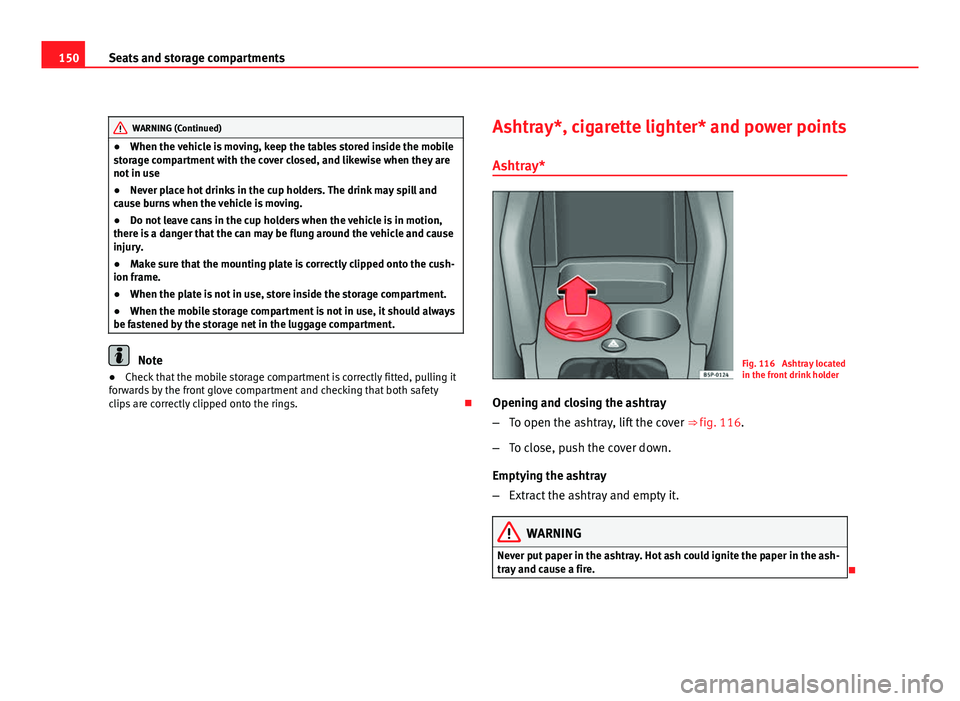
Ashtray*Fig. 116 Ashtray located
in the front drink holder
Opening and closing the ashtray
– To open the ashtray, lift the cover ⇒ fig. 116.
– To close, push the cover down.
Emptying the ashtray
– Extract the ashtray and empty it.
WARNING
Never put paper in the ashtray. Hot ash could ignite the paper in the ash-
tray and cause a fire.