check engine light Seat Altea 2013 User Guide
[x] Cancel search | Manufacturer: SEAT, Model Year: 2013, Model line: Altea, Model: Seat Altea 2013Pages: 315, PDF Size: 4.66 MB
Page 175 of 315
173
Driving
If the engine does not start immediately, switch the starter off after 10 sec-
onds and try again after half a minute. If the engine still does not start, the
fuel pump fuse should be checked ⇒ page 268, Fuses.
WARNING
● Never start or run the engine in unventilated or closed rooms. The ex-
haust gases contain carbon monoxide, an odourless and colourless poi-
sonous gas. Risk of fatal accidents. Carbon monoxide can cause loss of
consciousness. It can also result in death.
● Never leave the vehicle unattended if the engine is running.
● Never use “cold start sprays”, they could explode or cause the engine
to run at high revs. Risk of injury.
CAUTION
● When the engine is cold, you should avoid high engine speeds, driving
at full throttle and over-loading the engine. Risk of engine damage.
● The vehicle should not be pushed or towed more than 50 metres to start
the engine. Unburnt fuel could enter the catalytic converter and damage it.
● Before attempting to push-start or tow a vehicle in order to start it, you
should first try to start it using the battery of another vehicle. Note and fol-
low the instructions in ⇒ page 281, Jump-starting.
For the sake of the environment
Do not warm-up the engine by running the engine with the vehicle station-
ary. Start off immediately, driving gently. This helps the engine reach oper-
ating temperature faster and reduces emissions. Starting diesel engines
The engine can only be started using a genuine SEAT key
with its correct code.
– Move the gearbox lever to the neutral position and depress the
clutch pedal thoroughly and hold it in this position for the start-
er to turn the engine on.
– Turn the ignition key to the starting position.
– Turn the ignition key to position ⇒ Fig. 135 1
. The warning
lamp will light for engine pre-heating.
– When the lamp turns off, turn the ignition key to position 2
to
start the engine. Do not press the accelerator.
– Let go of the ignition key as soon as the engine starts, the start-
er motor must not be allowed to run on with the engine.
When starting a very cold engine, it may be a little noisy for the first few sec-
onds until oil pressure has built up in the hydraulic valve compensators.
This is quite normal, and no cause for concern.
If there are problems starting the engine, see the ⇒ page 281.
Glow plug system for the diesel engine
To avoid unnecessary discharging of the battery, do not use any other major
electrical equipment while the glow plugs are pre-heating.
Start the engine as soon as the glow plug warning lamp ⇒ page 83 goes
out.
Starting the diesel engine after the fuel tank has been completely run dry
If the fuel tank has been completely run dry, it may take longer than normal
(up to one minute) to start a diesel engine after refuelling. This is because
the fuel system must eliminate air first.
Safety FirstOperating InstructionsPractical TipsTechnical Specifications
Page 207 of 315
205
Driving and the environment
let the vehicle roll with a gear engaged, for example, if you see a red light
ahead. The braking effect achieved in this way helps to reduce the wear of
brakes and tyres; emissions and fuel consumption are reduced to zero (dis-
connection due to inertia).
Change gear early to save energy
An effective way of saving fuel is to change up quickly through the gears.
Running the engine at high rpm in the lower gears uses an unnecessary
amount of fuel.
Manual gearbox: Change from first to second gear as quickly as possible.
We recommend that, whenever possible, you change to a higher gear upon
reaching 2000 rpm. Follow the “recommended gear” indication that ap-
pears on the instrument panel ⇒ page 62.
Avoid driving at high speed
We advise you not to drive at the top speed permitted by the vehicle. Fuel
consumption, exhaust emissions and noise levels all increase very rapidly
at higher speeds. Driving at moderate speeds will help to save fuel.
Avoid idling
It is worthwhile switching off the engine when waiting in a traffic jam, at lev-
el crossings or at traffic lights with a long red phase. The fuel saved after
only 30 - 40 seconds is greater than the amount of fuel needed to restart
the engine.
The engine takes a long time to warm up when it is idling. Mechanical wear
and pollutant emissions are also especially high during this initial warm-up
phase. It is therefore best to drive off immediately after starting the engine.
Avoid running the engine at high speed.
Periodic maintenance
Periodic maintenance work guarantees that, before beginning a journey,
you will not consume more than the required amount of fuel. A well-serviced
engine gives you the benefit of improved fuel efficiency as well as maxi-
mum reliability and an enhanced resale value.
A badly serviced engine can consume up to 10% more fuel than necessary. Avoid short journeys
To reduce the consumption and emission of polluting exhaust gases, the
engine and the exhaust gas filtration systems should reach the optimum
operating temperature.
With the engine cold, fuel consumption is proportionally higher. The engine
does not warm up and fuel consumption does not normalise until having
driven approximately
four kilometres (2.5 miles). This is why we recommend
avoiding short trips whenever possible.
Maintain the correct tyre pressures
Bear in mind that keeping the tyres at an adequate pressure saves fuel. If
the tyre pressure is just one bar too low, fuel consumption can increase by
as much as 5%. Due to the greater rolling resistance, under-inflation also
increases tyre wear and impairs handling.
The tyre pressures should always be checked when the tyres are cold.
Do not use winter tyres all year round as they increase fuel consumption by
up to 10%.
Avoid unnecessary weight
Given that every kilo of extra weight will increase the fuel consumption, it is
advisable to always check the luggage compartment to make sure that no
unnecessary loads are being transported.
A roof rack is often left in place for the sake of convenience, even when it is
no longer needed. At a speed of 100-120 km/h (60-75 mph) your vehicle
will use about 12% more fuel as a result of the extra wind resistance caused
by the roof rack even when it is not in use.
Save electricity
The engine activates the alternator, which produces electricity. With the
need for electricity, fuel consumption is also increased. Because of this, al-
ways turn off electrical components when you do not need them. Examples
of components that use a lot of electricity are: the fan at high speeds, the
rear window heating or the seat heaters*.
Safety FirstOperating InstructionsPractical TipsTechnical Specifications
Page 221 of 315
219
Vehicle maintenance and cleaning
The longer stains or dirt remain on the vehicle surfaces, especially the fab-
rics covering the padded upholstery, the more difficult it becomes to clean
and maintain them. If stains and dirt are left for a long time, it may be that
they are impossible to remove.
WARNING
Car-care products may be toxic and hazardous. Using unsuitable car-care
products or, using them in the wrong way, may cause accidents, serious
injury, burns or intoxication.
● Keep your car-care products in their original containers.
● Read the instructions.
● Never keep car-care products in empty food containers, bottles or
other similar containers, other people may confuse them.
● Keep all car-care products out of the reach of children.
● Some products may give off harmful vapours during use. Therefore,
they should be used outdoors in well-ventilated places.
● Never use fuel, turpentine, engine oil, nail-varnish remover or any
other volatile product for washing, maintenance or cleaning. These are
toxic and highly flammable.
WARNING
Unsuitable maintenance and cleaning of vehicle components may impair
proper operation of safety equipment and cause serious injury.
● Maintain and clean vehicle components according to the manufactur-
er's instructions.
● Only use approved or recommended cleaning products.
CAUTION
● Cleaning products which contain solvents have a corrosive effect and
may damage the material irreparably.
● Stains and dirt containing aggressive substances or solvents attack the
material and may damage it irreparably, even when they are cleaned quick-
ly.
● Dirt and stains should not be allowed to dry and should be cleaned as
quickly as possible.
● In the case of stubborn stains, take the vehicle to a specialised work-
shop to avoid damage.
Treating your upholstery
Checklist
To treat and maintain your seat upholstery, keep the following in mind ⇒
:
¥ Before entering the vehicle, close any Velcro fasteners that might
snag on the upholstery or trim fabric. Any open Velcro fasteners may
damage the trim or upholstery fabrics.
¥ To prevent damage, avoid direct contact between sharp decorative
objects and the upholstery and trim fabrics. Decorative objects in-
clude zips, rivets and rhinestones on clothing and belts.
¥ From time to time, clean the dust that gathers in the perforations,
folds and seams so that the surfaces of the seats are not damaged
by its abrasive effect.
¥ Make sure clothes are colour-fast to avoid them running and staining
the upholstery. This is especially important if the upholstery is light
in colour.
Safety FirstOperating InstructionsPractical TipsTechnical Specifications
Page 237 of 315
235
Checking and refilling levels
Opening the bonnet
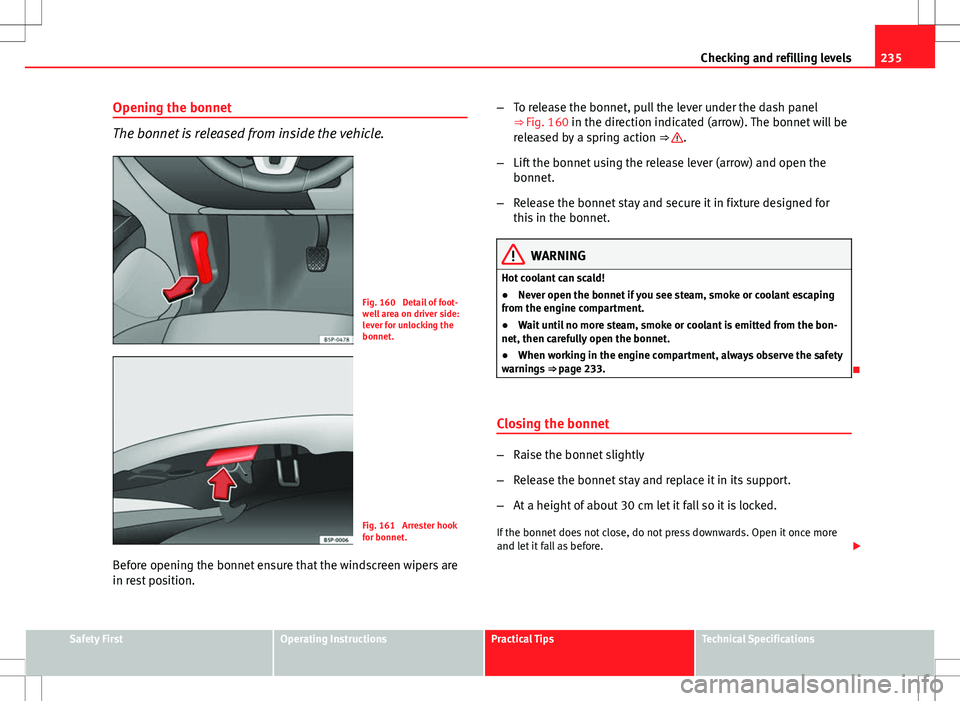
The bonnet is released from inside the vehicle.
Fig. 160 Detail of foot-
well area on driver side:
lever for unlocking the
bonnet.
Fig. 161 Arrester hook
for bonnet.
Before opening the bonnet ensure that the windscreen wipers are
in rest position. –
To release the bonnet, pull the lever under the dash panel
⇒ Fig. 160 in the direction indicated (arrow). The bonnet will be
released by a spring action ⇒
.
– Lift the bonnet using the release lever (arrow) and open the
bonnet.
– Release the bonnet stay and secure it in fixture designed for
this in the bonnet.
WARNING
Hot coolant can scald!
● Never open the bonnet if you see steam, smoke or coolant escaping
from the engine compartment.
● Wait until no more steam, smoke or coolant is emitted from the bon-
net, then carefully open the bonnet.
● When working in the engine compartment, always observe the safety
warnings ⇒ page 233.
Closing the bonnet
– Raise the bonnet slightly
– Release the bonnet stay and replace it in its support.
– At a height of about 30 cm let it fall so it is locked.
If the bonnet does not close, do not press downwards. Open it once more
and let it fall as before.
Safety FirstOperating InstructionsPractical TipsTechnical Specifications
Page 242 of 315
240Checking and refilling levels
Coolant
Engine coolant specifications
The engine cooling system is supplied from the factory with a specially trea-
ted mixture of water and, at least, 40 % of the additive G 13 (TLVW 774 J).
The engine coolant additive is recognisable by its purple colour. This mix-
ture of water and additive gives the necessary frost protection down to
-25 °C (-13 °F) and protects the light alloy parts of the cooling system
against corrosion. It also prevents scaling and considerably raises the boil-
ing point of the coolant.
To protect the engine cooling system, the percentage of additive must al-
ways be at least 40 %, even in warm climates where anti-freeze protection is
not required.
If greater frost protection is required in very cold climates, the proportion of
additive can be increased. However, the percentage of additive should not
exceed 60 %, as this would reduce the frost protection and, in turn, de-
crease the cooling capacity.
When the coolant is topped up, use a mixture of distilled water and, at
least, 40 % of the G 13 or G 12 plus-plus (TL-VW 774 G) additive (both are
purple) to obtain an optimum anticorrosion protection ⇒
. The mixture of
G 13 with G 12 plus (TL-VW 774 F), G 12 (red) or G 11 (green-blue) engine
coolants will significantly reduce the anticorrosion protection and should,
therefore be avoided ⇒
.
WARNING
If there is not enough anti-freeze in the coolant system, the engine may
fail leading to serious damage.
● Please make sure that the percentage of additive is correct with re-
spect to the lowest expected ambient temperature in the zone in which
the vehicle is to be used.
● When the outside temperature is very low, the coolant could freeze
and the vehicle would be immobilised. In this case, the heating would
not work either and inadequately dressed passengers could die of cold.
CAUTION
The original additives should never be mixed with coolants which are not
approved by SEAT. Otherwise, you run the risk of causing severe damage to
the engine and the engine cooling system.
● If the fluid in the expansion tank is not purple but is, for example,
brown, this indicates that the G 13 additive has been mixed with an inade-
quate coolant. The coolant must be changed as soon as possible if this is
the case! This could result in serious faults and engine damage.
For the sake of the environment
Coolants and additives can contaminate the environment. If any fluids are
spilled, they should be collected and correctly disposed of, with respect to
the environment.
Page 244 of 315
242Checking and refilling levels
CAUTION
● When mixed with other additives the colour of G12 will change to brown.
If this occurs you should have the coolant changed immediately. Failure to
do so will result in engine damage!
● If a lot of coolant fluid has been lost, wait for the engine to cool down
before putting in cold coolant. This avoids damaging the engine. Large cool-
ant losses are an indication of leaks in the cooling system. See a special-
ised workshop immediately and have the cooling system checked. Other-
wise, there is a risk of engine damage.
Washer fluid and windscreen wiper blades Topping up washer fluid
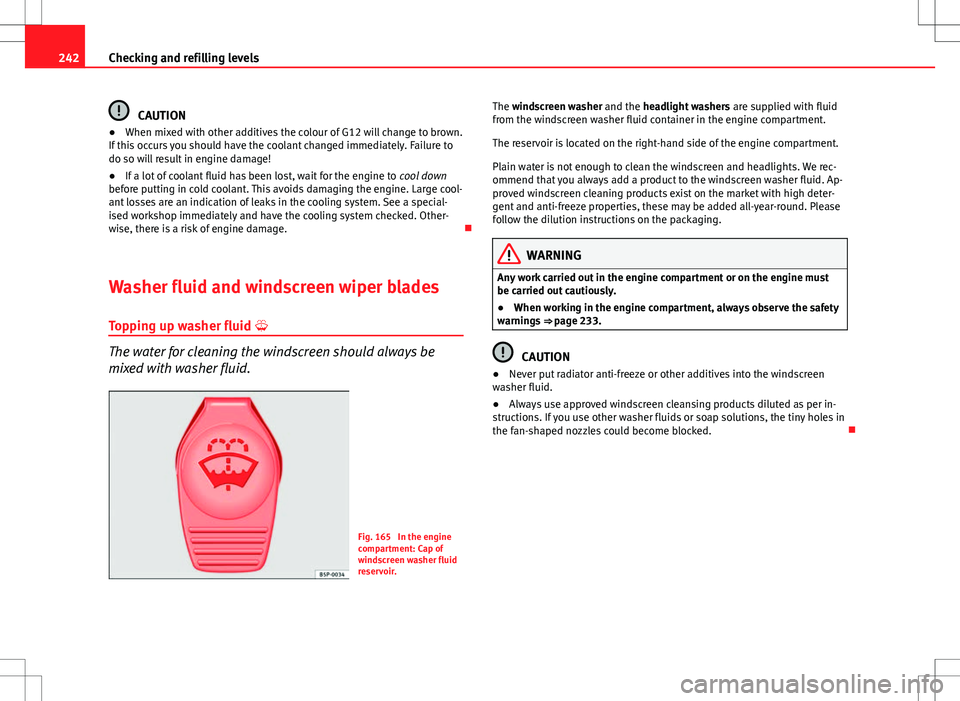
The water for cleaning the windscreen should always be
mixed with washer fluid.
Fig. 165 In the engine
compartment: Cap of
windscreen washer fluid
reservoir. The windscreen washer and the headlight washers
are supplied with fluid
from the windscreen washer fluid container in the engine compartment.
The reservoir is located on the right-hand side of the engine compartment.
Plain water is not enough to clean the windscreen and headlights. We rec-
ommend that you always add a product to the windscreen washer fluid. Ap-
proved windscreen cleaning products exist on the market with high deter-
gent and anti-freeze properties, these may be added all-year-round. Please
follow the dilution instructions on the packaging.
WARNING
Any work carried out in the engine compartment or on the engine must
be carried out cautiously.
● When working in the engine compartment, always observe the safety
warnings ⇒ page 233.
CAUTION
● Never put radiator anti-freeze or other additives into the windscreen
washer fluid.
● Always use approved windscreen cleansing products diluted as per in-
structions. If you use other washer fluids or soap solutions, the tiny holes in
the fan-shaped nozzles could become blocked.
Page 247 of 315
245
Checking and refilling levels
Removing the wiper blade
– Lift the wiper arm away from the glass ⇒ Fig. 168
– Slide the blade adapter in the direction of the arrow and remove
the blade ⇒ Fig. 168.
Fitting the wiper blade
– With one hand, hold the top end of the wiper arm.
– Place the blade as shown in the ⇒ Fig. 169 and slide the adapt-
er along until it engages.
Check the condition of the wiper blade regularly. Change as required.
If the windscreen wiper scrapes, it should be replaced if damaged, or
cleaned if soiled.
If this is not sufficient, refer to a specialised workshop.
WARNING
Do not drive unless you have good visibility through all windows!
● Clean the windscreen wiper blades and all windows regularly.
● The wiper blades should be changed once or twice a year.
CAUTION
● A damaged or dirty window wiper could scratch the rear window.
● Never use fuel, nail varnish remover, paint thinner or similar products to
clean the window.
● Never move the windscreen wiper by hand. This could cause damage. Brake fluid
Checking the brake fluid level
The brake fluid is checked at the intervals given in the serv-
ice schedule.
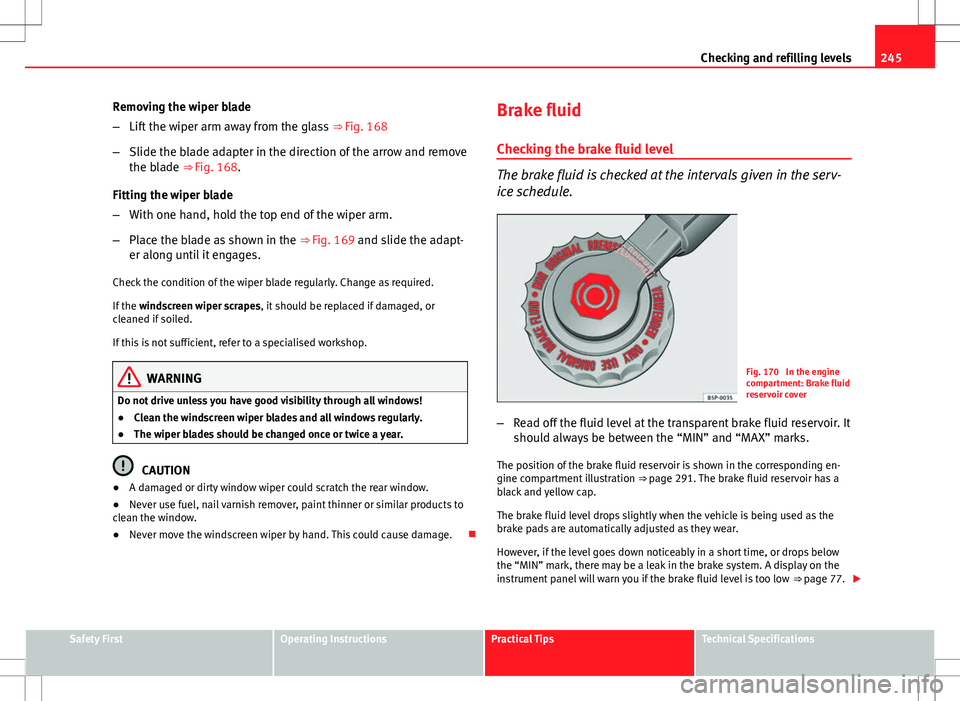
Fig. 170 In the engine
compartment: Brake fluid
reservoir cover
– Read off the fluid level at the transparent brake fluid reservoir. It
should always be between the “MIN” and “MAX” marks.
The position of the brake fluid reservoir is shown in the corresponding en-
gine compartment illustration ⇒ page 291. The brake fluid reservoir has a
black and yellow cap.
The brake fluid level drops slightly when the vehicle is being used as the
brake pads are automatically adjusted as they wear.
However, if the level goes down noticeably in a short time, or drops below
the “MIN” mark, there may be a leak in the brake system. A display on the
instrument panel will warn you if the brake fluid level is too low ⇒ page 77.
Safety FirstOperating InstructionsPractical TipsTechnical Specifications
Page 250 of 315
248Checking and refilling levels
CAUTION
● Never disconnect the battery if the ignition is switched on or if the en-
gine is running. This could damage the electrical system or electronic com-
ponents.
● Do not expose the battery to direct sunlight over a long period of time,
as the intense ultraviolet radiation can damage the battery housing.
● If the vehicle is left standing in cold conditions for a long period, protect
the battery from freezing. If it freezes it will be damaged.
Checking the electrolyte level
The electrolyte level should be checked regularly in high-
mileage vehicles, in hot countries and in older batteries. – Open the engine bonnet and the battery cover ⇒
in Safety in-
structions on working in the engine compartment on page 233
⇒
in Warnings on handling the battery on page 247.
– Check the colour display in the "magic eye" on the top of the
battery.
– If there are air bubbles in the window, tap the window gently
until they disperse.
The position of the battery is shown in the corresponding engine compart-
ment diagram ⇒ page 291.
The “magic eye” indicator, located on the top of the battery changes colour,
depending on the charge state and electrolyte level of the battery.
There are two different colours: ●
Black: correct charge status.
● Transparent/clear yellow: the battery must be replaced. Contact a speci-
alised workshop.
Charging and changing the vehicle battery
The battery is maintenance-free and is checked during the
inspection service. All work on the vehicle battery requires
specialist knowledge.
If you often drive short distances or if the vehicle is not driven for long peri-
ods, the battery should be checked by a specialised workshop between the
scheduled services.
If the battery has discharged and you have problems starting the vehicle,
the battery might be damaged. If this happens, we recommend you have
the vehicle battery checked by a Technical Service where it will be re-charg-
ed or replaced.
Charging the battery
The vehicle battery should be charged by a specialised workshop only, as
batteries using special technology have been installed and they must be
charged in a controlled environment.
Replacing a vehicle battery
The battery has been developed to suit the conditions of its location and
has special safety features.
Genuine SEAT batteries fulfil the maintenance, performance and safety
specifications of your vehicle.
Page 306 of 315
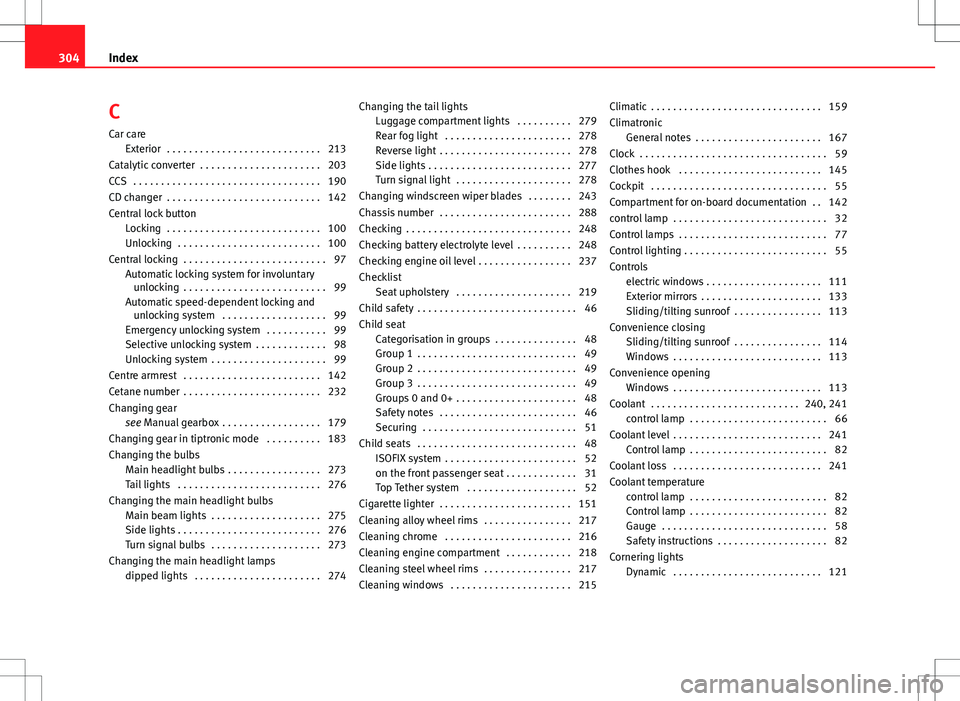
C
Car care Exterior . . . . . . . . . . . . . . . . . . . . . . . . . . . . 213
Catalytic converter . . . . . . . . . . . . . . . . . . . . . . 203
CCS . . . . . . . . . . . . . . . . . . . . . . . . . . . . . . . . . . 190
CD changer . . . . . . . . . . . . . . . . . . . . . . . . . . . . 142
Central lock button Locking . . . . . . . . . . . . . . . . . . . . . . . . . . . . 100
Unlocking . . . . . . . . . . . . . . . . . . . . . . . . . . 100
Central locking . . . . . . . . . . . . . . . . . . . . . . . . . . 97 Automatic locking system for involuntaryunlocking . . . . . . . . . . . . . . . . . . . . . . . . . . 99
Automatic speed-dependent locking and unlocking system . . . . . . . . . . . . . . . . . . . 99
Emergency unlocking system . . . . . . . . . . . 99
Selective unlocking system . . . . . . . . . . . . . 98
Unlocking system . . . . . . . . . . . . . . . . . . . . . 99
Centre armrest . . . . . . . . . . . . . . . . . . . . . . . . . 142
Cetane number . . . . . . . . . . . . . . . . . . . . . . . . . 232
Changing gear see Manual gearbox . . . . . . . . . . . . . . . . . . 179
Changing gear in tiptronic mode . . . . . . . . . . 183
Changing the bulbs Main headlight bulbs . . . . . . . . . . . . . . . . . 273
Tail lights . . . . . . . . . . . . . . . . . . . . . . . . . . 276
Changing the main headlight bulbs Main beam lights . . . . . . . . . . . . . . . . . . . . 275
Side lights . . . . . . . . . . . . . . . . . . . . . . . . . . 276
Turn signal bulbs . . . . . . . . . . . . . . . . . . . . 273
Changing the main headlight lamps dipped lights . . . . . . . . . . . . . . . . . . . . . . . 274 Changing the tail lights
Luggage compartment lights . . . . . . . . . . 279
Rear fog light . . . . . . . . . . . . . . . . . . . . . . . 278
Reverse light . . . . . . . . . . . . . . . . . . . . . . . . 278
Side lights . . . . . . . . . . . . . . . . . . . . . . . . . . 277
Turn signal light . . . . . . . . . . . . . . . . . . . . . 278
Changing windscreen wiper blades . . . . . . . . 243
Chassis number . . . . . . . . . . . . . . . . . . . . . . . . 288
Checking . . . . . . . . . . . . . . . . . . . . . . . . . . . . . . 248
Checking battery electrolyte level . . . . . . . . . . 248
Checking engine oil level . . . . . . . . . . . . . . . . . 237
Checklist Seat upholstery . . . . . . . . . . . . . . . . . . . . . 219
Child safety . . . . . . . . . . . . . . . . . . . . . . . . . . . . . 46
Child seat Categorisation in groups . . . . . . . . . . . . . . . 48
Group 1 . . . . . . . . . . . . . . . . . . . . . . . . . . . . . 49
Group 2 . . . . . . . . . . . . . . . . . . . . . . . . . . . . . 49
Group 3 . . . . . . . . . . . . . . . . . . . . . . . . . . . . . 49
Groups 0 and 0+ . . . . . . . . . . . . . . . . . . . . . . 48
Safety notes . . . . . . . . . . . . . . . . . . . . . . . . . 46
Securing . . . . . . . . . . . . . . . . . . . . . . . . . . . . 51
Child seats . . . . . . . . . . . . . . . . . . . . . . . . . . . . . 48 ISOFIX system . . . . . . . . . . . . . . . . . . . . . . . . 52
on the front passenger seat . . . . . . . . . . . . . 31
Top Tether system . . . . . . . . . . . . . . . . . . . . 52
Cigarette lighter . . . . . . . . . . . . . . . . . . . . . . . . 151
Cleaning alloy wheel rims . . . . . . . . . . . . . . . . 217
Cleaning chrome . . . . . . . . . . . . . . . . . . . . . . . 216
Cleaning engine compartment . . . . . . . . . . . . 218
Cleaning steel wheel rims . . . . . . . . . . . . . . . . 217
Cleaning windows . . . . . . . . . . . . . . . . . . . . . . 215 Climatic . . . . . . . . . . . . . . . . . . . . . . . . . . . . . . . 159
Climatronic
General notes . . . . . . . . . . . . . . . . . . . . . . . 167
Clock . . . . . . . . . . . . . . . . . . . . . . . . . . . . . . . . . . 59
Clothes hook . . . . . . . . . . . . . . . . . . . . . . . . . . 145
Cockpit . . . . . . . . . . . . . . . . . . . . . . . . . . . . . . . . 55
Compartment for on-board documentation . . 142
control lamp . . . . . . . . . . . . . . . . . . . . . . . . . . . . 32
Control lamps . . . . . . . . . . . . . . . . . . . . . . . . . . . 77
Control lighting . . . . . . . . . . . . . . . . . . . . . . . . . . 55
Controls electric windows . . . . . . . . . . . . . . . . . . . . . 111
Exterior mirrors . . . . . . . . . . . . . . . . . . . . . . 133
Sliding/tilting sunroof . . . . . . . . . . . . . . . . 113
Convenience closing Sliding/tilting sunroof . . . . . . . . . . . . . . . . 114
Windows . . . . . . . . . . . . . . . . . . . . . . . . . . . 113
Convenience opening Windows . . . . . . . . . . . . . . . . . . . . . . . . . . . 113
Coolant . . . . . . . . . . . . . . . . . . . . . . . . . . . 240, 241 control lamp . . . . . . . . . . . . . . . . . . . . . . . . . 66
Coolant level . . . . . . . . . . . . . . . . . . . . . . . . . . . 241 Control lamp . . . . . . . . . . . . . . . . . . . . . . . . . 82
Coolant loss . . . . . . . . . . . . . . . . . . . . . . . . . . . 241
Coolant temperature control lamp . . . . . . . . . . . . . . . . . . . . . . . . . 82
Control lamp . . . . . . . . . . . . . . . . . . . . . . . . . 82
Gauge . . . . . . . . . . . . . . . . . . . . . . . . . . . . . . 58
Safety instructions . . . . . . . . . . . . . . . . . . . . 82
Cornering lights Dynamic . . . . . . . . . . . . . . . . . . . . . . . . . . . 121
304 Index
Page 308 of 315
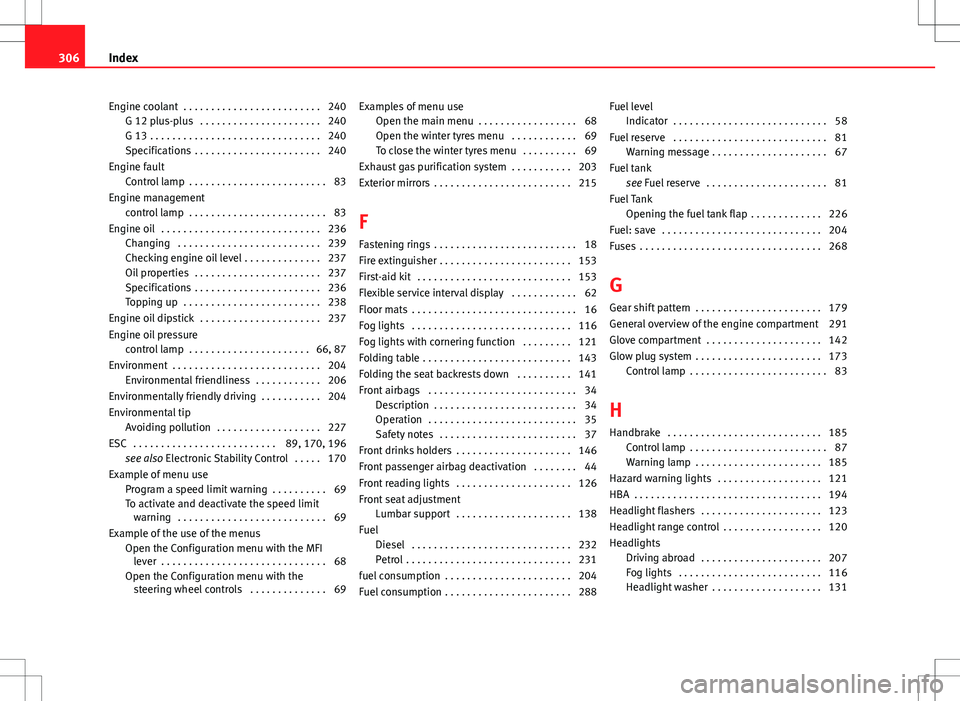
Engine coolant . . . . . . . . . . . . . . . . . . . . . . . . . 240G 12 plus-plus . . . . . . . . . . . . . . . . . . . . . . 240
G 13 . . . . . . . . . . . . . . . . . . . . . . . . . . . . . . . 240
Specifications . . . . . . . . . . . . . . . . . . . . . . . 240
Engine fault Control lamp . . . . . . . . . . . . . . . . . . . . . . . . . 83
Engine management control lamp . . . . . . . . . . . . . . . . . . . . . . . . . 83
Engine oil . . . . . . . . . . . . . . . . . . . . . . . . . . . . . 236 Changing . . . . . . . . . . . . . . . . . . . . . . . . . . 239
Checking engine oil level . . . . . . . . . . . . . . 237
Oil properties . . . . . . . . . . . . . . . . . . . . . . . 237
Specifications . . . . . . . . . . . . . . . . . . . . . . . 236
Topping up . . . . . . . . . . . . . . . . . . . . . . . . . 238
Engine oil dipstick . . . . . . . . . . . . . . . . . . . . . . 237
Engine oil pressure control lamp . . . . . . . . . . . . . . . . . . . . . . 66, 87
Environment . . . . . . . . . . . . . . . . . . . . . . . . . . . 204 Environmental friendliness . . . . . . . . . . . . 206
Environmentally friendly driving . . . . . . . . . . . 204
Environmental tip Avoiding pollution . . . . . . . . . . . . . . . . . . . 227
ESC . . . . . . . . . . . . . . . . . . . . . . . . . . 89, 170, 196 see also Electronic Stability Control . . . . . 170
Example of menu use Program a speed limit warning . . . . . . . . . . 69
To activate and deactivate the speed limitwarning . . . . . . . . . . . . . . . . . . . . . . . . . . . 69
Example of the use of the menus Open the Configuration menu with the MFIlever . . . . . . . . . . . . . . . . . . . . . . . . . . . . . . 68
Open the Configuration menu with the steering wheel controls . . . . . . . . . . . . . . 69 Examples of menu use
Open the main menu . . . . . . . . . . . . . . . . . . 68
Open the winter tyres menu . . . . . . . . . . . . 69
To close the winter tyres menu . . . . . . . . . . 69
Exhaust gas purification system . . . . . . . . . . . 203
Exterior mirrors . . . . . . . . . . . . . . . . . . . . . . . . . 215
F
Fastening rings . . . . . . . . . . . . . . . . . . . . . . . . . . 18
Fire extinguisher . . . . . . . . . . . . . . . . . . . . . . . . 153
First-aid kit . . . . . . . . . . . . . . . . . . . . . . . . . . . . 153
Flexible service interval display . . . . . . . . . . . . 62
Floor mats . . . . . . . . . . . . . . . . . . . . . . . . . . . . . . 16
Fog lights . . . . . . . . . . . . . . . . . . . . . . . . . . . . . 116
Fog lights with cornering function . . . . . . . . . 121
Folding table . . . . . . . . . . . . . . . . . . . . . . . . . . . 143
Folding the seat backrests down . . . . . . . . . . 141
Front airbags . . . . . . . . . . . . . . . . . . . . . . . . . . . 34 Description . . . . . . . . . . . . . . . . . . . . . . . . . . 34
Operation . . . . . . . . . . . . . . . . . . . . . . . . . . . 35
Safety notes . . . . . . . . . . . . . . . . . . . . . . . . . 37
Front drinks holders . . . . . . . . . . . . . . . . . . . . . 146
Front passenger airbag deactivation . . . . . . . . 44
Front reading lights . . . . . . . . . . . . . . . . . . . . . 126
Front seat adjustment Lumbar support . . . . . . . . . . . . . . . . . . . . . 138
Fuel Diesel . . . . . . . . . . . . . . . . . . . . . . . . . . . . . 232
Petrol . . . . . . . . . . . . . . . . . . . . . . . . . . . . . . 231
fuel consumption . . . . . . . . . . . . . . . . . . . . . . . 204
Fuel consumption . . . . . . . . . . . . . . . . . . . . . . . 288 Fuel level
Indicator . . . . . . . . . . . . . . . . . . . . . . . . . . . . 58
Fuel reserve . . . . . . . . . . . . . . . . . . . . . . . . . . . . 81 Warning message . . . . . . . . . . . . . . . . . . . . . 67
Fuel tank see Fuel reserve . . . . . . . . . . . . . . . . . . . . . . 81
Fuel Tank Opening the fuel tank flap . . . . . . . . . . . . . 226
Fuel: save . . . . . . . . . . . . . . . . . . . . . . . . . . . . . 204
Fuses . . . . . . . . . . . . . . . . . . . . . . . . . . . . . . . . . 268
G
Gear shift pattern . . . . . . . . . . . . . . . . . . . . . . . 179
General overview of the engine compartment 291
Glove compartment . . . . . . . . . . . . . . . . . . . . . 142
Glow plug system . . . . . . . . . . . . . . . . . . . . . . . 173 Control lamp . . . . . . . . . . . . . . . . . . . . . . . . . 83
H
Handbrake . . . . . . . . . . . . . . . . . . . . . . . . . . . . 185 Control lamp . . . . . . . . . . . . . . . . . . . . . . . . . 87
Warning lamp . . . . . . . . . . . . . . . . . . . . . . . 185
Hazard warning lights . . . . . . . . . . . . . . . . . . . 121
HBA . . . . . . . . . . . . . . . . . . . . . . . . . . . . . . . . . . 194
Headlight flashers . . . . . . . . . . . . . . . . . . . . . . 123
Headlight range control . . . . . . . . . . . . . . . . . . 120
Headlights Driving abroad . . . . . . . . . . . . . . . . . . . . . . 207
Fog lights . . . . . . . . . . . . . . . . . . . . . . . . . . 116
Headlight washer . . . . . . . . . . . . . . . . . . . . 131
306 Index