child restraint Seat Altea 2013 User Guide
[x] Cancel search | Manufacturer: SEAT, Model Year: 2013, Model line: Altea, Model: Seat Altea 2013Pages: 315, PDF Size: 4.66 MB
Page 48 of 315
46Child safety
Child safety
Brief introduction Introduction
Statistics show that children are generally safer on the rear
seat than on the front passenger seat.For safety reasons we recommend that children under 12 years of age travel
on the rear seats. Depending on their age, height and weight, children trav-
elling on the rear seat must use a child seat or a seat belt. For safety rea-
sons, the child seat should be installed in the centre of the rear seat or be-
hind the front passenger seat.
The physical laws involved and the forces acting in a collision apply also to
children ⇒ page 21, Why wear seat belts?. But unlike adults, children do not
have fully developed muscle and bone structures. This means that children
are subject to a greater risk of injury.
To reduce this risk, children must always use special child restraint systems
when travelling in the vehicle.
We recommend the use of child safety products from the SEAT Original Ac-
cessories Programme, which includes systems for all ages made by Peke 1)
.
These systems have been especially designed and approved, complying
with the ECE-R44. regulation.
Follow the manufacturer's instructions and observe any statutory require-
ments when installing and using child seats. Always read and note
⇒ page 46, Safety notes on using child seats. We recommend you to always include the manufacturer's Child Seat Instruc-
tion Manual together with the on-board documentation.
Safety notes on using child seats
Proper use of child seats substantially reduces the risk of in-
jury in an accident! As the driver, you are responsible for any children you transport in
your vehicle.
– Protect your children by properly using the appropriate child
seats ⇒ page 48.
– Always ensure that the seat belt is properly positioned accord-
ing to the instructions provided by the manufacturer of the child
seat.
– When travelling, do not allow children to distract you from traf-
fic.
– Take breaks regularly during long trips. Take a break at least ev-
ery two hours.
1)
Not for all countries
Page 51 of 315
49
Child safety
Group 1 child seats
A suitable child seat and a correctly adjusted seat belt can
help you to protect your child.
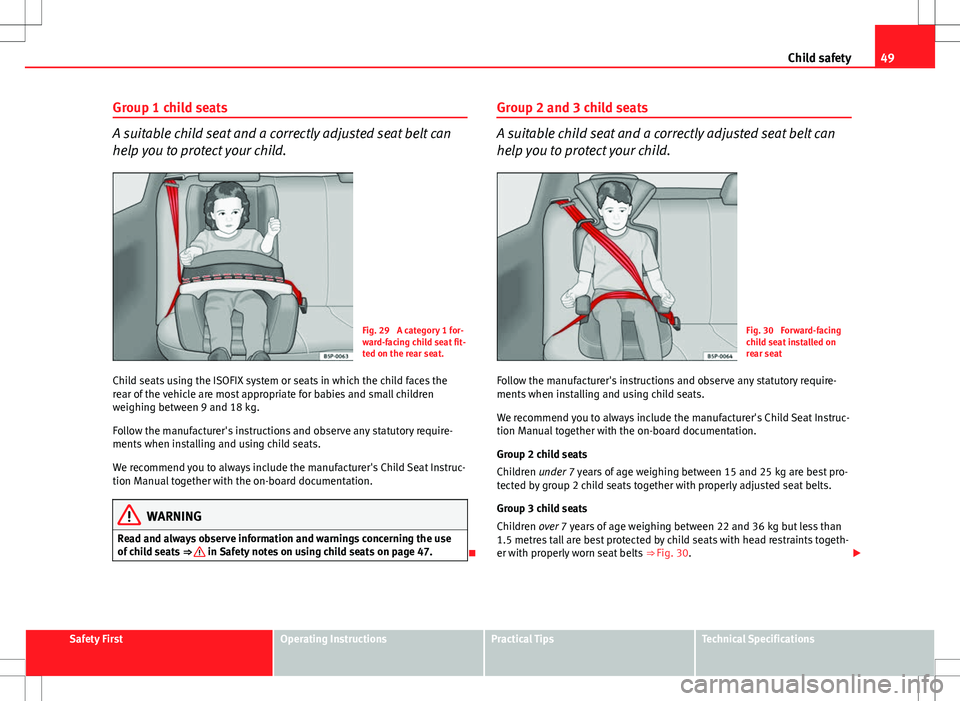
Fig. 29 A category 1 for-
ward-facing child seat fit-
ted on the rear seat.
Child seats using the ISOFIX system or seats in which the child faces the
rear of the vehicle are most appropriate for babies and small children
weighing between 9 and 18 kg.
Follow the manufacturer's instructions and observe any statutory require-
ments when installing and using child seats.
We recommend you to always include the manufacturer's Child Seat Instruc-
tion Manual together with the on-board documentation.
WARNING
Read and always observe information and warnings concerning the use
of child seats ⇒
in Safety notes on using child seats on page 47.Group 2 and 3 child seats
A suitable child seat and a correctly adjusted seat belt can
help you to protect your child.
Fig. 30 Forward-facing
child seat installed on
rear seat
Follow the manufacturer's instructions and observe any statutory require-
ments when installing and using child seats.
We recommend you to always include the manufacturer's Child Seat Instruc-
tion Manual together with the on-board documentation.
Group 2 child seats
Children under 7 years of age weighing between 15 and 25 kg are best pro-
tected by group 2 child seats together with properly adjusted seat belts.
Group 3 child seats
Children over 7 years of age weighing between 22 and 36 kg but less than
1.5 metres tall are best protected by child seats with head restraints togeth-
er with properly worn seat belts ⇒ Fig. 30.
Safety FirstOperating InstructionsPractical TipsTechnical Specifications
Page 53 of 315
51
Child safety
Securing child seats
Ways to secure a child seat
A child seat can be secured differently on the rear seat and
on the front passenger seat. You can secure a child seat to the rear seat or front passenger seat in the
following ways:
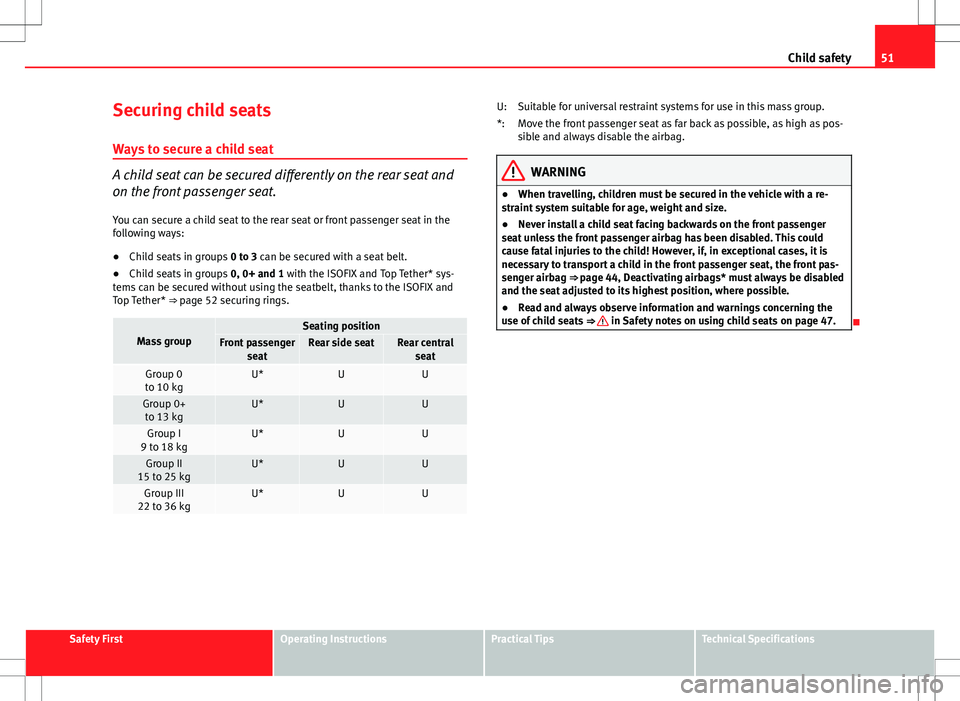
● Child seats in groups 0 to 3 can be secured with a seat belt.
● Child seats in groups 0, 0+ and 1 with the ISOFIX and Top Tether* sys-
tems can be secured without using the seatbelt, thanks to the ISOFIX and
Top Tether* ⇒ page 52 securing rings.
Mass groupSeating positionFront passenger seatRear side seatRear centralseat
Group 0
to 10 kgU*UU
Group 0+ to 13 kgU*UU
Group I
9 to 18 kgU*UU
Group II
15 to 25 kgU*UU
Group III
22 to 36 kgU*UU
Suitable for universal restraint systems for use in this mass group.
Move the front passenger seat as far back as possible, as high as pos-
sible and always disable the airbag.
WARNING
● When travelling, children must be secured in the vehicle with a re-
straint system suitable for age, weight and size.
● Never install a child seat facing backwards on the front passenger
seat unless the front passenger airbag has been disabled. This could
cause fatal injuries to the child! However, if, in exceptional cases, it is
necessary to transport a child in the front passenger seat, the front pas-
senger airbag ⇒ page 44, Deactivating airbags* must always be disabled
and the seat adjusted to its highest position, where possible.
● Read and always observe information and warnings concerning the
use of child seats ⇒
in Safety notes on using child seats on page 47.
U:
*:
Safety FirstOperating InstructionsPractical TipsTechnical Specifications
Page 55 of 315
53
Child safety
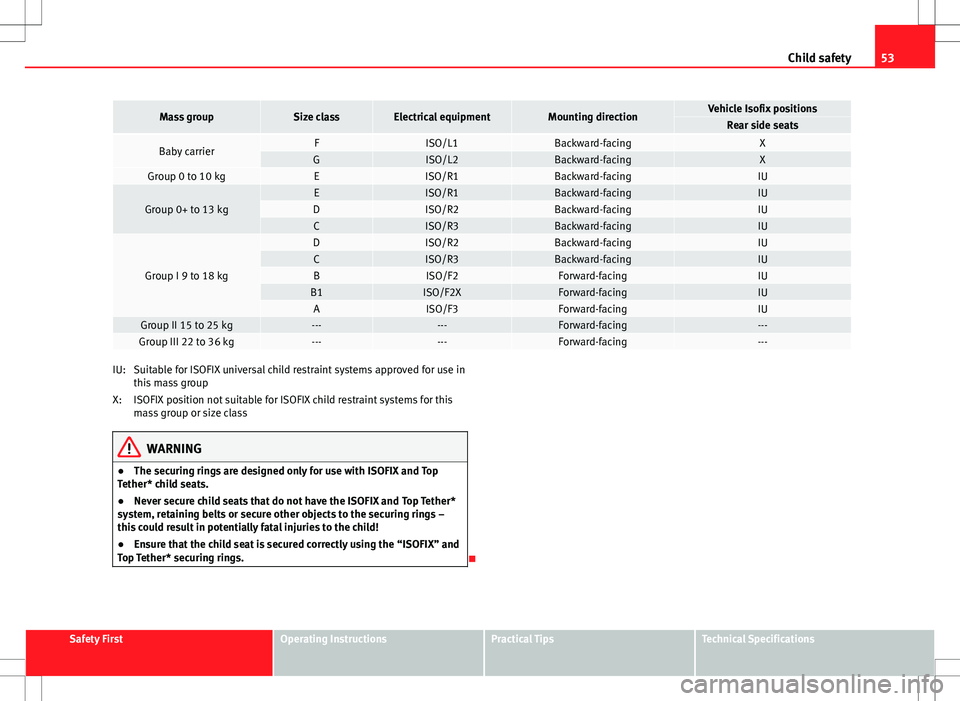
Mass groupSize classElectrical equipmentMounting directionVehicle Isofix positionsRear side seats
Baby carrierFISO/L1Backward-facingXGISO/L2Backward-facingXGroup 0 to 10 kgEISO/R1Backward-facingIU
Group 0+ to 13 kgEISO/R1Backward-facingIUDISO/R2Backward-facingIUCISO/R3Backward-facingIU
Group I 9 to 18 kg
DISO/R2Backward-facingIUCISO/R3Backward-facingIUBISO/F2Forward-facingIUB1ISO/F2XForward-facingIUAISO/F3Forward-facingIUGroup II 15 to 25 kg------Forward-facing---Group III 22 to 36 kg------Forward-facing---
Suitable for ISOFIX universal child restraint systems approved for use in
this mass group
ISOFIX position not suitable for ISOFIX child restraint systems for this
mass group or size class
WARNING
● The securing rings are designed only for use with ISOFIX and Top
Tether* child seats.
● Never secure child seats that do not have the ISOFIX and Top Tether*
system, retaining belts or secure other objects to the securing rings –
this could result in potentially fatal injuries to the child!
● Ensure that the child seat is secured correctly using the “ISOFIX” and
Top Tether* securing rings.
IU:
X:
Safety FirstOperating InstructionsPractical TipsTechnical Specifications
Page 137 of 315
135
Seats and storage
Seats and storage The importance of correct seat adjustment
Proper seat adjustment optimises the level of protection of-
fered by seat belts and airbags.
Your vehicle has five seats, two in the front and three in the rear. Each seat
is equipped with a three-point seat belt.
The driver seat and the front passenger seat can be adjusted in many ways
to suit the physical requirements of the vehicle occupants. The correct seat
position is very important for:
● a fast and easy operation of all controls on the instrument panel,
● a relaxed posture which does not cause drowsiness,
● a safe driving ⇒ page 7,
● ensuring that the seat belts and airbag system provide maximum pro-
tection ⇒ page 19.
WARNING
● If the driver and passengers assume improper sitting positions, they
may sustain critical injuries.
● Never transport more than the permitted amount of people in your ve-
hicle.
● Every vehicle occupant must properly fasten and wear the seat belt
belonging to his or her seat. Children must be protected with an appro-
priate child restraint system ⇒ page 46, Child safety.
● The front seats and all head restraints must always be adjusted to
body size and the seat belt must always be properly adjusted to provide
you and your passengers with optimum protection.
WARNING (Continued)
● Always keep your feet on the footwell when the vehicle is moving;
never rest them on the dash panel, out of the window or on the seat. This
is also applied to passengers. An incorrect sitting position exposes you
to an increased risk of injury in case of a sudden braking or an accident.
If the airbag is triggered, you could sustain severe injuries due to an in-
correct sitting position.
● It is important for the driver and front passenger to keep a distance of
at least 25 cm from the steering wheel and dash panel. Failure to respect
the minimum distance means that the airbag will not protect you. Risk of
fatal injury. The distance between the driver and the steering wheel or
between the front passenger and the dash panel should always be as
great as possible.
● Adjust the driver or front passenger seat only when the vehicle is sta-
tionary. This also applies to the forwards/backwards adjustment of the
rear seats. Otherwise, your seat could move unexpectedly while the vehi-
cle is moving. This could increase the risk of an accident and therefore,
injury. In addition, while adjusting your seat, you will assume an incor-
rect sitting position. Risk of fatal accidents.
● Special guidelines apply to installing a child seat on the front passen-
ger seat. When installing a child seat, please observe the warnings de-
scribed in ⇒ page 46, Child safety.
Safety FirstOperating InstructionsPractical TipsTechnical Specifications
Page 307 of 315
Correct adjustment of front seat head re-straints . . . . . . . . . . . . . . . . . . . . . . . . . . . . . . . 13
Correct adjustment of rear seat head restraints In-use and non-use positions . . . . . . . . . . . 14
Correct sitting position front passenger . . . . . . . . . . . . . . . . . . . . . . 11
Incorrect sitting position . . . . . . . . . . . . . . . 15
passenger . . . . . . . . . . . . . . . . . . . . . . . . . . . 12
Cruise control Complete system deactivation . . . . . . . . . 192
Control lamp . . . . . . . . . . . . . . . . . . . . . . . . . 88
Cruise control system . . . . . . . . . . . . . . . . . . . . 190
Cruise speed . . . . . . . . . . . . . . . . . . . . . . . . . . . 190 Control lamp . . . . . . . . . . . . . . . . . . . . . . . . . 88
Curtain airbags . . . . . . . . . . . . . . . . . . . . . . . . . . 41 Description . . . . . . . . . . . . . . . . . . . . . . . . . . 41
Operation . . . . . . . . . . . . . . . . . . . . . . . . . . . 42
Safety notes . . . . . . . . . . . . . . . . . . . . . . . . . 42
D Danger of fitting a child seat on the front pas- senger seat . . . . . . . . . . . . . . . . . . . . . . . . . . . 31
Dash panel . . . . . . . . . . . . . . . . . . . . . . . . . . . . . 55
Dash panel cleaning . . . . . . . . . . . . . . . . . . . . 222
Daytime driving lights . . . . . . . . . . . . . . . . . . . 118 Activating . . . . . . . . . . . . . . . . . . . . . . . . . . 118
Deactivating . . . . . . . . . . . . . . . . . . . . . . . . 118
Deactivating front passenger airbag Safety notes . . . . . . . . . . . . . . . . . . . . . . . . . 45
Deactivating the airbag Front passenger front airbag . . . . . . . . . . . . 44 Diesel . . . . . . . . . . . . . . . . . . . . . . . . . . . . . . . . 232
Diesel engine
Winter driving . . . . . . . . . . . . . . . . . . . . . . . 232
Diesel engine particulate filter . . . . . . . . . . . . 204
Differential lock . . . . . . . . . . . . . . . . . . . . . . . . 197
Differential lock fault (EDL) control lamp . . . . . . . . . . . . . . . . . . . . . . . . . 89
Digital clock . . . . . . . . . . . . . . . . . . . . . . . . . . . . 59
Dipped beam headlights . . . . . . . . . . . . . . . . . 116
Display (without warning or information texts) 61
Disposal Airbags . . . . . . . . . . . . . . . . . . . . . . . . . . . . . 32
Seat belt tensioners . . . . . . . . . . . . . . . . . . . 29
Door lock cylinders . . . . . . . . . . . . . . . . . . . . . . 216
Door release lever . . . . . . . . . . . . . . . . . . . . . . . 55
Doors Childproof locks . . . . . . . . . . . . . . . . . . . . . 102
control lamp . . . . . . . . . . . . . . . . . . . . . . . . . 88
Drawer . . . . . . . . . . . . . . . . . . . . . . . . . . . . . . . . 143
Driver see Correct sitting position . . . . . . . 10, 11, 12
Driveshaft differential XDS . . . . . . . . . . . . . . . . . . . . . . . . . . . . . . . 196
Drive wheel traction control system (ASR) . . . 195
Driving Driving abroad . . . . . . . . . . . . . . . . . . . . . . 206
Economical/Environmentally friendly . . . . 204
With a trailer . . . . . . . . . . . . . . . . . . . . . . . . 209
Driving abroad . . . . . . . . . . . . . . . . . . . . . . . . . 206 Headlights . . . . . . . . . . . . . . . . . . . . . . . . . 207
Driving programmes . . . . . . . . . . . . . . . . . . . . 180
Driving safety . . . . . . . . . . . . . . . . . . . . . . . . . . . . 8 Driving with automatic gearbox/DSG automatic
gearbox . . . . . . . . . . . . . . . . . . . . . . . . . . . . . 181
Duplicate keys . . . . . . . . . . . . . . . . . . . . . . . . . 103
Dust filter . . . . . . . . . . . . . . . . . . . . . . . . . . . . . 167
Dynamic headlight range control . . . . . . . . . . 120
E
Economical driving . . . . . . . . . . . . . . . . . . . . . . 204
EDL . . . . . . . . . . . . . . . . . . . . . . . . . . . . . . . . . . 197 control lamp . . . . . . . . . . . . . . . . . . . . . . . . . 84
Electrical sockets . . . . . . . . . . . . . . . . . . . . . . . 151
Electric power steering Control lamp . . . . . . . . . . . . . . . . . . . . . . . . . 88
Electronic differential lock . . . . . . . . . . . . . . . . 197 control lamp . . . . . . . . . . . . . . . . . . . . . . . . . 84
Electronic immobiliser . . . . . . . . . . . . . . . . 90, 172
Electronic Stability Control . . . . . . . . . . . . 89, 196 description . . . . . . . . . . . . . . . . . . . . . . . . . 170
Emergency braking warning . . . . . . . . . . 122, 194
Emergency manual locking . . . . . . . . . . . . . . . 101
Emergency opening Doors . . . . . . . . . . . . . . . . . . . . . . . . . . . . . . 107
Emission control system control lamp . . . . . . . . . . . . . . . . . . . . . . . . . 88
Engine Running in . . . . . . . . . . . . . . . . . . . . . . . . . 202
Engine compartment Working in the engine compartment . . . . 233
305
Index