fuel cap Seat Altea 2013 User Guide
[x] Cancel search | Manufacturer: SEAT, Model Year: 2013, Model line: Altea, Model: Seat Altea 2013Pages: 315, PDF Size: 4.66 MB
Page 259 of 315
257
Wheels and tyres
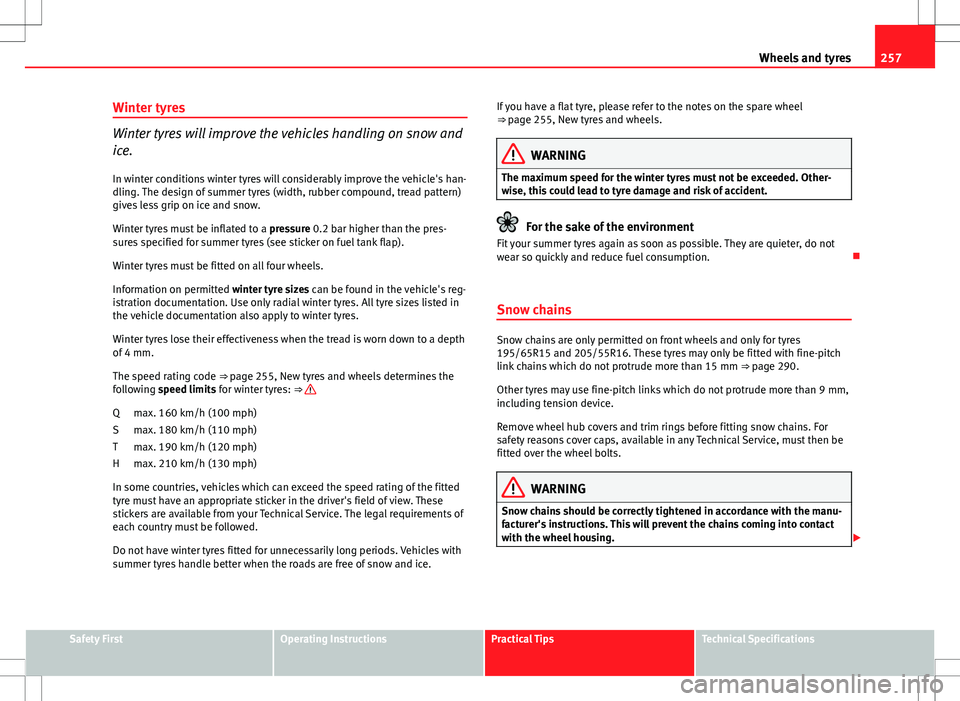
Winter tyres
Winter tyres will improve the vehicles handling on snow and
ice.
In winter conditions winter tyres will considerably improve the vehicle's han-
dling. The design of summer tyres (width, rubber compound, tread pattern)
gives less grip on ice and snow.
Winter tyres must be inflated to a pressure 0.2 bar higher than the pres-
sures specified for summer tyres (see sticker on fuel tank flap).
Winter tyres must be fitted on all four wheels.
Information on permitted winter tyre sizes can be found in the vehicle's reg-
istration documentation. Use only radial winter tyres. All tyre sizes listed in
the vehicle documentation also apply to winter tyres.
Winter tyres lose their effectiveness when the tread is worn down to a depth
of 4 mm.
The speed rating code ⇒ page 255, New tyres and wheels determines the
following speed limits for winter tyres: ⇒
max. 160 km/h (100 mph)
max. 180 km/h (110 mph)
max. 190 km/h (120 mph)
max. 210 km/h (130 mph)
In some countries, vehicles which can exceed the speed rating of the fitted
tyre must have an appropriate sticker in the driver's field of view. These
stickers are available from your Technical Service. The legal requirements of
each country must be followed.
Do not have winter tyres fitted for unnecessarily long periods. Vehicles with
summer tyres handle better when the roads are free of snow and ice. Q
S
T
H If you have a flat tyre, please refer to the notes on the spare wheel
⇒ page 255, New tyres and wheels.
WARNING
The maximum speed for the winter tyres must not be exceeded. Other-
wise, this could lead to tyre damage and risk of accident.
For the sake of the environment
Fit your summer tyres again as soon as possible. They are quieter, do not
wear so quickly and reduce fuel consumption.
Snow chains
Snow chains are only permitted on front wheels and only for tyres
195/65R15 and 205/55R16. These tyres may only be fitted with fine-pitch
link chains which do not protrude more than 15 mm ⇒ page 290.
Other tyres may use fine-pitch links which do not protrude more than 9 mm,
including tension device.
Remove wheel hub covers and trim rings before fitting snow chains. For
safety reasons cover caps, available in any Technical Service, must then be
fitted over the wheel bolts.
WARNING
Snow chains should be correctly tightened in accordance with the manu-
facturer's instructions. This will prevent the chains coming into contact
with the wheel housing.
Safety FirstOperating InstructionsPractical TipsTechnical Specifications
Page 262 of 315
260If and when
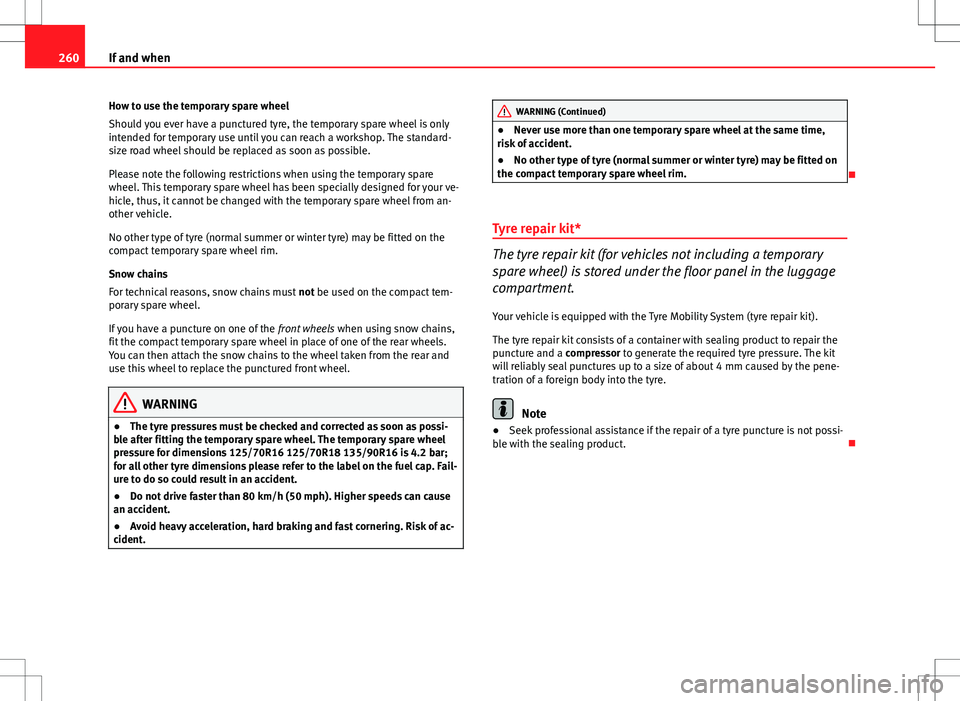
How to use the temporary spare wheel
Should you ever have a punctured tyre, the temporary spare wheel is only
intended for temporary use until you can reach a workshop. The standard-
size road wheel should be replaced as soon as possible.
Please note the following restrictions when using the temporary spare
wheel. This temporary spare wheel has been specially designed for your ve-
hicle, thus, it cannot be changed with the temporary spare wheel from an-
other vehicle.
No other type of tyre (normal summer or winter tyre) may be fitted on the
compact temporary spare wheel rim.
Snow chains
For technical reasons, snow chains must not be used on the compact tem-
porary spare wheel.
If you have a puncture on one of the front wheels when using snow chains,
fit the compact temporary spare wheel in place of one of the rear wheels.
You can then attach the snow chains to the wheel taken from the rear and
use this wheel to replace the punctured front wheel.
WARNING
● The tyre pressures must be checked and corrected as soon as possi-
ble after fitting the temporary spare wheel. The temporary spare wheel
pressure for dimensions 125/70R16 125/70R18 135/90R16 is 4.2 bar;
for all other tyre dimensions please refer to the label on the fuel cap. Fail-
ure to do so could result in an accident.
● Do not drive faster than 80 km/h (50 mph). Higher speeds can cause
an accident.
● Avoid heavy acceleration, hard braking and fast cornering. Risk of ac-
cident.
WARNING (Continued)
● Never use more than one temporary spare wheel at the same time,
risk of accident.
● No other type of tyre (normal summer or winter tyre) may be fitted on
the compact temporary spare wheel rim.
Tyre repair kit*
The tyre repair kit (for vehicles not including a temporary
spare wheel) is stored under the floor panel in the luggage
compartment. Your vehicle is equipped with the Tyre Mobility System (tyre repair kit).
The tyre repair kit consists of a container with sealing product to repair the
puncture and a compressor to generate the required tyre pressure. The kit
will reliably seal punctures up to a size of about 4 mm caused by the pene-
tration of a foreign body into the tyre.
Note
● Seek professional assistance if the repair of a tyre puncture is not possi-
ble with the sealing product.
Page 285 of 315
283
If and when
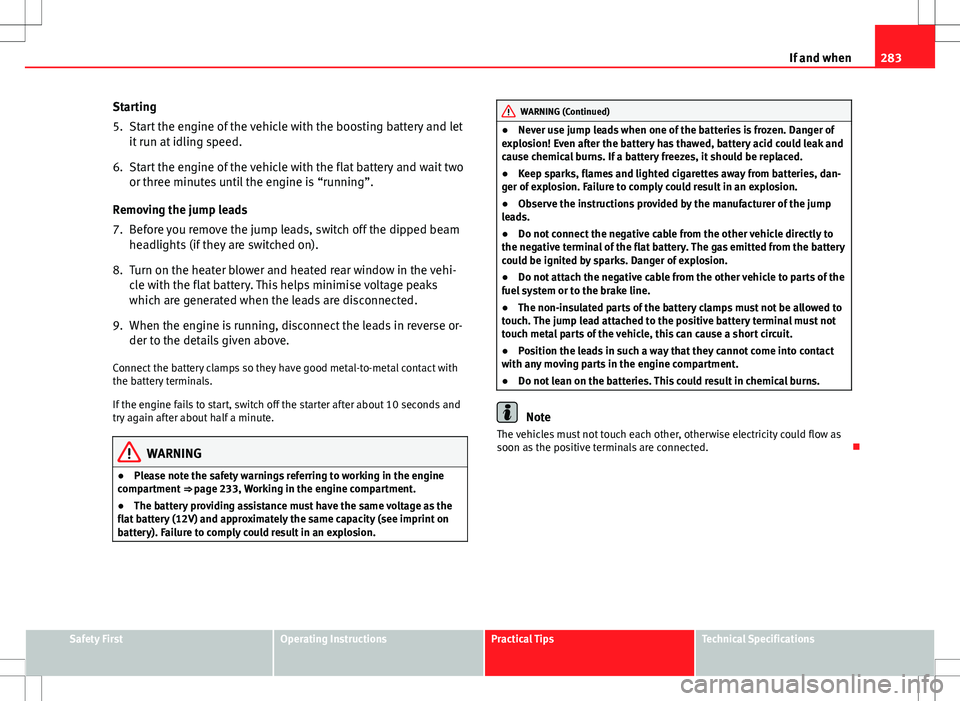
Starting
5. Start the engine of the vehicle with the boosting battery and let it run at idling speed.
6. Start the engine of the vehicle with the flat battery and wait two or three minutes until the engine is “running”.
Removing the jump leads
7. Before you remove the jump leads, switch off the dipped beam headlights (if they are switched on).
8. Turn on the heater blower and heated rear window in the vehi- cle with the flat battery. This helps minimise voltage peaks
which are generated when the leads are disconnected.
9. When the engine is running, disconnect the leads in reverse or- der to the details given above.
Connect the battery clamps so they have good metal-to-metal contact with
the battery terminals.
If the engine fails to start, switch off the starter after about 10 seconds and
try again after about half a minute.
WARNING
● Please note the safety warnings referring to working in the engine
compartment ⇒ page 233, Working in the engine compartment.
● The battery providing assistance must have the same voltage as the
flat battery (12V) and approximately the same capacity (see imprint on
battery). Failure to comply could result in an explosion.
WARNING (Continued)
● Never use jump leads when one of the batteries is frozen. Danger of
explosion! Even after the battery has thawed, battery acid could leak and
cause chemical burns. If a battery freezes, it should be replaced.
● Keep sparks, flames and lighted cigarettes away from batteries, dan-
ger of explosion. Failure to comply could result in an explosion.
● Observe the instructions provided by the manufacturer of the jump
leads.
● Do not connect the negative cable from the other vehicle directly to
the negative terminal of the flat battery. The gas emitted from the battery
could be ignited by sparks. Danger of explosion.
● Do not attach the negative cable from the other vehicle to parts of the
fuel system or to the brake line.
● The non-insulated parts of the battery clamps must not be allowed to
touch. The jump lead attached to the positive battery terminal must not
touch metal parts of the vehicle, this can cause a short circuit.
● Position the leads in such a way that they cannot come into contact
with any moving parts in the engine compartment.
● Do not lean on the batteries. This could result in chemical burns.
Note
The vehicles must not touch each other, otherwise electricity could flow as
soon as the positive terminals are connected.
Safety FirstOperating InstructionsPractical TipsTechnical Specifications
Page 291 of 315
289
Description of specifications
Information on fuel consumption
Fuel consumption
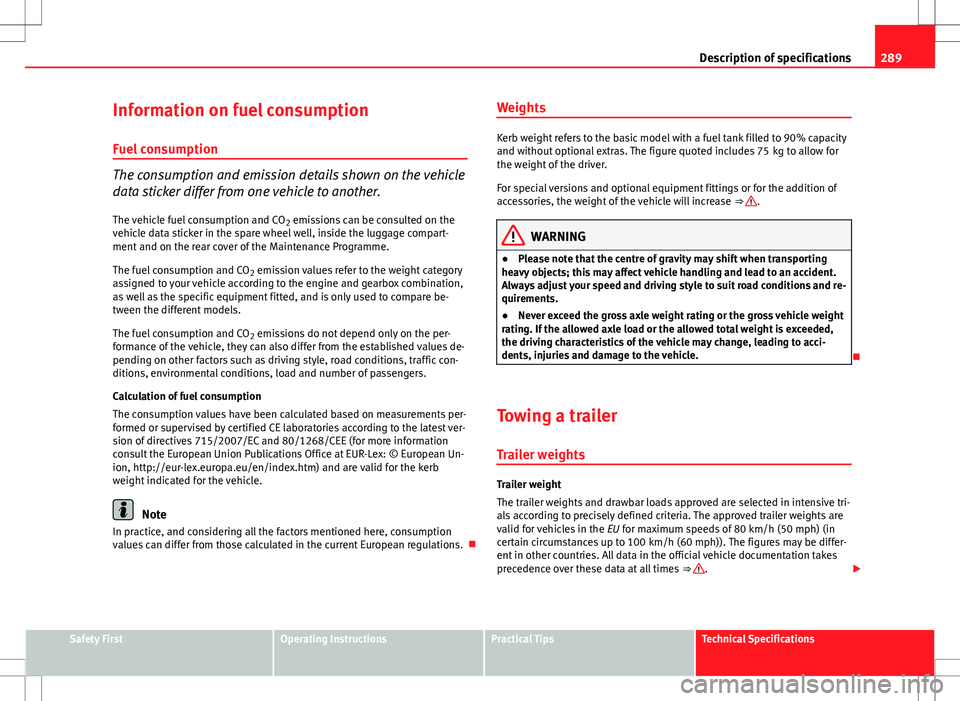
The consumption and emission details shown on the vehicle
data sticker differ from one vehicle to another. The vehicle fuel consumption and CO 2 emissions can be consulted on the
vehicle data sticker in the spare wheel well, inside the luggage compart-
ment and on the rear cover of the Maintenance Programme.
The fuel consumption and CO 2 emission values refer to the weight category
assigned to your vehicle according to the engine and gearbox combination,
as well as the specific equipment fitted, and is only used to compare be-
tween the different models.
The fuel consumption and CO 2 emissions do not depend only on the per-
formance of the vehicle, they can also differ from the established values de-
pending on other factors such as driving style, road conditions, traffic con-
ditions, environmental conditions, load and number of passengers.
Calculation of fuel consumption
The consumption values have been calculated based on measurements per-
formed or supervised by certified CE laboratories according to the latest ver-
sion of directives 715/2007/EC and 80/1268/CEE (for more information
consult the European Union Publications Office at EUR-Lex: © European Un-
ion, http://eur-lex.europa.eu/en/index.htm) and are valid for the kerb
weight indicated for the vehicle.
Note
In practice, and considering all the factors mentioned here, consumption
values can differ from those calculated in the current European regulations. Weights
Kerb weight refers to the basic model with a fuel tank filled to 90% capacity
and without optional extras. The figure quoted includes 75 kg to allow for
the weight of the driver.
For special versions and optional equipment fittings or for the addition of
accessories, the weight of the vehicle will increase
⇒
.
WARNING
● Please note that the centre of gravity may shift when transporting
heavy objects; this may affect vehicle handling and lead to an accident.
Always adjust your speed and driving style to suit road conditions and re-
quirements.
● Never exceed the gross axle weight rating or the gross vehicle weight
rating. If the allowed axle load or the allowed total weight is exceeded,
the driving characteristics of the vehicle may change, leading to acci-
dents, injuries and damage to the vehicle.
Towing a trailer Trailer weights
Trailer weight
The trailer weights and drawbar loads approved are selected in intensive tri-
als according to precisely defined criteria. The approved trailer weights are
valid for vehicles in the EU for maximum speeds of 80 km/h (50 mph) (in
certain circumstances up to 100 km/h (60 mph)). The figures may be differ-
ent in other countries. All data in the official vehicle documentation takes
precedence over these data at all times ⇒
.
Safety FirstOperating InstructionsPractical TipsTechnical Specifications
Page 294 of 315
292Technical specifications
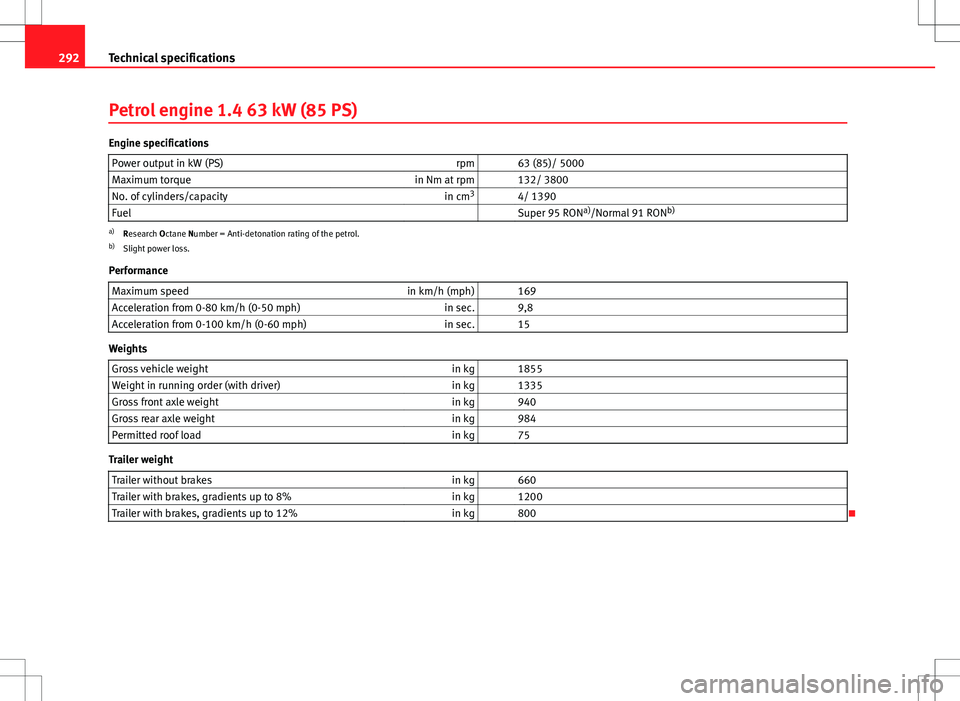
Petrol engine 1.4 63 kW (85 PS)
Engine specifications
Power output in kW (PS) rpm 63 (85)/ 5000
Maximum torque in Nm at rpm 132/ 3800
No. of cylinders/capacity in cm3
4/ 1390
Fuel Super 95 RON a)
/Normal 91 RON b)
a)
Research Octane Number = Anti-detonation rating of the petrol.
b) Slight power loss.
Performance Maximum speed in km/h (mph) 169
Acceleration from 0-80 km/h (0-50 mph) in sec. 9,8
Acceleration from 0-100 km/h (0-60 mph) in sec. 15
Weights
Gross vehicle weight in kg 1855
Weight in running order (with driver) in kg 1335
Gross front axle weight in kg 940
Gross rear axle weight in kg 984
Permitted roof load in kg 75
Trailer weight
Trailer without brakes in kg 660
Trailer with brakes, gradients up to 8% in kg 1200
Trailer with brakes, gradients up to 12% in kg 800
Page 295 of 315
293
Technical specifications
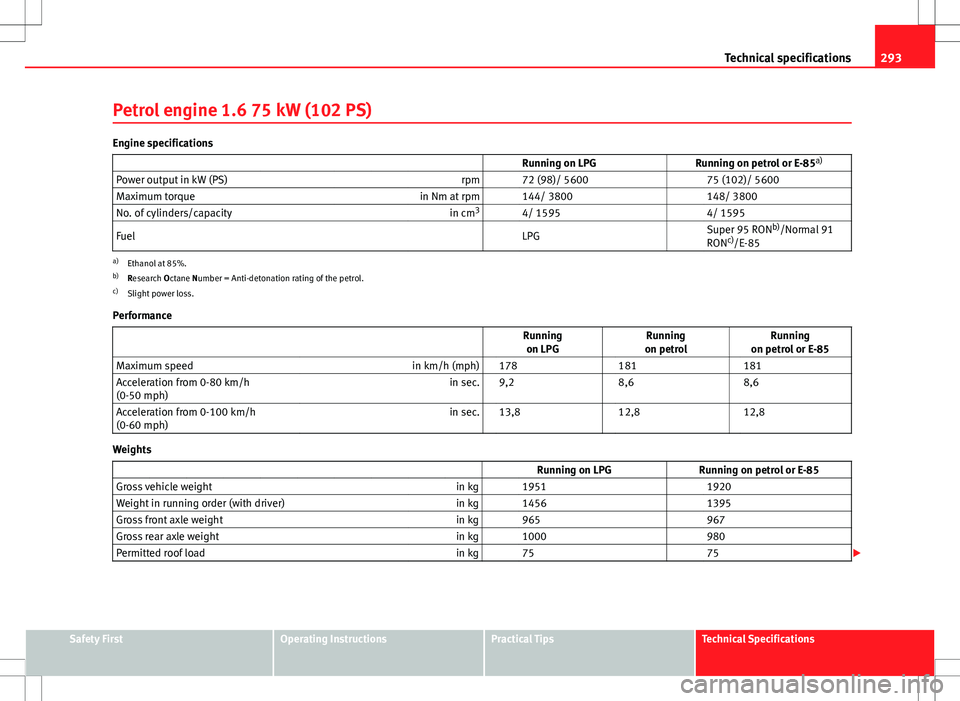
Petrol engine 1.6 75 kW (102 PS)
Engine specifications Running on LPG Running on petrol or E-85a)
Power output in kW (PS) rpm 72 (98)/ 5600 75 (102)/ 5600
Maximum torque in Nm at rpm 144/ 3800 148/ 3800
No. of cylinders/capacity in cm3
4/ 1595 4/ 1595
Fuel LPG Super 95 RON
b)
/Normal 91
RON c)
/E-85
a) Ethanol at 85%.
b) Research Octane Number = Anti-detonation rating of the petrol.
c) Slight power loss.
Performance Running
on LPG Running
on petrol Running
on petrol or E-85
Maximum speed in km/h (mph) 178 181 181
Acceleration from 0-80 km/h
(0-50 mph) in sec. 9,2
8,6 8,6
Acceleration from 0-100 km/h
(0-60 mph) in sec. 13,8
12,8 12,8
Weights
Running on LPG Running on petrol or E-85
Gross vehicle weight in kg 1951 1920
Weight in running order (with driver) in kg 1456 1395
Gross front axle weight in kg 965 967
Gross rear axle weight in kg 1000 980
Permitted roof load in kg 75 75
Safety FirstOperating InstructionsPractical TipsTechnical Specifications
Page 296 of 315
294Technical specifications
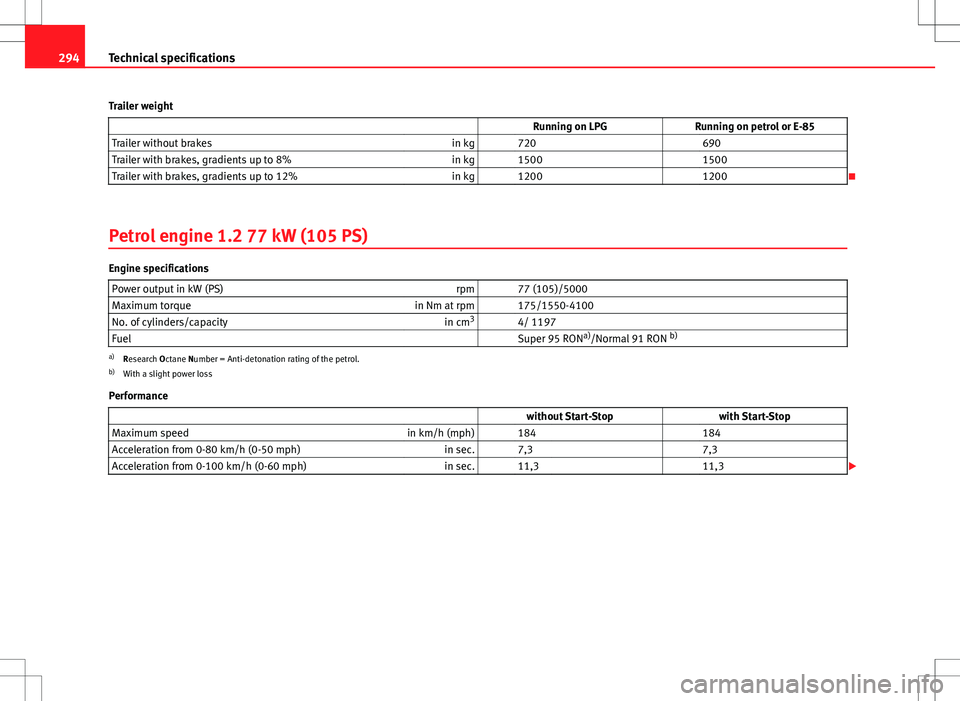
Trailer weight Running on LPGRunning on petrol or E-85
Trailer without brakes in kg 720 690
Trailer with brakes, gradients up to 8% in kg 1500 1500
Trailer with brakes, gradients up to 12% in kg 1200 1200
Petrol engine 1.2 77 kW (105 PS)
Engine specifications Power output in kW (PS) rpm 77 (105)/5000
Maximum torque in Nm at rpm 175/1550-4100
No. of cylinders/capacity in cm3
4/ 1197
Fuel Super 95 RON a)
/Normal 91 RON b)
a)
Research Octane Number = Anti-detonation rating of the petrol.
b) With a slight power loss
Performance without Start-Stopwith Start-Stop
Maximum speed in km/h (mph) 184 184
Acceleration from 0-80 km/h (0-50 mph) in sec. 7,3 7,3
Acceleration from 0-100 km/h (0-60 mph) in sec. 11,3 11,3
Page 297 of 315
295
Technical specifications
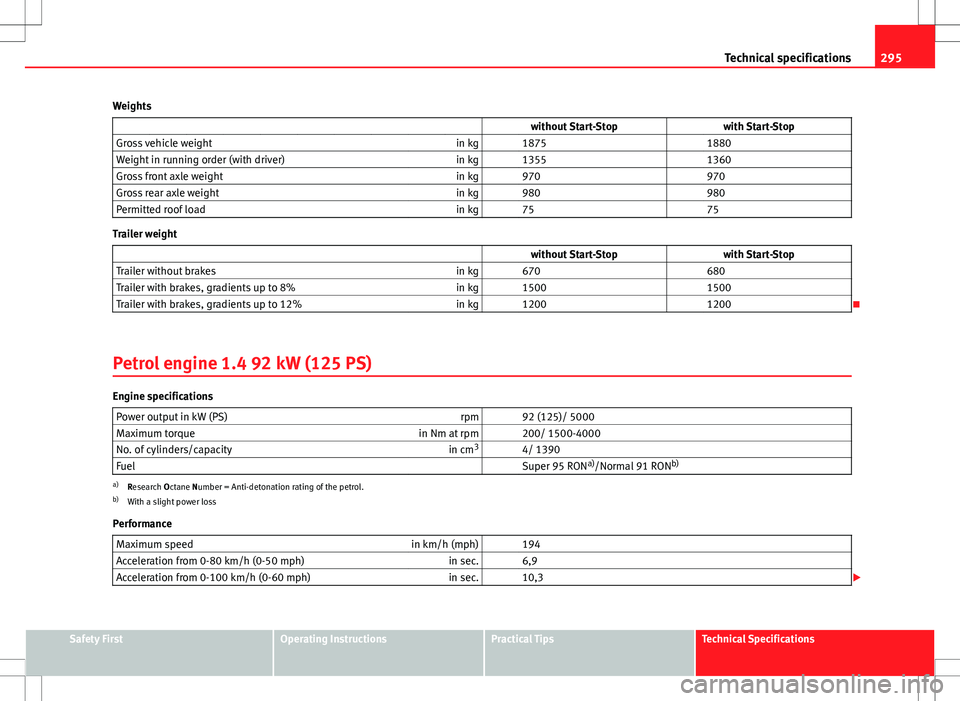
Weights without Start-Stop with Start-Stop
Gross vehicle weight in kg 1875 1880
Weight in running order (with driver) in kg 1355 1360
Gross front axle weight in kg 970 970
Gross rear axle weight in kg 980 980
Permitted roof load in kg 75 75
Trailer weight
without Start-Stopwith Start-Stop
Trailer without brakes in kg 670 680
Trailer with brakes, gradients up to 8% in kg 1500 1500
Trailer with brakes, gradients up to 12% in kg 1200 1200
Petrol engine 1.4 92 kW (125 PS)
Engine specifications Power output in kW (PS) rpm 92 (125)/ 5000
Maximum torque in Nm at rpm 200/ 1500-4000
No. of cylinders/capacity in cm3
4/ 1390
Fuel Super 95 RON a)
/Normal 91 RON b)
a)
Research Octane Number = Anti-detonation rating of the petrol.
b) With a slight power loss
Performance Maximum speed in km/h (mph) 194
Acceleration from 0-80 km/h (0-50 mph) in sec. 6,9
Acceleration from 0-100 km/h (0-60 mph) in sec. 10,3
Safety FirstOperating InstructionsPractical TipsTechnical Specifications
Page 298 of 315
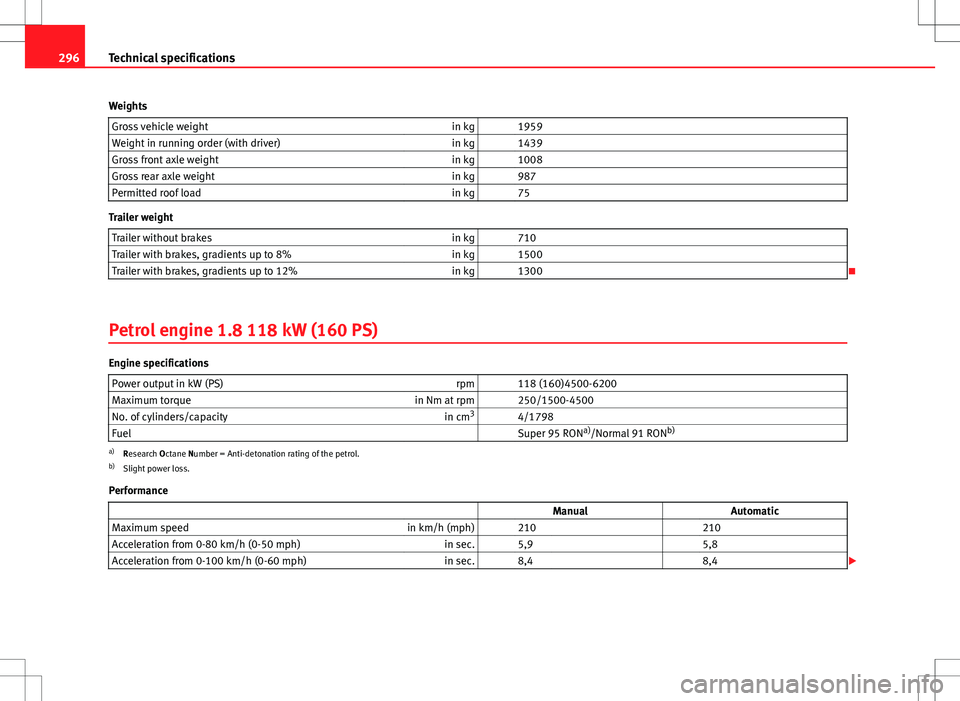
296Technical specifications
Weights Gross vehicle weight in kg 1959
Weight in running order (with driver) in kg 1439
Gross front axle weight in kg 1008
Gross rear axle weight in kg 987
Permitted roof load in kg 75
Trailer weight
Trailer without brakes in kg 710
Trailer with brakes, gradients up to 8% in kg 1500
Trailer with brakes, gradients up to 12% in kg 1300
Petrol engine 1.8 118 kW (160 PS)
Engine specifications Power output in kW (PS) rpm 118 (160)4500-6200
Maximum torque in Nm at rpm 250/1500-4500
No. of cylinders/capacity in cm3
4/1798
Fuel Super 95 RON a)
/Normal 91 RON b)
a)
Research Octane Number = Anti-detonation rating of the petrol.
b) Slight power loss.
Performance ManualAutomatic
Maximum speed in km/h (mph) 210 210
Acceleration from 0-80 km/h (0-50 mph) in sec. 5,9 5,8
Acceleration from 0-100 km/h (0-60 mph) in sec. 8,4 8,4
Page 299 of 315
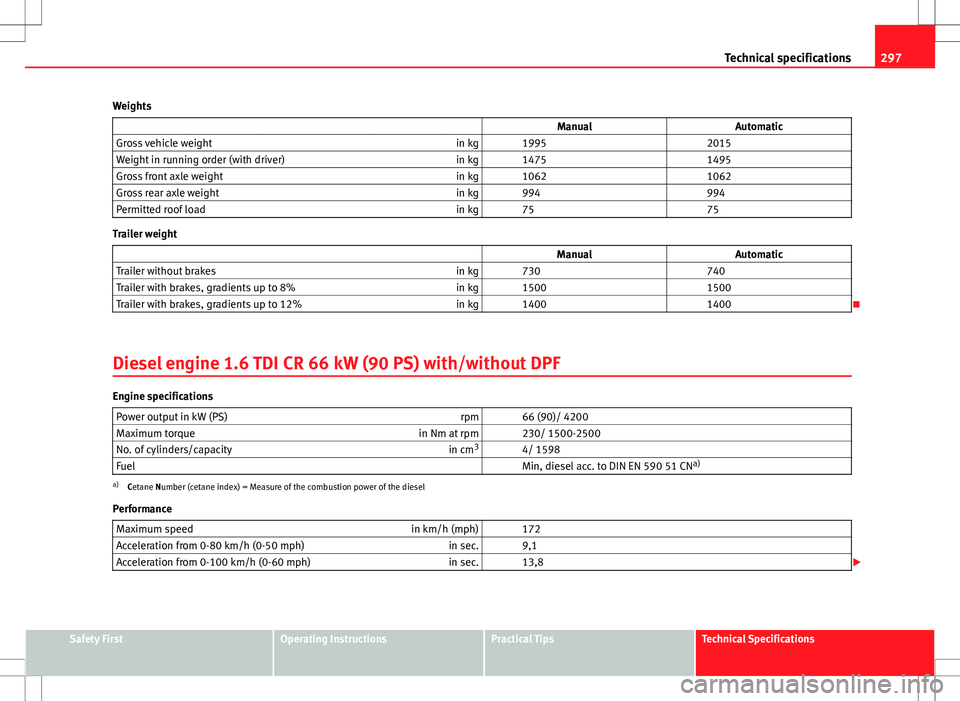
297
Technical specifications
Weights Manual Automatic
Gross vehicle weight in kg 1995 2015
Weight in running order (with driver) in kg 1475 1495
Gross front axle weight in kg 1062 1062
Gross rear axle weight in kg 994 994
Permitted roof load in kg 75 75
Trailer weight
ManualAutomatic
Trailer without brakes in kg 730 740
Trailer with brakes, gradients up to 8% in kg 1500 1500
Trailer with brakes, gradients up to 12% in kg 1400 1400
Diesel engine 1.6 TDI CR 66 kW (90 PS) with/without DPF
Engine specifications Power output in kW (PS) rpm 66 (90)/ 4200
Maximum torque in Nm at rpm 230/ 1500-2500
No. of cylinders/capacity in cm3
4/ 1598
Fuel Min, diesel acc. to DIN EN 590 51 CN a)
a)
Cetane Number (cetane index) = Measure of the combustion power of the diesel
Performance Maximum speed in km/h (mph) 172
Acceleration from 0-80 km/h (0-50 mph) in sec. 9,1
Acceleration from 0-100 km/h (0-60 mph) in sec. 13,8
Safety FirstOperating InstructionsPractical TipsTechnical Specifications