roof Seat Altea 2013 Owner's Guide
[x] Cancel search | Manufacturer: SEAT, Model Year: 2013, Model line: Altea, Model: Seat Altea 2013Pages: 315, PDF Size: 4.66 MB
Page 216 of 315
214Vehicle maintenance and cleaning
WARNING
● Wash your vehicle with the ignition switched off.
● Protect your hands and arms from cuts on sharp metal edges when
cleaning the underbody, the inside of the wheel housings etc. Risk of in-
jury.
● Water, ice and salt on the brake system can reduce braking effective-
ness. Risk of accident.
CAUTION
● Never remove dirt, mud or dust if the vehicle surface is dry. Never use a
dry cloth or sponge for cleaning purposes. This could scratch the paintwork
or glass on your vehicle.
● Washing the vehicle in low temperatures: when washing the vehicle
with a hose, do not direct water into the lock cylinders or the gaps around
the doors, rear lid, or sunroof. Risk of freezing.
For the sake of the environment
To protect environment, the vehicle should be washed only in specially pro-
vided wash bays. This prevents toxic, oil-laden waste water entering the
sewerage system. In some places, washing vehicles outside wash bays is
prohibited.
Note
Do not wash the vehicle in direct sunlight. Washing the vehicle with a high pressure cleaner
Be particularly careful when using a high pressure cleaner!
– Always observe the instructions for the high-pressure cleaner,
particularly those concerning the pressure and the spraying
distance.
– Increase the spraying distance for soft materials and painted
bumpers.
– Do not use a high pressure cleaner to remove ice or snow from
windows ⇒ page 215.
– Never use concentrated jet nozzles (“rotating jets”) ⇒
.
– After washing, avoid sudden and sharp braking. “Dry” the
brakes by braking several times ⇒ page 202.
WARNING
● Never wash tyres with a concentrated jet (“rotating nozzle”). Even at
large spraying distances and short cleaning times, visible and invisible
damage can occur to the tyres. This may cause an accident.
● Water, ice and salt on the brake system can reduce braking effective-
ness. Risk of accident.
CAUTION
● Do not use water hotter than 60 °C. This could damage the vehicle.
● To avoid damage to the vehicle, keep a sufficient distance from sensitive
materials such as flexible hoses, plastic, soundproofing material, etc. This
is also important for bumpers painted in the colour of the bodywork. The
closer the nozzle is to the surface, the greater the wear on the material.
Page 227 of 315
225
Accessories, replacement of parts and modifications
WARNING
Any type of work or modification performed incorrectly on your vehicle
can lead to malfunctions and can cause accidents.
Roof aerial*
The vehicle may be fitted with a foldable* and anti-theft* aerial that may be
positioned parallel to the roof.
To fold down
Unscrew the rod, position parallel to the roof and tighten once again.
To return to working position
Continue in the reverse order to the previous instruction.
CAUTION
If an automatic car wash tunnel is used, before entering the tunnel, put the
aerial down parallel to the roof and do not tighten to avoid damage.
Mobile phones and two-way radios
First consult your Technical Service if you wish to use a mobile telephone or
a two-way radio with a transmitting power output in excess of 10 watts.
Here you will receive information concerning the technical possibilities for
retrofitting this equipment.
Mobile telephones and two-way radios should be only fitted by a special-
ised workshop, for example a SEAT dealership.
WARNING
● Always concentrate primarily on driving. If you are distracted while
driving you could have an accident.
● Never attach the telephone mountings to the surfaces covering the
airbag units or within the range of the airbags. There is a high danger of
injury if the airbag is triggered.
Note
Please observe the operating instructions of your mobile telephone/two-
way radio.
Safety FirstOperating InstructionsPractical TipsTechnical Specifications
Page 251 of 315
249
Checking and refilling levels
WARNING
● We recommend you use only maintenance-free or cycle free leak-proof
batteries which comply with standards T 825 06 and VW 7 50 73. This
standard applies as of 2001.
● Before starting any work on the batteries, you must read and observe
the warnings ⇒
in Warnings on handling the battery on page 247.
For the sake of the environment
Batteries contain toxic substances such as sulphuric acid and lead. They
must be disposed of appropriately and must not be disposed of with ordi-
nary household waste.
Safety FirstOperating InstructionsPractical TipsTechnical Specifications
Page 272 of 315
270If and when
Fuses on left side of dash panel
Fuses
NumberConsumerAmps1Vacant 2Vacant 3Vacant 4Vacant 5Vacant 6Vacant 7Vacant 8Vacant 9Airbag510RSE input (roof screen)1011Vacant 12Left xenon headlight10
13Instrument panel (oil level)/Switchboard wiring
(BCM)/Heater / ABS, ESC / Park Pilot/ Gateway/
Flow meter5
14Gearbox/ Power steering/ Brake light sensor/
Trailer/ ABS, ESC/ Haldex/ Light switch10
15Heated windscreen / Instrument lighting / Diag-
nosis switchboard/Engine management/Addi-
tional heating/AFS headlights/Park Pilot10
16Right xenon headlight10
17Engine management/RSE system with START-
STOP10
18Kombi/levers with START-STOP519Navigation/Radio with START-STOP15
20Park Pilot (parking aid) / Gear lever/ ESC switch-
board10
NumberConsumerAmps21Vacant 22Volumetric alarm sensor/ Alarm horn523Diagnosis / Rain sensor / Light switch1024Trailer hook pre-installation assistant1525Vacant 26Vacuum pump2027RSE supply (Ceiling display) without START-STOP1028Rear window wiper motor2029Vacant 30Cigarette lighter/power socket2031Vacant 32Vacant 33Heater4034Vacant 35Vacant 36Vacant 37Vacant 38Vacant 39Trailer control unit (coupling)15
40Trailer control unit (turn signals, brakes and left
side)20
41Trailer control unit (fog light, reverse light and
right side)20
42BCM wiring switchboard2043Trailer pre-installation4044Heated rear window2545Electric windows (front)3046Rear electric windows3047Engine (Fuel control unit, petrol relay)15
Page 273 of 315
271
If and when
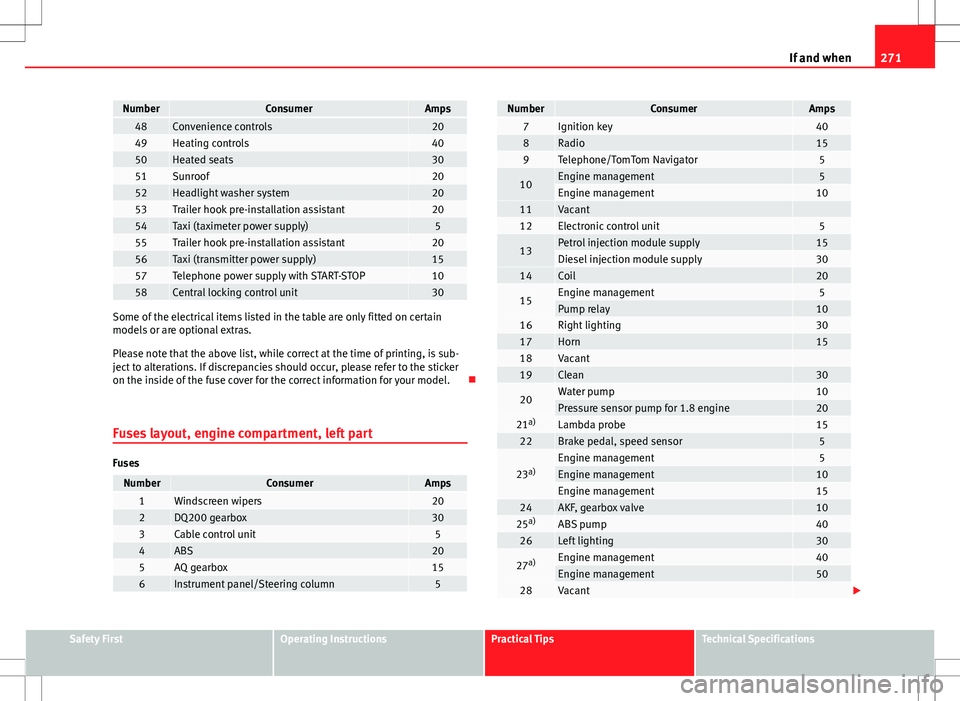
NumberConsumerAmps48Convenience controls2049Heating controls4050Heated seats3051Sunroof2052Headlight washer system2053Trailer hook pre-installation assistant2054Taxi (taximeter power supply)555Trailer hook pre-installation assistant2056Taxi (transmitter power supply)1557Telephone power supply with START-STOP1058Central locking control unit30
Some of the electrical items listed in the table are only fitted on certain
models or are optional extras.
Please note that the above list, while correct at the time of printing, is sub-
ject to alterations. If discrepancies should occur, please refer to the sticker
on the inside of the fuse cover for the correct information for your model.
Fuses layout, engine compartment, left part
Fuses
NumberConsumerAmps1Windscreen wipers202DQ200 gearbox303Cable control unit54ABS205AQ gearbox156Instrument panel/Steering column5
NumberConsumerAmps7Ignition key408Radio159Telephone/TomTom Navigator5
10Engine management5Engine management1011Vacant 12Electronic control unit5
13Petrol injection module supply15Diesel injection module supply3014Coil20
15Engine management5Pump relay1016Right lighting3017Horn1518Vacant 19Clean30
20Water pump10Pressure sensor pump for 1.8 engine2021 a)Lambda probe1522Brake pedal, speed sensor5
23a)Engine management5Engine management10Engine management1524AKF, gearbox valve1025a)ABS pump4026Left lighting30
27a)Engine management40Engine management5028Vacant
Safety FirstOperating InstructionsPractical TipsTechnical Specifications
Page 294 of 315
292Technical specifications
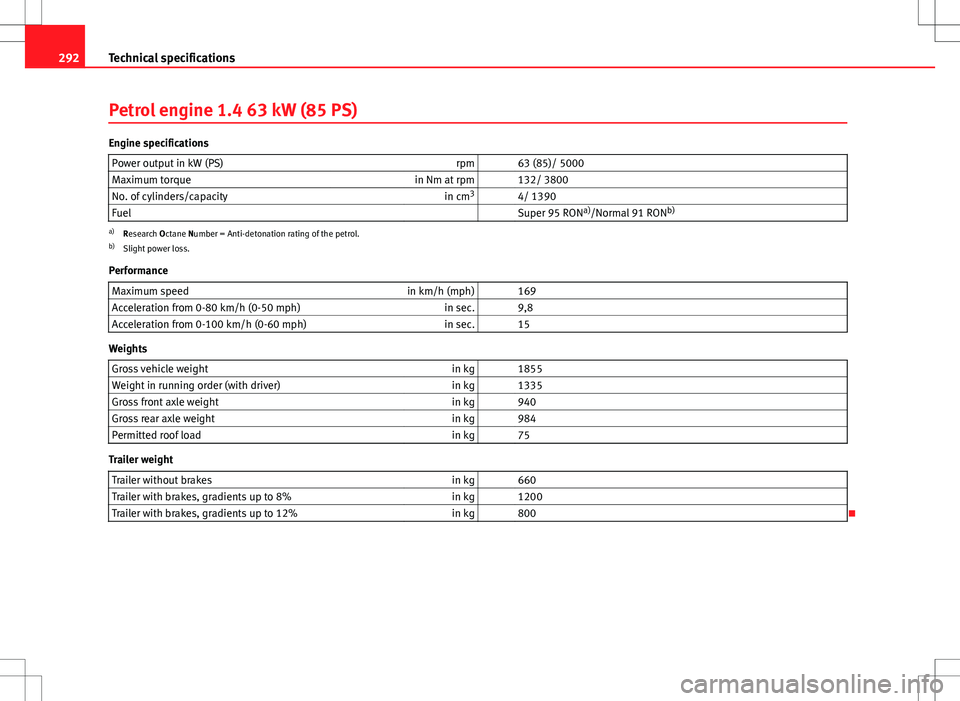
Petrol engine 1.4 63 kW (85 PS)
Engine specifications
Power output in kW (PS) rpm 63 (85)/ 5000
Maximum torque in Nm at rpm 132/ 3800
No. of cylinders/capacity in cm3
4/ 1390
Fuel Super 95 RON a)
/Normal 91 RON b)
a)
Research Octane Number = Anti-detonation rating of the petrol.
b) Slight power loss.
Performance Maximum speed in km/h (mph) 169
Acceleration from 0-80 km/h (0-50 mph) in sec. 9,8
Acceleration from 0-100 km/h (0-60 mph) in sec. 15
Weights
Gross vehicle weight in kg 1855
Weight in running order (with driver) in kg 1335
Gross front axle weight in kg 940
Gross rear axle weight in kg 984
Permitted roof load in kg 75
Trailer weight
Trailer without brakes in kg 660
Trailer with brakes, gradients up to 8% in kg 1200
Trailer with brakes, gradients up to 12% in kg 800
Page 295 of 315
293
Technical specifications
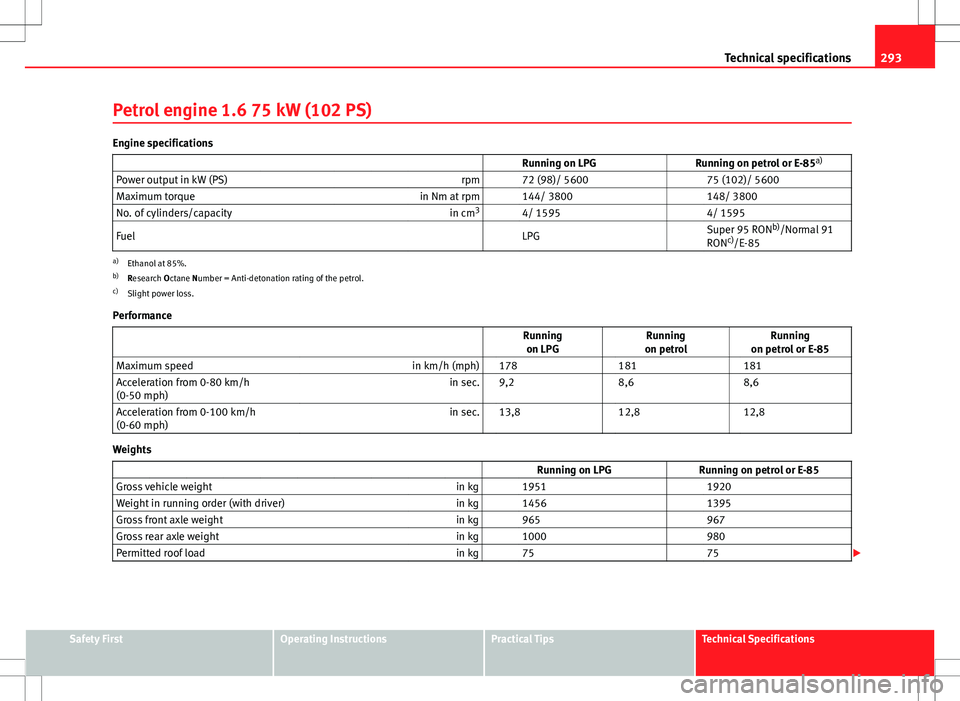
Petrol engine 1.6 75 kW (102 PS)
Engine specifications Running on LPG Running on petrol or E-85a)
Power output in kW (PS) rpm 72 (98)/ 5600 75 (102)/ 5600
Maximum torque in Nm at rpm 144/ 3800 148/ 3800
No. of cylinders/capacity in cm3
4/ 1595 4/ 1595
Fuel LPG Super 95 RON
b)
/Normal 91
RON c)
/E-85
a) Ethanol at 85%.
b) Research Octane Number = Anti-detonation rating of the petrol.
c) Slight power loss.
Performance Running
on LPG Running
on petrol Running
on petrol or E-85
Maximum speed in km/h (mph) 178 181 181
Acceleration from 0-80 km/h
(0-50 mph) in sec. 9,2
8,6 8,6
Acceleration from 0-100 km/h
(0-60 mph) in sec. 13,8
12,8 12,8
Weights
Running on LPG Running on petrol or E-85
Gross vehicle weight in kg 1951 1920
Weight in running order (with driver) in kg 1456 1395
Gross front axle weight in kg 965 967
Gross rear axle weight in kg 1000 980
Permitted roof load in kg 75 75
Safety FirstOperating InstructionsPractical TipsTechnical Specifications
Page 297 of 315
295
Technical specifications
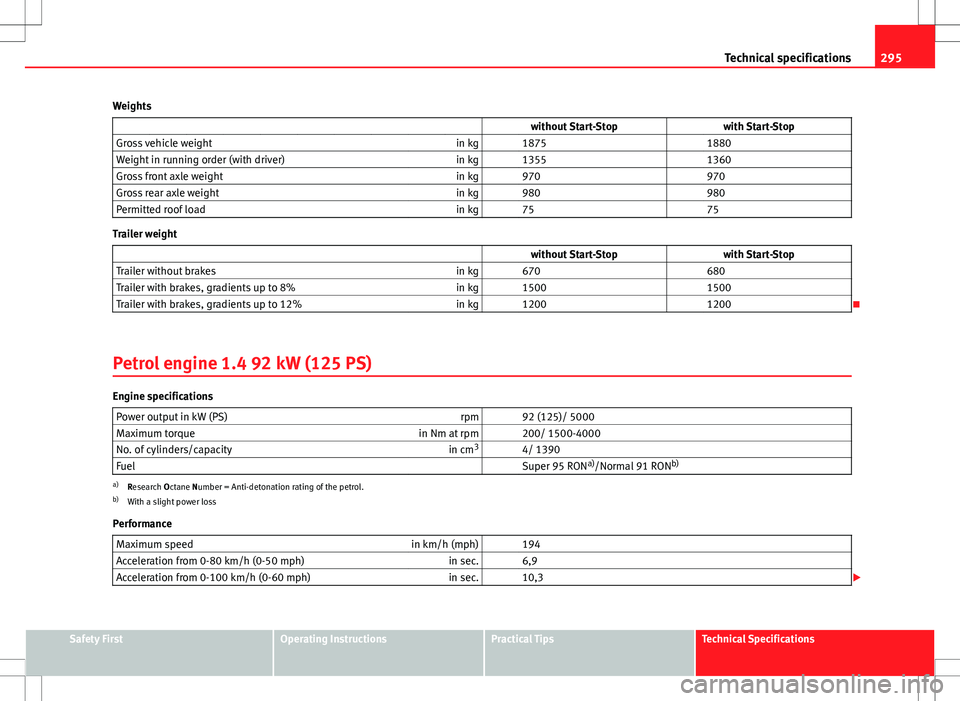
Weights without Start-Stop with Start-Stop
Gross vehicle weight in kg 1875 1880
Weight in running order (with driver) in kg 1355 1360
Gross front axle weight in kg 970 970
Gross rear axle weight in kg 980 980
Permitted roof load in kg 75 75
Trailer weight
without Start-Stopwith Start-Stop
Trailer without brakes in kg 670 680
Trailer with brakes, gradients up to 8% in kg 1500 1500
Trailer with brakes, gradients up to 12% in kg 1200 1200
Petrol engine 1.4 92 kW (125 PS)
Engine specifications Power output in kW (PS) rpm 92 (125)/ 5000
Maximum torque in Nm at rpm 200/ 1500-4000
No. of cylinders/capacity in cm3
4/ 1390
Fuel Super 95 RON a)
/Normal 91 RON b)
a)
Research Octane Number = Anti-detonation rating of the petrol.
b) With a slight power loss
Performance Maximum speed in km/h (mph) 194
Acceleration from 0-80 km/h (0-50 mph) in sec. 6,9
Acceleration from 0-100 km/h (0-60 mph) in sec. 10,3
Safety FirstOperating InstructionsPractical TipsTechnical Specifications
Page 298 of 315
296Technical specifications
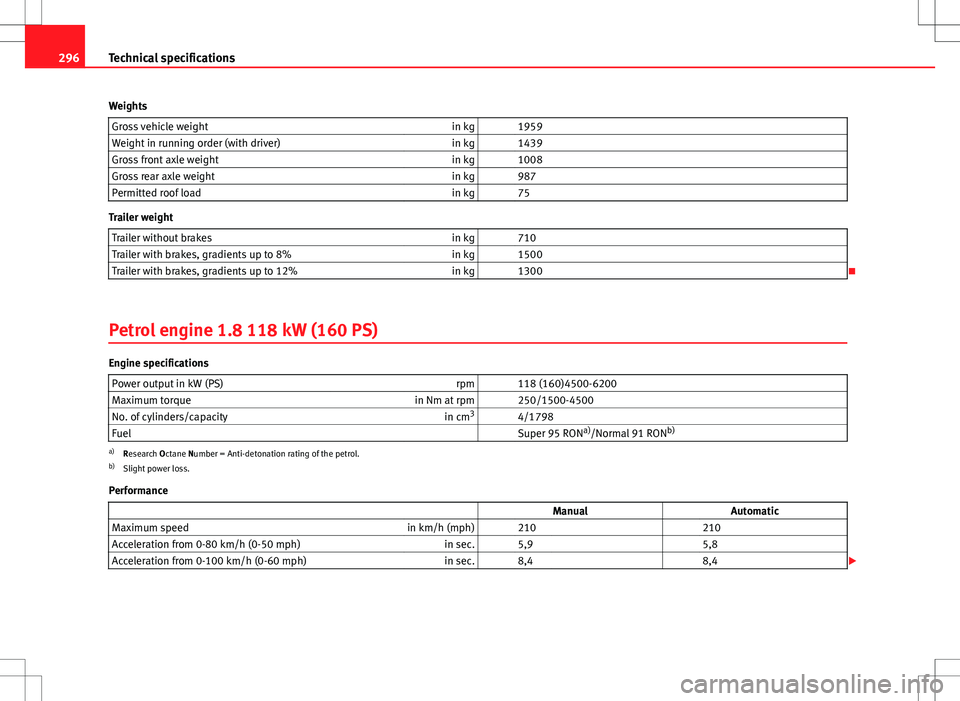
Weights Gross vehicle weight in kg 1959
Weight in running order (with driver) in kg 1439
Gross front axle weight in kg 1008
Gross rear axle weight in kg 987
Permitted roof load in kg 75
Trailer weight
Trailer without brakes in kg 710
Trailer with brakes, gradients up to 8% in kg 1500
Trailer with brakes, gradients up to 12% in kg 1300
Petrol engine 1.8 118 kW (160 PS)
Engine specifications Power output in kW (PS) rpm 118 (160)4500-6200
Maximum torque in Nm at rpm 250/1500-4500
No. of cylinders/capacity in cm3
4/1798
Fuel Super 95 RON a)
/Normal 91 RON b)
a)
Research Octane Number = Anti-detonation rating of the petrol.
b) Slight power loss.
Performance ManualAutomatic
Maximum speed in km/h (mph) 210 210
Acceleration from 0-80 km/h (0-50 mph) in sec. 5,9 5,8
Acceleration from 0-100 km/h (0-60 mph) in sec. 8,4 8,4
Page 299 of 315
297
Technical specifications
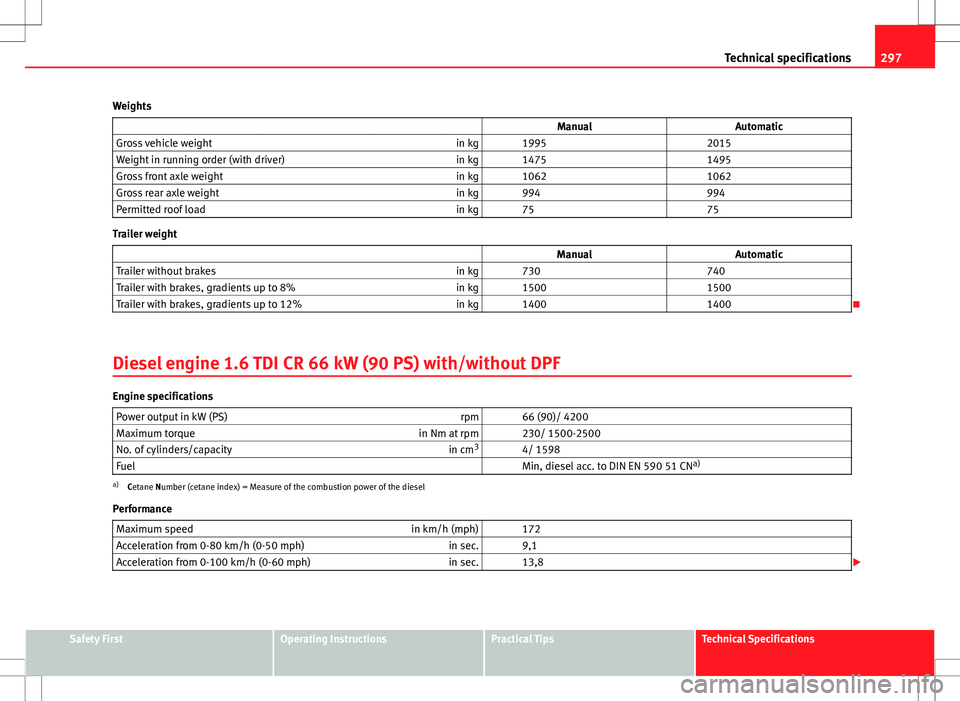
Weights Manual Automatic
Gross vehicle weight in kg 1995 2015
Weight in running order (with driver) in kg 1475 1495
Gross front axle weight in kg 1062 1062
Gross rear axle weight in kg 994 994
Permitted roof load in kg 75 75
Trailer weight
ManualAutomatic
Trailer without brakes in kg 730 740
Trailer with brakes, gradients up to 8% in kg 1500 1500
Trailer with brakes, gradients up to 12% in kg 1400 1400
Diesel engine 1.6 TDI CR 66 kW (90 PS) with/without DPF
Engine specifications Power output in kW (PS) rpm 66 (90)/ 4200
Maximum torque in Nm at rpm 230/ 1500-2500
No. of cylinders/capacity in cm3
4/ 1598
Fuel Min, diesel acc. to DIN EN 590 51 CN a)
a)
Cetane Number (cetane index) = Measure of the combustion power of the diesel
Performance Maximum speed in km/h (mph) 172
Acceleration from 0-80 km/h (0-50 mph) in sec. 9,1
Acceleration from 0-100 km/h (0-60 mph) in sec. 13,8
Safety FirstOperating InstructionsPractical TipsTechnical Specifications