child seat Seat Altea XL 2007 Owner's Guide
[x] Cancel search | Manufacturer: SEAT, Model Year: 2007, Model line: Altea XL, Model: Seat Altea XL 2007Pages: 298, PDF Size: 8.87 MB
Page 51 of 298
Child safety49
Safety First
Operating instructions
Tips and Maintenance
Te c h n i c a l D a t a
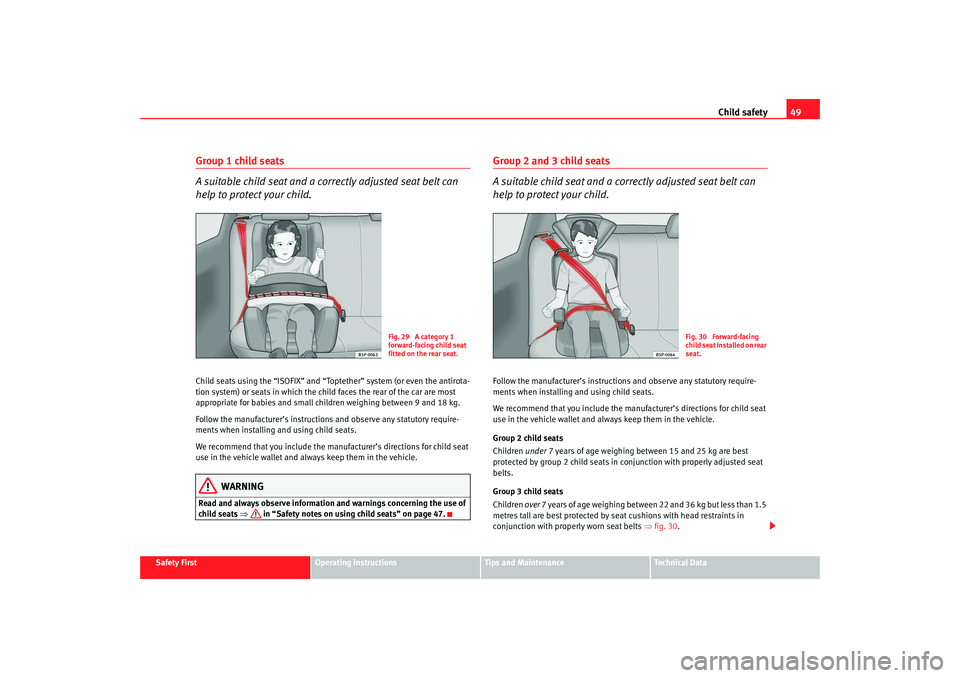
Group 1 child seats
A suitable child seat and a correctly adjusted seat belt can
help to protect your child.Child seats using the “ISOFIX” and “Top tether” system (or even the antirota-
tion system) or seats in which the chil d faces the rear of the car are most
appropriate for babies and small children weighing between 9 and 18 kg.
Follow the manufacturer’s instructions and observe any statutory require-
ments when installing and using child seats.
We recommend that you include the manufa cturer’s directions for child seat
use in the vehicle wallet and always keep them in the vehicle.
WARNING
Read and always observe information and warnings concerning the use of
child seats ⇒ in “Safety notes on using child seats” on page 47.
Group 2 and 3 child seats
A suitable child seat and a corr ectly adjusted seat belt can
help to protect your child.Follow the manufacturer’s instructio ns and observe any statutory require-
ments when installing and using child seats.
We recommend that you include the manufacturer’s directions for child seat
use in the vehicle wallet and always keep them in the vehicle.
Group 2 child seats
Children under 7 years of age weighing between 15 and 25 kg are best
protected by group 2 child seats in conjunction with properly adjusted seat
belts.
Group 3 child seats
Children over 7 years of age weighing between 22 and 36 kg but less than 1.5
metres tall are best protected by seat cushions with head restraints in
conjunction with properly worn seat belts ⇒fig. 30.
Fig. 29 A category 1
forward-facing child seat
fitted on the rear seat.
Fig. 30 Forward-facing
child seat installed on rear
seat.
AlteaXL_DEF_ingles Seite 49 Freitag, 25. August 2006 2:19 14
Page 52 of 298
Child safety
50
WARNING
•
The shoulder part of th e seat belt must lie approximately on the centre
of the shoulder, never across the neck or the arm. The seat belt must lie
close to the torso. The lap belt part must lie across the pelvis, not across the stomach, and always fit closely. Pull the belt tight if necessary to take
up any slack
⇒page 24, “Seat belts”.
•
Read and always observe information and warnings concerning the use
of child seats ⇒ in “Safety notes on using child seats” on page 47.
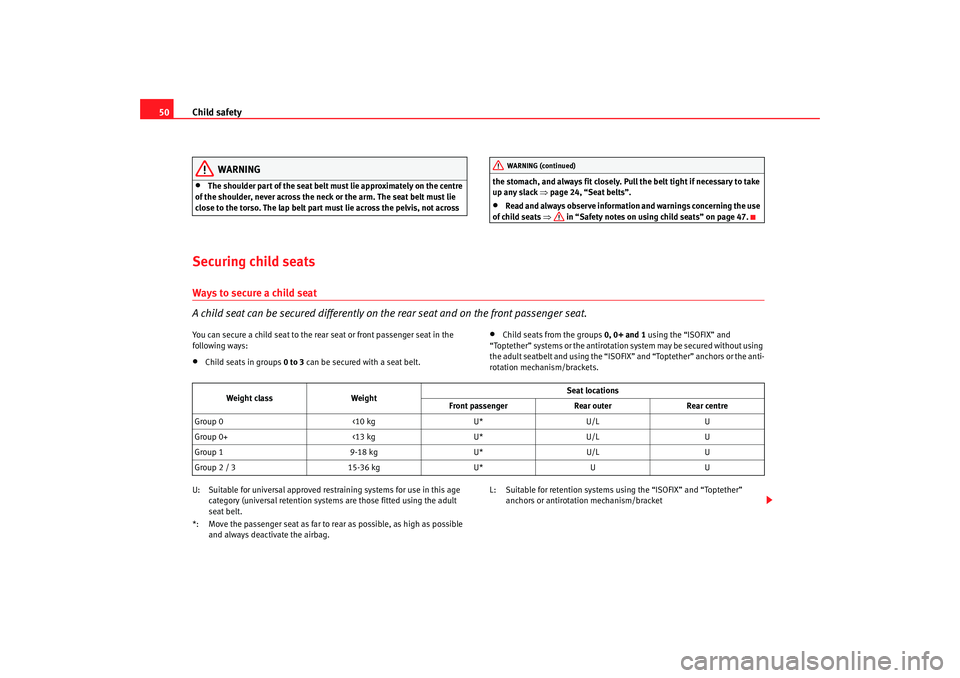
Securing child seatsWays to secure a child seat
A child seat can be secured differently on th e rear seat and on the front passenger seat.You can secure a child seat to the rear seat or front passenger seat in the
following ways:•
Child seats in groups 0 to 3 can be secured with a seat belt.
•
Child seats from the groups 0, 0+ and 1 using the “ISOFIX” and
“Toptether” systems or the antirotation system may be secured without using
the adult seatbelt and using the “ISOFIX” and “Toptether” anchors or the anti-
rotation mechanism/brackets.
U: Suitable for universal approved restraining systems for use in this age category (universal retention systems are those fitted using the adult
seat belt.
*: Move the passenger seat as far to rear as possible, as high as possible and always deactivate the airbag. L: Suitable for retention systems using the “ISOFIX” and “Toptether”
anchors or antirotation mechanism/bracketWARNING (continued)
Weight class Weight Seat locations
Front passenger Rear outerRear centre
Group 0 <10 kgU*U/L U
Group 0+ <13 kgU*U/L U
Group 1 9-18 kgU*U/L U
Group 2 / 3 15-36 kgU*UU
AlteaXL_DEF_ingles Seite 50 Freitag, 25. August 2006 2:19 14
Page 53 of 298
Child safety51
Safety First
Operating instructions
Tips and Maintenance
Te c h n i c a l D a t a
WARNING
•
When travelling, children must be secured in the vehicle with a
restraint system suitable for age, weight and size.
•
Never install a child seat facing backwards (or rear-facing) on the front
passenger seat unless the front passenger airbag has been disabled. This
represents a risk of fatal injuries to the child! However, if a child must,
under exceptional circumstances, travel in the front passenger seat, the
passenger airbag must be deactivated ⇒page 44, “Deactivating airbags*”
and the seat put into the h ighest position where possible.
•
Read and always observe information and warnings concerning the use
of child seats ⇒ in “Safety notes on using child seats” on page 47.
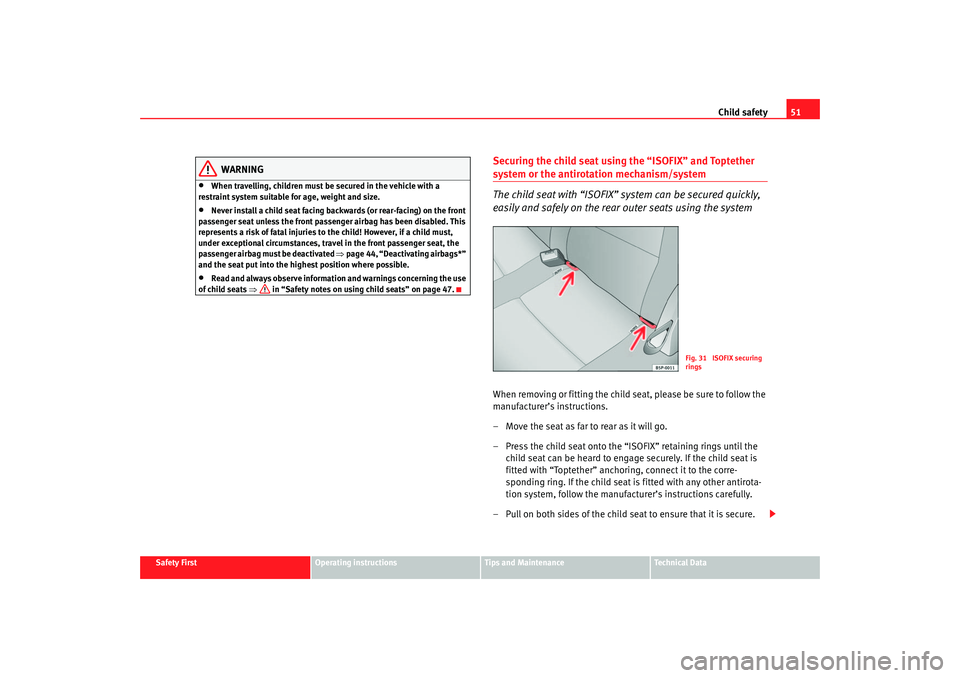
Securing the child seat using the “ISOFIX” and Toptether system or the antirotation mechanism/system
The child seat with “ISOFIX” system can be secured quickly,
easily and safely on the rear outer seats using the systemWhen removing or fitting the child seat, please be sure to follow the
manufacturer’s instructions.
– Move the seat as far to rear as it will go.
– Press the child seat onto the “ISOFIX” retaining rings until the
child seat can be heard to engage securely. If the child seat is
fitted with “Toptether” anchoring, connect it to the corre-
sponding ring. If the child seat is fitted with any other antirota-
tion system, follow the manufacturer’s instructions carefully.
– Pull on both sides of the child seat to ensure that it is secure.
Fig. 31 ISOFIX securing
rings
AlteaXL_DEF_ingles Seite 51 Freitag, 25. August 2006 2:19 14
Page 54 of 298
Child safety
52Two “ISOFIX” retaining rings are fitted on each outer rear seat. In some vehi-
cles, the rings are secured to the seat frame and in others they are secured to
the rear floor. The “ISOFIX” rings can be accessed between the seat back and
the seat cushion. The “Toptether” rings are located in the rear space in the
back. They are often located on the rear of the seat backs.
Child seats with “ISOFIX” and “Toptether” mountings are available from the
Authorised Service Centres.
WARNING
•
The retaining rings are designed only for use with “ISOFIX” and
“Toptether” systems.
•
Never secure child seats that do not have the “ISOFIX” or Toptether
system, retaining belts or objects to the fastening rings – this can result in
potentially fatal injuries to the child!
•
Ensure that the child seat is secured correctly using the “ISOFIX” and
Toptether anchors.
AlteaXL_DEF_ingles Seite 52 Freitag, 25. August 2006 2:19 14
Page 129 of 298

Seats and stowage127
Safety First
Operating instructions
Tips and Maintenance
Te c h n i c a l D a t a
Seats and stowageThe importance of correct seat adjustmentProper seat adjustment optimi ses the level of protection
offered by seat belts and airbags.Your vehicle has five passenger places, two individual front seats and three
places on the rear seat. Each seat is equipped with a three-point seat belt.
The driver seat and front passenger seat can be adjusted in many ways to suit
the physical requirements of the vehicle occupants. The correct seat position
is very important for:•
fast and easy operation of all controls on the instrument panel,
•
relaxed posture that does not cause drowsiness,
•
safe driving ⇒ page 7,
•
and to ensure that the seat belts and airbag system provide maximum
protection ⇒page 19.
WARNING
•
If the driver and passengers assume improper sitting positions, they
may sustain critical injuries.
•
Never transport more people than there are seats available in the
vehicle.
•
Every occupant in the vehicle must properly fasten and wear the seat
belt belonging to his or her seat. Children must be protected with an appro-
priate child restraint system ⇒page 46, “Child safety”.
•
The front seats and all headrests must always be adjusted to body size
and the seat belt must always be properly adjusted to provide you and your
passengers with optimum protection.
•
Always keep your feet in the foot well when the vehicle is moving; never
rest them on the dash panel, out of the window or on the seat. This also
applies to passengers. An incorrect sitting position exposes you to an
increased risk of injury in the event of a braking manoeuvre or an accident.
If the airbag is triggered, you could sustain severe injuries due to an incor-
rect sitting position.
•
It is important for the driver and front passenger to maintain a distance
of at least 25 cm from the steering wheel or dash panel. Failure to respect
the minimum distance means that the airbag will not protect you. Risk of
fatal injury. The distance between the driver and the steering wheel or
between the front passenger and the dash panel should always be as great
as possible.
•
Adjust the driver or front passenger seat only when the vehicle is
stationary. This also applies to the forwards/backwards adjustment of the
rear seats. Otherwise your seat coul d move unexpectedly while the vehicle
is moving. This could increase the risk of an accident and therefore injury.
In addition, while adjusting your seat, you will assume an incorrect sitting
position. Risk of fatal accidents.
•
Special guidelines apply to installing a child seat on the front
passenger seat. When installing a child seat, observe the warning note in
the ⇒page 46, “Child safety”.WARNING (continued)
AlteaXL_DEF_ingles Seite 127 Freitag, 25. August 2006 2:19 14
Page 144 of 298

Seats and stowage
142Ashtrays*, cigarette lighter* and electrical
socketsAshtray* Opening and closing the ashtray
– To open the ashtray, lift the cover ⇒fig. 113 .
–To close, lower the cover.
Emptying the ashtray
– Extract the ashtray and empty.
WARNING
Never put paper in the ashtray. Hot ash could ignite the paper in the
ashtray.
Cigarette lighter* – Press on the cigarette lighter ⇒fig. 114 to activate it ⇒.
– Wait for the lighter to pop out slightly.
– Pull out the cigarette lighter and light the cigarette on the glowing coil.
WARNING
•
Improper use of the cigarette lighter can lead to serious injuries or start
a fire.
•
Take care when using the cigarette lighter. Carelessness or negligence
when using the cigarette lighter can cause burns, risk of injury.
•
The cigarette lighter also works when the ignition is off and when the
ignition key is removed. To avoid the risk of fire, never leave children unsu-
pervised in the vehicle.
Fig. 113 Ashtray located
in the front drinks holder
Fig. 114 The cigarette
lighter is located in the
electric socket on the
front of the centre console
AlteaXL_DEF_ingles Seite 142 Freitag, 25. August 2006 2:19 14
Page 145 of 298

Seats and stowage143
Safety First
Operating instructions
Tips and Maintenance
Te c h n i c a l D a t a
Electrical sockets
Electrical equipment can be connected to any of the 12 volt
sockets.
Electrical accessories may be connected to the 12 volt socket in the front
centre console ⇒fig. 115 or to that of the luggage compartment* ⇒fig. 116 .
The appliances connected to each socket must not exceed a power rating of
120 Watt.
WARNING
The electrical sockets and any appliances connected to them are also func-
tional with the ignition switched off and the key removed. Improper use of
the sockets or electrical accessories can lead to serious injuries or cause a
fire. To avoid the risk of injury, never leave children unsupervised in the
vehicle.
Note
•
Using electrical appliances with the engine switched off will drain the
battery.
•
Before using any electrical accessories, see the instructions on
⇒ page 201.
Fig. 115 Socket in the
front centre consoleFig. 116 Luggage
compartment socket
AlteaXL_DEF_ingles Seite 143 Freitag, 25. August 2006 2:19 14
Page 164 of 298
Driving
162Starting
The engine is started when the key is in this position. Electrical components
with a high power consumption are switched off temporarily.
Each time that the vehicle must be star ted, the ignition key must be turned to
the position . The repetitive start prevention lock of the ignition prevents
possible damage to the starter moto r if the engine is already running.
WARNING
•
Wait for the vehicle to come to a standstill before removing the ignition
key from the lock. The steering lock could be activated immediately - Risk
of accident!
•
Always remove the key from the ignition lock when leaving the vehicle,
even if you only intend to be gone for a short period. This is especially
important if you must leave children or disabled people in the vehicle. They
could accidentally start the engine or work electrical equipment such as
the windows possibly resulting in an accident.
•
Unsupervised use of the keys could result in the engine being started
or electrical systems, such as the el ectric windows, being used. This can
result in serious injury.Caution
The starter motor will only work when the engine is stopped (ignition key
position ).
Electronic immobiliser
The immobiliser prevents unauthorised persons from driving
the vehicle.Inside the key there is a chip that deac tivates the electronic immobiliser auto-
matically when the key is inserted into the ignition.
The immobiliser will be activated again automatically as soon as you pull the
key out of the ignition lock.
The engine can only be started using a genuine SEAT key with the correct
code.
Note
The vehicle cannot be operated properly if you do not have a genuine SEAT
key.Starting and stopping the engineStarting petrol engines
The engine can only be started using a genuine SEAT key with
the correct code.– Move the gear lever to the ne utral position and depress the
clutch pedal fully and hold it in this position, the starter will then
only have to turn the engine.
– Turn the ignition key to position ⇒ page 161 to start the engine.
A2A0
A2
AlteaXL_DEF_ingles Seite 162 Freitag, 25. August 2006 2:19 14
Page 210 of 298
Checking and refilling levels
208Winter driving
Diesel can thicken in winter.Winter-grade diesel
When using “summer-grade diesel fuel”, difficulties may be experienced at
sub-zero temperatures because the fuel thickens due to wax separation. For
this reason, “winter-grade diesel fuel” is available in some countries during
the cold months. It can be used at temperatures as low as -22
°C.
In countries with different climatic conditions the diesel fuel sold generally
has different temperature characteristics. Check with an Authorised Service
Centre or filling stations in the country concerned regarding the type of diesel
fuels available.
Filter pre-heater
Your vehicle is fitted with a fuel filter pre-heater, making it well equipped for
operation in winter. This ensures that the fuel system remains operational to
approx. -24
°C, provided you use winter-grade diesel which is safe to -15
°C .
However, if the fuel has waxed to such an extent that the engine will not start
at temperatures of under -24
°C, simply place the vehicle in a warm place for
a while.
Caution
Do not mix fuel additives (“thinners”, or similar additives) with diesel fuel.
Working in the engine compartmentSafety instructions on working in the engine compartment
Any work carried out in the engine compartment or on the
engine must be carried out cautiously.Before starting any work on the engine or in the engine compart-
ment:
1. Switch off the engine and remove the key from the ignition.
2. Apply the handbrake.
3. Move the gear stick to neutral or the selector lever to position P.
4. Wait for the engine to cool down.
5. Keep children away from the vehicle.
6. Raise the bonnet ⇒page 210.You should not do any work in the engine compartment unless you know
exactly how to carry out the jobs and have the correct tools! Have the work
carried out by a qualified workshop if you are uncertain.
All service fluids and consumables, e.g. coolant, engine oil, spark plugs and
batteries, are being constantly developed . SEAT provides a constant flow of
information to the Authorised Service Centres concerning modifications. For
this reason we recommend that you have service fluids and consumables
replaced by an Authorised Service Centre. Please observe the relevant
instructions ⇒page 201. The engine compartmen t of any motor vehicle is a
hazardous area. ⇒.
AlteaXL_DEF_ingles Seite 208 Freitag, 25. August 2006 2:19 14
Page 224 of 298
Checking and refilling levels
222However, if the level goes down noticeably in a short time, or drops below the
“MIN” mark, there may be a leak in the brake system. A display on the instru-
ment panel will warn you if the brake fluid level is too low ⇒page 72.
WARNING
Before opening the bonnet to check the brake fluid level, read and observe
the warnings ⇒page 208.Changing the brake fluid
The brake fluid must be renewed every two years.We recommend that you have the brake fluid changed by an Authorised
Service Centre.
Before opening the bonnet, please read and follow the warnings ⇒ in
“Safety instructions on working in the engine compartment” on page 208 in
“Working in the engine compartment”.
Brake fluid absorbs moisture. In the cour se of time, it will absorb water from
the ambient air. If the water content in the brake fluid is too high, the brake
system could corrode. This also considerably reduces the boiling point of the
brake fluid. Heavy use of the brakes may then cause a vapour lock which
could impair the braking effect.
For this reason the brake fluid must be renewed every two years.
It is important that you use only use brake fluid compliant with the US
standard FMVSS 116 DOT 4. We recommend the use of Genuine SEAT brake
fluid.
WARNING
Brake fluid is poisonous. Old brake fluid impairs the braking effect.
•
Before opening the bonnet to check the brake fluid level, read and
observe the warnings ⇒page 208.
•
Brake fluid should be stored in the closed original container in a safe
place out of reach of children. There is a toxic risk.
•
Have the brake fluid changed every two years at the latest. Heavy use
of the brakes may cause a vapour lock if the brake fluid is left in the system
for too long. This would seriously affect the efficiency of the brakes and the
safety of the vehicle. This may cause an accident.Caution
Brake fluid could damage the paintwork. Wipe off any brake fluid from the
paintwork immediately.
For the sake of the environment
Brake fluid must be drained and disposed of in the proper manner observing
environmental regulations.
WARNING (continued)
AlteaXL_DEF_ingles Seite 222 Freitag, 25. August 2006 2:19 14