High level Seat Altea XL 2009 User Guide
[x] Cancel search | Manufacturer: SEAT, Model Year: 2009, Model line: Altea XL, Model: Seat Altea XL 2009Pages: 297, PDF Size: 9.36 MB
Page 212 of 297
Checking and refilling levels211
Safety First
Operating instructions
Practical tips
Te c h n i c a l D a t a
−
Never fill the spare fuel canister inside the vehicle or on it. An elec-
trostatic charge could build up during filling, causing the fuel fumes to
ignite. This may be fatally explosive. Always place the canister on the
ground to fill it.
− Insert the fuel nozzle into the mouth of the canister as far as
possible.
− If the spare fuel canister is made of metal, the filling nozzle must be
in contact with the canister during filling. This helps prevent an electro-
static charge building up.
− Never spill fuel in the vehicle or in the luggage compartment. Fuel
vapours are explosive. Danger of death.
Caution
•
Fuel spills should be removed from the paintwork immediately.
•
Never run the tank completely dry. An irregular fuel supply could cause
misfiring. As a result, unburnt fuel co uld enter the catalytic converter and
cause damage.For the sake of the environment
Do not try to put in more fuel after the automatic filler nozzle has switched off;
this may cause the fuel to overflow if it becomes warm.
PetrolPetrol types
The correct petrol types are listed on a sticker inside the fuel
tank flap.Only unleaded petrol, corresponding to the standard DIN EN 228 , may be
used for vehicles with catalytic converters (EN = “European Standard”).
Fuel types are differentiated by the octane rating, e.g: 91, 95, 98 RON (RON
= “Regulation Octane Number, unit for determining the knock resistance of
petrol”). You may use petrol with a higher octane number than the one recom-
mended for your engine. However, this has no advantage in terms of fuel
consumption and engine power.
The appropriate type of fuel for your vehicle is specified in your engine tech-
nical table. Section “Technical Data”.
Caution
•
Petrol that follows EN 228 may be mixed with small quantities of ethanol.
However, the so-called “bioethanol fuels” available at commercial establish-
ments with reference E50 or E85, which co ntain a high percentage of ethanol,
may not be used, as they will damage the fuel system.
•
Even one tankful of leaded fuel would permanently impair the efficiency
of the catalytic converter.
•
High engine speed and full throttle can damage the engine when using
petrol with an octane rating lower than the correct grade for the engine.For the sake of the environment
Just one full tank of leaded fuel would seriously impair the efficiency of the
catalytic converter.
WARNING (continued)
AlteaXL_EN.book Seite 211 M ontag, 2. Februar 2009 12:26 12
Page 213 of 297
Checking and refilling levels
212Petrol additives
Petrol additives improve the quality of the petrol.The quality of the petrol influences running behaviour, performance and
service life of the engine. For this reason, you should use good quality petrol
containing additives. These additives will help to prevent corrosion, keep the
fuel system clean and prevent deposits from building up in the engine.
If good quality petrol with additives is not available or engine problems occur,
the required additives must be added during refuelling.DieselDiesel*Diesel fuel must correspond to DIN EN 590 (EN = “European standard”). It
must have a cetane number (CN) of at least 51. The cetane number indicates
the ignition quality of the diesel fuel.
Notes on filling with fuel ⇒page 210.Biodiesel*The biodiesel fuel must comply with the DIN EN 14.214 (FAME) Standard.•
Biodiesel is a methylester obtained from rapeseed oil.
•
DIN is the German abbreviation for “Deutsches Institut für Normung e.V.”,
the German standards institute.
•
EN means E uropean Norm.
•
FAME is the English abbreviation for “ Fatty Acid Methyl Ester”. Your Authorised Service Centre can also be consulted to know if the vehicle
has been prepared for biodiesel use.
Things to note about RME fuel (biodiesel)
•
The performance of a vehicle using biodiesel maybe somewhat reduced.
•
Fuel consumption of a vehicle usin
g biodiesel may be slightly higher.
•
RME fuel is resistant to the cold down to approx. -10°C.
•
At temperatures below -10°C, we recommend using winter diesel fuel.
•
Your vehicle is designed to be refuelled with up to a maximum of 7%
blended biodiesel in accordance with standard DIN 51628.Caution
•
RME fuel can damage the fuel system in vehicles which are not suitably
adjusted.
•
If you decide to use biodiesel in your vehicle, please use only RME fuel
which is DIN E 14,214 compliant.
•
If you use biodiesel that does not me et the required standard, the fuel
filter could become clogged.Note
•
In case of low exterior temperatures and a fuel biodiesel percentage of
higher than 50%, an increase in gas emission may occur during operation of
the independent heating.
•
The fuel filter may become clogged when fuel is changed to biodiesel. For
this reason, we recommend you that, when having run 300 or 400 km after a
fuel change, the fuel filter change must also be done. Also note the instruc-
tions in the Inspection and Maintenance plan.
•
If the vehicle is to remain parked for more than about two weeks, we
recommend filling the fuel tank with biodiesel and driving about 50 km in
order to avoid damage to the injection system.
AlteaXL_EN.book Seite 212 M ontag, 2. Februar 2009 12:26 12
Page 215 of 297
Checking and refilling levels
214
WARNING
All work on the engine or in the engine compartment, e.g. checking and
refilling fluids, involves the danger of injury and scalding as well as the risk
of accident or fire.•
Never open the bonnet if you see steam, smoke or coolant escaping
from the engine compartment. Otherwise, there is a risk of sustaining
burns. Wait until no more steam or coolant is emitted, then allow the
engine to cool before carefully opening the bonnet.
•
Switch off the engine and remove the key from the ignition.
•
Apply the handbrake and move the gea r stick to neutral or selector
lever to position P.
•
Keep children away from the vehicle.
•
Never touch hot engine parts. There is a risk of burns.
•
Never spill liquids on a hot engine or on a hot exhaust gas system. This
is a fire hazard.
•
Avoid causing short-circuits in the electrical system, particularly at the
points where the jump leads are attached ⇒page 263. The battery could
explode.
•
Never touch the radiator fan. It is temperature controlled and could
start automatically, even when the engine has been switched off and the
key removed from the ignition!
•
Do not unscrew the cap on the expansion tank when the engine is hot.
If the coolant is hot, the cooling system will be pressurised!
•
Protect face, hands and arms by covering the cap with a large, thick
cloth to protect against escaping coolant and steam.
•
Always make sure you have not left any objects, such as cleaning cloths
and tools, in the engine compartment.
•
If you have to work underneath the vehicle, you must use suitable
stands additionally to support the vehicle, there is a risk of accident!. A
hydraulic jack is insufficient for securing the vehicle and there is a risk of
injury.
•
If any work has to be performed when the engine is started or with the
engine running, there is an additional, potentially fatal, safety risk from the
rotating parts, such as the drive belt s, alternator, radiator fan, etc., and
from the high-voltage ignition system. You should also observe the
following points:
−Never touch the electrical wiring of the ignition system.
− Ensure that jewellery, loose clothing and long hair do not get
trapped in rotating engine parts. Danger of death. Before starting any
work remove jewellery, tie back and cover hair, and wear tight-fitting
clothes.
− Always think carefully about pressing the accelerator if a gear is
engaged in either an automatic or manual gearbox. The vehicle could
move, even if the handbrake is applied. Danger of death.
•
If work has to be carried out on the fuel system or on electrical compo-
nents, you must observe the following safety notes in addition to the above
warnings:
−Always disconnect the battery. The vehicle must be unlocked when
this is done, otherwise the alarm will be triggered.
− Do not smoke.
− Never work near naked flames.
− Always have a fire extinguisher on hand.Caution
When changing or topping up service fluids, make absolutely certain that you
fill the fluids into the correct reservoirs. Failure to observe this point will result
in serious malfunctions and engine damage!
WARNING (continued)
AlteaXL_EN.book Seite 214 M ontag, 2. Februar 2009 12:26 12
Page 217 of 297
Checking and refilling levels
216•
Wait until no more steam, smoke or coolant is emitted from the bonnet,
then carefully open the bonnet.
•
When working in the engine compartment, always observe the safety
warnings ⇒ page 213.
Closing the bonnet– Raise the bonnet slightly.
– Release the bonnet stay and replace it in its support.
– At a height of about 30 cm let it fall so it is locked.If the bonnet does not close, do not press downwards. Open it once more and
let it fall as before.
WARNING
If the bonnet is not closed properly, it could open while you are driving and
completely obscure your view of the road. Risk of accident.•
After closing the bonnet, always check that it is properly secured. The
bonnet must be flush with the surrounding body panels.
•
If you notice that the bonnet latch is not secured when the vehicle is
moving, stop the vehicle immediately and close the bonnet properly. Risk
of accident.
Engine oilEngine oil specifications
The engine oil used must conform with exact specifications.Specifications
The engine comes with a special, high quality, multi grade oil that can be
used in all seasons of the year except for those regions affected by extreme
cold.
As the use of high quality oil is essential for the correct operation of the
engine and its long useful life, when topping up or replacement is necessary
use only those oils that conform to the requirements of the VW standards.
If it is not possible to find oil conforming to the VW standards then oil
conforming to the ACEA or API standards with an appropriate viscosity at
atmospheric temperature should be used in stead. The use of this type of oil
may have some repercussions on the performance of the engine for example,
long starting time, increased consumption and a higher emission level.
If a top up is required then different oils may be mixed as long as they all
conform to the VW standards.
The specifications (VW standards) set out in the following page should
appear on the container of the service oil; the container will display together
the different standards for petrol and diesel engines, the oil can be used for
both types of engines.
WARNING (continued)
AlteaXL_EN.book Seite 216 M ontag, 2. Februar 2009 12:26 12
Page 219 of 297
Checking and refilling levels
218
Checking oil level
– Park the vehicle in a horizontal position.
– Briefly run the engine at idle speed until the service temperature is reached then stop.
– Wait two minutes.
– Pull out the dipstick. Wipe the dipstick with a clean cloth and insert it again, pushing it in as far as it will go.
– Then pull it out once more and check the oil level ⇒page 217,
fig. 159. Top up with engine oil if necessary.Oil level in area
– Do not add oil.
Oil level in area
–Oil can be topped up. The indicated oil level should be after zone
Oil level in area
–Oil must be topped up. The indicated oil level should be after in zone .
Depending on how you drive and the conditions in which the car is used, oil
consumption can be up to 0.5 l/1,000 km. Oil consumption is likely to be
higher for the first 5,000 km. For this re ason the engine oil level must be
checked at regular intervals, preferably when filling the tank and before a
journey.
WARNING
Any work carried out in the engine compartment or on the engine must be
carried out cautiously.•
When working in the engine compartment, always observe the safety
warnings ⇒ page 213
Caution
If the oil level is above the area do not start the engine. This could result
in damage to the engine and catalytic converter. Contact an Authorised
Service Centre.Topping up engine oil
Top up gradually with small quantities of oil.
Before opening the bonnet, read and observe the warnings ⇒ in
“Safety instructions on working in the engine compartment” on
page 213.
– Unscrew cap from oil filler opening ⇒fig. 160 .
– Top-up oil in small amounts, using the correct oil.
AAAB
AA
AC
AA
AA
Fig. 160 In the engine
compartment: Engine oil
filler cap
AlteaXL_EN.book Seite 218 M ontag, 2. Februar 2009 12:26 12
Page 220 of 297
Checking and refilling levels219
Safety First
Operating instructions
Practical tips
Te c h n i c a l D a t a
– To avoid over-filling with engine oil, you should top-up using
small quantities, wait a while and check the oil level before
adding any more oil.
– As soon as the oil level is in area , carefully close the cap.The position of the oil filler opening is shown in the corresponding engine
compartment diagram ⇒page 273.
Engine oil specification ⇒page 216.
WARNING
Oil is highly inflammable! Ensure that no oil comes into contact with hot
engine components when topping up.
Caution
If the oil level is above the area do not start the engine. This could result
in damage to the engine and catalytic converter. Contact a qualified work-
shop.
For the sake of the environment
The oil level must never be above ar ea . Otherwise oil can be drawn in
through the crankcase breather and escape into the atmosphere via the
exhaust system.
Changing engine oil
The engine oil must be changed at the intervals given in the
service schedule.We recommend that you have the engine oil changed by an Authorised
Service Centre.
The oil change intervals are shown in the Maintenance Programme ⇒.
WARNING
Only change the oil yourself if you have the specialist knowledge required!•
Before opening the bonnet, read and observe the warnings
⇒ page 213, “Safety instructions on wo rking in the engine compartment”.
•
Wait for the engine to cool down. Hot oil may cause burn injuries.
•
Wear eye protection to avoid injuries caused by splashes of oil.
•
When removing the oil drain plug with your fingers, keep your arm hori-
zontal to help prevent oil from running down your arm.
•
Wash your skin thoroughly if it comes into contact with engine oil.
•
Engine oil is poisonous! Used oil must be stored in a safe place out of
the reach of children until it is disposed of.Caution
No additives should be used with engine oil. This could result in engine
damage. Any damage caused by the use of such additives would not be
covered by the factory warranty.
For the sake of the environment
•
Because of the disposal problems, the necessary special tools and
specialist knowledge required, we recommend that you have the engine oil
and filter changed by an Authorised Service Centre.
AB
AA
AA
AlteaXL_EN.book Seite 219 M ontag, 2. Februar 2009 12:26 12
Page 223 of 297
Checking and refilling levels
222•
When the engine is warm or hot, th e cooling system is pressurised! Do
not unscrew the cap on the expansion t ank when the engine is hot. This is
a burn injury risk.Caution
•
When mixed with other additives the colour of G 12 will change to brown.
If this occurs you should have the coolant changed immediately. Failure to do
so will result in engine damage!
•
If a lot of coolant has been lost, wait for the engine to cool down before
putting in cold coolant. This avoids damaging the engine. Large coolant
losses are an indication of leaks in the cooling system. See a specialised
workshop immediately and have the cooling system checked. Otherwise,
there is a risk of engine damage.
Washer fluid and windscreen wiper bladesTopping up washer fluid
The water for cleaning the windscreen should always be
mixed with washer fluid.The windscreen washer and the headlight washing system are supplied with
fluid from the windscreen washer flui d container in the engine compartment.
The reservoir is located on the right-hand side of the engine compartment.
Plain water is not enough to clean the windscreen and headlights. We recom-
mend that you always add a product to the windscreen washer fluid.
Approved windscreen cleaning products exist on the market with high deter-
gent and anti-freeze properties, these may be added all-year-round. Please
follow the dilution instructions on the packaging.
WARNING (continued)
Fig. 162 In the engine
compartment: Cap of
windscreen washer fluid
reservoir.
AlteaXL_EN.book Seite 222 M ontag, 2. Februar 2009 12:26 12
Page 227 of 297
Checking and refilling levels
226Brake fluidChecking the brake fluid level
The brake fluid is checked at the intervals given in the service
schedule.– Read off the fluid level at the transparent brake fluid reservoir. It
should always be between the “MIN” and “MAX” marks.The position of the brake fluid reservoir is shown in the corresponding engine
compartment diagram ⇒ page 273. The brake fluid reservoir has a black and
yellow cap.
The brake fluid level drops slightly when the vehicle is being used as the
brake pads are automatically adjusted as they wear. However, if the level goes down noticeab
ly in a short time, or drops below the
“MIN” mark, there may be a leak in the brake system. A display on the instru-
ment panel will warn you if the brake fluid level is too low ⇒page 73.
WARNING
Before opening the bonnet to check the brake fluid level, read and observe
the warnings ⇒page 213.Changing the brake fluid
The Maintenance Program indicates the brake fluid change
intervals.We recommend that you have the brake fluid changed by an Authorised
Service Centre.
Before opening the bonnet, please read and follow the warnings ⇒ in
“Safety instructions on working in the engine compartment” on page 213 in
“Working in the engine compartment”.
Brake fluid absorbs moisture. In the cour se of time, it will absorb water from
the ambient air. If the water content in the brake fluid is too high, the brake
system could corrode. This also consider ably reduces the boiling point of the
brake fluid. Heavy use of the brakes may then cause a vapour lock which
could impair the braking effect.
It is important that you use only brake fluid compliant with the US standard
FMVSS 116 DOT 4. We recommend the use of Genuine SEAT brake fluid.
WARNING
Brake fluid is poisonous. Old brake fluid impairs the braking effect.
Fig. 167 In the engine
compartment: Brake fluid
reservoir cover
AlteaXL_EN.book Seite 226 Montag, 2. Februar 2009 12:26 12
Page 228 of 297
Checking and refilling levels227
Safety First
Operating instructions
Practical tips
Te c h n i c a l D a t a
•
Before opening the bonnet to check the brake fluid level, read and
observe the warnings ⇒page 213.
•
Brake fluid should be stored in the closed original container in a safe
place out of reach of children. There is a toxic risk.
•
Complete the brake fluid change according to the Maintenance
Program. Heavy use of the brakes may cause a vapour lock if the brake fluid
is left in the system for too long. This would seriously affect the efficiency
of the brakes and the safety of the vehicle. This may cause an accident.Caution
Brake fluid could damage the paintwork. Wipe off any brake fluid from the
paintwork immediately.
For the sake of the environment
Brake fluid must be drained and disposed of in the proper manner observing
environmental regulations.
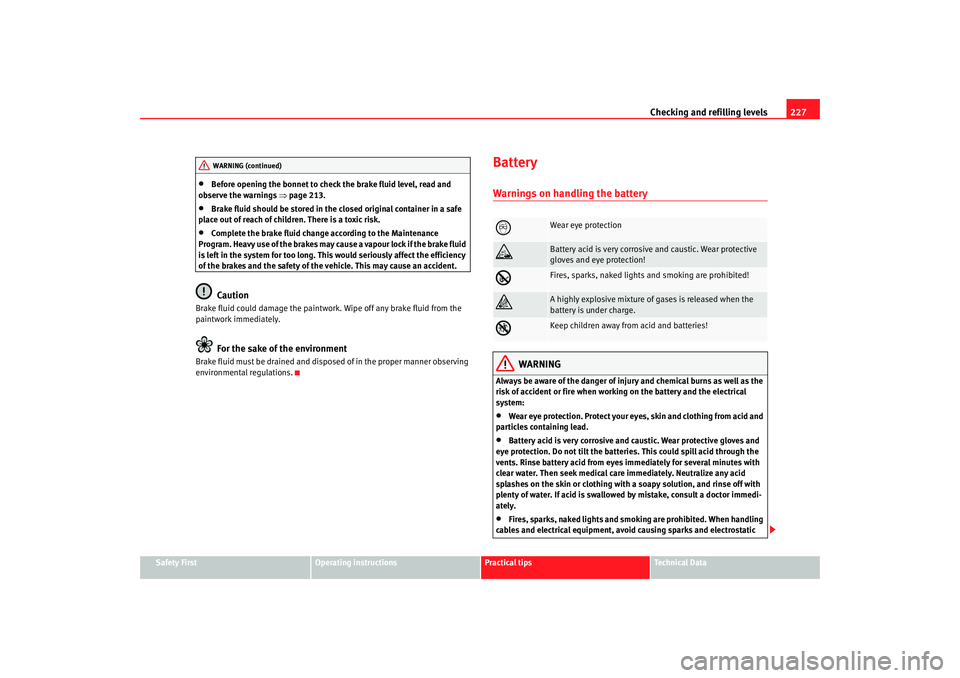
BatteryWarnings on handling the battery
WARNING
Always be aware of the danger of injury and chemical burns as well as the
risk of accident or fire when working on the battery and the electrical
system:•
Wear eye protection. Protect your eyes , skin and clothing from acid and
particles containing lead.
•
Battery acid is very corrosive and caustic. Wear protective gloves and
eye protection. Do not tilt the batter ies. This could spill acid through the
vents. Rinse battery acid from eyes immediately for several minutes with
clear water. Then seek medical care immediately. Neutralize any acid
splashes on the skin or clothing with a soapy solution, and rinse off with
plenty of water. If acid is swallowed by mistake, consult a doctor immedi-
ately.
•
Fires, sparks, naked lights and smoki ng are prohibited. When handling
cables and electrical equipment, avoid causing sparks and electrostatic
WARNING (continued)
Wear eye protection
Battery acid is very corrosive and caustic. Wear protective
gloves and eye protection!
Fires, sparks, naked lights and smoking are prohibited!
A highly explosive mixture of gases is released when the
battery is under charge.
Keep children away from acid and batteries!
AlteaXL_EN.book Seite 227 M ontag, 2. Februar 2009 12:26 12
Page 229 of 297
Checking and refilling levels
228charge. Never short the battery terminals. High-energy sparks can cause
injury.•
A highly explosive mixture of gases is released when the battery is
under charge. The batteries should be charged in a well-ventilated room
only.
•
Keep children away from acid and batteries.
•
Before working on the electrical system, you must switch off the
engine, the ignition and all consumers. The negative cable on the battery
must be disconnected. When a light bulb is changed, you need only switch
off the light.
•
Deactivate the anti-theft alarm by unlocking the vehicle before you
disconnect the battery! The alarm will otherwise be triggered.
•
When disconnecting the battery from the vehicle electrical system,
disconnect first the negative cable and then the positive cable.
•
Switch off all electrical consumers before reconnecting the battery.
Reconnect first the positive cable and then the negative cable. Never
reverse the polarity of the connections. This could cause an electrical fire.
•
Never charge a frozen battery, or one which has thawed. This could
result in explosions and chemical burns. Always replace a battery which
has frozen. A flat battery can freeze at temperatures around 0°
•
Ensure that the vent hose is always connected to the battery.
•
Never use a defective battery. This may be fatally explosive. Replace a
damaged battery immediately.Caution
•
Never disconnect the battery if the ignition is switched on or if the engine
is running. This could damage the electrical system or electronic compo-
nents.
•
Do not expose the battery to direct sunlight over a long period of time, as
the intense ultraviolet radiation can damage the battery housing.
•
If the vehicle is left standing in cold conditions for a long period, protect
the battery from frost. If it “freezes” it will be damaged.
Checking the electrolyte level
The electrolyte level should be checked regularly in high-
mileage vehicles, in hot countries and in older batteries.– Open the bonnet and open the battery cover at the front ⇒ in
“Safety instructions on working in the engine compartment” on
page 213 ⇒ in “Warnings on handling the battery” on
page 227.
– Check the colour display in the "magic eye" on the top of the battery.
– If there are air bubbles in the window, tap the window gently until they disperse.The position of the battery is show n in the corresponding engine compart-
ment diagram ⇒page 273.
The round window (“magic eye”) on the top of the battery changes colour,
depending on the charge level and electrolyte level of the battery.
If the colour in the window is colourless or bright yellow, the electrolyte level
of the battery is too low. Have the battery checked by a qualified workshop.
The colours green and black are used by the workshops for diagnostic
purposes.
WARNING (continued)
AlteaXL_EN.book Seite 228 M ontag, 2. Februar 2009 12:26 12