Water Seat Altea XL 2009 User Guide
[x] Cancel search | Manufacturer: SEAT, Model Year: 2009, Model line: Altea XL, Model: Seat Altea XL 2009Pages: 297, PDF Size: 9.36 MB
Page 206 of 297
Cleaning and caring for your vehicle205
Safety First
Operating instructions
Practical tips
Te c h n i c a l D a t a
Underbody sealant
The vehicle underbody is coated to protect it from chemical
and mechanical damage.The protective coating can be damaged when driving. We recommend you to
ckeck the protective coating under the body and on the running gear, and
reinstated if necessary, before and after the winter season.
We recommend you to go to your Authorised Service Centre to carry out repair
work and additional anti-corrosion work.
WARNING
Do not apply underseal or anti-corrosion coatings to the exhaust pipes,
catalytic converter or the heat shields on the exhaust system. The heat of
the exhaust system or the engine could cause them to ignite! Fire hazard.Cleaning the engine compartment
Take special care when cleaning the engine compartment.Anti-corrosion treatment
The engine compartment and the surface of the power unit are given anti-
corrosion treatment at the factory.
Good corrosion protection is particularly important in winter when the car is
frequently driven on salted roads. To prevent the salt corroding the vehicle,
the entire engine compartment should be thoroughly cleaned before and
after winter.
Your Authorised Service Centre has got the necessary equipment to provide
the correct cleaning and preserving products. For this reason, we recommend
having this work performed by them. The anti-corrosion protection is usually removed if the engine compartment
is cleaned with grease remo
ving solutions, or if you have the engine cleaned.
On commissioning theis work, ensure that all surfaces, seams, joints and
components in the engine compartment are given anti-corrosion treatment.
WARNING
•
When working in the engine compartm ent, always observe the safety
warnings ⇒page 213.
•
Before opening the bonnet, switch the engine off, apply the parking
brake firmly and always remove the key from the ignition.
•
Allow the engine to cool before you clean the engine compartment.
•
Do not clean the vehicle underbody, wheel arches without protecting
your hands and arms. You may cut your self on sharp-edged metal parts.
Failure to comply could result in injury.
•
Moisture, ice and salt on the brakes may affect braking efficiency. Risk
of accident. Directly after washing, avoid sudden and sharp braking.
•
Never touch the radiator fan. It is temperature-controlled and could
start automatically, even when the key is removed from the ignition!For the sake of the environment
Fuel, grease and oil deposits could be removed when the engine is washed.
The polluted water must be cleaned in an oil separator. For this reason,
engine washing should be carried out on ly by a qualified workshop or a petrol
station.
AlteaXL_EN.book Seite 205 M ontag, 2. Februar 2009 12:26 12
Page 207 of 297
Cleaning and caring for your vehicle
206Vehicle interior maintenancePlastic parts and dash panel cleaning– Use a clean, damp cloth to clean plastic parts and the dash
panel.
– If this does not provide satisfactory results, use a special solvent-free plastic cleaning product.
WARNING
Never clean the dash panel and the airbag module surface with cleansers
containing solvents. Solvents cause the surface to become porous. If the
airbag triggered, disintegrating plastic parts could cause substantial inju-
ries.
Caution
Cleaning products which contain solvents will damage the material.Wooden trim cleaning*– Clean the wooden trim with a water-moistened clean cloth.
– If this does not provide satisfactory results, use a gentle soap
solution.
CautionCleaning products which contain solvents will damage the material.
Cloth seat covers and fabric trim cleaningCloth seat covers and fabric trim on the doors, headlining etc. can be cleaned
with a special interior cleanser or with dry foam and a soft brush.Cleaning the radio and climate controlsTo clean the radio and/or climate controls, use a soft damp cloth. For more
resistant dirt, a neutral soap solution may be used.Leather cleaning*Normal cleaning
– Moisten a cotton or woollen cloth with water and wipe over the leather surfaces.
Cleaning stubborn stains
– More stubborn dirt can be removed using a mild soap solution (pure liquid soap; two tablespoons diluted in one litre of water)
and a cloth.
– Do not let the water soak through the leather or soak into the seams.
– Then wipe off with a soft, dry cloth.
Leather maintenance
– The leather should be treated twice a year with a special leather- care product, available in your Authorised Service Centre.
AlteaXL_EN.book Seite 206 M ontag, 2. Februar 2009 12:26 12
Page 221 of 297
Checking and refilling levels
220•
Never pour oil down drains or into the ground.
•
Use a suitable container when draining the used oil. It has to be large
enough to hold all the engine oil
CoolantCoolant specifications
Coolant is a mixture of water and at least 40% coolant addi-
tive.The cooling system must be filled with a mixture of water and at least 40 % of
our coolant additive G 12+ or an addi tive with the specification TT-VW 774 F
(it is dyed purple). This mixture gives the necessary frost protection down to
-25
° C and protects the alloy parts of the cooling system against corrosion. It
also prevents scaling and raises the boiling point of the coolant.
The concentration of coolant must always be at least 40% - even if frost
protection is not required.
If greater frost protection is required in very cold climates, the proportion of
the antifreeze additive G 12+ can be increased. However, the percentage of
coolant additives should not exceed 60%, as this would reduce the frost
protection. It would also reduce th e cooling effect. A mixture with 60%
coolant additive will give frost protection to approx. -40
° C.
WARNING
•
The coolant additive is toxic. There is a toxic risk. Always keep the
coolant additive in the original container which should be stored out of the
reach of children. The same applies to coolant which you have drained off.
•
The coolant additive G 12+ must be added in sufficient quantities to
provide anti-freeze protection at the coldest ambient temperatures that
can be expected. At extremely cold ambient temperatures, the coolant
could freeze, causing the vehicle to breakdown. As the heater would also
not work in this situation, there is a risk of suffering exposure!Caution
•
Other additives may give considerably inferior corrosion protection. The
resulting corrosion in the cooling syst em can lead to a loss of coolant,
causing serious damage to the engine.
•
The coolant additive G 12+ (purple) can be mixed with the additive G 12
(red) or G 11. Never mix G12 (red colour) with G 11.WARNING (continued)
AlteaXL_EN.book Seite 220 M ontag, 2. Februar 2009 12:26 12
Page 222 of 297
Checking and refilling levels221
Safety First
Operating instructions
Practical tips
Te c h n i c a l D a t a
Checking the coolant level and topping up
The correct coolant level is important for fault-free func-
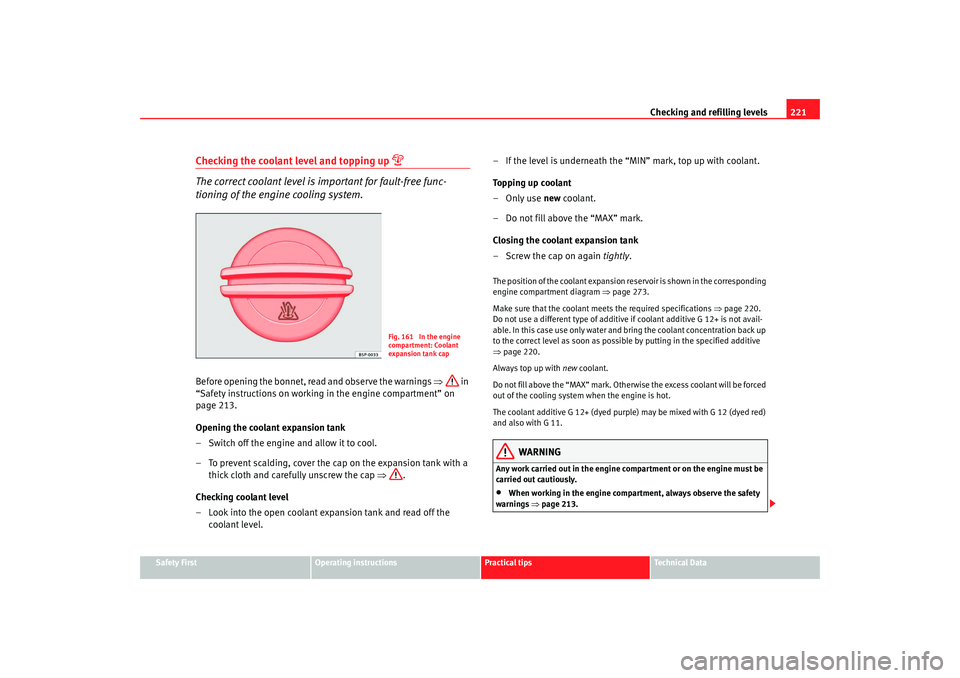
tioning of the engine cooling system.Before opening the bonnet, read and observe the warnings ⇒ in
“Safety instructions on working in the engine compartment” on
page 213.
Opening the coolant expansion tank
– Switch off the engine and allow it to cool.
– To prevent scalding, cover the cap on the expansion tank with a thick cloth and carefully unscrew the cap ⇒.
Checking coolant level
– Look into the open coolant expansion tank and read off the coolant level. – If the level is underneath the
“MIN” mark, top up with coolant.
Topping up coolant
–Only use new coolant.
– Do not fill above the “MAX” mark.
Closing the coolant expansion tank
–Screw the cap on again tightly.
The position of the coolant expansion reservoir is shown in the corresponding
engine compartment diagram ⇒page 273.
Make sure that the coolant meets the required specifications ⇒ page 220.
Do not use a different type of additive if coolant additive G 12+ is not avail-
able. In this case use only water and bring the coolant concentration back up
to the correct level as soon as possible by putting in the specified additive
⇒ page 220.
Always top up with new coolant.
Do not fill above the “MAX” mark. Otherwise the excess coolant will be forced
out of the cooling system when the engine is hot.
The coolant additive G 12+ (dyed purple) may be mixed with G 12 (dyed red)
and also with G 11.
WARNING
Any work carried out in the engine compartment or on the engine must be
carried out cautiously.•
When working in the engine compartm ent, always observe the safety
warnings ⇒page 213.
Fig. 161 In the engine
compartment: Coolant
expansion tank cap
AlteaXL_EN.book Seite 221 M ontag, 2. Februar 2009 12:26 12
Page 223 of 297
Checking and refilling levels
222•
When the engine is warm or hot, th e cooling system is pressurised! Do
not unscrew the cap on the expansion t ank when the engine is hot. This is
a burn injury risk.Caution
•
When mixed with other additives the colour of G 12 will change to brown.
If this occurs you should have the coolant changed immediately. Failure to do
so will result in engine damage!
•
If a lot of coolant has been lost, wait for the engine to cool down before
putting in cold coolant. This avoids damaging the engine. Large coolant
losses are an indication of leaks in the cooling system. See a specialised
workshop immediately and have the cooling system checked. Otherwise,
there is a risk of engine damage.
Washer fluid and windscreen wiper bladesTopping up washer fluid
The water for cleaning the windscreen should always be
mixed with washer fluid.The windscreen washer and the headlight washing system are supplied with
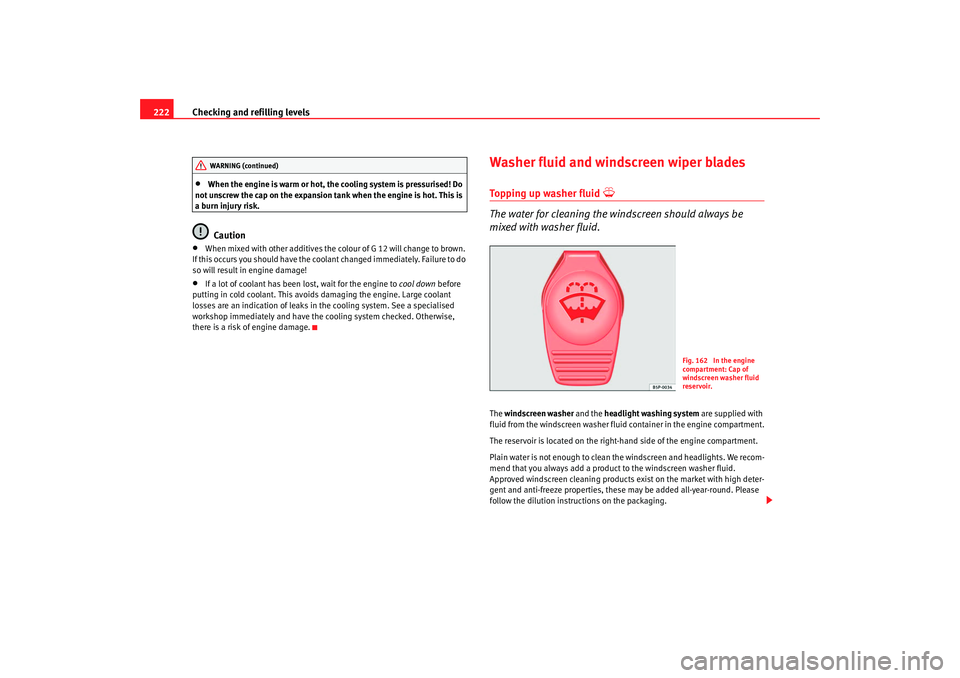
fluid from the windscreen washer flui d container in the engine compartment.
The reservoir is located on the right-hand side of the engine compartment.
Plain water is not enough to clean the windscreen and headlights. We recom-
mend that you always add a product to the windscreen washer fluid.
Approved windscreen cleaning products exist on the market with high deter-
gent and anti-freeze properties, these may be added all-year-round. Please
follow the dilution instructions on the packaging.
WARNING (continued)
Fig. 162 In the engine
compartment: Cap of
windscreen washer fluid
reservoir.
AlteaXL_EN.book Seite 222 M ontag, 2. Februar 2009 12:26 12
Page 227 of 297
Checking and refilling levels
226Brake fluidChecking the brake fluid level
The brake fluid is checked at the intervals given in the service
schedule.– Read off the fluid level at the transparent brake fluid reservoir. It
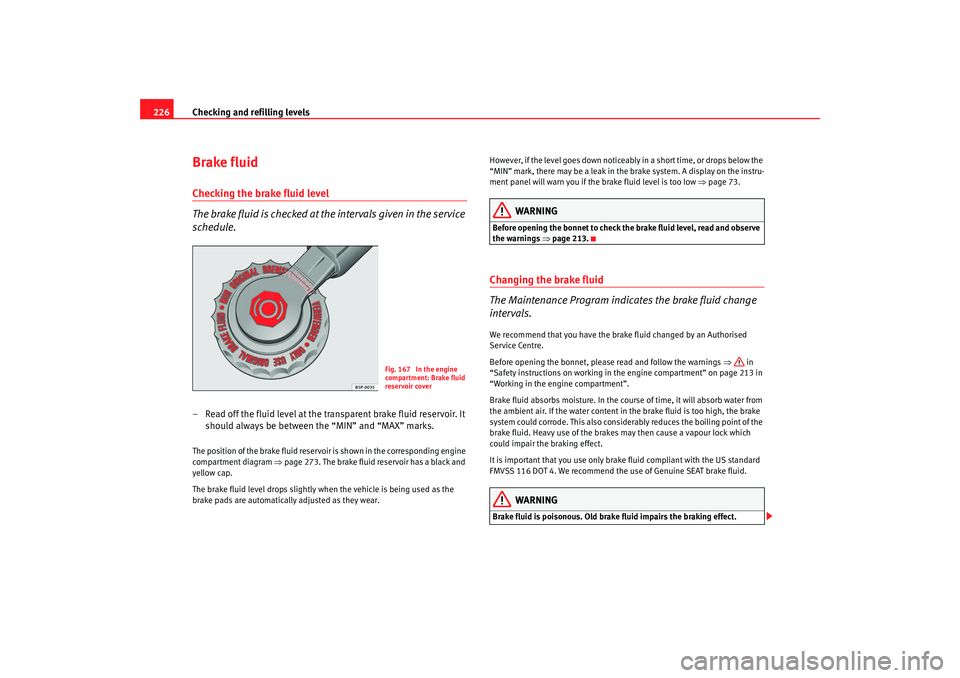
should always be between the “MIN” and “MAX” marks.The position of the brake fluid reservoir is shown in the corresponding engine
compartment diagram ⇒ page 273. The brake fluid reservoir has a black and
yellow cap.
The brake fluid level drops slightly when the vehicle is being used as the
brake pads are automatically adjusted as they wear. However, if the level goes down noticeab
ly in a short time, or drops below the
“MIN” mark, there may be a leak in the brake system. A display on the instru-
ment panel will warn you if the brake fluid level is too low ⇒page 73.
WARNING
Before opening the bonnet to check the brake fluid level, read and observe
the warnings ⇒page 213.Changing the brake fluid
The Maintenance Program indicates the brake fluid change
intervals.We recommend that you have the brake fluid changed by an Authorised
Service Centre.
Before opening the bonnet, please read and follow the warnings ⇒ in
“Safety instructions on working in the engine compartment” on page 213 in
“Working in the engine compartment”.
Brake fluid absorbs moisture. In the cour se of time, it will absorb water from
the ambient air. If the water content in the brake fluid is too high, the brake
system could corrode. This also consider ably reduces the boiling point of the
brake fluid. Heavy use of the brakes may then cause a vapour lock which
could impair the braking effect.
It is important that you use only brake fluid compliant with the US standard
FMVSS 116 DOT 4. We recommend the use of Genuine SEAT brake fluid.
WARNING
Brake fluid is poisonous. Old brake fluid impairs the braking effect.
Fig. 167 In the engine
compartment: Brake fluid
reservoir cover
AlteaXL_EN.book Seite 226 Montag, 2. Februar 2009 12:26 12
Page 228 of 297
Checking and refilling levels227
Safety First
Operating instructions
Practical tips
Te c h n i c a l D a t a
•
Before opening the bonnet to check the brake fluid level, read and
observe the warnings ⇒page 213.
•
Brake fluid should be stored in the closed original container in a safe
place out of reach of children. There is a toxic risk.
•
Complete the brake fluid change according to the Maintenance
Program. Heavy use of the brakes may cause a vapour lock if the brake fluid
is left in the system for too long. This would seriously affect the efficiency
of the brakes and the safety of the vehicle. This may cause an accident.Caution
Brake fluid could damage the paintwork. Wipe off any brake fluid from the
paintwork immediately.
For the sake of the environment
Brake fluid must be drained and disposed of in the proper manner observing
environmental regulations.
BatteryWarnings on handling the battery
WARNING
Always be aware of the danger of injury and chemical burns as well as the
risk of accident or fire when working on the battery and the electrical
system:•
Wear eye protection. Protect your eyes , skin and clothing from acid and
particles containing lead.
•
Battery acid is very corrosive and caustic. Wear protective gloves and
eye protection. Do not tilt the batter ies. This could spill acid through the
vents. Rinse battery acid from eyes immediately for several minutes with
clear water. Then seek medical care immediately. Neutralize any acid
splashes on the skin or clothing with a soapy solution, and rinse off with
plenty of water. If acid is swallowed by mistake, consult a doctor immedi-
ately.
•
Fires, sparks, naked lights and smoki ng are prohibited. When handling
cables and electrical equipment, avoid causing sparks and electrostatic
WARNING (continued)
Wear eye protection
Battery acid is very corrosive and caustic. Wear protective
gloves and eye protection!
Fires, sparks, naked lights and smoking are prohibited!
A highly explosive mixture of gases is released when the
battery is under charge.
Keep children away from acid and batteries!
AlteaXL_EN.book Seite 227 M ontag, 2. Februar 2009 12:26 12
Page 250 of 297
If and when249
Safety First
Operating instructions
Practical tips
Te c h n i c a l D a t a
FusesChanging a fuse
Blown fuses must be replaced
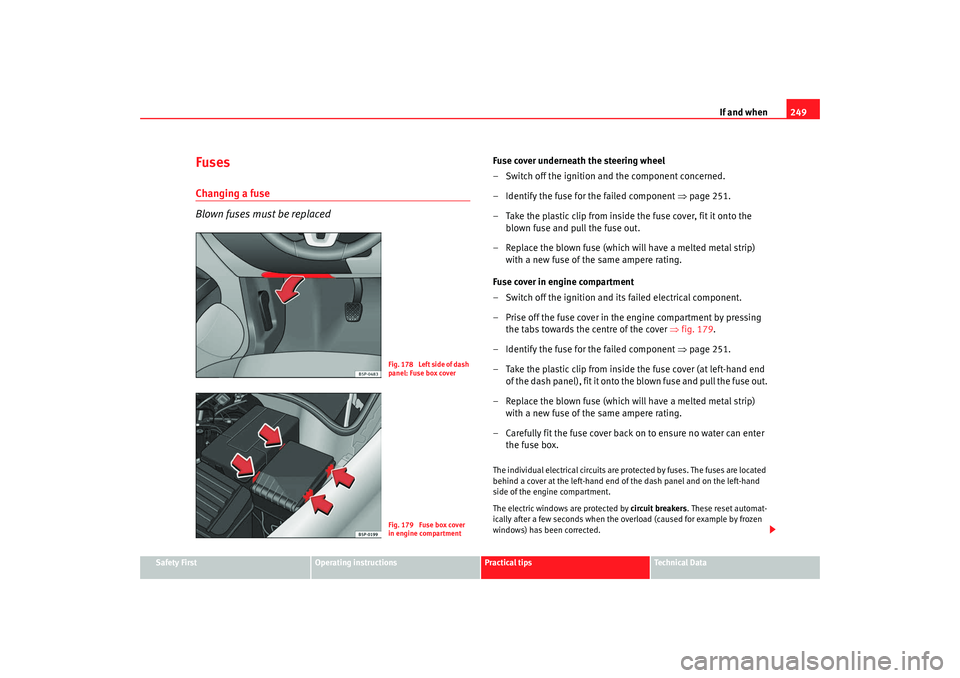
Fuse cover underneath the steering wheel
– Switch off the ignition and the component concerned.
– Identify the fuse for the failed component ⇒page 251.
– Take the plastic clip from inside the fuse cover, fit it onto the
blown fuse and pull the fuse out.
– Replace the blown fuse (which will have a melted metal strip) with a new fuse of the same ampere rating.
Fuse cover in engine compartment
– Switch off the ignition and its failed electrical component.
– Prise off the fuse cover in the engine compartment by pressing the tabs towards the centre of the cover ⇒fig. 179.
– Identify the fuse for the failed component ⇒page 251.
– Take the plastic clip from inside the fuse cover (at left-hand end of the dash panel), fit it onto th e blown fuse and pull the fuse out.
– Replace the blown fuse (which will have a melted metal strip) with a new fuse of the same ampere rating.
– Carefully fit the fuse cover back on to ensure no water can enter the fuse box.The individual electrical circuits are pr otected by fuses. The fuses are located
behind a cover at the left-hand end of the dash panel and on the left-hand
side of the engine compartment.
The electric windows are protected by circuit breakers. These reset automat-
ically after a few seconds when the overload (caused for example by frozen
windows) has been corrected.
Fig. 178 Left side of dash
panel: Fuse box coverFig. 179 Fuse box cover
in engine compartment
AlteaXL_EN.book Seite 249 M ontag, 2. Februar 2009 12:26 12
Page 254 of 297
If and when253
Safety First
Operating instructions
Practical tips
Te c h n i c a l D a t a
Bulb changeGeneral notesBefore changing any bulb, first turn off the failed component.
Do not touch the bulb glass. Fingerprints vaporise in the heat, causing a
reduction in the bulb life and conden sation on the mirror surface, thus
reducing efficiency.
A bulb should only be replaced by one of the same type. The type is inscribed
on the bulb, either on the glass part or on the base.
It is highly recommended to keep a box of spare bulbs in the vehicle. At the
very least, the following spare bulbs, which are essential for road safety,
should be kept in the vehicle.
Main headlights
Dipped beam - H7
Main beam - H1
Position - W5W
Indicator - PY21W
Xenon headlights
23) /self-directing
Dipped and full beam - D1S
24)
Daylight - P21W SLL
Position W5W
Indicators PY21W
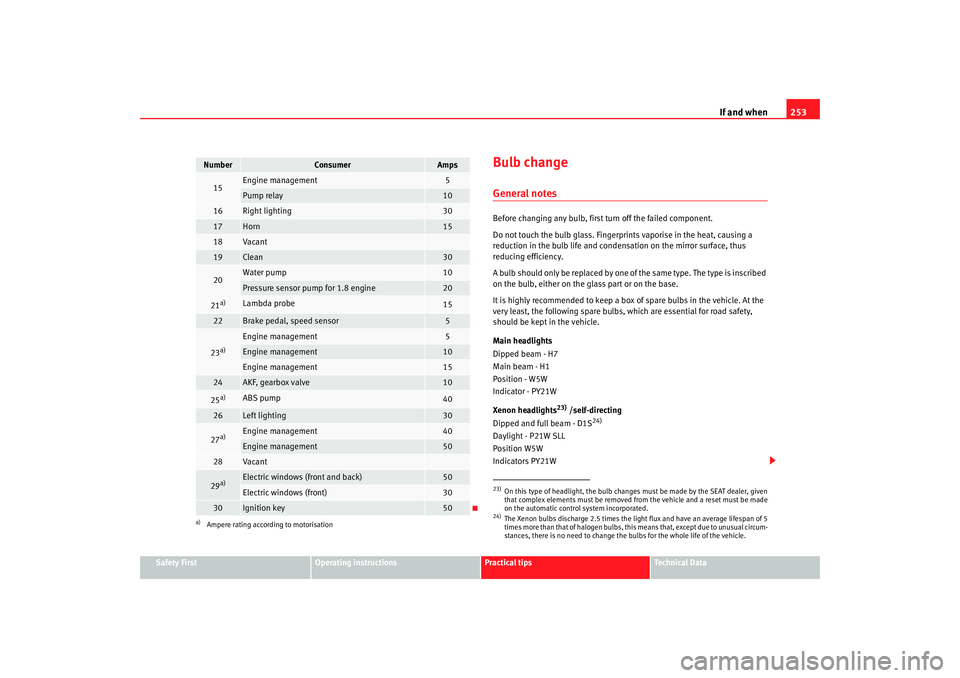
15
Engine management
5
Pump relay
10
16
Right lighting
30
17
Horn
15
18
Vacant
19
Clean
30
20
Water pump
10
Pressure sensor pump for 1.8 engine
20
21a)
Lambda probe
15
22
Brake pedal, speed sensor
5
23a)
Engine management
5
Engine management
10
Engine management
15
24
AKF, gearbox valve
10
25a)
ABS pump
40
26
Left lighting
30
27a)
Engine management
40
Engine management
50
28
Vacant
29a)
Electric windows (front and back)
50
Electric windows (front)
30
30
Ignition key
50
a)Ampere rating according to motorisationNumber
Consumer
Amps
23)On this type of headlight, the bulb changes must be made by the SEAT dealer, given
that complex elements must be removed from the vehicle and a reset must be made
on the automatic control system incorporated.24)The Xenon bulbs discharge 2.5 times the light flux and have an average lifespan of 5
times more than that of halogen bulbs, this means that, except due to unusual circum-
stances, there is no need to change the bulbs for the whole life of the vehicle.
AlteaXL_EN.book Seite 253 M ontag, 2. Februar 2009 12:26 12
Page 295 of 297
Index
294TCS (Traction control system)
Warning lamp . . . . . . . . . . . . . . . . . . . . . . . . 82
Technical modifications . . . . . . . . . . . . . . . . . . 208
The danger of not using the seat belt . . . . . . . . 21
Tools . . . . . . . . . . . . . . . . . . . . . . . . . . . . . . . . . . 238
Towing . . . . . . . . . . . . . . . . . . . . . . . . . . . . . . . . 265
Towing a trailer . . . . . . . . . . . . . . . . . . . . . . . . . 272
Towing bracket . . . . . . . . . . . . . . . . . . . . . . . . . 196
Towing bracket, fitting . . . . . . . . . . . . . . . . . . . 197
Towing eye . . . . . . . . . . . . . . . . . . . . . . . . . . . . . 265
Tow-starting . . . . . . . . . . . . . . . . . . . . . . . . . . . . 265
Traction control system warning lamp . . . . . . . . . . . . . . . . . . . . . . . . . 82
Trailer Trailer towing . . . . . . . . . . . . . . . . . . . . . . . . 195
Trailer turn signals Warning lamp . . . . . . . . . . . . . . . . . . . . . . . 116
Trailer weights . . . . . . . . . . . . . . . . . . . . . . . . . . 272
Trips, checklist . . . . . . . . . . . . . . . . . . . . . . . . . . . 8
Turn signals . . . . . . . . . . . . . . . . . . . . . . . . . . . . 116 Warning lamp . . . . . . . . . . . . . . . . . . . . 76, 116
Turning light . . . . . . . . . . . . . . . . . . . . . . . . . . . 114
Type plate . . . . . . . . . . . . . . . . . . . . . . . . . . . . . 270
Tyre Mobility-System (Tyre repair kit) . . . . . . . 239
Tyre monitor indicator . . . . . . . . . . . . . . . . . . . . . 78
Tyre pressure . . . . . . . . . . . . . . . . . . . . . . . . . . . 230 Loss . . . . . . . . . . . . . . . . . . . . . . . . . . . . . . . 232
Tyre pressure monitoring . . . . . . . . . . . . . . . . . 231
Tyre repair kit . . . . . . . . . . . . . . . . . . . . . . . 239, 247
Tyre-Mobility-System (Tyre repair kit) . . . . . . . 247 Tyres and wheels
Dimensions . . . . . . . . . . . . . . . . . . . . . . . . . 235
Tyres service life . . . . . . . . . . . . . . . . . . . . . . . . 232
Tyres tread depth . . . . . . . . . . . . . . . . . . . . . . . 233
Tyres with directional tread pattern . . . . . . . . . 230
UUnderbody sealant . . . . . . . . . . . . . . . . . . . . . . 205
Unlocking and locking Personalisation . . . . . . . . . . . . . . . . . . . . . . . 94
Using the Tiptronic gear syst em . . . . . . . . . . . 173VVehicle battery . . . . . . . . . . . . . . . . . . . . . . . . . 227
Vehicle data . . . . . . . . . . . . . . . . . . . . . . . . . . . . 270
Vehicle identification data . . . . . . . . . . . . . . . . 270
Vehicle identification number . . . . . . . . . . . . . 270
Vehicle Maintenance
Exterior . . . . . . . . . . . . . . . . . . . . . . . . . . . . . 200
Vehicle modifications . . . . . . . . . . . . . . . . . . . . 208
Vehicle paintwork Products for vehicle maintenance . . . . . . . 199
Waxing . . . . . . . . . . . . . . . . . . . . . . . . . . . . . 201
Vehicle tools Storage . . . . . . . . . . . . . . . . . . . . . . . . . . . . 238
Vehicle wallet storage . . . . . . . . . . . . . . . . . . . 135
Vehicle washing . . . . . . . . . . . . . . . . . . . . . . . . 200
Ventilation slits . . . . . . . . . . . . . . . . . . . . . . . . . . 18 Volumetric sensor*
Activation . . . . . . . . . . . . . . . . . . . . . . . . . . . 100
Deactivation . . . . . . . . . . . . . . . . . . . . . . . . 100
WWarning lamp . . . . . . . . . . . . . . . . . . . . . . . . . . . 30
Warning lamps . . . . . . . . . . . . . . . . . . . . . . . . . . 73
Warning reportsRed . . . . . . . . . . . . . . . . . . . . . . . . . . . . . . . . . 63
Yellow . . . . . . . . . . . . . . . . . . . . . . . . . . . . . . 63
Warning texts in the display . . . . . . . . . . . . . . . . 62
Warning triangle and first-aid kit . . . . . . . . . . . 147
Washer fluid . . . . . . . . . . . . . . . . . . . . . . . . . . . 222
Washing by hand . . . . . . . . . . . . . . . . . . . . . . . 200
Washing with high pressure cleaners . . . . . . . 201
Water warning . . . . . . . . . . . . . . . . . . . . . . . . . . . . . 63
Water in the windscreen washer tank . . . . . . . 222
Wear indicators . . . . . . . . . . . . . . . . . . . . . . . . . 233
Wheel bolts . . . . . . . . . . . . . . . . . . . . . . . . . . . . 242 Torque . . . . . . . . . . . . . . . . . . . . . . . . . . . . . 236
Wheel change . . . . . . . . . . . . . . . . . . . . . . . . . . 240
Wheel trims . . . . . . . . . . . . . . . . . . . . . . . . . . . . 241
Wheels . . . . . . . . . . . . . . . . . . . . . . . . . . . . . . . . 230
Why assume the correct sitting position? . . . . . 29
Why should head restraints be correctly adjusted? 13
Why to wear seat belts? . . . . . . . . . . . . . . . . . . . 19
Why wear seat belts? . . . . . . . . . . . . . . . . . . 20, 29
AlteaXL_EN.book Seite 294 M ontag, 2. Februar 2009 12:26 12