Start Seat Altea XL 2009 Workshop Manual
[x] Cancel search | Manufacturer: SEAT, Model Year: 2009, Model line: Altea XL, Model: Seat Altea XL 2009Pages: 297, PDF Size: 9.36 MB
Page 235 of 297
Wheels and tyres
234
Driving with anti-puncture tyres (emergency gear)
– Leave the ESP/TCS (electronic stabilisation programme) switched on, or switch on ⇒page 185.
– Continue driving carefully and slowly (80 km/h maximum).
– Avoid sudden manoeuvres and sharp turns.
– Avoid driving over obstacles (for example kerbs) or potholes.
– Look out for the ESP/TCS intervening often, smoke coming from the tyres or the smell of rubber, the vehicle vibrating or a clat-
tering noise. If any of these occur, stop the vehicle.The anti-puncture tyres have a tag on the side of the tyre, with the description:
“DSST”, “Eufonia”, “RFT”, “ROF”, “RSC”, “SSR” or “ZP”.
The sides of this type of tyre are reinforced. When the tyres lose air they are
supported on the sides (emergency driving).
The loss of pressure in the tyre is shown on the instrument panel. You can
then drive a maximum of 80 km and if the circumstances are favourable (for
example, low load), even more.
The damaged tyre should be changed as soon as possible. The rim should be
checked in a specialist workshop to detect possible damage and replace it if
necessary. We recommend you contact Technical Service. If more than one
tyre is being used under emergency co nditions, this reduces the distance
which can be travelled.
Starting driving in emergency conditions
When the loss in tyre pressure is displayed on the instrument panel, this
implies that at least one tyre is being driven in emergency conditions ⇒.
End of emergency operation
Do not drive on if:
•
smoke is coming from one of the tyres,
•
there is a smell of rubber,
•
the vehicle vibrates,
•
there is a rattling noise.
When is it no longer possible to co ntinue driving even using anti-puncture
tyres?
•
If one of the tyres has been severely damaged in an accident, etc. If a tyre
has been badly damaged there is a risk that parts of the tread can be thrown
off and cause damage to the fuel lines, brake pipes or fuel filler.
•
It is also advisable to stop driving if severe vibrations occur, or if the wheel
starts overheating and gives off smoke.
WARNING
When driving in emergency conditions, the driving quality of the vehicle is
considerably impaired.•
The maximum permitted speed of 80 km/h is subject to road and
weather conditions. Please observe legal requirements when doing so.
•
Avoid sharp turns and rapid manoeuvres, and brake earlier than usual.
•
Avoid driving over obstacles (for example kerbs) or potholes.
•
If one or more tyres is being driven in emergency conditions, the driving
quality of the vehicle is impaired and there is a risk of accident.Note
•
The anti-puncture tyres do not “deflate” on losing pressure because they
are supported on the reinforced sides. Th erefore defects in the tyre can not be
detected with a visual inspection.
•
Snow chains must not be used on front tyres used in emergency
conditions.
AlteaXL_EN.book Seite 234 M ontag, 2. Februar 2009 12:26 12
Page 239 of 297
If and when
238If and whenTools, tyre repair kit and spare wheelVehicle To ols
The vehicle onboard tools are located under the floor panel in
the luggage compartment.– Lift the cover of the luggage compartment, by pulling it up with a
finger in the fitting.
– Take the onboard tools out of the vehicle.The tool kit includes:•
Jack*
•
Hook for removing wheel covers* or hub caps*
•
Box spanner for wheel bolts*
•
Reversible screwdriver with handle (including hexagonal interior) for the
wheel bolts. The screwdriver is a combination tool.
•
To wi ng e ye
•
Adapter for the anti-theft wheel bolts*
Some of the items listed are only prov ided in certain models / model years,
or are optional extras.
WARNING
•
Do not use the hexagonal socket in the screwdriver handle to tighten
the wheel bolts as with this it is not possible to tighten the bolts to the
required torque. Risk of accident.
•
The jack* supplied by the factory is only designed for changing wheels
on this model. On no account attempt to use it for lifting heavier vehicles
or other loads. Risk of injury.
•
Use the jack* only on firm, level ground.
•
Never start the engine when the vehicle is on the jack. Risk of accident.
•
I f wo r k is t o b e ca r r i e d o u t un d e r n ea th the vehicle, this must be secured
by suitable stands. Otherwise, there is a risk of injury.WARNING (continued)
AlteaXL_EN.book Seite 238 M ontag, 2. Februar 2009 12:26 12
Page 263 of 297
If and when
262Sunroof light– Carefully remove the lamp, using the flat side of the screwdriver,
as shown in the figure ⇒fig. 198 . – Remove the bulb, moving it in the direction of the arrow and
outwards ⇒fig. 198 .
Jump-startingJump leads
The jump lead must have a sufficient wire cross section.If the engine fails to start because of a discharged battery, the battery can be
connected to the battery of anot her vehicle to start the engine.
Jump leads
Jump leads must comply with the standard DIN 72553 (see manufacturer's
documentation). The wire cross section must be at least 25 mm
2 for petrol
engines and at least 35 mm
2 for diesel engines.
Note
•
The vehicles must not touch each other, otherwise electricity could flow as
soon as the positive terminals are connected.
•
The discharged battery must be properly connected to the vehicle elec-
trical system.
Fig. 197 Removing
sunroof lightFig. 198 Removing
sunroof light
AlteaXL_EN.book Seite 262 M ontag, 2. Februar 2009 12:26 12
Page 264 of 297
If and when263
Safety First
Operating instructions
Practical tips
Te c h n i c a l D a t a
How to jump start: description⇒fig. 199 shows the flat battery and the charged battery.
Jump lead terminal connections
– Switch off the ignition on both vehicles ⇒.
1. Connect one end of the red jump lead to the positive ⇒fig. 199
terminal of the vehicle with the flat battery ⇒.
2. Connect the other end of the red jump lead to the positive terminal in the vehicle providing assistance.
3. Connect one end of the black jump lead to the negative terminal on the battery of the vehicle providing assistance. 4. Connect the other end of the black jump lead to a solid metal
component which is bolted on to the engine block, or onto the
engine block itself of the vehicle with the flat battery. Do not
connect it to a point near the battery ⇒.
5. Position the leads in such a way that they cannot come into contact with any moving parts in the engine compartment.
Starting
6. Start the engine of the vehicle with the boosting battery and let
it run at idling speed.
7. Start the engine of the car with the flat battery and wait one or two minutes until the engine is “running”.
Removing the jump leads
8. Before you remove the jump leads, switch off the headlights (if they are switched on).
9. Turn on the heater blower and rear window heater in the vehicle with the flat battery. This helps minimise voltage peaks which are
generated when the leads are disconnected.
10. When the engine is running, disconnect the leads in reverse order to the details given above.
Connect the battery clamps so they ha ve good metal-to-metal contact with
the battery terminals.
If the engine fails to start, switch off the starter after about 10 seconds and
try again after about half a minute.
Fig. 199 How to connect
the jump leads
AA
AB
A+
A+
A-
AX
AlteaXL_EN.book Seite 263 M ontag, 2. Februar 2009 12:26 12
Page 266 of 297
If and when265
Safety First
Operating instructions
Practical tips
Te c h n i c a l D a t a
Towing and tow-startingTo w - s t a r t i n g
The use of jump leads is preferable to tow-starting.We recommend that you do not tow-start your vehicle. Jump-starting
is preferable ⇒page 262.
However, if your vehicle has to be tow-started:
–Engage the 2
nd or the 3
rd gear.
– Keep the clutch pressed down.
– Switch the ignition on.
– Once both vehicles are mo ving, release the clutch.
– As soon as the engine starts, press the clutch and move the gear lever into neutral. This helps to prevent driving into the towing
vehicle.
WARNING
The risk of accidents is high when tow-starting. The vehicle being towed
can easily collide with the towing vehicle.
Caution
When tow-starting, fuel could enter the catalytic converter and damage it.
General notesPlease observe the following points if you use a tow-rope:
Notes for the driver of the towing vehicle
– Drive slowly at first until the tow-rope is taut. Then accelerate gradually.
– Begin and change gears cautiously. If you are driving an auto- matic vehicle, accelerate gently.
– Remember that the brake servo and power steering are not working in the vehicle you are towing. Brake earlier than you
would normally, but with a more gentle pressure on the brake.
Notes for the driver of the towed vehicle
– Ensure that the tow-rope remains taut at all times when towing.Tow-rope or tow-bar
It is easier and safer to tow a vehicle with a tow-bar. You should only use a
tow-rope if you do not have a tow-bar.
A tow-rope should be slightly elastic to reduce the loading on both vehicles.
It is advisable to use a tow-rope made of synthetic fibre or similarly elastic
material.
Attach the tow-rope or the tow-bar only to the towing eyes provided or a
towing bracket.
Driving style
Towing requires some experience, especially when using a tow-rope. Both
drivers should be familiar with the technique required for towing. Inexperi-
enced drivers should not attempt to tow-start or tow away another vehicle.
AlteaXL_EN.book Seite 265 M ontag, 2. Februar 2009 12:26 12
Page 267 of 297
If and when
266Do not pull too hard with the towing vehicle and take care to avoid jerking the
tow-rope. When towing on an unpaved ro ad, there is always a risk of over-
loading and damaging the anchorage points.
The ignition of the vehicle being towed must be switched on to prevent the
steering wheel from locking and also to allow the use of the turn signals,
horn, windscreen wipers and washers.
As the brake servo does not work if the engine is not running, you must apply
considerably more pressure to the br ake pedal than you normally would.
As the power assisted steering does not wo rk if the engine is not running, you
will need more strength to steer than you normally would.•
The vehicle must not be towed faster than 50 km/h.
•
The vehicle must not be towed faster than 50 km/h.
Towing vehicles with an automatic gearbox
•
Put the selector lever into position “N”.
•
Do not drive faster than 50 km/h when towing a vehicle.
•
Do not tow further than 50 km.
•
If a breakdown vehicle is used, the vehicle must be towed with the front
wheels raised.Note
•
Observe legal requirements when towing or tow-starting.
•
Switch on the hazard warning lights of both vehicles. However, observe
any regulations to the contrary.
•
For technical reasons, vehicles with an automatic gearbox must not be
tow-started.
•
If damage to your vehicle means that there is no lubricant in the gearbox,
you must raise the drive wheels while the vehicle is being towed.
•
If the vehicle has to be towed more than 50 km, the front wheels must be
raised during towing, and towing should be carried out by a qualified person.
•
The steering wheel is locked when the vehicle has no electrical power. The
vehicle must then be towed with the front wheels raised. Towing should be
carried out by a qualified person.
•
The towing eye should always be kept in the vehicle..
AlteaXL_EN.book Seite 266 M ontag, 2. Februar 2009 12:26 12
Page 272 of 297
General notes on the technical data 271
Safety First
Operating instructions
Practical tips
Te c h n i c a l D a t a
Data on fuel consumptionFuel consumption
The consumption and emission details shown on the vehicle
data sticker differ from one vehicle to another.The fuel consumption and CO
2 emissions of the vehicle can be found on the
vehicle data sticker.
The fuel consumption and emissions figures given are based on the vehicle
weight category, which is determine d according to the engine/gearbox
combination and the equipment fitted.
The consumption and emission figures ar e calculated in accordance with the
EC test requirements 1999/100/EC. These test requirements specify a real-
istic test method based on normal everyday driving.
The following test conditions are applied:
Note
•
Actual consumption may vary from quoted test values, depending on
personal driving style, road and traffic conditions, the weather and the
vehicle condition.
WeightsKerb weight refers to the basic model with a fuel tank filled to 90% capacity
and without optional extras. The figure quoted includes 75 kg to allow for the
weight of the driver.
For special versions and optional equipment fittings or for the addition of
accessories, the weight of the vehicle will increase ⇒.
WARNING
•
Please note that the centre of gravity may shift when transporting
heavy objects; this may affect the vehicle's handling and lead to an acci-
dent. Always adjust your speed and driving style to suit road conditions
and requirements.
•
Never exceed the gross axle weight rating or the gross vehicle weight
rating. If the allowed axle load or the allowed total weight is exceeded, the
driving characteristics of the vehicle may change, leading to accidents,
injuries and damage to the vehicle.
Urban cycle
The urban cycle starts with an engine cold start. City driving
is then simulated.
Extra urban
cycle
In the extra urban cycle simulation the vehicle frequently
accelerates and brakes in all gears, as in normal everyday
driving. The road speed ranges from 0 to 120 km/h.
Total con-
sumption
The average total consumption is calculated with a weighting
of around 37% for the urba n cycle and 63% for the extra
urban cycle.
CO2 emis-
sions
The exhaust gases are collected during both driving cycles to
calculate carbon dioxide emissions. The gas composition is
then analysed to evaluate the CO
2 content and other emis-
sions.
AlteaXL_EN.book Seite 271 M ontag, 2. Februar 2009 12:26 12
Page 292 of 297
Index291
Heating . . . . . . . . . . . . . . . . . . . . . . . . . . . . . . . . 151
High pressure cleaners . . . . . . . . . . . . . . . . . . . 201
Horn . . . . . . . . . . . . . . . . . . . . . . . . . . . . . . . . . . . 53IIdentification number . . . . . . . . . . . . . . . . . . . . 270
Ignition key . . . . . . . . . . . . . . . . . . . . . . . . . . . . 165
Ignition lock . . . . . . . . . . . . . . . . . . . . . . . . . . . . 165
Indicators
indication lamp . . . . . . . . . . . . . . . . . . . . . . . 76
Information texts in the display . . . . . . . . . . . . . 62
Instrument and switch lighting . . . . . . . . . . . . . 113
Instrument lighting . . . . . . . . . . . . . . . . . . . . . . . 53
Instrument panel . . . . . . . . . . . . . . . . . . . . . . . . . 53
Instrument panel menu Configuration menu . . . . . . . . . . . . . . . . . . . . 70
Example of menu use . . . . . . . . . . . . . . . . . . 64
Lights and visibility menu . . . . . . . . . . . . . . . 72
Instrument panel menus Main menu . . . . . . . . . . . . . . . . . . . . . . . . . . . 64
Vehicle status menu . . . . . . . . . . . . . . . . . . . 69
Instruments . . . . . . . . . . . . . . . . . . . . . . . . . . . . . 55
Interior lights . . . . . . . . . . . . . . . . . . . . . . . . . . . 117
Intermittent wipe, windscreen . . . . . . . . . . . . . 121
ISOFIX system . . . . . . . . . . . . . . . . . . . . . . . . . . . 50JJack position points Skirting with cover . . . . . . . . . . . . . . . . . . . . 245 Jump leads . . . . . . . . . . . . . . . . . . . . . . . . . . . . . 262
Jump-starting . . . . . . . . . . . . . . . . . . . . . . . . . . . 262
KKey tab . . . . . . . . . . . . . . . . . . . . . . . . . . . . . . . . . 97
Keys . . . . . . . . . . . . . . . . . . . . . . . . . . . . . . . . . . . 97LLeather cleaning . . . . . . . . . . . . . . . . . . . . . . . . 206
Lights . . . . . . . . . . . . . . . . . . . . . . . . . . . . . . . . . 109
Load compartment in the boot
See Luggage compartment . . . . . . . . . . . . . . 17
Locks . . . . . . . . . . . . . . . . . . . . . . . . . . . . . . . . . 203
Luggage compartment . . . . . . . . . . . . . . . . 17, 148 See also Luggage compartment . . . . . . . . . . 17
Luggage compartment cover . . . . . . . . . . . . . . 149
Luggage compartment retaining net . . . . . . . . 139MMain beam . . . . . . . . . . . . . . . . . . . . . . . . 109, 116
Main beam headlights Indicator lamp . . . . . . . . . . . . . . . . . . . . . . . . 77
Main headlight lamps . . . . . . . . . . . . . . . . . . . . 254
Maintenance airbags . . . . . . . . . . . . . . . . . . . . . . . . . . . . . . 31
Manual gearbox . . . . . . . . . . . . . . . . . . . . . . . . . 169
Manual mode 2C-Climatronic . . . . . . . . . . . . . . . . . . . . . . . 160 MEDIA-IN* connector . . . . . . . . . . . . . . . . . . . . . 147
MFD . . . . . . . . . . . . . . . . . . . . . . . . . . . . . . . . . . . . 60
Mileage display . . . . . . . . . . . . . . . . . . . . . . . . . . 59
Mirrors
Exterior mirrors, electrical . . . . . . . . . . . . . . 126
Interior mirror . . . . . . . . . . . . . . . . . . . . . . . . 125
Make-up mirrors . . . . . . . . . . . . . . . . . . . . . 120
Mobile telephone . . . . . . . . . . . . . . . . . . . . . . . 209
Multi-function display . . . . . . . . . . . . . . . . . . . . . 60
Multi-purpose* mobile stowage compartment 142
Closing . . . . . . . . . . . . . . . . . . . . . . . . . . . . . 142
Fitting . . . . . . . . . . . . . . . . . . . . . . . . . . . . . . 141
Opening . . . . . . . . . . . . . . . . . . . . . . . . . . . . 142
Removal . . . . . . . . . . . . . . . . . . . . . . . . . . . . 141
Uses . . . . . . . . . . . . . . . . . . . . . . . . . . . . . . . 142
NNumber of seats . . . . . . . . . . . . . . . . . . . . . . . . . 19OObservations . . . . . . . . . . . . . . . . . . . . . . . . . . . 194
Octane number . . . . . . . . . . . . . . . . . . . . . . . . . 211
Oil . . . . . . . . . . . . . . . . . . . . . . . . . . . . . . . . . . . . 216
Oil change . . . . . . . . . . . . . . . . . . . . . . . . . . . . . 219
Oil properties . . . . . . . . . . . . . . . . . . . . . . . . . . . 217
One-touch opening and closing Electric windows . . . . . . . . . . . . . . . . . . . . . 105
Opening and locking . . . . . . . . . . . . . . . . . . . . . 102
AlteaXL_EN.book Seite 291 M ontag, 2. Februar 2009 12:26 12
Page 293 of 297
Index
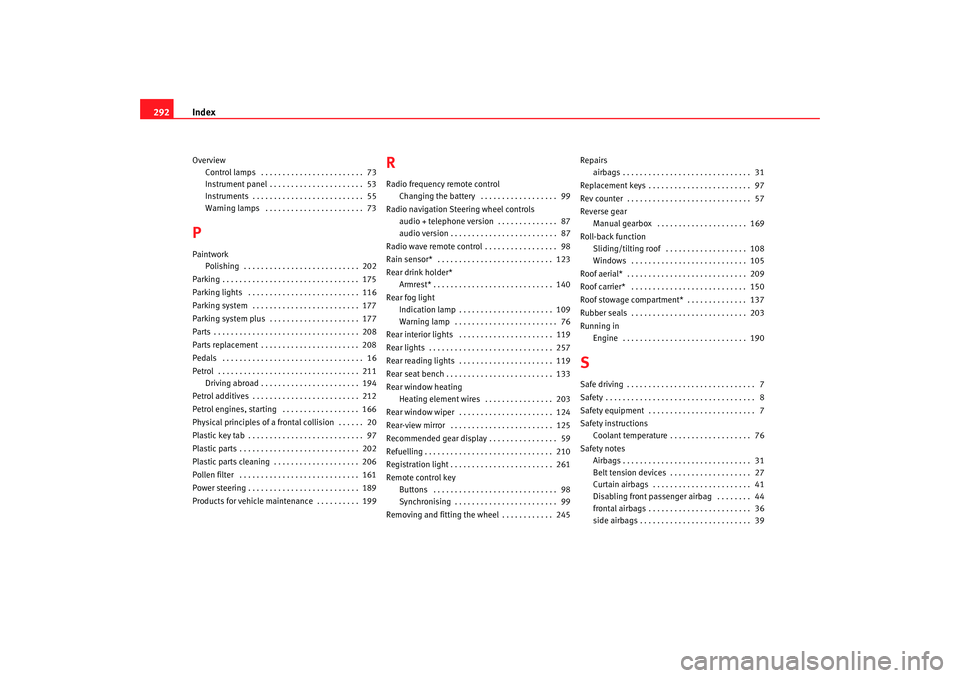
292Overview
Control lamps . . . . . . . . . . . . . . . . . . . . . . . . 73
Instrument panel . . . . . . . . . . . . . . . . . . . . . . 53
Instruments . . . . . . . . . . . . . . . . . . . . . . . . . . 55
Warning lamps . . . . . . . . . . . . . . . . . . . . . . . 73PPaintworkPolishing . . . . . . . . . . . . . . . . . . . . . . . . . . . 202
Parking . . . . . . . . . . . . . . . . . . . . . . . . . . . . . . . . 175
Parking lights . . . . . . . . . . . . . . . . . . . . . . . . . . 116
Parking system . . . . . . . . . . . . . . . . . . . . . . . . . 177
Parking system plus . . . . . . . . . . . . . . . . . . . . . 177
Parts . . . . . . . . . . . . . . . . . . . . . . . . . . . . . . . . . . 208
Parts replacement . . . . . . . . . . . . . . . . . . . . . . . 208
Pedals . . . . . . . . . . . . . . . . . . . . . . . . . . . . . . . . . 16
Petrol . . . . . . . . . . . . . . . . . . . . . . . . . . . . . . . . . 211 Driving abroad . . . . . . . . . . . . . . . . . . . . . . . 194
Petrol additives . . . . . . . . . . . . . . . . . . . . . . . . . 212
Petrol engines, starting . . . . . . . . . . . . . . . . . . 166
Physical principles of a frontal collision . . . . . . 20
Plastic key tab . . . . . . . . . . . . . . . . . . . . . . . . . . . 97
Plastic parts . . . . . . . . . . . . . . . . . . . . . . . . . . . . 202
Plastic parts cleaning . . . . . . . . . . . . . . . . . . . . 206
Pollen filter . . . . . . . . . . . . . . . . . . . . . . . . . . . . 161
Power steering . . . . . . . . . . . . . . . . . . . . . . . . . . 189
Products for vehicle maintenance . . . . . . . . . . 199
RRadio frequency remote control Changing the battery . . . . . . . . . . . . . . . . . . 99
Radio navigation Steering wheel controls audio + telephone version . . . . . . . . . . . . . . 87
audio version . . . . . . . . . . . . . . . . . . . . . . . . . 87
Radio wave remote control . . . . . . . . . . . . . . . . . 98
Rain sensor* . . . . . . . . . . . . . . . . . . . . . . . . . . . 123
Rear drink holder* Armrest* . . . . . . . . . . . . . . . . . . . . . . . . . . . . 140
Rear fog light Indication lamp . . . . . . . . . . . . . . . . . . . . . . 109
Warning lamp . . . . . . . . . . . . . . . . . . . . . . . . 76
Rear interior lights . . . . . . . . . . . . . . . . . . . . . . 119
Rear lights . . . . . . . . . . . . . . . . . . . . . . . . . . . . . 257
Rear reading lights . . . . . . . . . . . . . . . . . . . . . . 119
Rear seat bench . . . . . . . . . . . . . . . . . . . . . . . . . 133
Rear window heating Heating element wires . . . . . . . . . . . . . . . . 203
Rear window wiper . . . . . . . . . . . . . . . . . . . . . . 124
Rear-view mirror . . . . . . . . . . . . . . . . . . . . . . . . 125
Recommended gear display . . . . . . . . . . . . . . . . 59
Refuelling . . . . . . . . . . . . . . . . . . . . . . . . . . . . . . 210
Registration light . . . . . . . . . . . . . . . . . . . . . . . . 261
Remote control key Buttons . . . . . . . . . . . . . . . . . . . . . . . . . . . . . 98
Synchronising . . . . . . . . . . . . . . . . . . . . . . . . 99
Removing and fitting the wheel . . . . . . . . . . . . 245 Repairs
airbags . . . . . . . . . . . . . . . . . . . . . . . . . . . . . . 31
Replacement keys . . . . . . . . . . . . . . . . . . . . . . . . 97
Rev counter . . . . . . . . . . . . . . . . . . . . . . . . . . . . . 57
Reverse gear Manual gearbox . . . . . . . . . . . . . . . . . . . . . 169
Roll-back function Sliding/tilting roof . . . . . . . . . . . . . . . . . . . 108
Windows . . . . . . . . . . . . . . . . . . . . . . . . . . . 105
Roof aerial* . . . . . . . . . . . . . . . . . . . . . . . . . . . . 209
Roof carrier* . . . . . . . . . . . . . . . . . . . . . . . . . . . 150
Roof stowage compartment* . . . . . . . . . . . . . . 137
Rubber seals . . . . . . . . . . . . . . . . . . . . . . . . . . . 203
Running in Engine . . . . . . . . . . . . . . . . . . . . . . . . . . . . . 190
SSafe driving . . . . . . . . . . . . . . . . . . . . . . . . . . . . . . 7
Safety . . . . . . . . . . . . . . . . . . . . . . . . . . . . . . . . . . . 8
Safety equipment . . . . . . . . . . . . . . . . . . . . . . . . . 7
Safety instructionsCoolant temperature . . . . . . . . . . . . . . . . . . . 76
Safety notes Airbags . . . . . . . . . . . . . . . . . . . . . . . . . . . . . . 31
Belt tension devices . . . . . . . . . . . . . . . . . . . 27
Curtain airbags . . . . . . . . . . . . . . . . . . . . . . . 41
Disabling front passenger airbag . . . . . . . . 44
frontal airbags . . . . . . . . . . . . . . . . . . . . . . . . 36
side airbags . . . . . . . . . . . . . . . . . . . . . . . . . . 39
AlteaXL_EN.book Seite 292 M ontag, 2. Februar 2009 12:26 12
Page 294 of 297
Index293
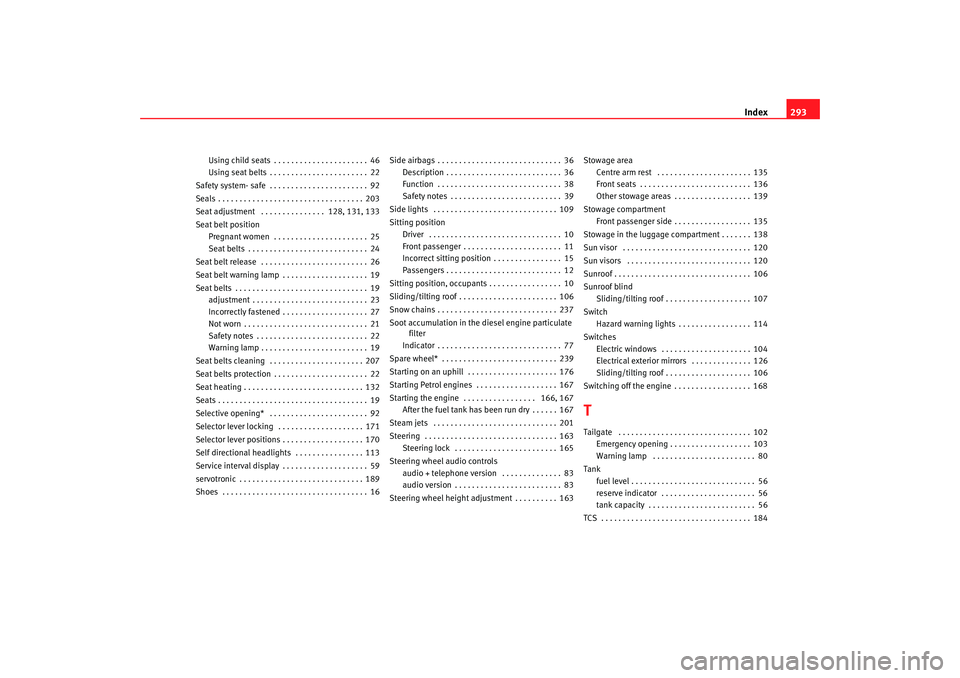
Using child seats . . . . . . . . . . . . . . . . . . . . . . 46
Using seat belts . . . . . . . . . . . . . . . . . . . . . . . 22
Safety system- safe . . . . . . . . . . . . . . . . . . . . . . . 92
Seals . . . . . . . . . . . . . . . . . . . . . . . . . . . . . . . . . . 203
Seat adjustment . . . . . . . . . . . . . . . 128, 131, 133
Seat belt position Pregnant women . . . . . . . . . . . . . . . . . . . . . . 25
Seat belts . . . . . . . . . . . . . . . . . . . . . . . . . . . . 24
Seat belt release . . . . . . . . . . . . . . . . . . . . . . . . . 26
Seat belt warning lamp . . . . . . . . . . . . . . . . . . . . 19
Seat belts . . . . . . . . . . . . . . . . . . . . . . . . . . . . . . . 19 adjustment . . . . . . . . . . . . . . . . . . . . . . . . . . . 23
Incorrectly fastened . . . . . . . . . . . . . . . . . . . . 27
Not worn . . . . . . . . . . . . . . . . . . . . . . . . . . . . . 21
Safety notes . . . . . . . . . . . . . . . . . . . . . . . . . . 22
Warning lamp . . . . . . . . . . . . . . . . . . . . . . . . . 19
Seat belts cleaning . . . . . . . . . . . . . . . . . . . . . . 207
Seat belts protection . . . . . . . . . . . . . . . . . . . . . . 22
Seat heating . . . . . . . . . . . . . . . . . . . . . . . . . . . . 132
Seats . . . . . . . . . . . . . . . . . . . . . . . . . . . . . . . . . . . 19
Selective opening* . . . . . . . . . . . . . . . . . . . . . . . 92
Selector lever locking . . . . . . . . . . . . . . . . . . . . 171
Selector lever positions . . . . . . . . . . . . . . . . . . . 170
Self directional headlights . . . . . . . . . . . . . . . . 113
Service interval display . . . . . . . . . . . . . . . . . . . . 59
servotronic . . . . . . . . . . . . . . . . . . . . . . . . . . . . . 189
Shoes . . . . . . . . . . . . . . . . . . . . . . . . . . . . . . . . . . 16 Side airbags . . . . . . . . . . . . . . . . . . . . . . . . . . . . . 36
Description . . . . . . . . . . . . . . . . . . . . . . . . . . . 36
Function . . . . . . . . . . . . . . . . . . . . . . . . . . . . . 38
Safety notes . . . . . . . . . . . . . . . . . . . . . . . . . . 39
Side lights . . . . . . . . . . . . . . . . . . . . . . . . . . . . . 109
Sitting position Driver . . . . . . . . . . . . . . . . . . . . . . . . . . . . . . . 10
Front passenger . . . . . . . . . . . . . . . . . . . . . . . 11
Incorrect sitting position . . . . . . . . . . . . . . . . 15
Passengers . . . . . . . . . . . . . . . . . . . . . . . . . . . 12
Sitting position, occupants . . . . . . . . . . . . . . . . . 10
Sliding/tilting roof . . . . . . . . . . . . . . . . . . . . . . . 106
Snow chains . . . . . . . . . . . . . . . . . . . . . . . . . . . . 237
Soot accumulation in the diesel engine particulate
filter
Indicator . . . . . . . . . . . . . . . . . . . . . . . . . . . . . 77
Spare wheel* . . . . . . . . . . . . . . . . . . . . . . . . . . . 239
Starting on an uphill . . . . . . . . . . . . . . . . . . . . . 176
Starting Petrol engines . . . . . . . . . . . . . . . . . . . 167
Starting the engine . . . . . . . . . . . . . . . . . 166, 167 After the fuel tank has been run dry . . . . . . 167
Steam jets . . . . . . . . . . . . . . . . . . . . . . . . . . . . . 201
Steering . . . . . . . . . . . . . . . . . . . . . . . . . . . . . . . 163 Steering lock . . . . . . . . . . . . . . . . . . . . . . . . 165
Steering wheel audio controls audio + telephone version . . . . . . . . . . . . . . 83
audio version . . . . . . . . . . . . . . . . . . . . . . . . . 83
Steering wheel height adjustment . . . . . . . . . . 163 Stowage area
Centre arm rest . . . . . . . . . . . . . . . . . . . . . . 135
Front seats . . . . . . . . . . . . . . . . . . . . . . . . . . 136
Other stowage areas . . . . . . . . . . . . . . . . . . 139
Stowage compartment Front passenger side . . . . . . . . . . . . . . . . . . 135
Stowage in the luggage compartment . . . . . . . 138
Sun visor . . . . . . . . . . . . . . . . . . . . . . . . . . . . . . 120
Sun visors . . . . . . . . . . . . . . . . . . . . . . . . . . . . . 120
Sunroof . . . . . . . . . . . . . . . . . . . . . . . . . . . . . . . . 106
Sunroof blind Sliding/tilting roof . . . . . . . . . . . . . . . . . . . . 107
Switch Hazard warning lights . . . . . . . . . . . . . . . . . 114
Switches Electric windows . . . . . . . . . . . . . . . . . . . . . 104
Electrical exterior mirrors . . . . . . . . . . . . . . 126
Sliding/tilting roof . . . . . . . . . . . . . . . . . . . . 106
Switching off the engine . . . . . . . . . . . . . . . . . . 168
TTailgate . . . . . . . . . . . . . . . . . . . . . . . . . . . . . . . 102 Emergency opening . . . . . . . . . . . . . . . . . . . 103
Warning lamp . . . . . . . . . . . . . . . . . . . . . . . . 80
Tank fuel level . . . . . . . . . . . . . . . . . . . . . . . . . . . . . 56
reserve indicator . . . . . . . . . . . . . . . . . . . . . . 56
tank capacity . . . . . . . . . . . . . . . . . . . . . . . . . 56
TCS . . . . . . . . . . . . . . . . . . . . . . . . . . . . . . . . . . . 184
AlteaXL_EN.book Seite 293 M ontag, 2. Februar 2009 12:26 12