technical data Seat Altea XL 2010 Owner's Manual
[x] Cancel search | Manufacturer: SEAT, Model Year: 2010, Model line: Altea XL, Model: Seat Altea XL 2010Pages: 312, PDF Size: 8.41 MB
Page 263 of 312
If and when261
Safety First
Operating instructions
Practical tips
Technical Data
Tyre repair kit (Tyre-Mobility-System)*General information and safety notesYour vehicle is equipped with a tyre repair kit: the Ty re Mo bil it y Syste m.
In the event of a tyre puncture, a sealing compound and an air compressor are
located in the luggage compartment under the floor panel.
The Tyre Mobility System will reliably seal punctures caused by the penetra-
tion of a foreign body of up to about 4 mm in diameter.
It is not necessary to remove the foreign body from the tyre.
Instructions for the sealing compound are located on the sealing compound
container.
Notes for the proper use of the air compressor are included in an additional
instruction leaflet.
WARNING
•Do not attempt to repair a puncture with the sealing compound if the
tyre has been damaged by driving the car after the tyre has lost its air.•Always observe warnings and follow instructions concerning
compressor and sealing compound carefully.•Do not drive faster than 80 km/h, avoid heavy acceleration, hard
braking and fast cornering.•Tyres which have been repaired with sealing compound are only suit-
able for temporary use over a short period. Therefore, please drive carefully
to the next available qualified workshop.For the sake of the environment
Used sealing compound containers should be disposed of at a proper facility.
Note
•If sealant should leak out, leave it to dry. When it has dried, you can pull
it off like a piece of foil.•Observe the expiry date stated on the sealing compound can. Have the
sealing compound exchanged by a qualified workshop.•Seek professional assistance if the repair of a tyre puncture is not
possible with the sealing compound.Preparation work
Certain steps must be taken before repairing a tyre.– If you have a flat tyre or puncture, park the vehicle as far away from the flow of traffic as possible.
–Apply the handbrake firmly.
– Engage first gear , or put the selector lever to position P.
–All passengers should leave the vehicle. They should wait in a
safe area (for instance behind the roadside crash barrier).
– Check whether a repair is possibl e using the Tyre Mobility System
“General information and safety notes.”
– Unscrew inflation cap from the affected wheel.
– Take the tyre repair kit out of the luggage compartment.
AlteaXL_EN.book Seite 261 Dienstag, 1. September 2009 10:37 10
Page 265 of 312
If and when263
Safety First
Operating instructions
Practical tips
Technical Data
FusesChanging a fuse
Blown fuses must be replaced
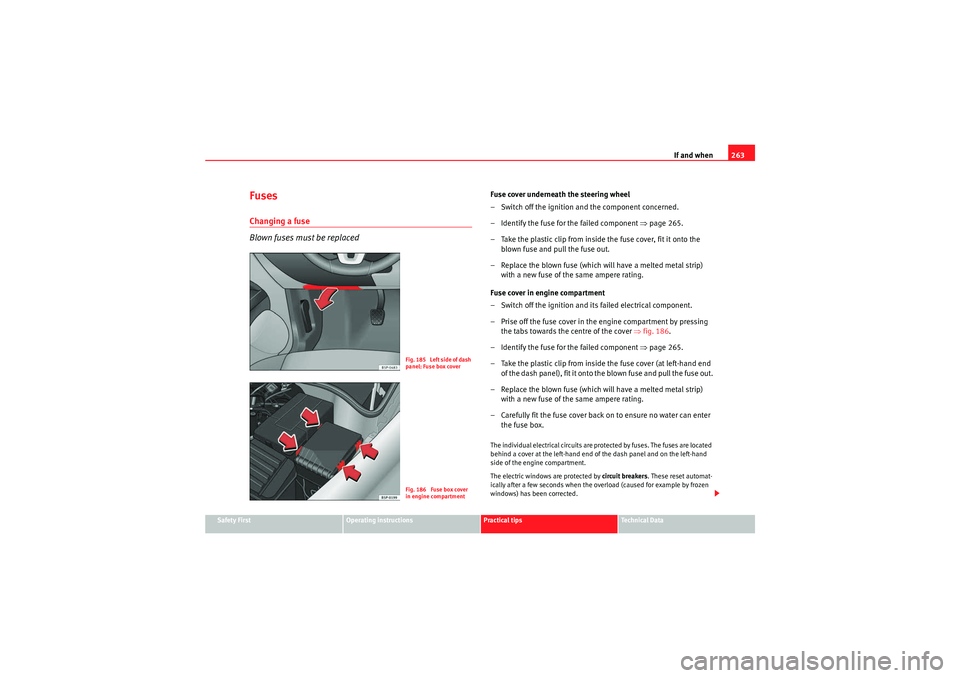
Fuse cover underneath the steering wheel
– Switch off the ignition and the component concerned.
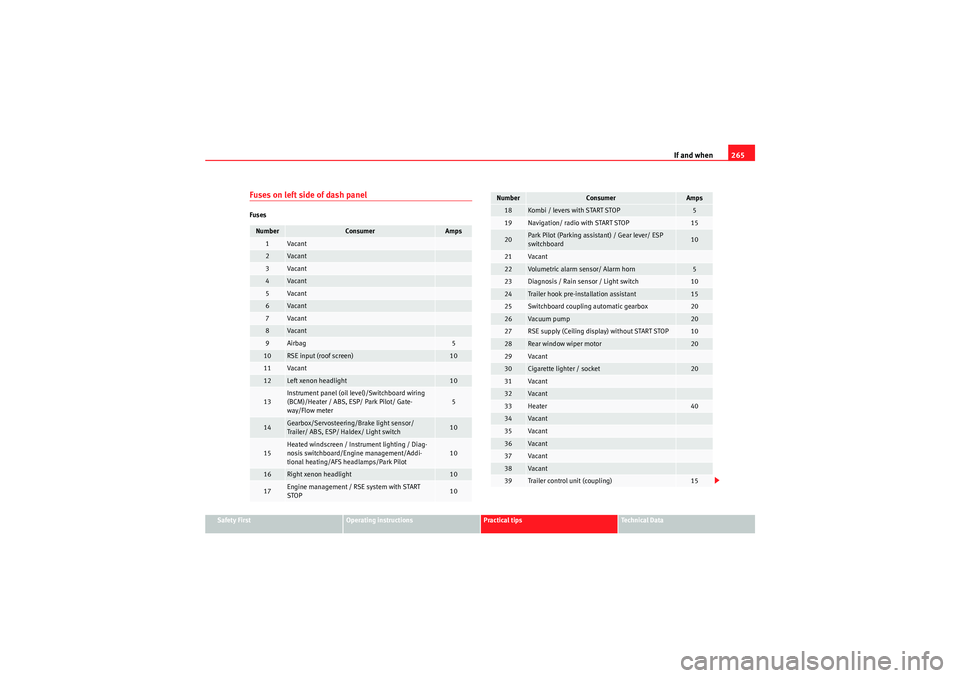
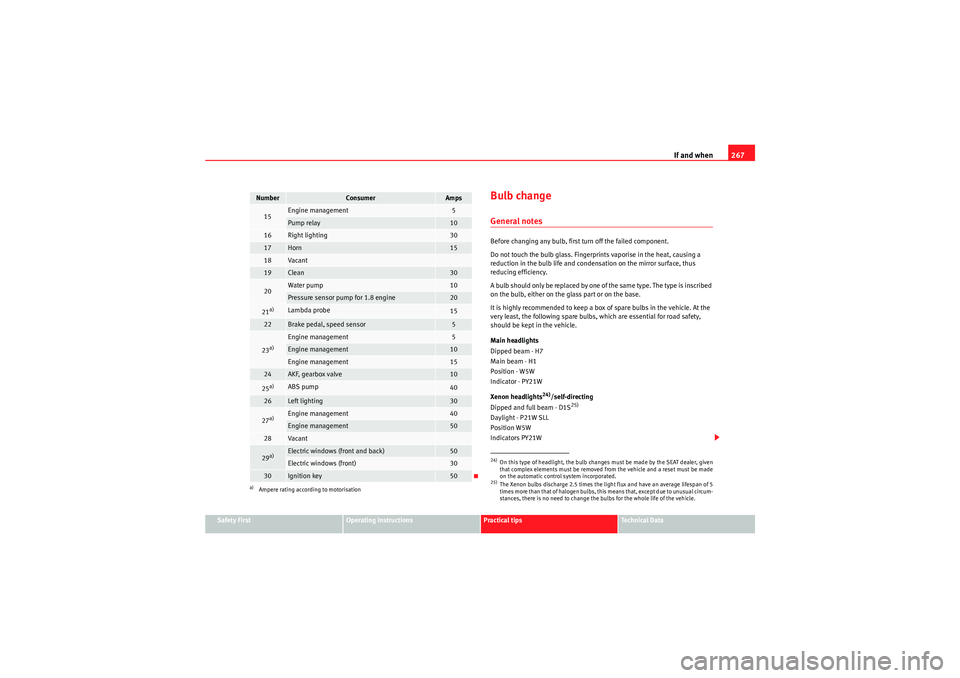
– Identify the fuse for the failed component ⇒page 265.
– Take the plastic clip from inside the fuse cover, fit it onto the blown fuse and pull the fuse out.
– Replace the blown fuse (which will have a melted metal strip) with a new fuse of the same ampere rating.
Fuse cover in engine compartment
– Switch off the ignition and its failed electrical component.
– Prise off the fuse cover in the engine compartment by pressing the tabs towards the centre of the cover ⇒fig. 186 .
– Identify the fuse for the failed component ⇒page 265.
– Take the plastic clip from inside the fuse cover (at left-hand end of the dash panel), fit it onto the blown fuse and pull the fuse out.
– Replace the blown fuse (which will have a melted metal strip) with a new fuse of the same ampere rating.
– Carefully fit the fuse cover back on to ensure no water can enter the fuse box.The individual electrical circuits are protected by fuses. The fuses are located
behind a cover at the left-hand end of the dash panel and on the left-hand
side of the engine compartment.
The electric windows are protected by circuit breakers . These reset automat-
ically after a few seconds when the overload (caused for example by frozen
windows) has been corrected.
Fig. 185 Left side of dash
panel: Fuse box coverFig. 186 Fuse box cover
in engine compartment
AlteaXL_EN.book Seite 263 Dienstag, 1. September 2009 10:37 10
Page 267 of 312
If and when265
Safety First
Operating instructions
Practical tips
Technical Data
Fuses on left side of dash panelFusesNumber
Consumer
Amps
1
Va can t
2
Va can t
3
Va can t
4
Va can t
5
Va can t
6
Va can t
7
Va can t
8
Va can t
9
Airbag
5
10
RSE input (roof screen)
10
11
Va can t
12
Left xenon headlight
10
13
Instrument panel (oil level)/Switchboard wiring
(BCM)/Heater / ABS, ESP/ Park Pilot/ Gate-
way/Flow meter
5
14
Gearbox/Servosteering/Brake light sensor/
Trailer/ ABS, ESP/ Haldex/ Light switch
10
15
Heated windscreen / Instrument lighting / Diag-
nosis switchboard/Engine management/Addi-
tional heating/AFS headlamps/Park Pilot
10
16
Right xenon headlight
10
17
Engine management / RSE system with START
STOP
10
18
Kombi / levers with START STOP
5
19
Navigation/ radio with START STOP
15
20
Park Pilot (Parking assistant) / Gear lever/ ESP
switchboard
10
21
Va can t
22
Volumetric alarm sensor/ Alarm horn
5
23
Diagnosis / Rain sensor / Light switch
10
24
Trailer hook pre-installation assistant
15
25
Switchboard coupling automatic gearbox
20
26
Vacuum pump
20
27
RSE supply (Ceiling display) without START STOP
10
28
Rear window wiper motor
20
29
Va can t
30
Cigarette lighter / socket
20
31
Va can t
32
Va can t
33
Heater
40
34
Va can t
35
Va can t
36
Va can t
37
Va can t
38
Va can t
39
Trailer control unit (coupling)
15
Number
Consumer
Amps
AlteaXL_EN.book Seite 265 Dienstag, 1. September 2009 10:37 10
Page 269 of 312
If and when267
Safety First
Operating instructions
Practical tips
Technical Data
Bulb changeGeneral notesBefore changing any bulb, first turn off the failed component.
Do not touch the bulb glass. Fingerprints vaporise in the heat, causing a
reduction in the bulb life and condensation on the mirror surface, thus
reducing efficiency.
A bulb should only be replaced by one of the sam e type. The type is inscribed
on the bulb, either on the glass part or on the base.
It is highly recommended to keep a box of spare bulbs in the vehicle. At the
very least, the following spare bulbs, which are essential for road safety,
should be kept in the vehicle.
Main headlights
Dipped beam - H7
Main beam - H1
Position - W5W
Indicator - PY21W
Xenon headlights
24)/self-directing
Dipped and full beam - D1S
25)
Daylight - P21W SLL
Position W5W
Indicators PY21W
15
Engine management
5
Pump relay
10
16
Right lighting
30
17
Horn
15
18
Vaca n t
19
Clean
30
20
Water pump
10
Pressure sensor pump for 1.8 engine
20
21a)
Lambda probe
15
22
Brake pedal, speed sensor
5
23a)
Engine management
5
Engine management
10
Engine management
15
24
AKF, gearbox valve
10
25a)
ABS pump
40
26
Left lighting
30
27a)
Engine management
40
Engine management
50
28
Vaca n t
29a)
Electric windows (front and back)
50
Electric windows (front)
30
30
Ignition key
50
a)Ampere rating according to motorisationNumber
Consumer
Amps
24)On this type of headlight, the bulb changes must be made by the SEAT dealer, given
that complex elements must be removed from the vehicle and a reset must be made
on the automatic control system incorporated.25)The Xenon bulbs discharge 2.5 times the light flux and have an average lifespan of 5
times more than that of halogen bulbs, this means that, except due to unusual circum-
stances, there is no need to change the bulbs for the whole life of the vehicle.
AlteaXL_EN.book Seite 267 Dienstag, 1. September 2009 10:37 10
Page 271 of 312
If and when269
Safety First
Operating instructions
Practical tips
Technical Data
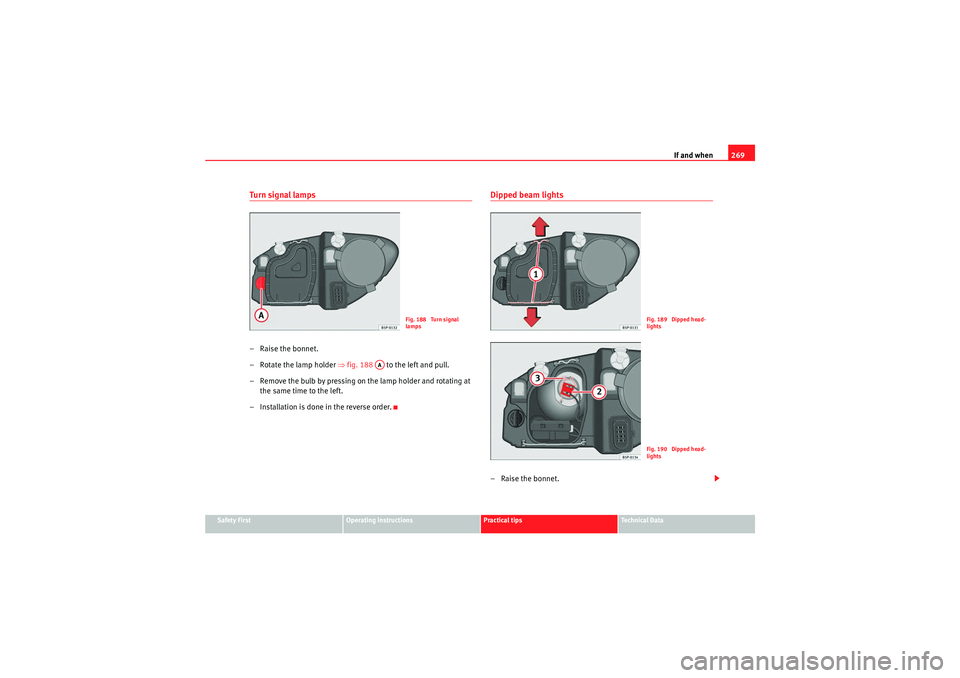
Turn signal lamps– Raise the bonnet.
– Rotate the lamp holder ⇒ fig. 188 to the left and pull.
– Remove the bulb by pressing on the lamp holder and rotating at the same time to the left.
– Installation is done in the reverse order.
Dipped beam lights– Raise the bonnet.
Fig. 188 Turn signal
lamps
AA
Fig. 189 Dipped head-
lightsFig. 190 Dipped head-
lights
AlteaXL_EN.book Seite 269 Dienstag, 1. September 2009 10:37 10
Page 273 of 312
If and when271
Safety First
Operating instructions
Practical tips
Technical Data
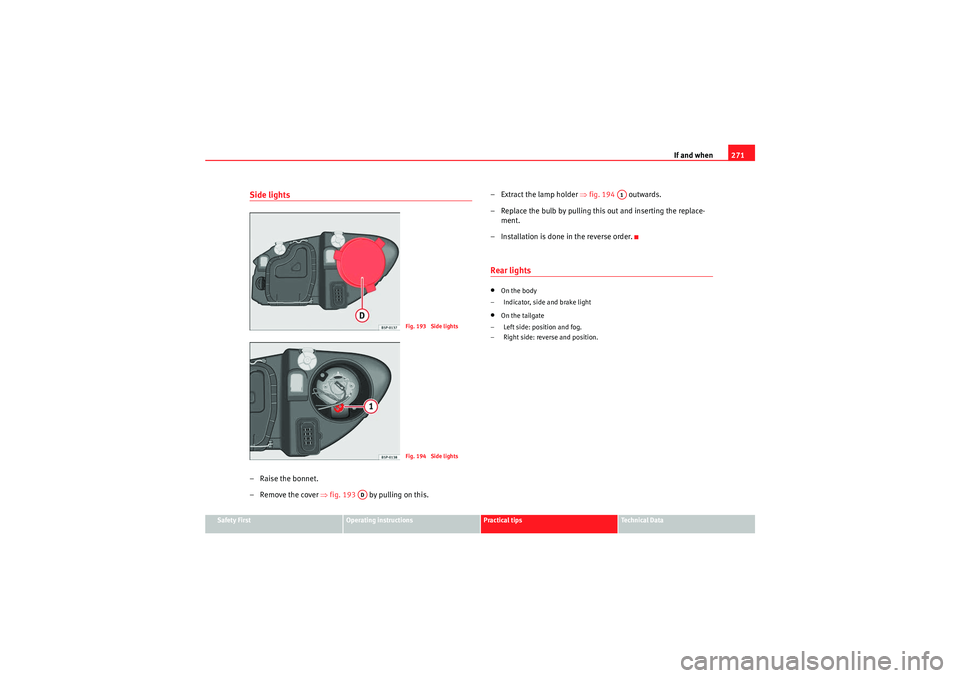
Side lights– Raise the bonnet.
– Remove the cover ⇒fig. 193 by pulling on this. –Extract the lamp holder
⇒fig. 194 outwards.
– Replace the bulb by pulling this out and inserting the replace- ment.
– Installation is done in the reverse order.
Rear lights•On the body
– Indicator, side and brake light•On the tailgate
– Left side: position and fog.
– Right side: reverse and position.
Fig. 193 Side lightsFig. 194 Side lights
AD
A1
AlteaXL_EN.book Seite 271 Dienstag, 1. September 2009 10:37 10
Page 275 of 312
If and when273
Safety First
Operating instructions
Practical tips
Technical Data
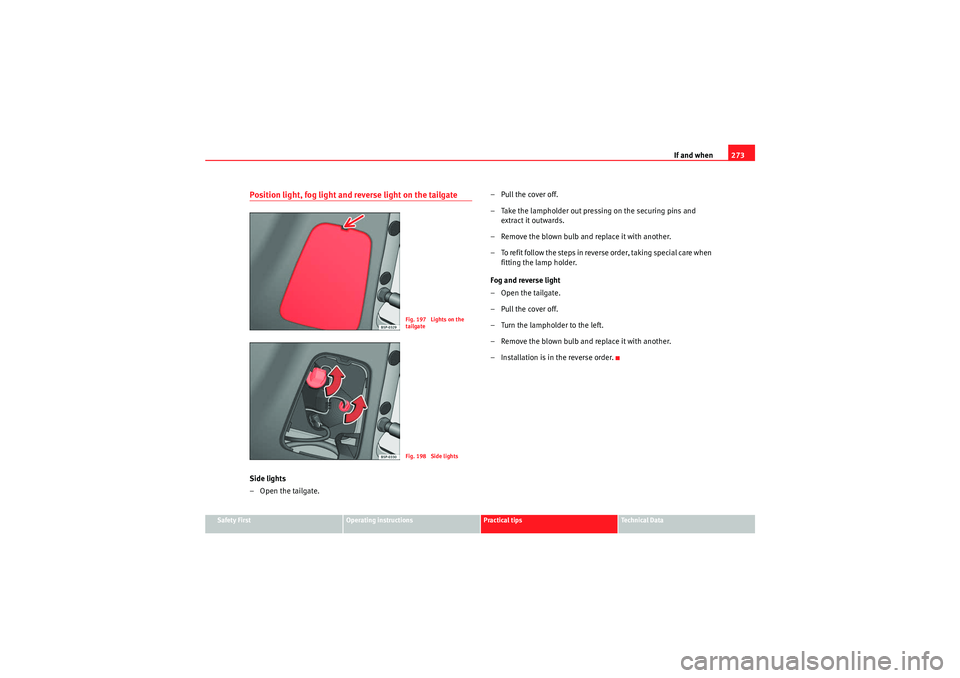
Position light, fog light and reverse light on the tailgateSide lights
–Open the tailgate. –Pull the cover off.
– Take the lampholder out pressing on the securing pins and
extract it outwards.
– Remove the blown bulb and replace it with another.
– To refit follow the steps in reverse order, taking special care when fitting the lamp holder.
Fog and reverse light
–Open the tailgate.
–Pull the cover off.
– Turn the lampholder to the left.
– Remove the blown bulb and replace it with another.
– Installation is in the reverse order.
Fig. 197 Lights on the
tailgateFig. 198 Side lights
AlteaXL_EN.book Seite 273 Dienstag, 1. September 2009 10:37 10
Page 277 of 312
If and when275
Safety First
Operating instructions
Practical tips
Technical Data
– Press the lamp sideways and remove it from the housing
⇒page 274, fig. 201 .Registration light
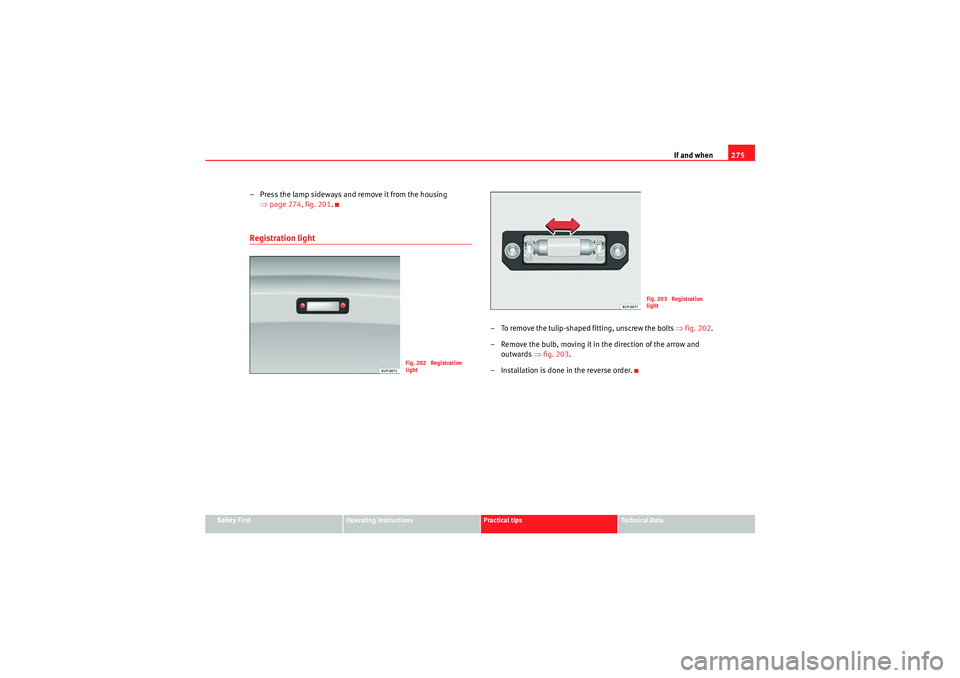
– To remove the tulip-shaped fitting, unscrew the bolts ⇒fig. 202 .
– Remove the bulb, moving it in the direction of the arrow and outwards ⇒fig. 203 .
– Installation is done in the reverse order.
Fig. 202 Registration
light
Fig. 203 Registration
light
AlteaXL_EN.book Seite 275 Dienstag, 1. September 2009 10:37 10
Page 279 of 312
If and when277
Safety First
Operating instructions
Practical tips
Technical Data
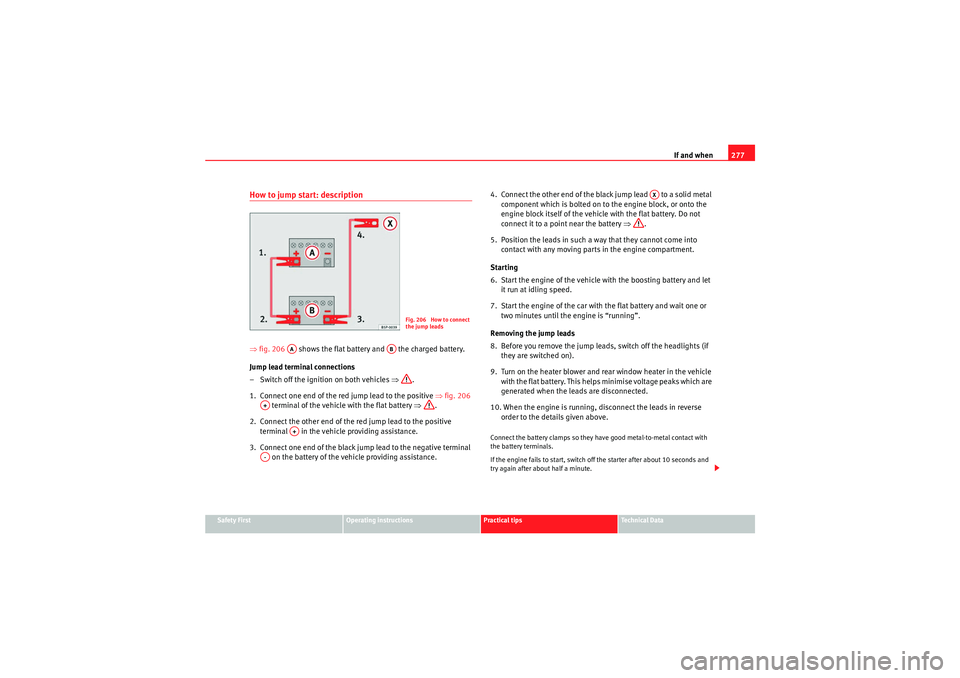
How to jump start: description⇒fig. 206 shows the flat battery and the charged battery.
Jump lead terminal connections
– Switch off the ignition on both vehicles ⇒.
1. Connect one end of the red jump lead to the positive ⇒fig. 206
terminal of the vehicle with the flat battery ⇒.
2. Connect the other end of the red jump lead to the positive terminal in the vehicle providing assistance.
3. Connect one end of the black jump lead to the negative terminal on the battery of the vehicle providing assistance. 4. Connect the other end of the black jump lead to a solid metal
component which is bolted on to the engine block, or onto the
engine block itself of the vehicle with the flat battery. Do not
connect it to a point near the battery ⇒.
5. Position the leads in such a way that they cannot come into contact with any moving parts in the engine compartment.
Starting
6. Start the engine of the vehicle with the boosting battery and let it run at idling speed.
7. Start the engine of the car with the flat battery and wait one or two minutes until the engine is “running”.
Removing the jump leads
8. Before you remove the jump leads, switch off the headlights (if they are switched on).
9. Turn on the heater blower and rear window heater in the vehicle with the flat battery. This helps minimise voltage peaks which are
generated when the leads are disconnected.
10. When the engine is running, disconnect the leads in reverse order to the details given above.
Connect the battery clamps so they have good metal-to-metal contact with
the battery terminals.
If the engine fails to start, switch off the starter after about 10 seconds and
try again after about half a minute.
Fig. 206 How to connect
the jump leads
AA
AB
A+
A+
A-
AX
AlteaXL_EN.book Seite 277 Dienstag, 1. September 2009 10:37 10
Page 281 of 312
If and when279
Safety First
Operating instructions
Practical tips
Technical Data
Towing and tow-startingTo w - s t a r t i n g
The use of jump leads is pr eferable to tow-starting.We recommend that you do not tow-start your vehicle. Jump-starting
is preferable ⇒page 276.
However, if your vehicle has to be tow-started:
– Engage the 2
nd or the 3
rd gear.
– Keep the clutch pressed down.
– Switch the ignition on.
– Once both vehicles are moving, release the clutch.
– As soon as the engine starts, press the clutch and move the gear lever into neutral. This helps to prevent driving into the towing
vehicle.
WARNING
The risk of accidents is high when tow-starting. The vehicle being towed
can easily collide with the towing vehicle.
Caution
When tow-starting, fuel could enter the catalytic converter and damage it.
General notesPlease observe the following po ints if you use a tow-rope:
Notes for the driver of the towing vehicle
– Drive slowly at first until the tow-rope is taut. Then accelerate gradually.
– Begin and change gears cautiously. If you are driving an auto- matic vehicle, accelerate gently.
– Remember that the brake servo and power steering are not working in the vehicle you are towing. Brake earlier than you
would normally, but with a more gentle pressure on the brake.
Notes for the driver of the towed vehicle
– Ensure that the tow-rope remains taut at all times when towing.Tow-rope or tow-bar
It is easier and safer to tow a vehicle with a tow-bar. You should only use a
tow-rope if you do not have a tow-bar.
A tow-rope should be slightly elastic to reduce the loading on both vehicles.
It is advisable to use a tow-rope made of synthetic fibre or similarly elastic
material.
Attach the tow-rope or the tow-bar only to the towing eyes provided or a
towing bracket.
Driving style
Towing requires some experience, especially when using a tow-rope. Both
drivers should be familiar with the technique required for towing. Inexperi-
enced drivers should not attempt to tow-start or tow away another vehicle.
AlteaXL_EN.book Seite 279 Dienstag, 1. September 2009 10:37 10