technical specifications Seat Altea XL 2011 Owner's Manual
[x] Cancel search | Manufacturer: SEAT, Model Year: 2011, Model line: Altea XL, Model: Seat Altea XL 2011Pages: 319, PDF Size: 8.92 MB
Page 283 of 319
If and when281
Safety First
Operating Instructions
Practical Tips
Technical Specifications
– Press the bulb sideways and remove it from the housing
⇒page 280, fig. 200 .Registration light
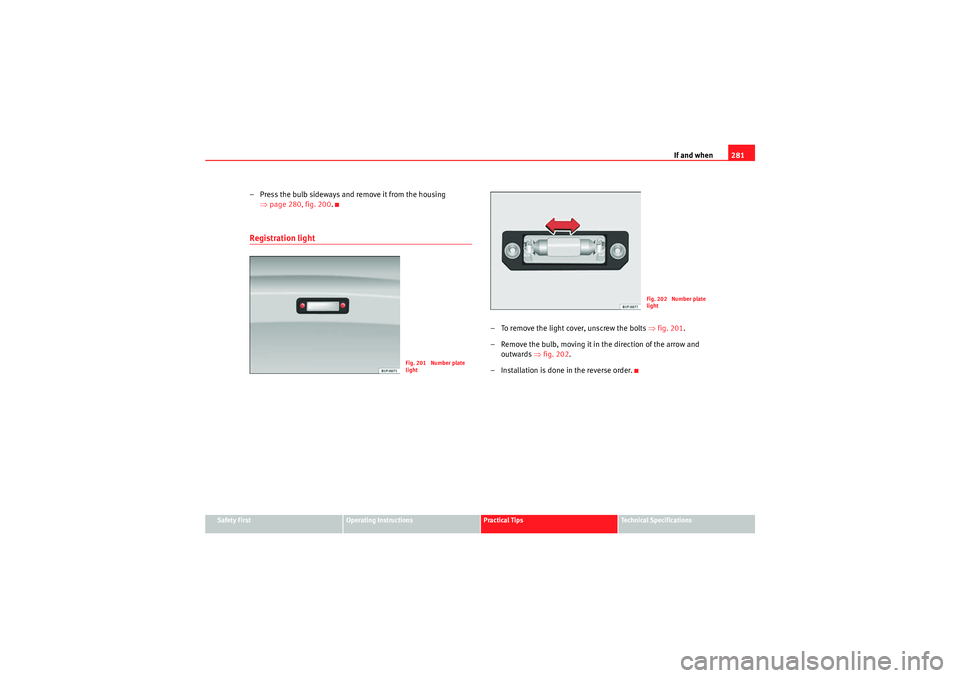
– To remove the light cover, unscrew the bolts ⇒fig. 201 .
– Remove the bulb, moving it in the direction of the arrow and outwards ⇒fig. 202 .
– Installation is done in the reverse order.
Fig. 201 Number plate
light
Fig. 202 Number plate
light
AlteaXL_EN.book Seite 281 Donnerstag, 9. September 2010 12:13 12
Page 285 of 319
If and when283
Safety First
Operating Instructions
Practical Tips
Technical Specifications
How to jump start: descriptionJump lead terminal connections
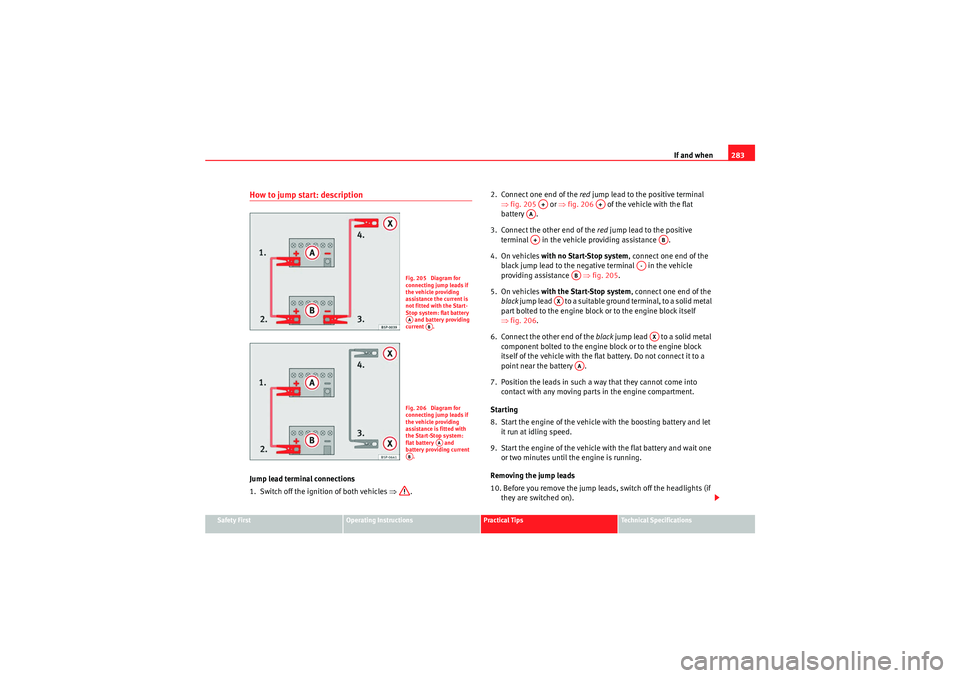
1. Switch off the ignition of both vehicles ⇒ .2. Connect one end of the
red jump lead to the positive terminal
⇒ fig. 205 or ⇒fig. 206 of the vehicle with the flat
battery .
3. Connect the other end of the red jump lead to the positive
terminal in the vehicle providing assistance .
4. On vehicles with no Start-Stop system, connect one end of the
black jump lead to the negative terminal in the vehicle
providing assistance ⇒fig. 205 .
5. On vehicles with the Start-Stop system , connect one end of the
black jump lead to a suitable ground terminal, to a solid metal
part bolted to the engine block or to the engine block itself
⇒ fig. 206 .
6. Connect the other end of the black jump lead to a solid metal
component bolted to the engine block or to the engine block
itself of the vehicle with the flat battery. Do not connect it to a
point near the battery .
7. Position the leads in such a way that they cannot come into contact with any moving parts in the engine compartment.
Starting
8. Start the engine of the vehicle with the boosting battery and let it run at idling speed.
9. Start the engine of the vehicle with the flat battery and wait one or two minutes until the engine is running.
Removing the jump leads
10. Before you remove the jump leads, switch off the headlights (if they are switched on).
Fig. 205 Diagram for
connecting jump leads if
the vehicle providing
assistance the current is
not fitted with the Start-
Stop system: flat battery and battery providing
current .AA
AB
Fig. 206 Diagram for
connecting jump leads if
the vehicle providing
assistance is fitted with
the Start-Stop system:
flat battery and
battery providing current .
AA
AB
A+
A+
AAA+
AB
A-
AB
AX
AX
AA
AlteaXL_EN.book Seite 283 Donnerstag, 9. September 2010 12:13 12
Page 287 of 319
If and when285
Safety First
Operating Instructions
Practical Tips
Technical Specifications
Towing and tow-startingTo w - s t a r t i n g
The use of jump leads is pr eferable to tow-starting.We recommend that you do not tow-start your vehicle. Jump-starting
is preferable ⇒page 282.
However, if your vehicle has to be tow-started:
– Engage the 2nd or the 3rd gear.
– Keep the clutch pressed down.
– Switch the ignition on.
– Once both vehicles are moving, release the clutch.
– As soon as the engine starts, press the clutch and move the gear lever into neutral. This helps to prevent driving into the towing
vehicle.
WARNING
The risk of accidents is high when tow-starting. The vehicle being towed
can easily collide with the towing vehicle.
Caution
When tow-starting, fuel could enter the catalytic converter and damage it.
General notesPlease observe the following po ints if you use a tow-rope:
Notes for the driver of the towing vehicle
– Drive slowly at first until the tow-rope is taut. Then accelerate gradually.
– Begin and change gears cautiously. If you are driving an auto- matic vehicle, accelerate gently.
– Remember that the brake servo and power steering are not working in the vehicle you are towing. Brake sooner than normal
and pressing the pedal gently.
Notes for the driver of the towed vehicle
– Ensure that the tow-rope remains taut at all times when towing.Tow-rope or tow-bar
It is easier and safer to tow a vehicle with a tow-bar. You should only use a
tow-rope if you do not have a tow-bar.
A tow-rope should be slightly elastic to reduce the loading on both vehicles.
It is advisable to use a tow-rope made of synthetic fibre or similarly elastic
material.
Attach the tow-rope or the tow-bar only to the towing eyes provided or a
towing bracket.
Driving style
Towing requires some experience, especially when using a tow-rope. Both
drivers should be familiar with the technique required for towing. Inexperi-
enced drivers should not attempt to tow.
AlteaXL_EN.book Seite 285 Donnerstag, 9. September 2010 12:13 12
Page 289 of 319
If and when287
Safety First
Operating Instructions
Practical Tips
Technical Specifications
Towing ringsFitting the towing eye
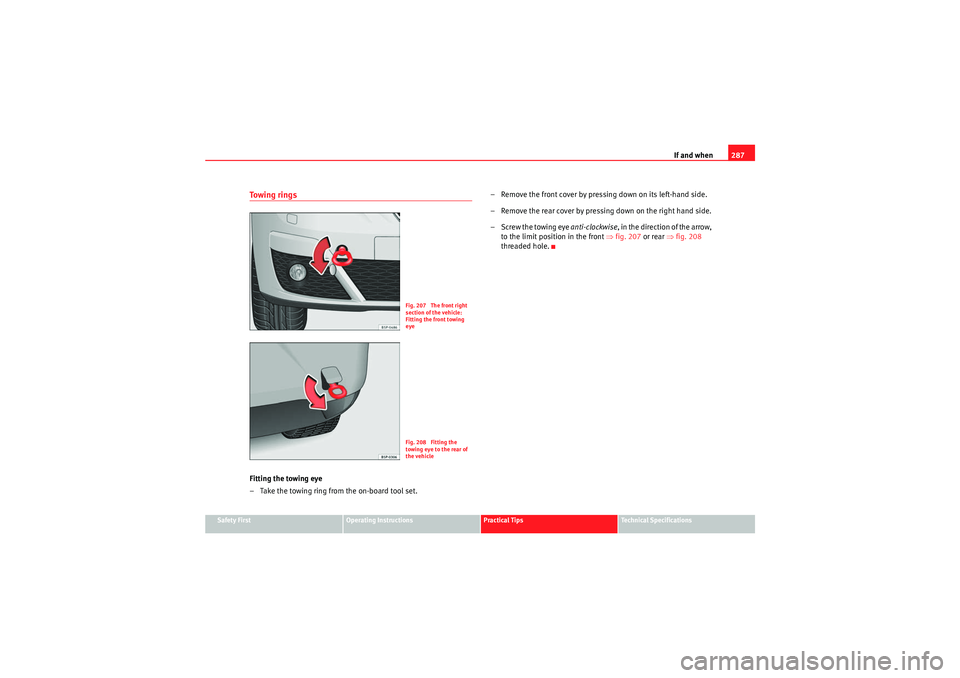
– Take the towing ring from the on-board tool set. – Remove the front cover by pressing down on its left-hand side.
– Remove the rear cover by pressing down on the right hand side.
– Screw the towing eye
anti-clockwise, in the direction of the arrow,
to the limit position in the front ⇒fig. 207 or rear ⇒fig. 208
threaded hole.
Fig. 207 The front right
section of the vehicle:
Fitting the front towing
eyeFig. 208 Fitting the
towing eye to the rear of
the vehicle
AlteaXL_EN.book Seite 287 Donnerstag, 9. September 2010 12:13 12
Page 291 of 319

Description of specifications289
Safety First
Operating Instructions
Practical Tips
Technical Specifications
Technical SpecificationsDescription of specificationsImportant informationImportant
The information in the vehicle documentation always has
precedence.All technical specifications provided in this manual are valid for the standard
model in Spain. The vehicle data card included in the Inspection and Mainte-
nance Plan in the vehicle documents shows which engine is installed in the
vehicle.
The figures may be different depending on if additional equipment is fitted,
for different models, for special vehicles and for other countries. Abbreviations used in the Technical Specifications section
Abbrevia-
tion
Meaning
kW
Kilowatt, engine power measurement.
PS
Pferdestärke (horsepower), formerly used to denote engine
power.
rpm
Revolutions per minute - engine speed.
Nm
Newton metres, unit of engine torque.
l/100 km
Fuel consumption in litres per 100 km.
g/km
Carbon dioxide emissions in grams per km travelled.
CO2
Carbon dioxide
CN
Cetane number, indication of the diesel combustion power.
RON
Research octane number, indication of the knock resistance
of petrol.
AlteaXL_EN.book Seite 289 Donnerstag, 9. September 2010 12:13 12
Page 293 of 319

Description of specifications291
Safety First
Operating Instructions
Practical Tips
Technical Specifications
Information on fuel consumptionFuel consumption
The consumption and emission details shown on the vehicle
data sticker differ from one vehicle to another.The fuel consumption and CO
2 emissions of the vehicle can be found on the
vehicle data sticker.
The fuel consumption and emissions figures given are based on the vehicle
weight category, which is determined according to the engine/gearbox
combination and the equipment fitted.
The consumption and emission figures are calculated in accordance with the
tests indicated in regulations 715/2007/EC and 692/2008/EC.
Note
•Actual consumption may vary from quoted test values, depending on
personal driving style, road and traffic conditions, the weather and the
vehicle condition.WeightsKerb weight refers to the basic model with a fuel tank filled to 90% capacity
and without optional extras. The figure quoted includes 75 kg to allow for the
weight of the driver.
For special versions and optional equipment fittings or for the addition of
accessories, the weight of the vehicle will increase ⇒.
WARNING
•Please note that the centre of gravity may shift when transporting
heavy objects; this may affect the vehicle’s handling and lead to an acci-
dent. Always adjust your speed and driving style to suit road conditions
and requirements.•Never exceed the gross axle weight rating or the gross vehicle weight
rating. If the allowed axle load or the allowed total weight is exceeded, the
driving characteristics of the vehicle may change, leading to accidents,
injuries and damage to the vehicle.
To w i n g a t r a i l e rTrailer weightsTrailer weight
The trailer weights and drawbar loads approved are selected in intensive
trials according to precisely defined criteria. The approved trailer weights are
valid for vehicles in the EU for maximum speeds of 80 km/h (in certain
circumstances up to 100 km/h). The figures may be different in other coun-
tries. All data in the official vehicle documents take precedence over these
data ⇒ .
Drawbar load
The maximum permitted drawbar load on the ball joint of the towing bracket
must not exceed 75 kg.
In the interest of road safety, we recommend that you always tow
approaching the maximum drawbar load. The response of the trailer on the
road will be poor if the drawbar load is too small.
AlteaXL_EN.book Seite 291 Donnerstag, 9. September 2010 12:13 12
Page 295 of 319
Technical Specifications293
Safety First
Operating Instructions
Practical Tips
Technical Specifications
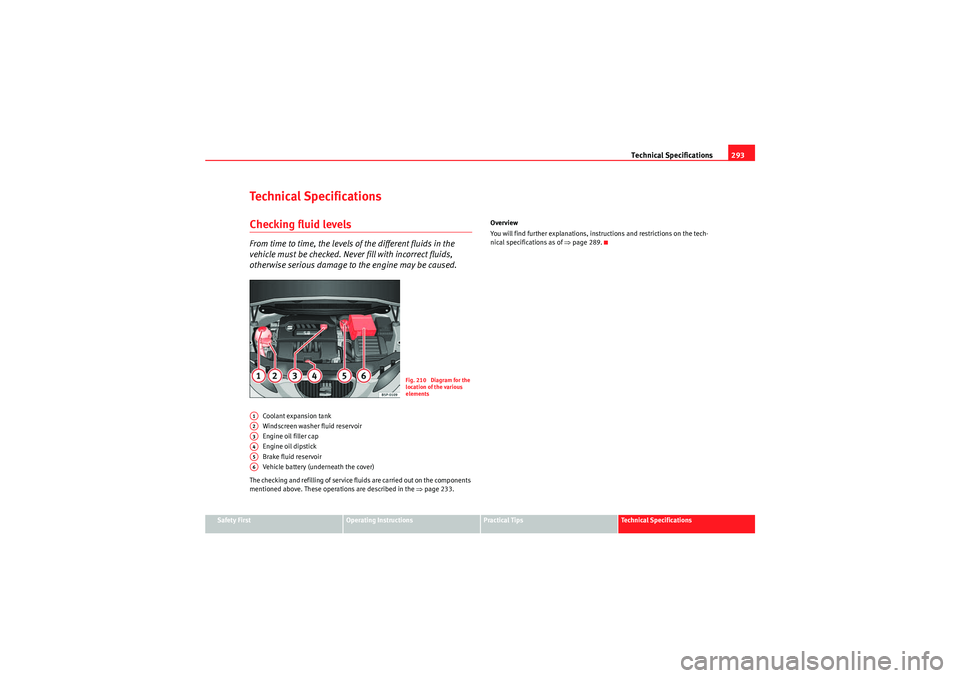
Technical SpecificationsChecking fluid levelsFrom time to time, the levels of the different fluids in the
vehicle must be checked. Never fill with incorrect fluids,
otherwise serious damage to the engine may be caused.
Coolant expansion tank
Windscreen washer fluid reservoir
Engine oil filler cap
Engine oil dipstick
Brake fluid reservoir
Vehicle battery (underneath the cover)
The checking and refilling of service fluids are carried out on the components
mentioned above. These operations are described in the ⇒page 233. Overview
You will find further explanations, instructions and restrictions on the tech-
nical specifications as of
⇒page 289.
Fig. 210 Diagram for the
location of the various
elements
A1A2A3A4A5A6
AlteaXL_EN.book Seite 293 Donnerstag, 9. September 2010 12:13 12
Page 296 of 319
Technical Specifications
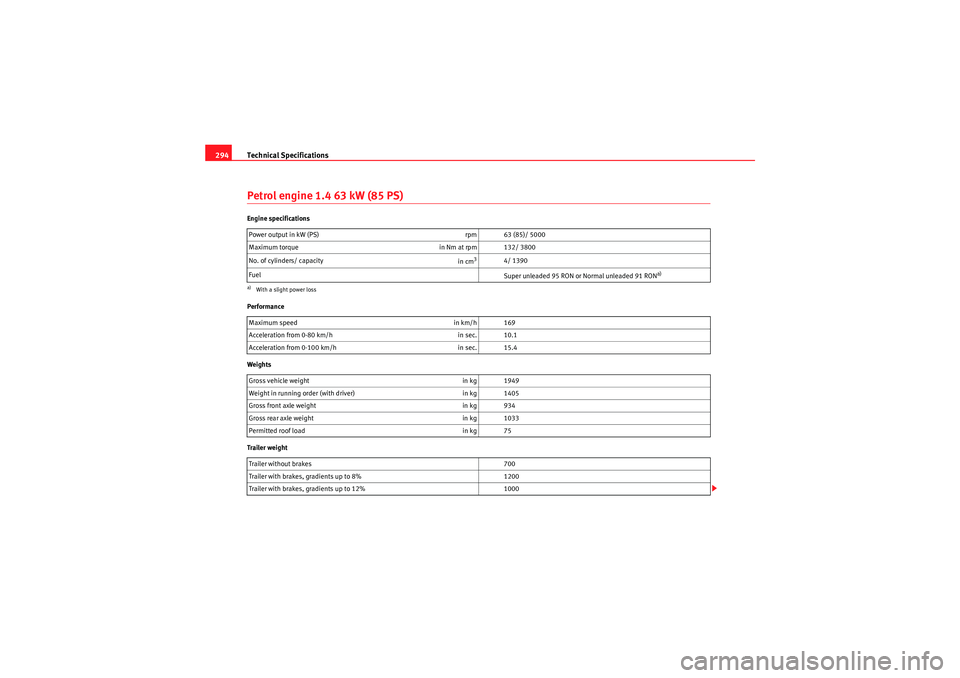
294Petrol engine 1.4 63 kW (85 PS)Engine specifications
Performance
Weights
Trailer weight Power output in kW (PS)
rpm 63 (85)/ 5000
Maximum torque in Nm at rpm 132/ 3800
No. of cylinders/ capacity in cm
3
4/ 1390
Fuel Super unleaded 95 RON or Normal unleaded 91 RON
a)
a)With a slight power lossMaximum speedin km/h 169
Acceleration from 0-80 km/h in sec. 10.1
Acceleration from 0-100 km/h in sec. 15.4
Gross vehicle weight in kg 1949
Weight in running order (with driver) in kg 1405
Gross front axle weight in kg 934
Gross rear axle weight in kg 1033
Permitted roof load in kg 75
Trailer without brakes 700
Trailer with brakes, gradients up to 8% 1200
Trailer with brakes, gradients up to 12% 1000
AlteaXL_EN.book Seite 294 Donnerstag, 9. September 2010 12:13 12
Page 297 of 319
Technical Specifications295
Safety First
Operating Instructions
Practical Tips
Technical Specifications
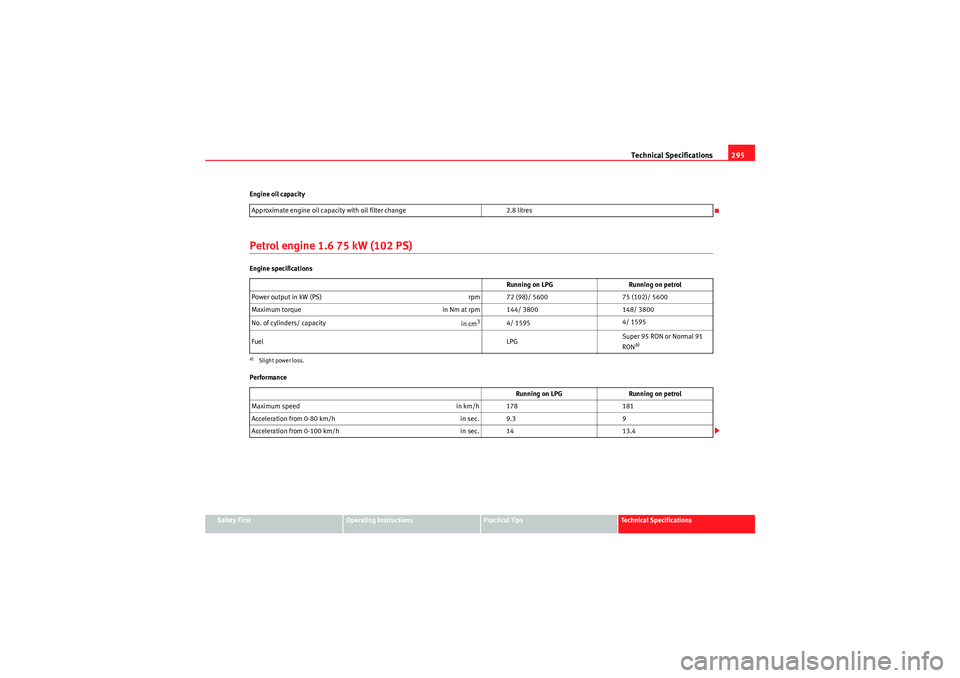
Engine oil capacity
Petrol engine 1.6 75 kW (102 PS)Engine specifications
Performance
Approximate engine oil capacity with oil filter change
2.8 litres
Running on LPG Running on petrol
Power output in kW (PS) rpm 72 (98)/ 560075 (102)/ 5600
Maximum torque in Nm at rpm 144/ 3800148/ 3800
No. of cylinders/ capacity in cm
3
4/ 15954/ 1595
Fuel LPGSuper 95 RON or Normal 91
RON
a)
a)Slight power loss.
Running on LPG
Running on petrol
Maximum speed in km/h 178181
Acceleration from 0-80 km/h in sec. 9.39
Acceleration from 0-100 km/h in sec. 1413.4
AlteaXL_EN.book Seite 295 Donnerstag, 9. September 2010 12:13 12
Page 298 of 319
Technical Specifications
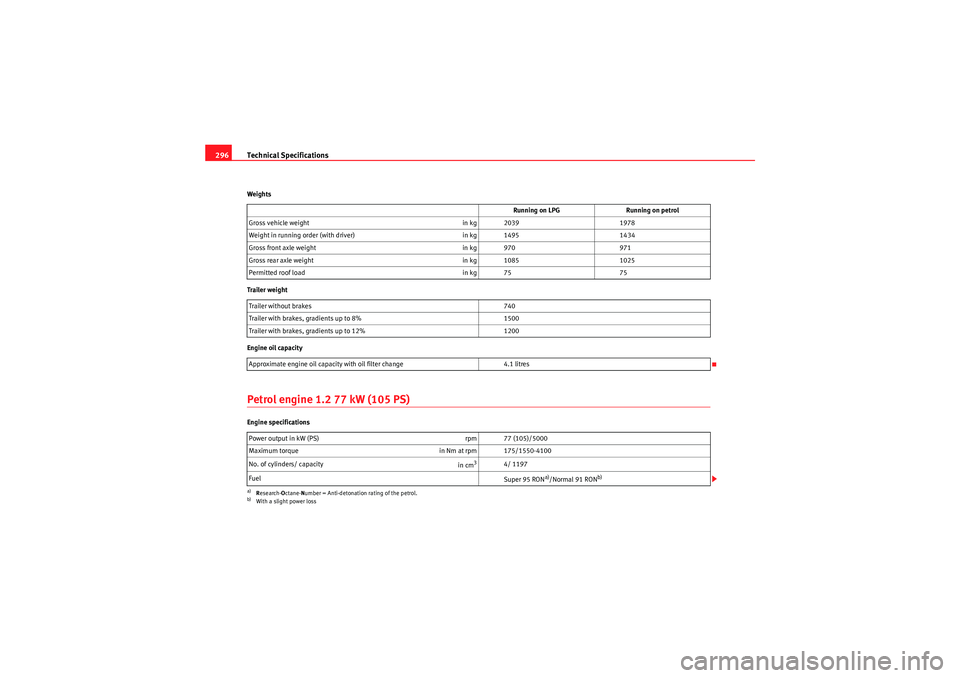
296Weights
Trailer weight
Engine oil capacityPetrol engine 1.2 77 kW (105 PS)Engine specifications Running on LPG
Running on petrol
Gross vehicle weight in kg 20391978
Weight in running order (with driver) in kg 14951434
Gross front axle weight in kg 970971
Gross rear axle weight in kg 10851025
Permitted roof load in kg 7575
Trailer without brakes 740
Trailer with brakes, gradients up to 8% 1500
Trailer with brakes, gradients up to 12% 1200
Approximate engine oil capacity with oil filter change 4.1 litres
Power output in kW (PS) rpm 77 (105)/5000
Maximum torque in Nm at rpm 175/1550-4100
No. of cylinders/ capacity in cm
3
4/ 1197
Fuel Super 95 RON
a)/Normal 91 RON
b)
a)Research- Octane- Number = Anti-detonation rating of the petrol.b)With a slight power loss
AlteaXL_EN.book Seite 296 Donnerstag, 9. September 2010 12:13 12