coolant temperature Seat Altea XL 2011 User Guide
[x] Cancel search | Manufacturer: SEAT, Model Year: 2011, Model line: Altea XL, Model: Seat Altea XL 2011Pages: 319, PDF Size: 8.92 MB
Page 180 of 319
Driving
178Driving with LPG*Your SEAT vehicle has a bivalent engine able to run on either LPG or petrol.
The LPG tank ⇒page 228, “Refuelling with LPG” is in the spare wheel well
⇒ .
It is possible to change from LPG to petrol while the engine is running, even
if the vehicle is moving, by pressing the button located on the centre
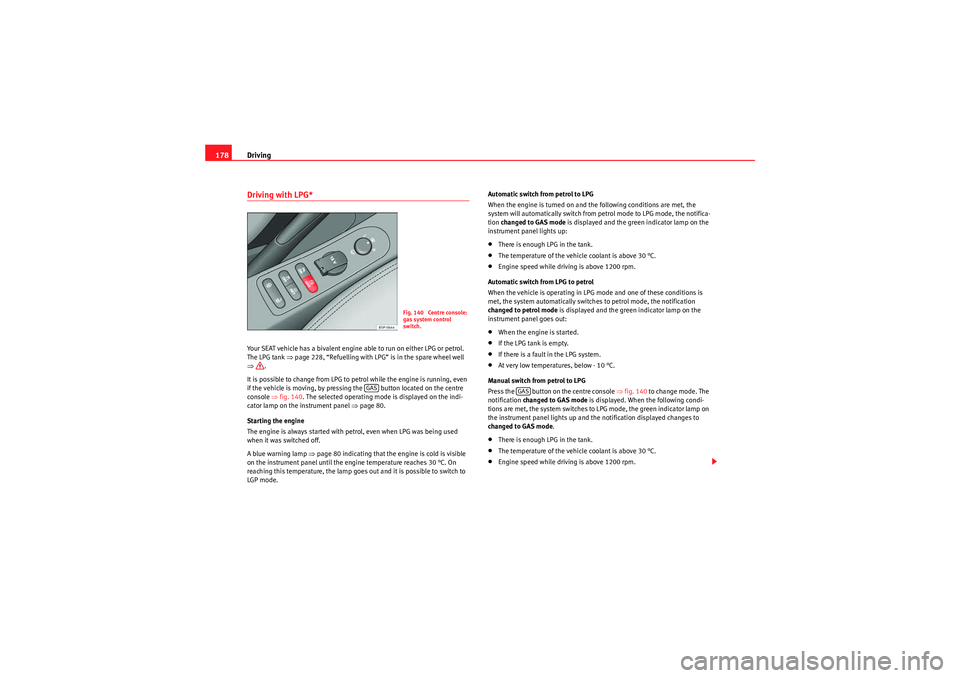
console ⇒ fig. 140. The selected operating mode is displayed on the indi-
cator lamp on the instrument panel ⇒page 80.
Starting the engine
The engine is always started with petrol, even when LPG was being used
when it was switched off.
A blue warning lamp ⇒page 80 indicating that the engine is cold is visible
on the instrument panel until the engine temperature reaches 30 °C. On
reaching this temperature, the lamp goes out and it is possible to switch to
LGP mode. Automatic switch from petrol to LPG
When the engine is turned on and the following conditions are met, the
system will automatically switch from petrol mode to LPG mode, the notifica-
tion
changed to GAS mode is displayed and the green indicator lamp on the
instrument panel lights up:
•There is enough LPG in the tank.•The temperature of the vehicle coolant is above 30 °C.•Engine speed while driving is above 1200 rpm.
Automatic switch from LPG to petrol
When the vehicle is operating in LPG mode and one of these conditions is
met, the system automatically switches to petrol mode, the notification
changed to petrol mode is displayed and the green indicator lamp on the
instrument panel goes out:•When the engine is started.•If the LPG tank is empty.•If there is a fault in the LPG system.•At very low temperatures, below - 10 °C.
Manual switch from petrol to LPG
Press the button on the centre console ⇒ fig. 140 to change mode. The
notification changed to GAS mode is displayed. When the following condi-
tions are met, the system switches to LPG mode, the green indicator lamp on
the instrument panel lights up and the notification displayed changes to
changed to GAS mode .•There is enough LPG in the tank.•The temperature of the vehicle coolant is above 30 °C.•Engine speed while driving is above 1200 rpm.
Fig. 140 Centre console:
gas system control
switch.
GAS
GAS
AlteaXL_EN.book Seite 178 Donnerstag, 9. September 2010 12:13 12
Page 182 of 319
Driving
180Start-Stop function interruption
In the following situations, the Start-Stop function will be interrupted and the
engine will automatically start:•The vehicle starts moving.•The brake pedal is pressed several times in a row.•The battery has been discharged excessively.•The Start-Stop System is manually deactivated.•The windscreen de-mist function is turned on.•The temperature of the passenger compartment exceeds the comfort
limits (button ⇒page 169, fig. 135 should be selected).•If in an increase in airflow ⇒page 169, fig. 135 is required for more
than three presses.•Temperature setting HI or LO is selected.•The engine coolant temperature is insufficient.•The alternator is faulty, for example the V-belt has ruptured.•If any of the conditions described in the previous section are not fulfilled.WARNING
Never allow the vehicle to move with the engine off for any reason. You
could lose control of your vehicle. This could cause an accident and serious
injury.•The brake ser vo does not work with the engine off. You need more force
to stop the vehicle.•Power steering does not work when the engine is not running. That is
why it is much more difficult to turn the steering wheel.•Disconnect the Start-Stop system when driving through water (fording
streams, etc.).
Note
•For vehicles with the Star t-Stop function and a manual gearbox, when the
engine is started, the clutch must be pressed.•When the conditions for the Start-Stop function are not fulfilled, the
instrument panel displays the Start-Stop indicator dimmed.•The vehicle can be restarted by rotating the steering wheel three times,
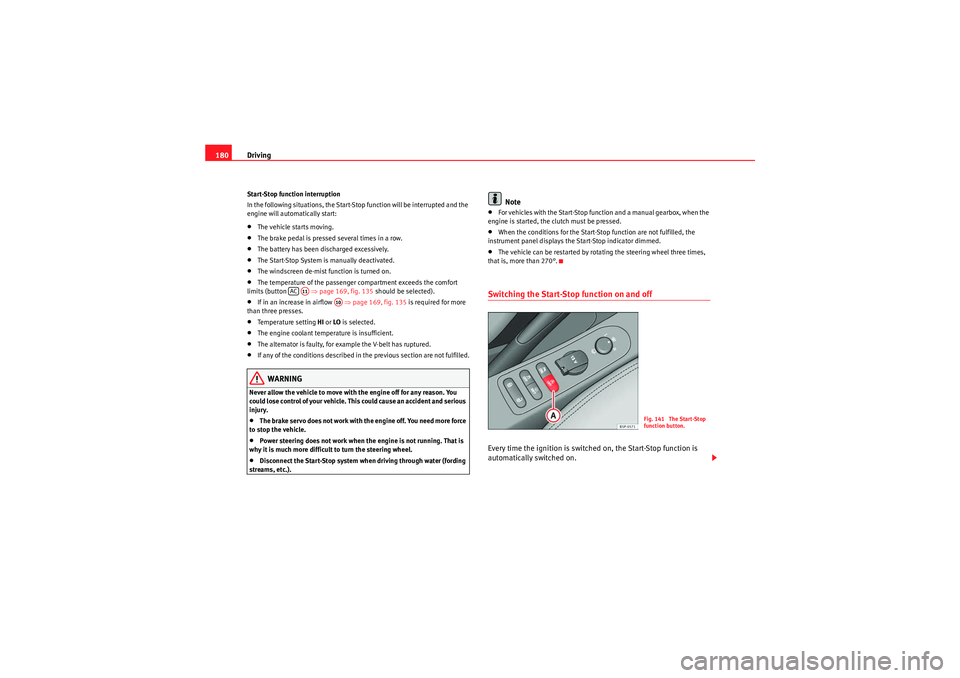
that is, more than 270°.Switching the Start-Stop function on and offEvery time the ignition is switched on, the Start-Stop function is
automatically switched on.
ACA11
A10
Fig. 141 The Start-Stop
function button.
AlteaXL_EN.book Seite 180 Donnerstag, 9. September 2010 12:13 12
Page 214 of 319
Trailer towing
212•Find out whether special regulations apply to towing a trailer in your
country.Ball coupling of towing bracket*Depending on the model version, the spherical head on the trailer hook may
be stored in the tool box.
The ball coupling is provided with instructions on fitting and removing the
ball coupling of the towing bracket.
WARNING
The towing bracket ball coupling must be stored securely in the luggage
compartment to prevent them being flung through the vehicle and causing
injury.
Note
•By law, the ball coupling must be re moved if a trailer is not being towed
and it obscures the number plate.Driving tipsDriving with a trailer always requires extra care.Weight distribution
The weight distribution of a loaded trailer with an unladen vehicle is very
unfavourable. However, if this cannot be avoided, drive extra slowly to allow
for the unbalanced weight distribution. Speed
The stability of the vehicle and trailer is reduced with increasing speed. For
this reason, it is advisable not to drive at the maximum permissible speed in
an unfavourable road, weather or wind conditions. This applies especially
when driving downhill.
You should always reduce speed immediately if the trailer shows the slightest
sign of
snaking . Never try to stop the “snaking” by increasing speed.
Always brake in due course. If the trailer has an overrun brake, apply the
brakes gently at first and then, firmly. This will prevent the jerking that can be
caused by the trailer wheels locking. Select a low gear in due course before
going down a steep downhill. This enables you to use the engine braking to
slow down the vehicle.
Reheating
At very high temperatures and during prolonged slopes, driving in a low gear
and high engine speed, always monitor the coolant temperature gauge
⇒ page 55.
Electronic Stability Programme*
The ESP* system helps to stabilise the trailer in case of skidding or rocking.
AlteaXL_EN.book Seite 212 Donnerstag, 9. September 2010 12:13 12
Page 235 of 319
Checking and refilling levels233
Safety First
Operating Instructions
Practical Tips
Technical Specifications
Filter pre-heater
Your vehicle is fitted with a fuel filter glow plug system, making it well
equipped for operation in winter. This ensures that the fuel system remains
operational to approx. -24 °C, provided you use winter diesel which is safe to
-15 °C.
However, if the fuel has waxed to such an extent that the engine will not start
at temperatures of under -24 °C, simply place the vehicle in a warm place for
a while.
Caution
Do not mix fuel additives (thinners or similar products) with diesel fuel.Working in the engine compartmentSafety instructions on workin
g in the engine compartment
Any work carried out in the engine compartment or on the
engine must be carried out cautiously.Before starting any work on the engine or in the engine compart-
ment:
1. Switch off the engine and remove the key from the ignition.
2. Apply the handbrake.
3. Move the gear lever to neutral or the selector lever to position P.
4. Wait for the engine to cool down.
5. Keep children away from the vehicle. 6. Raise the bonnet
⇒page 235.
You should not do any work in the engine compartment unless you know
exactly how to carry out the jobs and have the correct tools! Have the work
carried out by a specialised workshop if you are uncertain.
All service fluids and consumables, e.g. coolant, engine oil, spark plugs and
batteries, are being constantly developed. SEAT provides a constant flow of
information to the Authorised Service Centres concerning modifications. For
this reason, we recommend you to have service fluids and consumables
replaced by an Authorised Service Centre. Please observe the relevant
instructions ⇒page 224. The engine compartment of the vehicle is a
hazardous area ⇒.
WARNING
All work on the engine or in the engine compartment, e.g. checking and
refilling fluids, involves a risk of injury and scalding as well as the risk of
accident or fire.•Never open the bonnet if you see steam, smoke or coolant escaping
from the engine compartment. Otherwise, there is a risk of sustaining
burns. Wait until no more steam or coolant is emitted, then allow the
engine to cool before carefully opening the bonnet.•Switch off the engine and remove the key from the ignition.•Apply the handbrake and move the gear lever to neutral or selector
lever to position P.•Keep children away from the vehicle.•Never touch hot engine parts. There is a risk of burns.•Never spill liquids on a hot engine or on a hot exhaust gas system. This
is a fire hazard.•Avoid causing short-circuits in the electrical system, particularly at the
points where the jump leads are attached ⇒page 283. The battery could
explode.
AlteaXL_EN.book Seite 233 Donnerstag, 9. September 2010 12:13 12
Page 236 of 319
Checking and refilling levels
234•Never touch the radiator fan. It is temperature controlled and could
start automatically, even when the engine has been switched off and the
key removed from the ignition!•Do not unscrew the cap on the coolant reservoir when the engine is hot.
If the coolant is hot, the cooling system will be pressurised!•Protect face, hands and arms by covering the cap with a large, thick
cloth to protect against escaping coolant and steam.•Al wa ys m ake s u re yo u ha ve n o t l e f t a ny o bj e c t s , s u ch as cl e an i n g cl o t h s
and tools, in the engine compartment.•If you have to work underneath the vehicle, you must use suitable
stands additionally to support the vehicle, there is a risk of accident!. A
hydraulic jack is insufficient for securing the vehicle and there is a risk of
injury.•If any work has to be performed when the engine is started or with the
engine running, there is an additional, potentially fatal, safety risk from the
rotating parts, such as the drive belts, alternator, radiator fan, etc., and
from the high-voltage ignition system. You should also observe the
following points:
−Never touch the electrical wiring of the ignition system.
− Ensure that jewellery, loose clothing and long hair do not get
trapped in rotating engine parts. Da nger of death. Before starting any
work remove jewellery, tie back and cover hair, and wear tight-fitting
clothes.
− Never accelerate with a gear engaged without taking the necessary
precautions. The vehicle could move, even if the handbrake is applied.
Danger of death.•If work has to be carried out on the fuel system or on electrical compo-
nents, you must observe the following safety notes in addition to the above
warnings:
−Always disconnect the battery. The vehicle must be unlocked when
this is done, otherwise the alarm will be triggered. −
Do not smoke.
− Never work near naked flames.
− Always have a fire extinguisher on hand.
Caution
When topping up service fluids, make sure not to mistake them. Using the
wrong fluids could cause serious malfunctions and engine damage!
For the sake of the environment
Service fluids leaks are harmful to the environment. For this reason you
should make regular checks on the grou nd underneath your vehicle. If you
find spots of oil or other fluids, have your vehicle inspected at a specialised
workshop.
WARNING (continued)
WARNING (continued)
AlteaXL_EN.book Seite 234 Donnerstag, 9. September 2010 12:13 12
Page 242 of 319
Checking and refilling levels
240•Never pour oil down drains or into the ground.•Use a suitable container when draining the used oil. It must be large
enough to hold all the engine oil.CoolantCoolant specifications
Coolant is a mixture of water and at least 40% coolant addi-
tive.The cooling system must be filled with a mixture of water and at least 40 % of
our G 12+ additive or an additive with the TT-VW 774 F specification (it has a
purple colour). This mixture provides the necessary freeze protection down to
-25 °C and protects the alloy parts of the cooling system against corrosion. It
also prevents scaling and raises the boiling point of the coolant.
The concentration of coolant must always be at least 40% - even if freeze
protection is not required.
If greater freeze protection is required in very cold climates, the proportion of
the G 12+ additive can be increased. However, the percentage of coolant
add it iv es s ho uld n ot e xcee d 6 0% , as this wo u ld re d uce t he fr ee ze pro tec ti on.
It would also reduce the cooling effect. A mixture with 60% additive will give
antifreeze protection to approx. -40 °C.
WARNING
•The coolant additive is toxic. There is a toxic risk. Always keep the
coolant additive in the original container which should be stored out of the
reach of children. The same applies to coolant which you have drained off.
•The G 12+ additive must be added in sufficient quantities to provide
anti-freeze protection at the coldest ambient temperatures that can be
expected. At extremely cold outside temperatures, the coolant could
freeze, causing the vehicle to breakdown. As the heater would not work
either, there is a risk of freezing to death.Caution
•Other additives may give considerably inferior corrosion protection. The
resulting corrosion in the cooling system can lead to a loss of coolant,
causing serious damage to the engine.•The G 12+ additive (purple) can be mixed with the G 12 (red) or G 11 addi-
tive. Never mix G12 (red) with G 11.WARNING (continued)
AlteaXL_EN.book Seite 240 Donnerstag, 9. September 2010 12:13 12
Page 310 of 319
Index
308CCatalytic converter . . . . . . . . . . . . . . . . . . . . . . 206
CD changer . . . . . . . . . . . . . . . . . . . . . . . . . . . . 144
Central locking . . . . . . . . . . . . . . . . . . . . . . . . . . 99
Automatic speed dependent locking and un-locking system* . . . . . . . . . . . . . . . . . . . . 101
Emergency unlocking system . . . . . . . . . . . 101
Locking system for involuntary unlocking . 101
Selective unlocking system* . . . . . . . . . . . 100
Unlocking system* . . . . . . . . . . . . . . . . . . . 101
Central locking button Locking . . . . . . . . . . . . . . . . . . . . . . . . . . . . 102
Unlocking . . . . . . . . . . . . . . . . . . . . . . . . . . . 102
Centre armrest . . . . . . . . . . . . . . . . . . . . . . . . . . 144
Cetane number . . . . . . . . . . . . . . . . . . . . . . . . . 232
Changing a wheel . . . . . . . . . . . . . . . . . . . . . . . 260
Changing gear See Manual gearbox . . . . . . . . . . . . . . . . . . 182
Changing gear in tiptronic mode . . . . . . . . . . . 186
Changing the bulbs Main headlight bulbs . . . . . . . . . . . . . . . . . 274
Tail lights . . . . . . . . . . . . . . . . . . . . . . . . . . . 277
Changing the main headlight bulbs dipped beam headlights . . . . . . . . . . . . . . 275
Main beam headlights . . . . . . . . . . . . . . . . 276
Side lights . . . . . . . . . . . . . . . . . . . . . . . . . . 277
Turn signal bulbs . . . . . . . . . . . . . . . . . . . . 275
Changing the tail light bulbs Side light, fog light and tail light on the tailgate279 Changing the tail lights
Luggage compartment lights . . . . . . . . . . . 280
Turn signal, side and brake lights on the body278
Changing windscreen wiper blades . . . . . . . . . 243
Chassis number . . . . . . . . . . . . . . . . . . . . . . . . 290
Checking . . . . . . . . . . . . . . . . . . . . . . . . . . . . . . 248
Checking battery electrolyte level . . . . . . . . . . 248
Checking engine oil level . . . . . . . . . . . . . . . . . 237
Child safety . . . . . . . . . . . . . . . . . . . . . . . . . . . . . 46
Child seat . . . . . . . . . . . . . . . . . . . . . . . . . . . . . . . 48 Categorisation in groups . . . . . . . . . . . . . . . 48
Group 1 . . . . . . . . . . . . . . . . . . . . . . . . . . . . . 49
Group 2 . . . . . . . . . . . . . . . . . . . . . . . . . . . . . 49
Group 3 . . . . . . . . . . . . . . . . . . . . . . . . . . . . . 49
Groups 0 and 0+ . . . . . . . . . . . . . . . . . . . . . . 48
Safety notes . . . . . . . . . . . . . . . . . . . . . . . . . . 46
Securing . . . . . . . . . . . . . . . . . . . . . . . . . . . . . 51
Child seats ISOFIX system . . . . . . . . . . . . . . . . . . . . . . . . 52
on the front passenger seat . . . . . . . . . . . . . 31
Top Tether system . . . . . . . . . . . . . . . . . . . . . 52
Cigarette lighter* . . . . . . . . . . . . . . . . . . . . . . . . 153
Cleaning alloy wheels . . . . . . . . . . . . . . . . . . . . 220
Cleaning chrome . . . . . . . . . . . . . . . . . . . . . . . . 219
Cleaning engine compartment . . . . . . . . . . . . . 221
Cleaning steel wheel rims . . . . . . . . . . . . . . . . 220
Cleaning windows . . . . . . . . . . . . . . . . . . . . . . . 218
Climatic* . . . . . . . . . . . . . . . . . . . . . . . . . . . . . . 162
Climatronic General notes . . . . . . . . . . . . . . . . . . . . . . . 170 Clock . . . . . . . . . . . . . . . . . . . . . . . . . . . . . . . . . . 59
Cloth seat covers cleaning . . . . . . . . . . . . . . . . 222
Clothes hook . . . . . . . . . . . . . . . . . . . . . . . . . . . 148
Cockpit . . . . . . . . . . . . . . . . . . . . . . . . . . . . . . . . . 55
Coming/leaving home function . . . . . . . . . . . . 121
Compartment for on-board documentation . . 144
Control lamps . . . . . . . . . . . . . . . . . . . . . . . . . . . 77
Control lighting . . . . . . . . . . . . . . . . . . . . . . . . . . 55
Controls
Electric windows . . . . . . . . . . . . . . . . . . . . . 113
Exterior mirrors . . . . . . . . . . . . . . . . . . . . . . 135
Sliding/tilting sunroof . . . . . . . . . . . . . . . . 115
Convenience closing Sliding/tilting sunroof . . . . . . . . . . . . . . . . 116
Windows . . . . . . . . . . . . . . . . . . . . . . . . . . . 115
Convenience opening Windows . . . . . . . . . . . . . . . . . . . . . . . . . . . 115
Coolant . . . . . . . . . . . . . . . . . . . . . . . . . . . 240, 241 Warning lamp . . . . . . . . . . . . . . . . . . . . . . . . 66
Coolant level . . . . . . . . . . . . . . . . . . . . . . . . . . . 241 Warning lamp . . . . . . . . . . . . . . . . . . . . . . . . 82
Coolant loss . . . . . . . . . . . . . . . . . . . . . . . . . . . . 241
Coolant temperature Gauge . . . . . . . . . . . . . . . . . . . . . . . . . . . . . . 58
Safety instructions . . . . . . . . . . . . . . . . . . . . 83
Correct adjustment of front seat head restraints . . 13
Correct adjustment of rear seat head restraints In-use and non-use positions . . . . . . . . . . . 14
AlteaXL_EN.book Seite 308 Donnerstag, 9. September 2010 12:13 12
Page 315 of 319
Index313
Roof storage compartment* . . . . . . . . . . . . . . . 146
Rubber seals . . . . . . . . . . . . . . . . . . . . . . . . . . . 219
Run-flat tyres . . . . . . . . . . . . . . . . . . . . . . . . . . . 253
Running in
Engine . . . . . . . . . . . . . . . . . . . . . . . . . . . . . 205SSafe driving . . . . . . . . . . . . . . . . . . . . . . . . . . . . . . 7
Safety . . . . . . . . . . . . . . . . . . . . . . . . . . . . . . . . . . . 8
Safety equipment . . . . . . . . . . . . . . . . . . . . . . . . . 7
Safety instructionsCoolant temperature . . . . . . . . . . . . . . . . . . . 83
Safety notes Airbags . . . . . . . . . . . . . . . . . . . . . . . . . . . . . . 32
Curtain airbags . . . . . . . . . . . . . . . . . . . . . . . 42
Deactivating front passenger airbag . . . . . . 45
Front airbags . . . . . . . . . . . . . . . . . . . . . . . . . 37
Seat belt tensioners . . . . . . . . . . . . . . . . . . . 29
Side airbags . . . . . . . . . . . . . . . . . . . . . . . . . . 40
Using child seats . . . . . . . . . . . . . . . . . . . . . . 46
Using seat belts . . . . . . . . . . . . . . . . . . . . . . . 23
Safety system - Safe . . . . . . . . . . . . . . . . . . . . . 100
Seals . . . . . . . . . . . . . . . . . . . . . . . . . . . . . . . . . . 219
Seat adjustment . . . . . . . . . . . . . . . 137, 140, 142
Seat belt cleaning . . . . . . . . . . . . . . . . . . . . . . . 223
Seat belt position Pregnant women . . . . . . . . . . . . . . . . . . . . . . 26
Seat belts . . . . . . . . . . . . . . . . . . . . . . . . . . . . 25
Seat belt protection . . . . . . . . . . . . . . . . . . . . . . . 23
Seat belt release . . . . . . . . . . . . . . . . . . . . . . . . . 27 Seat belt tensioner
Warning lamp . . . . . . . . . . . . . . . . . . . . . . . . . 31
Seat belt tensioners . . . . . . . . . . . . . . . . . . . . . . 28
Seat belt warning lamp . . . . . . . . . . . . . . . . . . . . 19
Seat belts . . . . . . . . . . . . . . . . . . . . . . . . . . . . . . . 19 Adjustment . . . . . . . . . . . . . . . . . . . . . . . . . . . 24
Incorrectly fastened . . . . . . . . . . . . . . . . . . . . 28
Not worn . . . . . . . . . . . . . . . . . . . . . . . . . . . . . 22
Safety notes . . . . . . . . . . . . . . . . . . . . . . . . . . 23
Warning lamp . . . . . . . . . . . . . . . . . . . . . . . . . 19
Seat heating . . . . . . . . . . . . . . . . . . . . . . . . . . . . 141
Selective opening* . . . . . . . . . . . . . . . . . . . . . . 100
Selector lever locking . . . . . . . . . . . . . . . . . . . . 184
Selector lever positions . . . . . . . . . . . . . . . . . . . 183
Servotronic . . . . . . . . . . . . . . . . . . . . . . . . . . . . . 203
Side airbags . . . . . . . . . . . . . . . . . . . . . . . . . . . . . 37 Description . . . . . . . . . . . . . . . . . . . . . . . . . . . 37
Operation . . . . . . . . . . . . . . . . . . . . . . . . . . . . 39
Safety notes . . . . . . . . . . . . . . . . . . . . . . . . . . 40
Side lights . . . . . . . . . . . . . . . . . . . . . . . . . . . . . 118
Sitting position Driver . . . . . . . . . . . . . . . . . . . . . . . . . . . . . . . 10
Front passenger . . . . . . . . . . . . . . . . . . . . . . . 11
Sitting position, occupants . . . . . . . . . . . . . . . . . 10
Sliding/tilting sunroof . . . . . . . . . . . . . . . . . . . . 115
Snow chains . . . . . . . . . . . . . . . . . . . . . . . . . . . . 257
Soot accumulation in the diesel engine particulate filter
Warning lamp . . . . . . . . . . . . . . . . . . . . . . . . . 84
Spare parts . . . . . . . . . . . . . . . . . . . . . . . . . . . . . 224
Spare wheel* . . . . . . . . . . . . . . . . . . . . . . . . . . . 259 Starting Petrol engines . . . . . . . . . . . . . . . . . . . 176
Starting petrol engines . . . . . . . . . . . . . . . . . . . 175
Starting the engine . . . . . . . . . . . . . . . . . 175, 176
After the fuel tank has been run dry . . . . . . 176
Start-Stop Function . . . . . . . . . . . . . . . . . . . . . . . . . . . . 179
Switching on and off . . . . . . . . . . . . . . . . . . 180
Steam jets . . . . . . . . . . . . . . . . . . . . . . . . . . . . . 217
Steering . . . . . . . . . . . . . . . . . . . . . . . . . . . . . . . 172 Steering lock . . . . . . . . . . . . . . . . . . . . . . . . 174
Steering wheel audio controls Audio + telephone version . . . . . . . . . . . . . . 91
Audio version . . . . . . . . . . . . . . . . . . . . . . . . . 91
Steering wheel height adjustment . . . . . . . . . . 172
Storage area Centre armrest . . . . . . . . . . . . . . . . . . . . . . . 144
Front seats . . . . . . . . . . . . . . . . . . . . . . . . . . 145
Other storage areas . . . . . . . . . . . . . . . . . . . 148
Storage compartment Front passenger side . . . . . . . . . . . . . . . . . . 144
Storage in the luggage compartment . . . . . . . 147
Sun blind . . . . . . . . . . . . . . . . . . . . . . . . . . . . . . 129
Sun visor Sliding/tilting sunroof . . . . . . . . . . . . . . . . . 116
Sun visors . . . . . . . . . . . . . . . . . . . . . . . . . . . . . 129
Switch Hazard warning lights . . . . . . . . . . . . . . . . . 123
Light switch . . . . . . . . . . . . . . . . . . . . . . . . . 118
Switches Electric windows . . . . . . . . . . . . . . . . . . . . . 113
Switching off the engine . . . . . . . . . . . . . . . . . . 177
AlteaXL_EN.book Seite 313 Donnerstag, 9. September 2010 12:13 12