ESP Seat Altea XL 2011 Owner's Guide
[x] Cancel search | Manufacturer: SEAT, Model Year: 2011, Model line: Altea XL, Model: Seat Altea XL 2011Pages: 319, PDF Size: 8.92 MB
Page 159 of 319
Seats and storage compartments157
Safety First
Operating Instructions
Practical Tips
Technical Specifications
Luggage compartmentStoring objects
All luggage must be securely stowed.Please observe the following points to ensure the vehicle handles
well at all times:
– Distribute the load as evenly as possible.
– Place heavy objects as far forward in the luggage compartment
as possible.
– Secure luggage in the luggage compartment with suitable straps on the fastening rings*.
WARNING
•Loose luggage and other loose items in the vehicle can cause serious
injuries.•Loose objects in the luggage compartment can suddenly move and
change the way the vehicle handles.•During sudden manoeuvres or accidents, loose objects in the
passenger compartment can be flung forward, injuring vehicle occupants.•Always store objects in the luggage compartment and secure with suit-
able straps. This is especially important for heavy objects.•When you transport heavy objects, always take in account that a
change in the centre of gravity can also cause changes in vehicle handling.•Please observe information on safe driving ⇒page 7, “Safe driving”.
Caution
Hard objects on the shelf could chafe against the wires of the heating
element in the rear window and cause damage.
Note
The ventilation slots in front of the rear side windows must not be covered as
this would prevent stale air being extracted from the vehicle.
AlteaXL_EN.book Seite 157 Donnerstag, 9. September 2010 12:13 12
Page 161 of 319

Seats and storage compartments159
Safety First
Operating Instructions
Practical Tips
Technical Specifications
Partition net*
The net partition prevents loose objects in the luggage
compartment from being thrown forward into the passenger
compartment (e.g. under sudden braking).
– Pull the net from underneath between the backrest and the
folding tray and fit it to the slots in the roof, first the right then the
left ⇒fig. 126 .
– Hook the belts into the front anchor rings to tense the net ⇒fig. 127 .Roof rack*Please observe the following points if you intend to carry loads on the roof:•For safety reasons, only luggage racks and accessories approved by SEAT
should be used.•It is essential that you follow the assembly instructions included with the
bars exactly, being especially careful to position the front and rear luggage
compartment cover bars on the special housings on the longitudinal bars.
You must also respect their position according to the direction of travel indi-
cated in the assembly manual. Not following these instructions may cause
marks on the longitudinal bars.•Distribute the load evenly. A maximum load of 40 kg only is permitted for
each roof rack system support bar, the load must be distributed evenly along
the entire length. However, the maximum load permitted for the entire roof
(including the support system) of 75 kg must not be exceeded nor should the
total weight of the vehicle be exceeded. See the Technical Data section.•When transporting heavy or large objects on the roof, any change in the
normal vehicle behaviour due to a change in the centre of gravity or an
increased wind resistance must be taken into account. For this reason, a suit-
able speed and driving style must be used.•For those vehicles fitted with a sunroof*, ensure that it does not interfere
with the load on the roof rack system when opened.
Fig. 126 Partition netFig. 127 Anchor rings for
the separation net
AlteaXL_EN.book Seite 159 Donnerstag, 9. September 2010 12:13 12
Page 168 of 319
Air conditioning
1662C-Climatronic*Control switches
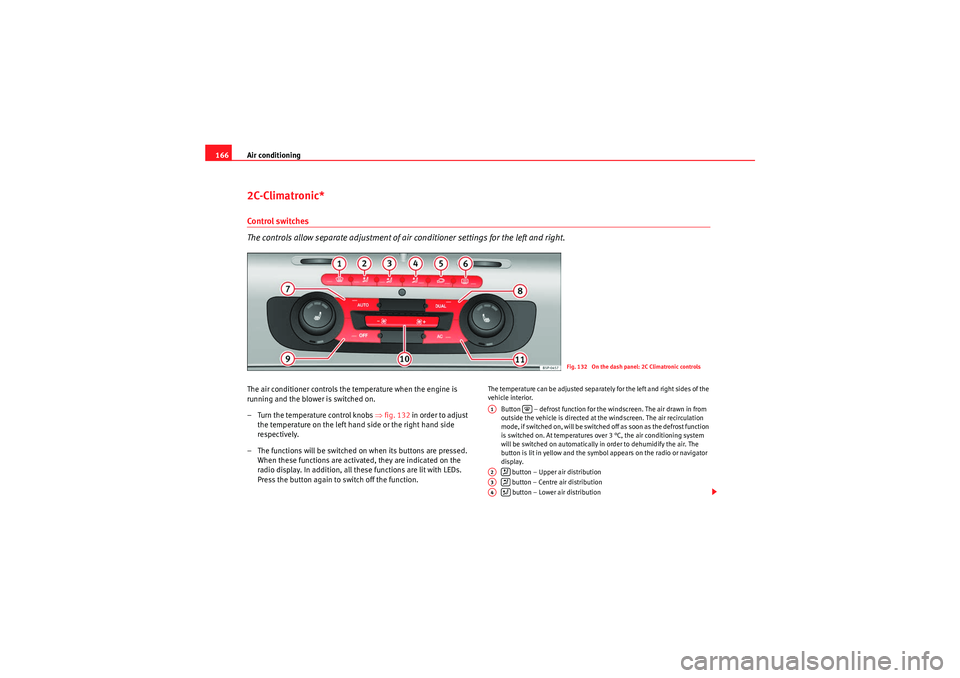
The controls allow separate adjustment of air conditioner settings for the left and right.The air conditioner controls the temperature when the engine is
running and the blower is switched on.
– Turn the temperature control knobs ⇒fig. 132 in order to adjust
the temperature on the left hand side or the right hand side
respectively.
– The functions will be switched on when its buttons are pressed. When these functions are activated, they are indicated on the
radio display. In addition, all these functions are lit with LEDs.
Press the button again to switch off the function.
The temperature can be adjusted separately for the left and right sides of the
vehicle interior.
Button – defrost function for the windscreen. The air drawn in from
outside the vehicle is directed at the windscreen. The air recirculation
mode, if switched on, will be switched off as soon as the defrost function
is switched on. At temperatures over 3 °C, the air conditioning system
will be switched on automatically in order to dehumidify the air. The
button is lit in yellow and the symbol appears on the radio or navigator
display. button – Upper air distribution
button – Centre air distribution
button – Lower air distribution
Fig. 132 On the dash panel: 2C Climatronic controls
A1
<
A2
A3
A4
AlteaXL_EN.book Seite 166 Donnerstag, 9. September 2010 12:13 12
Page 172 of 319
Air conditioning
170W h en t he but to n is of f, th e a ir co nd it io n ing s yste m is switch ed of f to sav e
fuel. The temperature continues to self-regulate. The set temperature can
then only be reached if it is higher than the outside temperature.
Driver and passenger temperature control
The button controls the synchronisation of the 2 Climatronic climate
zones.
When the button is on (LED lit), the climate zone of the Climatronic is
personalised, for example: Driver side temperature 22 °C and passenger side
temperature 23 °C.
When the button is off (LED off), the climate zone of the Climatronic is
synchronised, for example: Driver side temperature 22 °C and passenger side
temperature 22 °C.
If the button is off and the passenger side temperature is changed, the
function is automatically activated.Air recirculation mode
Air recirculation mode prevents fumes or unpleasant smells
from coming from the outside.–Press the button ⇒page 169, fig. 135 to switch air recir-
culation mode on or off. It is switched on if the following symbol
appears in the display
.
Air recirculation mode prevents strong odours in the ambient air from
entering the vehicle interior, for example when passing through a tunnel or in
a traffic jam.
With low outside temperatures, the air recirculation increases the effective-
ness of the heating system by heating the air inside the vehicle rather than
the air from outside. With high outside temperatures, the air recirculation increases the effective-
ness of the air conditioning system by cooling the air inside the vehicle rather
than the ambient air.
If the windscreen air output is on and the air recirculation mode is pressed,
this remains active. When the recirculation mode is on, if the air distribution
towards the windscreen mode is selected, the recirculation mode is deacti-
vated. For safety reasons, the air recirculation mode should not be
connected.
WARNING
In air recirculation mode, no cold air from the outside enters the vehicle
interior. If the air conditioning system is switched off, the windows can
quickly mist over. Therefore, never leave the air recirculation mode
switched on for a long time (risk of accident).General notesPollution filter
The pollution filter (a combined particulate filter and active carbon filter)
serves as a barrier against impurities in the outside air, including dust and
pollen.
For the air conditioner to work with maximum efficiency, the pollution filter
must be replaced at the intervals specified in the Service Schedule.
If the filter loses efficiency prematurely due to use in areas reaching very high
pollution levels, the pollen filter must be changed more frequently than
stated in the Service Schedule.
Air conditioner
When the air conditioning system is switched on, not only the temperature,
but also the air humidity in the vehicle interior is reduced. This improves
AC
DUAL
DUALDUAL
DUAL
A2
AlteaXL_EN.book Seite 170 Donnerstag, 9. September 2010 12:13 12
Page 175 of 319
Driving173
Safety First
Operating Instructions
Practical Tips
Technical Specifications
•Adjust the driver seat or steering wheel so that there is a distance of at
least 25 cm between the steering wheel and your chest ⇒page 172,
fig. 137 . If you fail to observe the minimum distance, the airbag will not
protect you. Risk of fatal injury.•If your physical constitution does not allow you to maintain the
minimum distance of 25 cm, contact an Authorised Service Centre. The
Authorised Service Centre will help you to decide if special specific modifi-
cations are necessary.•If you adjust the steering wheel so that it points towards your face, the
driver airbag will not protect you properly in the event of an accident. Make
sure that the steering wheel points towards your chest.•When driving, always hold the steering wheel with both hands on the
outside of the ring at the 9 o'clock and 3 o'clock positions. Never hold the
steering wheel at the 12 o'clock position, or in any other manner (e.g. in
the centre of the steering wheel, or on the inside of the rim). In such cases,
if the airbag is triggered, you may sustain injuries to the arms, hands and
head.
SafetyElectronic Stabilit y Programme (ESP)*
ESP helps make driving safer in certain situations.The Electronic Stability Programme (ESP) contains the electronic differential
lock (EDL) and the traction control system (TCS). The ESP function works
together with the ABS. Both warning lamps will light up if the ESP or ABS
systems are faulty.
The ESP is started automatically when the engine is started.
The ESP is always active, and cannot be switched off. With the ESP switch it is
only possible to switch TCS off.
The TCS can be deactivated when in cases where wheel sliding is desirable.
For example:•When driving with snow chains,
WARNING (continued)
Fig. 138 Detailed view of
the centre console: ESP
button
AlteaXL_EN.book Seite 173 Donnerstag, 9. September 2010 12:13 12
Page 176 of 319
Driving
174•when driving in deep snow or on loose surfaces,•when the vehicle is stuck, to rock it backwards and forwards.
Next, the button should be pressed to reactivate the TCS.WARNING
•The Electronic Stability Programme (ESP) cannot defy the laws of
physics. This should be kept in mi nd, particularly on slippery and wet
roads and when towing a trailer.•Always adapt your driving style to suit the condition of the roads and
the traffic situation. Do not let the extra safety afforded by ESP tempt you
into taking any risks when driving, as this can cause accidents.•Please refer to the corresponding warning notes on ESP in ⇒page 197,
“Intelligent technology”.
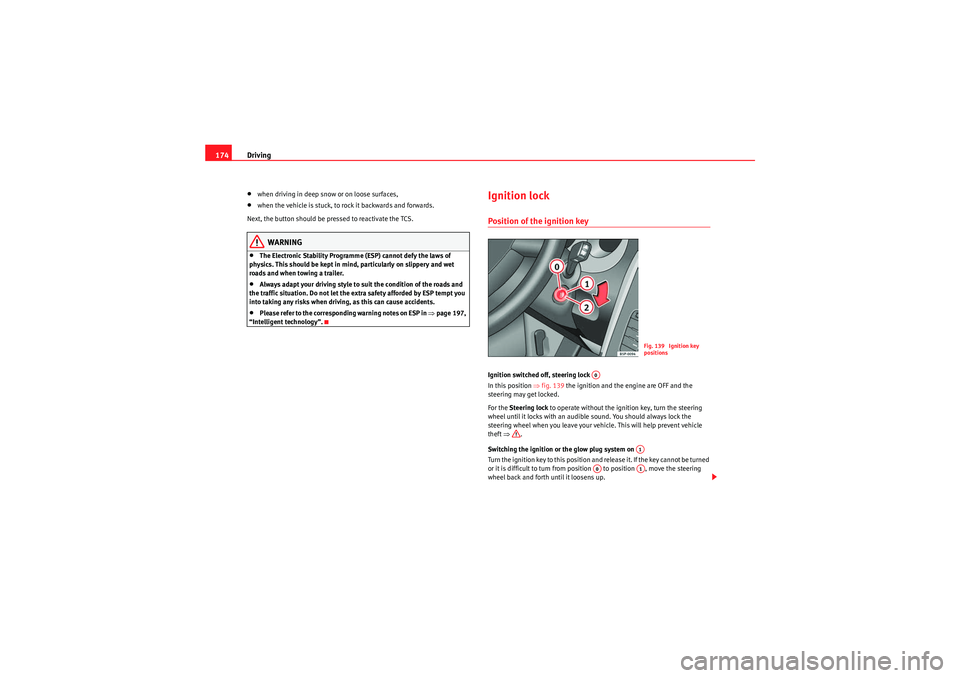
Ignition lockPosition of the ignition keyIgnition switched off, steering lock
In this position ⇒fig. 139 the ignition and the engine are OFF and the
steering may get locked.
For the Steering lock to operate without the ignition key, turn the steering
wheel until it locks with an audible sound. You should always lock the
steering wheel when you leave your vehicle. This will help prevent vehicle
theft ⇒ .
Switching the ignition or the glow plug system on
Turn the ignition key to this position and release it. If the key cannot be turned
or it is difficult to turn from position to position , move the steering
wheel back and forth until it loosens up.
Fig. 139 Ignition key
positions
A0
A1
A0
A1
AlteaXL_EN.book Seite 174 Donnerstag, 9. September 2010 12:13 12
Page 177 of 319
Driving175
Safety First
Operating Instructions
Practical Tips
Technical Specifications
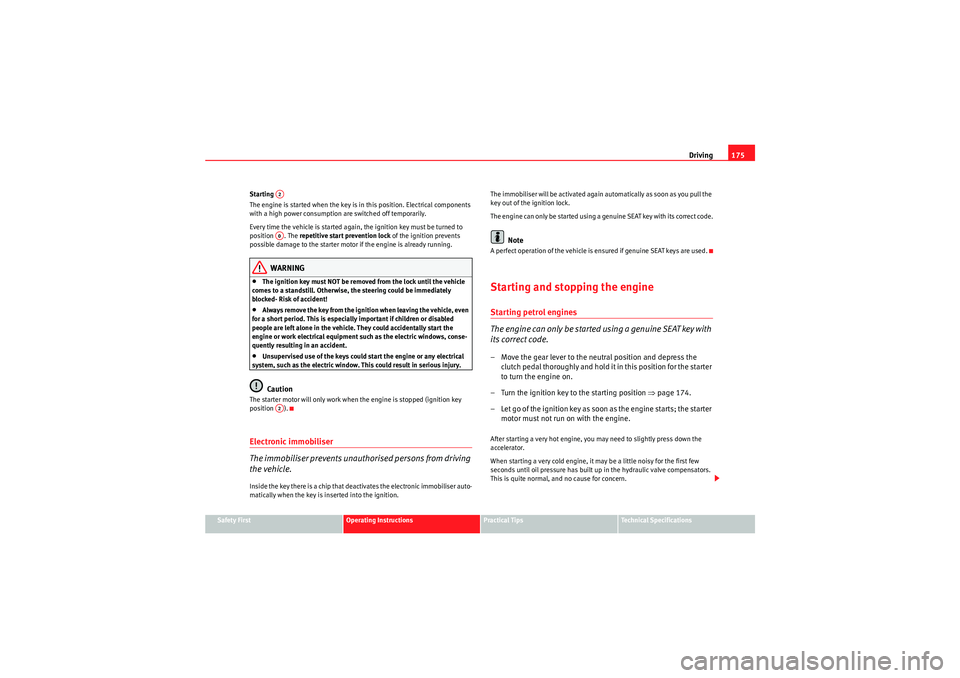
Starting
The engine is started when the key is in this position. Electrical components
with a high power consumption are switched off temporarily.
Every time the vehicle is started again, the ignition key must be turned to
position . The
repetitive start prevention lock of the ignition prevents
possible damage to the starter motor if the engine is already running.
WARNING
•The ignition key must NOT be removed from the lock until the vehicle
comes to a standstill. Otherwise, the steering could be immediately
blocked- Risk of accident!•Always remove the key from the ignition when leaving the vehicle, even
for a short period. This is especially important if children or disabled
people are left alone in the vehicle. They could accidentally start the
engine or work electrical equipment such as the electric windows, conse-
quently resulting in an accident.•Unsupervised use of the keys could start the engine or any electrical
system, such as the electric window. This could result in serious injury.Caution
The starter motor will only work when the engine is stopped (ignition key
position ).Electronic immobiliser
The immobiliser prevents unauthorised persons from driving
the vehicle.Inside the key there is a chip that deactivates the electronic immobiliser auto-
matically when the key is inserted into the ignition. The immobiliser will be activated again automatically as soon as you pull the
key out of the ignition lock.
The engine can only be started using a genuine SEAT key with its correct code.
Note
A perfect operation of the vehicle is ensured if genuine SEAT keys are used.Starting and stopping the engineStarting petrol engines
The engine can only be started using a genuine SEAT key with
its correct code.– Move the gear lever to the neutral position and depress the
clutch pedal thoroughly and hold it in this position for the starter
to turn the engine on.
– Turn the ignition key to the starting position ⇒page 174.
– Le t go o f the ig nit io n key as so on as the e ngin e star t s; t he sta r ter motor must not run on with the engine.After starting a very hot engine, you may need to slightly press down the
accelerator.
When starting a very cold engine, it may be a little noisy for the first few
seconds until oil pressure has built up in the hydraulic valve compensators.
This is quite normal, and no cause for concern.
A2A0A2
AlteaXL_EN.book Seite 175 Donnerstag, 9. September 2010 12:13 12
Page 181 of 319
Driving179
Safety First
Operating Instructions
Practical Tips
Technical Specifications
Manual switch from LPG to petrol
Press the button on the centre console
⇒page 178, fig. 140 to change
mode. The green lamp on the instrument panel goes out and the notification
changed to petrol mode is displayed.
Running on petrol
Run the engine with petrol for short journeys at regular intervals to avoid
problems in the petrol system.
WARNING
LPG is a highly explosive and inflammable substance. It may cause severe
burns and other injury.•Due care must be taken to avoid any risk of fire or explosion.•When parking the vehicle in a closed area (for example in a garage),
make sure that there is adequate ventilation, either natural or mechanical,
to neutralise the LPG in the event of a leak.Note
•If frequent short journeys are made, especially when the outside temper-
ature is low, the vehicle will tend to run on petrol more often than on LPG.
Therefore, the petrol tank may empty before the LPG tank.•The notification LPG mode not possible may be displayed.Start-Stop function*Description and operationThe Start-Stop function stops the engine when the vehicle is
stopped and starts it automatically when required. – When the vehicle is stopped, put it in neutral and release the
clutch pedal. The engine will stop.
– When the clutch pedal is pressed, the engine starts again.
– The instrument panel screen displays information about the status of the Start-Stop function ⇒page 181, fig. 142 .
Start-Stop function conditions•The driver seat belt must be buckled.•The engine hood must be closed.•The engine must be at operating temperature•The steering wheel must be straight.•The vehicle must be on flat ground.•The vehicle must not be in reverse.•A trailer must not be connected.•The temperature of the passenger compartment must be within the
comfort limits (button ⇒page 169, fig. 135 should be selected).•The windscreen de-mist function must be off.•If not , it requires an increase in airflow ⇒page 169, fig. 135 for more
than three presses.•The temperature must not be set to HI or LO .•The driver door must be closed.•The diesel particulate filter must not be in regeneration mode, for diesel
engines.•The battery charge must not be low for the next start.•The battery temperature must be between -1 °C and 55 °C.•The parking assistant, Park Assist* must not be activated.
GAS
ACA11
A10
AlteaXL_EN.book Seite 179 Donnerstag, 9. September 2010 12:13 12
Page 191 of 319
Driving189
Safety First
Operating Instructions
Practical Tips
Technical Specifications
– Apply the handbrake.
– The 1st gear should also be selected.
– Switch the engine off and remove the key from the ignition. Turn
the steering wheel slightly to engage the steering lock.
– Always take you car keys with you when you leave the vehicle ⇒ .Additional notes on parking the vehicle on gradients:
Turn the steering wheel so that the vehicle rolls against the kerb if it started
to roll.•If the vehicle is parked facing downhill, turn the front wheels so that they
point towards the kerb .•If the vehicle is parked facing uphill, turn the front wheels so that they
point away from the kerb .•Secure the vehicle as normal by applying the handbrake firmly and
engaging 1st gear.WARNING
•Take measures to reduce the risk of injury when you leave your vehicle
unattended.•Never park where the hot exhaust system could ignite inflammable
materials, such as dry grass, low bushes, spilt fuel etc.•Never allow vehicle occupants to remain in the vehicle when it is
locked. They would be unable to open the vehicle from the inside, and
could become trapped in the vehicle in an emergency. In the event of an
emergency, locked doors will delay assistance to occupants.•Never leave children alone in the vehicle. They could set the vehicle in
motion, for example, by releasing the handbrake or the gear lever.
•Depending on weather conditions, it may become extremely hot or cold
inside the vehicle. This can be fatal.
Hill-start aid*
This function is only included in vehicles with ESP.This device helps when starting uphill.
These are the basic operation conditions: doors closed, brake pedal pressed
down and vehicle in neutral. The system is activated on selecting a gear.
After removing your foot from the brake pedal, the braking force is maintained
for a few seconds to prevent the vehicle from moving backward when putting
into gear. This short space of time is enough to start the vehicle with ease.
This system also works when reversing uphill.
WARNING
•If you do not start the vehicle immediately after taking your foot off the
brake pedal, the vehicle may start to roll back under certain conditions.
Depress the brake pedal or use the hand brake immediately.•If the engine stalls, depress the brake pedal or use the hand brake
immediately.•When following a line of traffic uphill, if you want to prevent the vehicle
from rolling back accidentally when starting off, hold the brake pedal down
for a few seconds before starting off.WARNING (continued)
AlteaXL_EN.book Seite 189 Donnerstag, 9. September 2010 12:13 12
Page 192 of 319
Driving
190
NoteYour Authorised Service or a specialised workshop can tell you if your vehicle
is equipped with this system.Acoustic parking aid system*General notesVarious systems are available to help you when parking or manoeuvring in
tight spaces, depending on the equipment fitted on your vehicle.
The SEAT Parking System* gives an acoustic warning if there are any obsta-
cles behind your vehicle.
When you are parking, the SEAT Parking System Plus* warns you acoustically
and optically
23) about obstacles “in front of” and “behind” the vehicle.
Note
To ensure the acoustic parking aid works properly, the sensors must be kept
clean and free of snow and ice.
SEAT Parking System: Description
The Parking System is an acoustic parking aid.Sensors are located in the rear bumper. When the sensors detect an obstacle,
you are alerted by acoustic signals. The measuring range of the sensors starts
at approximately:
The acoustic signals sound with increasing frequency as you approach the
obstacle. When the vehicle is less than 0.30 m away from the obstacle, the
warning tone will sound continuously. Do not drive on!
The volume of the warning beeps will be gradually reduced after about four
seconds if the vehicle remains at a constant distance from a detected
obstacle (it does not affect the permanent acoustic signal).
The parking aid is switched on automatically when reverse gear is engaged.
You will hear a brief confirmation tone.
WARNING
•The parking aid is not a replacement for driver awareness. The driver is
personally responsible for safe parking and other manoeuvres.•The sensors have blind spots in which obstacles are not registered.
Always look out for small children and animals because the system will not
always detect them. Always pay attention when reversing to avoid acci-
dents.•Always keep a close eye on the area around the vehicle and make full
use of the rear view mirrors.
23)Vehicles with a navigation system.
Rear
Side
0.60
Centre
1.60
AlteaXL_EN.book Seite 190 Donnerstag, 9. September 2010 12:13 12