ignition Seat Altea XL 2011 Manual PDF
[x] Cancel search | Manufacturer: SEAT, Model Year: 2011, Model line: Altea XL, Model: Seat Altea XL 2011Pages: 319, PDF Size: 8.92 MB
Page 223 of 319
Vehicle maintenance and cleaning221
Safety First
Operating Instructions
Practical Tips
Technical Specifications
Underbody protection
The vehicle underbody is coated to protect it from chemical
and mechanical damage.The protective coating can be damaged when driving. We recommend you to
check the protective coating under the body and on the running gear, and
reinstated if necessary, before and after the winter season.
We recommend you to go to your Authorised Service Centre to carry out repair
work and additional anti-corrosion work.
WARNING
Do not apply underseal or anti-corrosion coatings to the exhaust pipes,
catalytic converter or the heat shields on the exhaust system. The heat of
the exhaust system or the engine could cause them to ignite. Risk of fire.Cleaning the engine compartment
Take special care when cleaning the engine compartment.Anti-corrosion treatment
The engine compartment and the surface of the power unit are given anti-
corrosion treatment at the factory.
Good corrosion protection is particularly important in winter when the vehicle
is frequently driven on salted roads. To prevent the salt corroding the vehicle,
the entire engine compartment should be thoroughly cleaned before and
after winter.
Yo u r A u t h o r i s e d S e r v i ce Ce n t re has got the necessary equipment to provide
the correct cleaning and preserving products. For this reason, we recommend
having this work performed by them. The anti-corrosion protection is usually removed if the engine compartment
is cleaned with grease removing solutions, or if you have the engine cleaned.
On commissioning this work, ensure that all surfaces, seams, joints and
components in the engine compartment are given anti-corrosion treatment.
WARNING
•When working in the engine compartment, always observe the safety
warnings ⇒page 233.•Before opening the bonnet, switch the engine off, apply the handbrake
firmly and always remove the key from the ignition.•Allow the engine to cool before you clean the engine compartment.•Do not clean the vehicle underbody, wheel arches or wheel trims
without protecting your hands and arms. You may cut yourself on sharp-
edged metal parts. Failure to comply could result in injury.•Moisture, ice and salt on the brakes may affect braking efficiency. Risk
of accident. Directly after washing, avoid sudden and sharp braking.•Never touch the radiator fan. It is temperature-controlled and could
start automatically, even when the key is removed from the ignition!For the sake of the environment
Fuel, grease and oil deposits could be removed when the engine is washed.
The polluted water must be cleaned in an oil separator. For this reason,
engine washing should only be carried out at a specialised workshop or an
adequate petrol station.
AlteaXL_EN.book Seite 221 Donnerstag, 9. September 2010 12:13 12
Page 230 of 319
Checking and refilling levels
228LPG system*Refuelling with LPG
The LPG filler neck is behind the fuel cap, next to the petrol filler neck.
Refuelling with LPG
– Before refuelling, stop the engine and switch off the ignition.
–Open the tank flap.
– Before refuelling, please read the instructions on the pump.
– Unscrew the cap of the gas filler neck .
– Screw the required adapter on the gas filler neck .
– Refuel as indicated in the instructions on the pump.
–Unscrew the adapter .
F ig. 161 Fuel tank ope n with LPG fille r neck and adap ter.
Fig. 162 LPG tank in
spare wheel well
A1
A2
A1
A2
AlteaXL_EN.book Seite 228 Donnerstag, 9. September 2010 12:13 12
Page 233 of 319

Checking and refilling levels231
Safety First
Operating Instructions
Practical Tips
Technical Specifications
The safety of the LPG system guarantees operation without risk. The following
safety measures have been adopted:
•The LPG tank has a solenoid valve which closes automatically when the
engine is switched off (ignition off) or when running on petrol.•A solenoid type main valve disconnects the supply of gas to the engine
compartment when the engine is switched off or running on petrol.•A safety valve in the LPG tank with pipes to the outside prevents the gas
from entering the vehicle interior.•All anchorage points and materials have been designed to ensure the
maximum possible levels of safety.
The condition of the LPG system should be checked regularly to guarantee
safe driving conditions ⇒ . These checks are included in the Maintenance
Programme.WARNING
•If there is a smell of gas or a suspected leak, stop the vehicle immedi-
ately and switch off the ignition. Open the doors to ventilate the vehicle. Do
not carry on driving! Take the vehicle to a specialised workshop and have
the fault repaired.•Immediately extinguish any cigarettes and remove from the vehicle any
objects which might produce a spark or cause a fire, and switch off imme-
diately if gas is smelt or a leak is detected.•LGP tanks are subject to pressure and must be checked regularly. The
owner of the vehicle must check that these services are performed
correctly.•When parking the vehicle in a closed area (for example in a garage),
make sure that there is adequate ventilation, either natural or mechanical,
to neutralise the LPG in the event of a leak.
Note
For any fault in the LGP system, please refer to the SEAT web page, which lists
the workshops authorised to repair these faults.PetrolPetrol types
The correct petrol types are listed on a sticker inside the fuel
tank flap.Only unleaded petrol conforming to standard DIN EN 228 may be used for
vehicles with catalytic converters (EN = “European Standard”).
Fuel types are differentiated by the octane rating, e.g: 91, 95, 98 RON (RON
= “Research Octane Number”, unit for determining the knock resistance of
petrol). You may use petrol with a higher octane number than the one recom-
mended for your engine. However, this has no advantage in terms of fuel
consumption and engine power.
The correct fuel type for your vehicle is given in the technical table for the
engine, in the Technical Data section.
Caution
•Petrol with standard EN 228 may be mixed with small quantities of
ethanol. However, the so-called “bioethanol fuels” available at commercial
establishments with reference E50 or E85, which contain a high percentage
of ethanol, may not be used, as they will damage the fuel system.•Even one tankful of leaded fuel would permanently impair the efficiency
of the catalytic converter.
AlteaXL_EN.book Seite 231 Donnerstag, 9. September 2010 12:13 12
Page 234 of 319
Checking and refilling levels
232•High engine speed and full throttle can damage the engine when using
petrol with an octane rating lower than the correct grade for the engine.For the sake of the environment
Just one full tank of leaded fuel would seriously impair the efficiency of the
catalytic converter.Petrol additives
Petrol additives improve the quality of the petrol.The quality of the petrol influences the performance, power and life of the
engine. For this reason, you should use good quality petrol containing addi-
tives. These additives will help to prevent corrosion, keep the fuel system
clean and prevent deposits from building up in the engine.
If good quality petrol with additives is not available or engine problems occur,
the required additives must be added during refuelling.DieselDiesel*Diesel fuel must conform to DIN EN 590 (EN = “European Standard”). It must
have a cetane number (CN) of at least 51. The cetane number indicates the
ignition quality of the diesel fuel.
Notes on refuelling ⇒page 226.
Biodiesel*
Caution
•Your vehicle is not designed to use biodiesel fuel. Never, under any
circumstances refuel with biodiesel. The use of biodiesel fuel could damage
the engine and the fuel system. The addition of biodiesel to diesel fuel by the
diesel manufacturer in accordance with standard EN 590 or DIN 51628 is
authorised and will not cause damage to the engine or the fuel system.•The diesel engine has been designed to be used exclusively with diesel
fu el con for m i ng to sta nda rd E N 59 0 . Never refuel or use petrol, kerosene, fuel
oil or any other type of fuel. If you accidentally fill up the vehicle with the
wrong type of fuel, do not start the engine. Seek assistance from specialised
personnel. The composition of these fuels may severely damage the fuel
system and the engine.Winter driving
Diesel can thicken in winter.Winter diesel
When using summer diesel fuel, difficulties may be experienced at tempera-
tures below 0 °C because the fuel thickens due to wax separation. Therefore,
winter diesel fuel is available in some countries during the cold months. It can
be used at temperatures as low as -22 °C.
In countries with different climatic conditions the diesel fuel generally sold
has different temperature characteristics. Check with an Authorised Service
Centre or filling stations in the country concerned regarding the type of diesel
fuels available.
AlteaXL_EN.book Seite 232 Donnerstag, 9. September 2010 12:13 12
Page 235 of 319
Checking and refilling levels233
Safety First
Operating Instructions
Practical Tips
Technical Specifications
Filter pre-heater
Your vehicle is fitted with a fuel filter glow plug system, making it well
equipped for operation in winter. This ensures that the fuel system remains
operational to approx. -24 °C, provided you use winter diesel which is safe to
-15 °C.
However, if the fuel has waxed to such an extent that the engine will not start
at temperatures of under -24 °C, simply place the vehicle in a warm place for
a while.
Caution
Do not mix fuel additives (thinners or similar products) with diesel fuel.Working in the engine compartmentSafety instructions on workin
g in the engine compartment
Any work carried out in the engine compartment or on the
engine must be carried out cautiously.Before starting any work on the engine or in the engine compart-
ment:
1. Switch off the engine and remove the key from the ignition.
2. Apply the handbrake.
3. Move the gear lever to neutral or the selector lever to position P.
4. Wait for the engine to cool down.
5. Keep children away from the vehicle. 6. Raise the bonnet
⇒page 235.
You should not do any work in the engine compartment unless you know
exactly how to carry out the jobs and have the correct tools! Have the work
carried out by a specialised workshop if you are uncertain.
All service fluids and consumables, e.g. coolant, engine oil, spark plugs and
batteries, are being constantly developed. SEAT provides a constant flow of
information to the Authorised Service Centres concerning modifications. For
this reason, we recommend you to have service fluids and consumables
replaced by an Authorised Service Centre. Please observe the relevant
instructions ⇒page 224. The engine compartment of the vehicle is a
hazardous area ⇒.
WARNING
All work on the engine or in the engine compartment, e.g. checking and
refilling fluids, involves a risk of injury and scalding as well as the risk of
accident or fire.•Never open the bonnet if you see steam, smoke or coolant escaping
from the engine compartment. Otherwise, there is a risk of sustaining
burns. Wait until no more steam or coolant is emitted, then allow the
engine to cool before carefully opening the bonnet.•Switch off the engine and remove the key from the ignition.•Apply the handbrake and move the gear lever to neutral or selector
lever to position P.•Keep children away from the vehicle.•Never touch hot engine parts. There is a risk of burns.•Never spill liquids on a hot engine or on a hot exhaust gas system. This
is a fire hazard.•Avoid causing short-circuits in the electrical system, particularly at the
points where the jump leads are attached ⇒page 283. The battery could
explode.
AlteaXL_EN.book Seite 233 Donnerstag, 9. September 2010 12:13 12
Page 236 of 319
Checking and refilling levels
234•Never touch the radiator fan. It is temperature controlled and could
start automatically, even when the engine has been switched off and the
key removed from the ignition!•Do not unscrew the cap on the coolant reservoir when the engine is hot.
If the coolant is hot, the cooling system will be pressurised!•Protect face, hands and arms by covering the cap with a large, thick
cloth to protect against escaping coolant and steam.•Al wa ys m ake s u re yo u ha ve n o t l e f t a ny o bj e c t s , s u ch as cl e an i n g cl o t h s
and tools, in the engine compartment.•If you have to work underneath the vehicle, you must use suitable
stands additionally to support the vehicle, there is a risk of accident!. A
hydraulic jack is insufficient for securing the vehicle and there is a risk of
injury.•If any work has to be performed when the engine is started or with the
engine running, there is an additional, potentially fatal, safety risk from the
rotating parts, such as the drive belts, alternator, radiator fan, etc., and
from the high-voltage ignition system. You should also observe the
following points:
−Never touch the electrical wiring of the ignition system.
− Ensure that jewellery, loose clothing and long hair do not get
trapped in rotating engine parts. Da nger of death. Before starting any
work remove jewellery, tie back and cover hair, and wear tight-fitting
clothes.
− Never accelerate with a gear engaged without taking the necessary
precautions. The vehicle could move, even if the handbrake is applied.
Danger of death.•If work has to be carried out on the fuel system or on electrical compo-
nents, you must observe the following safety notes in addition to the above
warnings:
−Always disconnect the battery. The vehicle must be unlocked when
this is done, otherwise the alarm will be triggered. −
Do not smoke.
− Never work near naked flames.
− Always have a fire extinguisher on hand.
Caution
When topping up service fluids, make sure not to mistake them. Using the
wrong fluids could cause serious malfunctions and engine damage!
For the sake of the environment
Service fluids leaks are harmful to the environment. For this reason you
should make regular checks on the grou nd underneath your vehicle. If you
find spots of oil or other fluids, have your vehicle inspected at a specialised
workshop.
WARNING (continued)
WARNING (continued)
AlteaXL_EN.book Seite 234 Donnerstag, 9. September 2010 12:13 12
Page 245 of 319
Checking and refilling levels243
Safety First
Operating Instructions
Practical Tips
Technical Specifications
Changing windscreen wiper blades
If the windscreen wiper blades are in perfect condition, you
will benefit from an improved visibility. Damaged wiper
blades should be replaced immediately.
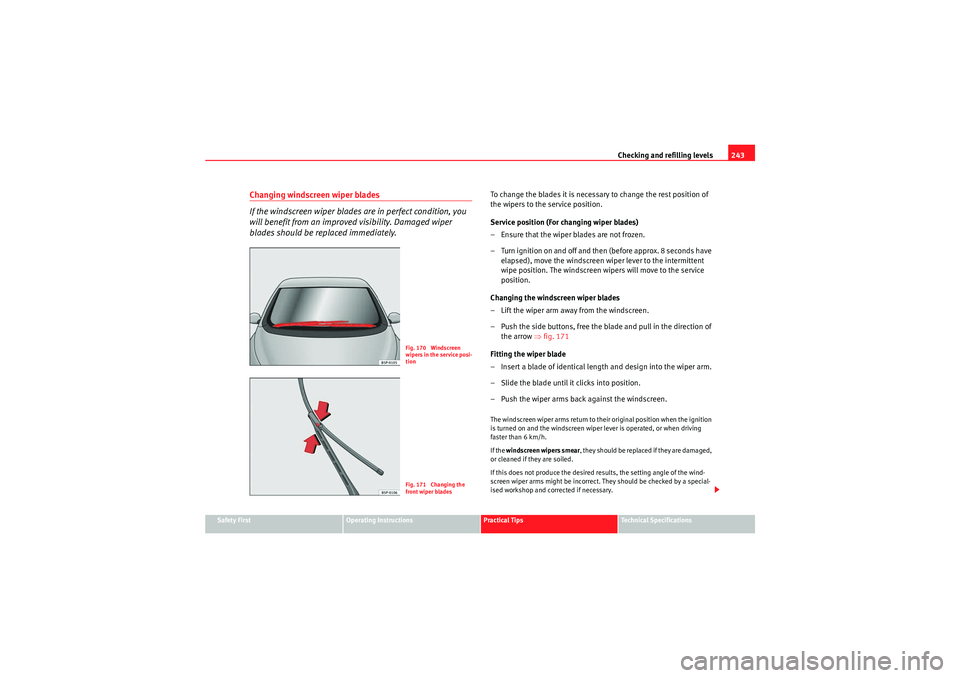
To change the blades it is necessary to change the rest position of
the wipers to the service position.
Service position (For changing wiper blades)
– Ensure that the wiper blades are not frozen.
– Turn ignition on and off and then (before approx. 8 seconds have
elapsed), move the windscreen wiper lever to the intermittent
wipe position. The windscreen wipers will move to the service
position.
Changing the windscreen wiper blades
– Lift the wiper arm away from the windscreen.
– Push the side buttons, free the blade and pull in the direction of the arrow ⇒fig. 171
Fitting the wiper blade
– Insert a blade of identical length and design into the wiper arm.
– Slide the blade until it clicks into position.
– Push the wiper arms back against the windscreen.The windscreen wiper arms return to their original position when the ignition
is turned on and the windscreen wiper lever is operated, or when driving
faster than 6 km/h.
If the windscreen wipers smear , t h e y s h o u l d b e r e p la ce d i f t h e y a r e d a m a ge d ,
or cleaned if they are soiled.
If this does not produce the desired results, the setting angle of the wind-
screen wiper arms might be incorrect. They should be checked by a special-
ised workshop and corrected if necessary.
Fig. 170 Windscreen
wipers in the service posi-
tionFig. 171 Changing the
front wiper blades
AlteaXL_EN.book Seite 243 Donnerstag, 9. September 2010 12:13 12
Page 249 of 319
Checking and refilling levels247
Safety First
Operating Instructions
Practical Tips
Technical Specifications
Vehicle batteryWarnings on handling the battery
WARNING
Always be aware of the danger of injury and chemical burns as well as the
risk of accident or fire when working on the battery and the electrical
system:•Wear eye protection. Protect your eyes, skin and clothing from acid and
particles containing lead.•Battery acid is very corrosive and caustic. Wear protective gloves and
eye protection. Do not tilt the batteries. This could spill acid through the
vents. Rinse battery acid from eyes immediately for several minutes with
clear water. Then seek medical care immediately. Neutralise any acid
splashes on the skin or clothing with a soapy solution, and rinse off with
plenty of water. If acid is swallowed by mistake, consult a doctor immedi-
ately.•Fires, sparks, open flames and smoking are prohibited. When handling
cables and electrical equipment, avoid causing sparks and electrostatic charge. Never short the battery terminals. High-energy sparks can cause
injury.
•A highly explosive mixture of gases is released when the battery is
under charge. The batteries should be charged in a well-ventilated room
only.•Keep children away from acid and batteries.•Before working on the electrical system, you must switch off the
engine, the ignition and all consumers. The negative cable on the battery
must be disconnected. When a light bulb is changed, you need only switch
off the light.•Deactivate the anti-theft alarm by unlocking the vehicle before you
disconnect the battery! The alarm will otherwise be triggered.•When disconnecting the battery from the vehicle electrical system,
disconnect first the negative cable and then the positive cable.•Switch off all electrical consumers before reconnecting the battery.
Reconnect first the positive cable and then the negative cable. Never
reverse the polarity of the connections. This could cause an electrical fire.•Never charge a frozen battery, or one which has thawed. This could
result in explosions and chemical burns. Always replace a battery which
has frozen. A flat battery can freeze at temperatures around 0 °C.•Ensure that the vent hose is always connected to the battery.•Never use a defective battery. This could cause an explosion. Replace a
damaged battery immediately.Caution
•Never disconnect the battery if the ignition is switched on or if the engine
is running. This could damage the electrical system or electronic compo-
nents.•Do not expose the battery to direct sunlight over a long period of time, as
the intense ultraviolet radiation can damage the battery housing.
Wear eye protection
Battery acid is very corrosive and caustic. Wear protective
gloves and eye protection!
Ž
Fires, sparks, open flames and smoking are prohibited!
Ÿ
A highly explosive mixture of gases is released when the
battery is under charge.
Keep children away from acid and batteries!
WARNING (continued)
AlteaXL_EN.book Seite 247 Donnerstag, 9. September 2010 12:13 12
Page 271 of 319
If and when269
Safety First
Operating Instructions
Practical Tips
Technical Specifications
FusesChanging a fuse
Blown fuses must be replaced
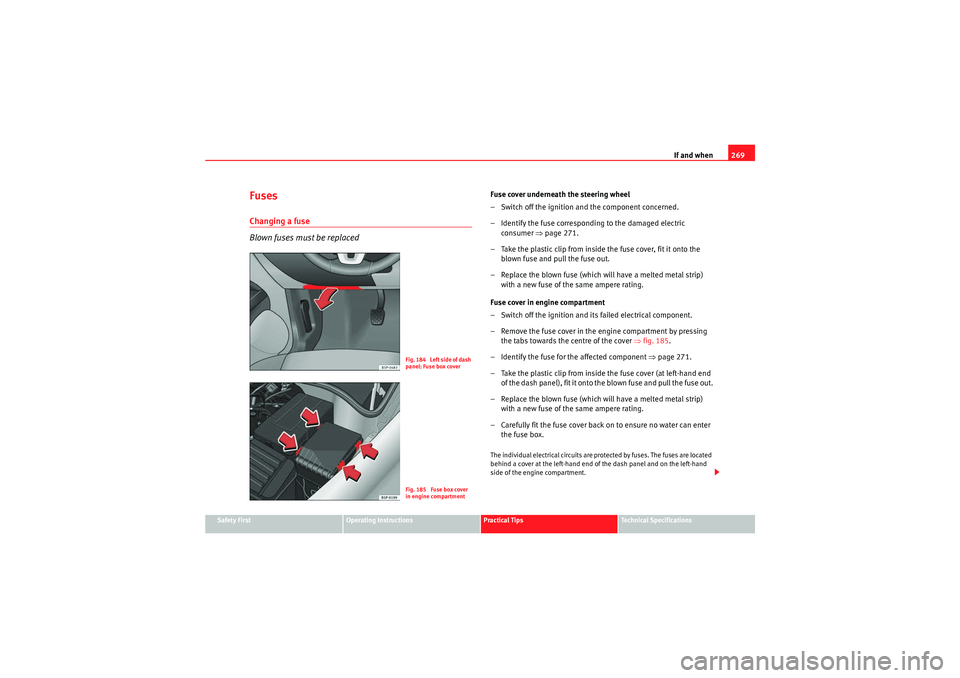
Fuse cover underneath the steering wheel
– Switch off the ignition and the component concerned.
– Identify the fuse corresponding to the damaged electric
consumer ⇒page 271.
– Take the plastic clip from inside the fuse cover, fit it onto the blown fuse and pull the fuse out.
– Replace the blown fuse (which will have a melted metal strip) with a new fuse of the same ampere rating.
Fuse cover in engine compartment
– Switch off the ignition and its failed electrical component.
– Remove the fuse cover in the engine compartment by pressing the tabs towards the centre of the cover ⇒fig. 185 .
– Identify the fuse for the affected component ⇒ page 271.
– Take the plastic clip from inside the fuse cover (at left-hand end of the dash panel), fit it onto the blown fuse and pull the fuse out.
– Replace the blown fuse (which will have a melted metal strip) with a new fuse of the same ampere rating.
– Carefully fit the fuse cover back on to ensure no water can enter the fuse box.The individual electrical circuits are protected by fuses. The fuses are located
behind a cover at the left-hand end of the dash panel and on the left-hand
side of the engine compartment.
Fig. 184 Left side of dash
panel: Fuse box coverFig. 185 Fuse box cover
in engine compartment
AlteaXL_EN.book Seite 269 Donnerstag, 9. September 2010 12:13 12
Page 274 of 319
If and when
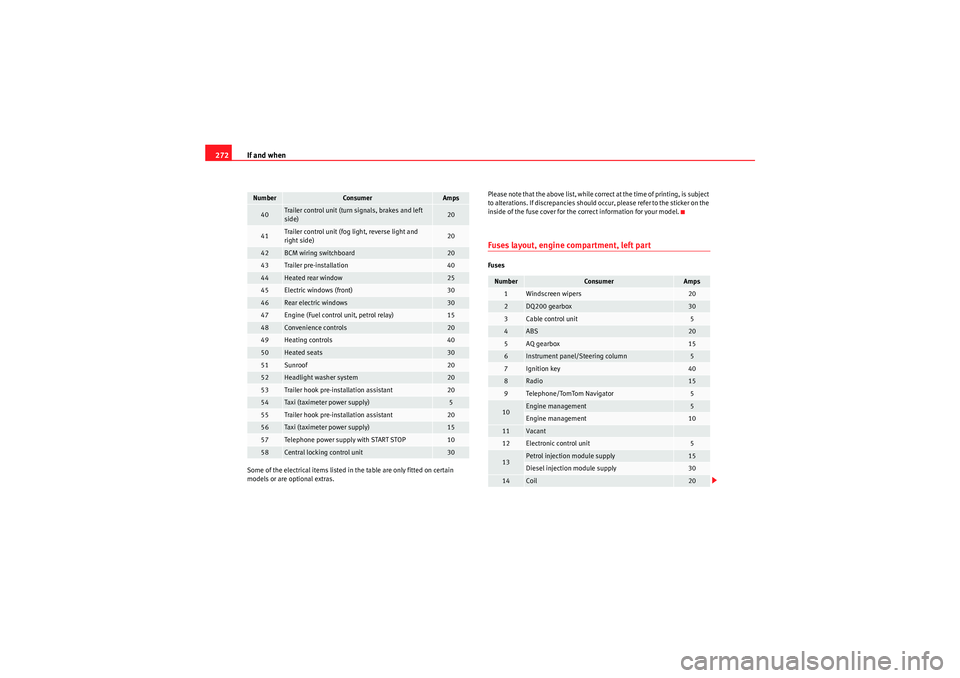
272Some of the electrical items listed in the table are only fitted on certain
models or are optional extras. Please note that the above list, while correct at the time of printing, is subject
to alterations. If discrepancies should occur, please refer to the sticker on the
inside of the fuse cover for the correct information for your model.
Fuses layout, engine compartment, left partFuses
40
Trailer control unit (turn signals, brakes and left
side)
20
41
Trailer control unit (fog light, reverse light and
right side)
20
42
BCM wiring switchboard
20
43
Trailer pre-installation
40
44
Heated rear window
25
45
Electric windows (front)
30
46
Rear electric windows
30
47
Engine (Fuel control unit, petrol relay)
15
48
Convenience controls
20
49
Heating controls
40
50
Heated seats
30
51
Sunroof
20
52
Headlight washer system
20
53
Trailer hook pre-installation assistant
20
54
Taxi (taximeter power supply)
5
55
Trailer hook pre-installation assistant
20
56
Taxi (taximeter power supply)
15
57
Telephone power supply with START STOP
10
58
Central locking control unit
30
Number
Consumer
Amps
Number
Consumer
Amps
1
Windscreen wipers
20
2
DQ200 gearbox
30
3
Cable control unit
5
4
ABS
20
5
AQ gearbox
15
6
Instrument panel/Steering column
5
7
Ignition key
40
8
Radio
15
9
Telephone/TomTom Navigator
5
10
Engine management
5
Engine management
10
11
Vacant
12
Electronic control unit
5
13
Petrol injection module supply
15
Diesel injection module supply
30
14
Coil
20
AlteaXL_EN.book Seite 272 Donnerstag, 9. September 2010 12:13 12