technical specifications Seat Altea XL 2011 Manual Online
[x] Cancel search | Manufacturer: SEAT, Model Year: 2011, Model line: Altea XL, Model: Seat Altea XL 2011Pages: 319, PDF Size: 8.92 MB
Page 165 of 319
Air conditioning163
Safety First
Operating Instructions
Practical Tips
Technical Specifications
Note
Please observe the general notes ⇒page 170.Heating and cooling the interiorInterior heating
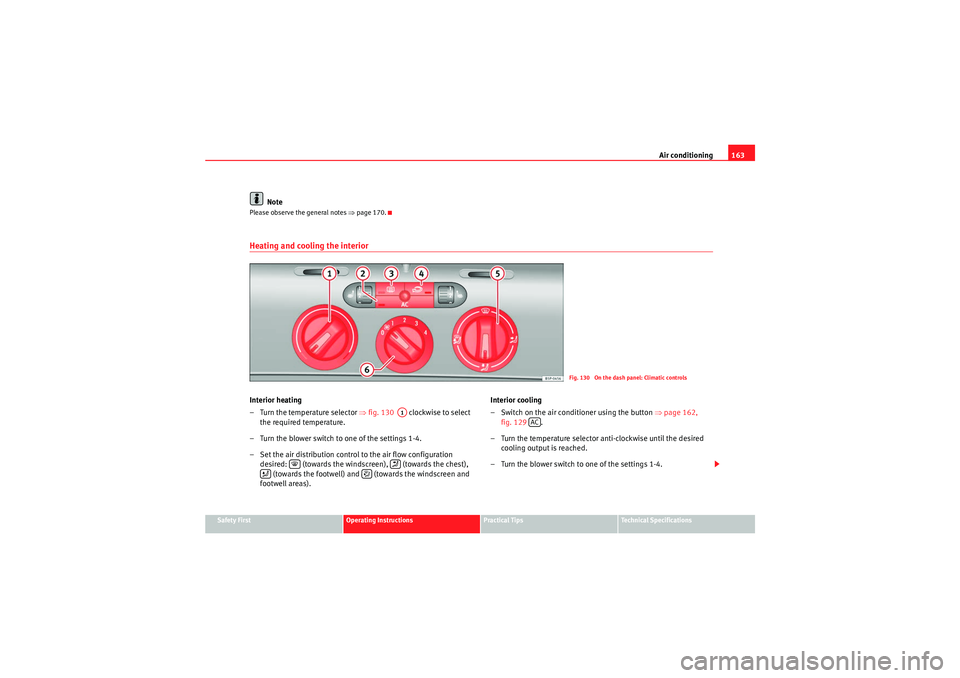
– Turn the temperature selector ⇒fig. 130 clockwise to select
the required temperature.
– Turn the blower switch to one of the settings 1-4.
– Set the air distribution contro l to the air flow configuration
desired: (towards the windscreen), (towards the chest), (towards the footwell) and (towards the windscreen and
footwell areas). Interior cooling
– Switch on the air conditioner using the button
⇒page 162,
fig. 129 .
– Turn the temperature selector anti-clockwise until the desired cooling output is reached.
– Turn the blower switch to one of the settings 1-4.
Fig. 130 On the dash panel: Climatic controls
A1
<
AC
AlteaXL_EN.book Seite 163 Donnerstag, 9. September 2010 12:13 12
Page 167 of 319
Air conditioning165
Safety First
Operating Instructions
Practical Tips
Technical Specifications
Air recirculation mode
⇒page 164, fig. 131 prevents strong odours in
the outside air from entering the vehicle interior, for example when passing
through a tunnel or in queuing traffic.
With low temperatures outside, the air recirculation increases the effective-
ness of the heating system by warming the air inside the vehicle rather than
the cold air from outside.
With high outside temperatures, the air recirculation increases the effective-
ness of the air conditioning system by cooling the air inside the vehicle rather
than the ambient air.
If the windscreen air output is on and the air recirculation mode is pressed,
this remains active. When the recirculation mode is on, if the air distribution
towards the windscreen mode is selected, the recirculation mode is deacti-
vated. For safety reasons, the air recirculation mode should not be
connected.
WARNING
In air recirculation mode, no cold air from the outside enters the vehicle
interior. If the air conditioning system is switched off, the windows can
quickly mist over. Therefore, never leave the air recirculation mode
switched on for a long time (risk of accident).
AlteaXL_EN.book Seite 165 Donnerstag, 9. September 2010 12:13 12
Page 169 of 319
Air conditioning167
Safety First
Operating Instructions
Practical Tips
Technical Specifications
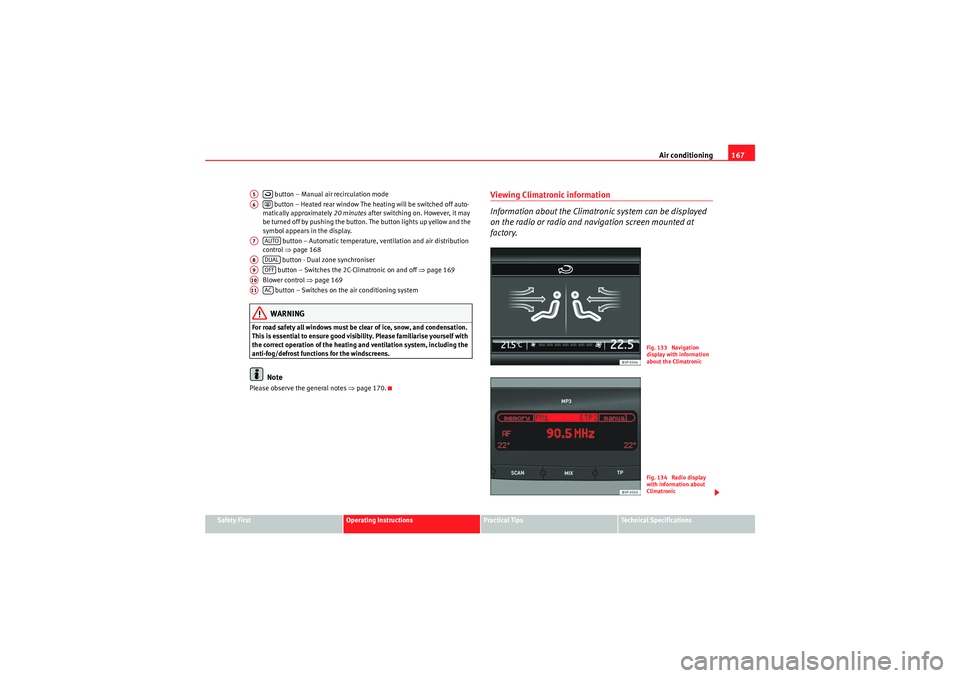
button – Manual air recirculation mode
button – Heated rear window The heating will be switched off auto-
matically approximately 20 minutes after switching on. However, it may
be turned off by pushing the button. The button lights up yellow and the
symbol appears in the display.
button – Automatic temperature, ventilation and air distribution
control ⇒page 168
button - Dual zone synchroniser
button – Switches the 2C-Climatronic on and off ⇒page 169
Blower control ⇒page 169
button – Switches on the air conditioning system
WARNING
For road safety all windows must be clear of ice, snow, and condensation.
This is essential to ensure good visibility. Please familiarise yourself with
the correct operation of the heating and ventilation system, including the
anti-fog/defrost functions for the windscreens.
Note
Please observe the general notes ⇒page 170.
Viewing Climatronic information
Information about the Climatronic system can be displayed
on the radio or radio and navigation screen mounted at
factory.
A5
A6
=
A7
AUTO
A8
DUAL
A9
OFF
A10A11
AC
Fig. 133 Navigation
display with information
about the ClimatronicFig. 134 Radio display
with information about
Climatronic
AlteaXL_EN.book Seite 167 Donnerstag, 9. September 2010 12:13 12
Page 171 of 319
Air conditioning169
Safety First
Operating Instructions
Practical Tips
Technical Specifications
Manual mode
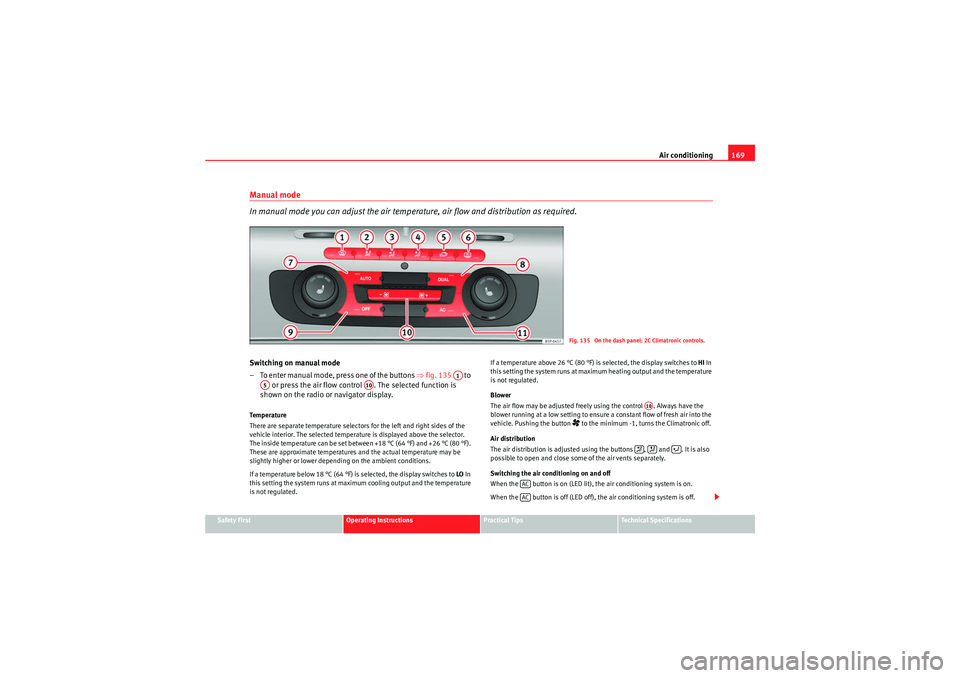
In manual mode you can adjust the air temperature, air flow and distribution as required.Switching on manual mode
– To enter manual mode, press one of the buttons ⇒fig. 135 to
or press the air flow control . The selected function is
shown on the radio or navigator display.Te m p e r a t u r e
There are separate temperature selectors for the left and right sides of the
vehicle interior. The selected temperature is displayed above the selector.
The inside temperature can be set between +18 °C (64 °F) and +26 °C (80 °F).
These are approximate temperatures and the actual temperature may be
slightly higher or lower depending on the ambient conditions.
If a temperature below 18 °C (64 °F) is selected, the display switches to LO In
this setting the system runs at maximum cooling output and the temperature
is not regulated. If a temperature above 26 °C (80 °F) is selected, the display switches to
HI In
this setting the system runs at maximum heating output and the temperature
is not regulated.
Blower
The air flow may be adjusted freely using the control . Always have the
blower running at a low setting to ensure a constant flow of fresh air into the
vehicle. Pushing the button
– to the minimum -1, turns the Climatronic off.
Air distribution
The air distribution is adjusted using the buttons , and . It is also
possible to open and close some of the air vents separately.
Switching the air conditioning on and off
When the button is on (LED lit), the air conditioning system is on.
When the button is off (LED off), the air conditioning system is off.Fig. 135 On the dash panel: 2C Climatronic controls.
A1
A5
A10
A10
ACAC
AlteaXL_EN.book Seite 169 Donnerstag, 9. September 2010 12:13 12
Page 173 of 319
Air conditioning171
Safety First
Operating Instructions
Practical Tips
Technical Specifications
comfort for the vehicle occupants and prevents misting of the windows when
the ambient air humidity is high.
If the air conditioning system cannot be switched on this may be caused by
the following reasons:
•The engine is not running.•The button is disconnected.•The outside temperature is below +3 °C.•The air conditioning system compressor has been temporarily switched
off because the engine coolant temperature is too high.•The air conditioner fuse is faulty.•Another fault in the vehicle. Have the air conditioner checked by a special-
ised workshop.Caution
•If you suspect that the air conditioner is damaged, switch it off with the button to prevent further damage and have it checked by a specialised
workshop.•Repairs to the air conditioner require specialist knowledge and special
tools. Therefore, we recommend you to take the vehicle to a specialised work-
shop.Note
•If the humidity and temperature outside the vehicle are high, condensa-
tion can drip off the evaporator in the cooling system and so forming a puddle
underneath the vehicle. This is completely normal and there is no need to
suspect a leak.•Keep the air intake slots in front of the windscreen free of snow, ice and
leaves to ensure heating and cooling are not impaired, and to prevent the
windows from misting over.
•The air from the vents flows through th e vehicle interior and is extracted
by slots designed for this purpose. Therefore, do not cover these slots with
items of clothing or other objects.•The air conditioner operates most effectively with the windows and the
sliding/tilting sunroof* closed. However, if the temperature inside the vehicle
is excessive because of the sun, the air inside can be cooled faster by opening
the windows for a short time.•Do not smoke while air recirculation mode is on, as smoke drawn into the
air conditioning system leaves a residue on the evaporator, producing a
permanent unpleasant odour.•It is advisable to connect the air conditioning at least once a month, to
lubricate the system gaskets and prevent leaks. If a decrease in the cooling
capacity is detected, an Authorised Service Centre should be consulted to
check the system.
AC
AC
AlteaXL_EN.book Seite 171 Donnerstag, 9. September 2010 12:13 12
Page 175 of 319
Driving173
Safety First
Operating Instructions
Practical Tips
Technical Specifications
•Adjust the driver seat or steering wheel so that there is a distance of at
least 25 cm between the steering wheel and your chest ⇒page 172,
fig. 137 . If you fail to observe the minimum distance, the airbag will not
protect you. Risk of fatal injury.•If your physical constitution does not allow you to maintain the
minimum distance of 25 cm, contact an Authorised Service Centre. The
Authorised Service Centre will help you to decide if special specific modifi-
cations are necessary.•If you adjust the steering wheel so that it points towards your face, the
driver airbag will not protect you properly in the event of an accident. Make
sure that the steering wheel points towards your chest.•When driving, always hold the steering wheel with both hands on the
outside of the ring at the 9 o'clock and 3 o'clock positions. Never hold the
steering wheel at the 12 o'clock position, or in any other manner (e.g. in
the centre of the steering wheel, or on the inside of the rim). In such cases,
if the airbag is triggered, you may sustain injuries to the arms, hands and
head.
SafetyElectronic Stabilit y Programme (ESP)*
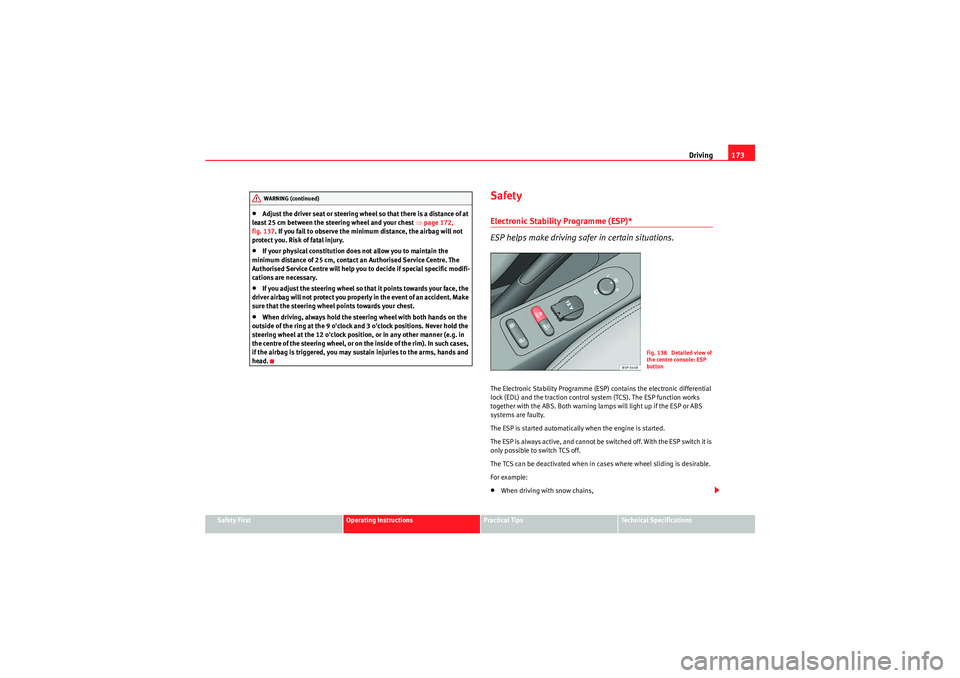
ESP helps make driving safer in certain situations.The Electronic Stability Programme (ESP) contains the electronic differential
lock (EDL) and the traction control system (TCS). The ESP function works
together with the ABS. Both warning lamps will light up if the ESP or ABS
systems are faulty.
The ESP is started automatically when the engine is started.
The ESP is always active, and cannot be switched off. With the ESP switch it is
only possible to switch TCS off.
The TCS can be deactivated when in cases where wheel sliding is desirable.
For example:•When driving with snow chains,
WARNING (continued)
Fig. 138 Detailed view of
the centre console: ESP
button
AlteaXL_EN.book Seite 173 Donnerstag, 9. September 2010 12:13 12
Page 177 of 319
Driving175
Safety First
Operating Instructions
Practical Tips
Technical Specifications
Starting
The engine is started when the key is in this position. Electrical components
with a high power consumption are switched off temporarily.
Every time the vehicle is started again, the ignition key must be turned to
position . The
repetitive start prevention lock of the ignition prevents
possible damage to the starter motor if the engine is already running.
WARNING
•The ignition key must NOT be removed from the lock until the vehicle
comes to a standstill. Otherwise, the steering could be immediately
blocked- Risk of accident!•Always remove the key from the ignition when leaving the vehicle, even
for a short period. This is especially important if children or disabled
people are left alone in the vehicle. They could accidentally start the
engine or work electrical equipment such as the electric windows, conse-
quently resulting in an accident.•Unsupervised use of the keys could start the engine or any electrical
system, such as the electric window. This could result in serious injury.Caution
The starter motor will only work when the engine is stopped (ignition key
position ).Electronic immobiliser
The immobiliser prevents unauthorised persons from driving
the vehicle.Inside the key there is a chip that deactivates the electronic immobiliser auto-
matically when the key is inserted into the ignition. The immobiliser will be activated again automatically as soon as you pull the
key out of the ignition lock.
The engine can only be started using a genuine SEAT key with its correct code.
Note
A perfect operation of the vehicle is ensured if genuine SEAT keys are used.Starting and stopping the engineStarting petrol engines
The engine can only be started using a genuine SEAT key with
its correct code.– Move the gear lever to the neutral position and depress the
clutch pedal thoroughly and hold it in this position for the starter
to turn the engine on.
– Turn the ignition key to the starting position ⇒page 174.
– Le t go o f the ig nit io n key as so on as the e ngin e star t s; t he sta r ter motor must not run on with the engine.After starting a very hot engine, you may need to slightly press down the
accelerator.
When starting a very cold engine, it may be a little noisy for the first few
seconds until oil pressure has built up in the hydraulic valve compensators.
This is quite normal, and no cause for concern.
A2A0A2
AlteaXL_EN.book Seite 175 Donnerstag, 9. September 2010 12:13 12
Page 179 of 319
Driving177
Safety First
Operating Instructions
Practical Tips
Technical Specifications
WARNING
•Never start or run the engine in unventilated or closed rooms. The
exhaust fumes contain carbon monoxide, an odourless and colourless
poisonous gas. Risk of fatal accidents. Carbon monoxide can cause loss of
consciousness. It can also cause death.•Never leave the vehicle unattended if the engine is running.•Never use “cold start sprays”, they could explode or cause the engine
to run at high revs. Risk of injury.Caution
•When the engine is cold, you should avoid high engine speeds, driving at
full throttle and over-loading the engine. Risk of engine damage.•The vehicle should not be pushed or towed more than 50 metres to start
the engine. Unburnt fuel could enter the catalytic converter and damage it.•Before attempting to push-start or tow a vehicle in order to start it, you
should first try to start it using the battery of another vehicle. Note and follow
the instructions in ⇒page 282, “Jump-starting”.For the sake of the environment
Do not warm-up the engine by running the engine with the vehicle stationary.
You should drive off as soon as you start the engine. This helps the engine
reach operating temperature faster and reduces emissions.Switching off the engine–Stop the vehicle.
– Turn the ignition key to position ⇒page 174, fig. 139 .
After switching the engine off, the radiator fan may run on for up to 10
m i n u t e s . I t i s a l s o p o s si bl e t ha t t h e fa n tu r n s i t s e l f o n o n ce m o r e i f t h e co o la n t
temperature increases due to the heat accumulated in the engine compart-
ment or due to its prolonged exposure to solar radiation.
WARNING
•Never switch the engine off until the vehicle is completely stationary.•The brake servo works only when the engine is running. With the
engine switched off, more strength is needed to brake. As normal brake
operation cannot be performed, risk of accidents and serious injury may
exist.•The steering lock can be immediately blocked once the key is removed
from the ignition. The steering wheel cannot be turned. Risk of accident.Caution
When the engine has been running under a heavy load for a long period, heat
can accumulate in the engine compartment and cause engine damage. For
this reason, you should idle the engine for approx. 2 minutes before you
switch it off.
A0
AlteaXL_EN.book Seite 177 Donnerstag, 9. September 2010 12:13 12
Page 181 of 319
Driving179
Safety First
Operating Instructions
Practical Tips
Technical Specifications
Manual switch from LPG to petrol
Press the button on the centre console
⇒page 178, fig. 140 to change
mode. The green lamp on the instrument panel goes out and the notification
changed to petrol mode is displayed.
Running on petrol
Run the engine with petrol for short journeys at regular intervals to avoid
problems in the petrol system.
WARNING
LPG is a highly explosive and inflammable substance. It may cause severe
burns and other injury.•Due care must be taken to avoid any risk of fire or explosion.•When parking the vehicle in a closed area (for example in a garage),
make sure that there is adequate ventilation, either natural or mechanical,
to neutralise the LPG in the event of a leak.Note
•If frequent short journeys are made, especially when the outside temper-
ature is low, the vehicle will tend to run on petrol more often than on LPG.
Therefore, the petrol tank may empty before the LPG tank.•The notification LPG mode not possible may be displayed.Start-Stop function*Description and operationThe Start-Stop function stops the engine when the vehicle is
stopped and starts it automatically when required. – When the vehicle is stopped, put it in neutral and release the
clutch pedal. The engine will stop.
– When the clutch pedal is pressed, the engine starts again.
– The instrument panel screen displays information about the status of the Start-Stop function ⇒page 181, fig. 142 .
Start-Stop function conditions•The driver seat belt must be buckled.•The engine hood must be closed.•The engine must be at operating temperature•The steering wheel must be straight.•The vehicle must be on flat ground.•The vehicle must not be in reverse.•A trailer must not be connected.•The temperature of the passenger compartment must be within the
comfort limits (button ⇒page 169, fig. 135 should be selected).•The windscreen de-mist function must be off.•If not , it requires an increase in airflow ⇒page 169, fig. 135 for more
than three presses.•The temperature must not be set to HI or LO .•The driver door must be closed.•The diesel particulate filter must not be in regeneration mode, for diesel
engines.•The battery charge must not be low for the next start.•The battery temperature must be between -1 °C and 55 °C.•The parking assistant, Park Assist* must not be activated.
GAS
ACA11
A10
AlteaXL_EN.book Seite 179 Donnerstag, 9. September 2010 12:13 12
Page 183 of 319
Driving181
Safety First
Operating Instructions
Practical Tips
Technical Specifications
Manually deactivating the Start-Stop function
– Press button ⇒page 180, fig. 141 located on the centre
console. When the Start-Stop function is deactivated, the push-
button indicator lights.
– If the Start-Stop function is operating then the engine starts immediately.
Switching the Start-Stop function on manually
– Press button ⇒page 180, fig. 141 located on the centre
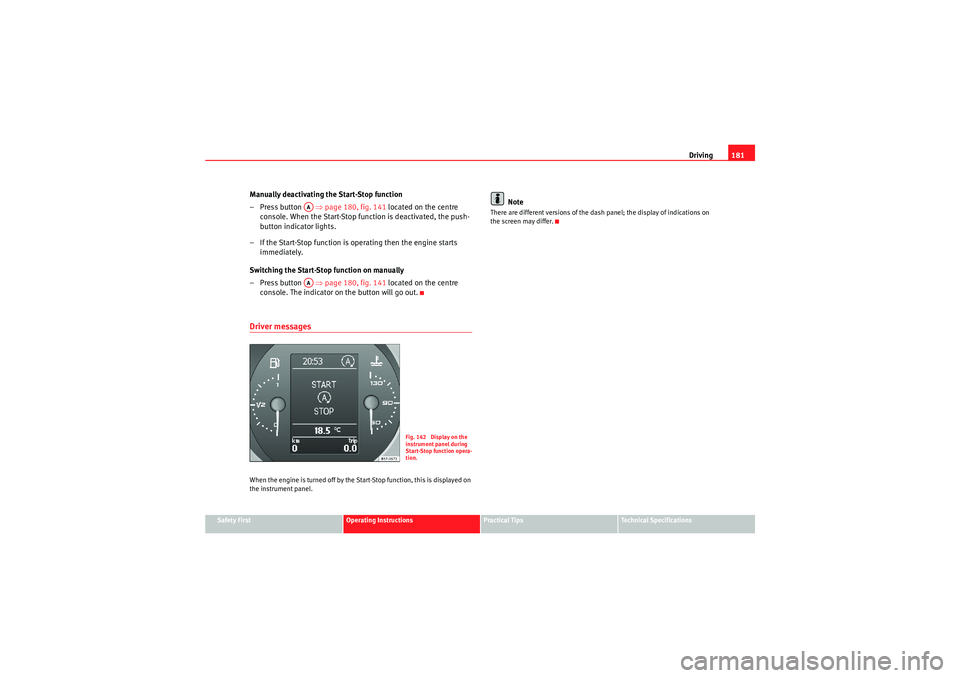
console. The indicator on the button will go out.Driver messagesWhen the engine is turned off by the Start-Stop function, this is displayed on
the instrument panel.
Note
There are different versions of the dash panel; the display of indications on
the screen may differ.
AAAA
Fig. 142 Display on the
instrument panel during
Start-Stop function opera-
tion.
AlteaXL_EN.book Seite 181 Donnerstag, 9. September 2010 12:13 12