headlights Seat Altea XL 2013 User Guide
[x] Cancel search | Manufacturer: SEAT, Model Year: 2013, Model line: Altea XL, Model: Seat Altea XL 2013Pages: 317, PDF Size: 4.69 MB
Page 209 of 317
207
Driving and the environment
SEAT importers and distributors will gladly provide information about the
technical preparations that you vehicle requires and also about necessary
maintenance and repair possibilities.
Adhesive strips for headlights
If you have to drive a right-hand drive vehicle in a left-hand drive country, or
vice versa, the asymmetric dipped beam headlights will dazzle oncoming
traffic.
To prevent dazzling, you must apply stickers to certain parts of the head-
light lenses. Further information is available at your Technical Service.
In vehicles with adaptive headlights, the rotation system must previously be
disconnected. To do this, please go to a specialised workshop.
Safety FirstOperating InstructionsPractical TipsTechnical Specifications
Page 245 of 317
243
Checking and refilling levels
The windscreen washer and the headlight washers are supplied with fluid
from the windscreen washer fluid container in the engine compartment.
The reservoir is located on the right-hand side of the engine compartment.
Plain water is not enough to clean the windscreen and headlights. We rec-
ommend that you always add a product to the windscreen washer fluid. Ap-
proved windscreen cleaning products exist on the market with high deter-
gent and anti-freeze properties, these may be added all-year-round. Please
follow the dilution instructions on the packaging.
WARNING
Any work carried out in the engine compartment or on the engine must
be carried out cautiously.
● When working in the engine compartment, always observe the safety
warnings ⇒ page 233.
CAUTION
● Never put radiator anti-freeze or other additives into the windscreen
washer fluid.
● Always use approved windscreen cleansing products diluted as per in-
structions. If you use other washer fluids or soap solutions, the tiny holes in
the fan-shaped nozzles could become blocked. Changing windscreen wiper blades
If the windscreen wiper blades are in perfect condition, you
will benefit from an improved visibility. Damaged wiper
blades should be replaced immediately.
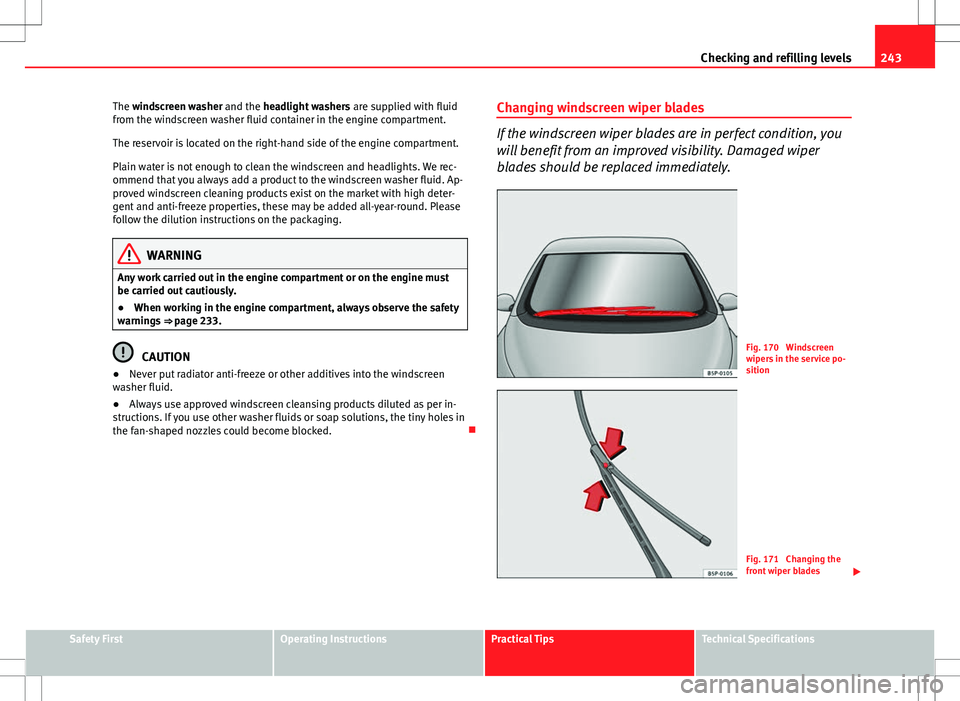
Fig. 170 Windscreen
wipers in the service po-
sition
Fig. 171 Changing the
front wiper blades
Safety FirstOperating InstructionsPractical TipsTechnical Specifications
Page 273 of 317
271
If and when
Fuses on left side of dash panel
Fuses
NumberConsumerAmps1Vacant 2Vacant 3Vacant 4Vacant 5Vacant 6Vacant 7Vacant 8Vacant 9Airbag510RSE input (roof screen)1011Vacant 12Left xenon headlight10
13Instrument panel (oil level)/Switchboard wiring
(BCM)/Heater / ABS, ESC / Park Pilot/ Gateway/
Flow meter5
14Gearbox/ Power steering/ Brake light sensor/
Trailer/ ABS, ESC/ Haldex/ Light switch10
15Heated windscreen / Instrument lighting / Diag-
nosis switchboard/Engine management/Addi-
tional heating/AFS headlights/Park Pilot10
16Right xenon headlight10
17Engine management/RSE system with START-
STOP10
18Kombi/levers with START-STOP519Navigation/Radio with START-STOP15
20Park Pilot (parking aid) / Gear lever/ ESC switch-
board10
NumberConsumerAmps21Vacant 22Volumetric alarm sensor/ Alarm horn523Diagnosis / Rain sensor / Light switch1024Trailer hook pre-installation assistant1525Vacant 26Vacuum pump2027RSE supply (Ceiling display) without START-STOP1028Rear window wiper motor2029Vacant 30Cigarette lighter/power socket2031Vacant 32Vacant 33Heater4034Vacant 35Vacant 36Vacant 37Vacant 38Vacant 39Trailer control unit (coupling)15
40Trailer control unit (turn signals, brakes and left
side)20
41Trailer control unit (fog light, reverse light and
right side)20
42BCM wiring switchboard2043Trailer pre-installation4044Heated rear window2545Electric windows (front)3046Rear electric windows3047Engine (Fuel control unit, petrol relay)15
Safety FirstOperating InstructionsPractical TipsTechnical Specifications
Page 275 of 317
273
If and when
NumberConsumerAmps
29 a)Electric windows (front and back)50Electric windows (front)3030Ignition key50a)
Ampere rating according to motorisation
Bulb change General notes
Before changing any bulb, first turn off the failed component.
Do not touch the glass part of the bulb with your bare hands. The finger-
prints left on the glass will vaporise as a result of the heat generated by the
bulb, causing a reduction in bulb life and condensation on the mirror sur-
face, thus reducing effectiveness.
A bulb must only be replaced by one of the same type. The type is indicated
on the bulb, either on the glass part or on the base.
It is highly recommended to keep a box of spare bulbs in the vehicle. At the
very least, the following spare bulbs, which are essential for road safety,
should be kept in the vehicle. Main headlights
- H7
- H1
- W5W - PY21W
Xenon 1)
/adaptive headlights
- D1S2)
- P21W SLL
- W5W - PY21W
Fog light - H3
Fixed tail light - P21W3)
- P21W
Mobile rear lid light - P21W- P21W
- W5W
Dipped beam
Main beam
Side
Turn signal
Dipped and full beam
Daylight
Side
Turn signals
Fog light
Stop/Position
Turn signal
Fog light (driver side)
Reverse (passenger side)
Side
1)
On this type of headlight, the bulb changes must be made by the Technical Service, given
that complex elements must be removed from the vehicle and a reset must be made on the
automatic control system incorporated.
2) The Xenon bulbs discharge 2.5 times the light flux and have an average lifespan of 5 times
more than that of halogen bulbs, this means that, except due to unusual circumstances,
there is no need to change the bulbs for the whole life of the vehicle.
3) Electronically controlled single filament bulb for Stop/side bulbs. If the bulb blows it will
not work in either position or Stop.
Safety FirstOperating InstructionsPractical TipsTechnical Specifications
Page 276 of 317
274If and when
Side turn signal - W5W
Number plate light - C5W
Note
● Depending on weather conditions (cold or wet), the front lights, the fog
lights, the tail lights and the turn signals may be temporarily misted. This
has no influence on the useful life of the lighting system. By switching on
the lights, the area through which the beam of light is projected will quickly
be demisted. However, the edges may continue to be misted.
● Please check at regular intervals that all lighting (especially the exterior
lighting) on your vehicle is functioning properly. This is not only in the inter-
est of your own safety, but also that of all other road users.
● Due to the difficulty in accessing some of the bulbs, any replacement
work should be done by a Technical Service. However, the following is a de-
scription of how to change the lamps except for the fog lights* and interior
lamps.
Side turn signal
Number plate light
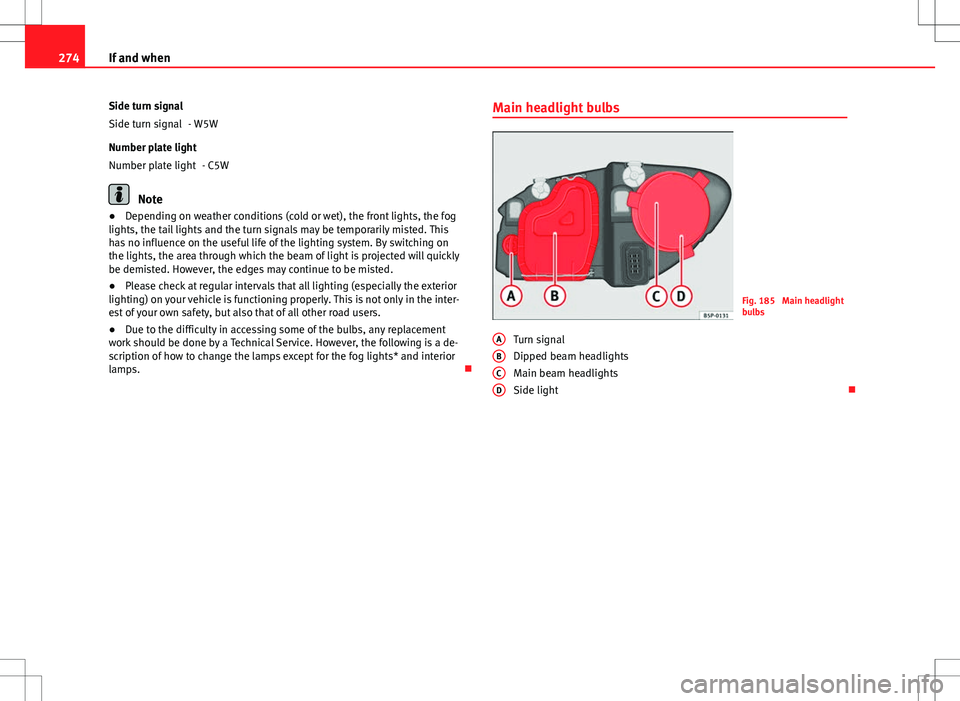
Main headlight bulbs
Fig. 185 Main headlight
bulbs
Turn signal
Dipped beam headlights
Main beam headlights
Side light
A
BCD
Page 277 of 317
275
If and when
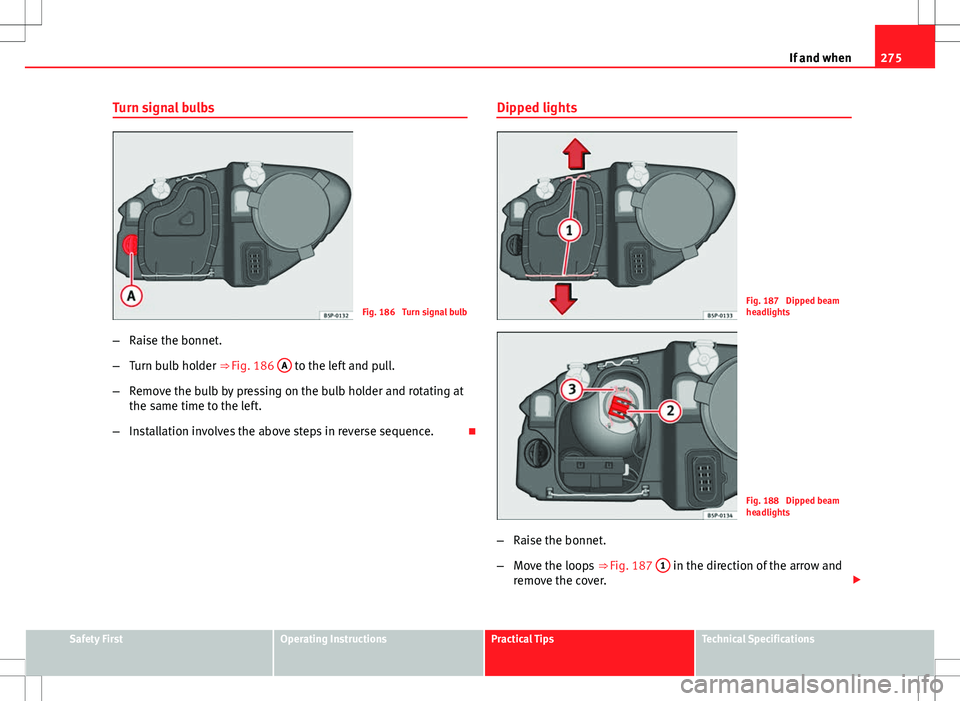
Turn signal bulbs
Fig. 186 Turn signal bulb
– Raise the bonnet.
– Turn bulb holder ⇒ Fig. 186 A
to the left and pull.
– Remove the bulb by pressing on the bulb holder and rotating at
the same time to the left.
– Installation involves the above steps in reverse sequence. Dipped lights
Fig. 187 Dipped beam
headlights
Fig. 188 Dipped beam
headlights
– Raise the bonnet.
– Move the loops ⇒ Fig. 187 1
in the direction of the arrow and
remove the cover.
Safety FirstOperating InstructionsPractical TipsTechnical Specifications
Page 278 of 317
276If and when
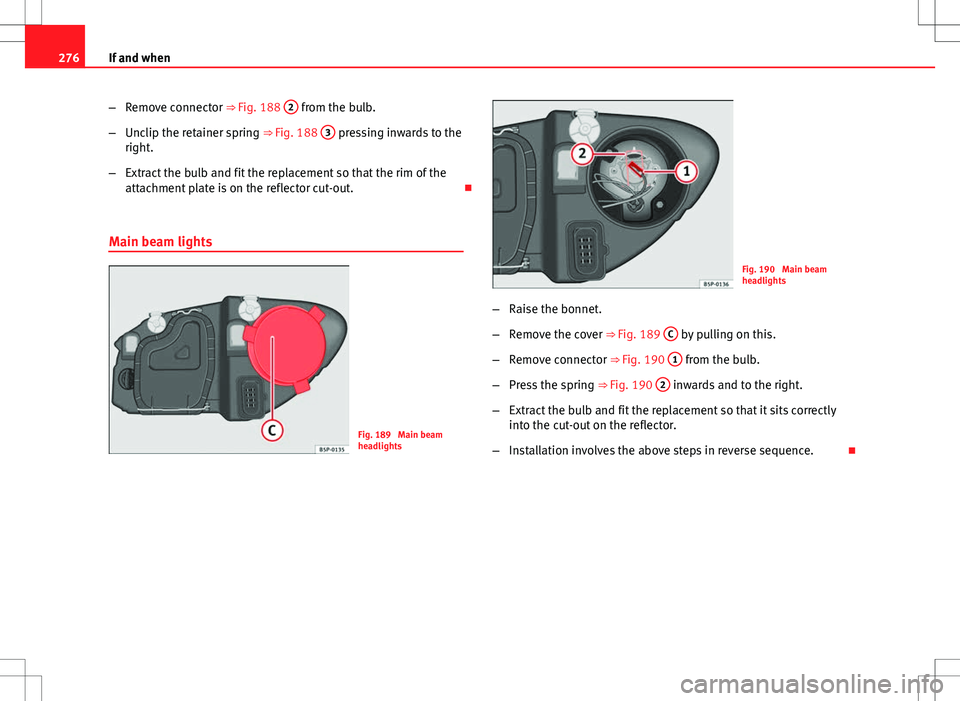
–Remove connector ⇒ Fig. 188 2
from the bulb.
– Unclip the retainer spring ⇒ Fig. 188 3
pressing inwards to the
right.
– Extract the bulb and fit the replacement so that the rim of the
attachment plate is on the reflector cut-out.
Main beam lights
Fig. 189 Main beam
headlights
Fig. 190 Main beam
headlights
– Raise the bonnet.
– Remove the cover ⇒ Fig. 189 C
by pulling on this.
– Remove connector ⇒ Fig. 190 1
from the bulb.
– Press the spring ⇒ Fig. 190 2
inwards and to the right.
– Extract the bulb and fit the replacement so that it sits correctly
into the cut-out on the reflector.
– Installation involves the above steps in reverse sequence.
Page 286 of 317
284If and when
Starting
5. Start the engine of the vehicle with the boosting battery and let
it run at idling speed.
6. Start the engine of the vehicle with the flat battery and wait two or three minutes until the engine is “running”.
Removing the jump leads
7. Before you remove the jump leads, switch off the dipped beam headlights (if they are switched on).
8. Turn on the heater blower and heated rear window in the vehi- cle with the flat battery. This helps minimise voltage peaks
which are generated when the leads are disconnected.
9. When the engine is running, disconnect the leads in reverse or- der to the details given above.
Connect the battery clamps so they have good metal-to-metal contact with
the battery terminals.
If the engine fails to start, switch off the starter after about 10 seconds and
try again after about half a minute.
WARNING
● Please note the safety warnings referring to working in the engine
compartment ⇒ page 233, Working in the engine compartment.
● The battery providing assistance must have the same voltage as the
flat battery (12V) and approximately the same capacity (see imprint on
battery). Failure to comply could result in an explosion.
WARNING (Continued)
● Never use jump leads when one of the batteries is frozen. Danger of
explosion! Even after the battery has thawed, battery acid could leak and
cause chemical burns. If a battery freezes, it should be replaced.
● Keep sparks, flames and lighted cigarettes away from batteries, dan-
ger of explosion. Failure to comply could result in an explosion.
● Observe the instructions provided by the manufacturer of the jump
leads.
● Do not connect the negative cable from the other vehicle directly to
the negative terminal of the flat battery. The gas emitted from the battery
could be ignited by sparks. Danger of explosion.
● Do not attach the negative cable from the other vehicle to parts of the
fuel system or to the brake line.
● The non-insulated parts of the battery clamps must not be allowed to
touch. The jump lead attached to the positive battery terminal must not
touch metal parts of the vehicle, this can cause a short circuit.
● Position the leads in such a way that they cannot come into contact
with any moving parts in the engine compartment.
● Do not lean on the batteries. This could result in chemical burns.
Note
The vehicles must not touch each other, otherwise electricity could flow as
soon as the positive terminals are connected.
Page 307 of 317
Index
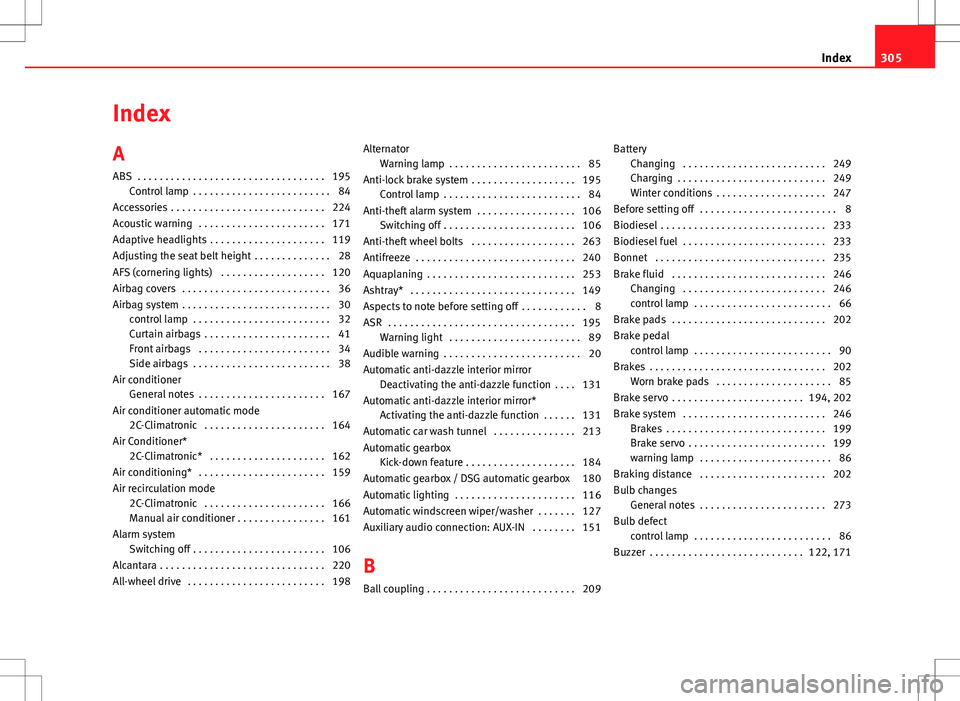
A
ABS . . . . . . . . . . . . . . . . . . . . . . . . . . . . . . . . . . 195Control lamp . . . . . . . . . . . . . . . . . . . . . . . . . 84
Accessories . . . . . . . . . . . . . . . . . . . . . . . . . . . . 224
Acoustic warning . . . . . . . . . . . . . . . . . . . . . . . 171
Adaptive headlights . . . . . . . . . . . . . . . . . . . . . 119
Adjusting the seat belt height . . . . . . . . . . . . . . 28
AFS (cornering lights) . . . . . . . . . . . . . . . . . . . 120
Airbag covers . . . . . . . . . . . . . . . . . . . . . . . . . . . 36
Airbag system . . . . . . . . . . . . . . . . . . . . . . . . . . . 30 control lamp . . . . . . . . . . . . . . . . . . . . . . . . . 32
Curtain airbags . . . . . . . . . . . . . . . . . . . . . . . 41
Front airbags . . . . . . . . . . . . . . . . . . . . . . . . 34
Side airbags . . . . . . . . . . . . . . . . . . . . . . . . . 38
Air conditioner General notes . . . . . . . . . . . . . . . . . . . . . . . 167
Air conditioner automatic mode 2C-Climatronic . . . . . . . . . . . . . . . . . . . . . . 164
Air Conditioner* 2C-Climatronic* . . . . . . . . . . . . . . . . . . . . . 162
Air conditioning* . . . . . . . . . . . . . . . . . . . . . . . 159
Air recirculation mode 2C-Climatronic . . . . . . . . . . . . . . . . . . . . . . 166
Manual air conditioner . . . . . . . . . . . . . . . . 161
Alarm system Switching off . . . . . . . . . . . . . . . . . . . . . . . . 106
Alcantara . . . . . . . . . . . . . . . . . . . . . . . . . . . . . . 220
All-wheel drive . . . . . . . . . . . . . . . . . . . . . . . . . 198 Alternator
Warning lamp . . . . . . . . . . . . . . . . . . . . . . . . 85
Anti-lock brake system . . . . . . . . . . . . . . . . . . . 195 Control lamp . . . . . . . . . . . . . . . . . . . . . . . . . 84
Anti-theft alarm system . . . . . . . . . . . . . . . . . . 106 Switching off . . . . . . . . . . . . . . . . . . . . . . . . 106
Anti-theft wheel bolts . . . . . . . . . . . . . . . . . . . 263
Antifreeze . . . . . . . . . . . . . . . . . . . . . . . . . . . . . 240
Aquaplaning . . . . . . . . . . . . . . . . . . . . . . . . . . . 253
Ashtray* . . . . . . . . . . . . . . . . . . . . . . . . . . . . . . 149
Aspects to note before setting off . . . . . . . . . . . . 8
ASR . . . . . . . . . . . . . . . . . . . . . . . . . . . . . . . . . . 195 Warning light . . . . . . . . . . . . . . . . . . . . . . . . 89
Audible warning . . . . . . . . . . . . . . . . . . . . . . . . . 20
Automatic anti-dazzle interior mirror Deactivating the anti-dazzle function . . . . 131
Automatic anti-dazzle interior mirror* Activating the anti-dazzle function . . . . . . 131
Automatic car wash tunnel . . . . . . . . . . . . . . . 213
Automatic gearbox Kick-down feature . . . . . . . . . . . . . . . . . . . . 184
Automatic gearbox / DSG automatic gearbox 180
Automatic lighting . . . . . . . . . . . . . . . . . . . . . . 116
Automatic windscreen wiper/washer . . . . . . . 127
Auxiliary audio connection: AUX-IN . . . . . . . . 151
B
Ball coupling . . . . . . . . . . . . . . . . . . . . . . . . . . . 209 Battery
Changing . . . . . . . . . . . . . . . . . . . . . . . . . . 249
Charging . . . . . . . . . . . . . . . . . . . . . . . . . . . 249
Winter conditions . . . . . . . . . . . . . . . . . . . . 247
Before setting off . . . . . . . . . . . . . . . . . . . . . . . . . 8
Biodiesel . . . . . . . . . . . . . . . . . . . . . . . . . . . . . . 233
Biodiesel fuel . . . . . . . . . . . . . . . . . . . . . . . . . . 233
Bonnet . . . . . . . . . . . . . . . . . . . . . . . . . . . . . . . 235
Brake fluid . . . . . . . . . . . . . . . . . . . . . . . . . . . . 246 Changing . . . . . . . . . . . . . . . . . . . . . . . . . . 246
control lamp . . . . . . . . . . . . . . . . . . . . . . . . . 66
Brake pads . . . . . . . . . . . . . . . . . . . . . . . . . . . . 202
Brake pedal control lamp . . . . . . . . . . . . . . . . . . . . . . . . . 90
Brakes . . . . . . . . . . . . . . . . . . . . . . . . . . . . . . . . 202 Worn brake pads . . . . . . . . . . . . . . . . . . . . . 85
Brake servo . . . . . . . . . . . . . . . . . . . . . . . . 194, 202
Brake system . . . . . . . . . . . . . . . . . . . . . . . . . . 246 Brakes . . . . . . . . . . . . . . . . . . . . . . . . . . . . . 199
Brake servo . . . . . . . . . . . . . . . . . . . . . . . . . 199
warning lamp . . . . . . . . . . . . . . . . . . . . . . . . 86
Braking distance . . . . . . . . . . . . . . . . . . . . . . . 202
Bulb changes General notes . . . . . . . . . . . . . . . . . . . . . . . 273
Bulb defect control lamp . . . . . . . . . . . . . . . . . . . . . . . . . 86
Buzzer . . . . . . . . . . . . . . . . . . . . . . . . . . . . 122, 171
305
Index
Page 309 of 317
Correct adjustment of rear seat head restraintsIn-use and non-use positions . . . . . . . . . . . 14
Correct sitting position front passenger . . . . . . . . . . . . . . . . . . . . . . 11
Incorrect sitting position . . . . . . . . . . . . . . . 15
passenger . . . . . . . . . . . . . . . . . . . . . . . . . . . 12
Cruise control Control lamp . . . . . . . . . . . . . . . . . . . . . . . . . 87
Cruise control system . . . . . . . . . . . . . . . . . . . . 190
Cruise control* Complete system deactivation . . . . . . . . . 192
Cruise speed . . . . . . . . . . . . . . . . . . . . . . . . . . . 190 Control lamp . . . . . . . . . . . . . . . . . . . . . . . . . 87
Curtain airbags . . . . . . . . . . . . . . . . . . . . . . . . . . 41 Description . . . . . . . . . . . . . . . . . . . . . . . . . . 41
Operation . . . . . . . . . . . . . . . . . . . . . . . . . . . 42
Safety notes . . . . . . . . . . . . . . . . . . . . . . . . . 42
D Danger of fitting a child seat on the front pas- senger seat . . . . . . . . . . . . . . . . . . . . . . . . . . . 31
Dash panel . . . . . . . . . . . . . . . . . . . . . . . . . . . . . 55
Dash panel cleaning . . . . . . . . . . . . . . . . . . . . 222
Daytime driving lights Activating . . . . . . . . . . . . . . . . . . . . . . . . . . 117
Deactivating . . . . . . . . . . . . . . . . . . . . . . . . 117
Daytime lights . . . . . . . . . . . . . . . . . . . . . . . . . 117
Deactivating front passenger airbag Safety notes . . . . . . . . . . . . . . . . . . . . . . . . . 45
Deactivating the airbag Front passenger front airbag . . . . . . . . . . . . 44 Diesel . . . . . . . . . . . . . . . . . . . . . . . . . . . . . . . . 232
Diesel engine
Winter driving . . . . . . . . . . . . . . . . . . . . . . . 233
Diesel engine particulate filter . . . . . . . . . . . . 204
Differential lock . . . . . . . . . . . . . . . . . . . . . . . . 197
Differential lock fault (EDL) Control lamp . . . . . . . . . . . . . . . . . . . . . . . . . 89
Digital clock . . . . . . . . . . . . . . . . . . . . . . . . . . . . 59
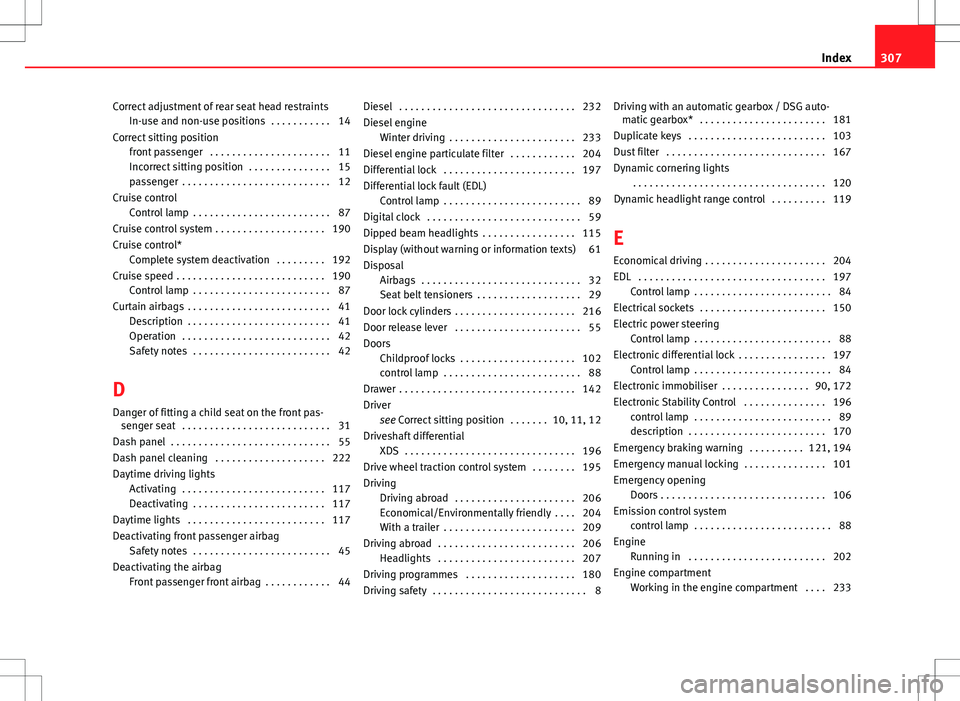
Dipped beam headlights . . . . . . . . . . . . . . . . . 115
Display (without warning or information texts) 61
Disposal Airbags . . . . . . . . . . . . . . . . . . . . . . . . . . . . . 32
Seat belt tensioners . . . . . . . . . . . . . . . . . . . 29
Door lock cylinders . . . . . . . . . . . . . . . . . . . . . . 216
Door release lever . . . . . . . . . . . . . . . . . . . . . . . 55
Doors Childproof locks . . . . . . . . . . . . . . . . . . . . . 102
control lamp . . . . . . . . . . . . . . . . . . . . . . . . . 88
Drawer . . . . . . . . . . . . . . . . . . . . . . . . . . . . . . . . 142
Driver see Correct sitting position . . . . . . . 10, 11, 12
Driveshaft differential XDS . . . . . . . . . . . . . . . . . . . . . . . . . . . . . . . 196
Drive wheel traction control system . . . . . . . . 195
Driving Driving abroad . . . . . . . . . . . . . . . . . . . . . . 206
Economical/Environmentally friendly . . . . 204
With a trailer . . . . . . . . . . . . . . . . . . . . . . . . 209
Driving abroad . . . . . . . . . . . . . . . . . . . . . . . . . 206 Headlights . . . . . . . . . . . . . . . . . . . . . . . . . 207
Driving programmes . . . . . . . . . . . . . . . . . . . . 180
Driving safety . . . . . . . . . . . . . . . . . . . . . . . . . . . . 8 Driving with an automatic gearbox / DSG auto-
matic gearbox* . . . . . . . . . . . . . . . . . . . . . . . 181
Duplicate keys . . . . . . . . . . . . . . . . . . . . . . . . . 103
Dust filter . . . . . . . . . . . . . . . . . . . . . . . . . . . . . 167
Dynamic cornering lights . . . . . . . . . . . . . . . . . . . . . . . . . . . . . . . . . . . 120
Dynamic headlight range control . . . . . . . . . . 119
E
Economical driving . . . . . . . . . . . . . . . . . . . . . . 204
EDL . . . . . . . . . . . . . . . . . . . . . . . . . . . . . . . . . . 197 Control lamp . . . . . . . . . . . . . . . . . . . . . . . . . 84
Electrical sockets . . . . . . . . . . . . . . . . . . . . . . . 150
Electric power steering Control lamp . . . . . . . . . . . . . . . . . . . . . . . . . 88
Electronic differential lock . . . . . . . . . . . . . . . . 197 Control lamp . . . . . . . . . . . . . . . . . . . . . . . . . 84
Electronic immobiliser . . . . . . . . . . . . . . . . 90, 172
Electronic Stability Control . . . . . . . . . . . . . . . 196 control lamp . . . . . . . . . . . . . . . . . . . . . . . . . 89
description . . . . . . . . . . . . . . . . . . . . . . . . . 170
Emergency braking warning . . . . . . . . . . 121, 194
Emergency manual locking . . . . . . . . . . . . . . . 101
Emergency opening Doors . . . . . . . . . . . . . . . . . . . . . . . . . . . . . . 106
Emission control system control lamp . . . . . . . . . . . . . . . . . . . . . . . . . 88
Engine Running in . . . . . . . . . . . . . . . . . . . . . . . . . 202
Engine compartment Working in the engine compartment . . . . 233
307
Index