fuel cap Seat Altea XL 2013 Owner's Manual
[x] Cancel search | Manufacturer: SEAT, Model Year: 2013, Model line: Altea XL, Model: Seat Altea XL 2013Pages: 317, PDF Size: 4.69 MB
Page 6 of 317
Trailer towing . . . . . . . . . . . . . . . . . . . . . . . . . . . . . . 208
Instructions to follow . . . . . . . . . . . . . . . . . . . . . . 208
Ball coupling of towing bracket* . . . . . . . . . . . . . 209
Driving tips . . . . . . . . . . . . . . . . . . . . . . . . . . . . . . 209
Fitting a towing bracket* . . . . . . . . . . . . . . . . . . . 210
Vehicle maintenance and cleaning . . . . . . . . . 212
General notes . . . . . . . . . . . . . . . . . . . . . . . . . . . . 212
Care of the vehicle exterior . . . . . . . . . . . . . . . . . . 213
Vehicle interior maintenance . . . . . . . . . . . . . . . . 218
Accessories, replacement of parts and
modifications . . . . . . . . . . . . . . . . . . . . . . . . . . . . . 224
Accessories and spare parts . . . . . . . . . . . . . . . . 224
Technical modifications . . . . . . . . . . . . . . . . . . . . 224
Roof aerial* . . . . . . . . . . . . . . . . . . . . . . . . . . . . . . 225
Mobile phones and two-way radios . . . . . . . . . . . 225
Checking and refilling levels . . . . . . . . . . . . . . . 226
Refuelling . . . . . . . . . . . . . . . . . . . . . . . . . . . . . . . 226
LPG system* . . . . . . . . . . . . . . . . . . . . . . . . . . . . . 228
Petrol . . . . . . . . . . . . . . . . . . . . . . . . . . . . . . . . . . . 232
Diesel . . . . . . . . . . . . . . . . . . . . . . . . . . . . . . . . . . . 232
Working in the engine compartment . . . . . . . . . . 233
Engine oil . . . . . . . . . . . . . . . . . . . . . . . . . . . . . . . . 236
Coolant . . . . . . . . . . . . . . . . . . . . . . . . . . . . . . . . . 240
Washer fluid and windscreen wiper blades . . . . 242
Brake fluid . . . . . . . . . . . . . . . . . . . . . . . . . . . . . . . 246
Vehicle battery . . . . . . . . . . . . . . . . . . . . . . . . . . . 247
Wheels and tyres . . . . . . . . . . . . . . . . . . . . . . . . . . 250
Wheels . . . . . . . . . . . . . . . . . . . . . . . . . . . . . . . . . . 250
If and when . . . . . . . . . . . . . . . . . . . . . . . . . . . . . . . 259
Vehicle tools, tyre repair kit and spare wheel . . . 259
Wheel change . . . . . . . . . . . . . . . . . . . . . . . . . . . . 261
Tyre repair kit (Tyre Mobility System)* . . . . . . . . . 266
Fuses . . . . . . . . . . . . . . . . . . . . . . . . . . . . . . . . . . . 269
Bulb change . . . . . . . . . . . . . . . . . . . . . . . . . . . . . 273
Jump-starting . . . . . . . . . . . . . . . . . . . . . . . . . . . . . 282
Towing and tow-starting . . . . . . . . . . . . . . . . . . . . 285 Technical Specifications
. . . . . . . . . . . 288
Description of specifications . . . . . . . . . . . . . . . 288
Important information . . . . . . . . . . . . . . . . . . . . . 288
Information on fuel consumption . . . . . . . . . . . . 290
Towing a trailer . . . . . . . . . . . . . . . . . . . . . . . . . . . 290
Technical specifications . . . . . . . . . . . . . . . . . . . . 292
Checking fluid levels . . . . . . . . . . . . . . . . . . . . . . . 292
Petrol engine 1.4 63 kW (85 PS) . . . . . . . . . . . . . 293
Petrol engine 1.6 75 kW (102 PS) . . . . . . . . . . . . 294
Petrol engine 1.2 77 kW (105 PS) . . . . . . . . . . . . 296
Petrol engine 1.4 92 kW (125 PS) . . . . . . . . . . . . 297
Petrol engine 1.8 118 kW (160 PS) . . . . . . . . . . . 298
Diesel engine 1.6 TDI CR 66 kW (90 PS) with/
without DPF . . . . . . . . . . . . . . . . . . . . . . . . . . . . . . 299
Diesel engine 1.6 TDI CR 77 kW (105 PS) with/
without DPF . . . . . . . . . . . . . . . . . . . . . . . . . . . . . . 300
Diesel engine 1.6 TDI CR 77 kW (105 PS)
Start-Stop . . . . . . . . . . . . . . . . . . . . . . . . . . . . . . . . 301
Diesel engine 2.0 TDI CR 103 kW (140 PS) . . . . . 302
Diesel engine 2.0 TDI CR 103 kW (140 PS) 4-
wheel drive . . . . . . . . . . . . . . . . . . . . . . . . . . . . . . 303
Dimensions and capacities . . . . . . . . . . . . . . . . . 304
Index . . . . . . . . . . . . . . . . . . . . . . . . . . . . . . . . . . . 305
4Table of Contents
Page 60 of 317
58Cockpit
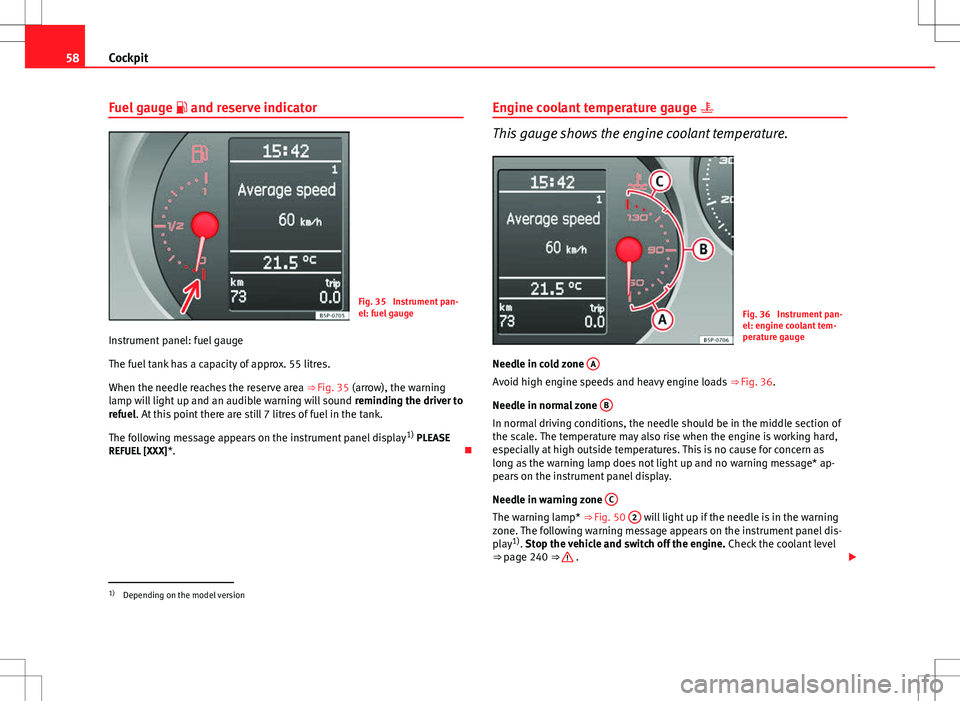
Fuel gauge and reserve indicator
Fig. 35 Instrument pan-
el: fuel gauge
Instrument panel: fuel gauge
The fuel tank has a capacity of approx. 55 litres.
When the needle reaches the reserve area ⇒ Fig. 35 (arrow), the warning
lamp will light up and an audible warning will sound reminding the driver to
refuel. At this point there are still 7 litres of fuel in the tank.
The following message appears on the instrument panel display 1)
PLEASE
REFUEL [XXX] *. Engine coolant temperature gauge
This gauge shows the engine coolant temperature.
Fig. 36 Instrument pan-
el: engine coolant tem-
perature gauge
Needle in cold zone A
Avoid high engine speeds and heavy engine loads
⇒ Fig. 36.
Needle in normal zone B
In normal driving conditions, the needle should be in the middle section of
the scale. The temperature may also rise when the engine is working hard,
especially at high outside temperatures. This is no cause for concern as
long as the warning lamp does not light up and no warning message* ap-
pears on the instrument panel display.
Needle in warning zone C
The warning lamp* ⇒ Fig. 50 2 will light up if the needle is in the warning
zone. The following warning message appears on the instrument panel dis-
play 1)
. Stop the vehicle and switch off the engine. Check the coolant level
⇒ page 240 ⇒
.
1)
Depending on the model version
Page 62 of 317
60Cockpit
LPG system*
LPG gauge
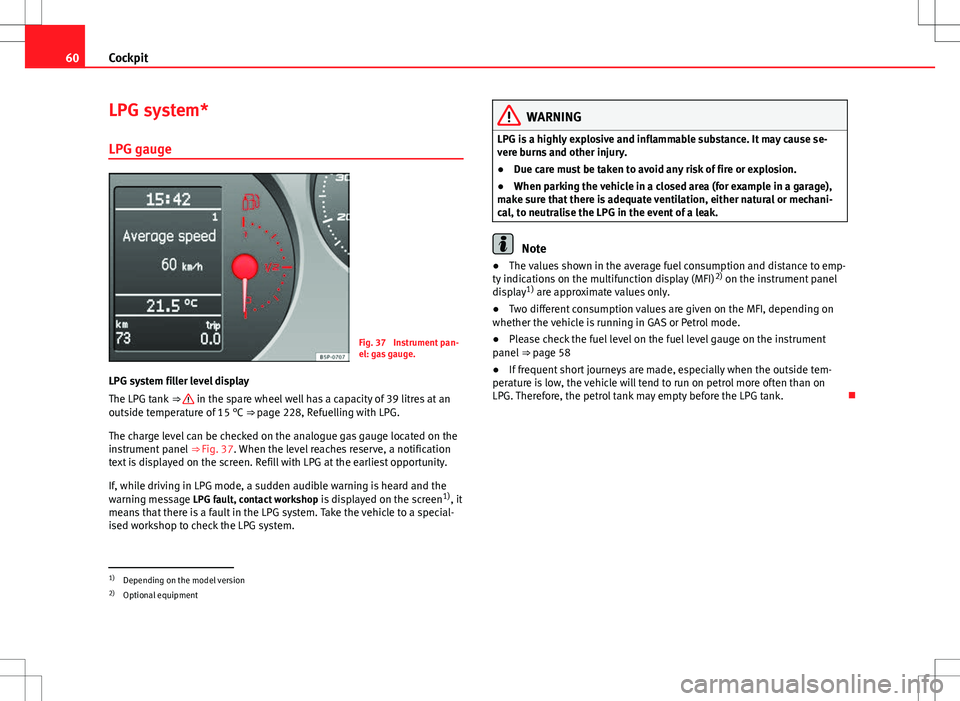
Fig. 37 Instrument pan-
el: gas gauge.
LPG system filler level display
The LPG tank ⇒
in the spare wheel well has a capacity of 39 litres at an
outside temperature of 15 °C ⇒ page 228, Refuelling with LPG.
The charge level can be checked on the analogue gas gauge located on the
instrument panel ⇒ Fig. 37. When the level reaches reserve, a notification
text is displayed on the screen. Refill with LPG at the earliest opportunity.
If, while driving in LPG mode, a sudden audible warning is heard and the
warning message LPG fault, contact workshop is displayed on the screen1)
, it
means that there is a fault in the LPG system. Take the vehicle to a special-
ised workshop to check the LPG system.
WARNING
LPG is a highly explosive and inflammable substance. It may cause se-
vere burns and other injury.
● Due care must be taken to avoid any risk of fire or explosion.
● When parking the vehicle in a closed area (for example in a garage),
make sure that there is adequate ventilation, either natural or mechani-
cal, to neutralise the LPG in the event of a leak.
Note
● The values shown in the average fuel consumption and distance to emp-
ty indications on the multifunction display (MFI) 2)
on the instrument panel
display 1)
are approximate values only.
● Two different consumption values are given on the MFI, depending on
whether the vehicle is running in GAS or Petrol mode.
● Please check the fuel level on the fuel level gauge on the instrument
panel ⇒ page 58
● If frequent short journeys are made, especially when the outside tem-
perature is low, the vehicle will tend to run on petrol more often than on
LPG. Therefore, the petrol tank may empty before the LPG tank.
1)
Depending on the model version
2) Optional equipment
Page 205 of 317
203
Driving and the environment
WARNING (Continued)
● On steep slopes, if brakes are excessively used, they will overheat.
Before driving down a long steep slope, it is advisable to reduce speed
and change down into a lower gear or range (depending on the type of
transmission). This makes use of engine braking and relieves the brakes.
● Never let the brakes “drag” by applying light pressure. Continuous
braking will cause the brakes to overheat and the braking distance will
increase. Apply and then release the brakes alternately.
● Never let the vehicle run with the engine switched off. The braking
distance is increased considerably when the brake servo is not active.
● If the brake fluid loses its viscosity and is subjected to heavy use, va-
pour bubbles can form in the brake system. This reduces the efficiency of
the brakes.
● Non-standard or damaged front spoilers could restrict the airflow to
the brakes and cause them to overheat. Before purchasing accessories
please observe the relevant instructions ⇒ page 224, Technical modifi-
cations.
● If a brake system circuit fails, the braking distance will be increased
considerably. Contact a specialised workshop immediately and avoid un-
necessary journeys.
Exhaust gas purification system Catalytic converter*
To maintain the useful life of the catalytic converter
– Use only unleaded petrol with petrol engines, as lead damages
the catalytic converter.
– Do not let the fuel get too low in the tank. –
For engine oil changes, do not replenish with too much engine
oil ⇒ page 239, Topping up engine oil .
– Never tow the vehicle to start it, use jump leads if necessary
⇒ page 282.
If you notice misfiring, uneven running or loss of power when the vehicle is
moving, reduce speed immediately and have the vehicle inspected at the
nearest specialised workshop. In general, the exhaust gas warning lamp
will light up when any of the described symptoms occur ⇒ page 77. If this
happens, unburnt fuel can enter the exhaust system and escape into the en-
vironment. The catalytic converter can also be damaged by overheating.
WARNING
The catalytic converter reaches very high temperatures! Risk of fire!
● Never park where the catalytic converter could come into contact with
dry grass or flammable materials under the vehicle.
● Do not apply additional underseal or anti-corrosion coatings to the
exhaust pipes, catalytic converter or the heat shields on the exhaust sys-
tem. These materials could catch fire when the vehicle is being driven.
CAUTION
Never run the fuel tank completely dry because the irregularity of the fuel
supply may cause ignition problems. This allows unburnt fuel to enter the
exhaust system, which could cause overheating and damage the catalytic
converter.
For the sake of the environment
Even when the emission control system is working perfectly, there may be a
smell of sulphur from the exhaust gas under some conditions. This depends
on the sulphur content of the fuel used. Quite often the problem can be
solved by changing to another brand of fuel.
Safety FirstOperating InstructionsPractical TipsTechnical Specifications
Page 228 of 317
226Checking and refilling levels
Checking and refilling levels
Refuelling
The tank flap is released manually. The tank holds approxi-
mately 55 litres. For all-wheel drive vehicles, the tank ca-
pacity is approximately 60 litres.
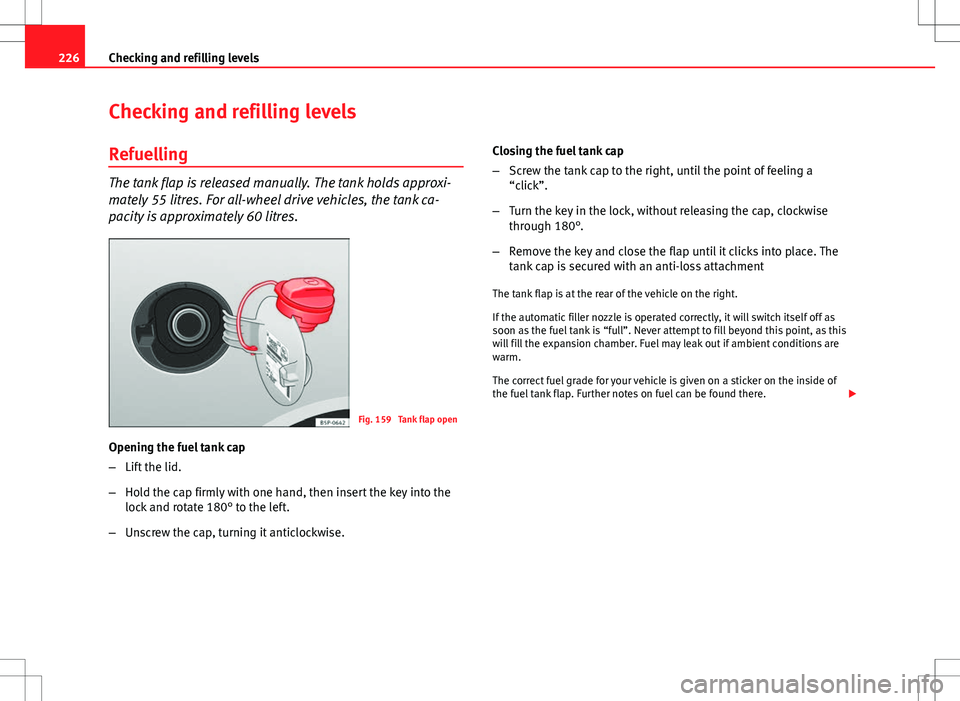
Fig. 159 Tank flap open
Opening the fuel tank cap
– Lift the lid.
– Hold the cap firmly with one hand, then insert the key into the
lock and rotate 180° to the left.
– Unscrew the cap, turning it anticlockwise. Closing the fuel tank cap
–
Screw the tank cap to the right, until the point of feeling a
“click”.
– Turn the key in the lock, without releasing the cap, clockwise
through 180°.
– Remove the key and close the flap until it clicks into place. The
tank cap is secured with an anti-loss attachment
The tank flap is at the rear of the vehicle on the right.
If the automatic filler nozzle is operated correctly, it will switch itself off as
soon as the fuel tank is “full”. Never attempt to fill beyond this point, as this
will fill the expansion chamber. Fuel may leak out if ambient conditions are
warm.
The correct fuel grade for your vehicle is given on a sticker on the inside of
the fuel tank flap. Further notes on fuel can be found there.
Page 230 of 317
228Checking and refilling levels
LPG system*
Refuelling with LPG
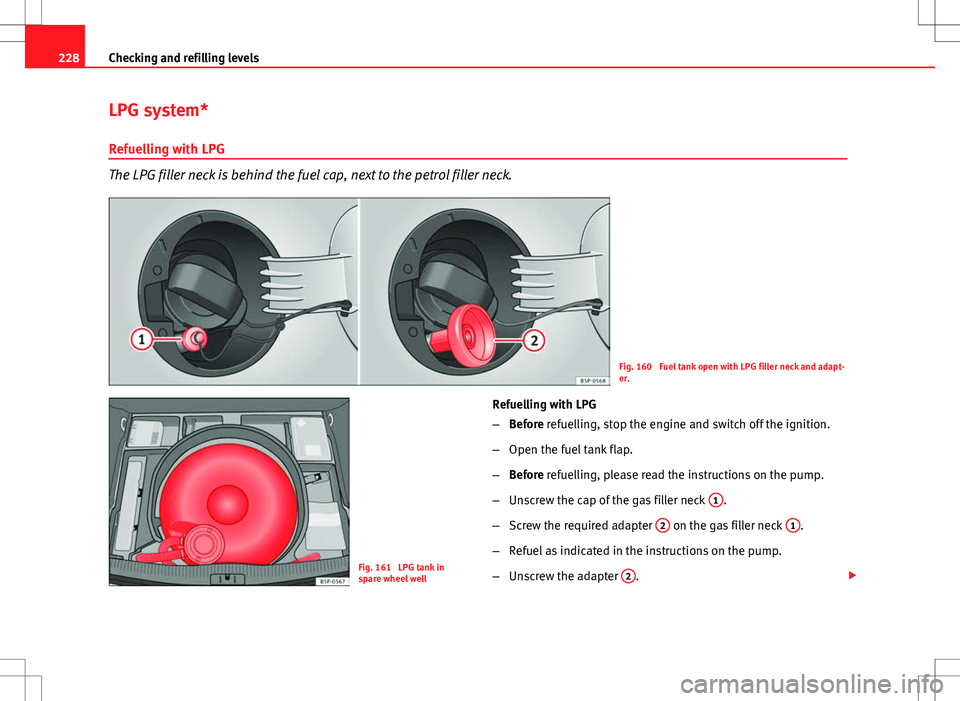
The LPG filler neck is behind the fuel cap, next to the petrol filler neck.
Fig. 160 Fuel tank open with LPG filler neck and adapt-
er.
Fig. 161 LPG tank in
spare wheel well Refuelling with LPG
–
Before refuelling, stop the engine and switch off the ignition.
– Open the fuel tank flap.
– Before refuelling, please read the instructions on the pump.
– Unscrew the cap of the gas filler neck 1
.
– Screw the required adapter 2
on the gas filler neck 1.
– Refuel as indicated in the instructions on the pump.
– Unscrew the adapter 2
.
Page 231 of 317
229
Checking and refilling levels
– Screw on the cap of the gas filler neck 1
.
– Close the fuel tank flap.
When the hose is removed from the tank, a small amount of LPG may spill
out ⇒
.
The LPG tank ⇒ Fig. 161 in the spare wheel well has a capacity of 39 litres. If
the outside temperatures are very low, it may not be possible to completely
fill the LPG tank.
Pump attachments
There are a variety of types of LPG pump, and the methods of use may vary.
Therefore, let the pump operator fill the tank when refuelling for the first
time or fill from another pump.
Noises when refuelling with LPG
When refuelling with LPG, noises may be heard. These noises are insignifi-
cant.
WARNING
Failure to refuel or handle LPG in the correct way could result in a fire,
cause an explosion or lead to injuries.
● LPG is a highly explosive and inflammable substance. It may cause
severe burns and other injury.
● Switch off the engine before refuelling.
● Always switch off mobile phones and any other radiophony applian-
ces, as electromagnetic waves may produce sparks and cause a fire.
● Do not remain in the vehicle while refuelling. If it is absolutely neces-
sary to enter the vehicle, close the door and touch a metal surface before
touching the attachment again. This will prevent the generation of static
electricity and any possible fires while refuelling.
WARNING (Continued)
● Small quantities of LPG may leak out after refuelling. If LPG comes in-
to contact with skin, there is a risk of freezing.
● Do not smoke and always keep bare flames away from the tank during
refuelling. Failure to do so may lead to an explosion.
Safety FirstOperating InstructionsPractical TipsTechnical Specifications
Page 236 of 317
234Checking and refilling levels
You should not do any work in the engine compartment unless you know ex-
actly how to carry out the jobs and have the correct tools! Have the work car-
ried out by a specialised workshop if you are uncertain.
All service fluids and consumables, e.g. coolant, engine oil, spark plugs
and batteries, are under constant development. SEAT provides a constant
flow of information to the Technical Services concerning modifications. For
this reason, we recommend you to have service fluids and consumables re-
placed by a Technical Service. Please observe the relevant instructions
⇒ page 224. The engine compartment of the vehicle is a hazardous area
⇒
.
WARNING
All work on the engine or in the engine compartment, e.g. checking and
refilling fluids, involves the danger of injury and scalding as well as the
risk of accident or fire.
● Never open the bonnet if you see steam, smoke or coolant escaping
from the engine compartment. Otherwise, there is a risk of sustaining
burns. Wait until no more steam or coolant is emitted, then allow the en-
gine to cool before carefully opening the bonnet.
● Switch off the engine and remove the key from the ignition.
● Apply the handbrake and move the gear lever to neutral or selector
lever to position P.
● Keep children away from the vehicle.
● Never touch hot engine parts. There is a risk of burns.
● Never spill liquids on a hot engine or on a hot exhaust gas system.
This is a fire hazard.
● Avoid causing short-circuits in the electrical system, particularly at
the points where the jump leads are attached ⇒ page 283. The battery
could explode.
WARNING (Continued)
● Never touch the radiator fan. It is temperature controlled and could
start automatically, even when the engine has been switched off and the
key removed from the ignition!
● Do not unscrew the cap on the coolant expansion tank when the en-
gine is hot. If the coolant is hot, the cooling system will be pressurised!
● Protect face, hands and arms by covering the cap with a large, thick
cloth to protect against escaping coolant and steam.
● Always make sure you have not left any objects, such as cleaning
cloths and tools, in the engine compartment.
● If you have to work underneath the vehicle, you must use suitable
stands additionally to support the vehicle, there is a risk of accident!. A
hydraulic jack is insufficient for securing the vehicle and there is a risk of
injury.
● If any work has to be performed when the engine is started or with
the engine running, there is an additional, potentially fatal, safety risk
from the rotating parts, such as the drive belts, alternator, radiator fan,
etc., and from the high-voltage ignition system. You should also observe
the following points:
–Never touch the electrical wiring of the ignition system.
– Ensure that jewellery, loose clothing and long hair do not get trap-
ped in rotating engine parts. Danger of death. Before starting any
work remove jewellery, tie back and cover hair, and wear tight-fitting
clothes.
– Never accelerate with a gear engaged without taking the necessary
precautions. The vehicle could move, even if the handbrake is ap-
plied. Danger of death.
● If work has to be carried out on the fuel system or on electrical com-
ponents, you must observe the following safety notes in addition to the
above warnings:
–Always disconnect the battery from the on-board network. The ve-
hicle must be unlocked when this is done, otherwise the alarm will be
triggered.
– Do not smoke.
Page 259 of 317
257
Wheels and tyres
Winter tyres
Winter tyres will improve the vehicles handling on snow and
ice.
In winter conditions winter tyres will considerably improve the vehicle's han-
dling. The design of summer tyres (width, rubber compound, tread pattern)
gives less grip on ice and snow.
Winter tyres must be inflated to a pressure 0.2 bar higher than the pres-
sures specified for summer tyres (see sticker on fuel tank flap).
Winter tyres must be fitted on all four wheels.
Information on permitted winter tyre sizes can be found in the vehicle's reg-
istration documentation. Use only radial winter tyres. All tyre sizes listed in
the vehicle documentation also apply to winter tyres.
Winter tyres lose their effectiveness when the tread is worn down to a depth
of 4 mm.
The speed rating code ⇒ page 255, New tyres and wheels determines the
following speed limits for winter tyres: ⇒
max. 160 km/h (100 mph)
max. 180 km/h (110 mph)
max. 190 km/h (120 mph)
max. 210 km/h (130 mph)
In some countries, vehicles which can exceed the speed rating of the fitted
tyre must have an appropriate sticker in the driver's field of view. These
stickers are available from your Technical Service. The legal requirements of
each country must be followed.
Do not have winter tyres fitted for unnecessarily long periods. Vehicles with
summer tyres handle better when the roads are free of snow and ice. Q
S
T
H If you have a flat tyre, please refer to the notes on the spare wheel
⇒ page 255, New tyres and wheels.
WARNING
The maximum speed for the winter tyres must not be exceeded. Other-
wise, this could lead to tyre damage and risk of accident.
For the sake of the environment
Fit your summer tyres again as soon as possible. They are quieter, do not
wear so quickly and reduce fuel consumption.
Snow chains
Snow chains are only permitted on front wheels and only for tyres
195/65R15 and 205/55R16. These tyres may only be fitted with fine-pitch
link chains which do not protrude more than 15 mm ⇒ page 255.
Other tyres may use fine-pitch links which do not protrude more than 9 mm,
including tension device.
Remove wheel hub covers and trim rings before fitting snow chains. For
safety reasons cover caps, available in any Technical Service, must then be
fitted over the wheel bolts.
All-wheel drive : Where snow chains are compulsory on certain roads, this
normally also applies to cars with all-wheel drive. Snow chains may only be
fitted to the front wheels (also on vehicles with all-wheel drive).
WARNING
Snow chains should be correctly tightened in accordance with the manu-
facturer's instructions. This will prevent the chains coming into contact
with the wheel housing.
Safety FirstOperating InstructionsPractical TipsTechnical Specifications
Page 262 of 317
260If and when
How to use the temporary spare wheel
Should you ever have a punctured tyre, the temporary spare wheel is only
intended for temporary use until you can reach a workshop. The standard-
size road wheel should be replaced as soon as possible.
Please note the following restrictions when using the temporary spare
wheel. This temporary spare wheel has been specially designed for your ve-
hicle, thus, it cannot be changed with the temporary spare wheel from an-
other vehicle.
No other type of tyre (normal summer or winter tyre) may be fitted on the
compact temporary spare wheel rim.
Snow chains
For technical reasons, snow chains must not be used on the compact tem-
porary spare wheel.
If you have a puncture on one of the front wheels when using snow chains,
fit the compact temporary spare wheel in place of one of the rear wheels.
You can then attach the snow chains to the wheel taken from the rear and
use this wheel to replace the punctured front wheel.
WARNING
● The tyre pressures must be checked and corrected as soon as possi-
ble after fitting the temporary spare wheel. The temporary spare wheel
pressure for dimensions 125/70R16 125/70R18 135/90R16 is 4.2 bar;
for all other tyre dimensions please refer to the label on the fuel cap. Fail-
ure to do so could result in an accident.
● Do not drive faster than 80 km/h (50 mph). Higher speeds can cause
an accident.
● Avoid heavy acceleration, hard braking and fast cornering. Risk of ac-
cident.
WARNING (Continued)
● Never use more than one temporary spare wheel at the same time,
risk of accident.
● No other type of tyre (normal summer or winter tyre) may be fitted on
the compact temporary spare wheel rim.
Tyre repair kit
The tyre repair kit (for vehicles not including a temporary
spare wheel) is stored under the floor panel in the luggage
compartment. In the event of a punctured tyre, your vehicle is equipped with the Tyre Mo-
bility System tyre repair kit.
The tyre repair kit consists of a container with sealing product to repair the
puncture and a compressor to generate the required tyre pressure. The kit
will reliably seal punctures up to a size of about 4 mm caused by the pene-
tration of a foreign body into the tyre.
Note
● Seek professional assistance if the repair of a tyre puncture is not possi-
ble with the sealing product.