warning light Seat Altea XL 2013 Owner's Manual
[x] Cancel search | Manufacturer: SEAT, Model Year: 2013, Model line: Altea XL, Model: Seat Altea XL 2013Pages: 317, PDF Size: 4.69 MB
Page 5 of 317
Table of Contents
Manual structure . . . . . . . . . . . . . . . . . . . . 5
Content . . . . . . . . . . . . . . . . . . . . . . . . . . . . . . . . 6
Safety First . . . . . . . . . . . . . . . . . . . . . . . . . . . . 7
Safe driving . . . . . . . . . . . . . . . . . . . . . . . . . . . . . . . 7
Brief introduction . . . . . . . . . . . . . . . . . . . . . . . . . 7
Proper sitting position for occupants . . . . . . . . . 10
Pedal area . . . . . . . . . . . . . . . . . . . . . . . . . . . . . . . 16
Storing objects . . . . . . . . . . . . . . . . . . . . . . . . . . . 17
Seat belts . . . . . . . . . . . . . . . . . . . . . . . . . . . . . . . . . 19
Brief introduction . . . . . . . . . . . . . . . . . . . . . . . . . 19
Why wear seat belts? . . . . . . . . . . . . . . . . . . . . . . 21
Seat belts . . . . . . . . . . . . . . . . . . . . . . . . . . . . . . . 25
Seat belt tensioners . . . . . . . . . . . . . . . . . . . . . . . 29
Airbag system . . . . . . . . . . . . . . . . . . . . . . . . . . . . . 30
Brief introduction . . . . . . . . . . . . . . . . . . . . . . . . . 30
Front airbags . . . . . . . . . . . . . . . . . . . . . . . . . . . . . 34
Side airbags* . . . . . . . . . . . . . . . . . . . . . . . . . . . . 38
Curtain airbags . . . . . . . . . . . . . . . . . . . . . . . . . . . 41
Deactivating airbags* . . . . . . . . . . . . . . . . . . . . . . 44
Child safety . . . . . . . . . . . . . . . . . . . . . . . . . . . . . . . 46
Brief introduction . . . . . . . . . . . . . . . . . . . . . . . . . 46
Child seats . . . . . . . . . . . . . . . . . . . . . . . . . . . . . . . 48
Securing child seats . . . . . . . . . . . . . . . . . . . . . . . 51 Operating Instructions
. . . . . . . . . . . . . 55
Cockpit . . . . . . . . . . . . . . . . . . . . . . . . . . . . . . . . . . . 55
Overview . . . . . . . . . . . . . . . . . . . . . . . . . . . . . . . . 55
Instruments . . . . . . . . . . . . . . . . . . . . . . . . . . . . . . 57
LPG system* . . . . . . . . . . . . . . . . . . . . . . . . . . . . . 60
Digital instrument panel display . . . . . . . . . . . . . 61
Instrument panel menus* . . . . . . . . . . . . . . . . . . . 68
Warning lamps . . . . . . . . . . . . . . . . . . . . . . . . . . . 77
Steering wheel controls . . . . . . . . . . . . . . . . . . . . 91
General information . . . . . . . . . . . . . . . . . . . . . . . 91
Audio system . . . . . . . . . . . . . . . . . . . . . . . . . . . . . 92
Radio navigation system . . . . . . . . . . . . . . . . . . . 95
Opening and closing . . . . . . . . . . . . . . . . . . . . . . 97
Central locking . . . . . . . . . . . . . . . . . . . . . . . . . . . 97
Keys . . . . . . . . . . . . . . . . . . . . . . . . . . . . . . . . . . . . 103
Radio frequency remote control . . . . . . . . . . . . . . 104
Anti-theft alarm system* . . . . . . . . . . . . . . . . . . . 106
Rear lid . . . . . . . . . . . . . . . . . . . . . . . . . . . . . . . . . . 108
Windows . . . . . . . . . . . . . . . . . . . . . . . . . . . . . . . . 110
Sliding/tilting sunroof* . . . . . . . . . . . . . . . . . . . . 112
Lights and visibility . . . . . . . . . . . . . . . . . . . . . . . . 115
Lights . . . . . . . . . . . . . . . . . . . . . . . . . . . . . . . . . . . 115
Interior lights . . . . . . . . . . . . . . . . . . . . . . . . . . . . . 123
Visibility . . . . . . . . . . . . . . . . . . . . . . . . . . . . . . . . . 126
Windscreen wipers . . . . . . . . . . . . . . . . . . . . . . . . 127
Rear vision mirrors . . . . . . . . . . . . . . . . . . . . . . . . 131
Seats and storage . . . . . . . . . . . . . . . . . . . . . . . . . 134
The importance of correct seat adjustment . . . . . 134
Head restraints . . . . . . . . . . . . . . . . . . . . . . . . . . . 135
Front seats . . . . . . . . . . . . . . . . . . . . . . . . . . . . . . . 137
Rear seats . . . . . . . . . . . . . . . . . . . . . . . . . . . . . . . 139
Storage compartment . . . . . . . . . . . . . . . . . . . . . . 141 Ashtrays*, cigarette lighter* and electrical
sockets . . . . . . . . . . . . . . . . . . . . . . . . . . . . . . . . . . 149
First-aid kit, warning triangle, fire extinguisher . 152
Luggage compartment . . . . . . . . . . . . . . . . . . . . . 153
Air conditioning . . . . . . . . . . . . . . . . . . . . . . . . . . . 157
Heating . . . . . . . . . . . . . . . . . . . . . . . . . . . . . . . . . 157
Climatic* . . . . . . . . . . . . . . . . . . . . . . . . . . . . . . . . 159
2C-Climatronic* . . . . . . . . . . . . . . . . . . . . . . . . . . . 162
General notes . . . . . . . . . . . . . . . . . . . . . . . . . . . . 167
Driving . . . . . . . . . . . . . . . . . . . . . . . . . . . . . . . . . . . . 169
Steering . . . . . . . . . . . . . . . . . . . . . . . . . . . . . . . . . 169
Safety . . . . . . . . . . . . . . . . . . . . . . . . . . . . . . . . . . . 170
Ignition lock . . . . . . . . . . . . . . . . . . . . . . . . . . . . . . 171
Starting and stopping the engine . . . . . . . . . . . . 172
Start-Stop function* . . . . . . . . . . . . . . . . . . . . . . . 176
Manual gearbox . . . . . . . . . . . . . . . . . . . . . . . . . . 179
Automatic gearbox* / DSG automatic gearbox* . 180
Handbrake . . . . . . . . . . . . . . . . . . . . . . . . . . . . . . . 185
Acoustic parking aid system* . . . . . . . . . . . . . . . 187
Cruise speed* (Cruise control system) . . . . . . . . 190
Practical Tips . . . . . . . . . . . . . . . . . . . . . . . . . 194
Intelligent technology . . . . . . . . . . . . . . . . . . . . . 194
Brakes . . . . . . . . . . . . . . . . . . . . . . . . . . . . . . . . . . 194
Anti-lock brake and traction control systems M-
ABS (ABS and ASR) . . . . . . . . . . . . . . . . . . . . . . . . 195
Electronic Stability Control (ESC)* . . . . . . . . . . . . 196
Driving and the environment . . . . . . . . . . . . . . . 202
Running-in . . . . . . . . . . . . . . . . . . . . . . . . . . . . . . . 202
Exhaust gas purification system . . . . . . . . . . . . . 203
Economical and environmentally friendly driving 204
Driving abroad . . . . . . . . . . . . . . . . . . . . . . . . . . . . 206
3
Table of Contents
Page 10 of 317
8Safe driving
passengers are sitting in a correct position and use this equipment proper-
ly.
Therefore, information is provided about why this equipment is so impor-
tant, how it protects you, what you have to consider when using it and how
you and your passengers can achieve the greatest possible benefit from the
safety equipment fitted. This manual includes important warnings that you
and your passengers should note in order to reduce the risk of injury.
Safety is everyone's business!
Before setting off
The driver is always responsible for the safety of the passen-
gers and the safe operation of the vehicle.
For your own safety and the safety of your passengers, always note
the following points before every trip:
– Make sure that the vehicle's lights and turn signals are working
properly.
– Check tyre pressure.
– Ensure that all windows provide a clear and good view of the
surroundings.
– Make sure all luggage is secured ⇒ page 17.
– Make sure that no objects can interfere with the pedals.
– Adjust front seat, head restraint and rear vision mirrors properly
according to your size. –
Ensure that the passengers in the rear seats always have the
head restraints in the in-use position ⇒ page 14.
– Instruct passengers to adjust the head restraints according to
their height.
– Protect children with appropriate child seats and properly ap-
plied seat belts ⇒ page 46.
– Assume the correct sitting position. Instruct your passengers al-
so to assume a proper sitting position. ⇒ page 10.
– Fasten your seat belt securely. Instruct your passengers also to
fasten their seat belts properly. ⇒ page 19.
What affects driving safety?
Driving safety is largely determined by your driving style
and the personal behaviour of all vehicle occupants.
As a driver, you are responsible for yourself and your passengers.
When your concentration or driving safety is affected by any cir-
cumstance, you endanger yourself as well as others on the road
⇒
, for this reason:
– Always pay attention to traffic and do not get distracted by pas-
sengers or telephone calls.
– Never drive when your driving ability is impaired (e.g. by medi-
cation, alcohol, drugs).
– Observe traffic laws and speed limits.
Page 22 of 317
20Seat belts
After the ignition has been switched on, the control lamp on the instru-
ment panel lights up 1)
if the driver has not fastened his/her seat belt, and
an audible warning is heard if the vehicle is driven at more than 30 km/h
(20 mph).
The warning lamp* is switched off if the driver seat belt is fastened while
the ignition is switched on.
1)
Depending on the version of the model.
Page 31 of 317

29
Seat belts
Seat belt tensioners
Function of the seat belt tensioner
During a frontal collision, the seat belts on the front seats
are retracted automatically. The seat belts for the occupants in the front seats are equipped with belt
tensioners. Sensors will only trigger the belt tensioners during severe head-
on, lateral and rear collisions, and only if the seat belt is actually being
worn. This retracts and tightens the seat belts, reducing the forward motion
of the occupants.
The seat belt tensioner can be triggered only once.
The seat belt tensioners will not be triggered in the event of a light frontal,
side or rear collision, if the vehicle overturns or in situations where no large
forces act on the front, side or rear of the vehicle.
Note
● If the seat belt tensioners are triggered, a fine dust is produced. This is
normal and it is not an indication of fire in the vehicle.
● The relevant safety requirements must be observed when the vehicle or
components of the system are scrapped. Specialised workshops are famili-
ar with these regulations, which are also available to you.
Service and disposal of belt tensioners
The belt tensioners are components of the seat belts that are installed in
the seats of your vehicle. If you work on the belt tensioners or remove and
install parts of the system when performing other repair work, the seat belt
may be damaged. The consequence may be that, in the event of an acci-
dent, the belt tensioners function incorrectly or not at all. So that the effectiveness of the seat belt tensioner is not reduced and that
removed parts do not cause any injuries or environmental pollution, regula-
tions, which are known to the specialised workshops, must be observed.
WARNING
● Improper use or repairs not carried out by qualified mechanics in-
crease the risk of severe or fatal injuries. The belt tensioners may fail to
trigger or may trigger in the wrong circumstances.
● Never attempt to repair, adjust, remove or install parts of the belt ten-
sioners or seat belts.
● The seat belt tensioner, seat belt and automatic retractor cannot be
repaired.
● Any work on the belt tensioners and seat belts, including the removal
and refitting of system parts in conjunction with other repair work, must
be performed by a specialised workshop only.
● The belt tensioners will only provide protection for one accident and
must be changed if they have been activated.
Safety FirstOperating InstructionsPractical TipsTechnical Specifications
Page 34 of 317
32Airbag system
Control lamp for airbag and seat belt tensioner
This control lamp monitors the airbag and seat belt tension-
er system.
The control lamp monitors all airbags and seat belt tensioners in the vehi-
cle, including control units and wiring connections.
Monitoring of airbag and belt tensioner system
Both the airbag and belt tensioner systems operation is constantly moni-
tored electronically. Each time the ignition is switched on, the control lamp
lights for several seconds and the instrument panel display* shows AIR-
BAG/TENSIONER.
The system must be checked when the control lamp :
● does not light up when the ignition is switched on
● turns off after 4 seconds after the ignition is switched on
● turns off and then lights up again after the ignition is switched on
● lights up or flashes while the vehicle is moving
In the event of a malfunction, the warning lamp remains on continuously. In
addition, depending on the malfunction, a fault message appears in the in-
strument panel display for approx. 10 seconds and a short audible warning
is given. In this event, you should have a specialised workshop check the
system immediately.
If any of the airbags are disabled by a Technical Service, the warning lamp
lights for several seconds more after the verification and will turn off if there
is no fault.WARNING
● If there is a malfunction, the airbag and belt tensioner system cannot
properly perform its protective function.
● If a malfunction occurred, have the system checked immediately by a
specialised workshop. Otherwise, in the event of an accident, the airbag
system and belt tensioners may not be triggered, or may not be triggered
correctly.
Repairs, maintenance and disposal of airbags
The parts of the airbag system are installed in various places in your vehi-
cle. If work is carried out on the airbag system or parts have to be removed
and fitted on the system when performing other repair work, parts of the air-
bag system may be damaged. In the event of an accident this could cause
the airbag to inflate incorrectly or not inflate at all.
The relevant safety requirements must be observed when the vehicle or
components of the airbag are scrapped. Specialised workshops and vehicle
disposal centres are familiar with these requirements.
WARNING
● If repairs are not carried out by a professional, or if the airbags are
used incorrectly, the risk of severe or fatal injuries is increased. The air-
bags may fail to inflate, or could inflate in the wrong circumstances.
● Do not cover or stick anything on the steering wheel hub or the sur-
face of the airbag unit on the passenger side of the dash panel, and do
not obstruct or modify them in any way.
● It is important not to attach any objects such as cup holders or tele-
phone mountings to the surfaces covering the airbag units.
Page 40 of 317
38Airbag system
Side airbags*
Description of side airbags
The airbag system is not a substitute for the seat belts.
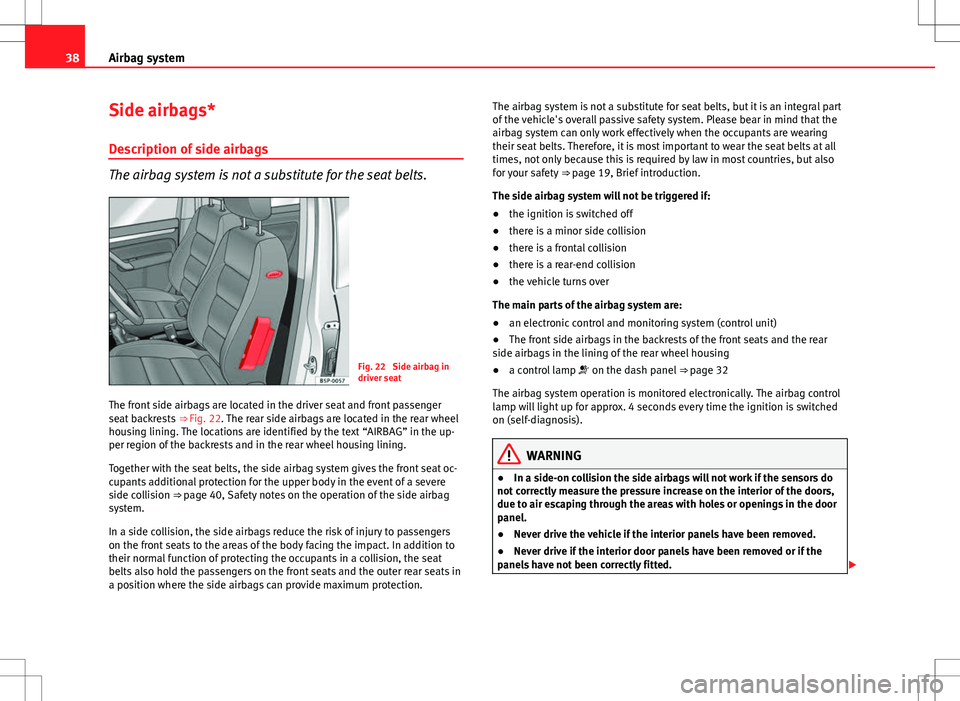
Fig. 22 Side airbag in
driver seat
The front side airbags are located in the driver seat and front passenger
seat backrests ⇒ Fig. 22. The rear side airbags are located in the rear wheel
housing lining. The locations are identified by the text “AIRBAG” in the up-
per region of the backrests and in the rear wheel housing lining.
Together with the seat belts, the side airbag system gives the front seat oc-
cupants additional protection for the upper body in the event of a severe
side collision ⇒ page 40, Safety notes on the operation of the side airbag
system.
In a side collision, the side airbags reduce the risk of injury to passengers
on the front seats to the areas of the body facing the impact. In addition to
their normal function of protecting the occupants in a collision, the seat
belts also hold the passengers on the front seats and the outer rear seats in
a position where the side airbags can provide maximum protection. The airbag system is not a substitute for seat belts, but it is an integral part
of the vehicle's overall passive safety system. Please bear in mind that the
airbag system can only work effectively when the occupants are wearing
their seat belts. Therefore, it is most important to wear the seat belts at all
times, not only because this is required by law in most countries, but also
for your safety
⇒ page 19, Brief introduction.
The side airbag system will not be triggered if:
● the ignition is switched off
● there is a minor side collision
● there is a frontal collision
● there is a rear-end collision
● the vehicle turns over
The main parts of the airbag system are:
● an electronic control and monitoring system (control unit)
● The front side airbags in the backrests of the front seats and the rear
side airbags in the lining of the rear wheel housing
● a control lamp on the dash panel ⇒ page 32
The airbag system operation is monitored electronically. The airbag control
lamp will light up for approx. 4 seconds every time the ignition is switched
on (self-diagnosis).
WARNING
● In a side-on collision the side airbags will not work if the sensors do
not correctly measure the pressure increase on the interior of the doors,
due to air escaping through the areas with holes or openings in the door
panel.
● Never drive the vehicle if the interior panels have been removed.
● Never drive if the interior door panels have been removed or if the
panels have not been correctly fitted.
Page 42 of 317
40Airbag system
The special design of the airbag allows the controlled escape of the propel-
lant gas when an occupant puts pressure on the bag. Thus, the head and
chest are surrounded and protected by the airbag.
Safety notes on the operation of the side airbag system
If airbags are used correctly, they can considerably reduce
the risk of injury in side impact collisions.
WARNING
● If you do not wear a seat belt, if you lean forward, or are not seated
correctly while the vehicle is in motion, you are at a greater risk of injury
if the side airbag system is triggered in an accident.
● In order for the side airbags to provide their maximum protection, the
prescribed sitting position must always be maintained with seat belts
fastened while travelling.
● Occupants of the outer seats must never carry any objects or pets in
the deployment space between them and the airbags, or allow children
or other passengers to travel in this position. It is also important not to
attach any accessories (such as cup holders) to the doors. This would im-
pair the protection offered by the side airbags.
● The built-in coat hooks should be used only for lightweight clothing.
Do not leave any heavy or sharp-edged objects in the pockets.
● Great forces, such as hard blows or kicks, must not be exerted upon
the backrest bolster because the system may be damaged. In this case,
the side airbags would not be triggered.
WARNING (Continued)
● Under no circumstances should protective covers be fitted over seats
with side airbags unless the covers have been approved for use in your
vehicle. Because the airbag is triggered from the side of the backrest, the
use of non-approved seat covers would obstruct the side airbag, serious-
ly reducing the airbag's effectiveness ⇒ page 224, Accessories, replace-
ment of parts and modifications.
● Any damage to the original seat upholstery or around the seams of
the side airbag units must be repaired immediately by a specialised
workshop.
● The airbags provide protection for just one accident; replace them
once they have deployed.
● When children assume an incorrect sitting position, they expose
themselves to an increased risk of injury in the event of an accident. This
is particularly the case if the child is travelling on the front passenger
seat and the airbag system is triggered in an accident; this could have
critical consequences including serious injury or death ⇒ page 46,
Child safety.
● Any work on the side airbag system or removal and installation of the
airbag components for other repairs (such as removal of the front seat)
should only be performed by a specialised workshop. Otherwise, faults
may occur during the airbag system operation.
● Do not attempt to modify components of the airbag system in any
way.
● The side and head airbags are managed through sensors located in
the interior of the front doors. To ensure the correct operation of the side
and head airbags neither the doors nor the door panels should be modi-
fied in any way (e.g. fitting loudspeakers). If the front door is damaged,
the airbag system may not work correctly. All work carried out on the
front door must be done in a specialised workshop.
Page 45 of 317
43
Airbag system
WARNING (Continued)
not been expressly approved for use in your vehicle may not be attached
to the side windows ⇒ page 224, Accessories, replacement of parts and
modifications.
● The built-in coat hooks should be used only for lightweight clothing.
Do not leave any heavy or sharp-edged objects in the pockets. Please, do
not hang the clothes on coat hangers.
● The airbags provide protection for just one accident; replace them
once they have deployed.
● Any work on the curtain airbag system or removal and installation of
the airbag components for other repairs (such as removal of the roof lin-
ing) should only be performed by a specialised workshop. Otherwise,
faults may occur during the airbag system operation.
● Do not attempt to modify components of the airbag system in any
way.
● The side and head airbags are managed through sensors located in
the interior of the front doors. To ensure the correct operation of the side
and head airbags neither the doors nor the door panels should be modi-
fied in any way (e.g. fitting loudspeakers). If the front door is damaged,
the airbag system may not work correctly. All work carried out on the
front door must be done in a specialised workshop.
Safety FirstOperating InstructionsPractical TipsTechnical Specifications
Page 47 of 317
45
Airbag system
– Check that the control lamp on the instrument panel ⇒ Fig. 27
does not light up when the ignition is switched on ⇒
.
WARNING
● The driver is responsible for the proper position of the key-operated
switch.
● You should deactivate the front passenger front airbag only if you
have to use a rear-facing child seat in exceptional cases. ⇒ page 46,
Child safety.
● Never install a child seat facing backwards on the front passenger
seat unless the front passenger front airbag has been disabled. Other-
wise, there is a risk of death. If under exceptional circumstances it is nec-
essary to transport a child in a rear-facing child seat on the front passen-
ger seat, you must always disable the front passenger front airbag.
● As soon as the child seat is no longer needed on the front passenger
seat, enable the front passenger front airbag again.
● Only deactivate the front passenger front airbag when the ignition is
off, otherwise a fault may occur in the airbag system, which could cause
the airbag to not deploy properly or not deploy at all.
WARNING (Continued)
● When the front passenger front airbag is deactivated, if the control
lamp AIRBAG OFF is not continuously lit up, there may be a fault in the
airbag system:
–Have the airbag system inspected immediately by a specialised
workshop.
– Do not use a child seat on the front passenger seat! The front pas-
senger front airbag could be triggered despite the fact that there is a
fault in the system and, as a result, a child could sustain serious or
fatal injuries.
– It is unpredictable whether the front passenger airbag will deploy
in the event of an accident. Warn all your passengers of this.
● When using the ignition key to activate/deactivate the front passen-
ger front airbag, only the front passenger airbag will be activated/deacti-
vated. The side airbag and head airbag on the passenger side will remain
active.
Safety FirstOperating InstructionsPractical TipsTechnical Specifications
Page 57 of 317
55
Cockpit
Operating Instructions Cockpit
Overview Overview of the dash panel
This overview will help you to familiarise yourself with the
controls and displays. Door release lever
Light switch . . . . . . . . . . . . . . . . . . . . . . . . . . . . . . . . . . . . . . . . . . . . . . . 115
Light intensity regulator for the instruments and controls . . . .119
Headlight range control . . . . . . . . . . . . . . . . . . . . . . . . . . . . . . . . . . . 119
Air vents
Turn signal and main beam lever and cruise control system* 122, 190
Controls on the steering wheel . . . . . . . . . . . . . . . . . . . . . . . . . . . . . 91
Instrument panel:
– Instruments . . . . . . . . . . . . . . . . . . . . . . . . . . . . . . . . . . . . . . . . . . . . 57
– Display . . . . . . . . . . . . . . . . . . . . . . . . . . . . . . . . . . . . . . . . . . . . . . . . 61
– Control and warning lamps . . . . . . . . . . . . . . . . . . . . . . . . . . . . . . 77
Horn (works only when the ignition is on)/ Driver front airbag . .30
Windscreen wiper and washer lever and operation of the
multifunction display* . . . . . . . . . . . . . . . . . . . . . . . . . . . . . . . . . . . . . 127, 63
Left seat heating button . . . . . . . . . . . . . . . . . . . . . . . . . . . . . . . . . . . 138
1
2345678
910
11
Controls for
–
Heating* and ventilation . . . . . . . . . . . . . . . . . . . . . . . . . . . . . . . . 157
– Climatic* . . . . . . . . . . . . . . . . . . . . . . . . . . . . . . . . . . . . . . . . . . . . . . . 159
– Climatronic* . . . . . . . . . . . . . . . . . . . . . . . . . . . . . . . . . . . . . . . . . . . . 162
Radio/Navigator*
Right seat heating button . . . . . . . . . . . . . . . . . . . . . . . . . . . . . . . . . . 138
Control lamp for deactivated front passenger airbag . . . . . . . .44
Front passenger front airbag . . . . . . . . . . . . . . . . . . . . . . . . . . . . . . . 30
Glove compartment lever . . . . . . . . . . . . . . . . . . . . . . . . . . . . . . . . . . 141
Selector lever . . . . . . . . . . . . . . . . . . . . . . . . . . . . . . . . . . . . . . . . . . . . . 180
Cup holder compartment . . . . . . . . . . . . . . . . . . . . . . . . . . . . . . . . . . 145
Controls on the centre console:
– Central locking . . . . . . . . . . . . . . . . . . . . . . . . . . . . . . . . . . . . . . . . . 97
– ESC . . . . . . . . . . . . . . . . . . . . . . . . . . . . . . . . . . . . . . . . . . . . . . . . . . . . 196
– Tyre pressure monitoring
– Park Pilot* . . . . . . . . . . . . . . . . . . . . . . . . . . . . . . . . . . . . . . . . . . . . . 187
– Cigarette lighter/Power socket . . . . . . . . . . . . . . . . . . . . . . . . . . 149
– Exterior mirror adjustment . . . . . . . . . . . . . . . . . . . . . . . . . . . . . . 132
– Start-Stop* . . . . . . . . . . . . . . . . . . . . . . . . . . . . . . . . . . . . . . . . . . . . . 176
Handbrake . . . . . . . . . . . . . . . . . . . . . . . . . . . . . . . . . . . . . . . . . . . . . . . . 185
Hazard warning light switch . . . . . . . . . . . . . . . . . . . . . . . . . . . . . . . 120
Pedals
Ignition lock . . . . . . . . . . . . . . . . . . . . . . . . . . . . . . . . . . . . . . . . . . . . . . 171
Steering column control lever* . . . . . . . . . . . . . . . . . . . . . . . . . . . . . 169
12
1314151617181920
2122232425
Safety FirstOperating InstructionsPractical TipsTechnical Specifications