service interval Seat Altea XL 2015 User Guide
[x] Cancel search | Manufacturer: SEAT, Model Year: 2015, Model line: Altea XL, Model: Seat Altea XL 2015Pages: 236, PDF Size: 4.23 MB
Page 169 of 236
Checking and refilling levels
Fixed service intervals*
If your vehicle does not have the “LongLife
service interval” or it has been disabled (by
request), you may use oils for fixed service
intervals , which also appear in
›
› › page 167,
Oil properties . In this case, your vehicle must
be serviced after a fixed interval of 1
year/15 000 km (10 000 miles)(whatever
comes first) ››› Booklet Maintenance Pro-
gramme.
● In ex
ceptional circumstances, if the engine
oil level is too low ››› page 167 and you can-
not o
btain the oil specified for your vehicle,
you can put in a small quantity of oil con-
forming to the specification ACEA A2 or
ACEA A3 (petrol engines) or ACEA B3 or
ACEA B4 (diesel engines) (up to 0.5 l).
Vehicles with a diesel particulate filter*
The Maintenance Programme states whether
your vehicle is fitted with a diesel particulate
filter.
Only VW 507 00 engine oil, with reduced ash
formation, may be used in diesel engines
equipped with particulate filter. Using other
types of oil will cause a higher soot concen-
tration and reduce the life of the DPF. There-
fore:
● Avoid mixing this oil with other engine oils.
● Only in exceptional circumstances, if the
engine oil level is too low ››› page 167 and you cannot obtain the oil specified for your
vehicle, you can use a small quantity of oil
(once) conforming to the VW 506 00,
VW 506 01, VW 505 00, VW 505 01 or
ACEA B3/ACEA B4 specification. (up to 0.5 l).
Oil properties
Engine typeSpecification
Petrol without flexible
service intervalVW 502 00/VW 504 00
Petrol with flexible serv-
ice interval (LongLife)VW 504 00
Diesel. Engines without
Particulate filter (DPF)VW 505 01/VW 506 01/VW
507 00
Diesel. Particulate Filter
Engines (DPF).
With or without flexible
service interval (with
and without LongLife) a)VW 507 00
a)
Only use recommended oils, otherwise you may damage the
engine.
Engine oil additives
No type of additive should be mixed with the
engine oil. The deterioration caused by these
additives is not covered by the warranty. Note
Before a long trip, we recommend finding an
engine oil that conforms to the correspond-
ing VW specifications and recommend keep-
ing it in the vehicle. This way, the correct en-
gine oil will always be available for a top-up if
needed. Checking the engine oil level
Fig. 147
Engine oil dipstick. The engine oil dipstick indicates the level of
the oil.
Checking oil level
– Park the vehicle in a horizontal position.
– Briefly run the engine at idle speed until
the operating temperature is reached and
then stop.
– Wait for about two minutes.
»
167
Technical specifications
Advice
Operation
Safety
Page 170 of 236
Advice
– Pull out the dipstick. Wipe the dipstick with
a clean cloth and insert it again, pushing it
in as far as it will go.
– Then pull it out once more and check the oil
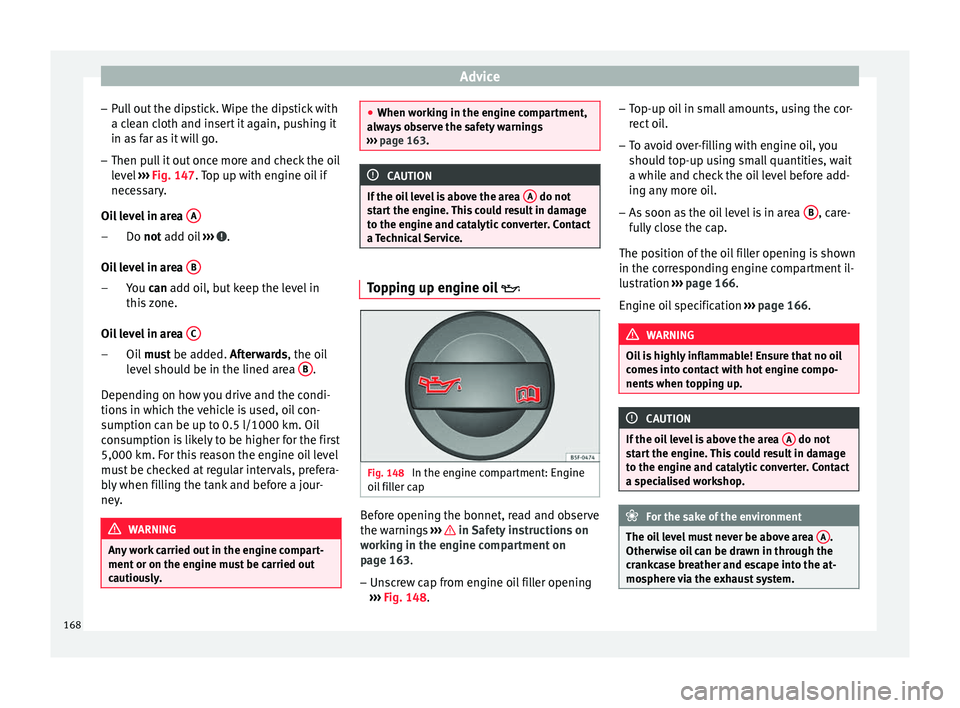
level ››› Fig. 147 . Top up with engine oil if
nec e
ssary.
Oil level in area ADo
not
add oil ›
›› .
Oil level in area BYou
can
add oil, but keep the level in
thi
s zone.
Oil level in area COil
must be added.
Afterwards
, the oil
level should be in the lined area B .
Depending on how you drive and the condi-
tions in which the vehicle is used, oil con-
sumption can be up to 0.5 l/1000 km. Oil
consumption is likely to be higher for the first
5,000 km. For this reason the engine oil level
must be checked at regular intervals, prefera-
bly when filling the tank and before a jour-
ney. WARNING
Any work carried out in the engine compart-
ment or on the engine must be carried out
cautiously. –
–
– ●
When working in the engine compartment,
always observe the safety warnings
››› page 163. CAUTION
If the oil level is above the area A do not
start the engine. This could result in damage
to the engine and catalytic converter. Contact
a Technical Service. Topping up engine oil
Fig. 148
In the engine compartment: Engine
oil filler cap Before opening the bonnet, read and observe
the warnings
››› in Safety instructions on
working in the engine compartment on
page 163 .
– Un s
crew cap from engine oil filler opening
››› Fig. 148. –
Top-up oi
l in small amounts, using the cor-
rect oil.
– To avoid over-filling with engine oil, you
should top-up using small quantities, wait
a while and check the oil level before add-
ing any more oil.
– As soon as the oil level is in area B , care-
fully close the cap.
The position of the oil filler opening is shown
in the corresponding engine compartment il-
lustration ››› page 166 .
En gine oi
l specification ››› page 166. WARNING
Oil is highly inflammable! Ensure that no oil
comes into contact with hot engine compo-
nents when topping up. CAUTION
If the oil level is above the area A do not
start the engine. This could result in damage
to the engine and catalytic converter. Contact
a specialised workshop. For the sake of the environment
The oil level must never be above area A .
Otherwise oil can be drawn in through the
crankcase breather and escape into the at-
mosphere via the exhaust system. 168
Page 171 of 236
Checking and refilling levels
Changing engine oil The engine oil must be changed at the inter-
vals given in the service schedule.
We recommend that you have the engine oil
changed by a Technical Service.
The oil change intervals are shown in the
Maintenance Programme.
WARNING
Only change the engine oil yourself if you
have the specialist knowledge required!
● Before opening the bonnet, read and ob-
serve the warnings ››› page 163, Safety in-
structions on working in the engine compart-
ment.
● Wait
for the engine to cool down. Hot oil
may cause burn injuries.
● Wear eye protection to avoid injuries, such
as acid burns, caused by splashes of oil.
● When removing the oil drain plug with your
fingers, keep your arm horizontal to help pre-
vent oil from running down your arm.
● Wash your skin thoroughly if it comes into
contact with engine oil.
● Engine oil is poisonous! Used oil must be
stored in a safe place out of the reach of chil-
dren. CAUTION
No additives should be used with engine oil.
This could result in engine damage. Any dam-
age caused by the use of such additives
would not be covered by the factory warranty. For the sake of the environment
● Because of disposal problems and the spe-
cial tools and specialist knowledge required,
we recommend that you have the engine oil
and filter changed by a Technical Service.
● Never pour oil down drains or into the
ground.
● Use a suitable container when draining the
used oil. It must be large enough to hold all
the engine oil. Cooling system
Engine coolant specifications The engine cooling system is supplied from
the factory with a specially treated mixture of
water and, at least, 40 % of the additive
G 13
(TLVW 774 J). The engine coolant additive is
recognisable by its purple colour. This mix-
ture of water and additive gives the necessa-
ry frost protection down to -25°C (-13 F) and
protects the light alloy parts of the cooling
system against corrosion. It also prevents scaling and considerably raises the boiling
point of the coolant.
To protect the engine cooling system, the
percentage of additive must
always be at
l e
ast 40 %, even in warm climates where an-
ti-freeze protection is not required.
If greater frost protection is required in very
cold climates, the proportion of additive can
be increased. However, the percentage of ad-
ditive should not exceed 60%, as this would
reduce frost protection and, in turn, decrease
cooling capacity.
When the coolant is topped up, use a mixture
of distilled water and, at least, 40 % of the G
13 or G 12 plu
s-plus (TL-VW 774 G) additive
(both are purple) to obtain an optimum anti-
corrosion protection ››› . The mixture of G
13 with G 12 plus (TL-VW 774 F), G 12 (red) or
G 11 (green-blue) engine coolants will signifi-
cantly reduce the anticorrosion protection
and should, therefore be avoided ››› .
WARNING
If there is not enough anti-freeze in the cool-
ant system, the engine may fail leading to se-
rious damage.
● Please make sure that the percentage of
additive is correct with respect to the lowest
expected ambient temperature in the zone
where the vehicle is to be used.
● When the outside temperature is very low,
the coolant could freeze and the vehicle » 169
Technical specifications
Advice
Operation
Safety
Page 174 of 236
Advice
Brake fluid Checking the brake fluid level Fig. 151
Engine compartment: brake fluid
reservoir cap –
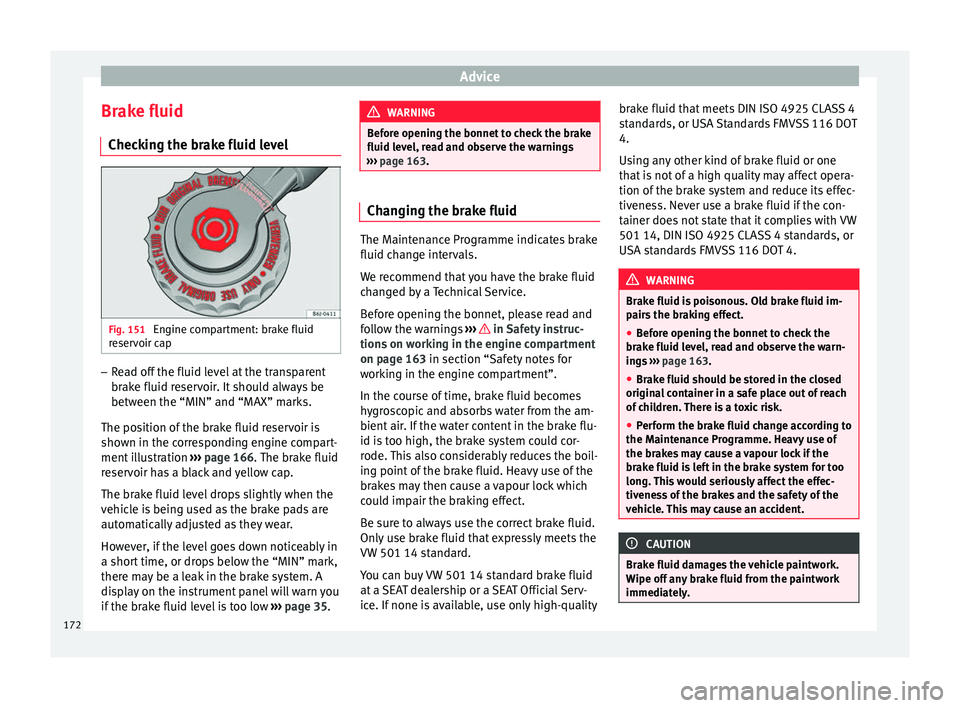
Read off the fluid level at the transparent
brake fluid reservoir. It should always be
between the “MIN” and “MAX” marks.
The position of the brake fluid reservoir is
shown in the corresponding engine compart-
ment illustration ››› page 166. The brake fluid
reservoir has a black and yellow cap.
The brake fluid level drops slightly when the
vehicle is being used as the brake pads are
automatically adjusted as they wear.
However, if the level goes down noticeably in
a short time, or drops below the “MIN” mark,
there may be a leak in the brake system. A
display on the instrument panel will warn you
if the brake fluid level is too low ››› page 35. WARNING
Before opening the bonnet to check the brake
fluid level, read and observe the warnings
››› page 163. Changing the brake fluid
The Maintenance Programme indicates brake
fluid change intervals.
We recommend that you have the brake fluid
changed by a Technical Service.
Before opening the bonnet, please read and
follow the warnings
››› in Safety instruc-
tions on working in the engine compartment
on page 163 in section “Safety notes for
w ork
ing in the engine compartment”.
In the course of time, brake fluid becomes
hygroscopic and absorbs water from the am-
bient air. If the water content in the brake flu-
id is too high, the brake system could cor-
rode. This also considerably reduces the boil-
ing point of the brake fluid. Heavy use of the
brakes may then cause a vapour lock which
could impair the braking effect.
Be sure to always use the correct brake fluid.
Only use brake fluid that expressly meets the
VW 501 14 standard.
You can buy VW 501 14 standard brake fluid
at a SEAT dealership or a SEAT Official Serv-
ice. If none is available, use only high-quality brake fluid that meets DIN ISO 4925 CLASS 4
standards, or USA Standards FMVSS 116 DOT
4.
Using any other kind of brake fluid or one
that is not of a high quality may affect opera-
tion of the brake system and reduce its effec-
tiveness. Never use a brake fluid if the con-
tainer does not state that it complies with VW
501 14, DIN ISO 4925 CLASS 4 standards, or
USA standards FMVSS 116 DOT 4.
WARNING
Brake fluid is poisonous. Old brake fluid im-
pairs the braking effect.
● Before opening the bonnet to check the
brake fluid level, read and observe the warn-
ings ››› page 163.
● Br ak
e fluid should be stored in the closed
original container in a safe place out of reach
of children. There is a toxic risk.
● Perform the brake fluid change according to
the Maintenance Programme. Heavy use of
the brakes may cause a vapour lock if the
brake fluid is left in the brake system for too
long. This would seriously affect the effec-
tiveness of the brakes and the safety of the
vehicle. This may cause an accident. CAUTION
Brake fluid damages the vehicle paintwork.
Wipe off any brake fluid from the paintwork
immediately. 172
Page 201 of 236
Fuses and bulbs
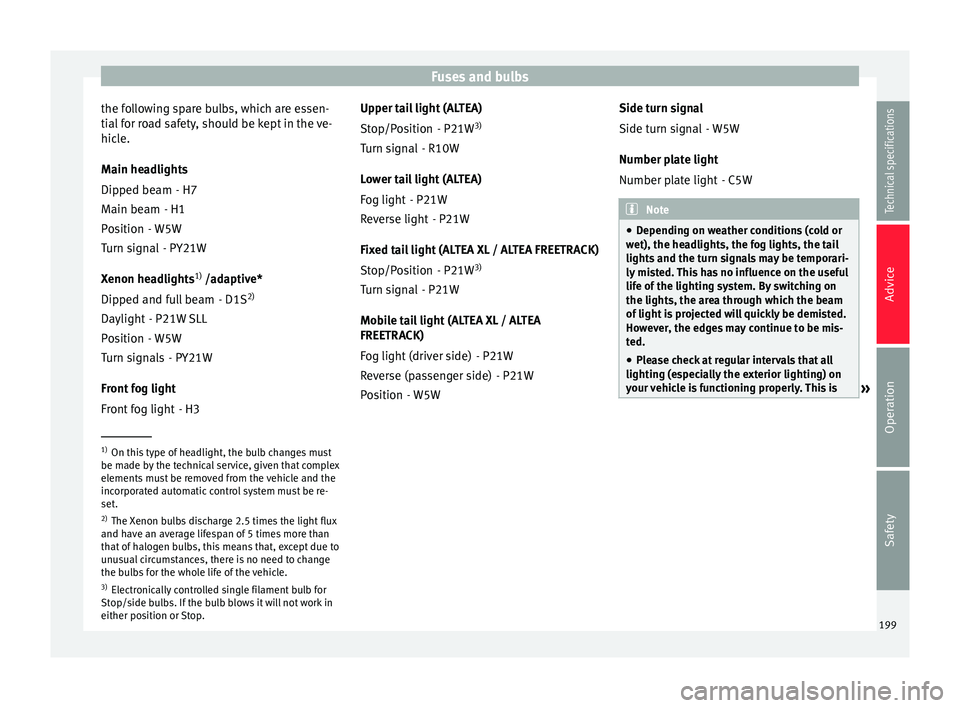
the following spare bulbs, which are essen-
tial for road safety, should be kept in the ve-
hicle.
Main headlights - H7
- H1
- W5W - PY21W
Xenon headlights 1)
/adaptive*
- D1S 2)
- P21W SLL
- W5W - PY21W
Front fog light - H3
Dipped beam
Main beam
Position
Turn signal
Dipped and full beam
Daylight
Position
Turn signals
Front fog light Upper tail light (ALTEA)
- P21W3)
- R10W
Lower tail light (ALTEA) - P21W- P21W
Fixed tail light (ALTEA XL / ALTEA FREETRACK) - P21W3)
- P21W
Mobile tail light (ALTEA XL / ALTEA
FREETRACK) - P21W- P21W
- W5W
Stop/Position
Turn signal
Fog light
Reverse light
Stop/Position
Turn signal
Fog light (driver side)
Reverse (passenger side)
Position Side turn signal
- W5W
Number plate light - C5W Note
● Depending on weather conditions (cold or
wet), the headlights, the fog lights, the tail
lights and the turn signals may be temporari-
ly misted. This has no influence on the useful
life of the lighting system. By switching on
the lights, the area through which the beam
of light is projected will quickly be demisted.
However, the edges may continue to be mis-
ted.
● Please check at regular intervals that all
lighting (especially the exterior lighting) on
your vehicle is functioning properly. This is » Side turn signal
Number plate light
1)
On this type of headlight, the bulb changes must
be made by the technical service, given that complex
elements must be removed from the vehicle and the
incorporated automatic control system must be re-
set.
2) The Xenon bulbs discharge 2.5 times the light flux
and have an average lifespan of 5 times more than
that of halogen bulbs, this means that, except due to
unusual circumstances, there is no need to change
the bulbs for the whole life of the vehicle.
3) Electronically controlled single filament bulb for
Stop/side bulbs. If the bulb blows it will not work in
either position or Stop. 199Technical specifications
Advice
Operation
Safety
Page 227 of 236
Index
Digital clock . . . . . . . . . . . . . . . . . . . . . . . . . . . . . . 35
Dipped beam headlights . . . . . . . . . . . . . . . . . . . . 75
Display (without warning or information texts) . . 47
Disposal Seat belt tensioners . . . . . . . . . . . . . . . . . . . . . . 16
Door lock . . . . . . . . . . . . . . . . . . . . . . . . . . . . . . . . 152
Door lock cylinder . . . . . . . . . . . . . . . . . . . . . . . . 152
Door lock handle . . . . . . . . . . . . . . . . . . . . . . . . . 152
Door release lever . . . . . . . . . . . . . . . . . . . . . . . . . 31
Doors Childproof locks . . . . . . . . . . . . . . . . . . . . . . . . . 66
control lamp . . . . . . . . . . . . . . . . . . . . . . . . . . . . 45
Drawer . . . . . . . . . . . . . . . . . . . . . . . . . . . . . . . . . . . 94
Driver see Correct sitting position . . . . . . . . . . . . . . . 6, 8
Driv e
shaft differential
XDS . . . . . . . . . . . . . . . . . . . . . . . . . . . . . . . . . . 137
Drive wheel traction control system (ASR) . . . . . 137
Driving Economically/with Respect for the Environ-ment . . . . . . . . . . . . . . . . . . . . . . . . . . . . . . . 132
journeys abroad . . . . . . . . . . . . . . . . . . . . . . . . 120
steering lock . . . . . . . . . . . . . . . . . . . . . . . . . . . 120
With a trailer . . . . . . . . . . . . . . . . . . . . . . . . . . . 145
Driving abroad Headlights . . . . . . . . . . . . . . . . . . . . . . . . . . . . 120
Driving Economically . . . . . . . . . . . . . . . . . . . . . . 132
Driving programmes . . . . . . . . . . . . . . . . . . . . . . 127
Driving safety . . . . . . . . . . . . . . . . . . . . . . . . . . . . . . 5
Driving with automatic gearbox/DSG automatic gearbox . . . . . . . . . . . . . . . . . . . . . . . . . . . . . . . 128
Driving with Respect for the Environment . . . . . 132
Duplicate keys . . . . . . . . . . . . . . . . . . . . . . . . . . . . 67
Dust filter . . . . . . . . . . . . . . . . . . . . . . . . . . . . . . . 116
Dynamic headlight range control . . . . . . . . . . . . . 79 E
EDL . . . . . . . . . . . . . . . . . . . . . . . . . . . . . . . . . . . . 135
control lamp . . . . . . . . . . . . . . . . . . . . . . . . . . . . 41
Electric power steering Control lamp . . . . . . . . . . . . . . . . . . . . . . . . . . . . 45
Electric windows . . . . . . . . . . . . . . . . . . . . . . . . . . . 72
Electronic differential lock . . . . . . . . . . . . . . . . . . 135 control lamp . . . . . . . . . . . . . . . . . . . . . . . . . . . . 41
Electronic immobiliser . . . . . . . . . . . . . . . . . 46, 121
Electronic Stability Control . . . . . . . . . . . . . . . . . . 45 description . . . . . . . . . . . . . . . . . . . . . . . . . . . . 134
Emergency braking warning . . . . . . . . . . . . 81, 136
Emergency manual locking . . . . . . . . . . . . . . . . . 193
Emergency opening Doors . . . . . . . . . . . . . . . . . . . . . . . . . . . . . . . . . . 69
Emission control system control lamp . . . . . . . . . . . . . . . . . . . . . . . . . . . . 45
Engine Running in . . . . . . . . . . . . . . . . . . . . . . . . . . . . . 130
Engine compartment . . . . . . . . . . . . . . . . . . . . . . 165 Working in the engine compartment . . . . . . . . 163
Engine coolant G 12 plus-plus . . . . . . . . . . . . . . . . . . . . . . . . . 169
G 13 . . . . . . . . . . . . . . . . . . . . . . . . . . . . . . . . . . 169
Specifications . . . . . . . . . . . . . . . . . . . . . . . . . . 169
Engine coolant fluid . . . . . . . . . . . . . . . . . . . . . . . 169
Engine fault Control lamp . . . . . . . . . . . . . . . . . . . . . . . . . . . . 41
Engine management control lamp . . . . . . . . . . . . . . . . . . . . . . . . . . . . 41
Engine oil . . . . . . . . . . . . . . . . . . . . . . . . . . . . . . . 166 Changing . . . . . . . . . . . . . . . . . . . . . . . . . . . . . . 169
Checking engine oil level . . . . . . . . . . . . . . . . . 167
Oil properties . . . . . . . . . . . . . . . . . . . . . . . . . . 167
Specifications . . . . . . . . . . . . . . . . . . . . . . . . . . 166
Topping up . . . . . . . . . . . . . . . . . . . . . . . . . . . . 168
Engine oil dipstick . . . . . . . . . . . . . . . . . . . . . . . . 167 Engine oil pressure
control lamp . . . . . . . . . . . . . . . . . . . . . . . . . 44, 49
Environment . . . . . . . . . . . . . . . . . . . . . . . . . . . . . 132 Environmental friendliness . . . . . . . . . . . . . . . 131
Environmental tip Avoiding pollution . . . . . . . . . . . . . . . . . . . . . . 159
Equipment . . . . . . . . . . . . . . . . . . . . . . . . . . . . . . 147
ESC . . . . . . . . . . . . . . . . . . . . . . . . . . . . . . . . 45, 134 see also Electronic Stability Control . . . . . . . . 134
Examp
le of menu use
Open the Configuration menu with the steer- ing wheel controls . . . . . . . . . . . . . . . . . . . . . 50
Program a speed limit warning . . . . . . . . . . . . . 50
To activate and deactivate the speed limit warning . . . . . . . . . . . . . . . . . . . . . . . . . . . . . . 50
Example of the use of the menus Open the Configuration menu with the MFIlever . . . . . . . . . . . . . . . . . . . . . . . . . . . . . . . . . 50
Examples of menu use Open the main menu . . . . . . . . . . . . . . . . . . . . . 50
Open the winter tyres menu . . . . . . . . . . . . . . . . 50
To close the winter tyres menu . . . . . . . . . . . . . 50
Exhaust gas emission control system . . . . . . . . . 131
F Fastening rings . . . . . . . . . . . . . . . . . . . . . . . . . . . 103
Filling the tank . . . . . . . . . . . . . . . . . . . . . . . . . . . 158
Fire extinguisher . . . . . . . . . . . . . . . . . . . . . . . . . . 100
First-aid kit . . . . . . . . . . . . . . . . . . . . . . . . . . . . . . 100
Flexible service interval display . . . . . . . . . . . . . . 48
Floor mats . . . . . . . . . . . . . . . . . . . . . . . . . . . . . . . . 11
Fog lights . . . . . . . . . . . . . . . . . . . . . . . . . . . . . . . . 76
Fog lights with cornering function . . . . . . . . . . . . 81
Folding table . . . . . . . . . . . . . . . . . . . . . . . . . . . . . . 94
Folding the seat backrest . . . . . . . . . . . . . . . . . . . . 92
Front airbags . . . . . . . . . . . . . . . . . . . . . . . . . . . . . 20 safety instructions . . . . . . . . . . . . . . . . . . . . . . . 20
225