heating Seat Altea XL 2015 Owner's Guide
[x] Cancel search | Manufacturer: SEAT, Model Year: 2015, Model line: Altea XL, Model: Seat Altea XL 2015Pages: 236, PDF Size: 4.23 MB
Page 124 of 236
Operation
For the sake of the environment
Do not warm-up the engine by running the
engine with the vehicle stationary. Start off
immediately, driving gently. This helps the
engine reach operating temperature faster
and reduces emissions. Starting diesel engines
The engine can only be started using a genu-
ine SEAT key with its correct code.
– Move the gearbox lever to the neutral posi-
tion and depress the clutch pedal thor-
oughly and hold it in this position for the
starter to turn the engine on.
– Turn the ignition key to position ›››
Fig. 122
1 . The warning lamp
will light for en-
gine pre-heating.
– When the lamp turns off, turn the ignition
key to position 2 to start the engine. Do
not press the accelerator.
– Release the ignition key as soon as the en-
gine starts. The starter motor should not
turn at the same time.
When starting a cold engine, it may be a little
noisy for the first few seconds until oil pres-
sure has built up in the hydraulic valve com-
pensators. This is quite normal, and no cause
for concern. If there are problems starting the engine, see
the
››› page 189 .
Glo w p
lug system for the diesel engine
To avoid unnecessary discharging of the bat-
tery, do not use any other major electrical
equipment while the glow plugs are pre-heat-
ing.
Start the engine as soon as the glow plug
warning lamp ››› page 41 goes out.
Starting a diesel engine after the fuel tank
has been completely run dry
If the fuel tank has been completely run dry,
it may take longer than normal (up to one mi-
nute) to start a diesel engine after refuelling.
This is because the fuel system must elimi-
nate air first. WARNING
● Never start or run the engine in unventila-
ted or closed rooms. The exhaust gases con-
tain carbon monoxide, an odourless and col-
ourless poisonous gas. Risk of fatal acci-
dents. Carbon monoxide can cause loss of
consciousness and result in death.
● Never leave the vehicle unattended if the
engine is running.
● Never use “cold start sprays”, they could
explode or cause the engine to run at high
revs. Risk of injury. CAUTION
● When the engine is cold, you should avoid
high engine speeds, driving at full throttle
and over-loading the engine. Risk of engine
damage.
● The vehicle should not be pushed or towed
more than 50 metres to start the engine. Un-
burnt fuel could enter the catalytic converter
and damage it.
● Before attempting to push-start or tow a ve-
hicle in order to start it, you should first try to
start it using the battery of another vehicle.
Note and follow the instructions in
››› page 189, Jump-starting. For the sake of the environment
Do not warm-up the engine by running the
engine with the vehicle stationary. You
should drive off as soon as you start the en-
gine. This helps the engine reach operating
temperature faster and reduces emissions. Switching off the engine
–
Stop the vehicle.
– Turn the ignition key to position ›››
Fig. 122
0 .
After switching the engine off, the radiator
fan may run on for up to 10 minutes. The fan
may also turn on again if coolant temperature
increases from accumulated heat in the
122
Page 133 of 236
Driving
From 1,000 to 1,500 kilometres
– Speeds can be gradually increased to the
maximum road speed or maximum
permissible engine speed (rpm).
During its first few hours of running, the in-
ternal friction in the engine is greater than
later on, when all the moving parts have bed-
ded in. For the sake of the environment
If the engine is run in gently, its life will be in-
creased and its oil consumption reduced. Environmental friendliness
Environmental protection is a top priority in
the design, choice of materials and manufac-
ture of your new SEAT.
Constructive measures to encourage
recycling
● Joints and connections designed for easy
dismantling
● Modular construction to facilitate disman-
tling
● Increased use of single-grade materials.
● Plastic parts and elastomers are marked in
accordance with ISO 1043, ISO 11469 and
ISO 1629. Choice of materials
●
Use of recycled materials.
● Use of compatible plastics in the same part
if its components are not easily separated.
● Use of recycled materials and/or materials
originating from renewable sources.
● Reduction of volatile components, includ-
ing odour, in plastic materials.
● Use of CFC-free coolants.
Ban on heavy metals, with the exceptions
dictated by law (Annex II of ELV Directive
2000/53/EC): cadmium, lead, mercury, hexa-
v al
ent chromium.
Manufacturing methods
● Reduction of the quantity of thinner in the
protective wax for cavities.
● Use of plastic film as protection during ve-
hicle transport.
● Use of solvent-free adhesives.
● Use of CFC-free coolants in cooling sys-
tems.
● Recycling and energy recovery from resi-
dues (RDF).
● Improvement in the quality of waste water.
● Use of systems for the recovery of residual
heat (thermal recovery, enthalpy wheels,
etc.).
● Use of water-soluble paints. Catalytic converter To maintain the useful life of the catalytic
converter
– Use only unleaded petrol with petrol en-
gines, as lead damages the catalytic con-
verter.
– Do not let the fuel get too low in the tank.
– For engine oil changes, do not replenish
with too much engine oil ››› page 168, Top-
ping up engine oil .
– Never tow the vehicle to start it, use jump
leads if necessary ›››
page 189.
If you notice misfiring, uneven running or
loss of power when the vehicle is moving, re-
duce speed immediately and have the vehi-
cle inspected at the nearest specialised
workshop. In general, the exhaust warning
lamp will light up when any of the described
symptoms occur ›››
page 35 . If this happens,
u nb
urnt fuel can enter the exhaust system
and escape into the environment. The cata-
lytic converter can also be damaged by over-
heating. WARNING
The catalytic converter reaches very high
temperatures! Risk of fire!
● Never park where the catalytic converter
could come into contact with dry grass or
flammable materials under the vehicle. » 131
Technical specifications
Advice
Operation
Safety
Page 134 of 236
Operation
●
Do not apply additional underseal or anti-
corrosion coatings to the exhaust pipes, cata-
lytic converter or the heat shields on the ex-
haust system. These materials could catch
fire when the vehicle is being driven. CAUTION
Never run the fuel tank completely dry be-
cause the irregularity of the fuel supply may
cause ignition problems. This allows unburnt
fuel to enter the exhaust system, which could
cause overheating and damage the catalytic
converter. For the sake of the environment
Even when the emission control system is
working perfectly, there may be a smell of
sulphur from the exhaust gas under some
conditions. This depends on the sulphur con-
tent of the fuel used. Quite often the problem
can be solved by changing to another brand
of fuel. Diesel engine particulate filter*
Fig. 130
Vehicle data sticker on back cover of
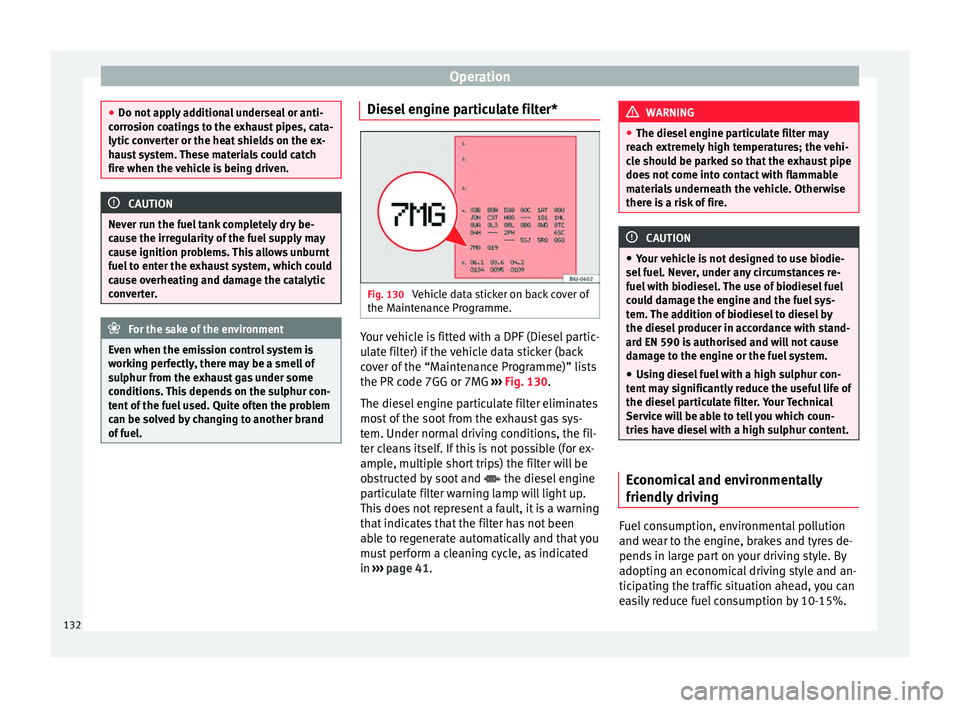
the Maintenance Programme. Your vehicle is fitted with a DPF (Diesel partic-
ulate filter) if the vehicle data sticker (back
cover of the “Maintenance Programme)” lists
the PR code 7GG or 7MG
››› Fig. 130 .
The die sel
engine particulate filter eliminates
most of the soot from the exhaust gas sys-
tem. Under normal driving conditions, the fil-
ter cleans itself. If this is not possible (for ex-
ample, multiple short trips) the filter will be
obstructed by soot and the diesel engine
particulate filter warning lamp will light up.
This does not represent a fault, it is a warning
that indicates that the filter has not been
able to regenerate automatically and that you
must perform a cleaning cycle, as indicated
in ››› page 41
. WARNING
● The diesel engine particulate filter may
reach extremely high temperatures; the vehi-
cle should be parked so that the exhaust pipe
does not come into contact with flammable
materials underneath the vehicle. Otherwise
there is a risk of fire. CAUTION
● Your vehicle is not designed to use biodie-
sel fuel. Never, under any circumstances re-
fuel with biodiesel. The use of biodiesel fuel
could damage the engine and the fuel sys-
tem. The addition of biodiesel to diesel by
the diesel producer in accordance with stand-
ard EN 590 is authorised and will not cause
damage to the engine or the fuel system.
● Using diesel fuel with a high sulphur con-
tent may significantly reduce the useful life of
the diesel particulate filter. Your Technical
Service will be able to tell you which coun-
tries have diesel with a high sulphur content. Economical and environmentally
friendly driving
Fuel consumption, environmental pollution
and wear to the engine, brakes and tyres de-
pends in large part on your driving style. By
adopting an economical driving style and an-
ticipating the traffic situation ahead, you can
easily reduce fuel consumption by 10-15%.
132
Page 136 of 236
Operation
and 120 km/h (75 mph) your vehicle will use
about 12% more fuel as a result of the extra
wind resistance caused by the roof rack even
when it is not in use.
Save electricity
The engine activates the alternator, which
produces electricity. With the need for elec-
tricity, fuel consumption is also increased.
Because of this, always turn off electrical de-
vices when you do not need them. Examples
of devices that use a lot of electricity are: the
fan at high speeds, the rear window heating
or the seat heaters*. Note
● If you vehicle has Start-Stop, it is not rec-
ommended t o sw
itch this function off.
● It is recommended to close the windows
when driving at more than 60 km/h
● Do not drive with your foot resting on the
clutch pedal,, as the pressure can make the
pl
ate spin, more fuel will be used and it can
burn the clutch plate lining, causing a serious
fault.
● Do not hold the vehicle on a hill with the
clutch, use the foot brake or hand brake, us-
ing the latter to start. The fuel consumption
will be lower and you will prevent the clutch
plate from being damaged.
● On descents, use the engine brake, chang-
ing to the gear that is more suitable for the slope. Fuel consumption will be “zero” and
the brakes will not suffer.
Driver assistance systems
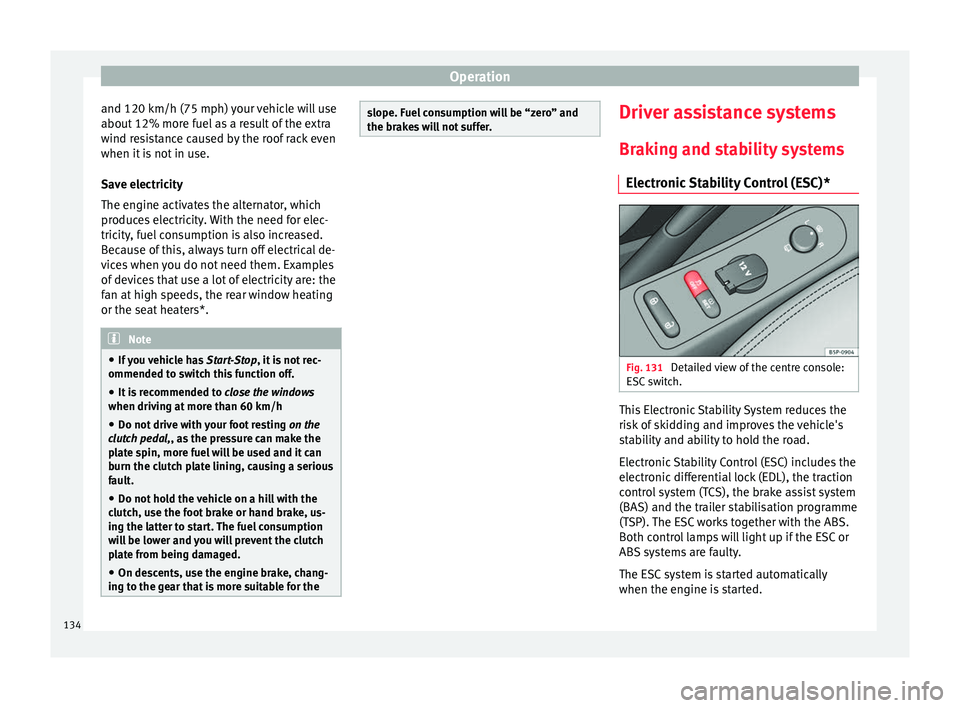
Braking and stability systems Electronic Stability Control (ESC)* Fig. 131
Detailed view of the centre console:
ESC switch. This Electronic Stability System reduces the
risk of skidding and improves the vehicle's
stability and ability to hold the road.
Electronic Stability Control (ESC) includes the
electronic differential lock (EDL), the traction
control system (TCS), the brake assist system
(BAS) and the trailer stabilisation programme
(TSP). The ESC works together with the ABS.
Both control lamps will light up if the ESC or
ABS systems are faulty.
The ESC system is started automatically
when the engine is started.
134
Page 137 of 236
Driver assistance systems
The ESC system is always active and cannot
be switched off. The ESC switch only switches
the ASR off.
The ASR can be deactivated when wheel spin
is desirable.
For example:
● When driving with snow chains.
● When driving in deep snow or on loose sur-
faces.
● When the vehicle is stuck, to rock it back-
wards and forwards.
Press the button to switch the ASR back on
when you no longer need wheel spin.
Electronic Stability Control (ESC)*
The ESC reduces the risk of skidding by brak-
ing the wheels individually.
The system uses the steering wheel angle
and road speed to calculate the changes of
direction desired by the driver, and constant-
ly compares them with the actual behaviour
of the vehicle. When irregularities occur, for
example, if the vehicle begins to skid, the
ESC brakes the appropriate wheel automati-
cally.
The forces acting on the braked wheel bring
the vehicle back to a stable condition. If the
vehicle tends to oversteer (the rear end
slides out), the system will act on the front
wheel on the outside of the turn. Steering manoeuvre recommendations
This is a complementary safety function in-
cluded in the ESC. This function aids the driv-
er to better stabilize the vehicle in a critical
situation. For example, in case of sudden
braking on a surface with varied adherence,
the vehicle will tend to destabilise its trajec-
tory to the right or to the left. In this case, the
ESC recognises the situation and assists the
driver with a counter steering manoeuvre
from the power steering.
This function simply provides the driver with
a recommended manoeuvre in critical situa-
tions.
The vehicle does not steer itself with this
function, the driver has full control of the ve-
hicle at all times.
WARNING
● Remember that not even the ESC can defy
the laws of physics. This should be kept in
mind, particularly on slippery and wet roads
and when towing a trailer.
● Always adapt your driving style to suit the
condition of the roads and the traffic situa-
tion. The greater safety provided by the ESC
should not encourage you to run any risks. CAUTION
● To ensure that the ESC works correctly, all
four wheels must be fitted with the same
tyres. Any differences in the rolling radius of the tyres can cause the system to reduce en-
gine power when this is not desired.
● Any modifications made to the vehicle (for
example, to the engine, brake system, run-
ning gear or to the combination of wheels
and tyres) may affect the operation of the
ABS, EDL, ESC and ASR. Electronic differential lock (EDL)*
EDL helps the vehicle to start moving, accel-
erate and climb a gradient in slippery condi-
tions where this may otherwise be difficult or
even impossible.
It uses the ABS sensors to monitor the speed
of the driven wheels. In case of an EDL fault,
the warning light for ABS lights up
››› page 41 .
At s
peeds of up to approximately 80 km/h
(50 mph), it is able to balance out differences
in the speed of the driven wheels of approxi-
mately 100 rpm/min caused by a partially
slippery road surface. It does this by braking
the wheel which has lost traction and distrib-
uting more driving force to the other driven
wheel via the differential.
To prevent the disc brake of the braking
wheel from overheating, the EDL cuts out au-
tomatically if subjected to excessive loads.
The vehicle will continue to function normally »
135
Technical specifications
Advice
Operation
Safety
Page 147 of 236
Towing bracket device
Tyre pressure
Set tyre pressure to the maximum permissi-
ble pressure shown on the sticker on the in-
side of the fuel tank flap. Set the tyre pres-
sure of the trailer tyres in accordance with the
trailer manufacturer's recommendations.
Exterior mirrors
Check whether you can see enough of the
road behind the trailer with the standard rear
vision mirrors. If this is not the case, you
should have additional exterior mirrors fitted.
Both exterior mirrors should be mounted on
hinged extension brackets. Adjust the mirrors
to give sufficient vision to the rear. WARNING
Never transport people in a trailer. This could
result in fatal accidents. Note
● Towing a trailer places additional demands
on the vehicle. We recommend additional
services between the normal inspection inter-
vals if the vehicle is used frequently for tow-
ing a trailer.
● Find out whether special regulations apply
to towing a trailer in your country. Ball coupling of towing bracket*
Depending on the model version, the spheri-
cal head on the trailer hook may be stored in
the tool box.
The ball coupling is provided with instruc-
tions on fitting and removing the ball cou-
pling of the towing bracket.
WARNING
The towing bracket ball coupling must be
stored securely in the luggage compartment
to prevent them being flung through the vehi-
cle and causing injury. Note
● By law, the ball coupling must be removed
if a trailer is not being towed if it obscures
the number plate. Driving tips
Driving with a trailer always requires extra
care.
Weight distribution
The weight distribution of a loaded trailer
with an unladen vehicle is very unfavourable.
However, if this cannot be avoided, drive ex-
tra slowly to allow for the unbalanced weight
distribution.Speed
The stability of the vehicle and trailer is re-
duced with increasing speed. For this reason,
it is advisable not to drive at the maximum
permissible speed in an unfavourable road,
weather or wind conditions. This applies es-
pecially when driving downhill.
You should always reduce speed immediately
if the trailer shows the slightest sign of
snak-
ing . Never try to stop the “snaking” by in-
c r
easing speed.
Always brake in due course. If the trailer has
an
overrun brake, apply the brakes gently at
first and then, firmly. This will prevent the
jerking that can be caused by locking of trail-
er wheels. Select a low gear in due course
before going down a steep downhill. This en-
ables you to use the engine braking to slow
down the vehicle.
Reheating
At very high temperatures and during pro-
longed slopes, driving in a low gear and high
engine speed, always monitor the coolant
temperature gauge ››› page 31.
Electronic Stability Control*
The ESC* system helps to stabilise the trailer
in case of skidding or rocking.
145
Technical specifications
Advice
Operation
Safety
Page 153 of 236
Care and maintenance
CAUTION
To prevent damage to the paintwork:
● Do not use polishes and hard wax on pain-
ted parts with a matt finish or on plastic
parts.
● Do not polish your vehicle in a sandy or
dusty environment. Caring for plastic parts
If normal washing fails to clean plastic parts,
clean them with approved solvent-free plas-
tic cleaning and care products.
CAUTION
● The use of liquid air freshener directly over
the air vents of the vehicle may damage plas-
tic parts if the liquid is accidentally spilled.
● Cleaning products which contain solvents
will damage the material. Cleaning windows and exterior
mirrors
Cleaning windows
– Moisten the windows with commercially
available, alcohol based glass cleaner.
– Dry the windows with a clean chamois
leather or a lint-free cloth. Removing snow
– Use a small brush to remove snow from the
windows and mirrors.
Removing ice – Use a de-icer spray.
Use a clean cloth or chamois leather to dry
the windows. The chamois leathers used on
painted surfaces are not suitable to clean
windows because they are soiled with wax
deposits which could smear the windows.
If possible, use a de-icing spray to remove
ice. If you use an ice scraper, push it in one
direction only without swinging it.
Use window cleaner or a silicone remover to
clean rubber, oil, grease and silicone depos-
its off.
Wax deposits can only be removed with a
special cleaner available at your Technical
Service. Wax deposits on the windscreen
could cause the wiper blades to judder. Add-
ing a window cleaner that dissolves wax to
the windscreen washer fluid prevents wiper
blades from juddering, but wax deposits are
not removed. CAUTION
● Never use warm or hot water to remove
snow and ice from windows and mirrors. This
could cause the glass to crack! ●
The heating element for the rear window is
located on the inner side of the window. To
prevent damage, do not put stickers over the
heating elements on the inside of the win-
dow. Cleaning windscreen wiper blades
Clean wiper blades improve visibility.
1. Use a soft cloth to remove dust and dirt
from the windscreen wiper blades.
2. Use window cleaner to clean the wind- screen wiper blades. Use a sponge or a
cloth to remove stubborn dirt.
Care of rubber seals If rubber seals are well looked after, they will
not freeze so quickly.
1. Use a soft cloth to remove dust and dirt
from the rubber seals.
2. Apply a specialist care product to the rub- ber seals.
The rubber strips on the doors, windows, etc.
will remain pliable and last longer if they are
treated with a suitable rubber care product
from time to time (for example silicone
spray). »
151Technical specifications
Advice
Operation
Safety
Page 163 of 236
Checking and refilling levels
Fig. 141
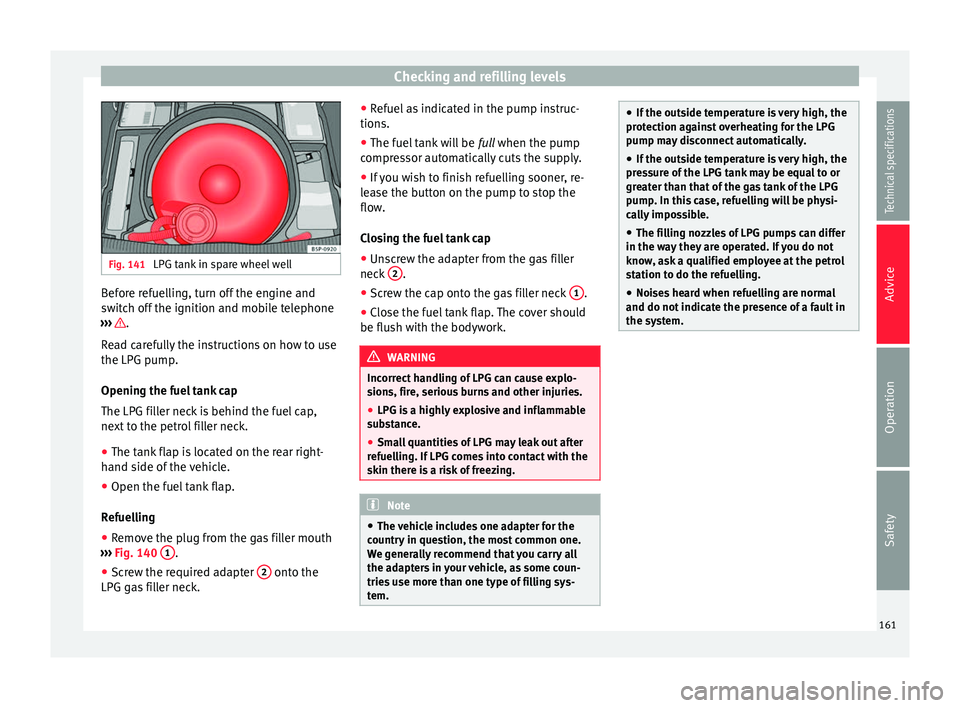
LPG tank in spare wheel well Before refuelling, turn off the engine and
switch off the ignition and mobile telephone
››› .
Read carefully the instructions on how to use
the LPG pump.
Opening the fuel tank cap
The LPG filler neck is behind the fuel cap,
next to the petrol filler neck.
● The tank flap is located on the rear right-
hand side of the vehicle.
● Open the fuel tank flap.
Refuelling
● Remove the plug from the gas filler mouth
››› Fig. 140 1 .
● Screw the required adapter 2 onto the
LPG gas filler neck. ●
Refuel as indicated in the pump instruc-
tions.
● The fuel tank will be full when the pump
c ompr
essor automatically cuts the supply.
● If you wish to finish refuelling sooner, re-
lease the button on the pump to stop the
flow.
Closing the fuel tank cap
● Unscrew the adapter from the gas filler
neck 2 .
● Screw the cap onto the gas filler neck 1 .
● Close the fuel tank flap. The cover should
be flush with the bodywork. WARNING
Incorrect handling of LPG can cause explo-
sions, fire, serious burns and other injuries.
● LPG is a highly explosive and inflammable
substance.
● Small quantities of LPG may leak out after
refuelling. If LPG comes into contact with the
skin there is a risk of freezing. Note
● The vehicle includes one adapter for the
country in question, the most common one.
We generally recommend that you carry all
the adapters in your vehicle, as some coun-
tries use more than one type of filling sys-
tem. ●
If the outside temperature is very high, the
protection against overheating for the LPG
pump may disconnect automatically.
● If the outside temperature is very high, the
pressure of the LPG tank may be equal to or
greater than that of the gas tank of the LPG
pump. In this case, refuelling will be physi-
cally impossible.
● The filling nozzles of LPG pumps can differ
in the way they are operated. If you do not
know, ask a qualified employee at the petrol
station to do the refuelling.
● Noises heard when refuelling are normal
and do not indicate the presence of a fault in
the system. 161
Technical specifications
Advice
Operation
Safety
Page 178 of 236
Advice
●
At continuously high speeds, a tyre with in-
sufficient pressure flexes more. In this way it
becomes too hot, and this can cause tread
separation and tyre blow-out. Always observe
the recommended tyre pressures.
● If the tyre pressure is too low or too high,
the tyres will wear prematurely and the vehi-
cle will not handle well. Risk of accident! For the sake of the environment
Under-inflated tyres will increase fuel con-
sumption. Tyre pressure monitoring
The tyre pressure monitoring system con-
stantly checks the pressure of the tyres.
The system uses the speed sensors of the
ABS wheels. It operates by analysing the
speed and frequency spectrum of each
wheel.
For optimum performance, use genuine SEAT
tyres. In addition, check and adjust tyre pres-
sures regularly.
Whenever the tyre pressure is are changed or
one or more tyres are changed, the system
should be reset by pressing the SET button
on the centre console.
The system warns the driver in the event of a
loss of pressure by means of symbols and messages in the instrument panel display.
The system operates via the ESC
››› page 134.
Note that tyre pressure also depends on tyre
temperature. Said pressure increases around
0.1 bar (2.9 psi/10 kPa) for each +10 °C
(+50 °F) in tyre temperature increase. The tyre
heats up while the vehicle is being driven
and the tyre pressure will rise accordingly.
Therefore, you should only adjust the tyre
pressure when they are cold (i.e. approxi-
mately at ambient temperature).
To ensure that the tyre pressure monitoring
system works reliably, you should check and,
if necessary, adjust the tyre pressures at reg-
ular intervals and store the correct pressures
(reference values) in the system.
A tyre pressure information label is attached
to the inside of the fuel tank flap. WARNING
● Never adjust tyre pressure when the tyres
are hot. This may damage or even burst the
tyres. Risk of accident!
● An insufficiently inflated tyre flexes a lot
more at high speeds and causes significant
heating of the tyre. Under these conditions,
the tyre bead may be released or the tyre may
burst. Risk of accident! For the sake of the environment
Under-inflated tyres lead to increased fuel
consumption and tyre wear. Significant tyre pressure loss
The tyre symbol
is displayed and indicates
th at
the tyre pressure of at least one tyre is
insufficient.
– Stop the vehicle.
– Switch the ignition off.
– Check the tyre(s).
– Change the wheel if necessary.
176
Page 180 of 236
Advice
For the sake of the environment
Under-inflated tyres will increase fuel con-
sumption. Run-flat tyres
Run-flat tyres allow you to continue driving
even with a punctured tyre, in the majority of
cases.
In vehicles that are factory-fitted with run-flat
tyres
1)
the loss of tyre pressure is indicated
on the instrument panel.
Driving with run-flat tyres (emergency
running)
– Leave the ESC/ASR on (Electronic Stability
Control), or switch it on ›››
page 137.
– Continue driving carefully and slowly
(80 km/h [50 mph] maximum).
– Avoid sudden manoeuvres and sharp turns.
– Avoid driving over obstacles (e.g. kerbs) or
potholes.
– Pay attention if the ESC/ASR activates of-
ten, if smoke comes from the tyres or there
is a smell of rubber, the vehicle vibrates or
there are clattering noises. If any of these
occur, stop the vehicle. The run-flat tyres have a tag on the side of
the tyre, with the description: “DSST”, “Eufo-
nia”, “RFT”, “ROF”, “RSC”, “SSR” or “ZP”.
The sides of this type of tyre are reinforced.
When the tyres lose air they are supported on
the sides (emergency driving).
The loss of pressure in the tyre is shown on
the instrument panel. You can then drive a
maximum of 80 km (50 miles) and if the cir-
cumstances are favourable (e.g. low load),
even more.
The damaged tyre should be changed as
soon as possible. The rim should be checked
in a specialised workshop to detect possible
damage and replace it if necessary. We rec-
ommend you contact your technical service.
If more than one tyre is being used under
emergency conditions, this reduces the dis-
tance that can be travelled.
Starting driving in emergency conditions
When loss in tyre pressure is displayed on
the instrument panel, this means that at least
one tyre is being driven in emergency condi-
tions
››› .
End of emergency operation
Do not drive on if:
● smoke is coming from one of the tyres, ●
there is a smell of rubber,
● the vehicle vibrates,
● there is a rattling noise.
When is it no longer possible to continue
driving even using run-flat tyres?
● If one of the tyres has been severely dam-
aged in an accident, etc. If a tyre has been
badly damaged there is a risk that parts of
the tread can be thrown off and cause dam-
age to the fuel lines, brake pipes or fuel filler.
● It is also advisable to stop driving if severe
vibrations occur, or if the wheel starts over-
heating and gives off smoke. WARNING
When driving in emergency conditions, the
driving quality of the vehicle is considerably
impaired.
● The maximum permitted speed of 80 km/h
(50 mph) is subject to road and weather con-
ditions. Please observe related legal require-
ments.
● Avoid sharp turns and rapid manoeuvres,
and brake earlier than usual.
● Avoid driving over obstacles (e.g. kerbs) or
potholes.
● If one or more tyres are being driven in
emergency conditions, the driving quality of 1)
Depending upon version and country.
178