lock Seat Altea XL 2015 Service Manual
[x] Cancel search | Manufacturer: SEAT, Model Year: 2015, Model line: Altea XL, Model: Seat Altea XL 2015Pages: 236, PDF Size: 4.23 MB
Page 94 of 236

Operation
Rear seats Seat adjustment Fig. 79
Unlock bar on rear seat Fig. 80
Rear seat backrest angle adjustment. The seats may be moved forwards or back-
wards independently. This movement range
can be 1/3 or 2/3 of the seat. There are vari-
ous possible positions. Adjusting reach
– In the seated position, unlock the lever in
the direction of the arrow ››› Fig. 79 .
– Mo v
e the seat cushion forwards or back-
wards to the desired position.
Adjusting the backrest angle
– Hold the backrest at the top. Pull the loop
on the side of the seat ››› Fig. 80 1 in the
direction of the arrow and hold it in this po-
sition. Push the backrest to the required
position and release the loop. WARNING
● Adjust the seat only when the vehicle is
stationary. Otherwise, your seat could move
unexpectedly while the vehicle is moving.
This could increase the risk of an accident
and therefore, injury.
● Do not push the backrests down when the
seat is moved to prevent damage to the cen-
tre console.
● Ensure that the seat, once moved, is fixed
in position. Note
● In order to maintain the maximum luggage
compartment space, put the backrests in po-
sition normal, without moving.
● In order to maintain the maximum space
without putting the backrests down, move
the seats forward to the desired position. Folding and lifting the seat backrest
Fig. 81
Folding the rear seat backrests down. Fig. 82
Lifting the rear seat backrests. Folding the backrest forwards
– Pull the loop on the side of the seat
››› Fig. 81 1 .
In this position the backrest is locked.
92
Page 95 of 236

Transport and practical equipment
Converting the table to a seat – Pull the loop on the side of the seat
››› Fig. 82 2 in the direction of the arrow
and lift the seat backrest until it is in place.
When folding and lifting the backrest, make
sure to place the side seat belts in the trim
clip ››› Fig. 81 to prevent them from being
d am
aged by becoming trapped in the back-
rest lock. WARNING
● You should check that the backrest has en-
gaged properly in position after the loop is
released.
● For safety reasons the locking system loops
on the seats may not be used to secure any
items.
● After locking the seat backrest into position
ensure that the seat belts protrude from the
seat. Transport and practical
equipment
Compartments Storage compartment on the front
passenger side Fig. 83
Passenger side: storage compartment The compartment can be opened by pulling
the lever
››› Fig. 83 . WARNING
Always keep the storage compartment cover
closed while the vehicle is in motion in order
to reduce the risk of injury caused by a sud-
den braking or by an accident. Front centre armrest with storage
compartment
Fig. 84
Front armrest with storage compart-
ment. There is a storage compartment in the arm-
rest.
– To open the storage compartment, lift the
armrest up in the direction of the arrow
››› Fig. 84 and then lift the cover.
– To ac
cess the CD changer* or the lower
storage compartment, pull on the armrest
cover without pressing on the button.
– To close the storage compartment, push
the armrest down. WARNING
Always keep the storage compartment closed
while the vehicle is in motion to reduce the » 93
Technical specifications
Advice
Operation
Safety
Page 96 of 236

Operation
risk of injury from the armrest during a sud-
den braking manoeuvre or in the event of an
accident.
Note
The CD changer is located in this compart-
ment. Storage compartment under the front
seats*
Fig. 85
Storage compartment under the front
seats. There is a storage compartment with a cover
under each front seat.
The drawer*
››› Fig. 85 is opened by pushing
the b utt
on and moving the cover back.
There are two open positions of 15 and 60
degrees depending on the pressure applied
to the cover. In the 60 degree position, the cover will collapse if too much pressure is ap-
plied.
To close the drawer, press the cover until it
locks into position.
WARNING
● The drawers will hold a maximum weight of
1.5 kg.
● Do not drive with the drawer cover open.
There is an injury risk for passengers if the
cargo is released in case of sudden braking or
an accident. Folding table*
Fig. 86
Folding tray on the front left seat. Folding trays are fitted to the rear of the front
seat backrests.
– To open the tray, open it up in the direction
of the arrow ›››
Fig. 86 . WARNING
● The folding trays may not be folded down
whilst the vehicle is in motion and anyone is
seated on the second row of seats. There is a
risk of injury during a sudden braking ma-
noeuvre! The tray must therefore be closed
and properly secured whilst the vehicle is in
motion.
● Do not put hot drinks in the drink holders.
During normal or sudden driving manoeuvres,
sudden braking or an accident, the hot drink
could be spilled. Danger of scalding. CAUTION
When driving, do not leave open cans in the
cup holders. The drink might be spilt on brak-
ing, for example, and could damage the vehi-
cle. Roof storage compartment*
Fig. 87
Roof storage compartments.94
Page 103 of 236
Transport and practical equipment
Luggage compartment Loading the luggage compartment All luggage and other loose objects must be
safely secured in the luggage compartment.
Unsecured objects which shift back and forth
could impair the driving safety or driving
characteristics of the vehicle by shifting the
centre of gravity.
– Distribute the load evenly in the luggage
compartment.
– Place heavy objects as far forward as possi-
ble in the luggage compartment.
– Place the heavy objects first.
– Secure heavy objects to the fitted fastening
rings ›››
page 103 . WARNING
● Loose luggage and other objects in the lug-
gage compartment could cause serious inju-
ries.
● Always stow objects in the luggage com-
partment and secure them on the fastening
rings.
● Use suitable straps to secure heavy ob-
jects.
● During sudden manoeuvres or accidents,
loose objects can be thrown forward, injuring
vehicle occupants or passers-by. This in-
creased risk of injury will be further increased if a loose object is struck by an inflating air-
bag. If this happens, objects can be trans-
formed into “missiles”. Risk of fatal injury.
●
Please note that the centre of gravity may
shift when transporting heavy objects; this
may affect vehicle handling and lead to an ac-
cident. Therefore, it is essential to adjust
your speed and driving style accordingly, to
avoid accidents.
● Never exceed the allowed axle weights or
allowed maximum weight. If said weights are
exceeded, the driving characteristics of the
vehicle may change, leading to accidents, in-
juries and damage to the vehicle.
● Never leave your vehicle unattended, espe-
cially when the rear lid is open. Children
could climb into the luggage compartment,
closing the door behind them; they will be
trapped and run the risk of death.
● Never allow children to play in or around
the vehicle. Close and lock all the doors and
rear lid when you leave the vehicle. Before
you lock the vehicle, make sure that there are
no adults or children in the vehicle. CAUTION
Hard objects on the boot cover could chafe
against the wires of the heating element in
the rear window and cause damage. Note
● Air circulation in the vehicle helps reduce
fogging of the windows. Used air escapes through ventilation slits in the side trim of
the luggage compartment. Ensure that these
ventilation slits are never covered.
● Straps for securing the load to the fasten-
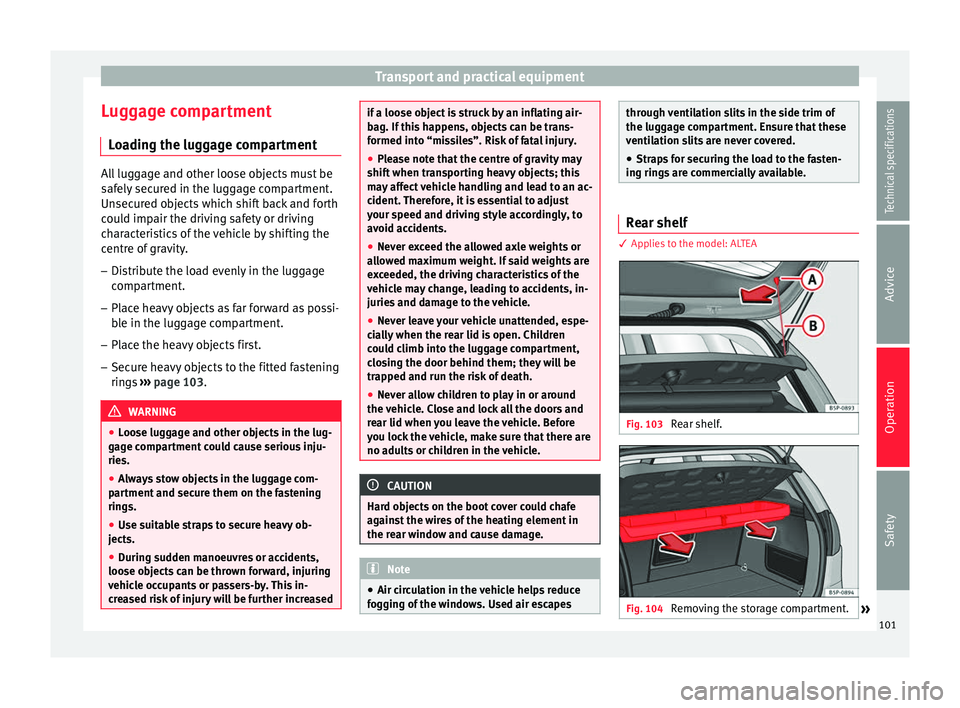
ing rings are commercially available. Rear shelf
3 Applies to the model: ALTEA
Fig. 103
Rear shelf. Fig. 104
Removing the storage compartment.
» 101Technical specifications
Advice
Operation
Safety
Page 112 of 236
Operation
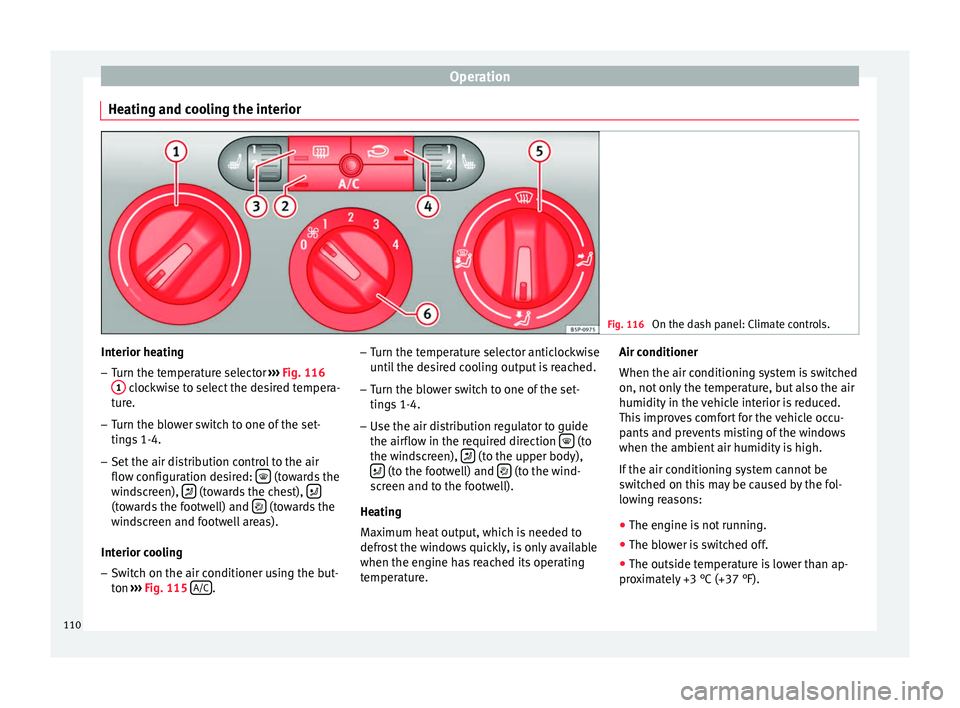
Heating and cooling the interior Fig. 116
On the dash panel: Climate controls. Interior heating
– Turn the temperature selector ››› Fig. 116
1 clockwise to select the desired tempera-
ture.
– Turn the blower switch to one of the set-
tings 1-4.
– Set the air distribution control to the air
flow configuration desired: (towards the
windscreen), (towards the chest),
(towards the footwell) and
(towards the
windscreen and footwell areas).
Interior cooling
– Switch on the air conditioner using the but-
ton ››› Fig. 115
A/C .–
Turn the temperature selector anticlockwise
until the desired cooling output is reached.
– Turn the blower switch to one of the set-
tings 1-4.
– Use the air distribution regulator to guide
the airflow in the required direction (to
the windscreen), (to the upper body),
(to the footwell) and
(to the wind-
screen and to the footwell).
Heating
Maximum heat output, which is needed to
defrost the windows quickly, is only available
when the engine has reached its operating
temperature. Air conditioner
When the air conditioning system is switched
on, not only the temperature, but also the air
humidity in the vehicle interior is reduced.
This improves comfort for the vehicle occu-
pants and prevents misting of the windows
when the ambient air humidity is high.
If the air conditioning system cannot be
switched on this may be caused by the fol-
lowing reasons:
● The engine is not running.
● The blower is switched off.
● The outside temperature is lower than ap-
proximately +3 °C (+37 °F).
110
Page 122 of 236
Operation
button while driving slowly and with low ac-
celeration. This procedure can be repeated
several times while driving carefully until all
the LPG left in the tank has been used up.
● Vehicles that display information or warn-
ing messages on the dash panel may show
information related to LPG operation.
● The notification LPG mode not possible may
be displayed. Journeys abroad
To drive abroad, the following must be taken
into consideration:
● For vehicles fitted with a catalytic converter
ensure that unleaded petrol is available for
the journey. See the chapter “Refuelling”. Au-
tomobile organisations will have information
about service station networks selling unlea-
ded fuel.
● In some countries, your vehicle model may
not be available, and therefore some spare
parts may not available or technical services
can only carry out limited repairs.
SEAT importers and distributors will gladly
provide information about the technical prep-
aration that your vehicle requires and also
about necessary maintenance and repair
possibilities. Adhesive strips for headlights
If you have to drive a right-hand drive vehicle
in a left-hand drive country, or vice versa, the
asymmetric dipped beam headlights will daz-
zle oncoming traffic.
To prevent dazzling, you must apply stickers
to certain parts of the headlight lenses. Fur-
ther information is available at any Technical
Service.
In vehicles with adaptive headlights, the ro-
tation system must previously be disconnec-
ted. To do this, please go to a specialised
workshop.
Ignition lock
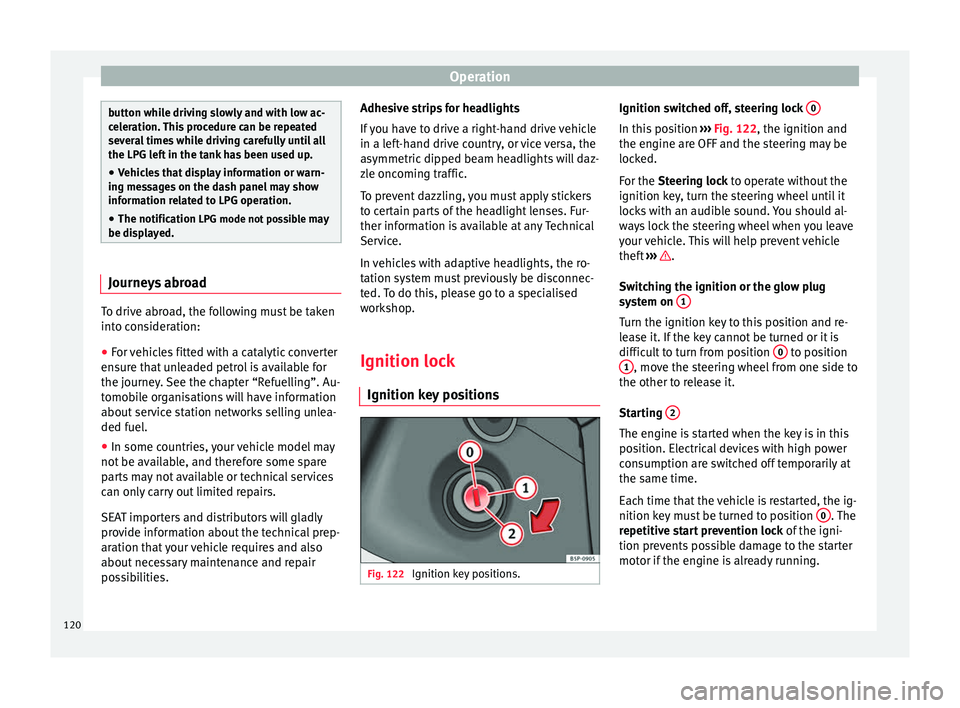
Ignition key positions Fig. 122
Ignition key positions. Ignition switched off, steering lock
0 In this position
››› Fig. 122, the ignition and
the engine are OFF and the steering may be
locked.
For the Steering lock
to operate without the
ignition k
ey, turn the steering wheel until it
locks with an audible sound. You should al-
ways lock the steering wheel when you leave
your vehicle. This will help prevent vehicle
theft ››› .
Switching the ignition or the glow plug
system on 1 Turn the ignition key to this position and re-
lease it. If the key cannot be turned or it is
difficult to turn from position
0 to position
1 , move the steering wheel from one side to
the other to release it.
Starting 2 The engine is started when the key is in this
position. Electrical devices with high power
consumption are switched off temporarily at
the same time.
Each time that the vehicle is restarted, the ig-
nition key must be turned to position
0 . The
repetitive start prevention lock of the igni-
tion prevents possible damage to the starter
motor if the engine is already running.
120
Page 123 of 236
Driving
WARNING
● The ignition key must NOT be removed from
the lock until the vehicle comes to a stand-
still. Otherwise, the steering could be imme-
diately blocked- Risk of accident!
● Always remove the key from the ignition
when leaving the vehicle, even if only for a
short period. This is especially important if
children or disabled people are left alone in
the vehicle. They could accidentally start the
engine or work electrical equipment such as
the electric windows, resulting in an acci-
dent.
● Unsupervised use of the key could start the
engine or any electrical system, such as the
electric windows. This could result in serious
injury. CAUTION
The starter motor will only work when the en-
gine is stopped (ignition key position 2 ).
Electronic immobiliser
The electronic immobiliser prevents unau-
thorised persons from driving the vehicle.
Inside the key there is a chip that deactivates
the electronic immobiliser automatically
when the key is inserted into the ignition. The electronic immobiliser will be activated
again automatically as soon as you pull the
key out of the ignition lock.
The engine can only be started using a genu-
ine SEAT key with its correct code.
Note
A perfect operation of the vehicle is ensured
if genuine SEAT keys are used. Starting petrol engines
The engine can only be started using a genu-
ine SEAT key with its correct code.
– Move the gearbox lever to the neutral posi-
tion and depress the clutch pedal thor-
oughly and hold it in this position for the
starter to turn the engine on.
– Turn the ignition key to the starting posi-
tion ›››
page 120 .
– Let
go of the ignition key as soon as the en-
gine starts; the starter motor must not run
on with the engine.
After starting a very hot engine, you may
need to slightly press down the accelerator.
When starting a cold engine, it may be a little
noisy for the first few seconds until oil pres-
sure has built up in the hydraulic valve com-
pensators. This is quite normal, and no cause
for concern. If the engine does not start immediately,
switch the starter off after 10 seconds and try
again after half a minute. If the engine still
does not start, the fuel pump fuse should be
checked
››› page 196, Fuses. WARNING
● Never start or run the engine in unventila-
ted or closed rooms. The exhaust gases con-
tain carbon monoxide, an odourless and col-
ourless poisonous gas. Risk of fatal acci-
dents. Carbon monoxide can cause loss of
consciousness and result in death.
● Never leave the vehicle unattended if the
engine is running.
● Never use “cold start sprays”, they could
explode or cause the engine to run at high
revs. Risk of injury. CAUTION
● When the engine is cold, you should avoid
high engine speeds, driving at full throttle
and over-loading the engine. Risk of engine
damage.
● The vehicle should not be pushed or towed
more than 50 metres to start the engine. Un-
burnt fuel could enter the catalytic converter
and damage it.
● Before attempting to push-start or tow a ve-
hicle in order to start it, you should first try to
start it using the battery of another vehicle.
Note and follow the instructions in
››› page 189, Jump-starting.
» 121
Technical specifications
Advice
Operation
Safety
Page 125 of 236
Driving
engine compartment or due to its prolonged
exposure to solar radiation. WARNING
● Never switch the engine off until the vehi-
cle is completely stationary.
● The brake servo works only when the en-
gine is running. With the engine switched off,
more strength is needed to brake. As normal
brake operation cannot be performed, risk of
accidents and serious injury may exist.
● The steering lock can be immediately
blocked once the key is removed from the ig-
nition. The vehicle cannot be steered. Risk of
accident. CAUTION
When the engine has been running under a
heavy load for a long period, heat can accu-
mulate in the engine compartment and cause
engine damage. For this reason, idle the en-
gine for approximately 2 minutes before
switching it off. Braking and parking
Braking capacity and distance The following factors impair braking capacity: New brake pads
New brake pads do not provide optimal per-
formance during the first 400 km; first they
must be “run in”. However, the reduced brak-
ing capacity may be compensated by press-
ing on the brake pedal a little harder. Avoid
overloading the brakes during run-in.
Wear
The rate of wear on the
brake pads depends
a great deal on how you drive and the condi-
tions in which the vehicle is operated. Nega-
tive factors are, for instance, city traffic, fre-
quent short trips or hard driving with abrupt
starts and stops.
Wet roads or road salt
In certain conditions, such as in heavy rain,
or after washing the vehicle or driving
through water, the full braking effect can be
delayed by moisture (or in winter by ice) on
the discs and brake pads. In this case the
brakes should be “dried” by pressing the
brake pedal several times.
The effectiveness of the brakes can also be
temporarily reduced if the vehicle is driven
for some distance without using the brakes
when there is a lot of salt on the road in win-
ter. In this case, the layer of salt on the brake
discs and pads has to wear off before brak-
ing. Corrosion
There may be a tendency for corrosion to
form on the discs and dirt to build up on the
brake pads if the vehicle is used infrequently
or the brakes are not used very often.
If the brakes are not used frequently, or if
rust has formed on the disks, it is advisable
to clean off the pads and disks by braking
firmly a few times at a moderately high speed
››› .
Faults in the brake system
If the brake pedal travel should ever increase
suddenly , this may mean that one of the two
br ak
e circuits has failed. Drive immediately
to the nearest specialised workshop and
have the fault repaired. Drive there slowly
and remember that you will have to apply
more pressure on the brake pedal and allow
for longer stopping distances.
Low brake fluid level
Malfunctions can occur in the brake system if
the brake fluid level is too low. The brake flu-
id level is monitored electronically.
Brake servo
The brake servo increases the pressure you
apply to the brake pedal. It works only when
the engine is running. »
123
Technical specifications
Advice
Operation
Safety
Page 127 of 236
Driving
●
If the handbrake is only partially released,
this will cause the rear brakes to overheat,
which can impair the function of the brake
system and could lead to an accident. This al-
so causes premature wear on the rear brake
pads. CAUTION
Always apply the handbrake before you leave
the vehicle. Put it in 1st gear as well. Parking
The handbrake should always be firmly ap-
plied when the vehicle is parked.
Always note the following points when park-
ing the vehicle:
– Use the brake pedal to stop the vehicle.
– Apply the handbrake.
– Put it in 1st gear.
– Switch the engine off and remove the key
from the ignition. Turn the steering wheel
slightly to engage the steering lock.
– Always take you keys with you when you
leave the vehicle ››› .Additional notes on parking the vehicle on
gradients:
Turn the steering wheel so that the vehicle
rolls against the kerb if it started to roll.
●
If the vehicle is parked facing downhill,
turn the front wheels so that they point to-
wards the kerb .
● If the vehicle is parked facing uphill, turn
the fr ont
wheels so that they point away from
the kerb
.
● Secure the vehicle as usual by applying the
handbrake firmly and putting it in 1st gear. WARNING
● Take measures to reduce the risk of injury
when you leave your vehicle unattended.
● Never park where the hot exhaust system
could ignite inflammable materials, such as
dry grass, low bushes, spilt fuel etc.
● Never allow vehicle occupants to remain in
the vehicle when it is locked. They would be
unable to open the vehicle from the inside,
and could become trapped in the vehicle in
an emergency. In the event of an emergency,
locked doors will delay assistance to vehicle
occupants.
● Never leave children alone in the vehicle.
They could set the vehicle in motion, for ex-
ample, by releasing the handbrake or the
gearbox lever. ●
Depending on weather conditions, it may
become extremely hot or cold inside the vehi-
cle. This can be fatal. Hill driving assistant*
This function is only included in vehicles with
ESC.
The hill driving assistant helps the driver to
move off and upward on a hill without rolling
backward.
The system maintains brake pressure for ap-
proximately 2 seconds after the driver takes
his foot off the brake pedal to prevent the ve-
hicle from rolling backward when starting off.
During these 2 seconds, the driver has
enough time to release the clutch pedal and
accelerate without the vehicle moving and
without having to use the handbrake, making
starting off easier, more comfortable and saf-
er.
These are the basic operation conditions:
● being on a ramp or hill/slope,
● closed doors,
● vehicle completely stationary,
● engine running and foot on the brake,
● besides having a gear engaged or being in
neutral for manual gear change and with the
selector lever at position S,
D
or R for an au-
tomatic gearbox. »
125
Technical specifications
Advice
Operation
Safety
Page 129 of 236
Driving
Automatic gearbox/DSG
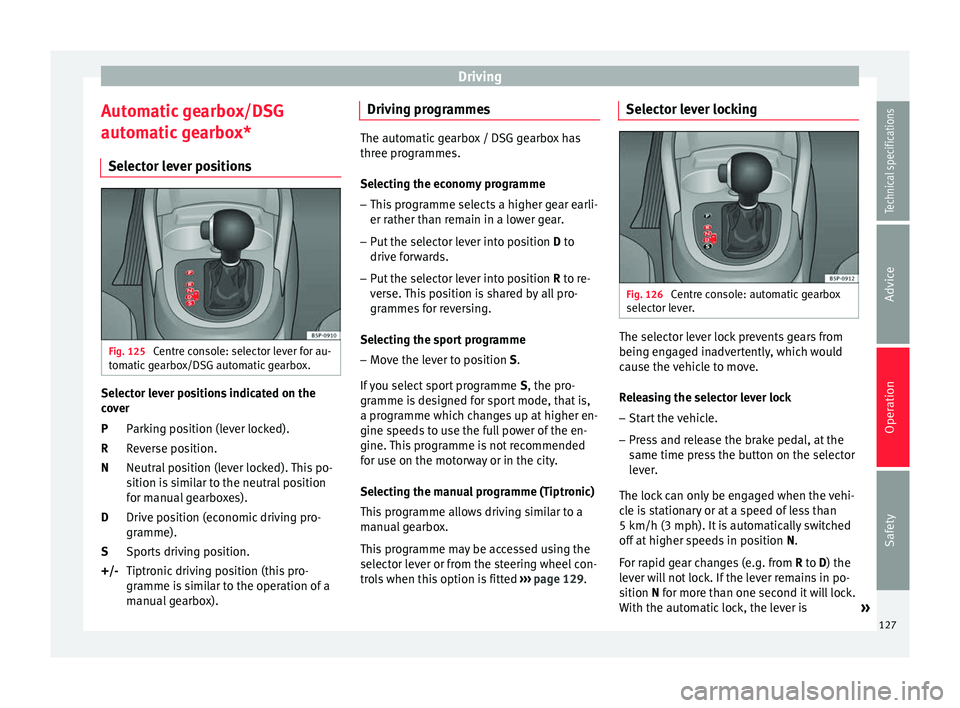
automatic gearbox* Selector lever positions Fig. 125
Centre console: selector lever for au-
tomatic gearbox/DSG automatic gearbox. Selector lever positions indicated on the
cover
Parking position (lever locked).
Reverse position.
Neutral position (lever locked). This po-
sition is similar to the neutral position
for manual gearboxes).
Drive position (economic driving pro-
gramme).
Sports driving position.
Tiptronic driving position (this pro-
gramme is similar to the operation of a
manual gearbox).
P
R
N
D
S
+/- Driving programmes The automatic gearbox / DSG gearbox has
three programmes.
Selecting the economy programme
– This programme selects a higher gear earli-
er rather than remain in a lower gear.
– Put the selector lever into position D to
driv e f
orwards.
– Put the selector lever into position R to re-
ver
se. This position is shared by all pro-
grammes for reversing.
Selecting the sport programme – Move the lever to position S.
If you select sport programme S, the pro-
gr amme i
s designed for sport mode, that is,
a programme which changes up at higher en-
gine speeds to use the full power of the en-
gine. This programme is not recommended
for use on the motorway or in the city.
Selecting the manual programme (Tiptronic)
This programme allows driving similar to a
manual gearbox.
This programme may be accessed using the
selector lever or from the steering wheel con-
trols when this option is fitted ›››
page 129. Selector lever locking
Fig. 126
Centre console: automatic gearbox
selector lever. The selector lever lock prevents gears from
being engaged inadvertently, which would
cause the vehicle to move.
Releasing the selector lever lock
– Start the vehicle.
– Press and release the brake pedal, at the
same time press the button on the selector
lever.
The lock can only be engaged when the vehi-
cle is stationary or at a speed of less than
5 km/h (3 mph). It is automatically switched
off at higher speeds in position N.
F or r
apid gear changes (e.g. from R
to D) the
lever will not lock. If the lever remains in po-
sition
N for more than one second it will lock.
With the automatic lock, the lever is »
127
Technical specifications
Advice
Operation
Safety