low beam Seat Altea XL 2015 Owner's Manual
[x] Cancel search | Manufacturer: SEAT, Model Year: 2015, Model line: Altea XL, Model: Seat Altea XL 2015Pages: 236, PDF Size: 4.23 MB
Page 38 of 236
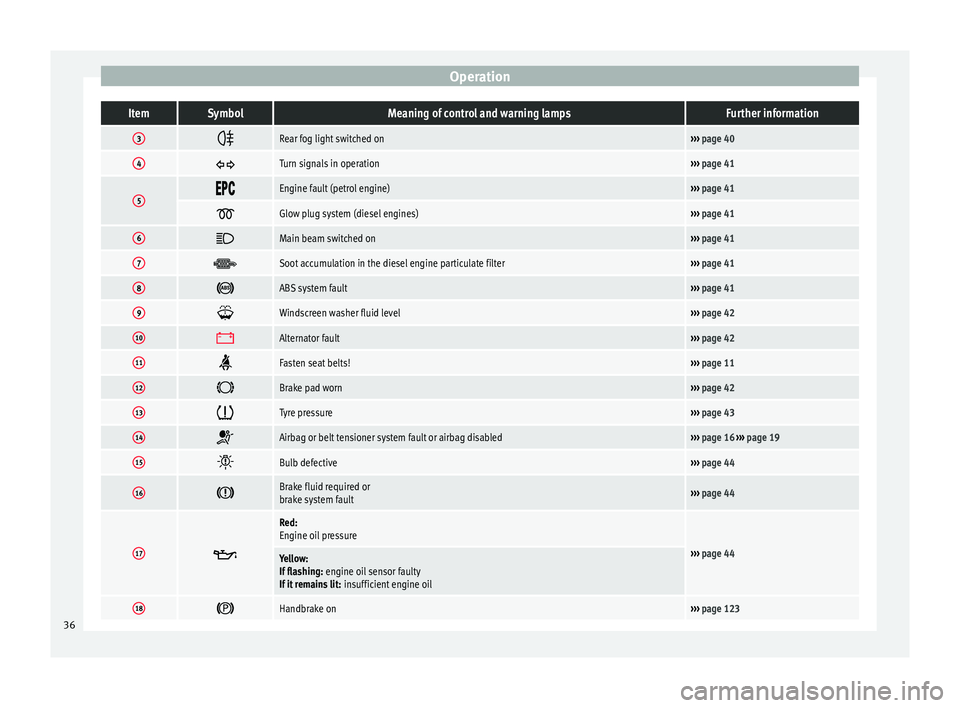
OperationItemSymbolMeaning of control and warning lampsFurther information
3
Rear fog light switched on›››
page 40
4 Turn signals in operation›››
page 41
5 Engine fault (petrol engine)›››
page 41
Glow plug system (diesel engines)›››
page 41
6 Main beam switched on›››
page 41
7 Soot accumulation in the diesel engine particulate filter›››
page 41
8 ABS system fault›››
page 41
9 Windscreen washer fluid level›››
page 42
10 Alternator fault›››
page 42
11 Fasten seat belts!›››
page 11
12 Brake pad worn›››
page 42
13 Tyre pressure›››
page 43
14 Airbag or belt tensioner system fault or airbag disabled›››
page 16 ››› page 19
15 Bulb defective›››
page 44
16 Brake fluid required or
brake system fault›››
page 44
17
Red:
Engine oil pressure
›››
page 44Yellow:
If flashing: engine oil sensor faulty
If it remains lit: insufficient engine oil
18 Handbrake on›››
page 123 36
Page 43 of 236
Dash panel
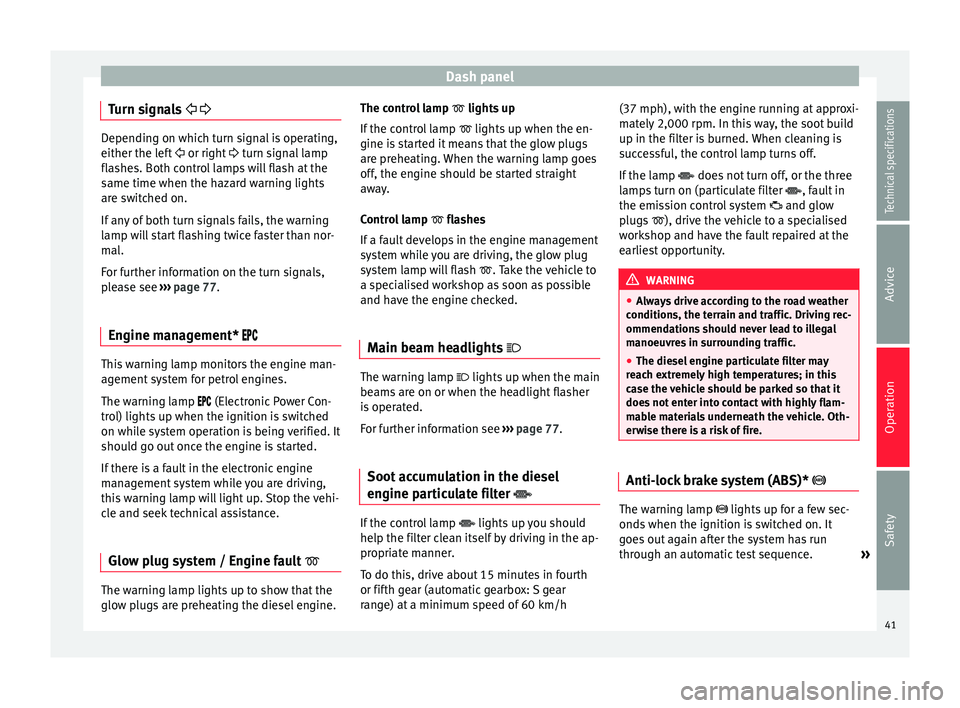
Turn signals
Depending on which turn signal is operating,
either the left
or right turn signal lamp
fl a
shes. Both control lamps will flash at the
same time when the hazard warning lights
are switched on.
If any of both turn signals fails, the warning
lamp will start flashing twice faster than nor-
mal.
For further information on the turn signals,
please see ››› page 77.
Engine management* This warning lamp monitors the engine man-
agement system for petrol engines.
The warning lamp (Electronic Power Con-
trol) lights up when the ignition is switched
on while system operation is being verified. It
should go out once the engine is started.
If there is a fault in the electronic engine
management system while you are driving,
this warning lamp will light up. Stop the vehi-
cle and seek technical assistance.
Glow plug system / Engine fault The warning lamp lights up to show that the
glow plugs are preheating the diesel engine. The control lamp
lights up
If the c
ontrol lamp lights up when the en-
gine is
started it means that the glow plugs
are preheating. When the warning lamp goes
off, the engine should be started straight
away.
Control lamp flashes
If a f
ault develops in the engine management
system while you are driving, the glow plug
system lamp will flash
. Take the vehicle to
a specialised workshop as soon as possible
and have the engine checked.
Main beam headlights The warning lamp lights up when the main
beams are on or when the headlight flasher
is operated.
For further information see
›››
page 77.
Soot accumulation in the diesel
engine particulate filter If the control lamp
lights up you should
help the filter clean itself by driving in the ap-
propriate manner.
To do this, drive about 15 minutes in fourth
or fifth gear (automatic gearbox: S gear
range) at a minimum speed of 60 km/h (37 mph), with the engine running at approxi-
mately 2,000 rpm. In this way, the soot build
up in the filter is burned. When cleaning is
successful, the control lamp turns off.
If the lamp
does not turn off, or the three
l amp
s turn on (particulate filter , fault in
the emission control system and glow
plugs ), drive the vehicle to a specialised
workshop and have the fault repaired at the
earliest opportunity. WARNING
● Always drive according to the road weather
conditions, the terrain and traffic. Driving rec-
ommendations should never lead to illegal
manoeuvres in surrounding traffic.
● The diesel engine particulate filter may
reach extremely high temperatures; in this
case the vehicle should be parked so that it
does not enter into contact with highly flam-
mable materials underneath the vehicle. Oth-
erwise there is a risk of fire. Anti-lock brake system (ABS)*
The warning lamp lights up for a few sec-
onds when the ignition is switched on. It
goes out again after the system has run
through an automatic test sequence.
»
41Technical specifications
Advice
Operation
Safety
Page 46 of 236
Operation
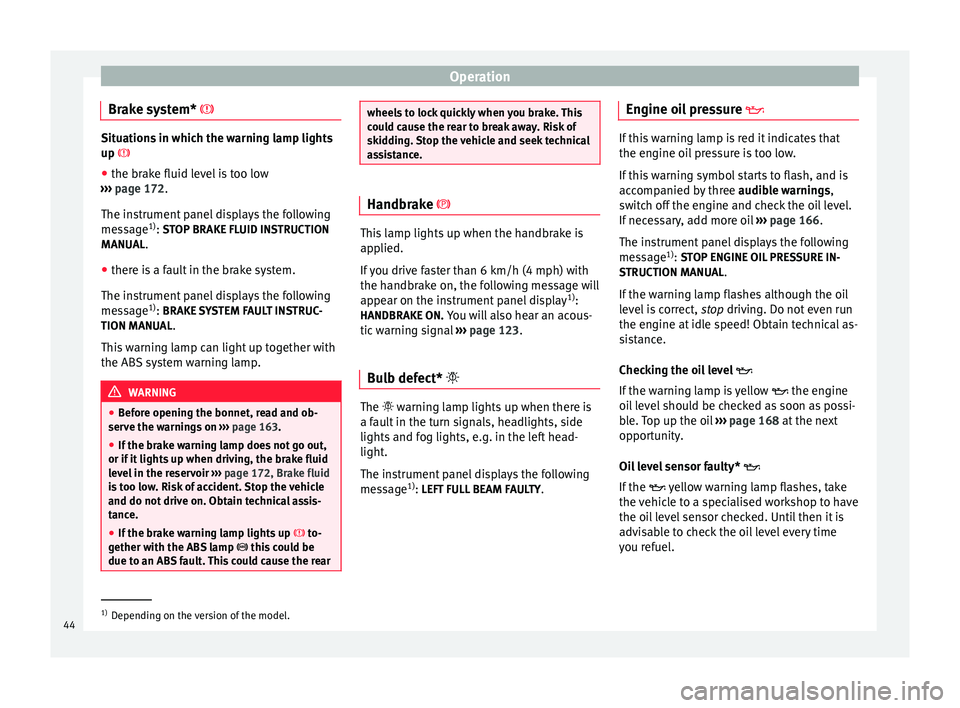
Brake system* Situations in which the warning lamp lights
up
● the br ak
e fluid level is too low
››› page 172.
The ins
trument panel displays the following
message 1)
: STOP BRAKE FLUID INSTRUCTION
MANUAL
.
● there is a fault in the brake system.
The instrument panel displays the following
message 1)
: BRAKE SYSTEM FAULT INSTRUC-
TION MANUAL .
This warning lamp can light up together with
the ABS system warning lamp. WARNING
● Before opening the bonnet, read and ob-
serve the warnings on ››› page 163.
● If the brake warning lamp does not go out,
or if it lights up when driving, the brake fluid
level in the reservoir ››› page 172, Brake fluid
is too low. Risk of accident. Stop the vehicle
and do not drive on. Obtain technical assis-
tance.
● If the brake warning lamp lights up to-
gether with the ABS lamp this could be
due to an ABS fault. This could cause the rear wheels to lock quickly when you brake. This
could cause the rear to break away. Risk of
skidding. Stop the vehicle and seek technical
assistance.
Handbrake
This lamp lights up when the handbrake is
applied.
If you drive faster than 6 km/h (4 mph) with
the handbrake on, the following message will
appear on the instrument panel display
1)
:
HANDBRAKE ON. You will also hear an acous-
tic warning signal ››› page 123.
Bulb defect* The warning lamp lights up when there is
a fault in the turn signals, headlights, side
lights and fog lights, e.g. in the left head-
light.
The instrument panel displays the following
message
1)
: LEFT FULL BEAM FAULTY .Engine oil pressure
If this warning lamp is red it indicates that
the engine oil pressure is too low.
If this warning symbol starts to flash, and is
accompanied by three
audible warnings,
switch off the engine and check the oil level.
If necessary, add more oil ››› page 166.
The instrument panel displays the following
message 1)
: STOP ENGINE OIL PRESSURE IN-
S TRUCTION MANU
AL.
If the warning lamp flashes although the oil
level is correct, stop driving. Do not even run
the en gine at
idle speed! Obtain technical as-
sistance.
Checking the oil level
If the warning lamp is yellow the engine
oil level should be checked as soon as possi-
ble. Top up the oil ›››
page 168 at the next
opportunity.
Oil level sensor faulty*
If the yellow warning lamp flashes, take
the vehicle to a specialised workshop to have
the oil level sensor checked. Until then it is
advisable to check the oil level every time
you refuel. 1)
Depending on the version of the model.
44
Page 79 of 236

Lights and visibility
When the automatic dipped beam headlight
control is on but the dipped beam headlights
are off, the warning lamp lights up on
the light control ››› Fig. 59. If the automatic
control switches on the dipped lights, the in-
strument and control lighting is also switch-
ed on. WARNING
● Even if the automatic headlight control is
switched on, the dipped beam headlights will
not be switched on with fog. Therefore, the
dipped beam must be switched on manually. Note
● For those vehicles with the automatic head-
light system, when the key is removed from
the ignition, the audible warning will only
sound if the light control is in the position
or if the vehicle is not fitted with the com-
in g home f
unction.
● If the daylight driving automatic light func-
tion is switched on, the front fog lights or
rear fog light cannot be switched on in addi-
tion.
● The use of the lighting described here is
subject to the relevant statutory require-
ments.
● Do not put stickers on the windscreen in
front of the sensor. This may cause disrup-
tions or faults in the automatic lighting sys-
tem. ●
To avoid damage to the tail lights, the
lights mounted on the rear lid go off when the
rear lid is opened (depending on the country). Turn signal and main beam headlight
lever
Fig. 60
Turn signal and main beam lever The turn signal and main beam headlight lev-
er has the following functions:
Switching on the turn signals
– Move the lever all the way up ››› Fig. 60 1 to indicate
right
, and all the way down 2 to indicate
left
.
Sign
alling a lane change
– Push the lever up 1 or down
2 to the
point where you incur resistance and then
release it. The turn signal will flash several times. The corresponding control lamp will
also flash.
Switching main beam on and off – If the dipped lights are on, push the lever
forward ››› Fig. 60 3 to switch on the main
beam headlights.
– Push the lever towards the steering wheel
››› Fig. 60 4 to switch off the main beam.
Headlight flashers
– Pull the lever towards the steering wheel
4 to operate the flasher.
Switching on parking lights
– Switch the ignition off and remove the key
from the lock.
– Move the turn signal lever up or down to
turn the right or left-hand parking lights on,
respectively. WARNING
The main beam can dazzle other drivers. Risk
of accident! Never use the main beam head-
lights or the headlight flasher if they could
dazzle other drivers. Note
● The turn signals only
work when the igni-
tion is switched on. The corresponding warn-
ing lamp or flashes in the instrument
» 77
Technical specifications
Advice
Operation
Safety
Page 82 of 236
Operation
Instrument and switch lighting 1When the headlights are switched on, the
brightness of the instrument panel and con-
trols can be adjusted by turning the thumb
wheel
››› Fig. 61 1 .
The instrument lighting (dials and needles),
the centre console illumination and the illu-
mination of the displays are regulated by a
photodiode incorporated in the instrument
panel.
The instrument lighting (dials and needles) is
switched on when the ignition is on and the
vehicle lights are off . The instrument lighting
is dimmed automatically as the daylight
starts to fade. It goes out completely when
ambient light is very low. This function is in-
tended to remind the driver to switch on the
dipped beam headlights in good time when
light conditions become poor.
Headlight range control 2By using the electrical headlight range con-
trol,
2 you can adjust the headlight range to
the load level that is being carried in the ve-
hicle. This way, it is possible to avoid daz-
zling oncoming traffic more than necessary.
At the same time, by using the correct head-
light settings, the driver has the best possi-
ble lighting for the road ahead.
The headlights can only be adjusted when
the dipped beam is switched on. To lower the beam, turn the thumb wheel down
2 from
the basic setting 0.
D y
namic headlight range control
Vehicles with gas discharge lamps (“xenon
lamps”) are equipped with
dynamic head-
light range control . This means that the
headlights will be adjusted to suit the load
level of the vehicle and “nodding move-
ments” when pulling off and braking are au-
tomatically compensated for.
Vehicles with gas discharge bulbs do not
have headlight range control.
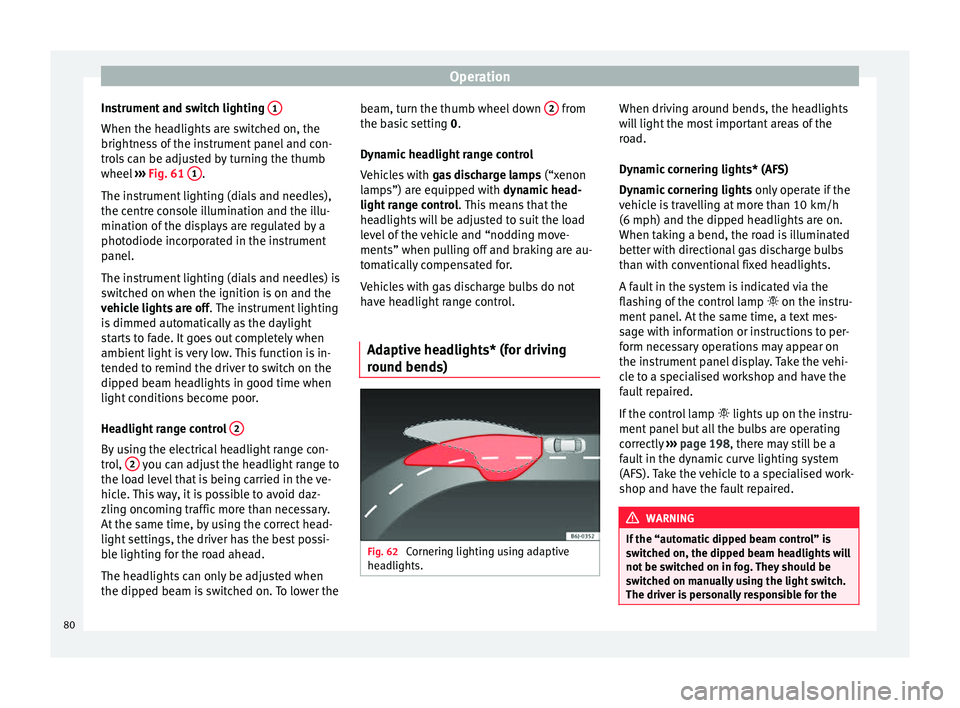
Adaptive headlights* (for driving
round bends) Fig. 62
Cornering lighting using adaptive
headlights. When driving around bends, the headlights
will light the most important areas of the
road.
Dynamic cornering lights* (AFS)
Dynamic cornering lights
only operate if the
vehicle is travelling at more than 10 km/h
(6 mph) and the dipped headlights are on.
When taking a bend, the road is illuminated
better with directional gas discharge bulbs
than with conventional fixed headlights.
A fault in the system is indicated via the
flashing of the control lamp on the instru-
ment panel. At the same time, a text mes-
sage with information or instructions to per-
form necessary operations may appear on
the instrument panel display. Take the vehi-
cle to a specialised workshop and have the
fault repaired.
If the control lamp lights up on the instru-
ment panel but all the bulbs are operating
correctly ››› page 198 , there may still be a
f au
lt in the dynamic curve lighting system
(AFS). Take the vehicle to a specialised work-
shop and have the fault repaired. WARNING
If the “automatic dipped beam control” is
switched on, the dipped beam headlights will
not be switched on in fog. They should be
switched on manually using the light switch.
The driver is personally responsible for the 80
Page 122 of 236
Operation
button while driving slowly and with low ac-
celeration. This procedure can be repeated
several times while driving carefully until all
the LPG left in the tank has been used up.
● Vehicles that display information or warn-
ing messages on the dash panel may show
information related to LPG operation.
● The notification LPG mode not possible may
be displayed. Journeys abroad
To drive abroad, the following must be taken
into consideration:
● For vehicles fitted with a catalytic converter
ensure that unleaded petrol is available for
the journey. See the chapter “Refuelling”. Au-
tomobile organisations will have information
about service station networks selling unlea-
ded fuel.
● In some countries, your vehicle model may
not be available, and therefore some spare
parts may not available or technical services
can only carry out limited repairs.
SEAT importers and distributors will gladly
provide information about the technical prep-
aration that your vehicle requires and also
about necessary maintenance and repair
possibilities. Adhesive strips for headlights
If you have to drive a right-hand drive vehicle
in a left-hand drive country, or vice versa, the
asymmetric dipped beam headlights will daz-
zle oncoming traffic.
To prevent dazzling, you must apply stickers
to certain parts of the headlight lenses. Fur-
ther information is available at any Technical
Service.
In vehicles with adaptive headlights, the ro-
tation system must previously be disconnec-
ted. To do this, please go to a specialised
workshop.
Ignition lock
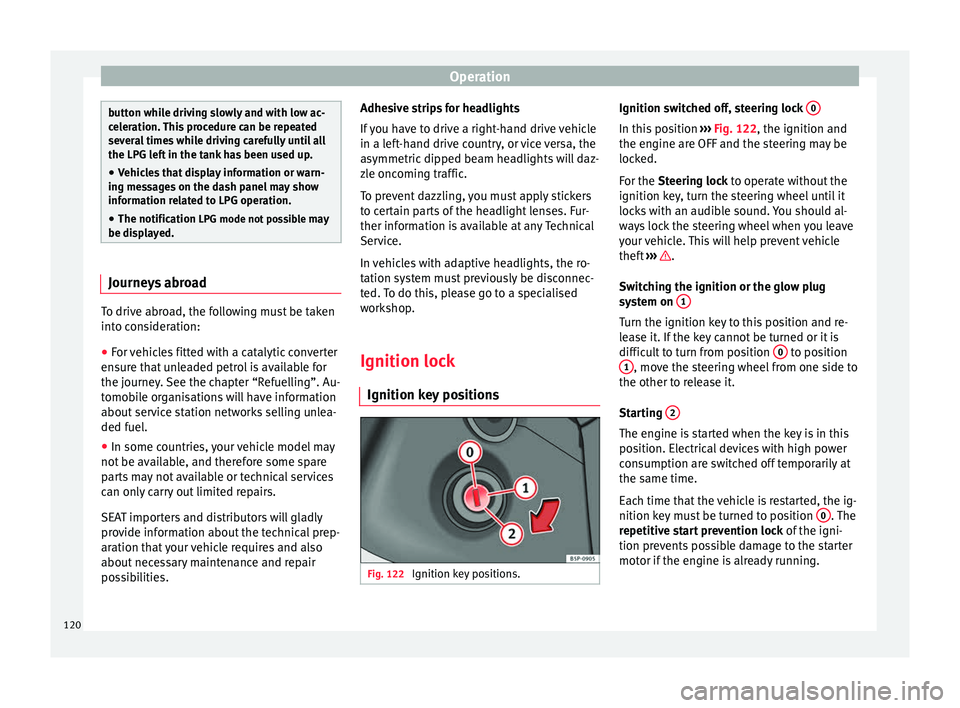
Ignition key positions Fig. 122
Ignition key positions. Ignition switched off, steering lock
0 In this position
››› Fig. 122, the ignition and
the engine are OFF and the steering may be
locked.
For the Steering lock
to operate without the
ignition k
ey, turn the steering wheel until it
locks with an audible sound. You should al-
ways lock the steering wheel when you leave
your vehicle. This will help prevent vehicle
theft ››› .
Switching the ignition or the glow plug
system on 1 Turn the ignition key to this position and re-
lease it. If the key cannot be turned or it is
difficult to turn from position
0 to position
1 , move the steering wheel from one side to
the other to release it.
Starting 2 The engine is started when the key is in this
position. Electrical devices with high power
consumption are switched off temporarily at
the same time.
Each time that the vehicle is restarted, the ig-
nition key must be turned to position
0 . The
repetitive start prevention lock of the igni-
tion prevents possible damage to the starter
motor if the engine is already running.
120
Page 144 of 236
Operation
detected while driving forward. The optical
display changes to towing mode.
Fault messages If you hear a long beep for a few seconds and
the LED on the switch
* starts flashing
when
you switch on the parking aid, a system
fault has occurred. Contact a SEAT official
service or specialised workshop. Note
If the fault is not corrected before you switch
off the ignition, it will only be indicated by
the flashing LED on the switch the next
time y
ou switch on the parking aid. Cruise speed* (cruise control
system - CCS)
Description The CCS is able to maintain the set speed in
the range from approx. 30 km/h (19 mph) to
180 km/h (112 mph).
Once the speed setting has been saved, you
may take your foot off the accelerator. WARNING
It could be dangerous to use the cruise con-
trol system if it is not possible to drive at con-
stant speed.
● Do not use the cruise control system when
driving in dense traffic, on roads with lots of
bends or on roads with poor conditions (with
ice, slippery surfaces, loose grit or gravel), as
this could cause an accident.
● Always switch the cruise control system off
after using it in order to avoid involuntary
use.
● It is dangerous to use a set speed which is
too high for the current road, traffic or weath-
er conditions. Risk of accident. Note
The cruise control cannot maintain a constant
speed when descending downhill. It will in-
crease due to its own weight. Use the foot
brake to slow the vehicle. Switching the cruise control system
on and off
Fig. 135
Turn signal and main beam head-
light lever: switch and rocker switch for the
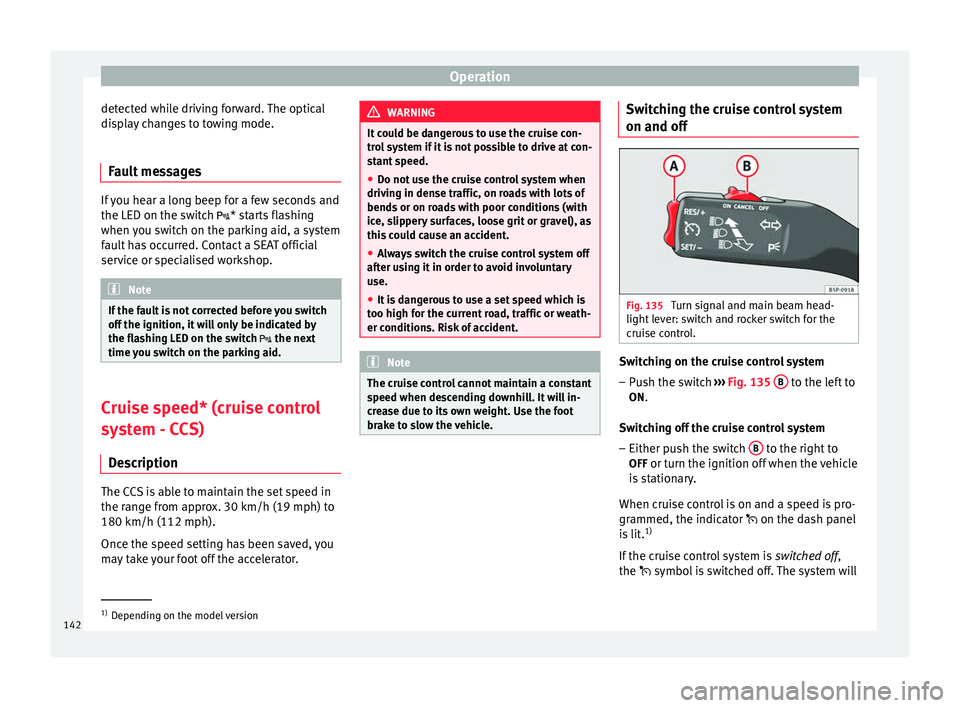
cruise control. Switching on the cruise control system
– Push the switch ››› Fig. 135 B to the left to
ON.
Switching off the cruise control system
– Either push the switch B to the right to
OFF or turn the ignition off when the vehicle
is stationary.
When cruise control is on and a speed is pro-
grammed, the indicator on the dash panel
is lit. 1)
If the cruise control system is switched off,
the symbo l
is switched off. The system will 1)
Depending on the model version
142
Page 145 of 236
Driver assistance systems
also be switched off fully when the 1st gear
i s
engaged.*
Setting speed* Fig. 136
Turn signal and main beam head-
light lever: switch and rocker switch for the
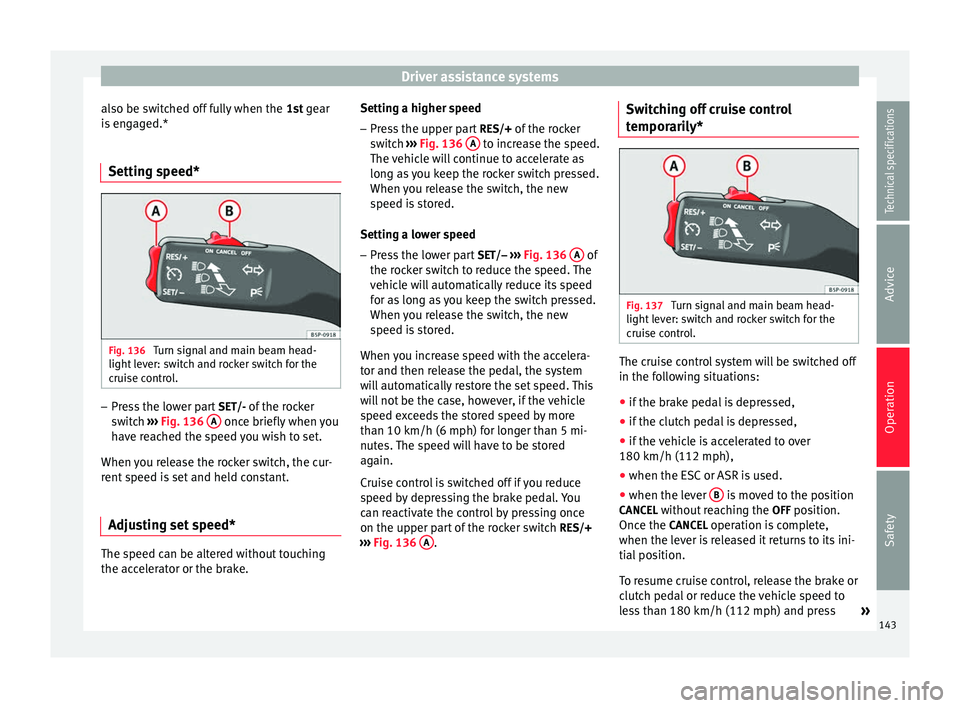
cruise control. –
Press the lower part SET/- of the rocker
switch ››› Fig. 136 A once briefly when you
have reached the speed you wish to set.
When you release the rocker switch, the cur-
rent speed is set and held constant.
Adjusting set speed* The speed can be altered without touching
the accelerator or the brake. Setting a higher speed
– Press the upper part RES/+ of the rocker
switch ››› Fig. 136 A to increase the speed.
The vehicle will continue to accelerate as
long as you keep the rocker switch pressed.
When you release the switch, the new
speed is stored.
Setting a lower speed – Press the lower part SET/– ››› Fig. 136 A of
the rocker switch to reduce the speed. The
vehicle will automatically reduce its speed
for as long as you keep the switch pressed.
When you release the switch, the new
speed is stored.
When you increase speed with the accelera-
tor and then release the pedal, the system
will automatically restore the set speed. This
will not be the case, however, if the vehicle
speed exceeds the stored speed by more
than 10 km/h (6 mph) for longer than 5 mi-
nutes. The speed will have to be stored
again.
Cruise control is switched off if you reduce
speed by depressing the brake pedal. You
can reactivate the control by pressing once
on the upper part of the rocker switch RES/+
››› Fig. 136 A .Switching off cruise control
temporarily*
Fig. 137
Turn signal and main beam head-
light lever: switch and rocker switch for the
cruise control. The cruise control system will be switched off
in the following situations:
● if the brake pedal is depressed,
● if the clutch pedal is depressed,
● if the vehicle is accelerated to over
180 km/h (112 mph),
● when the ESC or ASR is used.
● when the lever B is moved to the position
CANCEL without reaching the OFF position.
Once the CANCEL operation is complete,
when the lever is released it returns to its ini-
tial position.
To resume cruise control, release the brake or
clutch pedal or reduce the vehicle speed to
less than 180 km/h (112 mph) and press »
143
Technical specifications
Advice
Operation
Safety
Page 192 of 236
Advice
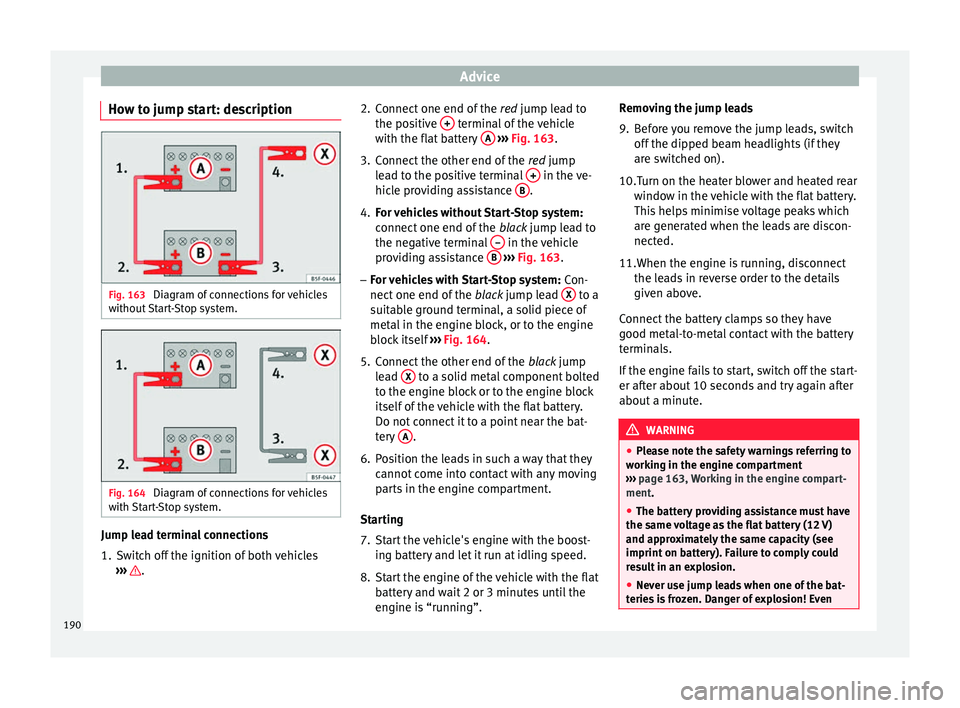
How to jump start: description Fig. 163
Diagram of connections for vehicles
without Start-Stop system. Fig. 164
Diagram of connections for vehicles
with Start-Stop system. Jump lead terminal connections
1. Switch off the ignition of both vehicles
››› . 2. Connect one end of the
red jump lead to
the po s
itive + terminal of the vehicle
with the flat battery A
››› Fig. 163 .
3. C
onnect the other end of the red
jump
lead to the positive terminal + in the ve-
hicle providing assistance B .
4. For vehicles without Start-Stop system:
connect one end of the black jump lead to
the negative terminal – in the vehicle
providing assistance B
››› Fig. 163 .
– For
vehicles with Start-Stop system: Con-
nect one end of the black jump lead X to a
suitable ground terminal, a solid piece of
metal in the engine block, or to the engine
block itself ››› Fig. 164.
5. Connect the other end of the black jump
lead X to a solid metal component bolted
to the engine block or to the engine block
itself of the vehicle with the flat battery.
Do not connect it to a point near the bat-
tery A .
6. Position the leads in such a way that they cannot come into contact with any moving
parts in the engine compartment.
Starting
7. Start the vehicle's engine with the boost- ing battery and let it run at idling speed.
8. Start the engine of the vehicle with the flat battery and wait 2 or 3 minutes until the
engine is “running”. Removing the jump leads
9. Before you remove the jump leads, switch
off the dipped beam headlights (if they
are switched on).
10.Turn on the heater blower and heated rear window in the vehicle with the flat battery.
This helps minimise voltage peaks which
are generated when the leads are discon-
nected.
11. When the engine is running, disconnect
the l e
ads in reverse order to the details
given above.
Connect the battery clamps so they have
good metal-to-metal contact with the battery
terminals.
If the engine fails to start, switch off the start-
er after about 10 seconds and try again after
about a minute. WARNING
● Please note the safety warnings referring to
working in the engine compartment
››› page 163, Working in the engine compart-
ment.
● The b att
ery providing assistance must have
the same voltage as the flat battery (12 V)
and approximately the same capacity (see
imprint on battery). Failure to comply could
result in an explosion.
● Never use jump leads when one of the bat-
teries is frozen. Danger of explosion! Even 190
Page 201 of 236
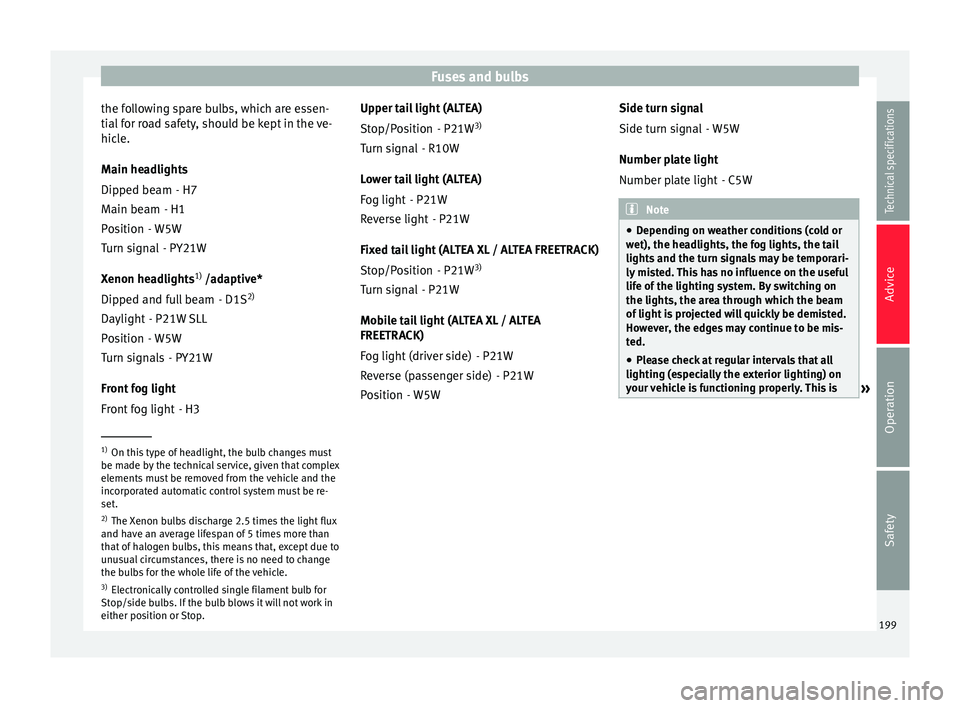
Fuses and bulbs
the following spare bulbs, which are essen-
tial for road safety, should be kept in the ve-
hicle.
Main headlights - H7
- H1
- W5W - PY21W
Xenon headlights 1)
/adaptive*
- D1S 2)
- P21W SLL
- W5W - PY21W
Front fog light - H3
Dipped beam
Main beam
Position
Turn signal
Dipped and full beam
Daylight
Position
Turn signals
Front fog light Upper tail light (ALTEA)
- P21W3)
- R10W
Lower tail light (ALTEA) - P21W- P21W
Fixed tail light (ALTEA XL / ALTEA FREETRACK) - P21W3)
- P21W
Mobile tail light (ALTEA XL / ALTEA
FREETRACK) - P21W- P21W
- W5W
Stop/Position
Turn signal
Fog light
Reverse light
Stop/Position
Turn signal
Fog light (driver side)
Reverse (passenger side)
Position Side turn signal
- W5W
Number plate light - C5W Note
● Depending on weather conditions (cold or
wet), the headlights, the fog lights, the tail
lights and the turn signals may be temporari-
ly misted. This has no influence on the useful
life of the lighting system. By switching on
the lights, the area through which the beam
of light is projected will quickly be demisted.
However, the edges may continue to be mis-
ted.
● Please check at regular intervals that all
lighting (especially the exterior lighting) on
your vehicle is functioning properly. This is » Side turn signal
Number plate light
1)
On this type of headlight, the bulb changes must
be made by the technical service, given that complex
elements must be removed from the vehicle and the
incorporated automatic control system must be re-
set.
2) The Xenon bulbs discharge 2.5 times the light flux
and have an average lifespan of 5 times more than
that of halogen bulbs, this means that, except due to
unusual circumstances, there is no need to change
the bulbs for the whole life of the vehicle.
3) Electronically controlled single filament bulb for
Stop/side bulbs. If the bulb blows it will not work in
either position or Stop. 199Technical specifications
Advice
Operation
Safety