warning Seat Ateca 2016 Owner's Manual
[x] Cancel search | Manufacturer: SEAT, Model Year: 2016, Model line: Ateca, Model: Seat Ateca 2016Pages: 328, PDF Size: 6.32 MB
Page 271 of 328
Care and maintenance
Carbon parts The carbon parts on your vehicle have a pain-
t
ed s
urface. They do not need any special
care and are cleaned just like any other pain-
ted part ››› page 266.
Paint damage Minor damage to the paint, such as scratches
or s
t
one chips, should be touched up without
delay before the metal starts to corrode. Suit-
able touch-up brushes or sprays for your car
can be obtained from a SEAT Official Service.
The number of the original paint finish on the
vehicle is given on the data sticker
››› page 301.
If corrosion is already visible it must be thor-
oughly removed by a specialised workshop.
Windows Clear vision is an essential safety factor.
The w
ind
screen must not be cleaned with in-
sect remover or wax, otherwise the wind-
screen wipers will not function properly (jud-
dering).
Traces of rubber, oil, grease or silicone can
be removed with a window cleaning solution
or a silicone remover. Wax residue can only be removed with a special cleaner. Your SEAT
Offic
ial Service will be able to provide you
with more detailed information.
The windows should also be cleaned on the
inside at regular intervals.
Use a separate cloth or chamois to dry the
windows. Cloths used for waxing and polish-
ing contain residues that will cause smears
on the glass. WARNING
Do not use water-repellent coatings on the
w ind
screen. In bad visibility conditions (e.g.
in the rain, dark or with a low sun), these
coatings may cause dazzle: risk of accident!
Such coatings can also cause the windscreen
wiper blades to make noise. CAUTION
● Remo
ve snow and ice from windows and ex-
terior mirrors with a plastic scraper only. To
avoid scratches caused by dirt on the glass,
the scraper should only be pushed in one di-
rection and not moved to and fro.
● The heating element for the rear window is
locat
ed on the inner side of the window. To
avoid damaging them, do not apply stickers
to these heating elements.
● Never use warm or hot water to remove
sno
w and ice from windows and mirrors. This
could cause the glass to crack! Wheels
The wheels require regular attention to pre-
ser
v
e their appearance. It is important to re-
move road salt and brake dust by washing
the wheels at regular intervals, otherwise the
finish will be impaired.
After washing, the wheels should only be
cleaned with an "acid-free" cleaning agent
for alloy wheels. This is available from SEAT
Official Services and specialist retailers. Nev-
er leave the cleaning agent on the rims for
any longer than specified in the instructions
before rinsing it off. If the wheel cleaner fluid
contains acid it can attack the surfaces of the
wheel bolts.
Car polish or other abrasive agents should
not be used for maintaining the rims. If the
protective coating is damaged, e.g. by flying
stones, the damaged area should be re-
paired immediately. WARNING
Please note when cleaning the wheels that
w at
er, ice and road salt can impair the effec-
tiveness of the brakes; this can cause an acci-
dent. Exhaust tail pipe
It is important to remove road salt and brake
du
s
t by washing the wheels at regular »
269
Technical data
Advice
Operation
Emergencies
Safety
Page 275 of 328
Intelligent technology
The retract function may not operate properly
in v
ery dirty belts. Make sure that the inertia
reel seat belts are completely dry before al-
lowing them to retract. CAUTION
● Do not r
emove the seat belts from the vehi-
cle to clean them.
● Do not use chemical cleaning agents on the
seat
belts, as this can damage the webbing.
Ensure that the seat belts do not come into
contact with corrosive fluids.
● If you find any damage to the belt webbing,
belt fittin
gs, the belt retractor or the buckle,
the belt in question must be replaced by a
specialised workshop. Intelligent technology
El ectr
omechanical steering Electro-mechanical power steering assists
the driv
er when s
teering.
Electro-mechanical power steering adapts
electronically to the speed of the car, torque
and turning angle.
If the power steering should fail at any time
or the engine is switched off (for instance
when being towed), the car can still be
steered. However, more effort than normal
will be required to turn the steering wheel.
Driver warning lamps and messages (in red) Faulty steering! To
park the vehicle
If the warning lamp remains on and the driver
indication appears, the power steering could
be faulty.
Do not continue driving. Seek specialist as-
sistance. (in yellow) Steering: System
fault! You may continue driving.
If the warning lamp comes on, the steering
could react with more difficultly or more sen-
sitivity than normal. In addition, when driving
in a straight line the steering wheel may be
off-centre. Drive slowly to a specialised workshop and
h
av
e the fault repaired.
(in yellow) Steering lock:
fault! Go to an Official Service
The electronic steering lock is malfunction-
ing.
Go to a specialised workshop as soon as
possible and have the fault repaired. WARNING
Take it immediately to a specialised work-
shop and h av
e the fault repaired: risk of acci-
dent! Note
If the lamp (in red) or el
se (in yellow)
lights up briefly, you may continue driving. Four-wheel drive
3
V
alid for vehicles: with four-wheel drive
On four-wheel drive models, the engine pow-
er is distributed to all four wheels
General notes
On four-wheel drive vehicles, the engine
power is distributed to all four wheels. The
distribution of power is controlled automati-
cally according to your driving style and the
road conditions. Also see ›››
page 173. »
273
Technical data
Advice
Operation
Emergencies
Safety
Page 276 of 328
Advice
The four-wheel drive is specially designed to
c omp
lement the superior engine power. This
combination gives the vehicle exceptional
handling and performance capabilities, both
on normal roads and in more difficult condi-
tions, such as snow and ice. Even so (or per-
haps especially for this reason), it is impor-
tant to observe certain safety points ››› .
W int
er tyres
Thanks to four-wheel drive, your vehicle will
have plenty of traction in winter conditions,
even with the standard tyres. Nevertheless,
we still recommend that winter tyres or all-
season tyres be fitted on all four wheels to
give even better braking response.
Snow chains
On roads where snow chains are mandatory,
this also applies to cars with four-wheel drive
››› page 56.
Changing tyres
On vehicles with four-wheel drive, all four
tyres must have the same rolling circumfer-
ence. Also avoid using tyres with varying
tread depths ››› page 293.
Off-roader?
Your SEAT is not an off-road vehicle: it does
not have enough ground clearance to be
used as such. It is therefore best to avoid rough tracks and uneven terrain as much as
pos
sible. WARNING
● Ev
en with four-wheel drive, you should al-
ways adjust your speed to suit the condi-
tions. Do not let the extra safety features
tempt you into taking any risks when driving.
Risk of accident!
● The braking capability of your vehicle is
limited b
y the tyres' grip. It is therefore no
different from a car without four-wheel drive.
So do not be tempted to drive too fast on firm
or slippery roads just because the vehicle
still has good acceleration in these condi-
tions. Risk of accident!
● On wet roads bear in mind that the front
wheels
may start to “aquaplane” and lose
contact with the road if the car is driven too
fast. If this should happen, there will be no
sudden increase in engine speed to warn the
driver, as occurs with a front-wheel drive car.
For this reason you should always choose a
driving speed suitable for the road condi-
tions. Risk of accident! Power Management
Thi s
system helps to ensure reliable
starting The power management controls the distribu-
tion of
el
ectrical energy and thus helps to en- sure that there is always enough power avail-
abl
e to start the engine.
If a vehicle with a conventional electrical sys-
tem is left parked for a long time, the battery
will gradually lose its charge because certain
electrical devices, such as the electronic
gearbox lock continues to draw current even
when the ignition is off. In some cases there
may not be enough power available to start
the engine.
Your vehicle is equipped with an intelligent
power management system to control the
distribution of electrical energy. This signifi-
cantly improves reliability when starting the
engine, and also prolongs the useful life of
the battery.
The main functions incorporated in the power
management system are battery diagnosis,
residual current management and dynamic
power management.
Battery diagnosis
The battery diagnosis function constantly
registers the condition of the battery. Sen-
sors detect the battery voltage, battery cur-
rent and battery temperature. This enables
the system to calculate the current power lev-
el and charge condition of the battery.
Residual current management
The residual current management reduces
power consumption while the vehicle is
274
Page 277 of 328
Intelligent technology
parked. It controls the supply of power to the
v ariou
s electrical devices while the ignition is
switched off. The system takes the battery di-
agnosis data into consideration.
Depending on the power level of the battery,
switch off the individual electrical devices
one after the other to prevent the battery
from losing too much charge and to ensure
that the engine can be started reliably.
Dynamic power management
While the vehicle is moving, this function dis-
tributes the available power to the various
electrical devices and systems according to
their requirements. The power management
ensures that on-board systems do not con-
sume more electrical power than the alterna-
tor can supply, and thus maintains the maxi-
mum possible battery power level. Note
● Neither i s
the power management system
able to overcome the given physical limits.
Please remember that the power and useful
life of the battery are limited.
● When there is a risk that the vehicle will
not s
tart, the alternator power failure or low
battery charge level warning lamp will be
shown ››› page 106. Flat battery
Starting ability has first priority.
Shor
t
trips, city traffic and low temperatures
all place a heavy load on the battery. In these
conditions a large amount of power is con-
sumed, but only a small amount is supplied.
The situation is also critical if electrical devi-
ces are in use when the engine is not run-
ning. In this case power is consumed when
none is being generated.
In these situations you will be aware that the
power management system is intervening to
control the distribution of electrical power.
When the vehicle is parked for long periods
If you do not drive your vehicle for a period of
several days or weeks, the power manage-
ment will gradually shut off the electrical de-
vices one by one or reduce the amount of cur-
rent they are using. This limits the amount of
power consumed and helps to ensure relia-
ble starting even after a long period. Some
convenience functions, such as remote vehi-
cle opening, may not be available under cer-
tain circumstances. These functions will be
restored when you switch on the ignition and
start the engine. With the engine switched off
F
or e
xample, if you listen to the sound sys-
tem with the engine switched off the battery
will run down.
If the energy consumption means there is a
risk that the engine will not start, a text will
appear in vehicles with a driver information
system*.
This driver indicator tells you that you must
start the engine so that the battery can re-
charge.
When the engine is running
Although the alternator generates electrical
power, the battery can still become dis-
charged while the vehicle is being driven.
This can occur when a lot of power is being
consumed but only a small amount supplied,
especially if the battery is not fully charged
initially.
To restore the necessary energy balance, the
system will then temporarily shut off the elec-
trical devices that are using a lot of power, or
reduce the current they are consuming. Heat-
ing systems in particular use a large amount
of electrical power. If you notice, for instance,
that the seat heating* or the rear window
heater is not working, they may have been
temporarily switched off or regulated to a
lower heat output. These systems will be
available again as soon as sufficient electri-
cal power is available. »
275
Technical data
Advice
Operation
Emergencies
Safety
Page 278 of 328
Advice
You may also notice that the engine runs at a
s lightly
faster idling speed when necessary.
This is quite normal, and no cause for con-
cern. The increased idling speed allows the
alternator to meet the greater power require-
ment and charge the battery at the same
time. Checking and refilling levels
Fi l
ling the tank
Filling up Read the additional information carefully
› ›
› page 48
If the automatic filler nozzle is operated cor-
rectly, it will switch itself off as soon as the
fuel tank is “full”. Do not try to put in more
fuel after the nozzle cuts out, as this will fill
the expansion chamber in the fuel tank.
The correct fuel grade for your vehicle is giv-
en on a sticker on the inside of the fuel tank
flap. Further notes on fuel can be found at
››› page 277.
The capacity of your vehicle's fuel tank is giv-
en in ›››
page 48. WARNING
Fuel is highly flammable and can cause seri-
ou s
burns and other injuries.
● When refuelling, turn off the engine, the
auxi
liary heater ››› page 161 and turn off the
ignition for safety reasons.
● Do not smoke when filling the fuel tank or a
cani
ster. Naked flames are forbidden in the
vicinity due to the risk of explosion. ●
Ob
serve legislation governing the use,
storage and carrying of a spare fuel canister
in the vehicle.
● For safety reasons we do not recommend
carr
ying a spare fuel canister in the vehicle.
In an accident the canister could be damaged
and could leak.
● If, in exceptional circumstances, you have
to c
arry a spare fuel canister, please observe
the following points:
– Never fill fuel into the spare fuel canister
if it is inside or on top of the vehicle. An
electrostatic charge could build up during
filling, causing the fuel vapour to ignite.
Danger of explosion. Always place the
canister on the ground to fill it.
– Insert the filling nozzle as far as possible
into the spare fuel canister.
– If the spare fuel canister is made of met-
al, the filling nozzle must be in contact
with the canister during filling. This
helps prevent an electrostatic charge
building up.
– Never spill fuel in the vehicle or in the
luggage compartment. Fuel vapour is ex-
plosive. Risk of fatal accident! CAUTION
● If an
y fuel is spilt onto the vehicle, it
should be removed immediately. It could oth-
erwise damage the paintwork.
● Never run the tank completely dry. An irreg-
ul
ar fuel supply could cause misfiring. As a 276
Page 280 of 328
Advice
Petrol additives
The quality of
the fuel influences the behav-
iour, power and service life of the engine.
This is why the petrol you use should carry
suitable additives already included by the
petrol industry, free of metals. These addi-
tives will help to prevent corrosion, keep the
fuel system clean and prevent deposits from
building up in the engine.
If good-quality petrol with metal-free addi-
tives is not available or engine problems
arise, the necessary additives must be added
when refuelling ››› .
Not al
l petrol additives have been shown to
be effective. The use of unsuitable petrol ad-
ditives may cause significant damage to the
engine and the catalytic converter. Metal ad-
ditives should never be used. Metal additives
may also be contained in petrol additives for
improving anti-detonation ratings or octane
ratings ››› .
S EA
T recommends “genuine Volkswagen
Group Fuel Additives for petrol engines”.
These additives can be bought at SEAT deal-
ers, where information on how to use them
can also be obtained. CAUTION
● Do not r
efuel if the filler indicates that the
fuel contains metal. LRP ( lead replacement
petrol) fuels contain high concentrations of
metal additives. Using them may damage the
engine!
● Never refuel with fuels containing a large
propor
tion of ethanol (for example, E50, E85).
This could damage the fuel system.
● Just filling one full tank of leaded fuel or
fuel
containing other metal additives would
seriously impair the efficiency of the catalytic
converter.
● Only use fuel additives that have been ap-
pro
ved by SEAT. Octane boosting or anti-
knock additives may contain metal additives
that could seriously damage the engine or
the catalytic converter. These additives must
not be used.
● High engine speed and full throttle can
dam
age the engine when using petrol with an
octane rating lower than the correct grade for
the engine. Note
● You m
ay use petrol with a high octane num-
ber than the one recommended for your en-
gine.
● In those countries where unleaded petrol is
not av
ailable, you may refuel with a fuel with
a low lead content. Diesel fuel
Please note the information on the inside of
the f
uel
tank flap.
We recommend the use of diesel fuel which
complies to European standard EN 590. If
diesel fuel which meets European standard
EN 590 is not available, the Cetane number
(CZ) must, at minimum, be 51. If the engine
is equipped with a particulate filter, the sul-
phur content of the fuel must be below 50
parts per million.
Winter-grade diesel
Summer fuel becomes thicker in winter and it
is more difficult to start the engine. For this
reason, petrol stations in some countries al-
so offer winter diesel with improved fluidity
when cold (winter-grade diesel).
Water in the fuel filter 1)
If your vehicle has a diesel engine and is
equipped with a fuel filter with a water sepa-
rator, the instrument panel may display the
following warning: Water in the
fuel filter. If this is the case, take the
vehicle to a specialised workshop so that
they can drain the fuel filter. 1)
Valid for the market: Algeria.
278
Page 281 of 328
Checking and refilling levels
CAUTION
● The v
ehicle is not designed for the use of
FAME fuel (biodiesel). The fuel system would
be damaged if you used biodiesel.
● Do not mix fuel additives, the so-called
“thinners”, petr
ol or similar additives with
diesel fuel.
● If poor-quality diesel fuel is used, it may be
nece
ssary to drain the fuel filter more fre-
quently than is specified in the Maintenance
Programme. We recommend having this done
by a specialised workshop. If water is allowed
to collect in the filter, this can cause engine
performance problems. Exhaust purification system for
v
ehic
les with diesel engines
(AdBlue ®
)
Introduction To reduce emissions, SCR (Selective Catalytic
R
eduction) c
an be used in vehicles with die-
sel engines. Through the special urea solu-
tion AdBlue ®
, SCR transforms nitrogen ox-
ides into nitrogen and water.
AdBlue ®
is stored in a separate tank in the
vehicle ›››
page 280. WARNING
If the level of AdBlue ®
is
too low and the igni-
tion is switched off, it will no longer be possi-
ble to re-start the engine. Not even by jump-
starting the car!
● Insert enough AdBlue ®
when the dis
tance
to empty is approx. 1000 km, at the latest.
● Never run the AdBlue ®
tank
completely dry. WARNING
AdBlue ®
is an irritant, corrosive liquid that
c
an cause injuries if it comes into contact
with the skin, eyes or respiratory organs.
● Before opening an AdBlue ®
rec
ipient, al-
ways take the manufacturer's instructions for
use into account. If the instructions are fol-
lowed correctly, it is not likely that the user
will come into contact with AdBlue ®
.
● If AdBlue ®
come
s into contact with your
eyes, rinse it immediately with plenty of wa-
ter for at least 15 minutes before seeking
medical attention.
● If AdBlue ®
come
s into contact with your
skin, rinse with water for at least 15 minutes
and, in case of skin irritation, seek medical
attention immediately.
● If you accidentally swallow AdBlue ®
, rinse
y
our mouth with plenty of water for at least
15 minutes. Do not induce vomiting unless
advised to by a doctor. Seek immediate medi-
cal attention. CAUTION
AdBlue ®
m ay damage the vehicle's painted
s
urfaces, plastic, upholstery and carpet,
among other things. In case of a spill, clean it
as soon as possible with a damp cloth and
plenty of cold water.
● Remove the AdBlue ®
that
has crystallised
with hot water and a sponge. Warning and control lamps
It lights up red
Unable to start
the engine! The
level of AdBlue is
too low.Park the vehicle on level ground,
taking the appropriate and neces-
sary safety precautions and fill the
tank with the necessary minimum
amount of AdBlue ®
››› page 280.
It lights up yellow
AdBlue
®
level is
low.
Fill tank with AdBlue ®
before the
indicated number of kilometres
››› page 280. SEAT recommends
contacting a specialised work-
shop.
» 279
Technical data
Advice
Operation
Emergencies
Safety
Page 282 of 328
Advice
together with
It lights up red
Unable to start
the engine! There
is a fault in the
AdBlue ®
system.Visit a specialised workshop with-
out switching the ignition off and
on, and have the system checked.
together with
It lights up yellow
The AdBlue
®
system
is malfunctioning or
has been filled with
AdBlue ®
that does
not meet the prescri-
bed standard.
Immediately consult a special-
ised workshop and have the
system checked. Some warning and control lamps will light up
briefly
when the ignition i
s switched on to
check certain functions. They will switch off
after a few seconds. WARNING
Observe the safety warnings ››
› in Warning
and c ontr
ol lamps on page 107. Information on AdBlue
®The consumption of AdBlue
®
depend s
on
your personal driving style, the temperature of the system and on the outdoor tempera-
tur
e when the vehicle is used.
AdBlue ®
freezes at temperatures of -11°C
(+13°F). The system has heating elements
that guarantee its operation even at low tem-
peratures.
The AdBlue ®
tank level capacity is approxi-
mately 12 litres.
The minimum amount to be poured in (as-
suming the tank is empty) is indicated on the
AdBlue ®
sticker located on the floor of the
luggage compartment.
The AdBlue ®
tank should never be empty.
When the distance to empty drops below
2400 km, a warning to refill the AdBlue ®
tank
will appear on the dash panel display
››› page 280. If this information is ignored, it
will later no longer be possible to re-start the
engine ››› in Introduction on page 279. If
thi s
warning does not appear, it is not neces-
sary to refill the AdBlue ®
tank.
AdBlue ®
is a registered brand of the German
Association of the Automotive Industry (VDA)
and is also known as AUS32 or DEF (Diesel
Exhaust Fluid). CAUTION
Filling the AdBlue ®
tank
excessively can
cause damage to the tank.
● SEAT recommends refilling the AdBlue ®
tank
at a specialised workshop. Refilling AdBlue
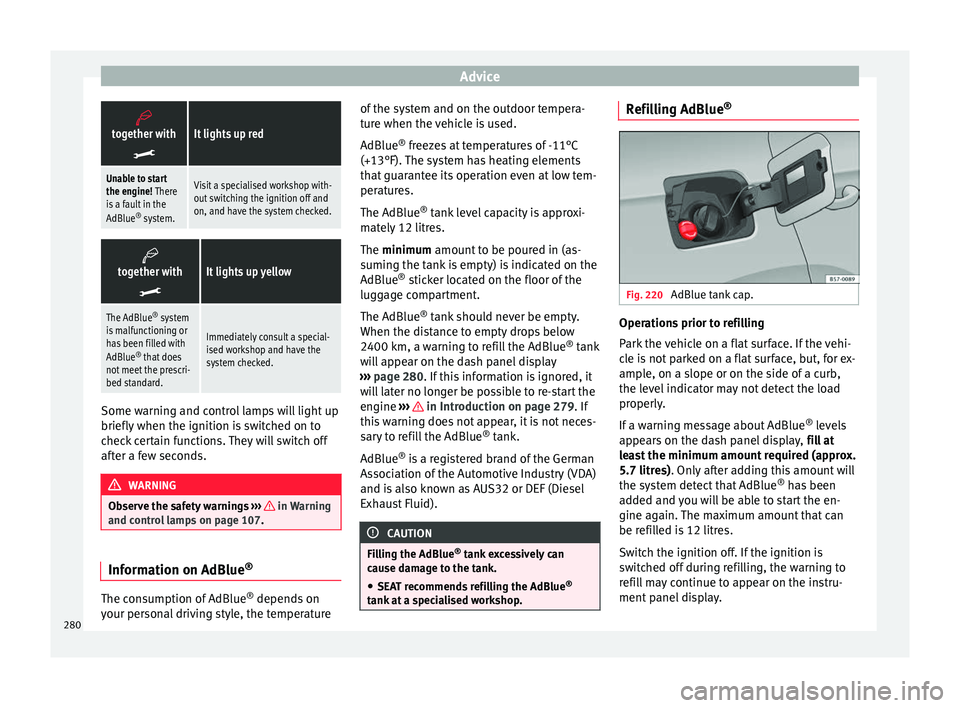
® Fig. 220
AdBlue tank cap. Operations prior to refilling
P
ark
the vehicle on a flat surface. If the vehi-
cle is not parked on a flat surface, but, for ex-
ample, on a slope or on the side of a curb,
the level indicator may not detect the load
properly.
If a warning message about AdBlue ®
levels
appears on the dash panel display, fill at
least the minimum amount required (approx.
5.7 litres). Only after adding this amount will
the system detect that AdBlue ®
has been
added and you will be able to start the en-
gine again. The maximum amount that can
be refilled is 12 litres.
Switch the ignition off. If the ignition is
switched off during refilling, the warning to
refill may continue to appear on the instru-
ment panel display.
280
Page 283 of 328
Checking and refilling levels
Opening the tank filling neck
● Open the fuel tank flap.
● Unscrew the tank cap by turning it in an an-
ti-c loc
kwise direction.
Fill with a refill bottle
Only use AdBlue ®
that complies with ISO
22241-1. Only use original containers.
● Please observe the manufacturer's instruc-
tions, indic
ated on the refill bottle.
● Check the expiry date.
● Remove the cap of the refill bottle.
● Insert the neck of the bottle in the tank fill-
er neck
vertically and screw the bottle on by
hand, by turning it in a clockwise direction.
● Press the refill bottle in the direction of the
fil
ler neck and hold it in this position.
● Wait until the contents of the refill bottle
hav
e been poured into the AdBlue ®
tank. Do
not compress or break the bottle!
● Turn the bottle in a counter-clockwise direc-
tion and gently
pull it upwards ››› .
● The AdBlue ®
tank
is full when no more liq-
uid comes out of the bottle.
Closing the tank filling neck
● Screw on the tank cap in a clockwise direc-
tion unti
l it is tightly closed.
● Close the fuel tank flap. Operations before driving
●
After refilling the tank, only
switch on the
ignition.
● Leave the ignition on for at least 30 sec-
onds
for the system to detect the fluid load.
● Make sure you wait for at least 30 seconds
befor
e starting the engine! WARNING
AdBlue ®
shou l
d only be stored in the original
container, which should be tightly closed and
kept in a safe place.
● Never keep AdBlue ®
in empty f
ood contain-
ers, bottles or other similar containers. Other
people may confuse it for other products.
● Keep AdBlue ®
out of
the reach of children. CAUTION
● On ly
use AdBlue ®
that complies with ISO
22241-1. Only use original containers.
● Never mix AdBlue ®
with w
ater, fuel or addi-
tives. Any type of damage caused by such a
mixture will not be covered by the warranty.
● Never pour AdBlue ®
into the f
uel tank. This
could result in engine damage.
● Do not carry the refill bottle inside the vehi-
cl
e. If there is a leak (due to temperature
changes or damage to the bottle), the
AdBlue ®
may damage the vehicle. For the sake of the environment
Dispose of the refill bottle in an environment-
friendly m
anner. Note
You can buy refill bottles that are adequate
f or AdBlue ®
u
se at SEAT dealerships. 281
Technical data
Advice
Operation
Emergencies
Safety
Page 284 of 328
Advice
Engine compartment Chec k
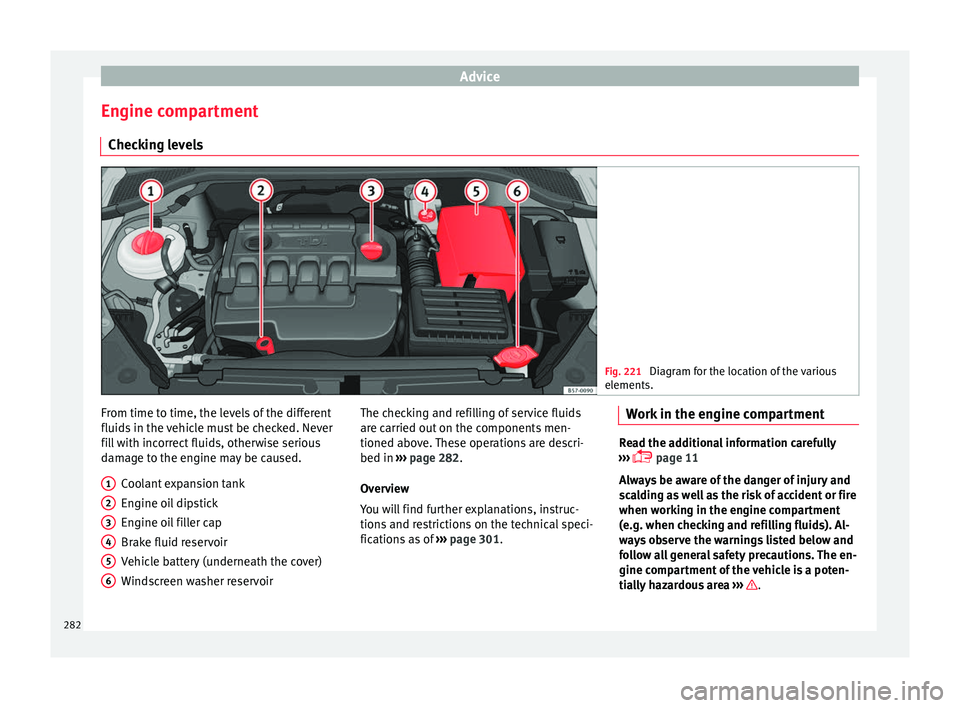
ing levels Fig. 221
Diagram for the location of the various
el ements. From time to time, the levels of the different
fluid
s
in the vehicle must be checked. Never
fill with incorrect fluids, otherwise serious
damage to the engine may be caused.
Coolant expansion tank
Engine oil dipstick
Engine oil filler cap
Brake fluid reservoir
Vehicle battery (underneath the cover)
Windscreen washer reservoir
1 2
3
4
5
6 The checking and refilling of service fluids
ar
e c
arried out on the components men-
tioned above. These operations are descri-
bed in ››› page 282.
Overview
You will find further explanations, instruc-
tions and restrictions on the technical speci-
fications as of ››› page 301. Work in the engine compartment Read the additional information carefully
› ›
› page 11
Always be aware of the danger of injury and
scalding as well as the risk of accident or fire
when working in the engine compartment
(e.g. when checking and refilling fluids). Al-
ways observe the warnings listed below and
follow all general safety precautions. The en-
gine compartment of the vehicle is a poten-
tially hazardous area ››› .
282