airbag Seat Ateca 2016 User Guide
[x] Cancel search | Manufacturer: SEAT, Model Year: 2016, Model line: Ateca, Model: Seat Ateca 2016Pages: 328, PDF Size: 6.32 MB
Page 65 of 328
Safe driving
● Belt
tensioners for the front seats
● Front airbags
● knee airbags,
● Side airbags in the front seat backrests
● Head-protection airbags
● “ISOFIX” anchor points for child seats in
the re
ar side seats with the “ISOFIX” system,
● Height-adjustable front head restraints
● Rear head restraints with in-use position
and non-use po
sition
● Adjustable steering column
The saf
ety equipment mentioned above
works together to provide you and your pas-
sengers with the best possible protection in
the event of an accident. However, these
safety systems can only be effective if you
and your passengers are sitting in a correct
position and use this equipment properly.
Safety is everyone's business! Correct position for passengers
Corr
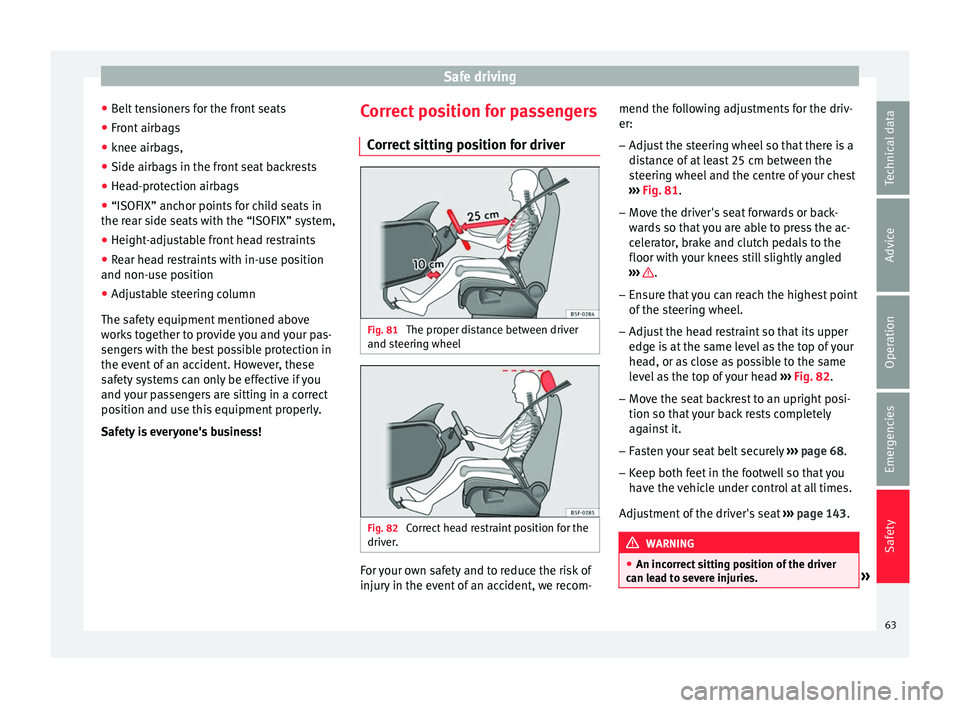
ect sitting position for driver Fig. 81
The proper distance between driver
and s t
eering wheel Fig. 82
Correct head restraint position for the
driv er
. For your own safety and to reduce the risk of
injur
y
in the event of an accident, we recom- mend the following adjustments for the driv-
er:
– Adjust the steering wheel so that there is a
dis
tance of at least 25 cm between the
steering wheel and the centre of your chest
››› Fig. 81.
– Move the driver's seat forwards or back-
war
ds so that you are able to press the ac-
celerator, brake and clutch pedals to the
floor with your knees still slightly angled
››› .
– Ensure that you can reach the highest point
of the s
teering wheel.
– Adjust the head restraint so that its upper
edge i
s at the same level as the top of your
head, or as close as possible to the same
level as the top of your head ››› Fig. 82.
– Move the seat backrest to an upright posi-
tion so that
your back rests completely
against it.
– Fasten your seat belt securely ››
› page 68.
– Keep both feet in the footwell so that you
hav
e the vehicle under control at all times.
Adjustment of the driver's seat ››› page 143. WARNING
● An inc orr
ect sitting position of the driver
can lead to severe injuries. » 63
Technical data
Advice
Operation
Emergencies
Safety
Page 66 of 328
Safety
●
Adju s
t the driver's seat so that there is at
least 25 cm distance between the centre of
the chest and the centre of the steering
wheel ››› Fig. 81. If you are sitting closer than
25 cm, the airbag system cannot protect you
properly.
● If your physical constitution prevents you
from m
aintaining the minimum distance of 25
cm, contact a specialised workshop. The
workshop will help you decide if special spe-
cific modifications are necessary.
● When driving, always hold the steering
wheel w
ith both hands on the outside of the
ring at the 9 o'clock and 3 o'clock positions.
This reduces the risk of injury when the driver
airbag is triggered.
● Never hold the steering wheel at the 12
o'cloc
k position, or in any other manner (e.g.
in the centre of the steering wheel). In such
cases, if the airbag is triggered, you may sus-
tain injuries to the arms, hands and head.
● To reduce the risk of injury to the driver
during s
udden braking manoeuvres or an ac-
cident, never drive with the backrest tilted far
back! The airbag system and seat belts can
only provide optimal protection when the
backrest is in an upright position and the
driver is wearing his or her seat belt correct-
ly.
● Adjust the head restraint properly to ach-
ieve optim
al protection. Adjusting the steering wheel position
Read the additional information carefully
› ›
› page 14. WARNING
● Nev er a
djust the position of the steering
wheel when the vehicle is moving, as this
could cause an accident.
● Move the lever up firmly so the steering
wheel po
sition does not accidentally change
during driving. risk of accident!
● Make sure you are capable of reaching and
firmly
holding the upper part of the steering
wheel: risk of accident!
● If you adjust the steering wheel so that it
points
towards your face, the driver airbag
will not protect you properly in the event of
an accident. Make sure that the steering
wheel points towards your chest. Correct sitting position for front pas-
sen
g
er For your own safety and to reduce the risk of
injur
y
in the event of an accident, we recom-
mend the following adjustments for the front
passenger:
– Move the front passenger seat back as far
as
possible ››› .–
Mo v
e the seat backrest to an upright posi-
tion so that your back rests completely
against it.
– Adjust the head restraint so that its upper
edge i
s at the same level as the top of your
head, or as close as possible to the same
level as the top of your head ››› page 66.
– Always keep both feet in the footwell in
front
of the front passenger seat.
– Fasten your seat belt securely ››
› page 68.
It is possible to deactivate the front passen-
ger airbag in exceptional circumstances
››› page 77.
Adjusting the front passenger seat
››› page 143. WARNING
● An inc orr
ect sitting position of the front
passenger can lead to severe injuries.
● Adjust the front passenger seat so that
there i
s at least 25 cm between your chest
and the dash panel. If you are sitting closer
than 25 cm, the airbag system cannot protect
you properly.
● If your physical constitution prevents you
from m
aintaining the minimum distance of 25
cm, contact a specialised workshop. The
workshop will help you decide if special spe-
cific modifications are necessary. 64
Page 67 of 328
Safe driving
●
Alw
ays keep your feet in the footwell when
the vehicle is moving; never rest them on the
dash panel, out the window or on the seat. An
incorrect sitting position exposes you to an
increased risk of injury in case of a sudden
braking or an accident. If the airbag is trig-
gered, you could sustain severe injuries due
to an incorrect sitting position.
● To reduce the risk of injury to the front pas-
seng
er in events such as sudden braking ma-
noeuvres or an accident, never travel with the
backrest tilted far back! The airbag system
and seat belts can only provide optimal pro-
tection when the backrest is in an upright po-
sition and the front passenger is wearing his
or her seat belt properly. The further the seat
backrests are tilted to the rear, the greater
the risk of injury due to incorrect positioning
of the belt web or to the incorrect sitting po-
sition!
● Adjust the head restraint correctly in order
to ac
hieve maximum protection. Correct sitting position for rear seat
p
a
ssengers To reduce the risk of injury in the event of a
s
ud
den braking manoeuvre or an accident,
passengers on the rear seat bench must con-
sider the following:
– Sit up straight.
– Adjust the head restraint to the correct po-
sition ›
›› page 66. –
Alw
ays keep both feet in the footwell in
front of the rear seat.
– Fasten your seat belt securely ››
› page 68.
– Use an appropriate child restraint system
when y
ou take children in the vehicle
››› page 79. WARNING
● If the p
assengers in the rear seats are not
sitting properly, they could sustain severe in-
juries.
● Adjust the head restraint correctly in order
to ac
hieve maximum protection.
● Seat belts can only provide optimal protec-
tion when seat
backrests are in an upright
position and the vehicle occupants are wear-
ing their seat belts correctly. If passengers In
the rear seats are not sitting in an upright po-
sition, the risk of injury due to incorrect posi-
tioning of the seat belt increases. Examples of incorrect sitting posi-
tion
s Seat belts can provide optimal protection on-
ly
when the belt
webs are properly posi-
tioned. Incorrect sitting positions substan-
tially reduce the protective function of seat
belts and increase the risk of injury due to in-
correct seat belt position. As the driver, you
are responsible for all passengers, especially
children. –
Never al
low anyone to assume an incorrect
sitting position in the vehicle while travel-
ling ››› .
The f o
llowing list contains examples of sit-
ting positions that could be dangerous for all
vehicle occupants. The list is not complete,
but we would like to make you aware of this
issue.
Therefore, whenever the vehicle is in motion:
● Never stand in the vehicle.
● Never stand on the seats.
● Never kneel on the seats.
● Never tilt your seat backrest far to the rear.
● Never lean against the dash panel.
● Never lie on the rear bench.
● Never sit on the front edge of a seat.
● Never sit sideways.
● Never lean out of a window.
● Never put your feet out of a window.
● Never put your feet on the dash panel.
● Never put your feet on the surface of a seat.
● Do not allow anyone to travel in the foot-
wel
l.
● Never travel without wearing the seat belt.
● Do not allow anyone to travel in the lug-
gag
e compartment. »
65
Technical data
Advice
Operation
Emergencies
Safety
Page 68 of 328
Safety
WARNING
● An y
incorrect sitting position increases the
risk of severe injuries. Sitting in an incorrect
position exposes the vehicle occupants to se-
vere injuries if airbags are triggered, by strik-
ing a vehicle occupant who has assumed an
incorrect sitting position.
● Before the vehicle moves, assume the prop-
er sittin
g position and maintain it throughout
the trip. Before every trip, instruct your pas-
sengers to sit properly and to stay in this po-
sition during the trip ››› page 63, Correct posi-
tion for passengers. Correct adjustment of front head re-
s
tr
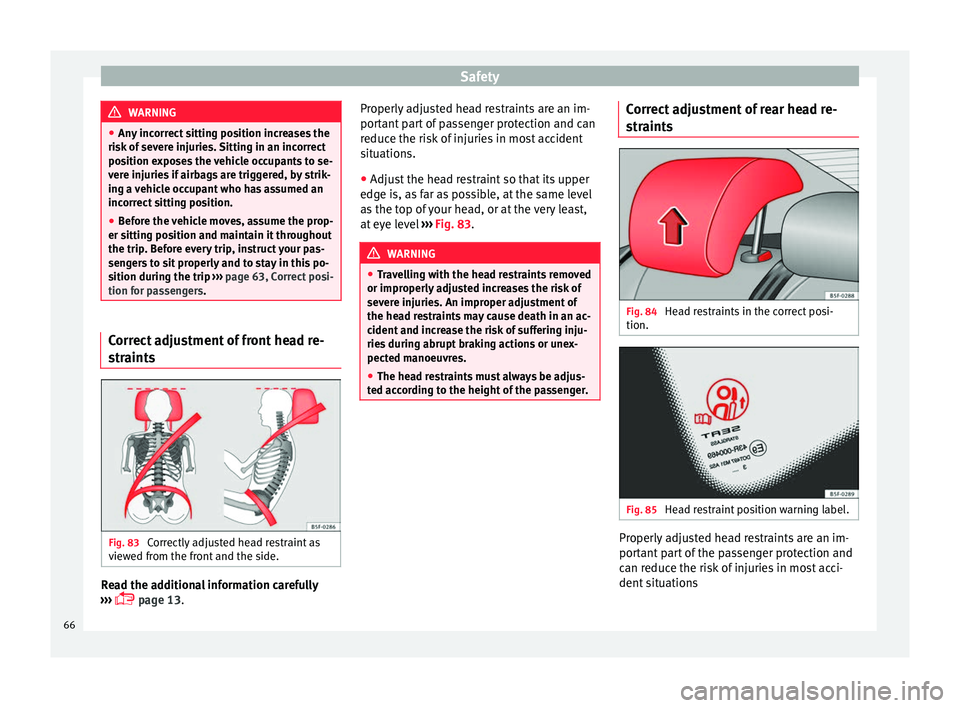
aints Fig. 83
Correctly adjusted head restraint as
v iew
ed from the front and the side. Read the additional information carefully
› ›
› page 13. Properly adjusted head restraints are an im-
port
ant part of passenger protection and can
reduce the risk of injuries in most accident
situations.
● Adjust the head restraint so that its upper
edge i
s, as far as possible, at the same level
as the top of your head, or at the very least,
at eye level ››› Fig. 83. WARNING
● Tr
avelling with the head restraints removed
or improperly adjusted increases the risk of
severe injuries. An improper adjustment of
the head restraints may cause death in an ac-
cident and increase the risk of suffering inju-
ries during abrupt braking actions or unex-
pected manoeuvres.
● The head restraints must always be adjus-
ted ac
cording to the height of the passenger. Correct adjustment of rear head re-
s
tr
aints Fig. 84
Head restraints in the correct posi-
tion. Fig. 85
Head restraint position warning label. Properly adjusted head restraints are an im-
por
t
ant part of the passenger protection and
can reduce the risk of injuries in most acci-
dent situations
66
Page 71 of 328
Seat belts
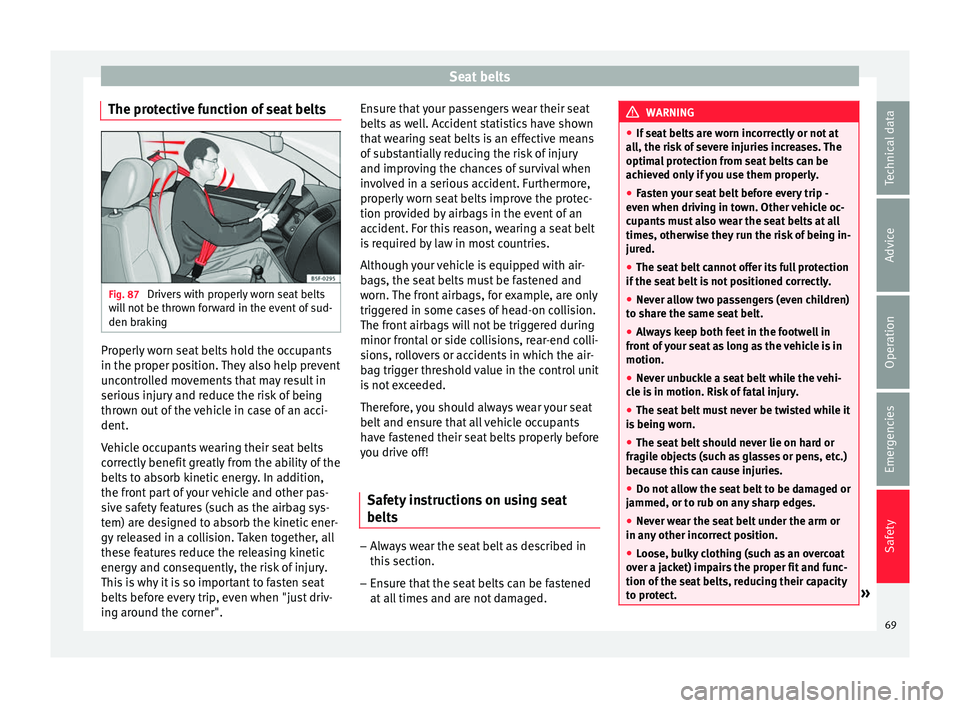
The protective function of seat belts Fig. 87
Drivers with properly worn seat belts
w i
ll not be thrown forward in the event of sud-
den braking Properly worn seat belts hold the occupants
in the pr
oper po
sition. They also help prevent
uncontrolled movements that may result in
serious injury and reduce the risk of being
thrown out of the vehicle in case of an acci-
dent.
Vehicle occupants wearing their seat belts
correctly benefit greatly from the ability of the
belts to absorb kinetic energy. In addition,
the front part of your vehicle and other pas-
sive safety features (such as the airbag sys-
tem) are designed to absorb the kinetic ener-
gy released in a collision. Taken together, all
these features reduce the releasing kinetic
energy and consequently, the risk of injury.
This is why it is so important to fasten seat
belts before every trip, even when "just driv-
ing around the corner". Ensure that your passengers wear their seat
belts a
s well. Accident statistics have shown
that wearing seat belts is an effective means
of substantially reducing the risk of injury
and improving the chances of survival when
involved in a serious accident. Furthermore,
properly worn seat belts improve the protec-
tion provided by airbags in the event of an
accident. For this reason, wearing a seat belt
is required by law in most countries.
Although your vehicle is equipped with air-
bags, the seat belts must be fastened and
worn. The front airbags, for example, are only
triggered in some cases of head-on collision.
The front airbags will not be triggered during
minor frontal or side collisions, rear-end colli-
sions, rollovers or accidents in which the air-
bag trigger threshold value in the control unit
is not exceeded.
Therefore, you should always wear your seat
belt and ensure that all vehicle occupants
have fastened their seat belts properly before
you drive off!
Safety instructions on using seat
belts –
Always wear the seat belt as described in
thi s
section.
– Ensure that the seat belts can be fastened
at al
l times and are not damaged. WARNING
● If se
at belts are worn incorrectly or not at
all, the risk of severe injuries increases. The
optimal protection from seat belts can be
achieved only if you use them properly.
● Fasten your seat belt before every trip -
even when driv
ing in town. Other vehicle oc-
cupants must also wear the seat belts at all
times, otherwise they run the risk of being in-
jured.
● The seat belt cannot offer its full protection
if the se
at belt is not positioned correctly.
● Never allow two passengers (even children)
to sh
are the same seat belt.
● Always keep both feet in the footwell in
front
of your seat as long as the vehicle is in
motion.
● Never unbuckle a seat belt while the vehi-
cl
e is in motion. Risk of fatal injury.
● The seat belt must never be twisted while it
is
being worn.
● The seat belt should never lie on hard or
fragi
le objects (such as glasses or pens, etc.)
because this can cause injuries.
● Do not allow the seat belt to be damaged or
jammed, or t
o rub on any sharp edges.
● Never wear the seat belt under the arm or
in any
other incorrect position.
● Loose, bulky clothing (such as an overcoat
ov
er a jacket) impairs the proper fit and func-
tion of the seat belts, reducing their capacity
to protect. » 69
Technical data
Advice
Operation
Emergencies
Safety
Page 75 of 328
Airbag system
WARNING
● Impr oper u
se or repairs not carried out by
qualified mechanics increase the risk of se-
vere or fatal injuries. The belt tensioners may
fail to trigger or may trigger in the wrong cir-
cumstances.
● Never attempt to repair, adjust, remove or
ins
tall parts of the belt tensioners or seat
belts.
● The seat belt tensioner, seat belt and auto-
matic
retractor cannot be repaired.
● Any work on the belt tensioners and seat
belts, inc
luding the removal and refitting of
system parts in conjunction with other repair
work, must be performed by a specialised
workshop only.
● The belt tensioners will only provide pro-
tection f
or one accident and must be changed
if they have been activated. Airbag system
Brief intr
oduction
Why is it so important to wear a seat
belt and to sit correctly? For the inflating airbags to achieve the best
pr
ot
ection, the seat belt must always be worn
properly and the correct sitting position must
be assumed.
The airbag system is not a substitute for seat
belts, but it is an integral part of the vehicle's
overall passive safety system. Please bear in
mind that the airbag system can only work ef-
fectively when the vehicle occupants are
wearing their seat belts correctly and have
adjusted the head restraints properly. There-
fore, it is most important to properly wear the
seat belts at all times, not only because this
is required by law in most countries, but also
for your safety ›››
page 68, Why wear a seat
belt?.
The airbag inflates in a matter of seconds, so
if you are not properly seated when the air-
bag is triggered, you may sustain fatal inju-
ries. Therefore, it is essential that all vehicle
occupants assume a correct sitting position
while travelling.
Sharp braking before an accident may cause
a passenger not wearing a seat belt to be
thrown forward into the area of the deploying airbag. In this case, the inflating airbag may
inflict
c
ritical or fatal injuries on the occu-
pant. This also applies to children.
Always maintain the greatest possible dis-
tance between yourself and the front airbag.
This way, the front airbags can completely
deploy when triggered, providing their maxi-
mum protection.
The most important factors that will trigger
an airbag are: the type of accident, the angle
of collision and the speed of the vehicle.
Whether or not the airbags are triggered de-
pends primarily on the vehicle deceleration
rate resulting from the collision and detected
by the control unit. If the vehicle deceleration
occurring during the collision and measured
by the control unit remains below the speci-
fied reference values, the front, side and/or
curtain airbags will not be triggered. Take in-
to account that the visible damage in a vehi-
cle involved in an accident, no matter how
serious, is not a determining factor for the
airbags to have been triggered. WARNING
● We
aring the seat belt incorrectly or assum-
ing an incorrect sitting position can lead to
critical or fatal injuries.
● All vehicle occupants, including children,
who are not
properly belted can sustain criti-
cal or fatal injuries if the airbag is triggered.
Children up to 12 years old should always » 73
Technical data
Advice
Operation
Emergencies
Safety
Page 76 of 328
Safety
travel on the rear seat. Never transport
c
hi
ldren in the vehicle if they are not restrain-
ed or the restraint system is not appropriate
for their age, size or weight.
● If you are not wearing a seat belt, or if you
le
an forward or to the side while travelling or
assume an incorrect sitting position, there is
a substantially increased risk of injury. This
increased risk of injury will be further in-
creased if you are struck by an inflating air-
bag.
● To reduce the risk of injury from an inflating
airbag, a
lways wear the seat belt properly
››› page 68.
● Always adjust the front seats properly. Description of the airbag system
Read the additional information carefully
› ›
› page 15.
The airbag system is not a substitute for the
seat belts. The airbag system offers addition-
al protection for the driver and passenger in
combination with the seat belts.
The airbag system comprises the following
modules (as per vehicle equipment):
● Electronic control unit
● Front airbags for driver and passenger
● Knee airbag for the driver
● Side airbags ●
Hea
d airbag
● Airbag control lamp on the ins
trument
panel
● Key-operated switch for front passenger air-
bag
● C
ontrol lamp to disconnect/connect the
front
airbag.
The airbag system operation is monitored
electronically. The airbag control lamp will il-
luminate for a few seconds every time the ig-
nition is switched on (self-diagnosis).
There is a fault in the system if the control
lamp :
● does not light up when the ignition is
swit
ched on,
● turns off after 4 seconds after the ignition
is
switched on
● turns off and then lights up again after the
ignition is
switched on
● illuminates or flashes while the vehicle is
mov
ing.
The airbag system is not triggered if:
● the ignition is switched off
● there is a minor frontal collision
● there is a minor side collision
● there is a rear-end collision
● the vehicle turns over. WARNING
● The se at
belts and airbags can only provide
maximum protection if the occupants are
seated correctly ››› page 63, Correct position
for passengers.
● If a fault has occurred in the airbag system,
hav
e the system checked immediately by a
specialised workshop. Otherwise there is a
danger that during a collision, the system
may fail to trigger, or not trigger correctly. Airbag activation
The airbags deploy extremely rapidly, within
thou
s
andths of a second, to provide addi-
tional protection in the event of an accident.
A fine dust may develop when the airbag de-
ploys. This is normal and it is not an indica-
tion of fire in the vehicle.
The airbag system is only ready to function
when the ignition is on.
In special accidents instances, several air-
bags may activate at the same time.
In the event of minor head-on and side colli-
sions, rear-end collisions, overturning or roll-
over of the vehicle, airbags do not activate.
Activation factors
The conditions that lead to the airbag system
activating in each situation cannot be gener-
alised. Some factors play an important role,
74
Page 77 of 328
Airbag system
such as the properties of the object the vehi-
c l
e hits (hard/soft), angle of impact, vehicle
speed, etc.
Deceleration trajectory is key for airbag acti-
vation.
The control unit analyses the collision trajec-
tory and activates the respective restraint
system.
If the deceleration rate is below the prede-
fined reference value in the control unit the
airbags will not be triggered, even though
the accident may cause extensive damage to
the car.
The following airbags are triggered in seri-
ous head-on collisions
● Driver airbag.
● Front passenger front airbag
● Knee airbag for the driver.
The fo
llowing airbags are triggered in seri-
ous side-on collisions
● Front side airbag on the side of the acci-
dent.
● R
ear side airbag on the side of the acci-
dent.
● C
urtain (head) airbag on the side of the ac-
cident
. In an accident with airbag activation:
●
the interior lights switch on (if the interior
light sw
itch is in the courtesy light position);
● the hazard warning lights switch on;
● all doors are unlocked;
● the fuel supply to the engine is cut.
Airbag safety instructions Front
airbags Read the additional information carefully
› ›
› page 15. WARNING
● The dep lo
yment space between the front
passengers and the airbags must not in any
case be occupied by other passenger, pets
and objects.
● The airbags provide protection for just one
acc
ident; replace them once they have de-
ployed.
● It is also important not to attach any ob-
ject
s such as cup holders or telephone
mountings to the surfaces covering the air-
bag units.
● Do not attempt to modify components of
the airbag sy
stem in any way. Knee airbag*
Read the additional information carefully
› ›
› page 16. WARNING
● The knee airb ag i
s deployed in front of the
driver's knees. Always keep the deployment
areas of the knee airbags free.
● Never not fix objects to the cover or in the
deplo
yment area of the knee airbag.
● Adjust the driver's seat so that there is a
dis
tance of at least 10 cm (4 inches) between
your knees and the location of the this air-
bag. If your physical constitution prevents
you from meeting these requirements, make
sure you contact a specialised workshop. Side airbags*
Read the additional information carefully
› ›
› page 16. WARNING
● If
you do not wear a seat belt, if you lean
forward, or are not seated correctly while the
vehicle is in motion, you are at a greater risk
of injury if the side airbag system is triggered
in an accident.
● In order for the side airbags to provide their
max
imum protection, the prescribed sitting » 75
Technical data
Advice
Operation
Emergencies
Safety
Page 78 of 328
Safety
position must always be maintained with
se
at
belts fastened while travelling.
● In a side-on collision the side airbags will
not w
ork if the sensors do not correctly meas-
ure the pressure increase on the interior of
the doors, due to air escaping through the
areas with holes or openings in the door pan-
el.
● Never drive if the interior door panels have
been remo
ved or if the panels have not been
correctly fitted.
● Never drive the vehicle if the loudspeakers
in the door panel
s have been removed, un-
less the holes left by the loudspeakers have
been closed properly.
● Always check that the openings are closed
or co
vered if loudspeakers or other equip-
ment are fitted inside the door panels.
● Occupants of the outer seats must never
carr
y any objects or pets in the deployment
space between them and the airbags, or al-
low children or other passengers to travel in
this position. It is also important not to at-
tach any accessories (such as cup holders) to
the doors. This would impair the protection
offered by the side airbags.
● The built-in coat hooks should be used only
for lightw
eight clothing. Do not leave any
heavy or sharp-edged objects in the pockets.
● Great forces, such as hard blows or kicks,
mus
t not be exerted upon the backrest bol-
ster because the system may be damaged. In
this case, the side airbags would not be trig-
gered. ●
Under no c ir
cumstances should protective
covers be fitted over seats with side airbags
unless the covers have been approved for use
in your vehicle. Because the airbag deploys
from the side of the backrest, the use of con-
ventional seat covers would obstruct the side
airbag, seriously reducing the airbag's effec-
tiveness.
● Any damage to the original seat upholstery
or arou
nd the seams of the side airbag units
must be repaired immediately by a special-
ised workshop.
● The airbags provide protection for just one
acc
ident; replace them once they have de-
ployed.
● Any work on the side airbag system or re-
mov
al and installation of the airbag compo-
nents for other repairs (such as removal of
the front seat) should only be performed by a
specialised workshop. Otherwise, faults may
occur during the airbag system operation.
● Do not attempt to modify components of
the airbag sy
stem in any way. Curtain airbags*
Read the additional information carefully
› ›
› page 17. WARNING
● In or der f
or the head-protection airbags to
provide their maximum protection, the pre- scribed sitting position must always be main-
t
ained w
ith seat belts fastened while travel-
ling.
● For safety reasons, the curtain airbag must
be dis
abled in those vehicles fitted with a
screen dividing the interior of the vehicle.
See your technical service to make this ad-
justment.
● There must be no other persons, animals or
ob
jects between the occupants of the outer
seats and the deployment space of the head-
protection airbags so that the head-protec-
tion airbag can deploy completely without re-
striction and provide the greatest possible
protection. Therefore, sun blinds which have
not been expressly approved for use in your
vehicle may not be attached to the side win-
dows
● The built-in coat hooks should be used only
for lightw
eight clothing. Do not leave any
heavy or sharp-edged objects in the pockets.
Please, do not hang the clothes on coat hang-
ers.
● The airbags provide protection for just one
acc
ident; replace them once they have de-
ployed.
● Any work on the head-protection airbag
sys
tem or removal and installation of the air-
bag components for other repairs (such as re-
moval of the roof lining) should only be per-
formed by a specialised workshop. Other-
wise, faults may occur during the airbag sys-
tem operation.
● Do not attempt to modify components of
the airbag sy
stem in any way.76
Page 79 of 328
Airbag system
●
The s ide and he
ad airbags are managed
through sensors located in the interior of the
front doors. To ensure the correct operation of
the side and curtain airbags neither the
doors nor the door panels should be modified
in any way (e.g. fitting loudspeakers). If the
front door is damaged, the airbag system
may not work correctly. All work carried out
on the front door must be done in a special-
ised workshop. Deactivating airbags
D e
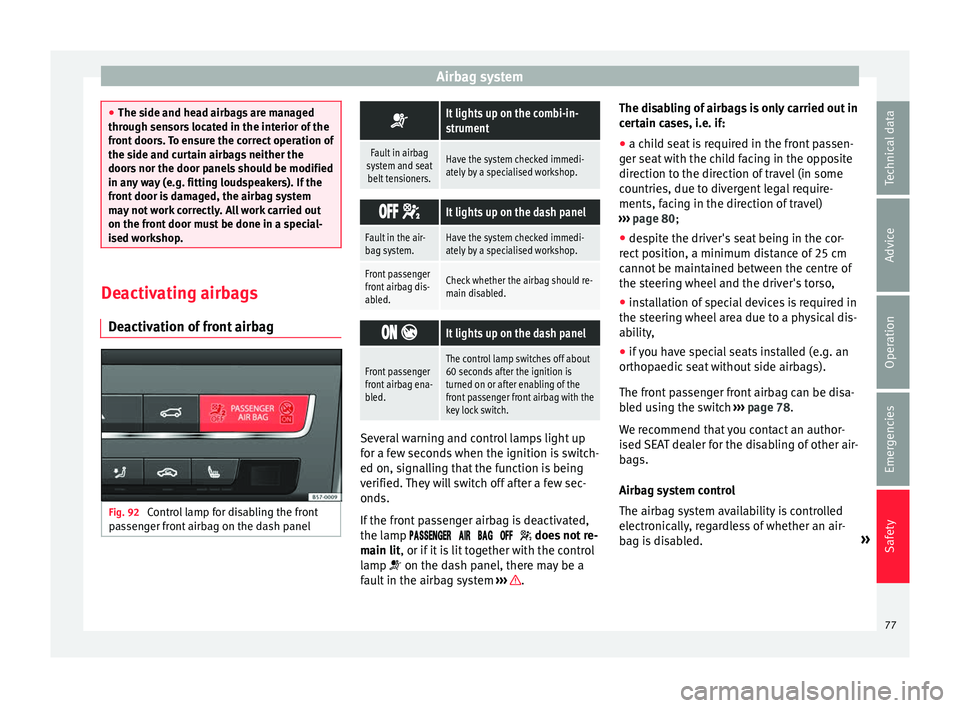
activation of front airbag Fig. 92
Control lamp for disabling the front
p a
ssenger front airbag on the dash panel
It lights up on the combi-in-
strument
Fault in airbag
system and seat belt tensioners.Have the system checked immedi-
ately by a specialised workshop.
It lights up on the dash panel
Fault in the air-
bag system.Have the system checked immedi-
ately by a specialised workshop.
Front passenger
front airbag dis-
abled.Check whether the airbag should re-
main disabled.
It lights up on the dash panel
Front passenger
front airbag ena-
bled.The control lamp switches off about
60 seconds after the ignition is
turned on or after enabling of the
front passenger front airbag with the
key lock switch. Several warning and control lamps light up
f
or a f
ew seconds when the ignition is switch-
ed on, signalling that the function is being
verified. They will switch off after a few sec-
onds.
If the front passenger airbag is deactivated,
the lamp does not re-
main lit, or if it is lit together with the control
lamp on the dash panel, there may be a
fault in the airbag system ››› .The disabling of airbags is only carried out in
c
er
tain cases, i.e. if:
● a child seat is required in the front passen-
ger se
at with the child facing in the opposite
direction to the direction of travel (in some
countries, due to divergent legal require-
ments, facing in the direction of travel)
››› page 80;
● despite the driver's seat being in the cor-
rect
position, a minimum distance of 25 cm
cannot be maintained between the centre of
the steering wheel and the driver's torso,
● installation of special devices is required in
the st
eering wheel area due to a physical dis-
ability,
● if you have special seats installed (e.g. an
orthop
aedic seat without side airbags).
The front passenger front airbag can be disa-
bled using the switch ››› page 78.
We recommend that you contact an author-
ised SEAT dealer for the disabling of other air-
bags.
Airbag system control
The airbag system availability is controlled
electronically, regardless of whether an air-
bag is disabled. »
77
Technical data
Advice
Operation
Emergencies
Safety