change wheel Seat Ateca 2016 Owner's Guide
[x] Cancel search | Manufacturer: SEAT, Model Year: 2016, Model line: Ateca, Model: Seat Ateca 2016Pages: 328, PDF Size: 6.32 MB
Page 293 of 328
Wheels
CAUTION
● Some v
ehicles, for example those with the
Start-Stop system* are fitted with a special
battery (AGM-type or EFB-type battery). If any
other type of battery is fitted, the Start-Stop
function may be considerably reduced and
the vehicle may not stop on repeated occa-
sions.
● Make sure that the vent hose is always at-
tac
hed to the original opening on the side of
the battery. Gases or battery acid can other-
wise escape and possibly cause damage.
● The battery holder and clamps must always
be corr
ectly secured.
● Before starting any work on the battery, al-
wa
ys observe the warnings listed under
››› page 289, Important safety warnings for
handling a vehicle battery .
● Do not forget to replace the battery cover-
ing
s, where applicable. It is a protection for
high temperatures. This in turn extends the
vehicle service life. For the sake of the environment
B atteries contain toxic substances includ-
in
g sulphuric acid and lead. They must be
disposed of appropriately and must not be
disposed of with ordinary household waste.
Make sure disconnected batteries cannot tip
over. Sulphuric acid could be spilt! Wheels
Wheel s
and tyres
General notes –
When driving with new ty r
es, be especially
careful during the first 500 km (300 miles).
– If you have to drive over a kerb or similar
ob
stacle, drive very slowly and as near as
possible at a right angle to the obstacle.
– Check from time to time if the tyres are
dam
aged (punctures, cuts, cracks or
dents). Remove any foreign objects embed-
ded in the treads.
– Damaged wheels and tyres must be re-
pl
aced immediately.
– Keep grease, oil and fuel off the tyres.
– Replace any missing valve caps as soon as
pos
sible.
– Mark the wheels before taking them off so
that
they rotate in the same direction when
put back.
– When removed, the wheels or tyres should
be st
ored in a cool, dry and preferably dark
place.
New tyres
New tyres do not give maximum grip straight
away and should therefore be “run in” by driving carefully and at moderate speeds for
about the fir
st 500 km (300 miles). This will
also increase the useful life of the tyres.
The tread depth of new tyres may vary, ac-
cording to the type and make of tyre and the
tread pattern.
Concealed damage
Damage to tyres and rims is often not readily
visible. If you notice unusual vibration or the
car pulling to one side, this may indicate that
one of the tyres is damaged. Reduce speed
immediately if there is any reason to suspect
that damage may have occurred. Inspect the
tyres for damage. If no external damage is
visible, drive slowly and carefully to the near-
est specialised workshop and have the car
inspected.
Tyres with directional tread pattern
An arrow on the tyre sidewall indicates the di-
rection of rotation on single drive tyres. Al-
ways note the direction of rotation indicated
when mounting the wheel. This guarantees
optimum grip and helps to avoid aquaplan-
ing, excessive noise and wear.
Retrofitting accessories
If you wish to change or fit wheels, rims or
wheel trims, we recommend that you consult
with a SEAT Official Service centre for advice
regarding current techniques.
291
Technical data
Advice
Operation
Emergencies
Safety
Page 295 of 328
Wheels
WARNING
● Alw
ays adapt the tyre pressure accordingly
when the vehicle load changes.
● A tyre with low air pressure has to flex a lot
more when the
vehicle is heavily loaded or at
high speeds, therefore causing overheating
to occur. Under these conditions, the tyre
bead may be released or the tyre may burst.
Risk of accident! For the sake of the environment
Under-inflated tyres will increase fuel con-
s umption. Wear indicators
Fig. 225
Tyre tread: tread wear indicators Tread wear indicators indicate if a tyre is
w
orn. The origin
al tyres on your vehicle have
1.6 mm high “tre
ad wear indicators” running
across the tread. Depending on the manufac-
turer, there will be 6 to 8 of them spaced at
equal distances around the tyre. Markings on
the tyre sidewall (for instance the letters
“TWI” or a triangle) indicate the positions of
the tread wear indicators.
The minimum tread depth required by law is
1.6 mm (measured in the tread grooves next
to the tread wear indicators). (Different fig-
ures may apply in other countries.) WARNING
The tyres must be replaced at the latest when
the tr e
ad is worn down to the tread wear indi-
cators. Failure to follow this instruction could
result in an accident.
● Especially in difficult driving conditions
suc
h as wet or icy roads. It is important that
the tyre tread be as deep as possible and be
approximately the same on the tyres of both
the front and the rear axles.
● The scant driving safety due to insufficient
tre
ad depth is particularly evident in vehicle
handling, when there is a risk of “aquaplan-
ing” in deep puddles of water and when driv-
ing through corners, and braking is also ad-
versely affected.
● The speed has to be adapted accordingly,
otherw
ise there is a risk of losing control over
the vehicle. Changing wheels
Fig. 226
Interchanging tyres. To ensure that the wear is equal on all tyres
the wheel
s
should be changed round from
time to time according to the system
››› Fig. 226. The useful life of all the tyres will
then be about the same time.
New tyres or new wheels –
All four wheels must be fitted with tyres of
the s ame type, s
ize (rolling circumference)
and preferably the same tread pattern.
– Tyres should be replaced at least in pairs
and not indiv
idually (i.e. both front tyres or
both rear tyres together).
– Do not use tyres whose effective size ex-
ceed
s the dimensions of the factory-ap-
proved makes of tyre. »
293
Technical data
Advice
Operation
Emergencies
Safety
Page 297 of 328
Wheels
●
Av
oid running the vehicle on tyres that are
more than 6 years old. If you have no alterna-
tive, you should drive slowly and with extra
care at all times.
● If wheel trims are fitted after the car is pur-
ch
ased, ensure that there is an adequate flow
of air for cooling the brake system. For the sake of the environment
Old tyres must be disposed of according to
the l a
ws in the country concerned. Note
● A S
EAT Service Centre should be consulted
to find out whether wheels or tyres of differ-
ent sizes to those originally fitted by SEAT
can be fitted, and to find out about the com-
binations allowed between the front axle
(axle 1) and the rear axle (axle 2).
● Never mount used tyres if you are not sure
of their
“previous history”.
● For technical reasons, it is not generally
pos
sible to use the wheels from other vehi-
cles. In some cases, this may also be true for
the same model of wheel. Wheel bolts
The wheel
bolts
ar
e matched to the rims.
When installing different wheels (for instance
alloy wheels or wheels with winter tyres) it is
important to use the correct wheel bolts with the right length and correctly shaped bolt
hea
ds. This ensures that wheels are fitted se-
curely and that the brake system functions
correctly.
The wheel bolts must be clean and turn easi-
ly.
A special adapter is required to turn the anti-
theft wheel bolts* ›››
page 54.
Tyre monitoring systems Introduction WARNING
Unsuitable handling of the wheels and tyres
m a
y lead to sudden tyre pressure losses, to
tread separation or even to a blow-out.
● Check tyre pressures regularly and ensure
they ar
e maintained at the pressures indica-
ted. Tyre pressure that is too low could cause
overheating, resulting in tread detachment or
even burst tyres.
● Tyre pressure should be that indicated on
the label
when the tyres are cold at all times
››› page 303.
● Regularly check the cold inflation pressure
of the ty
res. If necessary, change the tyre
pressure of the vehicle tyres while they are
cold. ●
Re
gularly check your tyres for damage and
wear.
● Never exceed the maximum permitted
speed or lo
ads specified for the type of tyre
fitted on your vehicle. For the sake of the environment
Under-inflated tyres lead to increased fuel
c on
sumption and tyre wear. Note
● Driv in
g for the first time with new tyres at a
high speed can cause them to slightly ex-
pand, which could then produce an air pres-
sure warning.
● Only replace used tyres with those author-
ised b
y SEAT for the corresponding type vehi-
cle.
● Do not only rely on the tyre monitoring sys-
tem. R
egularly check your tyres to ensure
that the tyre pressure is correct and that the
tyres are not damaged due to puncture, cuts,
tears and impacts/dents. Remove objects
from the tyres only when they have not
pierced the tyres. 295
Technical data
Advice
Operation
Emergencies
Safety
Page 299 of 328
Wheels
Tyre monitoring indicator Fig. 227
Instrument panel: warning of loss of
ty r
e pressure. The tyre monitor indicator compares wheel
r
ev
olutions and, with this information, the
tread of each wheel using the ABS sensors. If
the rolling circumference of one or more
wheels has changed, the tyre monitoring in-
dicator will indicate this on the instrument
panel through a warning lamp and a warning
to the driver ››› Fig. 227. When only one spe-
cific tyre is affected, its position within the
vehicle will be indicated.
Loss of pressure: Check left
tyre pressure! Wheel tread change
The wheel tr
ead changes when:
● Tyre pressure is manually changed
● Tyre pressure is insufficient
● Tyre structure is damaged
● The vehicle is unbalanced because of a
loa
d
● The wheels on an axle are subject to a
heav
ier load (e.g. with a heavy load).
● The vehicle is fitted with snow chains
● The temporary spare wheel is fitted
● The wheel on one axle is changed
There m
ay be a delay in the reaction of the
tyre monitoring indicator or it may not in-
dicate anything under certain circumstances
(e.g. sporty driving, snow-covered or un-
paved roads, or when driving with snow
chains).
Calibrating the tyre monitoring indica-
tor After changing the tyre pressure or replacing
one or mor
e wheel
s, the tyre monitoring indi- cator must be recalibrated. Do the same, for
ex
ample, when the front and rear wheels are
swapped.
● Switch the ignition on.
● Save the new tyre pressure in the Easy Con-
nect sy
stem1)
by using the button and the
Set up function button
››
›
page 26.
When driving, the system self-calibrates the
tyre pressure provided by the driver and the
wheels fitted. After a long journey with varied
speeds the programmed values are collected
and monitored.
With the wheels under very heavy loads, the
tyre pressure must be increased to the total
recommended tyre pressure before the cali-
bration ››› page 303. Note
● The ty r
e monitoring indicator does not
function when there is a fault in the ESC or
ABS ››› page 173.
● An erroneous indication may be given when
sno
w chains are in use because they increase
the tread of the wheel. 1)
In vehicles that are not equipped with the Easy
C onnect
system, the switch for adjusting tyre pres-
sure is located in the centre console next to the haz-
ard warning lights. 297
Technical data
Advice
Operation
Emergencies
Safety
Page 304 of 328
Technical data
Vehicle data sticker
The v
ehicle data sticker is under the carpet
trim in the luggage compartment, in the
spare wheel well. A sticker with the vehicle
data is attached to the inside cover of the
Maintenance Programme.
The following information is provided on the
vehicle data sticker: ››› Fig. 230
Vehicle identification number (chassis
number)
Vehicle type, model, capacity, engine
type, finish, engine power and gearbox
type
Engine code, gearbox code, external
paint code and internal equipment code
Optional extras and PR numbers
Identifying letters
The identifying letters of the engine can be
viewed on the instrument panel when the en-
gine is switched off and the ignition is on.
● Hold down the 0.0/SET
4
› ›
›
Fig. 115 but-
ton for more than 15 seconds. 1 2
3
4 Information on fuel consump-
tion
Fuel
consumption Approved consumption values are derived
fr
om me
asurements performed or supervised
by certified EU laboratories, according to the
legislation in force at the time (for more infor-
mation, see the Publications Office of the Eu-
ropean Union on the EUR-Lex website: © Eu-
ropean Union, http://eur-lex.europa.eu/) and
apply to the specified vehicle characteristics.
The values relating to fuel consumption and
CO 2 emissions can be found in the documen-
tation provided to the purchaser of the vehi-
cle at the time of purchase.
Fuel consumption and CO 2 emissions depend
on the equipment/features of each individual
vehicle, as well as on the driving style, road
conditions, traffic conditions, environmental
conditions, load or number of passengers. Note
In practice, and considering all the factors
mentioned her e, c
onsumption values can dif-
fer from those calculated in the current Euro-
pean regulations. Weights
Kerb weight refers to the basic model with a
f
uel
tank filled to 90% capacity and without
optional extras. The figure quoted includes
75 kg to allow for the weight of the driver.
Special versions, optional equipment fittings
or retro-fitting accessories will increase the
weight of the vehicle ››› .
WARNING
● Ple
ase note that the centre of gravity may
shift when transporting heavy objects; this
may affect vehicle handling and lead to an ac-
cident. Always adjust your speed and driving
style to suit road conditions and require-
ments.
● Never exceed the gross axle weight rating
or the gro
ss vehicle weight rating. If the per-
missible axle load or the permissible total
weight is exceeded, the driving characteris-
tics of the vehicle may change, which could
lead to accidents, injuries and damage to the
vehicle. 302
Page 305 of 328
Technical specifications
Trailer mode Tr
ailer weights Trailer weight
The tr
ai
ler weights and drawbar loads ap-
proved are selected in intensive trials accord-
ing to precisely defined criteria. The ap-
proved trailer weights are valid for vehicles in
the EU for maximum speeds of 80 km/h (50
mph) (in certain circumstances up to 100
km/h (62 mph)). The figures may be different
in other countries. All data in the official vehi-
cle documentation takes precedence over
these data at all times ››› .
Dr a
wbar loads
The maximum permitted drawbar load on the
ball joint of the towing bracket must not ex-
ceed 80 kg.
In the interest of road safety, we recommend
that you always tow approaching the maxi-
mum drawbar load. The response of the trail-
er on the road will be poor, if the drawbar
load is too small.
If the maximum permissible drawbar load
cannot be met (e.g. with small, empty and
light-weight single axle trailers or tandem
axle trailers with a wheelbase of less than 1
metre), a minimum of 4% of the actual trailer
weight is legally required for the drawbar
load. WARNING
● For s
afety reasons, you should not drive at
speeds above 80 km/h (50 mph) when towing
a trailer. This also applies in countries where
higher speeds are permitted.
● Never exceed the maximum trailer weights
or the dra
wbar load. If the permissible axle
load or the permissible total weight is excee-
ded, the driving characteristics of the vehicle
may change, leading to accidents, injuries
and damage to the vehicle. Wheels
Ty
re pressure, snow chains, wheel
bolts Tyre pressures
The s
tic
ker with the tyre pressure values can
be found on the inside of the fuel tank flap.
The tyre pressure values given there are for
cold tyres. The slightly raised pressures of
warm tyres must not be reduced. ››› The pressure for win
t
er tyres is 0.2 bar
(2.9 psi / 20 kPa) higher than that of summer
tyres.
Snow chains
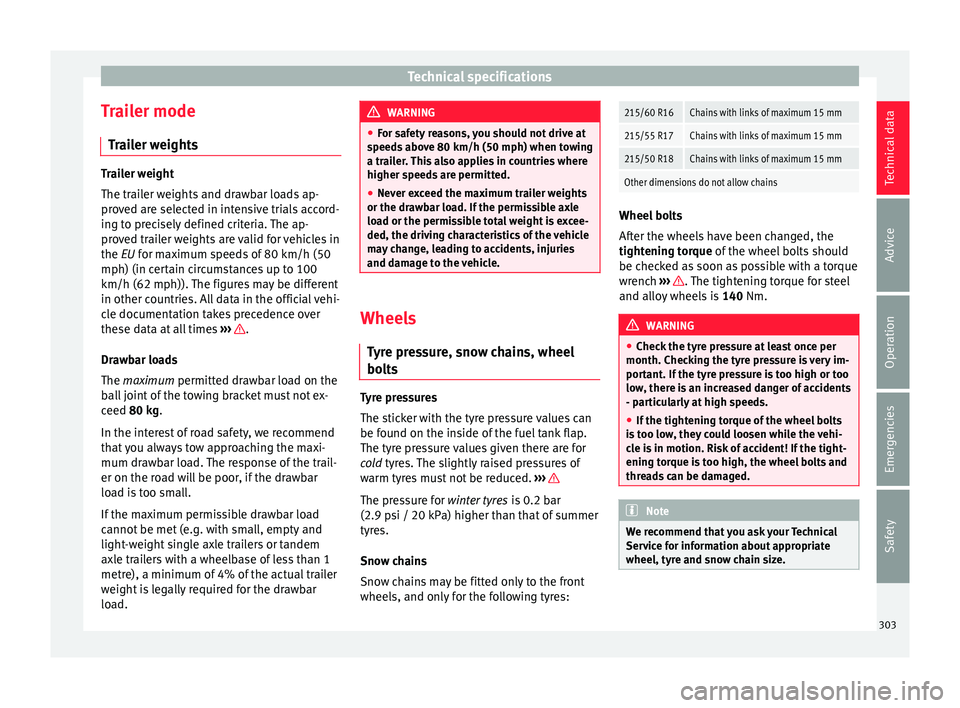
Snow chains may be fitted only to the front
wheels, and only for the following tyres:
215/60 R16Chains with links of maximum 15 mm
215/55 R17Chains with links of maximum 15 mm
215/50 R18Chains with links of maximum 15 mm
Other dimensions do not allow chains Wheel bolts
Af
t
er the wheels have been changed, the
tightening torque of the wheel bolts should
be checked as soon as possible with a torque
wrench ››› . The tightening torque for steel
and al lo
y wheels is 140 Nm. WARNING
● Chec k
the tyre pressure at least once per
month. Checking the tyre pressure is very im-
portant. If the tyre pressure is too high or too
low, there is an increased danger of accidents
- particularly at high speeds.
● If the tightening torque of the wheel bolts
is
too low, they could loosen while the vehi-
cle is in motion. Risk of accident! If the tight-
ening torque is too high, the wheel bolts and
threads can be damaged. Note
We recommend that you ask your Technical
Ser v
ice for information about appropriate
wheel, tyre and snow chain size. 303
Technical data
Advice
Operation
Emergencies
Safety
Page 310 of 328
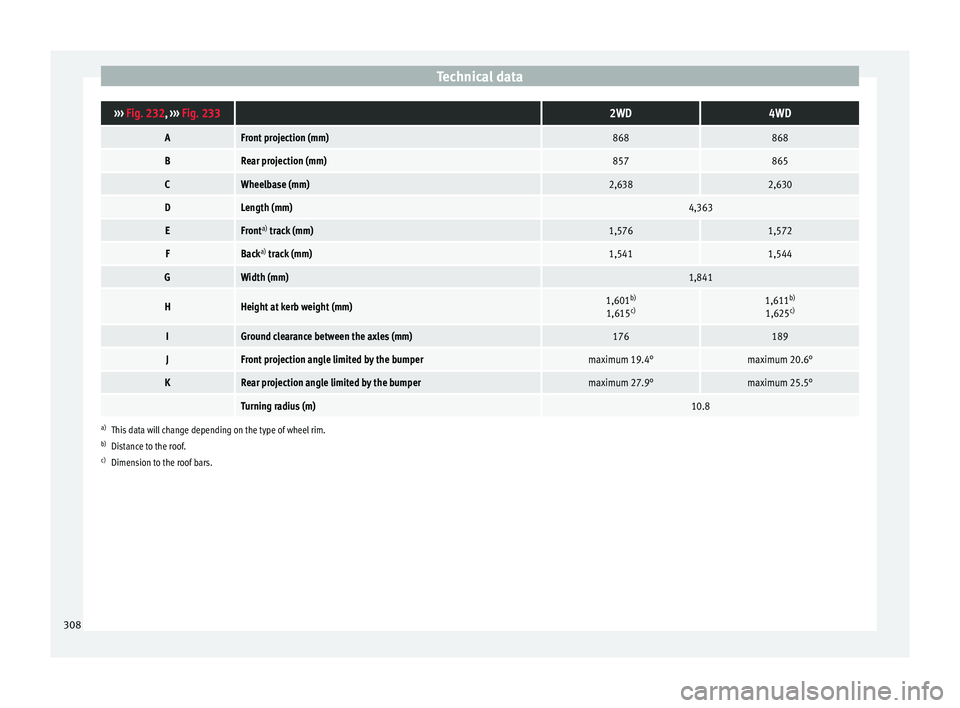
Technical data›››
Fig. 232, ››› Fig. 233 2WD4WD
AFront projection (mm)868868
BRear projection (mm)857865
CWheelbase (mm)2,6382,630
DLength (mm)4,363
EFront a)
track (mm)1,5761,572
FBack a)
track (mm)1,5411,544
GWidth (mm)1,841
HHeight at kerb weight (mm)1,601 b)
1,615 c)1,611b)
1,625 c)
IGround clearance between the axles (mm)176189
JFront projection angle limited by the bumpermaximum 19.4°maximum 20.6°
KRear projection angle limited by the bumpermaximum 27.9°maximum 25.5°
Turning radius (m)10.8
a)
This data will change depending on the type of wheel rim.
b) Distance to the roof.
c) Dimension to the roof bars.
308
Page 323 of 328
Index
replacing . . . . . . . . . . . . . . . . . . . . . . . . . . . . . . 290
w int
er conditions . . . . . . . . . . . . . . . . . . . . . . . 289
Vehicle care natural leather . . . . . . . . . . . . . . . . . . . . . . . . . 271
windscreen wipers service position . . . . . . . . . 60
Vehicle interior monitoring and anti-tow system 123 activation . . . . . . . . . . . . . . . . . . . . . . . . . . . . . 122
Vehicle seats . . . . . . . . . . . . . . . . . . . . . . . . . . . . . 68
Vehicle tool kit . . . . . . . . . . . . . . . . . . . . . . . . . . . . 54
Vehicle tools . . . . . . . . . . . . . . . . . . . . . . . . . . . . . . 83
Ventilation slits . . . . . . . . . . . . . . . . . . . . . . . . . . 149
Vertical load on the coupling . . . . . . . . . . . . . . . . 255
Vertical load on the trailer coupling loading the trailer . . . . . . . . . . . . . . . . . . . . . . . 261
W Warning and control lamps . . . . . . . . . . . . . 38, 106 adaptive cruise control . . . . . . . . . . . . . . . . . . . 199
Airbag system . . . . . . . . . . . . . . . . . . . . . . . . . . . 77
applying the brake . . . . . . . . . . . . . . . . . 199, 208
ASR . . . . . . . . . . . . . . . . . . . . . . . . . . . . . . . . . . 174
audible warning signal . . . . . . . . . . . . . . . . . . 106
Cruise control system (CCS) . . . . . . . . . . . . . . . 193
electromechanical steering . . . . . . . . . . . . . . . 273
engine management . . . . . . . . . . . . . . . . . . . . 187
engine pre-heating/fault system . . . . . . . . . . . 187
ESC . . . . . . . . . . . . . . . . . . . . . . . . . . . . . . . . . . 174
for seat belts . . . . . . . . . . . . . . . . . . . . . . . . . . . . 68
gear change . . . . . . . . . . . . . . . . . . . . . . . . . . . 183
instrument panel . . . . . . . . . . . . . . . . . . . . . 38, 40
instrument panel display . . . . . . . . . . . . . . . . . . 39
Lane Assist . . . . . . . . . . . . . . . . . . . . . . . . . . . . 214
lights . . . . . . . . . . . . . . . . . . . . . . . . . . . . . . . . . 131
refuelling . . . . . . . . . . . . . . . . . . . . . . . . . . . . . . 276
Start-Stop . . . . . . . . . . . . . . . . . . . . . . . . . . . . . 188
tyre monitoring system . . . . . . . . . . . . . . . . . . 296 Warning lamps
AdBlue . . . . . . . . . . . . . . . . . . . . . . . . . . . . . . . . 279
s
peed limiter . . . . . . . . . . . . . . . . . . . . . . . . . . . 194
Warning symbols see Warning and control lamps . . . . . . . . . . . . 106
Warning triangle . . . . . . . . . . . . . . . . . . . . . . . . . . 135
Washing the vehicle . . . . . . . . . . . . . . . . . . . . . . . 266 sensors . . . . . . . . . . . . . . . . . . . . . . . . . . . . . . . 232
special characteristics . . . . . . . . . . . . . . . . . . . 118
Weights . . . . . . . . . . . . . . . . . . . . . . . . . . . . . . . . . 302
Wheel changing . . . . . . . . . . . . . . . . . . . . . . . . . . . . . . 293
Wheel balance . . . . . . . . . . . . . . . . . . . . . . . . . . . 292
Wheel bolts . . . . . . . . . . . . . . . . . . . . . . . . . . . . . . 303 anti-theft . . . . . . . . . . . . . . . . . . . . . . . . . . . . . . . 54
caps . . . . . . . . . . . . . . . . . . . . . . . . . . . . . . . . . . . 54
loosening . . . . . . . . . . . . . . . . . . . . . . . . . . . . . . 55
tightening torque . . . . . . . . . . . . . . . . . . . . . . . 295
Wheel cover removing . . . . . . . . . . . . . . . . . . . . . . . . . . . . . . . 54
Wheels . . . . . . . . . . . . . . . . . . . . . . . . . . . . 291, 303 central wheel trim . . . . . . . . . . . . . . . . . . . . . . . . 54
chains . . . . . . . . . . . . . . . . . . . . . . . . . . . . . . . . 303
changing . . . . . . . . . . . . . . . . . . . . . . . . . . . . 54, 56
cleaning . . . . . . . . . . . . . . . . . . . . . . . . . . . . . . 269
new wheels . . . . . . . . . . . . . . . . . . . . . . . . . . . . 293
snow chains . . . . . . . . . . . . . . . . . . . . . . . . . . . . 56
temporary spare wheel . . . . . . . . . . . . . . . . . . 298
Wheel spanner . . . . . . . . . . . . . . . . . . . . . . . . . . . . 83
Windows electric . . . . . . . . . . . . . . . . . . . . . . . . . . . . . . . . . 12
Electric . . . . . . . . . . . . . . . . . . . . . . . . . . . . . . . . 126
removing ice . . . . . . . . . . . . . . . . . . . . . . . . . . . 269
Window wiper . . . . . . . . . . . . . . . . . . . . . . . . . . . . 139
Window wiper blade . . . . . . . . . . . . . . . . . . . . . . . . 25 windscreen and rear window wiper blades
ch anging . . . . . . . . . . . . . . . . . . . . . . . . . . . . . . . 61
cleaning . . . . . . . . . . . . . . . . . . . . . . . . . . . . . . . 61
Windscreen and rear window wiper blades . . . . . 85
Windscreen washer . . . . . . . . . . . . . . . . . . . 50, 139
Windscreen washer water Capacity . . . . . . . . . . . . . . . . . . . . . . . . . . . . . . 288
checking . . . . . . . . . . . . . . . . . . . . . . . . . . . . . . 288
Topping up . . . . . . . . . . . . . . . . . . . . . . . . . . . . 288
Windscreen wiper . . . . . . . . . . . . . . . . . . . . . . . . . 139 Heated windscreen washer jets . . . . . . . . . . . . 139
window wiper lever . . . . . . . . . . . . . . . . . . . . . . 139
Windscreen wiper and rear window wiper sys- tems
service position . . . . . . . . . . . . . . . . . . . . . . . . . 60
Windscreen wipers . . . . . . . . . . . . . . . . . . . . . . . . . 25 functions . . . . . . . . . . . . . . . . . . . . . . . . . . . . . . 139
headlight washer system . . . . . . . . . . . . . . . . . 139
Lifting the wiper blade . . . . . . . . . . . . . . . . . . . . 60
rain sensor . . . . . . . . . . . . . . . . . . . . . . . . . . . . 140
replacing the wiper blades . . . . . . . . . . . . . . . . 60
service position . . . . . . . . . . . . . . . . . . . . . . . . . 60
special characteristics . . . . . . . . . . . . . . . . . . . 139
Winter conditions battery . . . . . . . . . . . . . . . . . . . . . . . . . . . . . . . . 289
defrosting the windows . . . . . . . . . . . . . . . . . . 269
diesel . . . . . . . . . . . . . . . . . . . . . . . . . . . . . . . . . 278
snow chains . . . . . . . . . . . . . . . . . . . . . . . . . . . . 56
Taking care of your vehicle . . . . . . . . . . . . . . . . 266
tyres . . . . . . . . . . . . . . . . . . . . . . . . . . . . . . . . . . 299
Winter driving sunroof . . . . . . . . . . . . . . . . . . . . . . . . . . . . . . . 128
Winter operation headlight washers . . . . . . . . . . . . . . . . . . . . . . 140
Heated windscreen washer jets . . . . . . . . . . . . 139
Salt on the roads . . . . . . . . . . . . . . . . . . . . . . . 140
Winter tyres . . . . . . . . . . . . . . . . . . . . . . . . . . . . . . 299 four-wheel drive . . . . . . . . . . . . . . . . . . . . . . . . 274 321