air condition Seat Ateca XL 2006 User Guide
[x] Cancel search | Manufacturer: SEAT, Model Year: 2006, Model line: Ateca XL, Model: Seat Ateca XL 2006Pages: 288, PDF Size: 9.08 MB
Page 156 of 288
Heating, Ventilation and Air conditioning
154Air recirculation mode ⇒page 153, fig. 125 prevents strong odours in
the outside air from entering the vehicle interior, for example when passing
through a tunnel or in queuing traffic.
With low ambient temperatures, the air recirculation increases the effective-
ness of the heating system by heating the air inside the passenger compart-
ment rather than the ambient air.
With high ambient temperatures, the air recirculation increases the effective-
ness of the air conditioning system by cooling the air inside the passenger
compartment rather than the ambient air. For reasons of safety, air recirculation is
not possible when the control for air
distribution is set to the windscreen setting
.
WARNING
In air recirculation mode, no ambient air enters the vehicle interior. If the
air conditioning system is switched off, the windows can quickly mist over.
Therefore, you should never leave the air recirculation mode switched on
for longer periods, as this increases the risk of an accident.
2C-Climatronic*Control switches
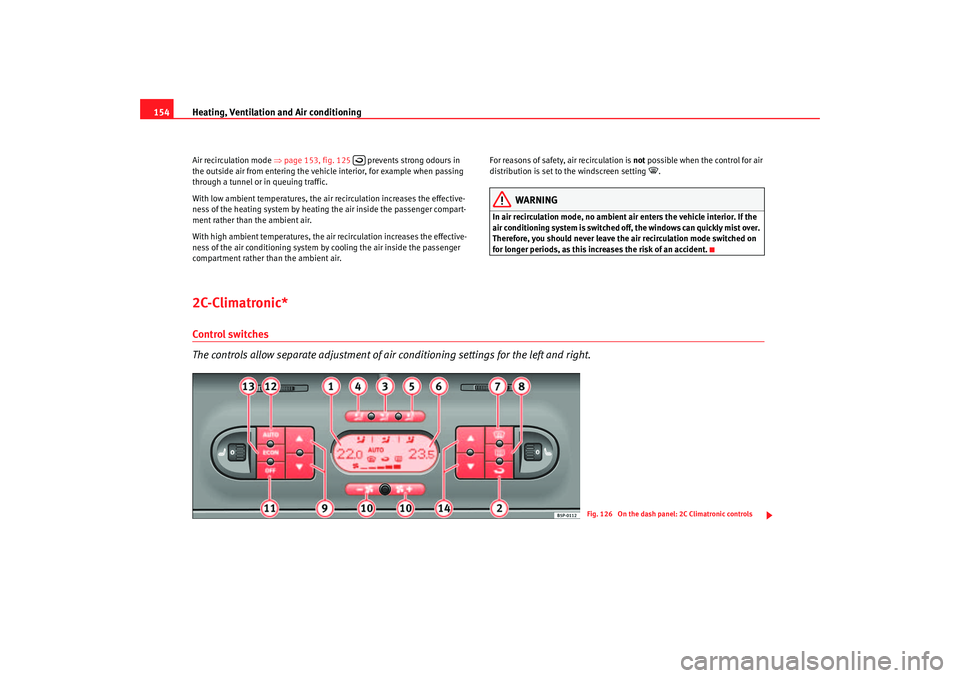
The controls allow separate adjustment of air conditioning settings for the left and right.
Fig. 126 On the dash panel: 2C Climatronic controls
AlteaXL_ingles_02_06 Seite 154 Dienstag, 1. August 2006 11:11 11
Page 157 of 288

Heating, Ventilation and Air conditioning 155
Safety First
Operating instructions
Tips and Maintenance
Te c h n i c a l D a t a
The air conditioning system only works when the engine is running
and the blower is switched on.
– Press the temperature control buttons ⇒page 154, fig. 126
or in order to adjust the temperature on the left hand side or
the right hand side respectively.
– The functions will be switched on when the buttons are pressed. When these functions are activated, they are indicated in the
display. Also, the de-icing and re ar heated window functions will
turn on along with their corres ponding yellow symbol. Press the
button again to switch off the function.The temperature can be adjusted separately for the left and right sides of the
vehicle interior.
Display of the selected interior temperature for the left side.
Button – Manual air recirculation mode
Button – Central air distribution
Button – Downward air distribution
Button – Upward air distribution
Display of the selected interior temperature for the right side.
Button – defrost function for the windscreen. The air drawn in from
outside the vehicle is directed at the windscreen. The air recirculation
mode, if switched on, will be switched off as soon as the defrost function
is swit ched on. At tempera t
ures over 3°C, the air conditio
ning system
will be switched on automatically and the blower speed will be increased
by one level in order to dry the air. The button lights up yellow and the
symbol appears in the display.
Button – Rear window heating. The heating will be switched off auto-
matically approximately 20 minutes after switching on. However, it may
be turned off by pushing the button. The button lights up yellow and the
symbol appears in the display.
Temperature selector for the left side ⇒page 155 Blower control
⇒page 156
Button – Switches the 2C-Climatronic on and off ⇒page 156
Button – Automatic temperature, ventilation and air distribution
control ⇒page 155
Button – Switches heating, ventilation and air-conditioning
system off
Temperature selector for the right side ⇒page 155
WARNING
For road safety all windows must be clear of ice, snow, and condensation.
This is essential to ensure good visibility. Please familiarise yourself with
the correct operation of the heating and ventilation system, including the
anti-fog/defrost functions for the windows.
Note
Please observe the general notes ⇒page 158.Automatic mode
In automatic mode air temperatur e, air flow and distribution
are automatically regulated so that a specified temperature is
attained as quickly as possible and then maintained.The temperature can be adjusted separately for the left and right
sides of the vehicle interior.
Switching on automatic mode
– Press the button ⇒page 154, fig. 126 . “AUTO” is shown
on the display.
A9
A14
A1A2
A3
A4
A5
A6A7
A8
A9
A10A11
OFF
A12
AUTO
A13
ECON
A14
AUTO
AlteaXL_ingles_02_06 Seite 155 Dienstag, 1. August 2006 11:11 11
Page 158 of 288
Heating, Ventilation and Air conditioning
156
– Press the temperature selectors to set the desired temperatures
for the left and right sides of the interior. We recommend 22°C
(72°F).A comfortable interior climate is quickly reached when a temperature of
+22°C (72°F) is set in automatic mode. It can be changed as necessary to suit
individual preferences or particular ci rcumstances. It is possible to select
interior temperatures from +16°C (61°F) to +29.5°C (86°F). These are approx-
imate temperatures and the actual temperature may be slightly higher or
lower depending on the ambient conditions. Climatronic maintains a constant temperature level fully automatically. The
temperature of the air supplied to the interior, the blower speed and the air
distribution are regulated automatically. The system also allows for the effect
of strong sunlight, so there is no need for manual adjustment. Therefore,
automatic mode
provides the best comfort for the vehicle occupants in virtu-
ally all conditions throughout the year.
Automatic mode is switched off whenever an adjustment is made using the
buttons for the air distribution, air flow or . The temperature will
continue to be regulated within the parameters manually selected by the
user.Manual mode
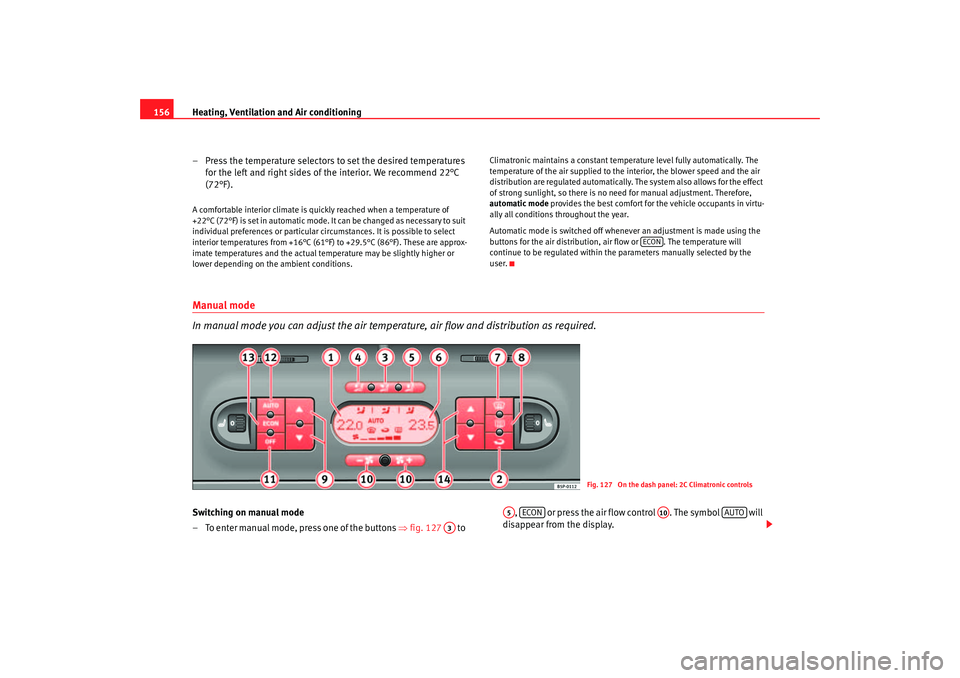
In manual mode you can adjust the air temperat ure, air flow and distribution as required.Switching on manual mode
– To enter manual mode, press one of the buttons ⇒fig. 127 to , or press the air flow control . The symbol will
disappear from the display.
ECON
Fig. 127 On the dash panel: 2C Climatronic controls
A3
A5
ECON
A10
AUTO
AlteaXL_ingles_02_06 Seite 156 Dienstag, 1. August 2006 11:11 11
Page 159 of 288
Heating, Ventilation and Air conditioning 157
Safety First
Operating instructions
Tips and Maintenance
Te c h n i c a l D a t a
Temperature
There are separate temperature selectors for the left and right sides of the
vehicle interior. The selected temperature is displayed above the selector. It
is possible to select interior tem
peratures from +16°C (61°F) to +29.5°C
(86°F). These are approximate temperat ures and the actual temperature may
be slightly higher or lower depending on the ambient conditions.
If a temperature below 16°C (61°F) is selected, the display switches to LO. In
this setting the system runs at maximum cooling output and the temperature
is not regulated.
If a temperature above 29.5°C (86°F) is selected the display switches to HI. In
this setting the system runs at maximum heating output and the temperature
is not regulated.
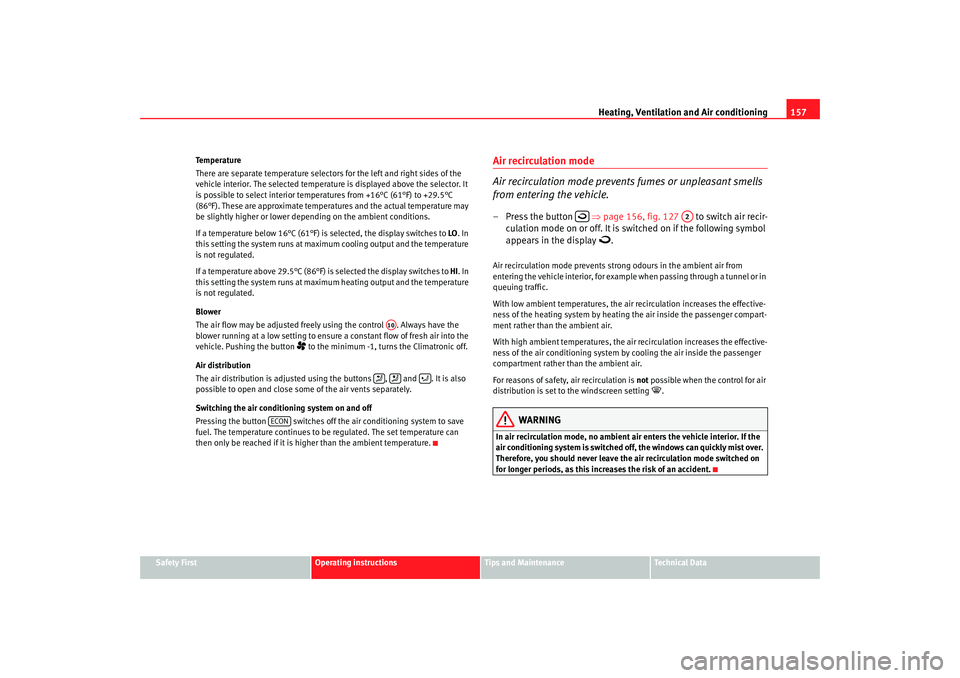
Blower
The air flow may be adjusted freely using the control . Always have the
blower running at a low setting to ensure a constant flow of fresh air into the
vehicle. Pushing the button
to the minimum -1, tu rns the Climatronic off.
Air distribution
The air distribution is adjusted using the buttons , and . It is also
possible to open and close some of the air vents separately.
Switching the air conditioning system on and off
Pressing the button switches off the air conditioning system to save
fuel. The temperature continues to be regulated. The set temperature can
then only be reached if it is higher than the ambient temperature.
Air recirculation mode
Air recirculation mode prevents fumes or unpleasant smells
from entering the vehicle.– Press the button ⇒page 156, fig. 127 to switch air recir-
culation mode on or off. It is switched on if the following symbol
appears in the display
.
Air recirculation mode prevents strong odours in the ambient air from
entering the vehicle interior, for example when passing through a tunnel or in
queuing traffic.
With low ambient temperatures, the air recirculation increases the effective-
ness of the heating system by heating the air inside the passenger compart-
ment rather than the ambient air.
With high ambient temperatures, the air recirculation increases the effective-
ness of the air conditioning system by cooling the air inside the passenger
compartment rather than the ambient air.
For reasons of safety, air recirculation is not possible when the control for air
distribution is set to the windscreen setting
.
WARNING
In air recirculation mode, no ambient air enters the vehicle interior. If the
air conditioning system is switched off, the windows can quickly mist over.
Therefore, you should never leave the air recirculation mode switched on
for longer periods, as this increases the risk of an accident.
A10
ECON
A2
AlteaXL_ingles_02_06 Seite 157 Dienstag, 1. August 2006 11:11 11
Page 160 of 288
Heating, Ventilation and Air conditioning
158General notesThe pollen filter
The pollution filter (a combined part iculate filter and active carbon filter)
serves as a barrier against impurities in the outside air, including dust and
pollen.
For the air conditioning system to work with maximum efficiency, the pollen
filter must be replaced at the intervals specified in the Service Schedule.
If the filter loses efficiency prematurely due to use in areas with very high
levels of air pollution, the pollen filte r must be changed more frequently than
stated in the Service Schedule.
Caution
•
If you suspect that the air conditioner is damaged, switch off the air condi-
tioner with button to prevent further damage and have it checked by a
qualified workshop.
•
Repairs to the air conditioning system require specialist knowledge and
special tools. Therefore, we recommend that you take the vehicle to a quali-
fied workshop should problems occur.Note
•
If the humidity and temperature outside the vehicle are high, condensa-
tion can drip off the evaporator in the cooling system and form a pool under-
neath the vehicle, this is completely normal and there is no need to suspect
a leak.
•
Keep the air intake slots in front of the windscreen free of snow, ice and
leaves to ensure heating and cooling is not impaired, and to prevent the
windows misting over.
•
The air from the vents flows through the passenger compartment and is
extracted by slots designed for this purpose. Do not cover these slots with
articles of clothing or other objects.
•
The air conditioning system operates most effectively with the windows
and the sliding/tilting roof* closed. Howe ver, if the sun has heated up the
vehicle, the air inside can be cooled more quickly by opening the windows for
a short period.
•
Do not smoke while air recirculation mode is on, as smoke drawn into the
air conditioning system leaves a r esidue on the evaporator, producing a
permanent unpleasant odour.
•
The air conditioning should be turned on at least once a month, to lubri-
cate the system gaskets and prevent leaks. If a decrease in the cooling
capacity is detected, an Authorised Service Centre should be consulted to
check the system.
ECON
AlteaXL_ingles_02_06 Seite 158 Dienstag, 1. August 2006 11:11 11
Page 174 of 288
Driving
172•
Depending on weather conditions, it may become extremely hot or cold
inside the vehicle. This can be fatal.
Acoustic parking aid system*Rear parking aid
The parking aid system will use an acoustic signal to warn of
the approach of any object towards the rear of the vehicle.Description
The acoustic parking aid system will measure the distance between the rear
of the vehicle and any possible obstacle using four ultrasonic sensors located
on the rear bumper. The measuring range of the sensors starts at approxi-
mately and depending on the nature of the obstacle at a distance of:•
side of the rear bumper: 0.8 m
•
centre of the rear bumper: 1.3 m
Activation
The system is activated by engagement of the reverse gear. A brief acoustic
signal confirms the activation and correct function of the system.
Reversing
The distance warning will begin as soon as an obstacle is detected by the
system. The frequency of the bleeps emitted by the system will increase
rapidly as the vehicle approaches the obstacle.
Within a short distance of about 25 cm, a continuous signal sounds (stop
signal). The driver should not reverse any further. Trailer towing
For vehicles fitted with a tow bar by the manufacturer, the parking aid system
will not be activated by the engagement of the reverse gear when pulling a
trailer, as the trailer’s electric conne
cter will be plugged into the vehicle.
To avoid system malfunctions, when not driving with a trailer, remove the
trailer hitch.
Possible faults
If a continuous bleep sounds for some seconds when the reverse gear is
engaged, this indicates that there is a fault in the parking aid system.
If the fault continues until the ignition is turned off, the acoustic signal
warning of the fault will not be emitted every time the system is reactivated
(by engaging the reverse gear). Thus, the system ready indication will not
sound either. Have the fault repaired by an Authorised Service Centre as soon
as possible.
If there is no ready signal or no acous tic warning signal then the parking aid
loudspeaker is faulty and may not warn of obstacles.
To ensure that the system works properly, the sensors must be kept clean and
free of ice and snow.
WARNING
•
The sensors have blind spots in which obstacles may not be detected.
•
Always look out for small children and animals because the system will
not always detect them. Always pay at tention when reversing to avoid acci-
dents.
•
The parking aid is not a replacement for driver awareness. The driver
must take full responsibility for parking and other manoeuvres.
WARNING (continued)
AlteaXL_ingles_02_06 Seite 172 Dienstag, 1. August 2006 11:11 11
Page 182 of 288

Intelligent technology
180
Caution•
In order to ensure that ESP functions correctly, all four wheels must be
fitted with the same tyres. Any differences in the rolling radius of the tyres can
cause the system to reduce engine power when this is not desired.
•
Modifications to the vehicle (e.g. to the engine, the brake system, running
gear or any components affecting the wheels and tyres) could affect the effi-
ciency of the ABS, EDL, ESP and TCS.Note
To disconnect using the ESP button ⇒page 160.Anti-lock brake system (ABS)The anti-lock brake system prevents the wheels locking during braking
⇒page 178.Electronic differential lock (EDL)*
The electronic differential lock helps prevent the loss of trac-
tion caused if one of the driven wheels starts spinning.EDL helps the vehicle to start moving, accelerate and climb a gradient in slip-
pery conditions where this may otherwise be difficult or even impossible.
The system will control the revolutions of the drive wheels using the ABS
sensors (in case of an EDL fault the warning lamp for ABS lights up)
⇒page 78.
At speeds of up to approximately 80 km/h, it is able to balance out differ-
ences in the speed of the driven wheel s of approximately 100 rpm caused by a slippery road surface on
one side of the vehicle. It does this by braking the
wheel which has lost traction and distributing more driving force to the other
driven wheel via the differential.
To prevent the disc brake of the braked wheel from overheating, the EDL cuts
out automatically if subjected to excessive loads. The vehicle will continue to
function normally without EDL. For this reason, the driver is not informed that
the EDL has been switched off.
The EDL will switch on again automatically when the brake has cooled down.
WARNING
•
When accelerating on a slippery surface, for example on ice and snow,
press the accelerator carefully. Despite EDL, the driven wheels may start to
spin. This could impair the vehicle’s stability.
•
Always adapt your driving style to su it road conditions and the traffic
situation. Do not let the extra safety afforded by EDL tempt you into taking
any risks when driving, this can cause accidents.Caution
Modifications to the vehi cle (e.g. to the engine, the brake system, running
gear or any components affecting the wheels and tyres) could affect the effi-
ciency of the EDL ⇒page 199.The traction control system (TCS)The traction control system prevents the drive wheels from spinning when the
car is accelerating ⇒page 178.
AlteaXL_ingles_02_06 Seite 180 Dienstag, 1. August 2006 11:11 11
Page 185 of 288

Driving and the environment183
Safety First
Operating instructions
Tips and Maintenance
Te c h n i c a l D a t a
WARNING
The catalytic converter reaches very high temperatures! Fire hazard!•
Never park where the catalytic converter could come into contact with
dry grass or inflammable materials under the vehicle.
•
Do not apply additional underseal or anti-corrosion coatings to the
exhaust pipes, catalytic converter or the heat shields on the exhaust
system. These materials could catch fire when the vehicle is driven.Caution
Never fully drain the fuel tank, in this case, the irregularity of the fuel supply
may cause ignition problems. This allow s unburnt fuel to enter the exhaust
system, which could cause overheating and damage the catalytic converter.
For the sake of the environment
Even when the emission control system is working perfectly, there may be a
smell of sulphur from the exhaust unde r some conditions. This depends on
the sulphur content of the fuel used. Quite often the problem can be reme-
died by changing to another brand of fuel.Diesel engine particulate filter*
The diesel engine particulate filter eliminates soot produced
by burning diesel.The diesel engine dust filter eliminates most of the soot from the exhaust gas
system. The soot particulates accumulate in the filter where they are regularly
burned. In order to facilitate this process, occasional journeys at speeds of more than 60 kmh should be made. If the vehicle is only used for short trips
then the soot will build up in the particulate filter.
WARNING
•
The diesel engine particulate filter may reach extremely high tempera-
tures; it should not enter into contact with flammable materials under-
neath the vehicle. Failure to comply could result in fire.Caution
Vehicles equipped with a diesel engine particulate filter must not be refuelled
using biodiesel (RME), given that the fuel system may be damaged.Driving abroadNotesFor driving abroad, the following must be taken into consideration:•
For vehicles fitted with a catalytic converter ensure that unleaded petrol is
available for the journey. See the chap ter “Refuelling”. Automobile organisa-
tions will have information about service station networks selling unleaded
fuel.
•
In some countries it is possible that a vehicle model is sold under condi-
tions where some spare parts are not available or that the Authorised Service
Centres may only carr y out limited repairs.
SEAT importers and distributors will gladly provide information about the
technical preparation of your vehicle in addition to necessary maintenance
and repair possibilities.
WARNING (continued)
AlteaXL_ingles_02_06 Seite 183 Dienstag, 1. August 2006 11:11 11
Page 195 of 288

Cleaning and caring for your vehicle193
Safety First
Operating instructions
Tips and Maintenance
Te c h n i c a l D a t a
Polishing the paintwork
Polishing brings back gloss to the paintwork.Polishing is only necessary if the paint has lost its shine, and the gloss cannot
be brought back by applying wax. Polish can be obtained from your Author-
ised Service Centre.
The car must be waxed after polishing if the polish used does not contain wax
compounds to seal the paint ⇒page 192, “Waxing the car”.
Caution
To prevent damage to the paintwork:•
Do not use polishes and hard wax on painted parts with a matt finish or
on plastic parts.
•
Do not polish your vehicle in a sandy or dusty environment.
Caring for plastic parts
Solvents will damage plastic parts.If normal washing fails to clean plastic parts, clean them with special solvent-
free plastic cleaning and care products.
Caution
•
The use of liquid air conditioners directly over the air vents of the vehicle
may damage the plastic parts if the liquid is accidentally spilled.
•
Cleaning products which contain solvents will damage the material.
Cleaning windows and exterior mirrorsCleaning the windows
– Moisten the windows with commercially available, alcohol based glass cleaner.
– Dry the windows with a clean chamois leather or a lint-free cloth.
Removing snow
– Use a small brush to remove snow from the windows and mirrors.
Removing ice
– Use a de-icer spray.Use a clean cloth or chamois leather to dry the windows. Chamois leathers
that have been used on painted surfaces are not suitable for use on windows.
They will be soiled with wax deposits that would smear the windows.
If possible use a de-icing spray to remove ice. If you use an ice scraper, push
it in one direction only. Do not move it to and fro.
Use window cleaner or a silicone remove r to clean off rubber, oil, grease and
silicone deposits.
Wax deposits have to be removed with a special cleaner that is available from
your Authorised Service Centre. Wax deposits on the windscreen could cause
the wiper blades to judder. A window cleanser specifically for removing wax
will stop the blades juddering if added to the windscreen washer fluid.
Grease removing cleansers will not remove wax deposits.
Caution
•
Never use warm or hot water to remove snow and ice from windows and
mirrors. This could cause the glass to crack!
AlteaXL_ingles_02_06 Seite 193 Dienstag, 1. August 2006 11:11 11
Page 200 of 288

Cleaning and caring for your vehicle
198•
To avoid damage, stubborn stains should be removed by a qualified
workshop.
Cleaning seat belts
A dirty belt may stop the seat belt working properly.Keep the seat belts clean and check all seat belts regularly.
Cleaning seat belts
– Carefully pull the dirty seat belt right out and leave it out.
– Clean the dirty seat belts with a gentle soap solution.
– Allow the seat belt fabric to dry.
– Do not roll up the seat belt until it is dry.If large stains form on the belts the belt will not retract correctly into the auto-
matic belt retractor.
WARNING
•
Do not use chemical cleaning agents on the seat belts, as this can
impair the strength of the webbing. Ensure that the belts do not come into
contact with corrosive fluids.
•
Check the condition of all seat belts at regular intervals. If you notice
that the belt webbing, fittings, retractor mechanism or buckle of any of the
belts is damaged, the belt must be replaced by a specialist workshop.
•
Do not attempt to repair a damaged se at belt yourself. The seat belts
must not be removed or modified in any way.
Caution
After cleaning, allow seat belts to dr y completely before rolling them up.
Otherwise the belt retractors could become damaged.
AlteaXL_ingles_02_06 Seite 198 Dienstag, 1. August 2006 11:11 11