service Seat Cordoba 2006 User Guide
[x] Cancel search | Manufacturer: SEAT, Model Year: 2006, Model line: Cordoba, Model: Seat Cordoba 2006Pages: 255, PDF Size: 7.57 MB
Page 61 of 255
Cockpit59
Safety First
Operating instructions
Tips and Maintenance
Te c h n i c a l D a t a
Service interval display
When it is time for a service, the lower counter (trip counter) of the speedom-
eter displays the symbol of a spanner, followed by one of the following
messages:
OIL
- Changing the engine oil
INSP - Maintenance service
The maintenance message switches off 3 minutes after the engine is started.
The trip counter can also be reset, by pressing the reset button for more than
0.5 seconds
2)
The Service Centre who carry out the maintenance service will reset the main-
tenance interval display on completion of the service.
We recommend that the repair and main tenance work only be carried out at
Authorised Service Centres.
The service indicator can also be reset by pressing the trip counter button.
Proceed as follows:
Switch off ignition.
Keep “Reset” button on distance counter pressed.
Connect ignition with the “Reset” button pressed. The fixed mode
display appears.
After a minimum of 10 sec, release the reset button.
Caution
We recommend that the resetting of the service interval indicator be carried
out in an Authorised Service Centre to avoid possible faults in the vehicle.
Note
•
Only the desired service message should be reset in each case. By
pressing the reset button it is possible to change from one message to
another.
•
Do not reset the display between two service intervals, otherwise the
dispaly will be incorrect.
•
The values are stored even when the battery is disconnected.
2)With “Ignition OFF” the maintenance display remains visible.A-A-A-A-
cordoba_ingles Seite 59 Freitag, 7. Oktober 2005 6:00 18
Page 65 of 255
Cockpit63
Safety First
Operating instructions
Tips and Maintenance
Te c h n i c a l D a t a
Electro-hydraulic steering*
The level of steering assistance depends on the vehicle speed and on the
steering angle.
The warning lamp should light up for a few seconds when the ignition is
switched on. It should go out when the engine has started running.
There is a fault in the electro-hydraulic steering system if the lamp does not
go out or lights up whilst the vehicle is in motion. Take the vehicle to the
Authorised Service Centre as soon as possible.Engine management
This warning lamp monitors th e engine management system
for petrol engines.The warning lamp
(Electronic Power Control) lights up when the ignition
is switched on to show that the lamp is working properly. It should go out
when the engine has started running.
If a fault develops in the electronic engine management system while you are
driving, this warning lamp will light up. Take the vehicle to an Authorised
Service Centre as soon as possible and have the engine checked.
Glow plug system / Engine fault
The warning lamp lights up to show that the glow plugs are
preheating. It flashes if there is an engine fault.Warning lamp
is lit
The warning lamp lights up while the glow plugs are preheating. When the
warning lamp goes off, the engine should be started straight away.
Warning lamp
flashes
If a fault develops in the engine management system while you are driving,
the glow plug lamp will flash
. Take the vehicle to an Authorised Service
Centre as soon as possible and have the engine checked.
Tu r n si g nals
The warning lamp flashes when the turn signals are in oper-
ation.Depending on which turn signal is operated, either the left
or right
indi-
cator lamp flashes. Both warning lamps will flash at the same time when the
hazard warning lights are switched on.
If one turn signal fails, the warning lamp will start flashing twice as fast.
Further information on the turn signals ⇒page 91.
cordoba_ingles Seite 63 Freitag, 7. Oktober 2005 6:00 18
Page 66 of 255
Cockpit
64Coolant Level* / temperature
The warning lamp lights up if the coolant temperature is too
high or if the coolant level is too low.There is a fault if:•
The warning symbol does not go out again after a few seconds.
•
The warning lamp lights up or flashes while the vehicle is moving, while
three acoustic warning signals ⇒ are emitted.
This means that either the coolant level is too low or the coolant temperature
is too high.
Coolant temperature too high
First look at the coolant temperature gauge. The coolant temperature is too
high if the needle is over the warning area on the dial. Stop the vehicle,
switch off the engine and wait for it to cool down. Check the coolant level.
If the coolant level is correct, the overheating may be caused by a malfunction
of the radiator fan. Check the radiator fan fuse and have it replaced if neces-
sary ⇒page 197.
If the warning lamp lights up again after driving on for a short distance, stop
the vehicle and switch off the engine. Contact an Authorised Service Centre
or a qualified workshop.
Coolant level too low
First look at the coolant temperature gauge. If the needle is in the normal
range, top up with coolant at the earliest opportunity ⇒ .
WARNING
•
If your vehicle is immobilised for any technical reasons, move it to a
safe distance from traffic. Turn off the engine, turn on the hazard lights and
place the warning triangle.
•
Never open the bonnet if you can see or hear steam or coolant escaping
from the engine compartment. Risk of scalding. Wait until you can no
longer see or hear escaping steam or coolant.
•
The engine compartment of any motor vehicle is a dangerous area!
Before carrying out any work in th e engine compartment, switch off the
engine and a llow it to cool down. Al ways note the corresponding warnings
⇒ page 169.
Main beam headlights
This warning lamp lights up when the main beams are on.The warning lamp
lights up when the main beams are on or when the
headlight flasher is operated.
Fu rther information ⇒ page 91
.
Fuel level / reserve
This symbol lights up to indicate that the fuel tank is down to
the reserve level.This lights when only 7 litres of fuel remain in the tank. Also, an audible
warning is given. This serves as a reminder to fill up with fuel at the earliest
opportunity ⇒page 166.
WARNING (continued)
cordoba_ingles Seite 64 Freitag, 7. Oktober 2005 6:00 18
Page 78 of 255
Opening and closing
76To fold the key bit, press the button and push with the hand, until it is
correctly folded ⇒ page 75, fig. 47.
Duplicate keys
If you need a replacement key, take your key tab to an Authorised Service
Centre.
WARNING
•
Incorrect use of the keys can result in critical injuries.
•
Never leave children or disabled persons in the vehicle; in case of emer-
gency they may not be able to leave the vehicle or look after themselves.
•
Unsupervised use of a key could mean that the engine is started or that
electrical equipment is used (e.g. elec tric windows). Risk of accident. The
doors can be locked using the remote control key. This could result in
people being trapped in the vehicle in an emergency.
•
Never leave any of the vehicle keys in the vehicle. Unauthorised use of
your vehicle could result in injury, damage or theft. Always take the key
with you when you leave the vehicle.
•
Never remove the key from the ignition if the vehicle is in motion. Risk
of accident. The steering lock could engage suddenly, and you would not be
able to steer the vehicle.Caution
There are electronic components in th e key and remote control. Protect the
keys from moisture and excessive vibration.
cordoba_ingles Seite 76 Freitag, 7. Oktober 2005 6:00 18
Page 81 of 255
Opening and closing79
Safety First
Operating instructions
Tips and Maintenance
Te c h n i c a l D a t a
–Maximum time allowed for synchronising is 30 seconds.
– The normal key is used to activa te the ignition, and the key with
the remote control is the key to be programmed.
– Check that the car is open before commencing programming.
– Place the key without remote control in the contact inside the steering and ignition lock.
– Use the key with remote control and mechanically lock the vehicle from the driver's door.
– Open and close the driver's door lock mechanically, using the remote control key.
– At the same time press the button on the remote control key.
– Complete the procedure by removing the key from the contactIt is possible that the vehicle could no longer be opened and closed with the
remote control if the button is repeatedly pressed outside of the effective
range of the radio frequency remote cont rol. The remote control key will have
to be resynchronised.
Spare remote control keys are available from Authorised Service Centres, they
must be matched to the locking system.
Anti-theft alarm system*Description of anti-theft alarm system*
The anti-theft alarm triggers an alarm if unauthorised move-
ments are detected around the vehicle.The anti-theft alarm makes it more difficult to break into the vehicle or steal
it. Audible and visible alarms are triggered if the car is opened using the
mechanical key, or if unauthorised access is gained to the vehicle.
The anti-theft alarm system is automatically switched on when the vehicle is
locked. To lock the door either turn the key once in the lock towards the
locking position or press button on the radio-frequency remote
control*. The system is activated immediately and the indicator light located
on the drivers door will flash along with the indicators indicating that the
alarm and the locking security system (double lock) have been turned on.
When the vehicle is locked the indicator lamps light up only if the alarm has
been correctly activated (all the protec tion zones should be correctly closed).
If any of the doors or the bonnet are open, when the alarm is connected these
will not be included in the protection zones of the vehicle. If the door or
bonnet is subsequently closed, they will automatically be included in the
vehicle protection zones and the indicators will flash accordingly.
When does the system trigger an alarm?
The alarm system is triggered, in the locked vehicle, when:•
a door
•
the bonnet or
•
the tailgate
are unduly opened
•
or the ignition is switched on
A1
A2
cordoba_ingles Seite 79 Freitag, 7. Oktober 2005 6:00 18
Page 87 of 255
Opening and closing85
Safety First
Operating instructions
Tips and Maintenance
Te c h n i c a l D a t a
– Use the key to lock the vehicle from outside and hold the key in
the lock position for at least one second. The one-touch function
is now ready for operation.The buttons ⇒ page 83, fig. 52 and have two levels for opening the
window and two for closing it. This makes it easier to open or close windows
to the desired position.
One-touch closing does not work when the ignition has been switched off,
even if the key is in the ignition.
The automatic open and close function wi ll not work if the battery has been
temporarily disconnected, or if the battery is flat. The function then has to be
reactivated.
The one-touch function and roll-back fu nction will not work if there is a
malfunction in the electric windows. Contact an Authorised Service Centre.Roll-back function
The windows have a roll-back function. This reduces the risk
of injuries when the windows are closing.•
If a window is obstructed when closing automatically, the window stops
at this point and lowers immediately ⇒ .
•
If this happens, check immediately (within 10 seconds) why the window
could not be closed before attempting to close it again. After 10 seconds the
normal automatic function resumes.
•
If the window is still obstructed, the window stops at this point.
•
If there is no obvious reason why the window cannot be closed, try to
close it again within five seconds.
If you wait longer than 10 / 5 seconds, the window will open fully when you
operate one of the buttons. One-touch closing is reactivated. The one-touch function and roll-back function will not work if there is a
malfunction in the electric windows. Contact an Authorised Service Centre.
WARNING
•
Incorrect use of the electric windows can result in injury.
•
Always take the key with you when leaving the vehicle, even if you only
intend to be gone for a short time. Plea se ensure that children are never left
unsupervised in the vehicle.
•
The electric windows will work until the key has been removed from the
ignition and one of the front doors has been opened.
•
Never close the tailgate without observin g and ensuring it is clear, to do
otherwise could cause serious injury to you and others. Make sure that no
one is in the path of a window.
•
Never allow people to remain in th e vehicle when you close the vehicle
from the outside. The windows cannot be opened even in an emergency.Note
The roll-back function is deactivate d if the windows are closed from the
outside of the vehicle using the ignition key for convenience closing
⇒ page 85.Convenience opening and closing*Using the door lock
– Hold the key in the door lock of the driver door in either the
locking or the unlocking position until all windows are either
opened or closed.
– Release the key to interrupt this function.
A1
A2
cordoba_ingles Seite 85 Freitag, 7. Oktober 2005 6:00 18
Page 112 of 255
Seats and stowage
110
CautionHard objects on the shelf could chafe against the wires of the heating
element in the rear window and cause damage.
Note
The ventilation slots in front of the rear side windows must not be covered as
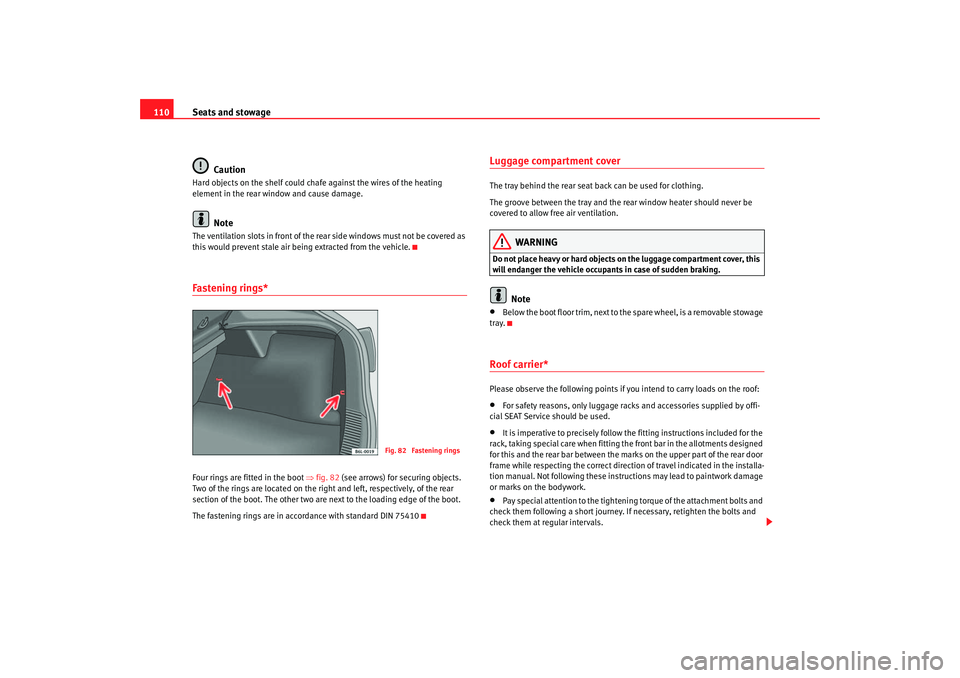
this would prevent stale air being extracted from the vehicle.Fastening rings*Four rings are fitted in the boot ⇒fig. 82 (see arrows) for securing objects.
Two of the rings are located on the right and left, respectively, of the rear
section of the boot. The other two are next to the loading edge of the boot.
The fastening rings are in accordance with standard DIN 75410
Luggage compartment coverThe tray behind the rear seat back can be used for clothing.
The groove between the tray and the re ar window heater should never be
covered to allow free air ventilation.
WARNING
Do not place heavy or hard objects on the luggage compartment cover, this
will endanger the vehicle occupants in case of sudden braking.
Note
•
Below the boot floor trim, next to the spare wheel, is a removable stowage
tray.
Roof carrier*Please observe the following points if you intend to carry loads on the roof:•
For safety reasons, only luggage racks and accessories supplied by offi-
cial SEAT Service should be used.
•
It is imperative to precisely follow the fitting instructions included for the
rack, taking special care when fitting th e front bar in the allotments designed
for this and the rear bar between the marks on the upper part of the rear door
frame while respecting the correct direction of travel indicated in the installa-
tion manual. Not following these instr uctions may lead to paintwork damage
or marks on the bodywork.
•
Pay special attention to the tightening torque of the attachment bolts and
check them following a short journey. If necessary, retighten the bolts and
check them at regular intervals.
Fig. 82 Fastening rings
cordoba_ingles Seite 110 Freitag, 7. Oktober 2005 6:00 18
Page 123 of 255
Air conditioning121
Safety First
Operating instructions
Tips and Maintenance
Te c h n i c a l D a t a
For the air conditioning system to wo
rk with maximum efficiency, the pollu-
tion filter must be replaced at the intervals specified in the Service Schedule.
If the filter loses efficiency prematurely due to use in areas with very high
levels of air pollution, the pollution filter must be changed more frequently
than stated in the Service Schedule.
Caution
•
If you suspect that the air conditioner is damaged, switch off the air condi-
tioner with button to prevent further damage and have it checked by a
qualified workshop.
•
Repairs to the air conditioning system require specialist knowledge and
special tools. Therefore, we recommend that you take the vehicle to a quali-
fied workshop should problems occur.Note
•
If the humidity and temperature outside the vehicle are high, condensa-
tion can drip off the evaporator in the cooling system and form a pool under-
neath the vehicle, this is completely normal and there is no need to suspect
a leak.
•
Keep the air intake slots in front of the windscreen free of snow, ice and
leaves to ensure heating and cooling is not impaired, and to prevent the
windows misting over.
•
The air from the vents flows through the passenger compartment and is
extracted by slots designed for this purpose. Do not cover these slots with
articles of clothing or other objects.
•
The air conditioning system operates most effectively with the windows
and the sliding/tilting roof* closed. Ho wever, if the sun has heated up the
vehicle, the air inside can be cooled more quickly by opening the windows for
a short period.
•
Do not smoke while air recirculation mode is on, as smoke drawn into the
air conditioning system leaves a residue on the evaporator, producing a
permanent unpleasant odour.
•
At low outside temperatures the comp ressor switches off automatically.
The button cannot be switched on either.
•
It is advidable to connect the air conditioning at least once a month, to
lubricate the system gasket s and prevent leaks. If a decrease in the cooling
capacity is detected, an Authorised Service Centre should be consulted to
check the system.
•
For correct operation of the system, do not block the grille between the button and the button
.
•
When the engine is under extreme strain, switch off the compressor for a
moment.
ECON
AUTO
AUTO
cordoba_ingles Seite 121 Freitag, 7. Oktober 2005 6:00 18
Page 125 of 255
Driving123
Safety First
Operating instructions
Tips and Maintenance
Te c h n i c a l D a t a
•
Adjust the driver seat or steering wheel so that there is a distance of at
least 25 cm between the steering wheel and your breast bone ⇒page 122,
fig. 90 . If you fail to observe the minimum distance, the airbag will not
protect you. Risk of fatal injury.
•
If your physical constitution prevents you from maintaining the
minimum distance of 25 cm, contact an Authorised Service Centre. The
Authorised Service Centre will help you decide if special specific modifica-
tions are necessary.
•
If you adjust the steering wheel so th at it points towards your face, the
driver airbag will not protect you prop erly in the event of an accident. Make
sure that the steering wheel points towards your chest.
•
When driving, always hold the steering wheel with both hands on the
outside of the ring at the 9 o'clock and 3 o'clock positions. Never hold the
steering wheel at the 12 o'clock position, or in any other manner (e.g. in
the centre of the steering wheel, or on the inside of the rim). In such cases,
you could receive severe injuries to the arms, hands and head.
SafetyElectronic stabilisation programme (ESP)*
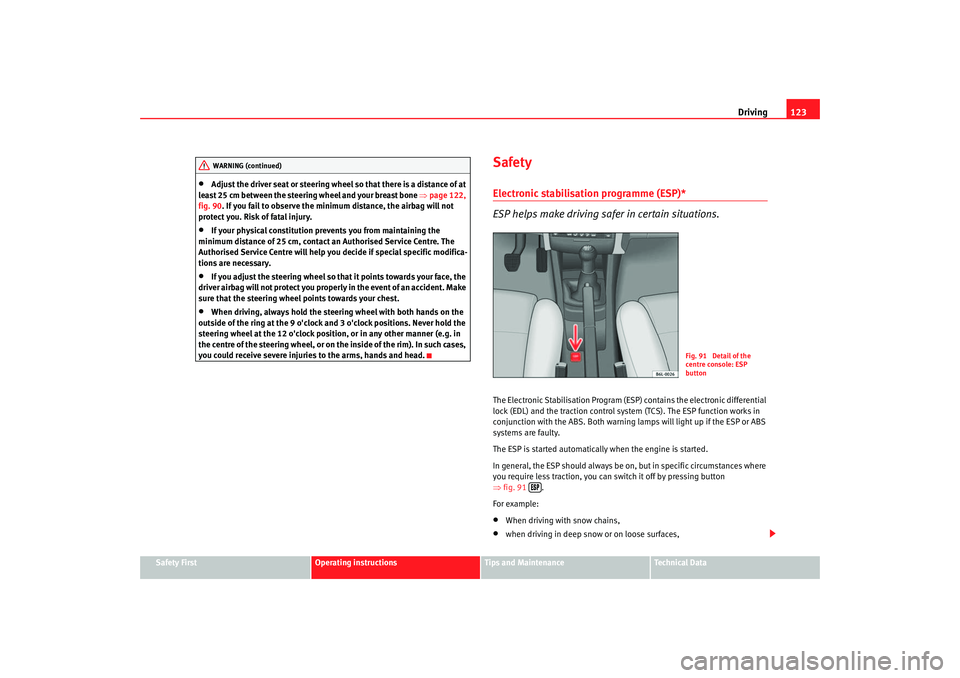
ESP helps make driving safer in certain situations.The Electronic Stabilisation Program (ESP ) contains the electronic differential
lock (EDL) and the traction control system (TCS). The ESP function works in
conjunction with the ABS. Both warning la mps will light up if the ESP or ABS
systems are faulty.
The ESP is started automatically when the engine is started.
In general, the ESP should always be on, but in specific circumstances where
you require less traction, you can switch it off by pressing button
⇒ fig. 91 .
For example:•
When driving with snow chains,
•
when driving in deep snow or on loose surfaces,
WARNING (continued)
Fig. 91 Detail of the
centre console: ESP
button
cordoba_ingles Seite 123 Freitag, 7. Oktober 2005 6:00 18
Page 134 of 255
Driving
132If, while driving, the selector lever accidentally moves to position N, first
release the accelerator pedal and wait until the engine slows to idling before
selecting a forwards gear ⇒ .
Starting
Select a range ( R, D, 3, 2, 1). Wait until the change has taken place and the
power transmission of the drive wheels has stabilised (slight pressure is
noticeable). Then depress the accelerator.
Stopping
In the case of a temporary stop, for example at a traffic lights, it is not neces-
sary to move to position N , it is sufficent to brake using the brake pedal. The
engine should only run at idle speed.
Parking
On slopes, first pull handbrake on firmly and then connect block. This
prevents overloading the blocking mechanism, making the subsequent
disconnect ion easier ⇒ .
Emergency start
in vehicles fitted with an automatic gearbox the engine can not be started by
towing or pushing the vehicle ⇒ page 217.
If the vehicle battery is flat, a battery from another car can be used to jump-
start the car using a set of jump leads ⇒ pa ge 125.
To w i n g
If the vehicle requires towing at any time, observe the instructions of
⇒ page 217, “Towing and tow-starting”
Back-up programme
In the event of a malfunction of the gearbox electronics, emergency
programmes are activated, according to the type of fault.•
The gearbox continues to connect gears automatically, but the operations
are jerky. Consult the Authorised Service Centre.
•
The gearbox does not automatically engage gears.
In this case they can be change d manually. 3rd gear is only available in posi-
tions D, 3 and 2 of the selector lever.
In positions 1 and R of the selector lever 1st gear and reve rse gear are available
respectively as normal
As the torque converter is required to work more, especially due to the lack of
2nd gear, it is possible that the gearbox oil may overheat. In this case,
consult the Auth orised Service Centre as soon as possible.
WARNING
•
In all the ranges the vehicle must always be held with the foot brake
when the engine is running. This is because an automatic gearbox still
transmits power even at idling speed , and the vehicle tends to “creep”.
•
If, when the car is at a standstill and the engine is idling, a range is
connected, take care not to accelerate accidentally (for example, when
working in the engine compartment), as the car will start to move immedi-
ately.
•
Before working on a running engine, place the selector lever in position
P and apply the handbrake.
•
To prevent the vehicle from moving out of control, the handbrake
should always be applied when the vehicle is at a standstill. In addition
move the selector lever to position P.
cordoba_ingles Seite 132 Freitag, 7. Oktober 2005 6:00 18