lights Seat Cordoba 2006 Owner's Guide
[x] Cancel search | Manufacturer: SEAT, Model Year: 2006, Model line: Cordoba, Model: Seat Cordoba 2006Pages: 255, PDF Size: 7.57 MB
Page 148 of 255
Driving and the environment
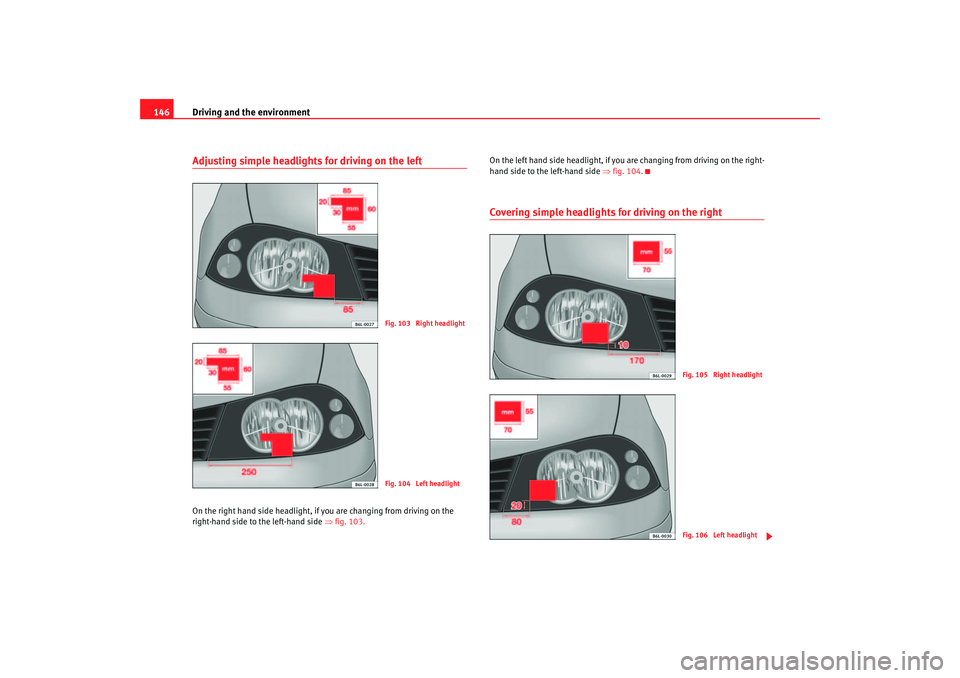
146Adjusting simple headlights for driving on the leftOn the right hand side headlight, if you are changing from driving on the
right-hand side to the left-hand side ⇒ fig. 103. On the left hand side headlight, if y
ou are changing from driving on the right-
hand side to the left-hand side ⇒ fig. 104.
Covering simple headlights for driving on the right
Fig. 103 Right headlightFig. 104 Left headlight
Fig. 105 Right headlightFig. 106 Left headlight
cordoba_ingles Seite 146 Freitag, 7. Oktober 2005 6:00 18
Page 154 of 255
Driving and the environment
152Think ahead when drivingA vehicle uses most fuel when accelerating. If you think ahead when driving,
you will need to brake less and thus accelerate less. Wherever possible, let
the vehicle roll slowly to a stop, for instance when you can see that the next
traffic lights are red.Regular servicingBy taking your car to an Authorised Service Centre for regular servicing you
can establish a basis for good fuel economy before you start driving. A well-
serviced engine give s you the benefit of improved fuel efficiency as well as
maximum reliability and an enhanced resale value.
A badly serviced engine can consume up to 10% more fuel than necessary.
Check the oil level every time you fill the tank ⇒page 174. Oil consumption
depends to a great extent on the engine load and engine speed. Depending
on your personal driving style, oil consumption can be up to 1 litre per 1,000
km.
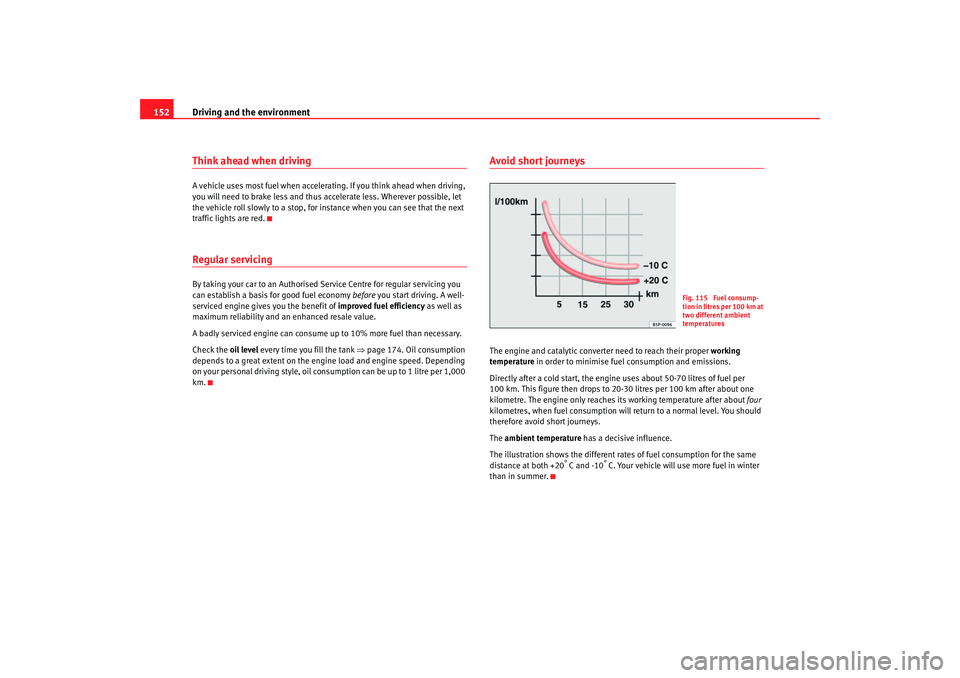
Avoid short journeysThe engine and catalytic converter need to reach their proper working
temperature in order to minimise fuel consumption and emissions.
Directly after a cold start, the engine uses about 50-70 litres of fuel per
100 km. This figure then drops to 20-30 litres per 100 km after about one
kilometre. The engine only reaches its working temperature after about four
kilometres, when fuel consumption will return to a normal level. You should
therefore avoid short journeys.
The ambient temperature has a decisive influence.
The illustration shows the different rates of fuel consumption for the same
distance at both +20
°C and -10
°C. Your vehicle will use more fuel in winter
than in summer.
Fig. 115 Fuel consump-
tion in litres per 100 km at
two different ambient
temperatures
cordoba_ingles Seite 152 Freitag, 7. Oktober 2005 6:00 18
Page 181 of 255
Checking and refilling levels179
Safety First
Operating instructions
Tips and Maintenance
Te c h n i c a l D a t a
Washer fluid and windscreen wiper bladesTopping up washer fluid
The water for cleaning the windscreen should always be
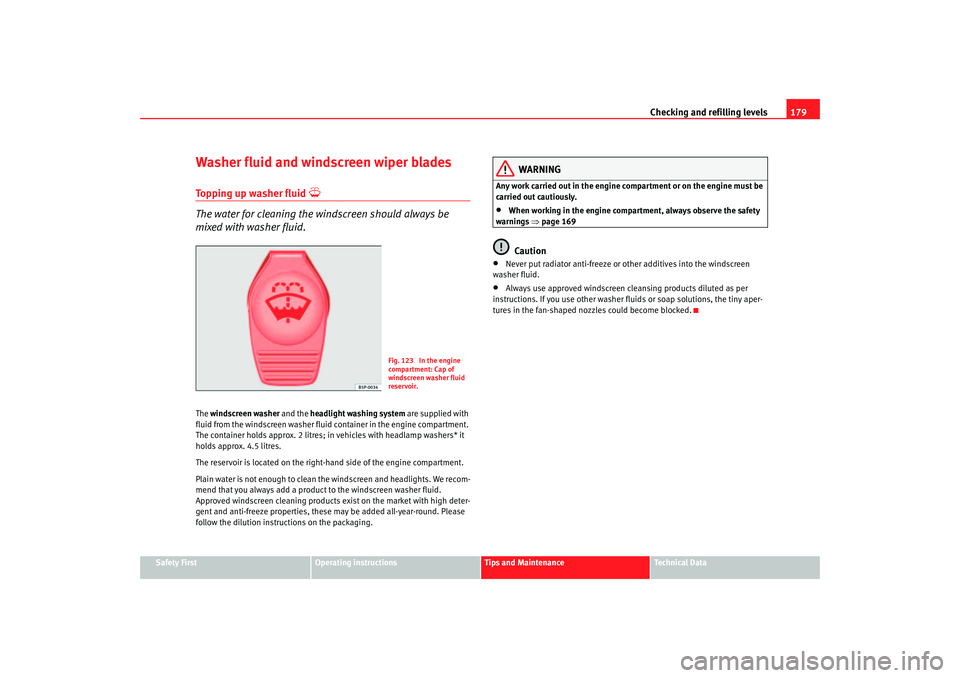
mixed with washer fluid.The windscreen washer and the headlight washing system are supplied with
fluid from the windscreen washer fluid container in the engine compartment.
The container holds approx. 2 litres; in vehicles with headlamp washers* it
holds approx. 4.5 litres.
The reservoir is located on the right-hand side of the engine compartment.
Plain water is not enough to clean the windscreen and headlights. We recom-
mend that you always add a product to the windscreen washer fluid.
Approved windscreen cleaning products exist on the market with high deter-
gent and anti-freeze properties, these may be added all-year-round. Please
follow the dilution instructions on the packaging.
WARNING
Any work carried out in the engine compartment or on the engine must be
carried out cautiously.•
When working in the engine compartm ent, always observe the safety
warnings ⇒page 169Caution
•
Never put radiator anti-freeze or other additives into the windscreen
washer fluid.
•
Always use approved windscreen cleansing products diluted as per
instructions. If you use other washer fl uids or soap solutions, the tiny aper-
tures in the fan-shaped nozzles could become blocked.
Fig. 123 In the engine
compartment: Cap of
windscreen washer fluid
reservoir.
cordoba_ingles Seite 179 Freitag, 7. Oktober 2005 6:00 18
Page 185 of 255
Checking and refilling levels183
Safety First
Operating instructions
Tips and Maintenance
Te c h n i c a l D a t a
•
Before opening the bonnet to check the brake fluid level, read and
observe the warnings ⇒page 169.
•
Brake fluid should be stored in the closed original container in a safe
place out of reach of children. This represents a toxic danger.
•
Have the brake fluid changed every two years at the latest. Heavy use
of the brakes may cause a vapour lock if the brake fluid is left in the system
for too long. This would seriously affect the efficiency of the brakes and the
safety of the vehicle. This may be an accident risk.Caution
Brake fluid could damage the paintwork. Wipe off any brake fluid from the
paintwork immediately.
For the sake of the environment
Brake fluid must be drained and disposed of in the proper manner observing
environmental regulations.
BatteryWarnings on handling the battery
WARNING
Always be aware of the danger of injury and chemical burns as well as the
risk of accident or fire when working on the battery and the electrical
system:•
Wear eye protection. Protect your eyes , skin and clothing from acid and
particles containing lead.
•
Battery acid is very corrosive and caustic. Wear protective gloves and
eye protection. Do not tilt the batter ies. This could spill acid through the
vents. Rinse battery acid from eyes immediately for several minutes with
clear water. Then seek medical care immediately. Neutralize any acid
splashes on the skin or clothing with a soapy solution, and rinse off with
plenty of water. If acid is swallowed by mistake, consult a doctor immedi-
ately.
•
Fires, sparks, naked lights and smoki ng are prohibited. When handling
cables and electrical equipment, avoid causing sparks and electrostatic
WARNING (continued)
Wear eye protection
Battery acid is very corrosive and caustic. Wear protec-
tive gloves and eye protection!
Fires, sparks, naked lights and smoking are prohibited!
A highly explosive mixture of gases is given off when the
battery is under charge.
Keep children away from acid and batteries!
cordoba_ingles Seite 183 Freitag, 7. Oktober 2005 6:00 18
Page 193 of 255
If and when191
Safety First
Operating instructions
Tips and Maintenance
Te c h n i c a l D a t a
If and whenVehicle tools, spare wheelVeh icle To ols
The tools and jack are stored under the floor panel in the
luggage compartment.–Lift floor panel
– Remove the tools or jack.The tool kit includes:•
Hook for removing wheel covers* or hub caps*
•
Box spanner for wheel bolts
•
Reversible screwdriver with handle (i ncluding hexagonal interior) for the
wheel bolts. The screwdriver is a combination tool.
•
Towing ring*
•
Adapter for the anti-theft wheel bolts*
Before replacing the jack in the storage area, wind the arm of the jack down
as far as it will go.
Some of the items listed are only provided on certain models, or are optional
extras.
WARNING
•
Do not use the hexagonal socket in the screwdriver handle to tighten
the wheel bolts. It is impossible to tighten the bolts with the torque neces-
sary, risk of accident.
•
The jack supplied by the factory is only designed for changing wheels
on this model. On no account attempt to use it for lifting heavier vehicles
or other loads, risk of injury.
•
Use the jack only on firm, level ground.
•
Never start the engine when the vehicle is on the jack, risk of accident.
•
I f w o r k is t o b e ca r r i e d o ut un d e r n ea t h t h e v e h i cle , t h is m u st b e s e c ure d
by suitable stands. Otherwise, there is a risk of injury in an accident.
Wheel changePreparation work
What you must do before changing a wheel.– If you have a flat tyre or puncture, park the vehicle as far away from the flow of traffic as possible. Choose a location that is as
level as possible.
– All passengers should leave the vehicle. They should wait in a
safe area (for instance behind the roadside crash barrier).
– Switch off the engine. Switch on the hazard warning lights.
–Apply the handbrake firmly.
WARNING (continued)
cordoba_ingles Seite 191 Freitag, 7. Oktober 2005 6:00 18
Page 194 of 255
If and when
192
– Engage the first gear, or put the selector lever to position P for
those vehicles with an automatic gearbox.
– If you are towing a trailer, unhitch it from your vehicle.
– Take the vehicle tools and the spare wheel out of the luggage
compartment.
WARNING
Put the hazard warning lights on and pl ace the warning triangle in position.
This is for your own safety and also warns other road users.
Caution
If you have to change the tyre on a gradient, block the wheel opposite the
wheel being changed by placing a stone or similar object under it to prevent
the vehicle from rolling away.
Note
Please observe legal requirements when doing so.Changing a wheelChange the wheel as described below
– Remove the wheel cover. Also refer to page 193, fig.
–Slacken the wheel bolts.
– Raise the car with the jack in the corresponding zone –
Ta k e o f f the wheel and then put on the spare wheel
– Lower the vehicle.
– Tighten the wheel bolts firmly in diagonal sequence with the box
spanner
–Replace the cover .
After changing a wheel
After changing the wheel there are still tasks to complete.– Put the tools and jack back in the luggage compartment.
– Place the wheel with the defective tyre in the luggage compart-
ment and secure it.
– Check the tyre pressure of the newly fitted tyre as soon as possible.
– Have the tightening torque of the wheel bolts checked as soon as possible with a torque wrench. The prescribed torque is 120 Nm.
Note•
If you notice that the wheel bolts are corroded and difficult to turn when
changing a wheel, they must be replaced before having the wheel bolt torque
checked.
•
In the interest of safety, drive at moderate speeds until the wheel bolt
torque has been checked.
cordoba_ingles Seite 192 Freitag, 7. Oktober 2005 6:00 18
Page 202 of 255
If and when
200
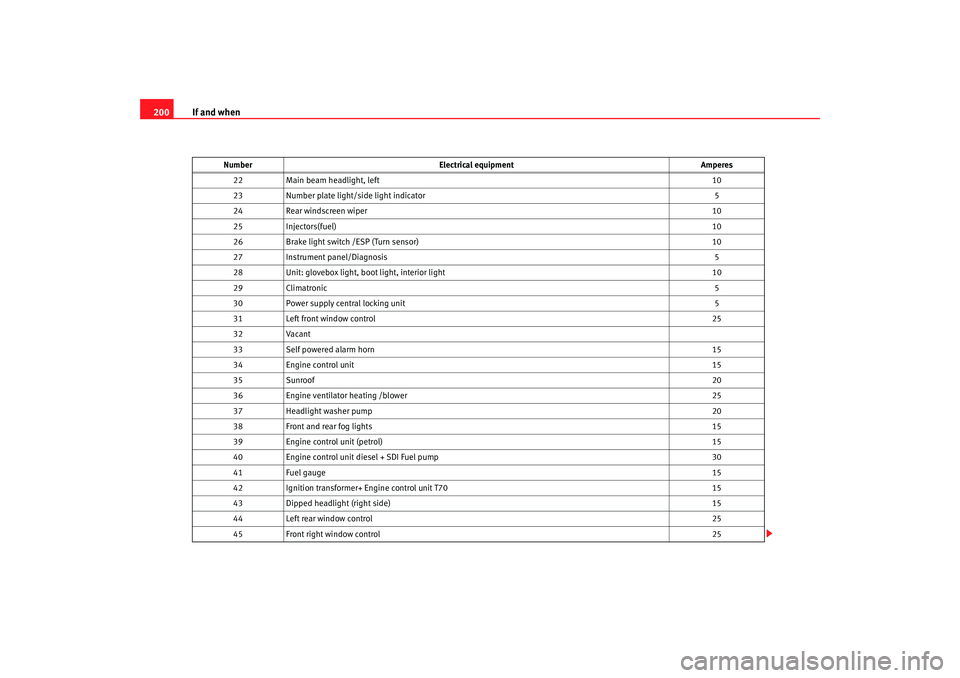
22 Main beam headlight, left 10
23 Number plate light/si de light indicator 5
24 Rear windscreen wiper 10
25 Injectors(fuel) 10
26 Brake light switch /ESP (Turn sensor) 10
27 Instrument panel/Diagnosis 5
28 Unit: glovebox light, boot light, interior light 10
29 Climatronic 5
30 Power supply central locking unit 5
31 Left front window control 25
32 Vacant
33 Self powered alarm horn 15
34 Engine control unit 15
35 Sunroof 20
36 Engine ventilator heating /blower 25
37 Headlight washer pump 20
38 Front and rear fog lights 15
39 Engine control unit (petrol) 15
40 Engine control unit diesel + SDI Fuel pump 30
41 Fuel gauge 15
42 Ignition transformer+ Engine control unit T70 15
43 Dipped headlight (right side) 15
44 Left rear window control 25
45 Front right window control 25
Number
Electrical equipment Amperes
cordoba_ingles Seite 200 Freitag, 7. Oktober 2005 6:00 18
Page 206 of 255
If and when
204Some of the electrical items listed in the table are only fitted on certain
models or are optional extras.
Please note that the above list, while corr ect at the time of printing, is subject
to alterations.Lamp changeGeneral notesBefore changing any lamp first turn off the equipment concerned.
Do not touch the lamp glass. Fingerprints vaporise in the heat, causing a
reduction in the lamp life and conden sation on the mirror surface, thus
reducing efficiency.
A lamp should only be placed by one of the same type. The designation is
inscribed on the bulb, either on the glass part or on the base.
It is highly recommended to keep a box of spare lamps in the vehicle. At the
very least, the lamps that most affect road safety should have spares in the
vehicle.
Rear lights on frame
Brake/side 12V/P21/5W
Indicator 12V/P21W Rear lights on tailgate
small side light 12V/W5W
fog light 12V/P21W
reverse 12V/P21W
Single reflector headlamps
main/dipped 12V 60/55W (H4)
indicator 12V/PY21W
side 12/W5W
Double reflector headlamps
dipped 12V/55W (H7)
main 12V/55W (H3)
indicator 12V/PY21W
side 12V/W5W
Xenon headlights
6)
dipped 12V/35W (D1S)
7)
main 12V/55W (H7)
indicator 12V/PY21W
side 12V/W5W
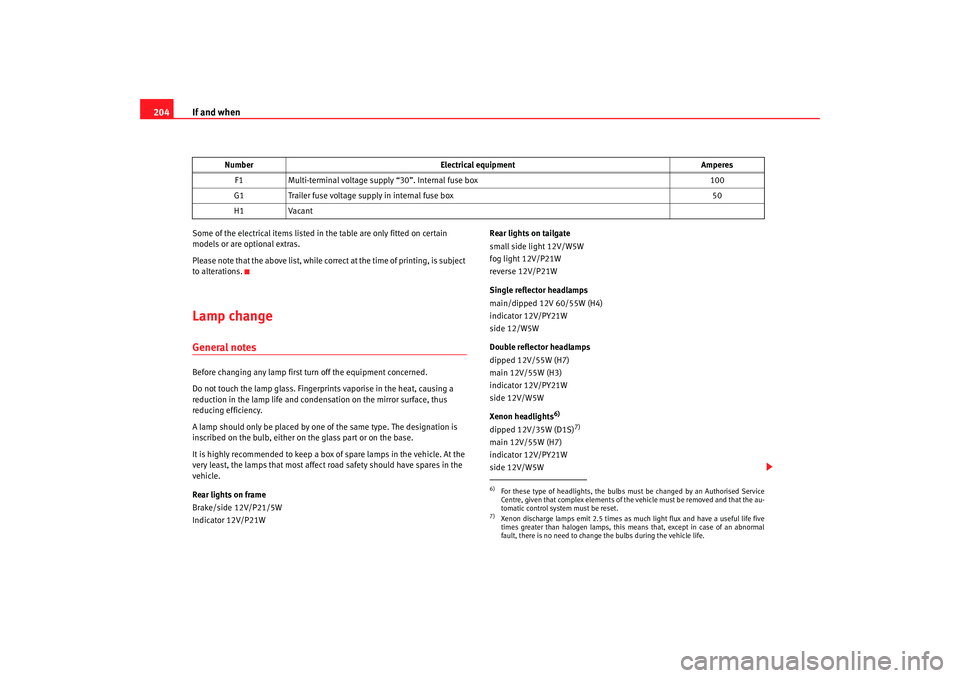
F1
Multi-terminal voltage supply “30”. Internal fuse box 100
G1 Trailer fuse voltage supply in internal fuse box 50
H1 Vacant
Number
Electrical equipment Amperes6)For these type of headlights, the bulbs must be changed by an Authorised Service
Centre, given that complex elements of the vehicle must be removed and that the au-
tomatic control system must be reset.7)Xenon discharge lamps emit 2.5 times as much light flux and have a useful life five
times greater than halogen lamps, this means that, except in case of an abnormal
fault, there is no need to change the bulbs during the vehicle life.
cordoba_ingles Seite 204 Freitag, 7. Oktober 2005 6:00 18
Page 207 of 255
If and when205
Safety First
Operating instructions
Tips and Maintenance
Te c h n i c a l D a t a
Fog lights*
Fog lights 12V/55W (H3)
Registration plate light
Registration plate light - C5W
Caution
•
The halogen lamps (H3, H7, H4...) are pressurised and might explode on
changing them.
•
Therefore protective gloves and glasses should be worn when changing a
halogen lamp.Note
•
Due to the difficulty in accessing the lamps, these must be changed by an
Authorised Service Centre. However, we shall explain how to change these
lamps, except for the xenon lights*.
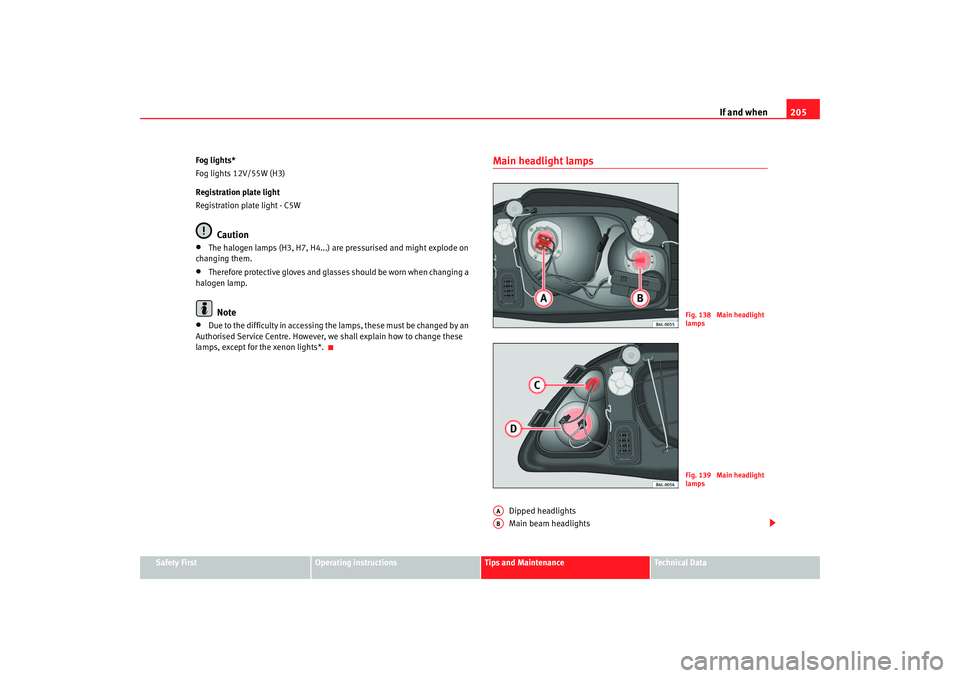
Main headlight lamps
Dipped headlights
Main beam headlights
Fig. 138 Main headlight
lampsFig. 139 Main headlight
lamps
AAAB
cordoba_ingles Seite 205 Freitag, 7. Oktober 2005 6:00 18
Page 208 of 255
If and when
206
Side lights
Indicator lights
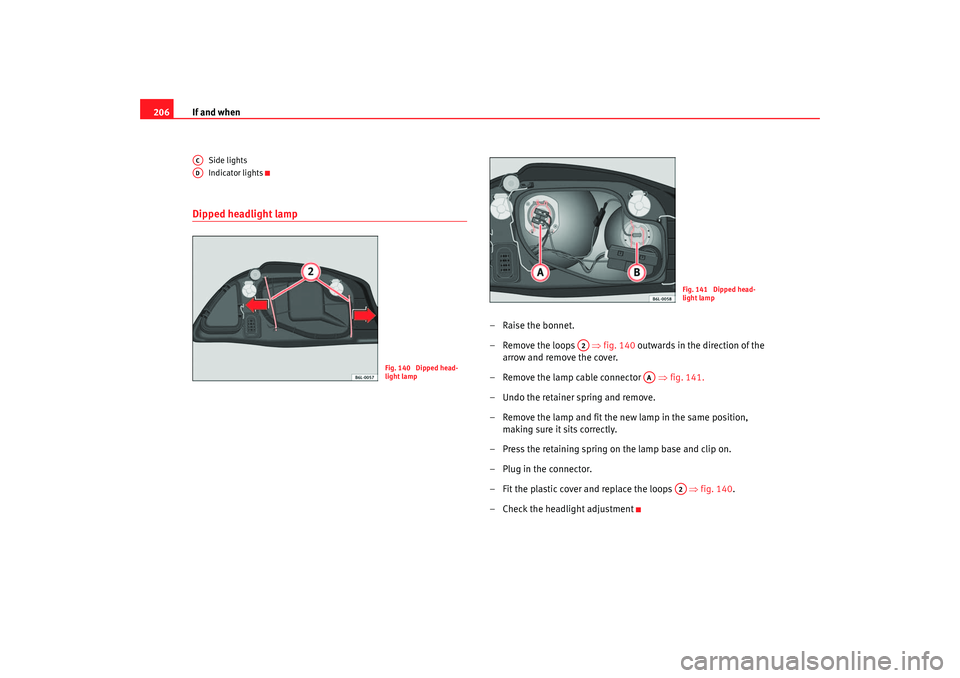
Dipped headlight lamp
–Raise the bonnet.
– Remove the loops ⇒fig. 140 outwards in the direction of the
arrow and remove the cover.
– Rem ove the lamp cable connector ⇒ fig. 141.
– Undo the retainer spring and remove.
– Remove the lamp and fit the new lamp in the same position, making sure it sits correctly.
– Press the retaining spring on the lamp base and clip on.
– Plug in the connector.
– Fit the plastic cover and replace the loops ⇒fig. 140.
– Check the headlight adjustment
ACAD
Fig. 140 Dipped head-
light lamp
Fig. 141 Dipped head-
light lamp
A2
AA
A2
cordoba_ingles Seite 206 Freitag, 7. Oktober 2005 6:00 18