maintenance Seat Cordoba 2006 Owner's Manual
[x] Cancel search | Manufacturer: SEAT, Model Year: 2006, Model line: Cordoba, Model: Seat Cordoba 2006Pages: 255, PDF Size: 7.57 MB
Page 3 of 255
ForewordThis owner's manual and the corresponding supplements should be read carefully to familiarise yourself quickly
with your vehicle.
Also, the regular care and maintenance and correct handling of the vehicle will contribute to the conservation of
its value.
For safety reasons, note the information concerning accessories, modifications and parts exchange.
If se lling the vehicle, give all of the onboard documentation to the new owner be cause this belongs with the
vehicle.
cordoba_ingles Seite 1 Fre itag, 7. Oktober 2005 6:00 18
Page 5 of 255
Contents3
ContentsThe structure of this manual
. . . . .
Content
. . . . . . . . . . . . . . . . . . . . . . . . . . . . . . . .
Safety First
. . . . . . . . . . . . . . . . . . . . . . . . . . .
Safe driving
. . . . . . . . . . . . . . . . . . . . . . . . . . . . . .
Brief introduction . . . . . . . . . . . . . . . . . . . . . . . .
Proper sitting position for occupants . . . . . . . . .
Pedal area . . . . . . . . . . . . . . . . . . . . . . . . . . . . . .
Stowing luggage . . . . . . . . . . . . . . . . . . . . . . . . .
Seat belts
. . . . . . . . . . . . . . . . . . . . . . . . . . . . . . . .
Introduction . . . . . . . . . . . . . . . . . . . . . . . . . . . . .
Why wear seat belts? . . . . . . . . . . . . . . . . . . . . . .
Seat belts . . . . . . . . . . . . . . . . . . . . . . . . . . . . . . .
Belt tension devices* . . . . . . . . . . . . . . . . . . . . .
Airbag system
. . . . . . . . . . . . . . . . . . . . . . . . . . . .
Brief introduction . . . . . . . . . . . . . . . . . . . . . . . .
Front airbags . . . . . . . . . . . . . . . . . . . . . . . . . . . .
Side airbags . . . . . . . . . . . . . . . . . . . . . . . . . . . . .
Curtain airbags . . . . . . . . . . . . . . . . . . . . . . . . . .
Deactivating airbags* . . . . . . . . . . . . . . . . . . . . .
Child safety
. . . . . . . . . . . . . . . . . . . . . . . . . . . . . .
Brief introduction . . . . . . . . . . . . . . . . . . . . . . . .
Child seats . . . . . . . . . . . . . . . . . . . . . . . . . . . . . .
Securing child seats . . . . . . . . . . . . . . . . . . . . . .
Operating instructions
. . . . . . . . . . . .
Cockpit
. . . . . . . . . . . . . . . . . . . . . . . . . . . . . . . . . . .
Overview . . . . . . . . . . . . . . . . . . . . . . . . . . . . . . .
Instruments . . . . . . . . . . . . . . . . . . . . . . . . . . . . .
Digital display in the instrument panel . . . . . . .
Warning lamps . . . . . . . . . . . . . . . . . . . . . . . . . . .
Steering wheel controls*
. . . . . . . . . . . . . . . . . .
Audio control via the controls on the steering
wheel . . . . . . . . . . . . . . . . . . . . . . . . . . . . . . . . . .
Opening and closing
. . . . . . . . . . . . . . . . . . . . . .
Central locking . . . . . . . . . . . . . . . . . . . . . . . . . . .
Keys . . . . . . . . . . . . . . . . . . . . . . . . . . . . . . . . . . .
Radio frequency remote control . . . . . . . . . . . . .
Anti-theft alarm system* . . . . . . . . . . . . . . . . . . .
Tailgate . . . . . . . . . . . . . . . . . . . . . . . . . . . . . . . . .
Windows . . . . . . . . . . . . . . . . . . . . . . . . . . . . . . .
Sliding/tilting roof* . . . . . . . . . . . . . . . . . . . . . . .
Lights and visibility
. . . . . . . . . . . . . . . . . . . . . . .
Lights . . . . . . . . . . . . . . . . . . . . . . . . . . . . . . . . . .
Interior lights . . . . . . . . . . . . . . . . . . . . . . . . . . . .
Visibility . . . . . . . . . . . . . . . . . . . . . . . . . . . . . . . .
Windscreen washers . . . . . . . . . . . . . . . . . . . . . .
Mirrors . . . . . . . . . . . . . . . . . . . . . . . . . . . . . . . . .
Seats and stowage
. . . . . . . . . . . . . . . . . . . . . . .
The importance of correct seat adjustment . . . .
Head restraints . . . . . . . . . . . . . . . . . . . . . . . . . .
Front seats . . . . . . . . . . . . . . . . . . . . . . . . . . . . . .
Rear seat bench . . . . . . . . . . . . . . . . . . . . . . . . . .
Stowage compartments . . . . . . . . . . . . . . . . . . .
Ashtrays, cigarette lighter and electrical sockets
First-aid kit, warning triangle, fire extinguisher
Luggage compartment . . . . . . . . . . . . . . . . . . . .
Air conditioning
. . . . . . . . . . . . . . . . . . . . . . . . . .
Heating . . . . . . . . . . . . . . . . . . . . . . . . . . . . . . . . .
Semiautomatic air conditio ning (Climatic) . . . .
Climatronic . . . . . . . . . . . . . . . . . . . . . . . . . . . . . .
General notes . . . . . . . . . . . . . . . . . . . . . . . . . . .
Driving
. . . . . . . . . . . . . . . . . . . . . . . . . . . . . . . . . . .
Steering . . . . . . . . . . . . . . . . . . . . . . . . . . . . . . . .
Safety . . . . . . . . . . . . . . . . . . . . . . . . . . . . . . . . . .
Ignition lock . . . . . . . . . . . . . . . . . . . . . . . . . . . . .
Starting and stopping the engine . . . . . . . . . . .
Manual gearbox . . . . . . . . . . . . . . . . . . . . . . . . . .
Automatic gearbox* . . . . . . . . . . . . . . . . . . . . . .
Handbrake . . . . . . . . . . . . . . . . . . . . . . . . . . . . . .
Cruise control system (CCS)* . . . . . . . . . . . . . . .
Tips and Maintenance
. . . . . . . . . . . . .
Intelligent technology
. . . . . . . . . . . . . . . . . . . . .
Brakes . . . . . . . . . . . . . . . . . . . . . . . . . . . . . . . . .
Anti-lock brake system and traction control ABS
Electronic stabilisation program (ESP)* . . . . . . .
Driving and the environment
. . . . . . . . . . . . . .
Running-in . . . . . . . . . . . . . . . . . . . . . . . . . . . . . .
Catalytic converter* . . . . . . . . . . . . . . . . . . . . . . .
Driving abroad . . . . . . . . . . . . . . . . . . . . . . . . . . .
Trailer towing . . . . . . . . . . . . . . . . . . . . . . . . . . . .
Driving economically and with respect for the
environment . . . . . . . . . . . . . . . . . . . . . . . . . . . . .
Cleaning and caring for your vehicle
. . . . . . .
General notes . . . . . . . . . . . . . . . . . . . . . . . . . . .
Care of the vehicle exterior . . . . . . . . . . . . . . . . .
Care of the vehicle interior . . . . . . . . . . . . . . . . .
5
6
7
7
7
9
14
15
17
17
19
22
26
28
28
31
34
38
41
43
43
45
47 51
51
51
52
54
60
68
68
70
70
75
77
79
82
83
86
88
88
92
93
94
96
99
99
100
102
104
105
107
109
109 112
112
115
118
120
122
122
123
124
125
128
129
133
134
139
139
139
140
141
143
143
144
145
149
151
153
153
154
159
cordoba_ingles Seite 3 Fre
itag, 7. Oktober 2005 6:00 18
Page 8 of 255
Content
6ContentThis manual is structured to give you the information you need as quickly and
clearly as possible. The contents of t his Manual are grouped into relatively
short sections making up chapters (e.g.“Air conditioning”). The entire
manual is divided into five large parts which are:1. Safety FirstInformation on the vehicle equipment relating to passive safety such as seat
belts, airbags, seats, etc.2. Controls and equipmentInformation about the distribution of co ntrols in the driver position of the
vehicle, about the seat adjustment possibilities, how to create a suitable
climate in the passenger compartment, etc.3. Tips and MaintenanceAdvice relating to driving, care and ma intenance of your vehicle and certain
problems which you may solve yourself.4. Technical DataFigures, data, dimensions and measurements (for example fuel consump-
tion) of your vehicle.5. Alphabetic indexAt the end of this manual there is a detailed alphabetical index, this will help
you to rapidly find the information you require.
cordoba_ingles Seite 6 Fre itag, 7. Oktober 2005 6:00 18
Page 9 of 255
Safe driving7
Safety First
Operating instructions
Tips and Maintenance
Te c h n i c a l D a t a
Safety FirstSafe drivingBrief introductionDear SEAT Driver
Safety first!This chapter contains important information, advice, suggestions
and warnings that should be read and followed in the interest of
your own safety and the safety of your passengers.
WARNING
•
This manual contains important info rmation concerning the driver's
and passengers' handling of the vehicle. The other booklets in the vehicle
wallet also contain further informatio n which you should be aware of for
your own safety and for the safety of your passengers.
•
Ensure that the complete vehicle wallet is always in the vehicle. This is
especially important when you lend or sell the vehicle to others.
Safety equipment
The safety equipment is a part of the occupant protection
system and can reduce the risk of injury during an accident.Never “gamble” with your safety and the safety of your passengers. In the
event of an accident, the safety equipment could reduce the risk of injury. The
following list includes most of the safety equipment in your SEAT:•
Optimised three-point seat belts,
•
Belt tension limiter for the front and rear seats,
•
belt tension devices for the front seats,
•
belt height adjustment for the front seats,
•
front airbags,
•
side airbags in the front seat backrests.
•
curtain airbags,
•
“ISOFIX” anchor points for “ISOFIX” child seats on the outer seats in the
second row,
•
height-adjustable head restraints,
•
head restraints with in-use position and non-use position
•
adjustable steering column.
The safety equipment mentioned above works together to provide you and
your passengers with the best possible protection in accident situations. But
this safety equipment cannot help you or your passengers if you or your
passengers assume an incorrect sitting position or do not properly adjust or
use this equipment.
cordoba_ingles Seite 7 Fre itag, 7. Oktober 2005 6:00 18
Page 11 of 255
Safe driving9
Safety First
Operating instructions
Tips and Maintenance
Te c h n i c a l D a t a
– When travelling long distances, take breaks regularly - at least
every two hours.
– If possible, avoid driving when you are tired or are under pres- sure of time.
WARNING
When driving safety is impaired during a trip, the risk of injury and acci-
dents increases.Proper sitting position for occupantsProper sitting position for driver
The proper sitting position for the driver is important for safe
and relaxed driving.
For your own safety and to reduce the risk of injury in the event of an
accident, we recommend the following adjustments for the driver:
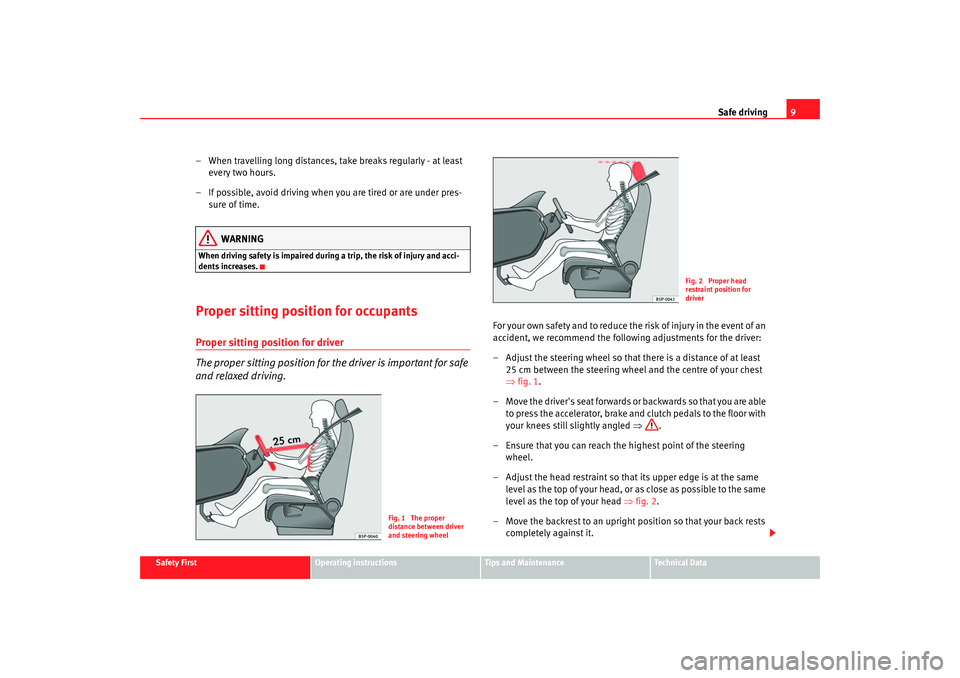
– Adjust the steering wheel so that there is a distance of at least
25 cm between the steering wheel and the centre of your chest
⇒ fig. 1.
– Move the driver's seat forwards or backwards so that you are able to press the accelerator, brake and clutch pedals to the floor with
your knees still slightly angled ⇒.
– Ensure that you can reach the highest point of the steering wheel.
– Adjust the head restraint so that its upper edge is at the same level as the top of your head, or as close as possible to the same
level as the top of your head ⇒fig. 2.
– Move the backrest to an upright position so that your back rests completely against it.
Fig. 1 The proper
distance between driver
and steering wheel
Fig. 2 Proper head
restraint position for
driver
cordoba_ingles Seite 9 Fre itag, 7. Oktober 2005 6:00 18
Page 13 of 255
Safe driving11
Safety First
Operating instructions
Tips and Maintenance
Te c h n i c a l D a t a
•
Adjust the front passenger seat so that there is at least 25 cm between
your breast bone and the dash panel. If you are sitting nearer than 25 cm,
the airbag system cannot protect you properly.
•
If your physical constitution prevents you from maintaining the
minimum distance of 25 cm, contact a qualified workshop. The workshop
will help you decide if special specific modifications are necessary.
•
Always keep your feet in the footwe ll when the vehicle is moving; never
rest them on the instrument panel, out the window or on the seat. An incor-
rect sitting position exposes you to an increased risk of injury in the event
of a braking manoeuvre or an accident. If the airbag is triggered, you could
sustain severe injuries due to an incorrect sitting position.
•
To reduce the risk of injury to the front passenger during sudden
braking manoeuvres or an accident, never travel with the backrest tilted far
back! The airbag system and seat belts can only provide optimal protection
when the backrest is in an upright position and the front passenger is
wearing his or her seat belt properly. The further the backrests are tilted to
the rear, the greater the risk of inju ry due to incorrect positioning of the
belt web or the incorrect sitting position!
•
Adjust the head restraint properly to achieve maximum protection.
Correct sitting position for passengers in the rear seats
Passengers in the rear seats must sit up straight, keep their
feet in the footwells, have the rear central head restraint posi-
tioned for use and wear their seat belts properly.To reduce the risk of injury in the event of a sudden braking
manoeuvre or an accident, passengers on the rear bench seat must
observe the following: –
Adjust the headrest to the correct position ⇒ page 12
– Keep both feet in the footwell in front of the rear seat.
– Always fasten your seat belt correctly ⇒page 17.
– Use an appropriate child restraint system when you take children in the vehicle ⇒page 43.
WARNING
•
If the passengers on the rear seat are not sitting properly, they could
sustain severe injuries.
•
Adjust the head restraint properly to achieve maximum protection.
•
Seat belts can only provide optimal protection when backrests are in an
upright position and the passengers ar e wearing their seat belts properly.
If passengers on the rear seat are not sitting in an upright position, the risk
of injury due to incorrect positioning of the belt web increases.
WARNING (continued)
cordoba_ingles Seite 11 Freitag, 7. Oktober 2005 6:00 18
Page 15 of 255
Safe driving13
Safety First
Operating instructions
Tips and Maintenance
Te c h n i c a l D a t a
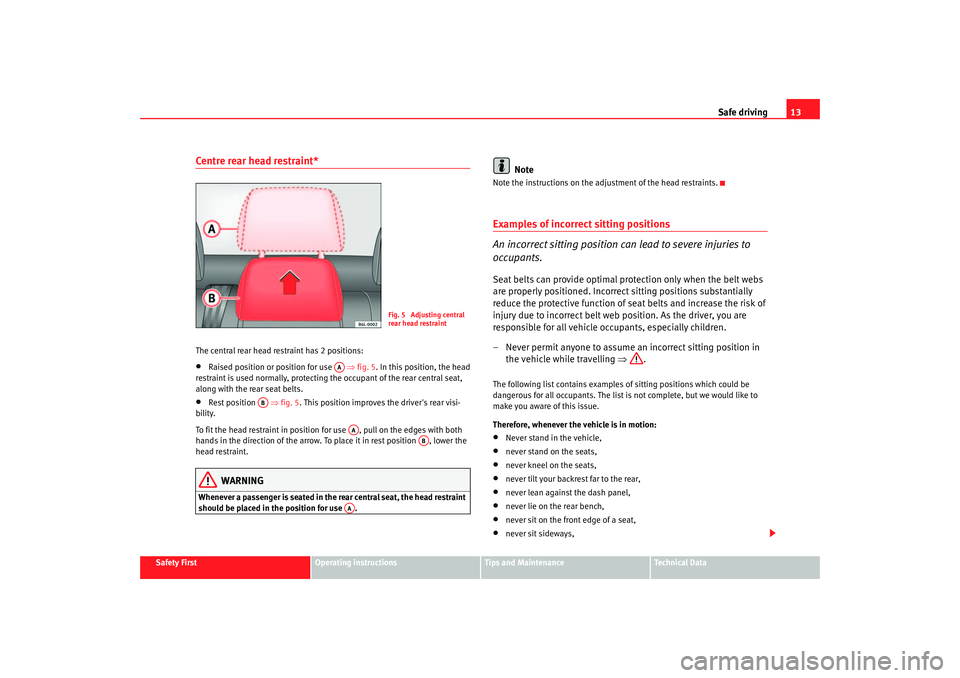
Centre rear head restraint*The central rear head restraint has 2 positions:•
Raised position or position for use ⇒fig. 5 . In this position, the head
restraint is used normally, protecting the occupant of the rear central seat,
along with the rear seat belts.
•
Rest position ⇒fig. 5 . This position improves the driver's rear visi-
bility.
To fit the head restraint in position for use , pull on the edges with both
hands in the direction of the arrow. To place it in rest position , lower the
head restraint.
WARNING
Whenever a passenger is seated in the rear central seat, the head restraint
should be placed in the position for use .
Note
Note the instructions on the adjustment of the head restraints.Examples of incorrect sitting positions
An incorrect sitting position can lead to severe injuries to
occupants.Seat belts can provide optimal protection only when the belt webs
are properly positioned. Incorrec t sitting positions substantially
reduce the protective function of se at belts and increase the risk of
injury due to incorrect belt web position. As the driver, you are
responsible for all vehicle occupants, especially children.
– Never permit anyone to assume an incorrect sitting position in the vehicle while travelling ⇒ .The following list contains examples of sitting positions which could be
dangerous for all occupants. The list is not complete, but we would like to
make you aware of this issue.
Therefore, whenever the vehicle is in motion:•
Never stand in the vehicle,
•
never stand on the seats,
•
never kneel on the seats,
•
never tilt your backrest far to the rear,
•
never lean against the dash panel,
•
never lie on the rear bench,
•
never sit on the front edge of a seat,
•
never sit sideways,
Fig. 5 Adjusting central
rear head restraint
AA
AB
AA
AB
AA
cordoba_ingles Seite 13 Freitag, 7. Oktober 2005 6:00 18
Page 17 of 255
Safe driving15
Safety First
Operating instructions
Tips and Maintenance
Te c h n i c a l D a t a
WARNING
•
If the pedals are obstructed, you could cause an accident. Risk of
serious injuries.
•
Ensure that the floor mats are always securely attached.
•
Never lay or fit floor mats or other floor coverings over the original floor
mats. This would reduce the pedal area and could obstruct the pedals. Risk
of accident.
Stowing luggageLoading the luggage compartment
All luggage and other loose object s must be safely secured in
the luggage compartment.Unsecured objects which shift back and forth could impair the
driving safety or driving characteristics of the vehicle by shifting the
centre of gravity.
– Distribute the load evenly in the luggage compartment.
– Lay and stow heavy luggage as far forward as possible in the luggage compartment.
– Stow heavy luggage as low as possible in the luggage compart- ment.
– Secu re hea vy ob
jects to the fitted fastening rings ⇒ p
age
16.
WARNING
•
Loose luggage and other objects in the luggage compartment can
cause serious injuries.
•
Always stow objects in the luggag e compartment and secure them on
the fastening rings.
•
Use suitable specialist straps to secure heavy objects.
•
During sudden manoeuvres or accidents, loose objects can be flung
forward, injuring vehicle occupants. Th is increased risk of injury will be
further increased if a loose object is struck by an inflating airbag. If this
happens, objects can be transformed into “missiles”. Risk of fatal injury.
•
Please note that the centre of gravity may shift when transporting
heavy objects; this may affect the vehicle's handling and lead to an acci-
dent. Therefore, it is essential to adjust your speed and driving style
accordingly, to avoid accidents.
•
Never exceed the allowed axle loads or allowed maximum weight. If the
allowed axle load or the allowed total weight is exceeded, the driving char-
acteristics of the vehicle may change, leading to accidents, injuries and
damage to the vehicle.
•
Never leave your vehicle unattended, especially when the tailgate is
open. Children could climb into the luggage compartment closing the door
behind them; they will remain trapped without help and there is a mortal
risk.
•
Never allow children to play in or around the vehicle. Close and lock
both the tailgate and all the doors when you leave the vehicle. Before you
lock the vehicle, make sure that ther e are no adults or children in the
vehicle.
•
Never transport passengers in the luggage compartment. Every
passenger must be properly belted in ⇒ page 17.
cordoba_ingles Seite 15 Freitag, 7. Oktober 2005 6:00 18
Page 19 of 255
Seat belts17
Safety First
Operating instructions
Tips and Maintenance
Te c h n i c a l D a t a
Seat belts IntroductionAlways fasten seat belts before driving!
Properly worn seat belts can save lives!In this chapter you will learn why seat belts are so important, how
they work and how to properly fasten, adjust and wear them.
– Read and observe all the information as well as the warnings in
this chapter.
WARNING
•
If the seat belts are worn incorrectly or not at all, the risk of severe inju-
ries increases.
•
Properly worn seat belts can reduce severe injuries in the event of
sudden braking manoeuvres or accidents. Therefore, you and your passen-
gers should always wear the seat belts properly as long as the vehicle is in
motion.
•
Pregnant women or persons with physical disabilities must also use
seat belts. Like all other occupants, these persons can also sustain severe
injuries if they are not wearing their seat belts properly.
Number of seatsYour vehicle has five passenger places, two individual front seats and three
places on the rear seat. Each seat is equipped with a three-point seat belt.
WARNING
•
Never transport more people than there are seats available in the
vehicle.
•
Every occupant in the vehicle must properly fasten and wear the seat
belt belonging to his or her seat. Chil dren must be protected with an appro-
priate child restraint system.
Seat belt warning la mp*
The warning lamp acts as a reminder to the driver to fasten
the seat belt.Before you drive:
– Always fasten your seat belt correctly before driving off.
– Instruct your passengers to fasten their seat belts properly before
driving off.
– Protect your children with child restraint systems appropriate for the size and age of the children.
cordoba_ingles Seite 17 Freitag, 7. Oktober 2005 6:00 18
Page 21 of 255
Seat belts19
Safety First
Operating instructions
Tips and Maintenance
Te c h n i c a l D a t a
Why wear seat belts?Frontal collisions and the laws of physics
In the event of a frontal collision, a large amount of kinetic
energy must be released.
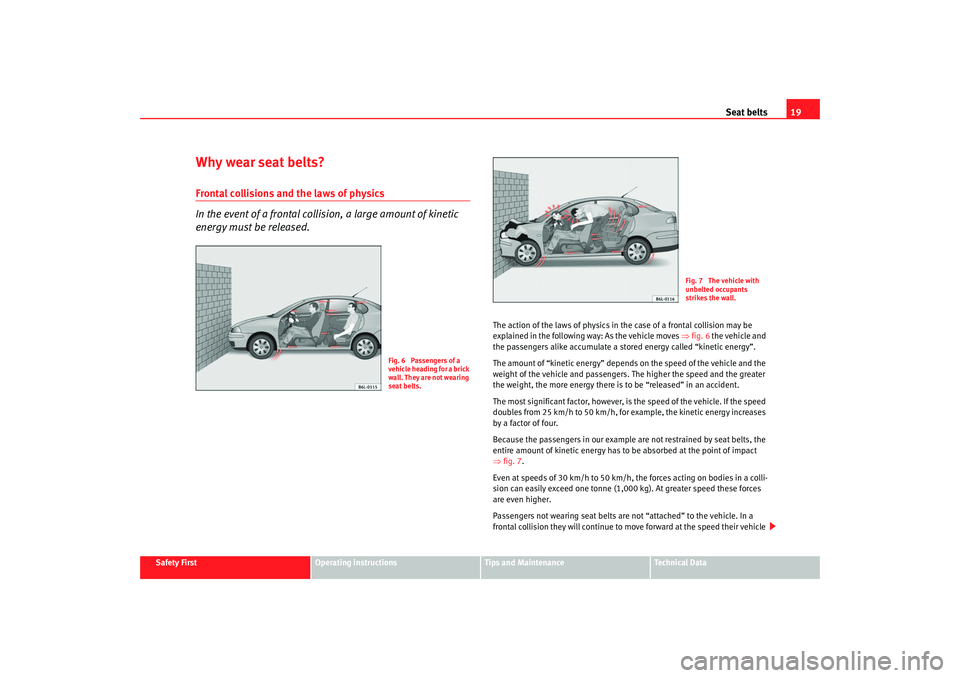
The action of the laws of physics in the case of a frontal collision may be
explained in the following way: As the vehicle moves ⇒fig. 6 the vehicle and
the passengers alike accumulate a stored energy called “kinetic energy”.
The amount of “kinetic energy” depends on the speed of the vehicle and the
weight of the vehicle an d passengers. The higher the speed and the greater
the weight, the more energy there is to be “released” in an accident.
The most significant factor, however, is the speed of the vehicle. If the speed
doubles from 25 km/h to 50 km/h, for example, the kinetic energy increases
by a factor of four.
Because the passengers in our example are not restrained by seat belts, the
entire amount of kinetic energy has to be absorbed at the point of impact
⇒ fig. 7 .
Even at speeds of 30 km/h to 50 km/h, the forces acting on bodies in a colli-
sion can easily exceed one tonne (1,000 kg). At greater speed these forces
are even higher.
Passengers not wearing seat belts are not “attached” to the vehicle. In a
frontal collision they will continue to move forward at the speed their vehicle
Fig. 6 Passengers of a
vehicle heading for a brick
wall. They are not wearing
seat belts.
Fig. 7 The vehicle with
unbelted occupants
strikes the wall.
cordoba_ingles Seite 19 Freitag, 7. Oktober 2005 6:00 18