ECU Seat Cordoba 2007 User Guide
[x] Cancel search | Manufacturer: SEAT, Model Year: 2007, Model line: Cordoba, Model: Seat Cordoba 2007Pages: 256, PDF Size: 7.75 MB
Page 48 of 256
Child safety
46Securing the child seat using the “ISOFIX” and “Toptether” system or the antirotation mechanism/system
Child seats with the “ISOFIX” and “Toptether” system can be
secured quickly, easily and safely on the rear outer seats.When removing or fitting the child seat, please be sure to follow the
manufacturer’s instructions.
– Move the seat as far to rear as it will go.
– Press the child seat onto the “ISOFIX” retaining rings until the
child seat can be heard to engage securely. If the child seat is
fitted with “Toptether” anchoring, connect it to the corre-
sponding ring. If the child seat is fitted with any other antirota-
tion system, follow the manufacturer instructions carefully.
– Pull on both sides of the child se at to ensure that it is secure.
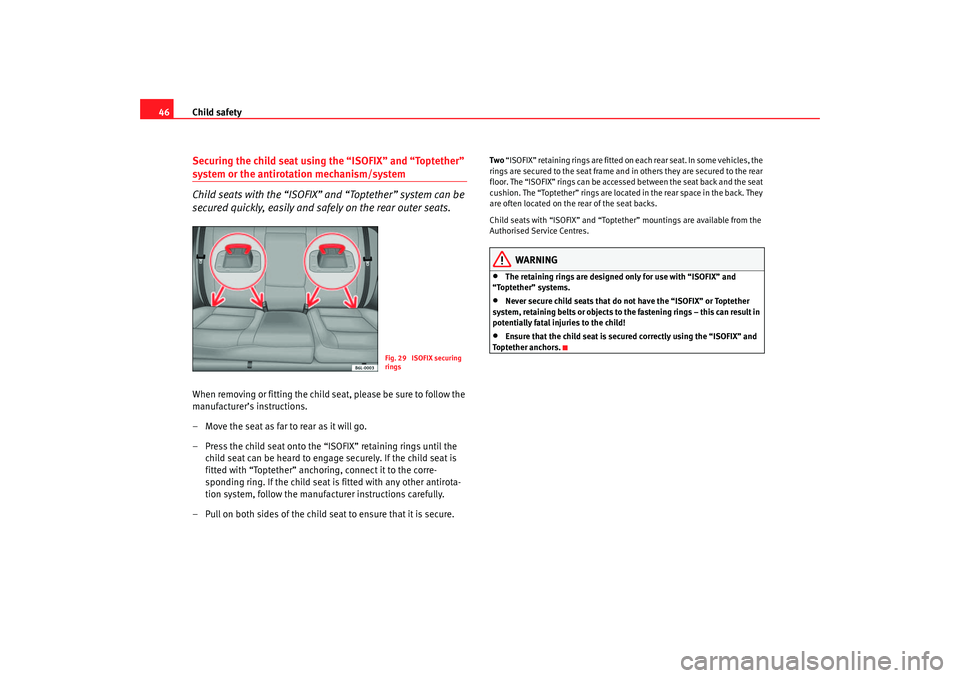
Two “ISOFIX” retaining rings are fitted on each rear seat. In some vehicles, the
rings are secured to the seat frame and in others they are secured to the rear
floor. The “ISOFIX” rings can be accessed between the seat back and the seat
cushion. The “Toptether” rings are located in the rear space in the back. They
are often located on the rear of the seat backs.
Child seats with “ISOFIX” and “Topteth er” mountings are available from the
Authorised Service Centres.
WARNING
•
The retaining rings are designed only for use with “ISOFIX” and
“Toptether” systems.
•
Never secure child seats that do not have the “ISOFIX” or Toptether
system, retaining belts or objects to the fastening rings – this can result in
potentially fatal injuries to the child!
•
Ensure that the child seat is secu red correctly using the “ISOFIX” and
Toptether anchors.
Fig. 29 ISOFIX securing
rings
cordoba_ingles_0706 Seite 46 Montag, 28. August 2006 1:18 13
Page 70 of 256
Unlocking and locking
68Unlocking and lockingDoorsLocking and unlocking the vehicle
From the outside of the vehicle, the driver’s door may be
locked or unlocked using the key.When opened , the latch will rise up (for vehicles without central locking)
For vehicles equipped with electric windows and central locking, if the key is
maintained in the opening position all of the electric side windows will open.
When locking the latch will descend (for vehicles without central locking)
In some vehicle models equipped with electric windows and central locking,
if the key is maintained in the locking position on the driver side, any side
windows left open, as well as the electric sunroof, will close.
For vehicles without central locking, the passenger door and the rear doors
may be locked from the outside without using a key. Just press the button
down and close the door.
The latch on the driver’s door may not be pushed down while the door is open
(only in vehicles without central locking) . This avoids accidentally leaving the
keys in the ignition.
From inside all the doors may be locked by pushing the security buttons down
(in vehicles withou t central locking).
WARNING
•
Exercise extreme caution when closing the windows and the sunroof
from the outside of the vehicle.
•
Closing from the outside without ta king care or observing all the
vehicle may cause bruising for other people especially children.
•
When locking a vehicle, never leave children unaccompanied inside, as
it will be difficult to provide assistance if required.
•
When the doors are locked, any intrusion is impeded, for example while
stopped at a red light.
Ce ntral l ocking *Description
The central locking system enables you to lock and unlock all
the doors and the tailgate from one point.Central locking can be activated us ing any of the following options:•
the key, by inserting it into the driver’s door cylinder and rotating manu-
ally,
•
the central locking button , (electronic control) in the passenger compart-
ment ⇒page 71,
•
the radio frequency remote control , using the buttons on the key
⇒ page 76.
Various functions are available to improve the vehicle security:
- Locking system “Safe”
- Selective unlocking system*WARNING (continued)
cordoba_ingles_0706 Seite 68 Montag, 28. August 2006 1:18 13
Page 71 of 256
Unlocking and locking69
Safety First
Operating instructions
Tips and Maintenance
Te c h n i c a l D a t a
- Auto-locking to prevent involuntary unlocking
- Automatic speed dependent locking and unlocking system*
- Emergency unlocking system
Note
For anti-theft security, only the driver’s door is fitted with a lock cylinder.Safety system “Safe”
This is an anti-theft device consisting of a double lock for the
door locks and a deactivation func
tion for the boot in order to
make forced entry more difficult.Activation
The “safe” system is activated when the vehicle is locked using the key or the
remote control.
To activate this system with the key, rotate the key once in the door lock
cylinder in the locking direction.
To activate the system using the remote control, press the lock button on the
remote once.
When this system is activated, it is not possible to open the doors normally,
from the outside or the inside. The boot/tailgate may not be opened. The
central locking button does not work.
Voluntary deactivation
The “Safe” system can be deactivated voluntarily by the user.
This is done by locking two times in quick succession (in under 2 seconds).
This double locking can be executed using the key or the remote control.
Using the key, rotate the lock cyli nder twice in the locking direction. To activate the system using the remote control, press the lock button on the
remote twice.
When the “Safe” system is deactivated, the alarm volumetric sensor is also
deactivated.
When the “Safe” system is deactivated, the doors are locked using the simple
locking system, meaning that they may
be opened from the interior but not
from the exterior.
Involuntary deactivation
The methods described for deactivati on of the “Safe” system may be
executed involuntarily (for example, if we press the button because we
want to lock the vehicle, and it locks as a result, however, we are not sure that
it is locked and we press the button once more within 2 seconds, we will have
deactivated the “Safe” system).
Deactivation when opening
To deactivate the system on opening, see “Selective unlocking system*”.
“Safe” status
On the driver’s door, there is a light in dicator visible from the outside of the
vehicle that indicates the “Safe” system status.
We can see that the “Safe” system is activated, by the flashing of the light
indicator . The indicator will flash on in all vehicles, whether they are fitted
with an alarm or not, and until the ve hicle is unlocked.
Remember:
Safe activated with or without alarm: Continuous flashing of the indicator.
Safe deactivated without alarm: The indicator remains unlit.
Safe deactivated with alarm: The indicator remains unlit.
cordoba_ingles_0706 Seite 69 Montag, 28. August 2006 1:18 13
Page 73 of 256
Unlocking and locking71
Safety First
Operating instructions
Tips and Maintenance
Te c h n i c a l D a t a
Each door may be unlocked and opened
from the interior (for example when
a passenger gets out). For this, simply operate the lever on the inside of the
door twice.
WARNING
When the vehicle is in motion, the internal door release levers should not
be operated, this could cause a door to open.Emergency unlocking systemThe entire vehicle is unlocked if the airbags are triggered during an accident,
except for the boot. It is possible to lock the vehicle from inside using the
central locking, after turning the ignition off and back on again.
Central locking button
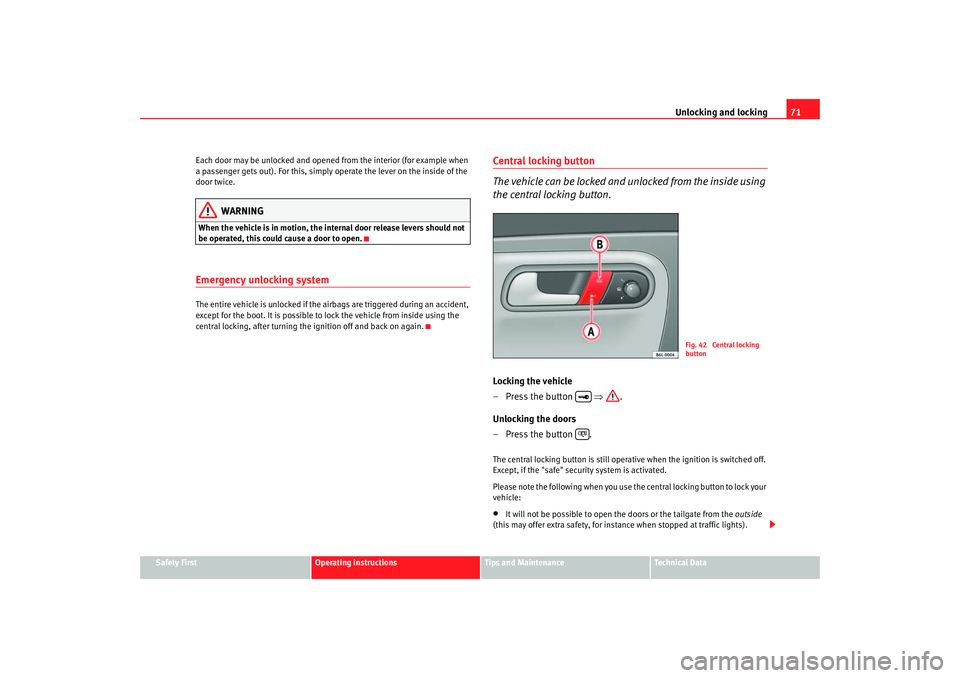
The vehicle can be locked and unlocked from the inside using
the central locking button.Locking the vehicle
– Press the button ⇒.
Unlocking the doors
– Press the button .The central locking button is still operative when the ignition is switched off.
Except, if the "safe" security system is activated.
Please note the following when you use the central locking button to lock your
vehicle:•
It will not be possible to open th e doors or the tailgate from the outside
(this may offer extra safety, for instance when stopped at traffic lights).
Fig. 42 Central locking
button
cordoba_ingles_0706 Seite 71 Montag, 28. August 2006 1:18 13
Page 78 of 256
Unlocking and locking
76Radio frequency remote controlLocking and unlocking the vehicle
The remote control key can be used to lock and unlock the
vehicle from a distance.
The following functions can be perf ormed using the remote control and
without using the key itself•
Opening and closing central locking system.
•
Turning the anti theft alarm* and the locking security system (double
lock) on and off.
•
Turning interior light on.
The radio frequency remote control device with batteries is fitted in the head
of the vehicle key. The receiver is in the interior of the vehicle.
The indicator light for the key always flashes when the remote control is used.
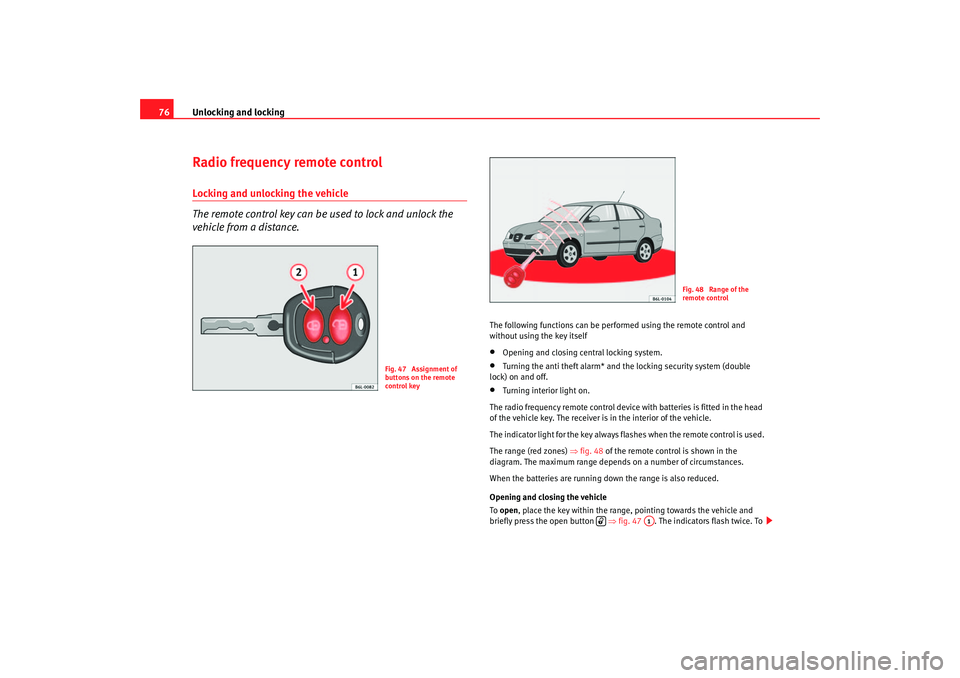
The range (red zones) ⇒fig. 48 of the remote cont rol is shown in the
diagram. The maximum range depends on a number of circumstances.
When the batteries are running down the range is also reduced.
Opening and closing the vehicle
To open , place the key within the range, pointing towards the vehicle and
briefly press the open button ⇒fig. 47 . The indicators flash twice. To
Fig. 47 Assignment of
buttons on the remote
control key
Fig. 48 Range of the
remote control
A1
cordoba_ingles_0706 Seite 76 Montag, 28. August 2006 1:18 13
Page 79 of 256
Unlocking and locking77
Safety First
Operating instructions
Tips and Maintenance
Te c h n i c a l D a t a
close
the vehicle, press the close button briefly ⇒fig. 47 . The indica-
tors flash once.
By pressing the locking button twice ⇒page 76, fig. 47 both the
locking security mechanism (double) and the volumetric alarm* are deacti-
vated but the perimetric alarm* remains active and this is indicated by the
indicator light on the driver’s door.
Selective unlocking*
When the button ⇒page 76, fig. 47 is used the driver’s door is
unlocked, all others remain locked.
Press the button ⇒page 76, fig. 47 twice to unlock all doors.
WARNING
•
Incorrect use of the key can result in critical injuries.
•
Never leave children or disabled persons in the vehicle; in case of emer-
gency they may not be able to leave the vehicle or look after themselves.
•
Never leave any of the vehicle keys in the vehicle. This could result in
serious injuries, accidents or the theft of your vehicle. Always take the key
with you when you leave the vehicle.
•
Unsupervised use of a key could me an that the engine is started or that
electrical equipment is used (e.g. elec tric windows). Risk of accident. The
vehicle can be locked using the remote control key. This could result in
people being trapped in the vehicle in an emergency.Note
•
The radio-frequency remote control ca n also be programmed so that only
the driver’s door is unlocked the first time that the unlocking button on the
radio frequency remote control key is pressed. When the button is pressed
once more, all doors and the tailgate will be unlocked.
•
The remote control functions only when you are in range ⇒page 76,
fig. 48 (red area).
•
If the vehicle is unlocked using the button, the vehicle will be
locked again automatically if any of the doors or the tailgate are not opened
within 30 seconds of unlocking the vehicle. This function prevents the vehicle
from remaining unlocked if the unlocking button is pressed by mistake.
•
If the vehicle cannot be opened and closed using the remote control, the
remote control key will have to be re-synchronised ⇒page 77.
Changing the batteryIf the battery indicator does not flash when the buttons are pushed, the
battery must be replaced.
Caution
Use of inappropriate batteries may damage the radio frequency remote
control. For this reason, always replac e the dead battery with another of the
same size and power.
For the sake of the environment
The flat batteries must be disposed of in accordance with regulations
governing the protection of the environment.Synchronising the remote control keySynchronising the remote control key
– Use both keys that have been delivered with the vehicle; the key with the remote and the normal key ⇒page 76, fig. 47
⇒ page 76, fig. 48 .
A2
A2
A1
A1
A1
cordoba_ingles_0706 Seite 77 Montag, 28. August 2006 1:18 13
Page 80 of 256
Unlocking and locking
78
–Maximum time allowed for synchronising is 30 seconds.
– The normal key is used to activate the ignition, and the key with the remote control is the key to be programmed.
– Check that the car is open before commencing programming.
– Place the key without remote control in the contact inside the steering and ignition lock.
– Use the key with remote control and mechanically lock the vehicle from the driver’s door.
– Open and close the driver’s door lock mechanically, using the remote control key.
– At the same time press the button on the remote control key.
– Complete the procedure by removing the key from the contactIt is possible that the vehicle could no longer be opened and closed with the
remote control if the button is repeatedly pressed outside of the effective
range of the radio frequency remote cont rol. The remote control key will have
to be resynchronised.
Spare remote control keys are available from Authorised Service Centres, they
must be matched to the locking system.
Anti-theft alarm system*Description of anti-theft alarm system*
The anti-theft alarm triggers an alarm if unauthorised move-
ments are detected around the vehicle.The anti-theft alarm makes it more difficult to break into the vehicle or steal
it. Audible and visible alarms are triggered if the car is opened using the
mechanical key, or if unauthorised access is gained to the vehicle.
The anti-theft alarm system is automatically switched on when the vehicle is
locked. To lock the door either turn the key once in the lock towards the
locking position or press button on the radio-frequency remote
control*. The system is activated imme diately and the indicator light located
on the driver’s door will flash along with the indicators indicating that the
alarm and the locking security system (double lock) have been turned on.
When the vehicle is locked the indicator lamps light up only if the alarm has
been correctly activated (all the protection zones should be correctly closed).
If any of the doors or the bonnet are open, when the alarm is connected these
will not be included in the protection zones of the vehicle. If the door or
bonnet is subsequently closed, they wi ll automatically be included in the
vehicle protection zones and the indicators will flash accordingly.
When does the system trigger an alarm?
The alarm system is triggered, in the locked vehicle, when:•
a door
•
the bonnet or
•
the tailgate
are unduly opened
•
or the ignition is switched on
A1
A2
cordoba_ingles_0706 Seite 78 Montag, 28. August 2006 1:18 13
Page 104 of 256
Seats and stowage
102Removing or adjust ing head restraints
The head restraints can be adjusted by moving them up and
down.Adjusting height (front seats)
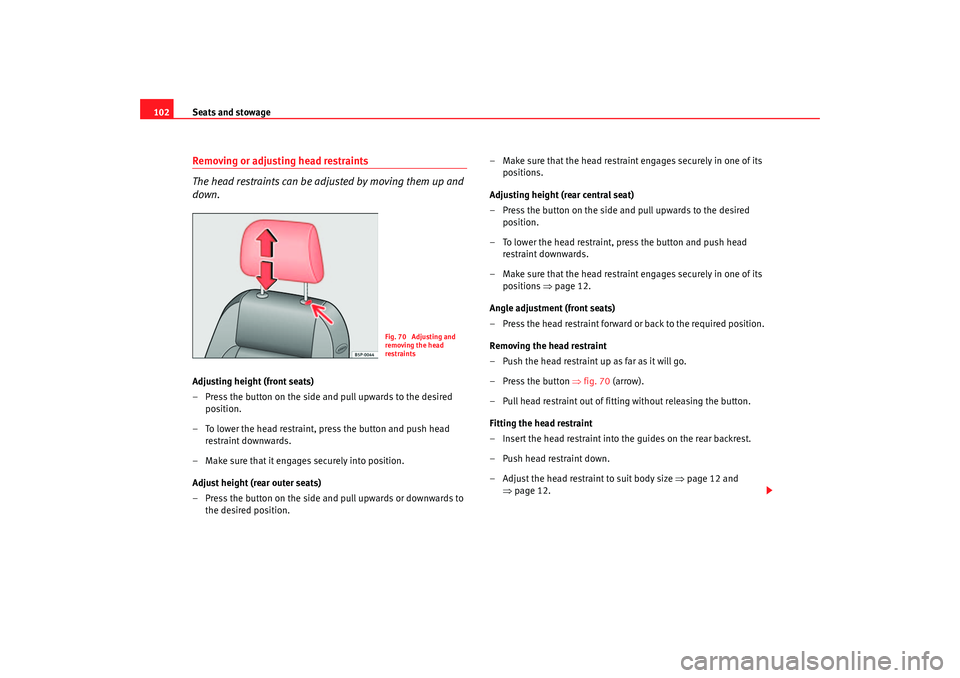
– Press the button on the side and pull upwards to the desired position.
– To lower the head restraint, press the button and push head restraint downwards.
– Make sure that it engages securely into position.
Adjust height (rear outer seats)
– Press the button on the side and pull upwards or downwards to the desired position. – Make sure that the head restrain
t engages securely in one of its
positions.
Adjusting height (rear central seat)
– Press the button on the side and pull upwards to the desired position.
– To lower the head restraint, press the button and push head restraint downwards.
– Make sure that the head restrain t engages securely in one of its
positions ⇒page 12.
Angle adjustment (front seats)
– Press the head restraint forward or back to the required position.
Removing the head restraint
– Push the head restraint up as far as it will go.
– Press the button ⇒fig. 70 (arrow).
– Pull head restraint out of fitting without releasing the button.
Fitting the head restraint
– Insert the head restraint into the guides on the rear backrest.
– Push head restraint down.
– Adjust the head restraint to suit body size ⇒page 12 and
⇒ page 12.
Fig. 70 Adjusting and
removing the head
restraints
cordoba_ingles_0706 Seite 102 Montag, 28. August 2006 1:18 13
Page 114 of 256
Seats and stowage
112the boot using rubber straps. The fire ex tinguisher can be fixed on the left-
hand side of the boot floor, fastened with velcro.
Note
• The first -a id kit, the warning tria ngles and the fire extinguisher are not
supplied with the vehicle as standard.
• The first-aid kit, the warning triangles and the fire extinguisher should
meet le gal requirements.
• The expiry d at e of the content of the first-aid kit should be checked.
•
Ensure that the fire extinguisher is fully functional. The fire extinguisher
should, therefore, be checked regularly. The sticker on the fire extinguisher
will inform you of the next date for checking.
•
Before acquiring accessories and emergency equipment see the instruc-
tions on ⇒ page 165, “Accessories, parts replacement and modifications”.
Luggage compartmentStowing luggage
All luggage must be securely stowed.Please observe the following points to ensure the vehicle handles
well at all times:
– Distribute the load as evenly as possible.
– Place heavy objects as far forward in the luggage compartment
as possible.
WARNING
•
Loose luggage and other loose items in the vehicle can cause serious
injuries.
•
Loose objects in the luggage compartment can suddenly move and
change the way the vehicle handles.
•
During sudden manoeuvres or accidents, loose objects in the
passenger compartment can be flung forward, injuring vehicle occupants.
•
Always put objects in the luggage compartment.
•
When you transport heavy objects, always keep in mind that a change
in the centre of gravity can also cause changes in vehicle handling.
•
Please observe information on safe driving ⇒page 7, “Safe driving”.Caution
Hard objects on the shelf could chafe against the wires of the heating
element in the rear window and cause damage.
Note
The ventilation slots in front of the rear side windows must not be covered as
this would prevent stale air being extracted from the vehicle.Luggage compartment coverThe tray behind the rear seat back can be used for clothing.
The groove between the tray and the re ar window heater should never be
covered, to allow free air ventilation.
cordoba_ingles_0706 Seite 112 Montag, 28. August 2006 1:18 13
Page 139 of 256
Driving137
Safety First
Operating instructions
Tips and Maintenance
Te c h n i c a l D a t a
– Switch off the engine and remove the key from the ignition lock.
Turn the steering wheel slightly to engage the steering lock.
– Always take you car keys with you when you leave the vehicle ⇒ .Additional notes on parking the vehicle on gradients:
Turn the steering wheel so that the vehicle would roll against the kerb if it did
start to roll.•
If the vehicle is facing downhill, turn the front wheels so that they point
towards the kerb.
•
If the vehicle is facing uphill , turn the front wheels so that they point away
from the kerb .
•
Secure the vehicle as normal by applying the handbrake firmly and
selecting first gear.
WARNING
•
Take measures to reduce the risk of injury when you leave your vehicle
unattended.
•
Never park where the hot exhaust system could ignite inflammable
materials, such as dry grass, low bushes, spilt fuel etc.
•
Never allow vehicle occupants to re main in the vehicle when it is
locked. They would be unable to open the vehicle from the inside, and
could become trapped in the vehicle in an emergency. In the event of an
emergency, locked doors will delay assistance to occupants.
•
Never leave children unsupervised in the vehicle. They could set the
vehicle in motion, for example, by releasing the handbrake or the gear
lever / selector lever.
•
Depending on weather conditions, it may become extremely hot or cold
inside the vehicle. This can be fatal.
Cruise control system (CCS)*Description
The cruise control system is able to maintain the set speed in
the range from approx. 30 km/h to 180 km/h.Once the speed setting has been saved, you may take your foot off the accel-
erator.
WARNING
It could be dangerous to use the cruise control system if it is not possible
to drive at constant speed.•
For safety reasons the cruise control system should not be used in
dense traffic, in sections with bends or where roads conditions are poor
(e.g. aquaplaning, loose chippings, slippery surfaces, snow). Risk of acci-
dent.
•
Always switch off the CCS when you have finished using it. This will
prevent you using it by mistake.
•
It is dangerous to use a set speed which is too high for the current road,
traffic or weather conditions. Risk of accident.Note
The cruise control cannot maintain a constant speed when descending gradi-
ents. The vehicle will accelerate under its own weight. Use the foot brake to
slow the vehicle.
cordoba_ingles_0706 Seite 137 Montag, 28. August 2006 1:18 13