coolant Seat Cordoba 2007 User Guide
[x] Cancel search | Manufacturer: SEAT, Model Year: 2007, Model line: Cordoba, Model: Seat Cordoba 2007Pages: 256, PDF Size: 7.75 MB
Page 132 of 256
Driving
130Glow plug system for the diesel engine
To avoid unnecessary load on the battery, do not use any other major elec-
trical equipment while the glow plugs are pre-heating.
Start the engine as soon as the glow plug warning lamp ⇒page 61 goes out.
Starting the engine after the fuel tank has been completely run dry
If the fuel tank has been completely run dry, it may take longer than normal
(up to one minute) to start the engine afte r refuelling with diesel fuel. This is
because the system must eliminate air first.
WARNING
•
Never start or run the engine in un ventilated or closed rooms. The
exhaust fumes contain carbon mono xide, an odourless and colourless
poisonous gas. Risk of fatal accidents. Carbon monoxide can cause loss of
consciousness. It can also cause death.
•
Never leave the vehicle unattended if the engine is running.
•
Never use “cold start sprays”, they could explode or cause the engine
to run at high revs. Risk of injury.Caution
•
When the engine is cold, you should av oid high engine speeds, driving at
full throttle and over loading the engine. Risk of engine damage.
•
The vehicle should not be pushed or towed for more than approximately
50 metres to start the engine. Fuel could enter the catalytic converter and
damage it.
•
Before attempting to push-start or tow a vehicle to start it, you should first
try to start it using the battery of another vehicle. Note and follow the instruc-
tions ⇒page 218, “Jump-starting”.
For the sake of the environment
Do not warm up the engine by running th e engine with the vehicle stationary.
You should drive off as soon as you start the engine. This helps the engine
reach operating temperature faster and reduces emissions.Switching off the engine– Stopping the engine.
– Turn the ignition key to position ⇒page 127, fig. 95 .After the engine is switched off the radiator fan may run on for up to 10
minutes, even if the ignition is switched of f. It is also possible that it will turn
itself on once more if the temperature of the coolant increases due to the
elimination of built up heat in the engine compartment or if this is heated due
to prolonged exposure to the heat of the sun.
WARNING
•
Never switch off the engine until the vehicle is stationary.
•
The brake servo works only when the engine is running. You will need
more strength to brake the vehicle when the engine is switched off. As you
cannot brake in the normal manner, there is a greater risk of accidents and
serious injury.
•
The steering lock can engage immediately when the key is removed
from the ignition lock. The vehicle cannot be steered. Risk of accident.
A0
cordoba_ingles_0706 Seite 130 Montag, 28. August 2006 1:18 13
Page 155 of 256
Driving and the environment153
Safety First
Operating instructions
Tips and Maintenance
Te c h n i c a l D a t a
Note
•
Towing a trailer places additional demands on the vehicle. We recom-
mend additional services between the normal inspection intervals if the
vehicle is used frequently for towing a trailer.
•
Find out whether special regulations apply to towing a trailer in your
country.
Ball coupling of towing bracket*
The ball coupling of the towing bracket is located in the tool
boxThe ball coupling is provided with instructions on fitting and removing the
ball coupling of the towing bracket.
WARNING
The towing bracket ball coupling must be stored securely in the luggage
compartment to prevent them being flung through the vehicle and causing
injury.
Note
•
By law, the ball coupling must be re moved if a trailer is not being towed
and it obscures the number plate.
Driving tips
Driving with a trailer always requires extra care.Weight distribution
The weight distribution of a loaded trailer with an unladen vehicle is very
unfavourable. However, if this cannot be avoided, drive extra slowly to allow
for the unbalanced we ight distribution.
Speed
The stability of the vehicle and trailer is reduced with increasing speed. For
this reason it is advisable not to drive at the maximum permissible speed in
unfavourable road, weather or wind conditions. This applies especially when
driving downhill.
You should always reduce speed immediately if the trailer shows the slightest
sign of snaking . Never try to stop the “s naking” by increasing speed.
Always brake in good time. If the trailer has an overrun brake, apply the
brakes gently at first and then firmly. This will pr event the jerking that can be
caused by the trailer wheel s locking. Select a low gear in good time before
going down a steep descent. This enables you to use the engine braking to
slow down the vehicle.
Heating
At very high temperatures and during prolonged ascents, driving in a low gear
and high engine speed, always monitor the temperature indicator for the
coolant ⇒page 49.
Electronic Stabilisation programme*
Do not switch off the ESP* when towing a trailer. The ESP* makes it easier to
stabilise if the trailer starts to snake.
cordoba_ingles_0706 Seite 153 Montag, 28. August 2006 1:18 13
Page 174 of 256
Checking and refilling levels
172In countries with different climatic conditions the diesel fuel sold generally
has different temperature characteristics. Check with an Authorised Service
Centre or filling stations in the country concerned regarding the type of diesel
fuels available.
Filter pre-heater
Your vehicle is fitted with a fuel filter pre-heater, making it well equipped for
operation in winter. This ensures that the fuel system remains operational to
approx. -24
°C, provided you use winter-grade diesel which is safe to -15
°C .
However, if the fuel has waxed to such an extent that the engine will not start
at temperatures of under -24
°C, simply place the vehicle in a warm place for
a while.
Caution
Do not mix fuel additives (“thinners”, or similar additives) with diesel fuel.Working in the engine compartmentSafety instructions on working in the engine compartment
Any work carried out in the engine compartment or on the
engine must be carried out cautiously.Before starting any work on the engine or in the engine compart-
ment:
1. Switch off the engine and remove the key from the ignition.
2. Apply the handbrake.
3. Move the gear stick to neutral or the selector lever to position P. 4. Wait for the engine to cool down.
5. Keep children away from the vehicle.
6. Raise the bonnet
⇒page 174.
You should not do any work in the engine compartment unless you know
exactly how to carry out the jobs and have the correct tools! Have the work
carried out by a qualified workshop if you are uncertain.
All service fluids and consumables, e.g. coolant, engine oil, spark plugs and
batteries, are being constantly developed . SEAT provides a constant flow of
information to the Authorised Service Centres concerning modifications. For
this reason we recommend that you have service fluids and consumables
replaced by an Authorised Service Centre. Please observe the relevant
instructions ⇒page 165. The engine compartmen t of any motor vehicle is a
hazardous area. ⇒.
WARNING
All work on the engine or in the engine compartment, e.g. checking and
refilling fluids, involves the danger of injury and scalding as well as the risk
of accident or fire.•
Never open the bonnet if you see steam, smoke or coolant escaping
from the engine compartment. Otherwise, there is a risk of sustaining
burns. Wait until no more steam or coolant is emitted, then allow the
engine to cool before carefully opening the bonnet.
•
Switch off the engine and remove the key from the ignition.
•
Apply the handbrake and move the gear stick to neutral or selector
lever to position P.
•
Keep children away from the vehicle.
•
Never touch hot engine parts. There is a risk of burns.
•
Never spill liquids on a hot engine or on a hot exhaust gas system. This
is a fire hazard.
cordoba_ingles_0706 Seite 172 Montag, 28. August 2006 1:18 13
Page 175 of 256
Checking and refilling levels173
Safety First
Operating instructions
Tips and Maintenance
Te c h n i c a l D a t a
•
Avoid causing short-circuits in the electrical system, particularly at the
points where the jump leads are attached ⇒page 219. The battery could
explode.
•
Never touch the radiator fan. It is temperature controlled and could
start automatically, even when the engine has been switched off and the
key removed from the ignition!
•
Do not unscrew the cap on the expansion tank when the engine is hot.
If the coolant is hot, the cooling system will be pressurised!
•
Protect face, hands and arms by covering the cap with a large, thick
cloth to protect against escaping coolant and steam.
•
Always make sure you have not left any objects, such as cleaning cloths
and tools, in the engine compartment.
•
If you have to work underneath the vehicle, you must use suitable
stands additionally to support the vehicle, there is a risk of accident!. A
hydraulic jack is insufficient for securing the vehicle and there is a risk of
injury.
•
If any work has to be performed when the engine is started or with the
engine running, there is an additional, pote ntially fatal, safety risk from the
rotating parts, such as the drive belts, alternator, radiator fan, etc., and
from the high-voltage ignition syst em. You should also observe the
following points:
−Never touch the electrical wiring of the ignition system.
− Ensure that jewellery, loose clothing and long hair do not get
trapped in rotating engine parts. Danger of death. Before starting any
work remove jewellery, tie back and cover hair, and wear tight-fitting
clothes.
− Always think carefully about pressing the accelerator if a gear is
engaged in either an automatic or manual gearbox. The vehicle could
move, even if the handbrake is applied. Danger of death.
•
If work has to be carried out on the fuel system or on electrical compo-
nents, you must observe the following sa fety notes in addition to the above
warnings:
−Always disconnect the battery. The vehicle must be unlocked when
this is done, otherwise the alarm will be triggered.
− Do not smoke.
− Never work near naked flames.
− Always have a fire extinguisher on hand.Caution
When changing or topping up service fluids, make absolutely certain that you
fill the fluids into the correct reservoirs. Failure to observe this point will result
in serious malfunctions and engine damage!
For the sake of the environment
Service fluids leaks are harmful to the environment. For this reason you
should make regular checks on the ground underneath your vehicle. If you
find spots of oil or other fluids, have your vehicle inspected in a qualified
workshop.
WARNING (continued)
WARNING (continued)
cordoba_ingles_0706 Seite 173 Montag, 28. August 2006 1:18 13
Page 176 of 256
Checking and refilling levels
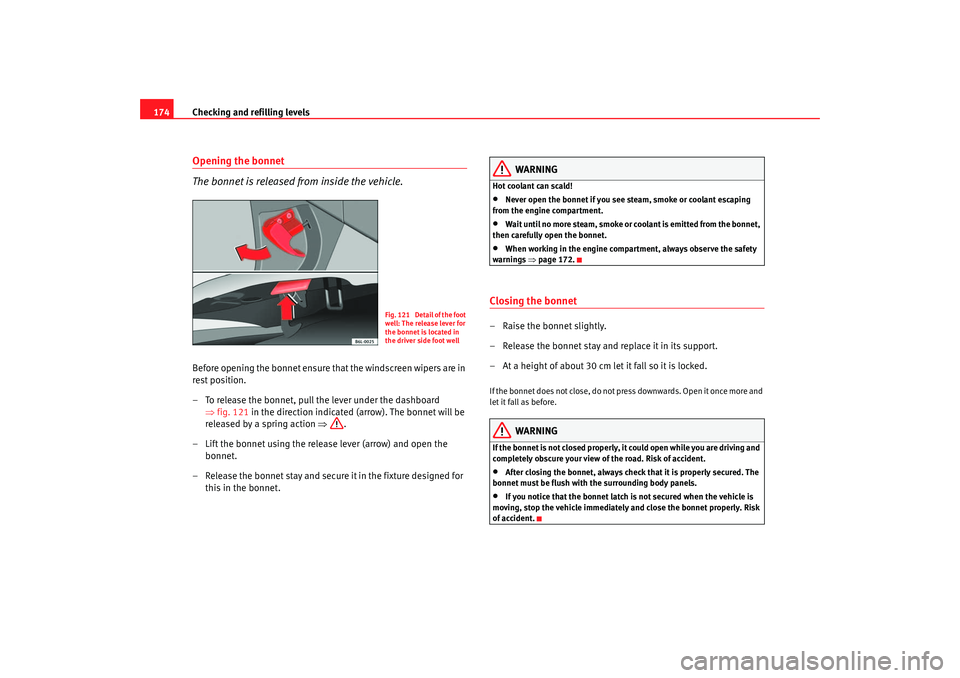
174Opening the bonnet
The bonnet is released from inside the vehicle.Before opening the bonnet ensure that the windscreen wipers are in
rest position.
– To release the bonnet, pull the lever under the dashboard
⇒fig. 121 in the direction indicated (arrow). The bonnet will be
released by a spring action ⇒.
– Lift the bonnet using the release lever (arrow) and open the bonnet.
– Release the bonnet stay and secure it in the fixture designed for
this in the bonnet.
WARNING
Hot coolant can scald!•
Never open the bonnet if you see steam, smoke or coolant escaping
from the engine compartment.
•
Wait until no more steam, smoke or coolant is emitted from the bonnet,
then carefully open the bonnet.
•
When working in the engine compartment, always observe the safety
warnings ⇒page 172.
Closing the bonnet–Raise the bonnet slightly.
– Release the bonnet stay and replace it in its support.
– At a height of about 30 cm let it fall so it is locked.If the bonnet does not close, do not press downwards. Open it once more and
let it fall as before.
WARNING
If the bonnet is not closed properly, it could open while you are driving and
completely obscure your view of the road. Risk of accident.•
After closing the bonnet, always check that it is properly secured. The
bonnet must be flush with the surrounding body panels.
•
If you notice that the bonnet latch is not secured when the vehicle is
moving, stop the vehicle immediately and close the bonnet properly. Risk
of accident.
Fig. 121 Detail of the foot
well: The release lever for
the bonnet is located in
the driver side foot well
cordoba_ingles_0706 Seite 174 Montag, 28. August 2006 1:18 13
Page 181 of 256
Checking and refilling levels179
Safety First
Operating instructions
Tips and Maintenance
Te c h n i c a l D a t a
For the sake of the environment
•
Because of the disposal problems, the necessa ry special tools and
specialist knowledge required, we reco mmend that you have the engine oil
and filter changed by an Authorised Service Centre.
•
Never pour oil down drains or into the ground.
•
Use a suitable container when draining the used oil. It has to be large
enough to hold all the engine oil
CoolantCoolant specifications
Coolant is a mixture of water and at least 40% coolant addi-
tive.The cooling system must be filled with a mixture of water and at least 40 % of
our coolant additive G 12+ or an additive with the specification TT-VW 774 F
(it is dyed purple). This mixture gives the necessary frost protection down to
-25
° C and protects the alloy parts of the cooling system against corrosion. It
also prevents scaling and raises the boiling point of the coolant.
The concentration of coolant must always be at least 40% - even if frost
protection is not required.
If greater frost protection is required in very cold climates, the proportion of
the antifreeze additive G 12+ can be increased. However, the percentage of
coolant additives should not exceed 60%, as this would reduce the frost
protection. It would also reduce the cooling effect. A mixture with 60%
coolant additive will give frost protection to approx. -40
° C.
WARNING
•
The coolant additive is toxic. There is a toxic risk. Always keep the
coolant additive in the original container which should be stored out of the
reach of children. The same applies to coolant that you have drained off.
•
The coolant additive G 12+ must be added in sufficient quantities to
provide anti-freeze protection at the coldest ambient temperatures that
can be expected. At extremely cold ambient temperatures, the coolant
could freeze, causing the vehicle to breakdown. As the heater would also
not work in this situat ion, there is a risk of suffering exposure!Caution
•
Other additives may give considerably inferior corrosion protection. The
resulting corrosion in the cooling system can lead to a loss of coolant,
causing serious damage to the engine.
•
The coolant additive G 12+ (purple) can be mixed with the additive G 12
(red) or G 11. Never mix G12 (red colour) with G 11.
cordoba_ingles_0706 Seite 179 Montag, 28. August 2006 1:18 13
Page 182 of 256
Checking and refilling levels
180Checking the coolant level and topping up
The correct coolant level is important for fault-free func-
tioning of the engine cooling system.Before opening the bonnet, read and observe the warnings ⇒ in
“Safety instructions on working in the engine compartment” on
page 172.
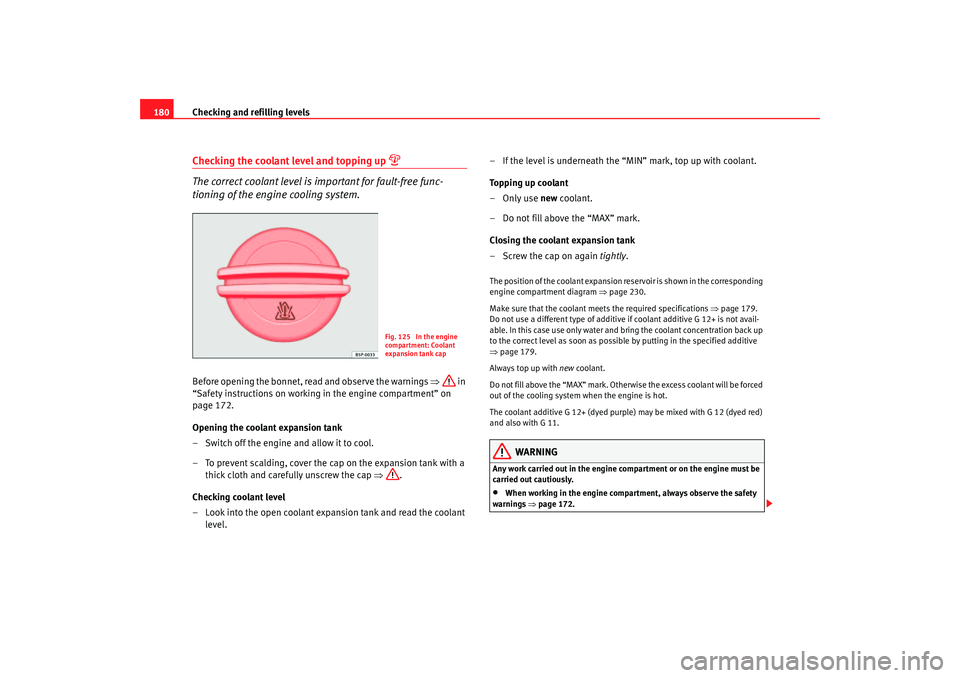
Opening the coolant expansion tank
– Switch off the engine and allow it to cool.
– To prevent scalding, cover the cap on the expansion tank with a thick cloth and carefully unscrew the cap ⇒.
Checking coolant level
– Look into the open coolant expansion tank and read the coolant level. – If the level is underneath the “MIN” mark, top up with coolant.
Topping up coolant
–Only use
new coolant.
– Do not fill above the “MAX” mark.
Closing the coolant expansion tank
– Screw the cap on again tightly.
The position of the coolant expansion re servoir is shown in the corresponding
engine compartment diagram ⇒page 230.
Make sure that the coolant meets the required specifications ⇒page 179.
Do not use a different type of additive if coolant additive G 12+ is not avail-
able. In this case use only water and bring the coolant concentration back up
to the correct level as soon as possible by putting in the specified additive
⇒ page 179.
Always top up with new coolant.
Do not fill above the “MAX” mark. Otherwise the excess coolant will be forced
out of the cooling system when the engine is hot.
The coolant additive G 12+ (dyed purple ) may be mixed with G 12 (dyed red)
and also with G 11.
WARNING
Any work carried out in the engine compartment or on the engine must be
carried out cautiously.•
When working in the engine compartment, always observe the safety
warnings ⇒page 172.
Fig. 125 In the engine
compartment: Coolant
expansion tank cap
cordoba_ingles_0706 Seite 180 Montag, 28. August 2006 1:18 13
Page 183 of 256
Checking and refilling levels181
Safety First
Operating instructions
Tips and Maintenance
Te c h n i c a l D a t a
•
When the engine is warm or hot, the cooling system is pressurised! Do
not unscrew the cap on the expansion t ank when the engine is hot. This is
a burn injury risk.Caution
•
When mixed with other additives the colour of G 12 will change to brown.
If this occurs you should have the coolant changed immediately. Failure to do
so will result in engine damage!
•
If a lot of coolant has been lost, wait for the engine to cool down before
putting in cold coolant. This avoids damaging the engine. Large coolant
losses are an indication of leaks in the cooling system. See a specialised
workshop immediately and have the c ooling system checked. Otherwise,
there is a risk of engine damage.
Washer fluid and windscreen wiper bladesTopping up washer fluid
The water for cleaning the windscreen should always be
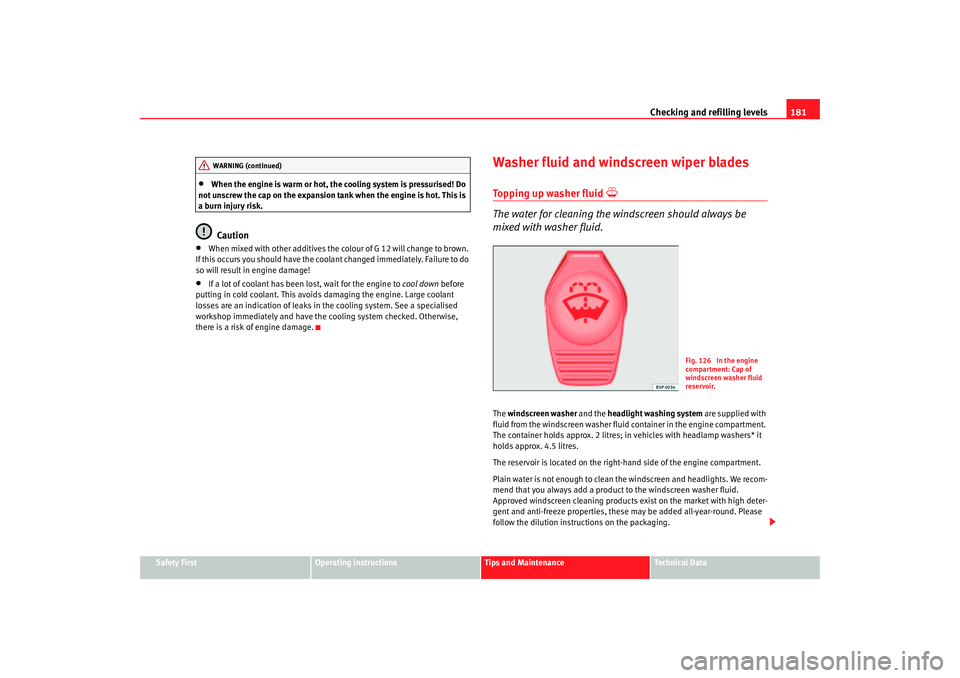
mixed with washer fluid.The windscreen washer and the headlight washing system are supplied with
fluid from the windscreen washer fluid container in the engine compartment.
The container holds approx. 2 litres; in vehicles with headlamp washers* it
holds approx. 4.5 litres.
The reservoir is located on the right-hand side of the engine compartment.
Plain water is not enough to clean th e windscreen and headlights. We recom-
mend that you always add a product to the windscreen washer fluid.
Approved windscreen cleaning products exist on the market with high deter-
gent and anti-freeze properties, these may be added all-year-round. Please
follow the dilution instructions on the packaging.
WARNING (continued)
Fig. 126 In the engine
compartment: Cap of
windscreen washer fluid
reservoir.
cordoba_ingles_0706 Seite 181 Montag, 28. August 2006 1:18 13
Page 248 of 256
Index
246CCar care
Exterior . . . . . . . . . . . . . . . . . . . . . . . . . . . . . 157
Car care products . . . . . . . . . . . . . . . . . . . . . . . 156
Car phone . . . . . . . . . . . . . . . . . . . . . . . . . . . . . 166
Car washes . . . . . . . . . . . . . . . . . . . . . . . . . . . . 157
Catalytic converter . . . . . . . . . . . . . . . . . . . . . . 146
Central locking . . . . . . . . . . . . . . . . . . . . . . . . . . 68 Automatic speed dependent locking and un-locking system* . . . . . . . . . . . . . . . . . . . . . 70
Emergency unlocking system . . . . . . . . . . . . 71
Locking system for invo luntary unlocking . . 70
Selective unlocking system* . . . . . . . . . . . . 70
Unlocking system* . . . . . . . . . . . . . . . . . . . . 70
Central locking button Central locking . . . . . . . . . . . . . . . . . . . . . . . 71
unlocking . . . . . . . . . . . . . . . . . . . . . . . . . . . . 71
Cetane number . . . . . . . . . . . . . . . . . . . . . . . . . 171
Change lamps dipped headlight lamp . . . . . . . . . . . . . . . . 210
Changing gear See Manual gearbox . . . . . . . . . . . . . . . . . . 131
Changing lamps interior light and reading light . . . . . . . . . . 217
changing lamps rear lights on frame . . . . . . . . . . . . . . . . . . . 216
rearlights on tailgate . . . . . . . . . . . . . . . . . 215
Changing the lamps glove box light* . . . . . . . . . . . . . . . . . . . . . . 217
indicator lights . . . . . . . . . . . . . . . . . . . . . . 213 main beam lights . . . . . . . . . . . . . . . . . . . . 211
Main headlight lamps . . . . . . . . . . . . . . . . . 209
number plate light . . . . . . . . . . . . . . . . . . . 217
side beam lights . . . . . . . . . . . . . . . . . . . . . 212
Side indicator lights . . . .
. . . . . . . . . . . . . . 215
Changing windscreen wiper blades . . . . . . . . . 182
Chassis number . . . . . . . . . . . . . . . . . . . . . . . . 226
Checking . . . . . . . . . . . . . . . . . . . . . . . . . . . . . . 186
Checking battery electrolyte level . . . . . . . . . . 186
Checking engine oil level . . . . . . . . . . . . . . . . . 176
Child safety . . . . . . . . . . . . . . . . . . . . . . . . . . . . . 41
Child seat . . . . . . . . . . . . . . . . . . . . . . . . . . . . . . . 42 Categorisation in groups . . . . . . . . . . . . . . . 42
Group 1 . . . . . . . . . . . . . . . . . . . . . . . . . . . . . 43
Group 2 . . . . . . . . . . . . . . . . . . . . . . . . . . . . . 44
Group 3 . . . . . . . . . . . . . . . . . . . . . . . . . . . . . 44
Groups 0 and 0+ . . . . . . . . . . . . . . . . . . . . . . 43
Safety notes . . . . . . . . . . . . . . . . . . . . . . . . . . 41
Securing . . . . . . . . . . . . . . . . . . . . . . . . . . . . . 45
Child seats ISOFIX and Toptether system . . . . . . . . . . . . 46
on the front passenger seat . . . . . . . . . . . . . 27
Cigarette lighter . . . . . . . . . . . . . . . . . . . . . . . . 109
Cleaning alloy wheels . . . . . . . . . . . . . . . . . . . . 161
Cleaning and caring for your vehicle . . . . . . . . 156
Cleaning chrome . . . . . . . . . . . . . . . . . . . . . . . . 160
Cleaning cloth seat covers . . . . . . . . . . . . . . . . 163
Cleaning dash panel . . . . . . . . . . . . . . . . . . . . . 162
Cleaning engine compartment . . . . . . . . . . . . . 162
Cleaning fabric trim . . . . . . . . . . . . . . . . . . . . . . 163 Cleaning leather . . . . . . . . . . . . . . . . . . . . . . . . 163
Cleaning plastic parts . . . . . . . . . . . . . . . . . . . . 162
Cleaning seat belts . . . . . . . . . . . . . . . . . . . . . . 164
Cleaning steel wheels . . . . . . . . . . . . . . . . . . . . 160
Cleaning windows . . . . . . . . . . . . . . . . . . . . . . . 159
Cleaning wooden trim . . . . . . . . . . . . . . . . . . . . 163
Climatronic
automatic mode . . . . . . . . . . . . . . . . . . . . . 121
controls . . . . . . . . . . . . . . . . . . . . . . . . . . . . 120
General notes . . . . . . . . . . . . . . . . . . . . . . . 123
manual mode . . . . . . . . . . . . . . . . . . . . . . . 122
Clock . . . . . . . . . . . . . . . . . . . . . . . . . . . . . . . . . . 52
Cockpit . . . . . . . . . . . . . . . . . . . . . . . . . . . . . . . . . 49
Control Light switches . . . . . . . . . . . . . . . . . . . . . . . . 87
wing mirrors . . . . . . . . . . . . . . . . . . . . . . . . . 98
Control lamps . . . . . . . . . . . . . . . . . . . . . . . . . . . 58
Control lighting . . . . . . . . . . . . . . . . . . . . . . . . . . 49
Controls electric windows . . . . . . . . . . . . . . . . . . . . . . 82
Convenience closing Sliding/tilting roof . . . . . . . . . . . . . . . . . . . . 86
Windows . . . . . . . . . . . . . . . . . . . . . . . . . . . . 84
Convenience opening Windows . . . . . . . . . . . . . . . . . . . . . . . . . . . . 84
Coolant . . . . . . . . . . . . . . . . . . . . . . . . . . . 179, 180
Coolant Level . . . . . . . . . . . . . . . . . . . . . . . . . . . 180
Coolant level warning light . . . . . . . . . . . . . . . . . . . . . . . . . 61
Coolant Loss . . . . . . . . . . . . . . . . . . . . . . . . . . . 180
cordoba_ingles_0706 Seite 246 Montag, 28. August 2006 1:18 13
Page 249 of 256
Index247
Coolant temperature
Display . . . . . . . . . . . . . . . . . . . . . . . . . . . . . . 51
Safety instructions . . . . . . . . . . . . . . . . . . . . . 62
Correct adjustment of front head restraints . . . . 12
Cruise control system . . . . . . . . . . . . . . . . . . . . 137
Curtain airbags . . . . . . . . . . . . . . . . . . . . . . . . . . 36 Description . . . . . . . . . . . . . . . . . . . . . . . . . . . 36
Function . . . . . . . . . . . . . . . . . . . . . . . . . . . . . 37
Safety notes . . . . . . . . . . . . . . . . . . . . . . . . . . 37DDanger of fitting a child seat on the front passenger seat . . . . . . . . . . . . . . . . . . . . . . . . . . . . . . . 27
Diesel . . . . . . . . . . . . . . . . . . . . . . . . . . . . . . . . . 171
Diesel engine Winter driving . . . . . . . . . . . . . . . . . . . . . . . . 171
Diesel engine particulate filter* . . . . . . . . . . . . 147
Differential lock . . . . . . . . . . . . . . . . . . . . . . . . . 144
Differential lock fault (EDL) warning lamp . . . . . . . . . . . . . . . . . . . . . . . . . 65
Digital clock . . . . . . . . . . . . . . . . . . . . . . . . . . . . . 52
Dipped headlights . . . . . . . . . . . . . . . . . . . . . . . . 87
Disabling front passenger airbag Safety notes . . . . . . . . . . . . . . . . . . . . . . . . . . 40
Disabling the airbag Disabling front passenger airbag . . . . . . . . . 39
Displays in the Multi-function display Memory displays . . . . . . . . . . . . . . . . . . . . . . 54
Door lock cylinders . . . . . . . . . . . . . . . . . . . . . . 160
Door release lever . . . . . . . . . . . . . . . . . . . . . . . . 49 Doors
Childproof locks . . . . . . . . . . . . . . . . . . . . . . . 72
Unlocking and locking . . . . . . . . . . . . . . . . . 68
Drive wheels traction control system . . . . . . . . 142
Driving Driving abroad . . . . . . . . . . . . . . . . . . . . . . . 147
With a trailer . . . . . . . . . . . . . . . . . . . . . . . . . 153
with a trailer . . . . . . . . . . . . . . . . . . . . . . . . . 152
Driving abroad . . . . . . . . . . . . . . . . . . . . . . . . . . 147 Headlights . . . . . . . . . . . . . . . . . . . . . . . . . . 148
Driving economically . . . . . . . . . . . . . . . . . . . . . 154
Driving safety . . . . . . . . . . . . . . . . . . . . . . . . . . . . . 8
Driving with respect for the environment . . . . . 154
Duplicate keys . . . . . . . . . . . . . . . . . . . . . . . . . . . 75
Dust filter . . . . . . . . . . . . . . . . . . . . . . . . . . . . . . 123
Dynamic headlight range control . . . . . . . . . . . . 88
EEDL . . . . . . . . . . . . . . . . . . . . . . . . . . . . . . . . . . . 144
EDS Warning lamp . . . . . . . . . . . . . . . . . . . . . . . . . 62
Electrical sockets . . . . . . . . . . . . . . . . . . . . . . . . 110
Electrohydraulic steering warning lamp . . . . . . . . . . . . . . . . . . . . . . . . . 60
Electronic differential lock . . . . . . . . . . . . . . . . 144 Warning lamp . . . . . . . . . . . . . . . . . . . . . . . . . 62
Electronic immobiliser . . . . . . . . . . . . . . . . . 65, 128
Electronic stabilisation programme . . . . . . 64, 143 Description . . . . . . . . . . . . . . . . . . . . . . . . . . 126
Warning lamp . . . . . . . . . . . . . . . . . . . . . . . . 127 Electronic stabilisation programme (ESP)
warning lamp . . . . . . . . . . . . . . . . . . . . . . . . . 64
Emission control system warning lamp . . . . . . . . . . . . . . . . . . . . . . . . . 63
Engine Running-in . . . . . . . . . . . . . . . . . . . . . . . . . . 145
Engine compartment Working in the engine compartment . . . . . 172
Engine coolant . . . . . . . . . . . . . . . . . . . . . . . . . . 179
Engine fault warning lamp . . . . . . . . . . . . . . . . . . . . . . . . . 61
Engine management Warning lamp . . . . . . . . . . . . . . . . . . . . . . . . 61
Engine oil . . . . . . . . . . . . . . . . . . . . . . . . . . . . . . 175 Changing . . . . . . . . . . . . . . . . . . . . . . . . . . . 178
Checking level . . . . . . . . . . . . . . . . . . . . . . . 176
Oil properties . . . . . . . . . . . . . . . . . . . . . . . . 175
Specifications . . . . . . . . . . . . . . . . . . . . . . . 175
Topping up . . . . . . . . . . . . . . . . . . . . . . . . . . 177
Engine oil dipstick . . . . . . . . . . . . . . . . . . . . . . . 176
Engine oil pressure Warning lamp . . . . . . . . . . . . . . . . . . . . . . . . 65
Environmental tip Avoiding pollution . . . . . . . . . . . . . . . . . . . . 170
ESP . . . . . . . . . . . . . . . . . . . . . . . . . . . . . . . . 64, 143
Exhaust gases purification system . . . . . . . . . 146
Exterior mirrors . . . . . . . . . . . . . . . . . . . . . . . . . 159
External aerial . . . . . . . . . . . . . . . . . . . . . . . . . . 166
cordoba_ingles_0706 Seite 247 Montag, 28. August 2006 1:18 13